

There is a very particular kind of silence that settles over a crowded space when a boundary is crossed. It isn’t the absence of sound; it is the sudden, suffocating tightening of the air itself.
It was 8:14 AM at O’Hare International Airport, Gate K16. The air carried stale coffee, industrial floor polish, and the quiet urgency of three hundred passengers trying to reach Seattle.

I stood exactly three feet from the polished boarding podium. I had already been standing there for forty-four minutes.
My name is Marcus Vance. I am forty-two years old. I am the CEO and founder of Apex Core, a global supply chain technology company most people have never heard of, yet one that quietly moves around twenty percent of retail goods across North America. I wear bespoke Tom Ford suits because they fit my shoulders, I wear a vintage Patek Philippe watch because it belonged to my mentor, and I carry myself with the controlled stillness of a man who spent his first twenty years learning how not to be seen as a threat.
None of that mattered to Sarah Jenkins.
Sarah was the lead gate agent for TransContinental Airlines. Her brass name tag sat slightly off-kilter. She had ash-blonde hair pulled back so tightly it looked painful, and a small permanent crease between her eyebrows that suggested unpaid bills and a life she never fully controlled.
I knew the type. Growing up on the South Side of Chicago teaches you to read the micro-expressions of people who hold small amounts of power over your life. You learn who uses rules as weapons, and who hides bias behind procedure.
Forty-four minutes earlier, I had approached the priority lane. Group 1. First Class.
I handed her my phone with the digital boarding pass. She didn’t look up. She took the scanner, tapped the screen, and the machine emitted a sharp, discordant BEEP. A red light flashed.
“Ticket’s flagged,” she said, her tone flat and stripped of customer service warmth. She finally looked up. Her pale, watery blue eyes moved over me from my neatly trimmed hair to my polished Oxfords.
I noticed the subtle shift in her posture. The slight tightening in her shoulders.
I am six-foot-three. I am built like the former college linebacker I once was. And I am Black.
“Flagged for what?” I asked, keeping my voice perfectly steady. The rule my late father drilled into me echoed in my mind: Never raise your voice. Never give them a reason to escalate. Let your success carry the weight.
“Security protocol,” Sarah said smoothly, pulling my phone closer and typing aggressively. “I need you to step to the side, sir. I have to make a call.”
“I fly this route twice a month,” I said calmly. “My Global Entry and TSA PreCheck are linked to the profile. There shouldn’t be a flag.”
“Step. To. The. Side,” she enunciated, her voice rising just enough to draw the attention of the businessman behind me—a man in a wrinkled Brooks Brothers shirt holding a half-eaten scone. “You’re holding up the priority line.”
I stepped aside without argument. I have built a multi-billion-dollar company by knowing which battles matter and which do not.
Ten minutes passed.
I pulled out my phone and texted Chloe, my Chief of Staff. Chloe is a thirty-two-year-old force of nature from Boston who treats any obstacle in my path as a personal offense.
Stuck at the gate, I texted. Flagged.
Want me to call the airline’s executive liaison? she replied instantly. We literally have their VP of Enterprise Sales sitting in our lobby right now waiting for you to sign the new corporate contract.
I looked at the message. Chloe was right. Today was the scheduled signing of a ten-year exclusive corporate travel and freight agreement with TransContinental Airlines. A contract worth, over its lifetime, roughly half a billion dollars.
No, I typed back. Let’s see how this plays out.
Fifteen minutes passed. Sarah began boarding Group 1.
I stood by the podium as white executives, wealthy retirees, and tech workers in Patagonia vests passed me. The scanner chirped green for every single one of them. Several glanced at me—some curious, others wary. Why is he still here? What happened?
“Excuse me, Sarah?” I said, leaning in slightly during a pause between Group 1 and Group 2. “Has the system cleared? The flight leaves in thirty minutes.”
She didn’t meet my eyes. “I am waiting on a supervisor, sir. I cannot override a security flag. Please stop interrupting my boarding process.”
Twenty-five minutes.
The ache in my chest wasn’t physical illness, but something inherited. It was the echo of my father, a gifted mechanic who spent thirty years being passed over for management at a Ford plant because he didn’t fit the “right cultural fit.”
I remembered being twelve, watching him try to buy a used sedan at a dealership. We had cash in a brown paper envelope. The white salesman made us sit for three hours while he “ran checks,” serving others while my father sat rigid, swallowing humiliation so I wouldn’t have to feel it.
Don’t let them see you sweat, Marcus, my father used to whisper. They want anger. Anger is the trap.
Thirty-five minutes.
Groups 3 and 4 were boarding. The terminal was thinning. I felt like a ghost in a busy transit hub. I was a CEO, a board member of three charities, a man who employed six thousand people—and in that moment, just a problem to be contained.
I watched Sarah. I watched her laugh with a young white couple with oversized carry-ons, warmly offering to check one bag for free. I watched her process more than a hundred passengers efficiently.
She hadn’t made a single phone call.
It landed with cold certainty. There was no supervisor coming. No hidden security review. She had stalled my ticket—consciously or not—because I did not fit her expectation of who belonged there, and she wanted to assert control.
I walked back to the podium.
“Sarah,” I said. My voice dropped slightly in pitch. It carried.
She slammed her hand on the desk. “Sir! I have told you to wait!”
“You haven’t called anyone,” I said. “I’ve been standing here for forty minutes. You haven’t picked up the phone. You haven’t entered my confirmation into the secondary system. I know how the SABRE system works. You’ve simply parked my PNR.”
Her face turned a deep, ugly red. The last passengers in Group 5—about twenty people—stopped moving. They were watching.
“Are you telling me how to do my job?” she snapped, her voice shaking with defensive rage and indignation.
“I am telling you that my flight leaves in four minutes, and I have a seat in 2A, and you are illegally denying me boarding.”
And then she did it.
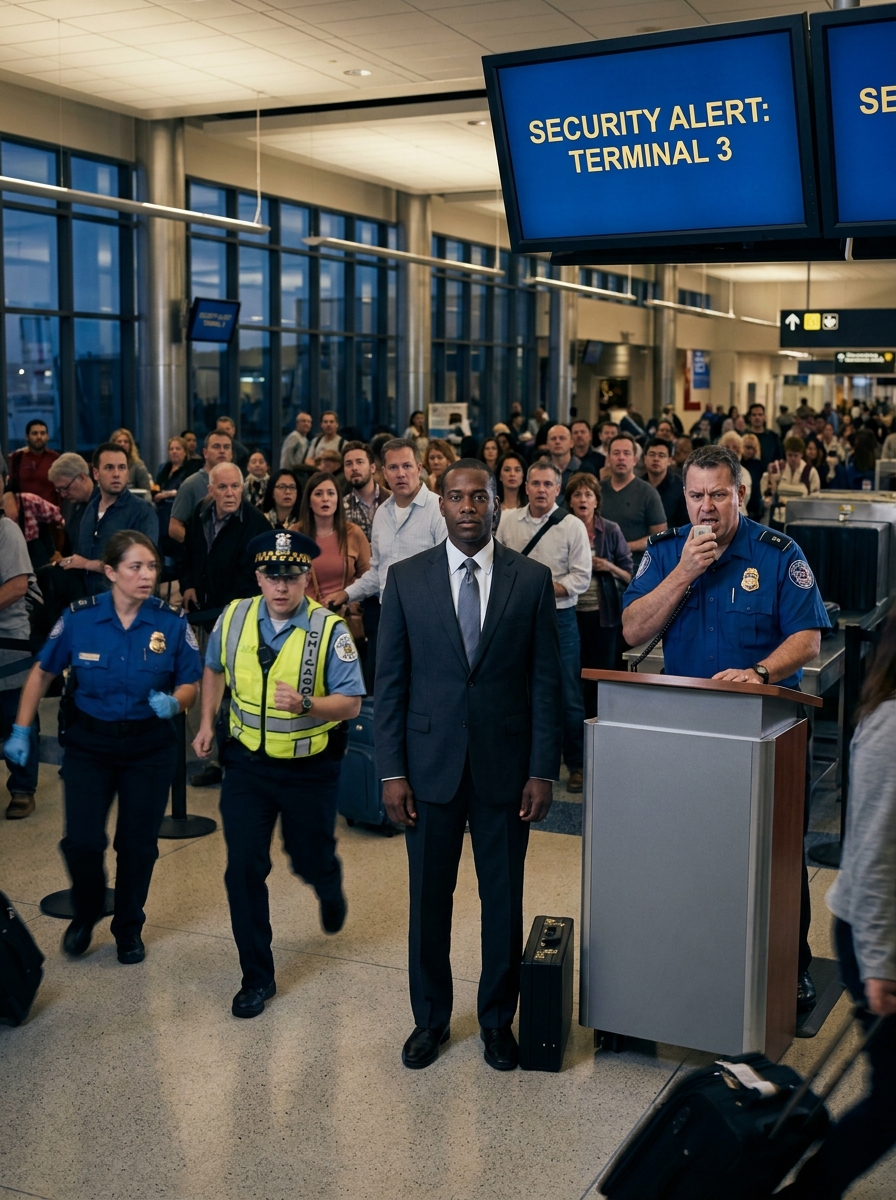
She grabbed the PA microphone and pressed the button. The chime echoed through the entire concourse.
“Ladies and gentlemen waiting to board Flight 882 to Seattle,” Sarah’s voice filled the terminal, thick with manufactured distress. “I apologize for the delay in processing the final group. We are currently dealing with an uncooperative passenger who is holding up the line and refusing to follow security instructions. We will have you on board as soon as airport security arrives to clear the area.”
She released the button.
The silence that followed was total.
Every eye in the gate area turned to me. I was the only Black man standing there. The implication was immediate. I was the threat. I was the delay. I was the problem.
A woman in the front clutched her purse tighter. A man muttered in disgust and shook his head.
In that moment, I was no longer Marcus Vance, CEO. I was every stereotype the world had ever projected. I was the angry Black man disrupting order.
I looked at Sarah. She was breathing hard, staring at me with a look of fearful satisfaction. She had pressed the panic button. She had turned the entire airport against me.
Two TSA officers and a uniformed Chicago Police Officer were already moving quickly down the concourse toward us, hands near their belts.
My phone vibrated. It was Elias Thorne, my mentor and board chairman, a sixty-year-old man who understood corporate machinery better than most.
I answered without taking my eyes off Sarah.
“Marcus,” Elias said. “The TransContinental execs are popping champagne in the boardroom. They are ready for your signature. Where are you?”
I watched the officer unclip his radio. I looked at the crowd staring. I looked at the gate agent who had decided my dignity was expendable.
“Elias,” I said calmly, my voice cutting cleanly through the terminal noise. “Tell the TransContinental executives to put the champagne away.”
“Excuse me?” Elias said, confused.
“Tell them the deal is dead,” I said, letting every word carry. “Tell them Apex Core is pulling all current freight contracts by the end of the fiscal quarter. And tell their VP of Enterprise Sales to turn on the news in about an hour.”
I ended the call.
I looked at Sarah. The smug certainty on her face cracked, replaced by the first visible fracture of doubt.
“You wanted a delay,” I said quietly as the officers closed in. “You’re about to get the most expensive one in aviation history.”
Chapter 2
The human body has a remarkable relationship with danger. Long before conscious thought can interpret a threat, the autonomic nervous system has already taken control. Cortisol surges through the bloodstream. Pupils widen to absorb more light. The heart pounds a heavy, frantic rhythm against the ribcage, forcing oxygen-rich blood toward the limbs in preparation for fight or flight.
As the three officers closed the gap between the concourse corridor and Gate K16, I experienced all of it. The ancient, primal surge of adrenaline was there. But beneath it was something heavier, more modern, and painfully specific: the crushing burden of history.
Officer Stan Kowalski led the approach. I didn’t yet know his name, but I could read him instantly—the worn fatigue under his eyes, the tightness in his thick neck. A Chicago patrol officer reassigned to airport duty, likely surviving on little sleep and gas station coffee. His hand rested casually but deliberately on his taser. Two TSA agents followed, tense and visibly alert.
“Alright, let’s bring it down,” Officer Kowalski said. His voice was a rough baritone—authoritative, but not yet hostile. He looked at me, then at Sarah behind the podium, then at the silent cluster of passengers watching. “What’s the problem here?”
“Officer, thank God,” Sarah gasped. She leaned heavily against the tall podium, her voice trembling with carefully performed vulnerability. She pointed directly at me. “This passenger is refusing to comply with security protocols. His ticket is flagged. He’s been verbally aggressive, interrupting the boarding process, and refusing to step away from the podium when ordered. He’s making the other passengers feel unsafe.”
There it was. That single word. Unsafe.
It is the ignition switch of American racial tension. When a white woman in authority labels a quiet, motionless Black man in an expensive suit as “unsafe,” the entire system tilts. The presumption of innocence collapses. The burden of proof shifts instantly.
Kowalski turned toward me. His stance widened. His hand settled more firmly on his taser. “Sir. Step away from the desk. Hands where I can see them.”
I did not move quickly. Speed is a privilege I am not afforded in encounters with law enforcement. Slowly, deliberately, I unbuttoned my suit jacket and brought my hands together loosely in front of me.
“Officer,” I said quietly. My voice was so soft Kowalski leaned in to hear it. “My name is Marcus Vance. I am a million-mile flyer with this airline. I am standing exactly where this agent instructed me to stand forty-four minutes ago. I have not raised my voice, nor made any aggressive movement. If you check the cameras—” I tilted my head slightly toward the black dome above the gate “—you will see I have been still for nearly an hour.”
Kowalski blinked. He dealt daily with real disruption—drunk passengers, shouting matches, genuine threats. The man in front of him was calm. Controlled. Not sweating.
“She said your ticket is flagged for security,” Kowalski said, his tone lowering as initial urgency gave way to uncertainty.
“She said that,” I replied, shifting my gaze back to Sarah. Her pale blue eyes were wide now, tracking the exchange like someone realizing the situation was slipping beyond her control. “But she hasn’t made a single call to verify it in forty-four minutes. No supervisor. No escalation. She simply parked my reservation.”
“Is this true, ma’am?” Kowalski asked, turning to her.
“I—I was managing the boarding process!” Sarah stammered, color rushing up her neck. “I am the lead agent! I control the flow of the gate! He was intimidating me!”
“By existing?” I asked. The words left my mouth before I could restrain them. A breach in discipline my father would have warned me about.
“Sir, I need your ID,” Kowalski said, stepping closer.
“It’s in my inner left breast pocket,” I said clearly. “I will retrieve it now using two fingers.”
I reached into my Tom Ford jacket. The silk lining slid against my knuckles. I removed my leather cardholder, then pulled out my driver’s license. Beneath it, I intentionally extracted another card: a matte black, heavy metal access card. The TransContinental Chairman’s Club card. A tier above first class. A tier above published elite status. A tier that does not exist publicly. Issued only to a few hundred global partners—heads of state, major executives, and select corporate leaders.
I handed both to Officer Kowalski.
He examined the license. Then the black card. He flipped it over. No frequent flyer number—only a dedicated executive hotline and my name engraved in gold.
Kowalski understood hierarchy. Years in airports had taught him the invisible ranking system of air travel and money.
He looked up at me. His posture changed instantly. The tension in his shoulders released, replaced by a quiet realization that he had stepped into something far larger than a gate dispute.
“Mr. Vance,” Kowalski said. The “sir” was gone, replaced by recognition. “Can you wait right here for just one moment?”
“I’ve been waiting for forty-five minutes, Officer. I’m quite used to it,” I said.
Kowalski turned to the podium. “Ma’am. Print his ticket.”
“I told you, it’s flagged!” Sarah’s voice cracked. Panic replaced control. “I need a supervisor to override—”
“Then call your supervisor. Now,” Kowalski said sharply. It was not a request.
As Sarah finally picked up the gate phone with shaking hands, my attention drifted away from Terminal K. It moved across the city, over the Kennedy Expressway, toward the forty-second floor of the Apex Core tower in downtown Chicago.
I already knew what was unfolding in that boardroom. I had set it in motion. I could see it as clearly as if I were there.
Ten miles away, the Apex Core boardroom smelled of polished mahogany, fresh lilies, and impending certainty.
Chloe, my Chief of Staff, sat at the head of the table. Thirty-two years old, razor-sharp, forged in Boston grit, and defined by a relentless command of numbers. Navy St. John suit. Gold pen tapping against a leather folder.
To her right sat Elias Thorne—my mentor, early investor, and closest thing to a father I had after mine passed. Sixty-four, composed, silver-haired, academic in appearance but strategic in mind. A man who understood how corporate America truly operated beneath its surface.
Across from them sat Richard Sterling, Vice President of Enterprise Sales for TransContinental Airlines.
Richard radiated certainty—the kind of man who believed systems existed to accommodate him. Polished, confident, and already imagining victory. He sipped espresso as though nothing could go wrong.
“I have to say, Chloe,” Richard said with a smile. “This partnership will redefine North American logistics. Combined with Apex Core’s routing AI, we’re looking at a fifteen percent efficiency gain. Wall Street will explode tomorrow morning.”
In front of him sat a stack of contracts three inches thick. A ten-year exclusive agreement. All of Apex Core’s high-value freight—technology, pharmaceuticals, global retail—locked exclusively into TransContinental’s cargo system. A half-billion-dollar arrangement in direct revenue, with far greater market implications.
“We see this as a strategic alignment,” Chloe said evenly, though her eyes kept flicking to her phone. I should have been on my flight. Silence from me was not normal.
Elias checked his pocket watch. “Marcus is never late. I assume O’Hare is being O’Hare.”
“You know how it goes,” Richard laughed. “Even VIPs hit delays. But don’t worry—we’ve assigned our best crew to him. He’ll be treated like royalty.”
At that exact moment, Chloe’s phone lit up.
Incoming Call: Marcus Vance.
She answered and placed it on speaker.
“Marcus,” she said. “Richard Sterling is here. Everything is ready for signature. We’re waiting on your approval.”
The boardroom went silent. The airport noise carried faintly through the line. Announcements. Movement. And a steady, close breath of a police officer nearby.
“Elias,” my voice came through the speaker—flat, stripped of its usual calm warmth. It was the voice of a decision already made.
“Marcus, I’m here,” Elias said, immediately alert. “TransContinental is ready to sign. Where are you?”
Then the pause. The shift.
“Tell the TransContinental executives to put the champagne away.”
Richard let out a short laugh. “Marcus, what is this? Some kind of joke?”
“Tell them the deal is dead,” my voice continued, unwavering. “Apex Core is terminating all freight contracts by the end of the fiscal quarter. And tell their VP of Enterprise Sales to turn on the news in about an hour.”
Click. The line went dead.
The silence that followed in the boardroom was absolute.
Richard’s hand trembled. Espresso spilled onto his cuff.
“What… what just happened?” he whispered, paling rapidly. “Is this a negotiation tactic? We already agreed on terms—”
Chloe didn’t look at him. She was already moving. Elias slowly closed his pocket watch.
“Richard,” Elias said quietly, almost pitying. “If Marcus made that call, something irreversible just happened.”
Back at Gate K16, reality was catching up.
A TransContinental manager in a red blazer arrived, breathless. David. Mid-forties. The kind of man who lived inside metrics and damage control.
“Officer, what is going on?” he asked.
Kowalski gestured toward me. “Your agent refused to board him. Claimed a security flag. Called us in.”
David turned to the system. His face shifted instantly. Alarm replacing confusion.
“Sarah,” he said slowly, voice dropping. “There is no security flag on this PNR.”
“There is! It turned red!” she insisted.
“It turned red because the system auto-upgraded his seat. All you had to do was accept the change.”
Silence fell over her.
The truth arrived all at once. Not just procedural failure—but perception, assumption, and unchecked judgment collapsing into reality.
“I… I thought…” she whispered, finally looking at me—not with authority anymore, but with fear.
She hadn’t seen status. She hadn’t seen access. She had seen a man who did not fit her expectation of belonging. And she had acted on that assumption instead of verifying the truth.
“Mr. Vance,” David said, turning toward me. He was almost shaking with panic now. He knew who I was. The system highlighted Chairman’s Club members in gold. “Mr. Vance, I cannot apologize enough. This is a catastrophic failure of our service standards. I am going to open the jet bridge immediately. We will hold the aircraft. I will personally escort you—”
“No,” I said.
David froze. “Sir?”
Through the wide terminal windows, I looked out at the tarmac. The ground crew had already removed the wheel chocks from the Boeing 737. The red anti-collision beacon on the tail rotated steadily.
“The door is closed,” I said, my voice stripped of anger and anchored in cold finality. “The aircraft has pushed back. You cannot violate federal aviation rules to hold a flight that is already detached from the jet bridge.”
“I… I can call the captain…” David said, pleading now. He was begging. He understood that if I walked away from this gate dissatisfied, his career was finished.
“Do not disrupt the travel of a hundred and fifty innocent people because your agent could not see beyond her own prejudice,” I said. My eyes shifted to Sarah. She was crying now—silent, heavy tears of self-pity smearing her carefully applied makeup.
I felt no satisfaction watching it. I did not want her tears. I did not want to destroy her. But I was exhausted in a way that went deeper than anger.
I was exhausted from constantly adjusting my presence so others would feel comfortable. I was exhausted from lowering my voice so I would not be perceived as a threat. I was exhausted from knowing that no matter how many companies I built, how much wealth I created, or how many charities I funded, there would always be a Sarah Jenkins at a gate, a counter, or a roadside stop ready to reduce my entire existence to a flashing red warning in her mind.
My father died of a stress-induced heart attack at fifty-five. A lifetime of swallowing humiliation, of smiling through insults, of apologizing for things he never did just to keep his job and support his family. He absorbed the world’s poison so I could rise above it.
I had promised him on his deathbed that I would never shrink myself.
“David,” I said, turning back to the manager. “I want this incident fully documented in your report log. I want it recorded that I was denied boarding due to racial profiling, misuse of law enforcement, and gross negligence.”
“Mr. Vance, please, let’s go to the VIP lounge. We can resolve this—”
“You cannot resolve it,” I said quietly. “Because the failure is structural.”
I turned away from the podium. The remaining Group 5 passengers instinctively parted as I walked through them. They no longer looked at me with suspicion. They looked at me with shock—and in some cases, deep, uncomfortable shame. Ten minutes earlier, many of them had been ready to believe I was the problem.
As I moved down the concourse, my phone buzzed. A Twitter notification.
I rarely checked social media, but Chloe monitored everything tied to Apex Core and had alerts set for viral mentions.
I opened the app.
The video was already spreading.
A young man, maybe nineteen, in a faded Nirvana T-shirt, had been sitting across from the podium and recorded everything the moment Sarah raised her voice.
He captured it all. Me standing still. Sarah screaming. The PA announcement. The arrival of police. And, most damningly, David admitting there was no security flag.
The caption beneath it was simple, almost restrained, which made it more powerful:
Watched this airline agent lie to the cops to get a Black passenger arrested because she didn’t want to print his First Class ticket. The manager just admitted she made it up. Insane. @TransContinentalAir do better.
The video had been live for four minutes. It already had twelve thousand views. By the time I reached baggage claim, it would be in the hundreds of thousands. By the time I reached my car, it would be national news.
I stepped out through the sliding glass doors of O’Hare International. The Chicago wind hit me hard—sharp, metallic, carrying the scent of fuel and cold pavement.
I dialed Chloe. She answered immediately.
“The video is going viral,” she said. Her voice was steel. “PR is already mobilizing. TransContinental stock is down three percent in ten minutes since the rumor of the terminated deal leaked. Richard Sterling is currently panicking in the lobby.”
“Let him,” I said, stepping into my waiting car.
“What do you want next, Marcus?” Chloe asked.
I looked through the tinted window at the airport fading behind me. I thought about the $500 million contract. I thought about how money could move markets, but not grant basic dignity at Gate K16. Yet it could force consequences. And consequences, in my world, were the only language that lasted.
“Draft a press release,” I said, leaning back into the leather seat. “Apex Core is establishing a fifty-million-dollar legal defense fund. It will provide top-tier representation for any minority passenger who can document profiling by major U.S. airlines.”
Chloe paused for only a fraction of a second. Then I heard the edge of a sharp, satisfied smile in her voice. “I’ll have it ready in ten minutes.”
“And Chloe?” I added quietly.
“Yes, Marcus?”
“Send a car for Richard Sterling. Take him back to his office. Let him watch his empire collapse from behind his own desk.”
Chapter 3
The silence inside a Maybach is not natural—it is engineered. German acoustics specialists design the cabin to suppress the outside world: sirens, engines, street noise, even human chaos—all reduced to a muted, distant hum.
As my driver merged onto Interstate 90 toward downtown Chicago, I sat in that controlled silence and felt my hands begin to tremble.
Not from fear. From release. From adrenaline draining out and leaving something hollow behind. I looked down at my hands—manicured, steady, the hands of a man who signs contracts and types on glass.
Not my father’s hands.
My father, Arthur Vance, had hands like maps of a difficult life—scarred, stained permanently with oil and grease that never fully washed away. He was a master mechanic who could diagnose an engine just by listening to it idle.
I closed my eyes and returned to a night in November 1994. I was ten years old. My father had saved for months to take me to a downtown steakhouse for my birthday. He wore a cheap gray suit that still smelled faintly of mothballs.
At the entrance, the maître d’—young, white, perfectly dressed—looked through him, not at him.
“Do you have a reservation?” the maître d’ asked, glancing at my father’s worn hands and scuffed shoes.
“Yes, sir. Arthur Vance. Table for two,” my father said politely, carefully, trying to fit into a space that refused to accept him.
The maître d’ flipped through a ledger. “I’m sorry, I don’t see a Vance. We are fully booked. You’ll need to leave the entrance area.”
I saw it immediately. The lie. The name was there. But my father didn’t argue. He didn’t protest. He simply placed a steady hand on my shoulder, forced a fragile smile, and said, “That’s alright. Let’s go get deep dish, Marcus. Steaks are overrated anyway.”
We walked out into the freezing Chicago night. I remember looking up at him, tears burning in my eyes—not from hunger, but from watching him quietly erased.
“Dad,” I whispered. “Why didn’t you say anything? Your name was right there.”
He knelt under a streetlight, eyes heavy with exhaustion.
“Marcus,” he said softly. “In this world, they can embarrass you, but only you let them define you. If I yell, I become what they already think I am. You win by building higher. You win by becoming untouchable.”
I opened my eyes in the back of the Maybach.
My father was wrong.
That was the painful truth. He believed dignity could be earned through distance—through success, wealth, elevation. He believed I could rise far enough that bias would lose reach.
But Gate K16 proved otherwise. You can build a half-billion-dollar company, hold elite status, carry every symbol of access—and still be one person’s assumption away from erasure.
My phone vibrated sharply against the armrest.
Elias.
I answered. “Elias.”
“I’m in your office,” Elias said. His voice was strained, unfamiliar. “Richard Sterling just left. He looked like he was going to collapse. The rest of their legal team is gone. It’s over, Marcus. The contract is shredded.”
“Good,” I said, watching the skyline slide past.
“Marcus…” Elias paused. I heard him breathe deeply. “I saw the video.”
Silence stretched. Elias Thorne—privileged, Ivy League, insulated by generations of advantage—had always understood my world only through proximity. Not experience.
“I’m sorry,” he said finally. “I truly thought success had insulated you from this.”
“It insulated me from the taser,” I said evenly. “But not from the assumption. Wealth doesn’t stop profiling. It just buys time after it happens.”
“It’s unacceptable,” Elias said quietly.
“Yes,” I replied. “Which is why we break TransContinental.”
“Chloe’s legal fund—fifty million—”
“Call the board,” I said. “Tomorrow morning. Anyone who refuses can exit under clause 4B. I don’t care what it costs. We are not negotiating this.”
“I’ll handle it,” Elias said immediately.
“You will,” I said. “Because this is no longer just business.”
At that moment, a thousand miles away, inside TransContinental Airlines headquarters in Dallas, the atmosphere was already shifting—tight, volatile, and breaking toward something irreversible.
William Hayes, the CEO of TransContinental, stood at the floor-to-ceiling windows of his corner office, staring down at the sprawling Dallas metroplex below. At sixty-two, he was a former Marine logistics officer who had spent twenty years transforming TransContinental from a struggling regional carrier into a global powerhouse. He understood numbers, margins, and operational efficiency.
What he did not understand was what was now unfolding on his computer screen.
Behind him, seated around a massive conference table, his executive crisis team waited in tense silence. The Chief Operating Officer, the Head of Public Relations, the General Counsel, and a visibly sweating, unnaturally pale Richard Sterling—freshly flown in from Chicago on a company jet.

“Explain it to me again, Richard,” William Hayes said in a dangerously low voice. He did not turn around. His eyes stayed fixed on the skyline. “Explain how a five-hundred-million-dollar logistics contract, the one that was supposed to define our third quarter, evaporated into nothing at eight-thirty this morning.”
Richard swallowed hard. “William… it was a catastrophic failure at gate level. Marcus Vance was departing O’Hare. The system flagged his ticket due to an equipment-change upgrade. The gate agent… didn’t recognize him. She refused to print the boarding pass.”
“She didn’t recognize him,” William repeated slowly, finally turning. His blue eyes were ice. “Richard, Marcus Vance is a Chairman’s Club member. His profile displays in gold. A trained monkey could identify that he’s a VIP.”
“She said he was acting aggressive,” the Head of PR cut in quickly, a tense woman gripping a tablet. “She called airport police. She made a PA announcement labeling him a security threat.”
William Hayes went still. “She called the police. On Marcus Vance.”
“Yes,” Richard whispered.
“And was he aggressive?” William asked.
The Head of PR slid the tablet across the table. The viral video was queued. “We have footage. A passenger recorded everything. William… it’s now the number one trending topic worldwide on Twitter. CNN is leading with it. Forty million views and climbing.”
William walked over and pressed play.
He watched the grainy footage unfold. He watched Marcus Vance—a man he had personally hosted, a man he respected for discipline and restraint—standing motionless, hands folded, voice controlled. He watched Sarah Jenkins escalate, panic, and weaponize authority. He heard the manager, David, confirm there was no security flag.
A cold sweat formed at the back of William’s neck.
He had spent his entire career managing predictable risks—fuel spikes, labor disputes, mechanical failures. But this was different. This was a cultural detonation, and his company had triggered it internally.
“What is the market reaction?” William asked flatly.
The COO glanced at his laptop. “Down six percent since market open. Rumors of the Apex Core cancellation triggered institutional selling. We’ve lost roughly two billion in market cap in three hours.”
Two billion dollars. From a single gate interaction.
“Have we terminated her?” William snapped.
The General Counsel adjusted his glasses, uneasy. “She’s been suspended pending investigation under union protocol. Immediate termination without review could trigger a Chicago-based strike.”
“I don’t care if they strike on Mars!” William shouted, slamming his fist on the table. “Fire her. Fire whoever supervised this. Issue a public apology to Marcus Vance. Offer him whatever it takes—free lifetime travel, board advisory seat, anything—get him to reverse the cancellation!”
“William,” the Head of PR said softly, dread rising in her voice. “It’s too late.”
“What do you mean, too late?”
She turned her tablet around.
“Apex Core released a statement five minutes ago. They are not just canceling the contract. Marcus Vance is establishing a fifty-million-dollar legal defense fund targeting airlines for systemic racial profiling—starting with us.”
Silence collapsed across the room.
William Hayes read the statement. The words were precise, controlled, and surgically deliberate. Written by Chloe. Not anger—execution.
He understood instantly.
They were no longer dealing with a passenger.
They were dealing with a force that had decided they were an example.
Sarah Jenkins sat in her beige 2014 Honda Civic in the employee parking lot of O’Hare International Airport.
The engine was off. The windows were sealed. The air inside was thick, stale, and faintly sweet with old fast food and cheap vanilla air freshener.
Her hands clutched the steering wheel so tightly her knuckles had gone white.
Two hours earlier, she had been a Lead Gate Agent. She had health insurance, modest retirement benefits, and flight privileges that let her visit her sister in Florida twice a year. She had a defined role, a paycheck, and a small sense of authority in a life that otherwise felt invisible.
Now her badge sat on an HR desk.
She had been escorted out by two silent security guards who could not meet her eyes.
Her phone vibrated nonstop in the cup holder, the sound sharp and insect-like.
She finally picked it up.
4,200 Twitter notifications.
18,000 Instagram comments.
She tapped one.
Look at this racist trash. Hope you enjoy the unemployment line, Karen.
Another.
We found her address. Send her pizza. 442 Elm Street.
Sarah dropped the phone as if it burned her hand.
They had her address.
In just two hours, she had gone from anonymous worker to national target.
Tears filled her eyes, hot and uncontrollable. “It’s not fair,” she whispered into the empty car. “I was just following protocol. He was intimidating. He was…”
She stopped.
Even saying it aloud felt hollow now.
The truth began to surface, uncomfortable and unavoidable.
Why had she flagged him?
She thought back.
A fight with her ex-husband that morning. Late child support again. A throbbing tooth she could not afford to fix. Exhaustion that felt permanent.
Then Marcus Vance had appeared.
Tall. Controlled. Expensively dressed. Completely composed.
He belonged in First Class. In a world she only observed from behind a podium.
The system beeped red. A simple override.
But something inside her had tightened.
Why is he so calm? Why does he get to move through life like that while I’m stuck?
She did not consciously think about race—but the assumption filled the gaps anyway, shaped by years of quiet bias and resentment. His composure became “arrogance.” His stillness became “threat.”
And in that moment, she took control.
She wanted him reduced. She wanted him delayed. She wanted him contained in the only space where she had authority.
When he didn’t yield—when he calmly dismantled her claim—panic replaced certainty. She escalated. She called police. She used the only irreversible weapon available to someone who feels powerless: danger.
Sarah leaned forward, pressing her forehead into the steering wheel, and broke into a sob.
Not yet remorse. Not yet understanding.
Just collapse.
Because the world had already decided the story—and it was too late to rewrite it.
By 8:00 PM, everything had changed.
I sat in my Lincoln Park brownstone study, surrounded by books, leather, and the faint burn of Glenfiddich in a crystal glass.
The muted television showed CNN. My face filled the screen beside grainy footage from Gate K16. The headline read: APEX CORE CEO CANCELS $500M DEAL AFTER AIRLINE PROFILING INCIDENT.
Chloe sat across from me on the leather sofa, laptop glowing in the dim light. She had not stopped working in fourteen hours.
“TransContinental’s CEO, William Hayes, has called your personal line five times,” Chloe said without looking up. “He sent a full apology, termination confirmations for the agent and manager, and a twenty percent freight discount to reinstate the deal.”
“Delete it,” I said calmly. “Block the number.”
Chloe smirked faintly. “Already done. Delta just contacted us. They want the contract. Full rate match, mandatory bias training across all operations.”
“Tell Delta next week,” I said. “But training isn’t enough. I want enforcement metrics. I want consequences written into contract structure.”
“Understood.” She closed the laptop. Then, softer: “Marcus… are you okay?”
I looked at the screen. Analysts were calling it historic. A turning point.
“I’m fine,” I said.
Chloe hesitated. “They’re going to attack you now. PR firms, leaks, character hits.”
“I know.”
“Are you ready for that?”
I stood and walked to the window. Chicago stretched endlessly beneath the night sky. Somewhere out there, my father had once broken his body for a system that never saw him.
“They can call me whatever they want,” I said quietly.
I turned back to her.
“But tomorrow morning,” I said, “they will call me Sir.”
Chapter 4
There is a deep, ringing silence that follows an explosion. Once the shockwave passes and the glass settles, what remains is stillness—and the full visibility of consequences.
For three months, I lived inside that stillness.
The media storm was relentless. TransContinental became a case study in failure. William Hayes was pushed into retirement. Richard Sterling disappeared into a severance agreement and legal silence. The company’s stock never fully recovered from the shock.
But the real change was not their collapse.
It was the creation of the Arthur Vance Foundation.
Funded initially with fifty million dollars of Apex Core capital, it grew rapidly—beyond control, beyond expectation. Donations poured in from everywhere: executives, athletes, strangers who had lived their own versions of Gate K16.
It became a legal machine. Airlines. Banks. Retail systems. Any institution where discrimination had been normalized as “procedure” became subject to scrutiny, litigation, and forced reform.
But victory had a weight.
And it settled slowly.
One cold October afternoon, Chloe walked into my office holding a single sheet of paper.
No device. No report. Just a letter.
“The Atlanta legal team sent this,” she said quietly. “It’s from the first settlement.”
I took it.
A handwritten note. A nurse. A delayed flight. A glass room. A child crying while she was questioned.
The apology had already been paid.
But the words remained.
Dear Mr. Vance,
They transferred the money today. It’s enough to clear my nursing debt, secure a home in a safe neighborhood for Sofia, and remove the worry of grocery bills entirely. But I am not writing to thank you for the money. I am writing to thank you for the lawyers. When I was held in that detention room, I felt reduced, insignificant, like my daughter and I were nothing more than debris to be swept aside. I felt deep shame that my little girl had to watch her mother treated like a criminal for doing absolutely nothing wrong.
When your lawyers entered the mediation room yesterday, they didn’t only secure compensation. They forced the airline executives to look me in the eye and apologize. They made them truly see me. You restored my dignity, Mr. Vance. You ensured my daughter will never again witness me swallowing my pride. God bless you.
Maria.
I read the letter once more. Then again. And again.
I tried to set the paper down, but my fingers refused to release it. My chest tightened. My breath caught in my throat.
“Marcus?” Chloe stepped closer, alarm flashing across her face. She had watched me dismantle hostile boards, end executive careers, and navigate billion-dollar crises without a flinch. She had never seen me fall apart.
“I’m fine,” I forced out, but it wasn’t true.
The dam that had held for forty-two years—built from precision discipline, tailored suits, and silent endurance—finally broke.
I leaned forward, burying my face in my hands, and cried.
It wasn’t controlled or restrained. It was raw, breaking, and uncontrolled. I cried for Maria. I cried for the ten-year-old boy who had to eat deep-dish pizza because a maître d’ didn’t want his father in a steakhouse. I cried for Arthur Vance, who died with grease under his nails and a lifetime of swallowed anger so his son could sit in a glass office.
I cried because, for the first time, I understood that success had never been armor. It had been isolation. The wealth didn’t heal anything; it only built a quieter place for the wound to continue bleeding.
Chloe said nothing. No comfort, no reassurances. She simply came over, placed her hand firmly on my shaking shoulder, and stood there in silence, guarding me while I finally felt the full weight of it.
Sarah Jenkins was not in a sterile room.
She was in a cramped two-bedroom apartment outside Chicago, working overnight as an inventory scanner in a massive, windowless logistics warehouse.
It was 3:00 AM. The building roared with conveyor belts and forklifts. Sarah stood at line 4B, gripping a barcode scanner, her feet aching inside steel-toed boots that didn’t fit properly.
She looked drained, older than she was. The internet outrage had moved on, but the consequences had not. She could no longer get work in any public-facing role. Her name instantly brought up the Gate K16 video.
A large cardboard box rolled toward her station. It carried a familiar logo.
Apex Core Logistics. Sarah froze. The scanner buzzed uselessly in her grip.
She stared at the black-and-silver branding. Months earlier, she would have scanned it without thought. Now it felt like something haunting her.
Her supervisor, a young, sharp-tongued man who didn’t care about her past as long as quotas were met, shouted across the floor. “Hey! Jenkins! Keep the line moving!”
Sarah flinched, quickly scanning the box and pushing it forward.
When her fifteen-minute break came, she stepped into her 2014 Honda Civic. The November air was freezing. She sat inside, heater blasting, and picked up her phone.
She no longer used social media. She opened a news app instead.
A feature story filled the top of the page: The Arthur Vance Foundation Settles Its Fiftieth Case: How One Moment at O’Hare Changed Civil Rights.
A photo showed Marcus Vance on courthouse steps—calm, composed, and unchanged from that day at the gate.
Sarah stared at his face.
In the first weeks after losing her job, she had drowned in anger and denial. She told herself she was the victim of a powerful billionaire and an online mob.
But now, sitting in the cold car with aching hands and a sore back from warehouse labor, that story collapsed.
She remembered how she had looked at him. She remembered the irritation she felt simply because he carried himself with ease she didn’t have. She had used authority—the police, the PA system, security procedures—as a weapon to diminish him.
She had looked at a man quietly standing there and decided he was a threat.
“I’m sorry,” Sarah whispered toward the glowing phone screen.
No one heard it. The internet wouldn’t care. Marcus Vance would never know. The apology changed nothing outside of her.
But as tears finally came—not of victimhood, but of recognition—she felt a small, unfamiliar calm. She had lost everything external. But she had finally seen herself clearly.
She wiped her face, pulled on her neon vest, and went back into the warehouse noise.
On the anniversary of my father’s death, snow fell lightly over Chicago.
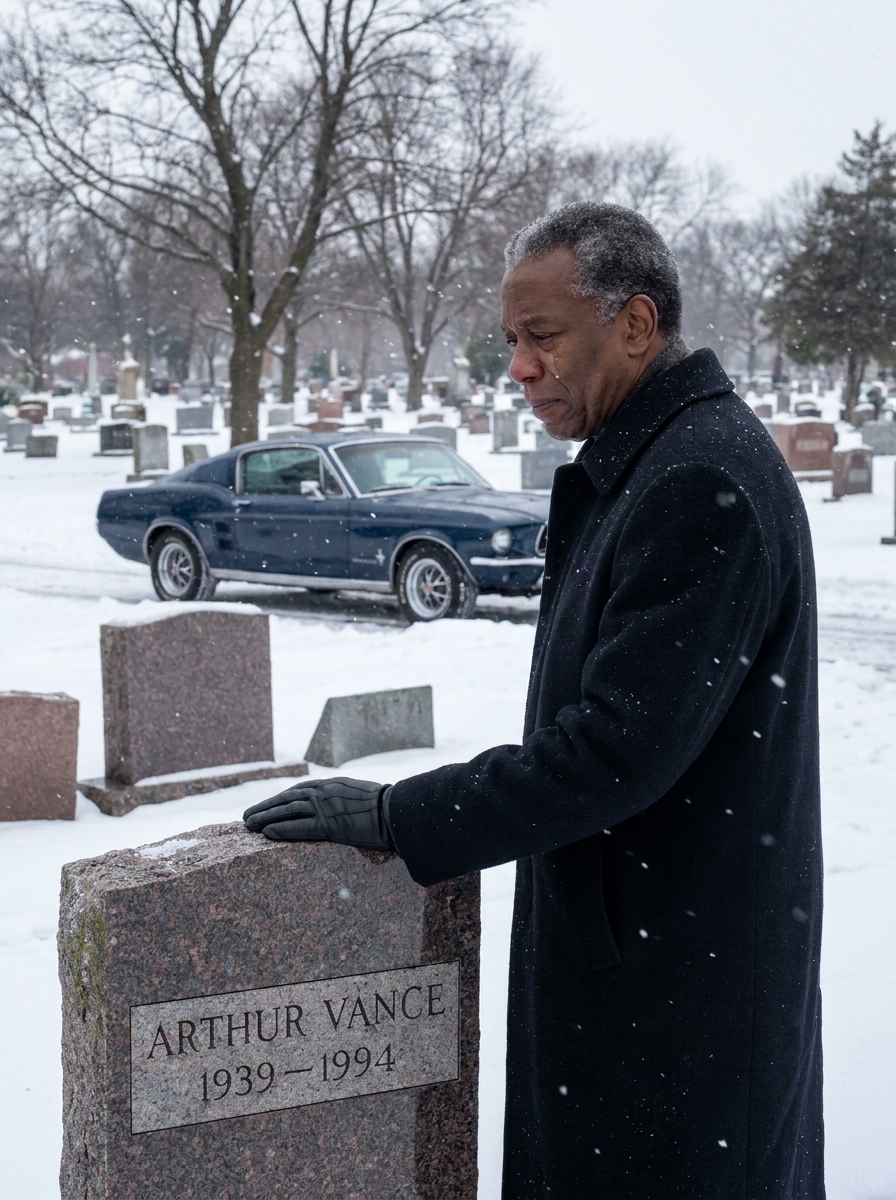
I took the afternoon off. I drove myself—no driver, no Maybach—just an old restored 1968 Ford Mustang my father had taught me to rebuild as a teenager.
I drove to the South Side cemetery.
Snow gathered on the gravestones. I followed the familiar path until I reached his plot.
Arthur Vance.
1939 – 1994.
A Good Man.
I stood there for a long time as snow melted against stone.
“I broke the rules, Dad,” I said quietly, my breath fading into the cold. “I didn’t stay quiet. I didn’t stay small. I made noise.”
Wind moved through the bare branches overhead.
“I know you believed money would protect me,” I said, brushing snow from his name. “I know you thought success would be enough. That if I climbed high enough, they would let me in. But they don’t, Dad. The system is locked.”
My finger traced his engraved name.
“So I stopped trying to unlock it,” I whispered. “I bought the building and removed the door.”
I stood up. I felt lighter than I had in years. The constant pressure in my chest—the inherited weight of restraint—was finally gone.
I had lost a half-billion-dollar contract, but I had regained something deeper. The Arthur Vance Foundation now fought for people who had no protection. We forced systems to answer for themselves.
My phone buzzed. Elias again—another airline, another negotiation, another contract shaped by our new rules.
I didn’t answer. I let it ring. Business could wait.
I looked back at my father’s grave through falling snow. The world remained flawed. There would always be more gates, more Sarahs, more biases buried in systems. The fight would continue indefinitely.
But the terms had changed permanently.
I waited forty-four minutes at Gate K16, but my father waited his entire life. Today, finally, we moved forward.
AUTHOR’S NOTE: PHILOSOPHIES AND ADVICE
Dignity is Not Negotiable: Success, wealth, and status are external metrics. They can be built, lost, and rebuilt. But basic human dignity—the right to exist peacefully and be treated with respect—is inherent. Never allow anyone to put a price tag on your dignity, and never shrink yourself to make someone else’s prejudice comfortable.
The Power of the Pause: In the face of intense, manufactured hostility, silence and stillness are often your most devastating weapons. Marcus didn’t win by yelling; he won by refusing to give his antagonist the reaction she desperately needed to justify her narrative. Anger is a trap. Discipline is a fortress.
True Wealth is Leverage for Others: If you manage to climb the mountain, you owe it to those still climbing to throw down a rope. Financial success is hollow if it is only used to buy personal comfort. True power is realized when you weaponize your success to protect the vulnerable and force systemic accountability.
Confronting Bias: For every interaction we have, we carry an invisible backpack of assumptions. We must actively, brutally interrogate our own biases. When you feel a sudden, inexplicable friction towards someone who is simply existing in a space, ask yourself: Am I reacting to their actions, or am I reacting to my own unexamined beliefs about who belongs here?
