

“Step aside, ma’am. I need to clear the actual priority line before I can deal with… whatever your situation is.”
The words didn’t just hang in the air; they struck me across the face.

I stood there, my phone held out, the digital QR code for Seat 2A in First Class shining on the screen. I was thirty-eight, running on only four hours of sleep across the past three days, wearing a faded UCLA hoodie that still carried the faint smell of the hospital waiting room where I had buried my father a week earlier.
My name is Maya Vance. For ten years, I’ve built one of the largest logistics software companies in the country from nothing. If you’ve ever ordered a package, booked a flight, or tracked a shipment anywhere in North America, my code made it possible. My life has always been driven by security—an obsessive, relentless push to build a fortress of wealth and power so strong I’d never again feel like that helpless, invisible little Black girl growing up under a Detroit eviction notice.
But at Gate K12 in Chicago O’Hare, none of that mattered. To the man in the navy blue airline blazer, I wasn’t Maya Vance, CEO. I was just a nuisance in a hoodie.
His name tag said Kevin. Mid-forties, tight jaw, eyes carrying the bitter exhaustion of a man passed over for promotion for fifteen straight years. His resentment had become irrelevance; his need was the urge to exert small authority over anyone he saw as beneath him. Today, that person was me.
“Sir, my ticket is for Group 1,” I said quietly, keeping my tone even. I’d learned long ago that raising my voice only fed the stereotype people expected. “The app says I’m cleared.”
“And the system says there’s a discrepancy,” Kevin snapped without looking at my screen. He didn’t type. He didn’t scan. He just waved his hand toward my chest as if brushing me away. “Stand against the wall over there. I have seventy First Class and Diamond members to board, and I am not holding up my flight for this.”
Behind me, a frustrated sigh cut through the terminal noise.
“Excuse me, do you mind?”
I turned. A woman in her sixties—let’s call her Eleanor—stared at me over tortoiseshell glasses. She wore a spotless cream cashmere sweater and held a Louis Vuitton tote like armor. Everything about her suggested inherited wealth and resentment, the kind of woman whose identity depended on being above everyone else.
“Some of us actually belong in this line,” Eleanor muttered loudly to the man behind her, who chuckled in response.
A burning heat rose in my neck, familiar and sharp. The same feeling as being followed in stores. The same feeling as a venture capitalist questioning my role in my own company. The same accumulation of a thousand cuts.
I stepped aside. I leaned against the cold airport glass and watched.
And that’s how the longest forty-four minutes of my life began.
For the first ten minutes, I tried to rationalize it. Maybe the system was failing. Maybe he was overwhelmed. I watched Kevin force a tight customer-service smile as he processed passenger after passenger. The scanner chimed a bright, cheerful beep. Beep. Welcome aboard, Mr. Smith. Beep. Have a great flight, Mrs. Davis. Every single one of them was white. I was the only Black woman in the boarding area.
At minute fifteen, the priority lanes were empty. I approached again.
“Excuse me, Kevin. The line is clear now. Can we check my ticket?”
Kevin didn’t look up. “We are moving to Group 2. If you interrupt me again, I’m calling security and you won’t be flying at all today.”
My breath caught. The threat was casual, but the meaning was not. Security. For asking to board with a valid ticket.
By minute twenty-five, Group 3 was boarding. People were watching me now. To the hundreds passing by, I wasn’t someone being wronged; I was a problem. I saw it in their eyes—the judgment, the pity, the way they tightened their grips on their bags as they passed the Black woman in a hoodie under the gate agent’s gaze.
My chest tightened. The grief of losing my father, the exhaustion of a ninety-hour week closing the biggest deal of my career, the crushing humiliation of standing there like a scolded child—it all began to turn inside me.
I looked at my phone. A message from my lead attorney, Marcus.
Marcus: “Contracts are ready, Maya. The airline’s board has signed off. The minute you land in SFO, we close. $150 million cash. Aegis Systems is taking over their entire digital infrastructure.”
I stared at it.
This airline—the logo behind Kevin, the plane sitting outside on the tarmac—was in crisis. Their systems were failing. Flights delayed worldwide. Money bleeding out. For six months, their executives had begged me to sell Aegis Systems, my logistics platform, to save them.
I was literally flying to San Francisco to sign the deal that would fix the system Kevin insisted had a “discrepancy” with my ticket.
By minute thirty-five, Group 4 was boarding.
“Kevin,” I said softly. “Check the ticket. Now.”
He finally looked at me, smirking. “I told you to wait. And honestly, with your attitude? I’m inclined to rebook you on tomorrow’s flight. We don’t tolerate aggressive behavior at this airline.”
Aggressive. There it was. The word that made everything acceptable.
I wasn’t aggressive. I was still. I hadn’t raised my voice. I hadn’t moved. But in Kevin’s eyes, insisting on my own existence was aggression.
Minute forty-four. Group 5—the final group—was called. The gate emptied. The last passengers disappeared down the jet bridge. Eleanor was probably already seated in First Class, irritated by an empty seat beside her.
Kevin shut down the podium, stacking papers, picking up his radio.
“Alright,” he sighed, looking at me like discarded trash. “Let’s see this so-called First Class ticket. Though I highly doubt—”
“Don’t bother,” I said.
My voice didn’t shake. The humiliation that had built over forty-four minutes evaporated, replaced by something cold and precise.
“Excuse me?” Kevin frowned.
“I said, don’t bother.”
I didn’t hand him my phone. I opened my contacts and tapped Marcus. It rang once.
“Maya?” Marcus answered. “You boarding? Everyone’s waiting.”
“Marcus,” I said, locking eyes with Kevin. “Kill the deal.”
Silence. “Maya… what? That’s $150 million.”
“I know exactly what it is,” I said. “Pull the plug. Withdraw everything. And execute the backdoor kill-switch on their temporary API license. The trial expired at midnight.”
“Maya, if I do that, their entire boarding and routing system goes down nationwide in sixty seconds.”
“I said, kill it.”
I hung up.
I slid the phone back into my hoodie. Kevin let out a sharp laugh.
“I don’t know what kind of show this is,” he sneered, grabbing his radio. “But I’m closing the doors. You’re not getting on this flight.”
I smiled slightly. “Kevin, in about ten seconds, there isn’t going to be a flight.”
Before he could respond, the departure board behind him flickered, distorted, and went black.
Then the boarding scanner on his desk emitted a long, piercing ERRRRRRRR sound.
CHAPTER 2
The sound of a full enterprise system failure is not an explosion. It is a cascading collapse of silence followed by digital panic.
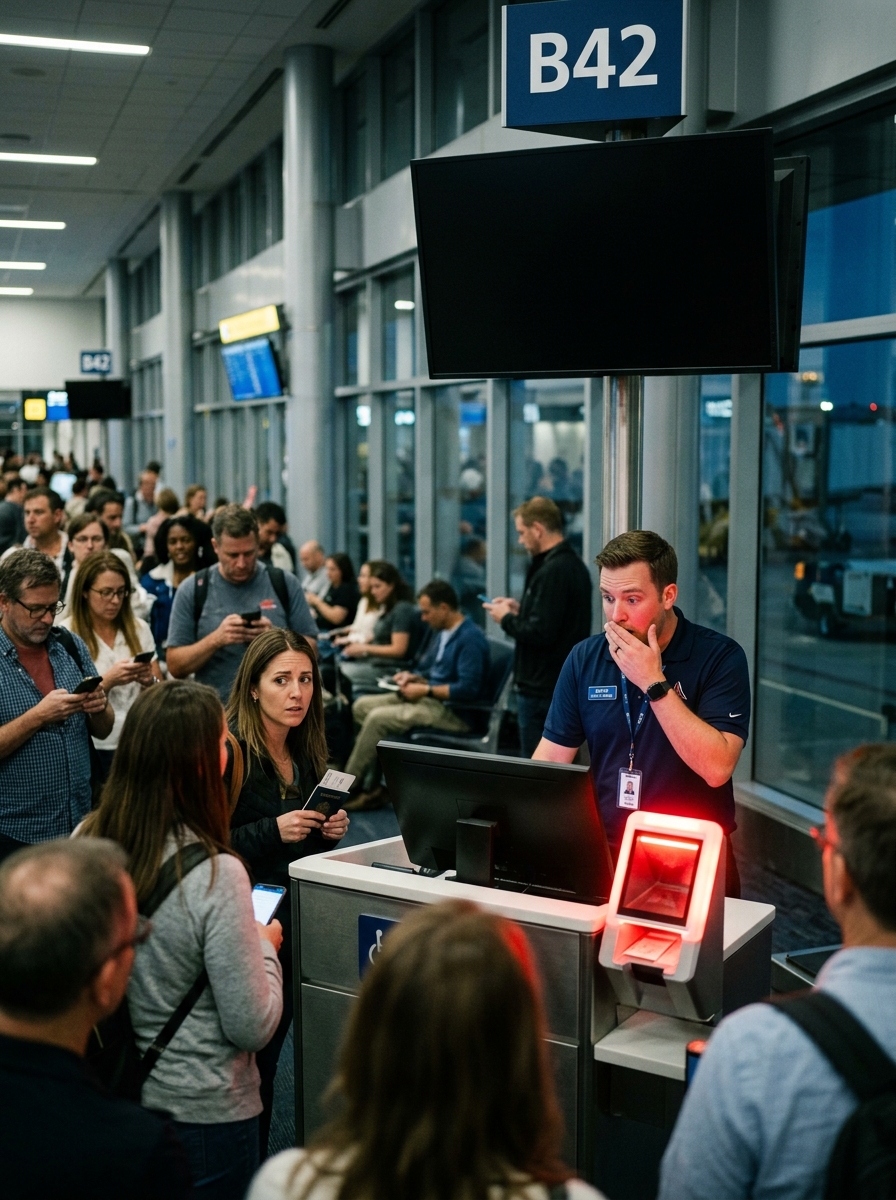
The scanner on Kevin’s podium didn’t beep—it screamed. A flat, continuous ERRRRRRRR that cut through the terminal like an alarm. The massive departure board above Gate K12 flickered violently. Flight data fractured into pixelated chaos before the entire screen went dead black.
Kevin stumbled back from the podium, startled. He looked down at his monitor. The airline’s booking system had vanished, replaced by a stark gray screen with a single line of text:
FATAL ERROR: API GATEWAY UNREACHABLE. CONNECTION REFUSED.
I didn’t move. I stayed against the glass, hands in my hoodie pockets. My father’s silver dog tags pressed against my chest beneath the fabric. My pulse was loud, heavy, but my face stayed still. I had spent years perfecting that stillness in rooms where I was never supposed to win. Kevin wouldn’t get even a flicker from me.
“What the hell?” Kevin muttered, slamming his hand against the monitor. He clicked frantically, the sound sharp in the suddenly quiet gate.
Nothing responded.
I watched his jaw tighten. The confidence that had humiliated me minutes earlier was gone, replaced by confusion and panic.
To understand what just happened, you need to understand Aegis Systems. I didn’t build an app. I built the backbone of modern logistics. For six months, this airline had been running on a temporary license of my system, patching a failing 1990s-era infrastructure that was collapsing under its own weight.
Aegis controlled everything—boarding validation, crew scheduling, baggage routing, system authentication. Without it, their entire operation was fragile at best, nonfunctional at worst.
And I had just shut it down.
“Hey—hey, come on,” Kevin said, slamming keys. “Work, damn it.”
He grabbed his radio. “K12 to Ops. Do you copy? My terminal just crashed. I need a reset. I can’t print my manifest.”
Static answered. Then a voice broke through—panicked, breathless.
“All gates, this is Ops. Do not board passengers. I repeat, do not board. We have a full system failure. The mainframe is down. Stand by.”
Kevin froze.
He looked at the radio, then the black screen above him.
But it wasn’t just Gate K12.
Across the terminal, the failure spread in real time. Boarding music cut out. Screens died. Agents froze mid-action as systems went dark. A low wave of confusion turned into alarm across the airport.
Every screen was black.
Kevin turned to me, eyes widening, confusion turning into fear. His mind still couldn’t connect me to what was happening.
“You,” he pointed, voice shaking. “Did you do something?”
I let out a quiet, tired laugh. “Kevin, I’ve been standing where you told me to stand.”
“Don’t play games with me,” he snapped, though his voice cracked. “If you damaged company systems—”
“I didn’t touch anything,” I said calmly. “Your system is just finally showing you what it is.”
My phone buzzed again. Marcus.
I answered without looking away from him.
“Tell me,” I said.
“Maya, what did you just do?” Marcus’s voice was tight, shaking with a mix of awe and pure fear. Marcus has been my lead counsel for six years. He’s a former corporate litigator who thrives in high-stakes negotiations, a man in five-thousand-dollar suits with the resting pulse of a reptile. I had never heard him sound like this.
“I executed my rights as the sole proprietor of Aegis Systems to terminate a provisional API license due to hostile conditions,” I said, the legal wording coming out like something rehearsed and precise. “Is it done?”
“It’s not just done, Maya, it’s a bloodbath,” Marcus replied quickly, his breathing uneven. “I’m outside the boardroom in San Francisco. David Sterling just got a call from their Virginia servers. The executives are literally screaming at each other inside.”
David Sterling. Vice President of Global Operations for the airline. A man who had spent the last three months courting me over Michelin-star dinners, pouring $500 bottles of wine, calling me a “visionary,” a “genius,” the “future of logistics.” The same man who accidentally cc’d me on an email last week referring to me as a “stubborn diversity hire who got lucky with some code.”
I had swallowed that insult. I had swallowed it because my father was dying of pancreatic cancer, because hospital bills had drained my savings before the company went fully liquid, and because I needed the $150 million to preserve the legacy he had bled for. I buried him on Tuesday, signed travel papers on Thursday, and flew across the country to hand David Sterling the keys to my kingdom.
“What is David doing right now?” I asked, leaning casually against the glass while watching Kevin pry at the back of his monitor.
“He threw a chair, Maya. I’m not exaggerating. He threw a leather chair across the room,” Marcus said. “The system is completely dark. They can’t clear takeoffs because weight-and-balance manifests are generated by Aegis. They can’t route baggage. They can’t even unlock jet bridge doors. Every aircraft they have on the ground globally is a two-hundred-ton paperweight. You just grounded a multinational airline.”
“Good.”
“Maya, listen to me,” Marcus said, urgency rising. “They’re going to sue us into the ground. Breach of contract, malicious interference—”
“No, they won’t,” I cut in smoothly. “Read Section 4, Paragraph 9 of the provisional agreement. The trial software is under an at-will continuation clause. If the vendor—that’s me—faces hostile, discriminatory, or bad-faith conduct from the buyer’s agents, the vendor can sever access immediately without notice. It’s a poison pill. You reviewed it.”
Silence. I could almost hear him flipping through memory.
“Maya… you told me that clause was a standard liability protection,” he said quietly.
“No, Marcus. I told you it was security.”
I closed my eyes briefly. The airport smell—burnt coffee, disinfectant, anxious sweat—faded into something older: motor oil and Old Spice. My father.
At twelve, I was evicted from our Detroit apartment. The notice on the door was neon green, screaming against peeling paint. My father had worked two jobs—factory and cab driving—but missed three days due to a lung infection. That was enough for the landlord to decide we were disposable.
I remember standing in freezing rain with a trash bag of clothes while my father knelt in the puddles, ruining his only decent work pants. His hands were rough, but his eyes were gentle.
“They can take the walls, Maya,” he said. “They can take the roof. The bed. But they can’t make you small unless you forget who you are. You build your own walls, baby girl. So high nobody can ever tell you to step aside again.”
I built those walls. Aegis Systems became my fortress. My bank account became my moat. My Forbes cover became armor.
But standing here, watching Kevin wave seventy passengers past me like I was nothing, I understood something cold and simple. The walls didn’t matter. The money didn’t matter. To people like him, I would always just be a Black woman in a hoodie in the wrong place.
He wasn’t just insulting me. He was insulting my father’s sacrifice. He was insulting that little girl in the Detroit rain.
I opened my eyes. Kevin was still panicking into his radio.
“Marcus,” I said quietly, “call David Sterling. Tell him the deal is off.”
“Maya, wait—”
“Tell him I’m at Gate K12 in O’Hare. Tell him his gate agent, Kevin, decided I wasn’t allowed to board my flight because I didn’t look like First Class. Tell him the system stays dead until I get a public apology from the board—and Kevin finds a new job.”
I hung up before he could respond.
Outside the window, the Boeing 777 sat attached to the jet bridge. I knew exactly what was happening inside it.
My kill switch had triggered a verification failure between the passenger manifest and TSA database. Without that handshake, the captain couldn’t legally push back. Worse, the jet bridge itself was locked into the same network. It couldn’t detach.
Passengers who had smirked at me—Eleanor, businessmen, all of them—were trapped inside a metal tube baking under the Chicago sun.
Then the jet bridge door slammed open.
A man in a captain’s uniform stormed out, face flushed, sweat already forming. Captain Harris.
“Kevin!” he barked. “What the hell is happening? We lost APU power, cabin temps are rising, cockpit screens are throwing 404 errors. I’ve got three hundred passengers cooking back there. Why aren’t we pushing back?”
Kevin flinched. “I—I don’t know, Captain. The terminal’s down. Ops issued a ground stop.”
“A ground stop?” the captain snapped. “For a network glitch? Detach the bridge manually. Run paper manifests. We need this aircraft moving.”
“We can’t,” Kevin stammered. “The bridge locks are tied to the main server. And the server—”
“Gone? What do you mean gone?”
A voice suddenly screamed from the jet bridge.
“Excuse me! Is someone going to tell us what is happening?!”
Eleanor. Her pristine composure was gone, replaced by sweat and panic. Her cashmere clung damply to her shoulders.
“Ma’am, return to your seat,” Captain Harris ordered.
“I will not!” she snapped. “It’s unbearable in there! You—” she pointed at Kevin— “fix this! My husband is waiting in Maui!”
“I can’t—” Kevin began.
“I don’t care!” she shouted, then suddenly turned her head and locked onto me.
Her expression sharpened.
“You,” she said, marching over. “This is because of her, isn’t it? She did something!”
The captain and Kevin both looked at me.
“Ma’am, she didn’t—” Kevin started, but hesitation crept in.
“She was causing trouble before boarding!” Eleanor insisted, voice rising. “She’s the problem! She probably broke everything on purpose!”
Passengers began gathering. The gate filled with noise, suspicion, confusion.
I didn’t respond. I simply reached into my hoodie pocket and pulled out my printed boarding pass—crisp, physical, undeniable. I held it up between two fingers.
“Seat 2A, Eleanor,” I said calmly. “You’re in 2B. I’m your seatmate.”
She froze. Her mouth opened, but nothing came out.
Then I added, evenly, for everyone to hear:
“And for the record, I didn’t break the scanner. I broke the airline.”
At that exact moment, the red emergency phone on Kevin’s podium began to ring.
Brrrrrriiiing. Brrrrrriiiing.
Kevin stared at it like it were a venomous snake. He didn’t want to pick it up. Somewhere deep in his gut, he already understood that whatever voice was waiting on the other end would end his career.
“Answer it, Kevin,” I said.
He swallowed hard. His hand shook as he reached for the heavy red receiver and lifted it to his ear.
“Gate K12, this is… this is Kevin.”
I couldn’t hear the voice on the other end, but I didn’t need to. I watched Kevin’s eyes widen into saucers. I watched his knees weaken until he had to grip the edge of the podium just to stay upright. I watched the air drain from his lungs in one long, uneven exhale.
“Y-yes, sir,” Kevin stuttered, his voice barely audible. “Yes, Mr. Sterling. Sh-she is. Yes, sir. She’s right here.”
Slowly, mechanically, Kevin pulled the phone away from his ear and extended it toward me. His hand shook so badly the coiled cord slapped against the desk.
“He… he wants to talk to you,” Kevin whispered, his voice breaking. “It’s the Vice President of Operations.”
I looked at the phone. Then I looked at Kevin.
“Tell David he can hold,” I said. “I’m busy waiting for my group to be called.”
CHAPTER 3
The heavy red receiver hung from Kevin’s trembling hand like a live grenade. The coiled cord swayed back and forth, a slow, uneasy pendulum cutting through the suffocating silence of Gate K12.
“Tell David he can hold,” I had said. “I’m busy waiting for my group to be called.”
The silence that followed was total. Not just quiet—erasure. A vacuum that seemed to pull the air out of the entire gate. Somewhere far down the concourse, a baggage cart squeaked faintly, the sound only making the stillness around us feel sharper, heavier.
Kevin’s mouth opened and shut uselessly, like a fish gasping on dry land. The arrogant gate agent who had minutes earlier weaponized his authority to erase my place in line was gone. In his place stood a man watching his career, his status, and his certainty collapse in real time. His eyes darted between the phone, me, and the dead screens.
“M-ma’am,” Kevin stammered, the word scraping out of him. “Please. He… he said it’s an emergency. He’s yelling.”
“I’m sure he is,” I replied, my voice calm, controlled. I didn’t move. I didn’t shift. I stayed leaned against the terminal glass while, outside, the trapped Boeing 777 shimmered in the heat above the tarmac. “But as you so clearly explained earlier, Kevin, I don’t belong in the priority line. I wouldn’t want to interfere with your process. So David can wait.”
Eleanor suddenly gasped sharply. The sound cut through the stillness. Whatever illusion she had been clinging to finally cracked. Her eyes flicked between the red boarding pass in my hand—Seat 2A—and the blinking emergency phone light.
Her posture collapsed. Her Louis Vuitton tote slipped from her arm and hit the carpet with a heavy thud.
“You…” Eleanor whispered, her voice stripped of arrogance, reduced to something fragile and uncertain. “You’re… you’re not just a passenger.”
I didn’t look at her. I was finished looking at Eleanor. Women like her had never truly seen me anyway. They were the teachers who assumed I cheated. The store clerks who shadowed my steps. The investors’ wives who smiled politely while asking if I was part of a “diversity program.” They never saw me—only their assumptions projected onto me.
“I am a passenger, Eleanor,” I said quietly, eyes still on Kevin. “I’m just a passenger who decided to stop being polite.”
Captain Harris finally moved. He was built for emergencies—engine failure, turbulence, medical crises at altitude. Not for a woman in a hoodie quietly dismantling his airline at a gate.
He stepped forward, boots scraping the floor, and snatched the red receiver from Kevin’s shaking hand.
“This is Captain Harris, Flight 1492,” he said sharply into the phone. “Who is this?”
A pause. Then his expression changed.
“Mr. Sterling. Yes, sir,” Harris replied, straightening instinctively. “Sir, we have a total systems failure. APU is offline, jet bridge is locked, cabin temperature is rising rapidly. I have three hundred passengers trapped. What is happening?”
Another pause. The voice on the other end—David Sterling—was so loud and frantic it bled through the receiver.
Captain Harris’s eyes slowly lifted from the podium, moved past Kevin, and landed on me. His anger dissolved into shock. He lowered the phone slightly.
“Sir, you’re telling me… the woman at my gate…” He swallowed. “You’re saying she caused this?”
He didn’t wait for confirmation. He pressed the phone’s speaker.
David Sterling’s voice erupted into the gate, distorted and panicked, nothing like the polished executive I had once sat across from at expensive dinners.
“…I don’t care what you have to do, Harris! Give her the phone! Put her on the line right now! The board is threatening to freeze my shares! Every major network is reporting a nationwide ground stop! Put Maya Vance on the phone!”
My name echoed through the terminal.
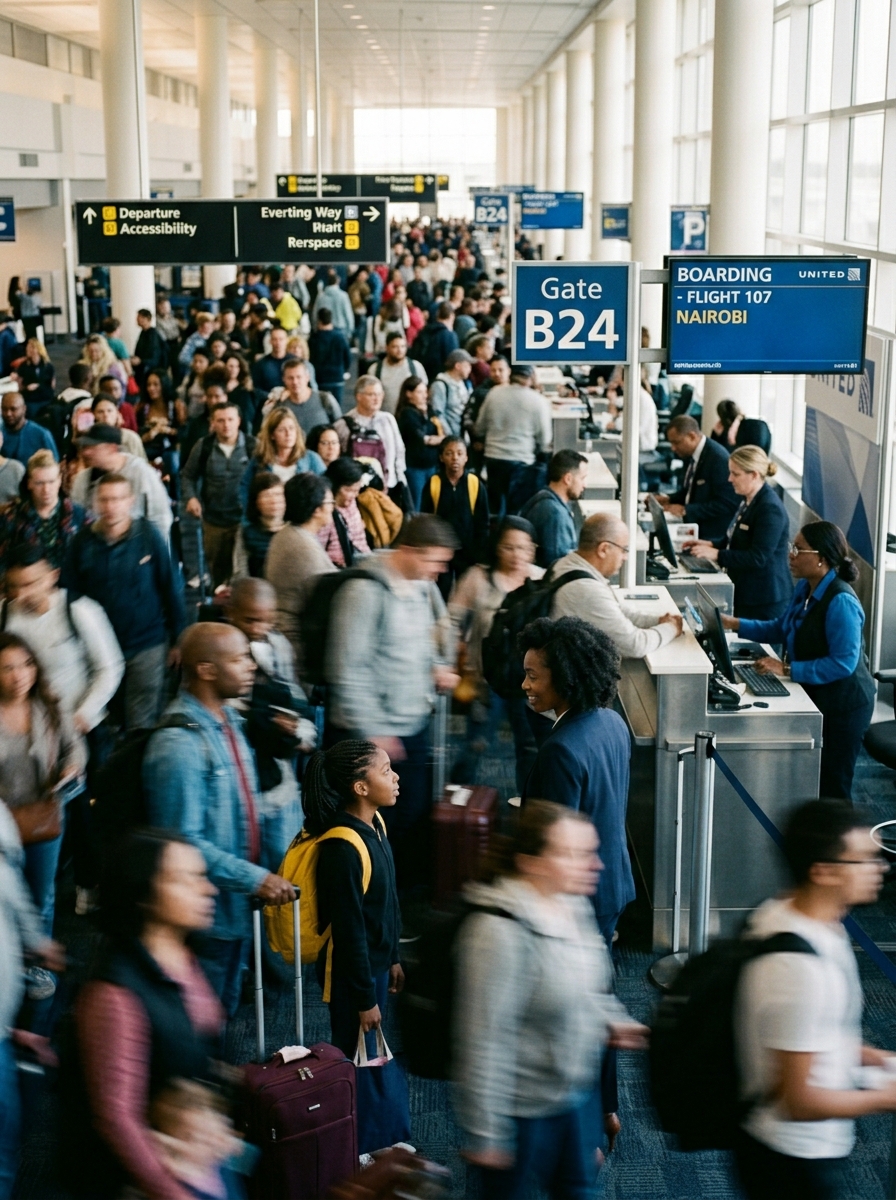
A ripple of movement passed through the growing crowd. Over the past minutes, chaos from the terminal had drifted toward Gate K12. Stranded passengers gathered in clusters, drawn in by the breakdown unfolding here. About thirty people now stood watching.
Among them, I noticed a young Black girl—maybe thirteen or fourteen—standing near a dead charging station. She wore a yellow backpack and held her mother’s hand. The mother, in medical scrubs, was frantically trying to reload her phone. But the girl wasn’t looking at her screen.
She was looking at me.
Her eyes were wide, fixed on the scene. The panicked gate agent. The stunned captain. The wealthy woman unraveling. And me—standing still at the center of it all, holding the room without raising my voice.
Something tightened in my chest.
I saw myself in her. I saw the little girl sitting on a wet Detroit sidewalk, watching a landlord lock us out of our home. I remembered that feeling of absolute powerlessness, the knowledge that the system was never built with us inside it. My father had promised me that night that if I built high enough, I would be safe.
Work twice as hard just to get half as far. That was the rule. That was the cost of existing in their world.
I had paid the tax. I had built the walls. I had coded late into the night until my vision blurred. I had sacrificed relationships, sleep, and my own mental health to create Aegis Systems. I had become undeniable. And still, the moment I took off my CEO armor and put on a simple hoodie to grieve my father, I was instantly reduced back to a nuisance.
The walls were a lie. The money was a lie. If you don’t demand respect at a basic human level, no amount of wealth will ever secure it for you.
I pushed myself away from the window.
The crowd instinctively shifted as I walked the ten feet toward the podium. I didn’t hurry. I moved with the slow, controlled certainty of someone who understood they owned the air around them.
I stopped in front of Captain Harris. I reached out, steady-handed, and tapped the speakerphone on the red console, turning the volume all the way up.
“Hello, David,” I said.
The frantic shouting on the other end stopped immediately. A heavy, ragged breath came through the speaker.
“Maya,” David gasped. He sounded like a man who had run in the wrong direction for miles. “Maya, thank God. Listen to me. Whatever happened there, whatever misunderstanding, I will fix it. I will fire that gate agent myself right now. Just… please. Turn the servers back on. We’ve got planes over the Atlantic that can’t access routing data. You’re playing with people’s lives.”
“Don’t try to manipulate me with safety protocols, David,” I replied sharply. My tone was clinical. “Aegis Systems is a logistics framework, not an avionics override. In a full network outage, FAA analog procedures take over for airborne aircraft. Your pilots can land. They just can’t park, unload, or process revenue. No one is in danger. You’re just losing about five million dollars every sixty seconds.”
A strangled sound came through the speaker. “Maya, this is insane! We had a deal! You’re breaking a hundred-and-fifty-million-dollar acquisition over a… customer service dispute?”
“A customer service dispute?” I repeated, letting the words hang. I looked down at Kevin. He flinched, avoiding my gaze, staring hard at the floor, his face deep red with shame.
“David, let me describe your ‘customer service dispute,’” I said, leaning slightly closer to the microphone. “I arrived at Gate K12 an hour ago with a valid Group 1 First Class ticket. Your agent, Kevin, refused to scan it. He physically blocked me and told me to ‘step aside’ for the ‘actual’ priority passengers. He then boarded seventy consecutive white passengers while I stood against a wall for forty-four minutes. When I politely asked him to recheck my ticket, he threatened to call security.”
A ripple moved through the crowd. A few gasps broke the silence. The mother in scrubs pulled her daughter closer, glaring at Kevin.
“That isn’t a customer service dispute, David,” I continued, my voice tightening with contained heat. “That is the casual, systemic erasure of a Black woman. It is the certainty in Kevin’s mind that I did not belong. That I was an imposter. That I was beneath him.”
“Maya, he’s an idiot,” David pleaded, voice cracking. “He’s a low-level employee who made a mistake. I’ll destroy him. I’ll make sure he never works again. Just give me the override code!”
“You’re still missing the point, David,” I said. “Kevin isn’t the exception. Kevin is the culture. And I know it’s the culture because it starts at the top.”
Silence filled the line.
“What… what are you saying?” David asked, more carefully now.
I inhaled slowly. My chest was tight. There was no retreat after this.
“Last Thursday,” I said clearly, so every word carried through the gate. “At 11:42 PM, you forwarded an internal memo about the Aegis acquisition to your board. You meant to BCC me, but you CC’d me instead. Do you remember that email, David?”
The silence that followed was absolute. The kind of silence that confirms guilt before a word is spoken.
“Should I read it to everyone here?” I asked. “Or summarize? You told your board my valuation was ‘manageable’ because, and I quote, ‘Vance is just a stubborn diversity hire who got lucky with some open-source code. We can squeeze her in negotiations because people like her don’t know how to handle real corporate pressure.’”
A low whistle escaped someone in the crowd. Eleanor raised a hand to her mouth, stunned. Her expression shifted into something like horror. She was no longer looking at me as an outsider. She was realizing she had been standing beside the system.
Captain Harris looked visibly disgusted. He stepped back from the console, arms folding tightly across his chest as if distancing himself from it all.
“Maya… that was taken out of context,” David stammered, panic rising. “It was late, I was managing board expectations—”
“You reduced my life’s work, my intelligence, and a decade of sacrifice into a stereotype,” I cut in. My voice sharpened. “You smiled across dinner tables and called me a visionary, while behind closed doors you stripped me of merit the same way Kevin did today.”
I looked out at the crowd. My eyes found the young girl in the yellow backpack. She stood still, watching every word.
“I built Aegis Systems to create structure,” I said. “To build something fair, logical, and efficient. I will not let it power an organization that operates on prejudice. I will not let my father’s legacy run through a system that treats his daughter like she is disposable.”
“You’re destroying your own company, Maya!” David shouted, completely unraveling. “If you kill this deal, you walk away with nothing! You’ll be buried in litigation for years!”
“No, David,” I said quietly. A strange calm settled over me. The exhaustion, the grief, the pressure—it all lifted at once. “I’m not destroying my company. I’m ending yours. I already have other buyers in Europe. You, however, now have a grounded fleet, a collapsed system, and a public crisis that will cost you your position by the end of the day.”
I pressed the red button and ended the call.
The line cut. Silence returned instantly.
I looked at Kevin. He was gripping the podium so tightly his hands were white. Slowly, he lifted his eyes to me, tears forming.
“I’m sorry,” Kevin whispered brokenly. “I… I didn’t know who you were.”
I held his gaze for a long moment.
“That’s the problem, Kevin,” I said softly. “You shouldn’t need to know who I am to treat me like a human being.”
I turned away from the podium. I didn’t look back at Eleanor or the captain. I walked through the crowd as it parted. As I passed the girl in the yellow backpack, I gave her a small nod. She smiled—bright, steady, unafraid.
I walked down the concourse, leaving the chaos, the heat, and the $150 million deal behind. I pulled out my phone and called Marcus.
“Hey,” I said.
“Maya,” Marcus exhaled, exhausted. “Tell me you didn’t do it.”
“Draft a press release,” I said, pulling my hoodie up. “Aegis Systems is withdrawing from the Trans-Global acquisition due to irreconcilable ethical differences.”
“Maya… they’re going to come after us.”
“Let them,” I said, stepping into the bright Chicago afternoon. “We’ve got walls for that. Now get me a car. I need to see my father.”
CHAPTER 4
The inside of the black Lincoln Navigator was unnervingly quiet. The air carried the scent of expensive leather polish and the faint, sterile bite of high-powered air conditioning. After the suffocating heat of the terminal, the silence settled over me like a heavy blanket. I sank into the back seat, pulling my knees up, suddenly feeling small inside my oversized, faded UCLA hoodie.
As the driver merged onto I-190 away from O’Hare, my phone started vibrating.
Not ringing—just a relentless, continuous buzz against my thigh. I pulled it out and stared at the screen. Notifications were flooding in so fast they blurred into one bright block.
CNN Breaking: Trans-Global Airlines Suspends All Operations Amid “Catastrophic” IT Failure.
Bloomberg: Aegis Systems CEO Maya Vance Terminates $150M Acquisition; Airline Stocks Plunge 18% in Ten Minutes.
Twitter Trending: #GateK12, #MayaVance, #TransGlobalDown.
I opened a video a friend had sent. It already had millions of views in less than an hour. Shaky phone footage from the crowd at the gate.
There I was—small in a gray hoodie—standing motionless as David Sterling’s voice echoed through the speakerphone, begging me to restore the servers. The video caught me reading his words back to him. It caught the collective shock of the crowd. And it caught Kevin’s complete collapse, standing at the center of it all.
I locked the screen and dropped the phone beside me. Then I leaned my head against the cool window.
I had just detonated my life. Walked away from $150 million. Made an enemy of a global corporation with lawyers everywhere. Turned myself into the center of a corporate disaster.
And yet—for the first time in ten years—I could breathe.
The adrenaline drained out of me, leaving something deeper and heavier behind. My engine—the obsessive need to build walls high enough to never feel powerless again—had finally burned out.
Because I saw the flaw in everything I built. You can construct the highest walls in the world, surround them with gold, call it safety—but if you still have to shrink yourself inside them, then you are not free. You are contained.
“They only have the power to make you feel small if you forget who you are.” My father’s voice filled the quiet car like he was sitting right beside me.
I closed my eyes for a moment. Then I said, “Take me to Detroit.”
The driver glanced at me in the mirror, surprised. “Ma’am? Marcus booked you for the Four Seasons downtown. Detroit is four hours away.”
“I’ll pay triple,” I said calmly. “Just keep driving east.”
He didn’t argue. He merged lanes and pointed the SUV toward Michigan.
For the next four hours, I watched everything unfold through the window. The fallout came faster than expected. By 3:00 PM, Trans-Global had canceled over two thousand flights. Millions were stranded. The FAA had opened an investigation.
By 4:00 PM, the internet escalated everything.
A leaked thread of David Sterling’s emails surfaced. Not just about me—years of racist, sexist comments about employees, vendors, executives. My “diversity hire” label was only one entry in a much larger record.
By 4:30 PM, the board held an emergency press conference. No waiting for market close. A shaken spokesperson announced David Sterling’s immediate termination and a full internal restructuring. Kevin and his chain of command were gone too.
Then came the online investigations. Eleanor was identified. Her posts, affiliations, and connections were exposed within hours. The same entitlement that made her point at me in the airport now dismantled her public image.
But something else appeared too.
A post from the mother in scrubs. A photo of her daughter with the yellow backpack watching the coverage.
Caption: “My daughter saw a woman stand up to an entire system today. She hasn’t stopped talking about Maya Vance for hours. Today she learned what real power looks like. Thank you, Maya.”
A tear slipped down my face before I realized it. I didn’t wipe it away. I just let it fall.
I hadn’t just destroyed something. I had illuminated something.
By the time we reached Detroit, the sky was turning orange and bruised. The city looked the same as I remembered—worn, resilient, still standing.
We passed old streets. The corner where my father’s cab used to break down. The building where we were evicted, its peeling paint now replaced with a modern storefront. Everything different, yet the same beneath it.
“Turn left,” I said quietly. “Woodmere Cemetery.”
The gates were open. The car rolled slowly along the winding paths until I told the driver to stop.
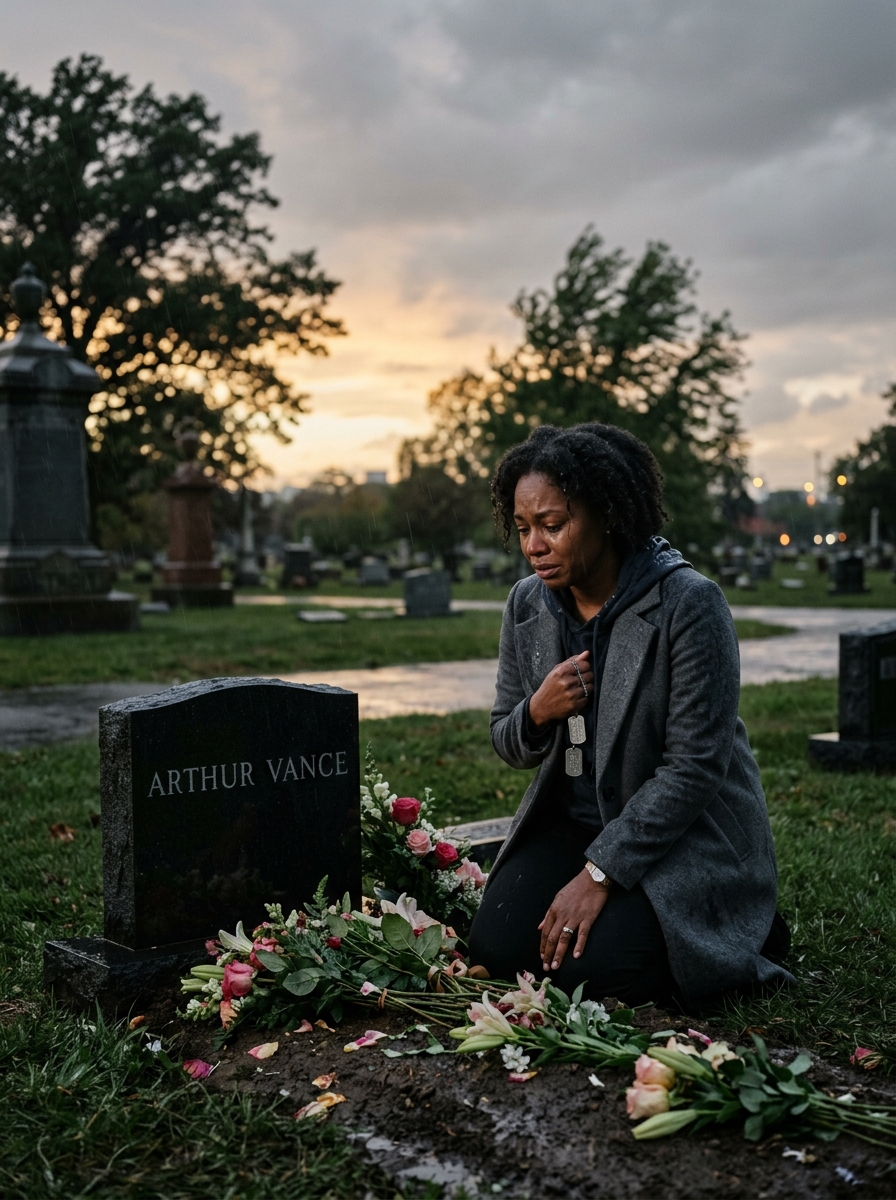
I stepped out. The air was cool, damp, carrying the smell of earth and river rain. I pulled my hood up and walked down the slope until I reached a fresh grave. No headstone yet. Just a temporary marker under plastic.
Arthur Vance. 1952 – 2026. Beloved Father.
I knelt at the edge. The silence here felt different—heavier, sacred.
I pulled the silver dog tags from my hoodie and held them in my palm. Then I pressed my fingers into the cold soil.
“Hey, Dad,” I whispered.
Wind moved through the trees above me.
“I broke the rules today,” I said, forcing a small, trembling smile. “I was supposed to take the money. Stay quiet. Do what we planned.”
Tears began falling into the dirt.
“They offered me $150 million, Dad. It would’ve meant we made it. That everything we went through meant something. That I was finally safe.”
My breath shook.
“But I was standing there in that line… and he looked through me. He told me to step aside. And I realized something. If I took their money while they treated me like I didn’t exist, I wasn’t buying freedom. I was buying silence.”
I clenched the soil, letting it fall through my fingers.
“You told me to build walls so no one could make me small. But I think the walls became my cage. I forgot how to push back.”
Rain began to fall, light at first, then steady.
“I lost the deal,” I said softly. “I burned the system. I made enemies. They’re coming for me now. The world is going to tear it apart.”
I wiped my face with my sleeve, breathing in sharply.
“But I didn’t step aside,” I whispered. “And for the first time, Dad… I think they actually saw me.”
My phone buzzed again. Marcus. I didn’t answer. I already knew what he would say—new buyers, higher offers, increased value. Proof I had “won.”
But I didn’t need that anymore.
I stood, brushing dirt from my knees. I placed the dog tags back against my chest. The cold metal felt different now—less like grief, more like grounding.
I walked back toward the car as rain washed the earth clean behind me.
Not erasing what happened. Just revealing what was left.
No amount of money can replace the dignity lost when you step out of the line you were never meant to leave.
END OF STORY
