

I have led thousands of troops in some of the most hostile, unforgiving warzones on Earth.
I have stared into the eyes of insurgents, held my ground through mortar fire, and made split-second decisions that decided who lived and who died before dawn.

Yet nothing in my thirty-four years of service in the military could have prepared me for the blinding, consuming rage that took hold of me at Checkpoint 4 in O’Hare International Airport.
It was a Tuesday morning—the kind of dull, overcast Chicago day where everyone just wants to reach their gate and leave.
I was dressed in a worn grey wool sweater, relaxed jeans, and scuffed boots. I didn’t look like a Four-Star General. That was intentional.
When I’m off duty, I’m just Tom.
And more importantly, I’m just Sarah’s husband.
Sarah is the strongest person I have ever known. Full stop.
She completed two brutal deployments in Afghanistan as a combat medic. She spent her twenties pulling wounded soldiers out of active firefights while bullets tore into the ground around her boots.
She saved thirty-two lives.
And on her final patrol, an IED buried in the dust ensured she returned without her left leg.
She endured two years at Walter Reed Hospital fighting through relentless pain, infections, and rehabilitation that would have broken most people.
But Sarah isn’t most people. She is a force of nature.
She taught herself to walk again. Then to run again. She adjusted to her titanium prosthetic with a quiet, relentless determination that still leaves me in awe every day.
But traveling is difficult for her.
The prosthetic causes deep friction sores on her residual limb. Standing in long queues sends sharp, radiating pain through her lower back.
She never complains. Not once. But after ten years of marriage, I recognize the slight tightening at the corner of her eyes when she’s hurting.
And that morning at O’Hare, she was hurting.
We had already been in the winding security line for forty-five minutes.
The airport was crowded. The air carried stale coffee, cheap perfume, and the tension of impatient travelers.
Children were crying. The overhead announcements repeated endlessly over the loudspeakers.
When we finally reached the metal bins to unload our belongings, I noticed the TSA officer at the body scanner.
I’ve spent my life observing human behavior, reading pressure in men’s posture. I knew exactly what he was the moment I saw him.
He was a bully.
A large, heavy man with a tight buzz cut, sweat already soaking through his blue uniform shirt.
He wasn’t just doing his job; he was pushing people around, rolling his eyes, and snapping at elderly passengers who moved too slowly.
He was intoxicated by the small authority his badge gave him.
“Laptops out! Shoes off! I shouldn’t have to repeat myself, people! Let’s go, let’s go, let’s go!” he barked, clapping sharply.
Sarah calmly placed her boots into the grey plastic bin.
Because of her prosthetic, she wore a thick athletic sock on her left side and a regular sock on her right. She stepped toward the scanner, slightly leaning on her cane.
“Ma’am, the cane goes on the belt,” the guard barked, stepping into her path.
“I know,” Sarah said softly, offering a polite smile. “But I have a titanium prosthetic leg. I can’t walk through the scanner without my cane. If you want to pat me down manually, I am happy to step to the side.”
It was routine. We traveled often. Every other agent had always simply nodded, directed her aside, and requested a female officer for a respectful pat-down.
But not him.
He folded his arms, chest out. “I don’t care what you have, ma’am. Nobody bypasses the scanner on my watch. Put the cane on the belt and step into the machine.”
I felt my jaw tighten. I took a half-step forward.
But Sarah caught my eye. That subtle, familiar look: I’ve got this, Tom. Don’t escalate it.
She didn’t want attention. She never did.
So she sighed, placed her cane on the conveyor belt, and carefully hopped on her right foot, dragging her heavy prosthetic leg as she entered the scanner.
She raised her arms overhead, steadying herself.
The machine rotated around her.
Immediately, the screen flashed red. The alarm sounded.
“Step out,” the guard ordered sharply.
Sarah stepped out, her cheeks flushed with embarrassment as dozens of people watched.
“I told you,” she said calmly, respectfully. “It’s a full titanium limb. It will trigger the machine every time. I need a manual check by a female agent.”
“I am giving the orders here,” the guard snapped, moving uncomfortably close. “You are going to stand on those yellow footprints, spread your legs, and keep your hands on your head.”
“I can’t spread my legs like that,” Sarah explained, her voice shaking slightly from the effort of balancing. “The socket of my prosthetic doesn’t allow that movement. I will fall.”
“Stop arguing with me and spread your legs!” he shouted, his voice echoing through the terminal.
Conversation around us stopped. The entire checkpoint fell silent.
Every eye was on us.
“Officer,” I said, my voice low and steady. “My wife is a disabled combat veteran. She physically cannot do that stance. Call your supervisor.”
The guard slowly turned toward me. He looked me over—my grey sweater, worn jeans, calm posture.
He didn’t see three decades of command experience. He didn’t see the man who had advised the Joint Chiefs at the Pentagon.
He just saw someone he thought he could push around.
“Back off, pal, or you won’t be flying anywhere today,” he sneered.
Then he turned back to Sarah.
“I am not asking you again,” he snarled.
And before my mind could fully register what was happening, he reached out.
He didn’t just touch her.
He grabbed her left shoulder—the prosthetic side—and violently shoved her backward toward the scanner.
“I said assume the position!” he roared.
Sarah gasped sharply.
Without her cane, she lost balance instantly.
Her prosthetic foot slipped on the polished tile. Metal scraped loudly against the floor.
She slammed into the clear plastic wall of the scanner, arms flailing as she tried to recover. Then she fell hard onto her hip.
A collective gasp erupted from the crowd. Someone screamed.
Everything stopped.
The sound of rolling luggage, announcements, distant voices—it all disappeared.
A ringing silence filled my ears.
I looked down at my wife, a decorated American hero, lying on the filthy floor of an airport checkpoint, clutching her shoulder in pain.
Then I lifted my gaze to the guard.
He stood over her, chest thrust out, wearing a smug expression.
He believed he had won.
He believed he had just put an unruly passenger in her place.
He had no idea who I was.
He had no idea that the quiet civilian husband standing behind her was General Thomas Vance.
And he had no idea that I was about to methodically dismantle his entire world.
The silence after Sarah went down wasn’t ordinary quiet. It was dense. The kind of silence that comes right before an explosion—the kind I had heard countless times in the moments after a fuse is lit.
I didn’t run. I didn’t shout.
In my world, when everything collapses, you don’t panic. You switch into precision. You become a machine.
A cold, familiar weight settled in my chest. My pulse didn’t rise; it dropped. My focus narrowed until nothing existed except my wife on the floor and the man standing over her.
I moved toward Sarah. Each step was controlled, deliberate. My boots struck the linoleum in a steady, disciplined rhythm that sliced through the tension.
I reached her and dropped to a knee. I ignored the guard completely. My attention stayed on her.
“Sarah,” I said quietly, my voice rough. “Don’t move. Where does it hurt?”
Her face was pale, twisted between pain and humiliation. Her hand was pressed to her left hip, where the prosthetic socket met living tissue.
“My hip, Tom,” she gasped. “The impact… it feels like it jammed the bone. And my leg… I think he damaged the housing.”
I glanced at her titanium limb. A sharp scuff ran along the carbon fiber casing, and the hydraulic system that supported her gait was leaking a thin, clear fluid.
That leg cost more than most luxury cars. It was cutting-edge medical engineering built to restore a life.
And he had treated it like garbage.
“Stay still,” I said, placing a hand on her shoulder as she trembled.
Then I rose.
Not like an elderly man in a grey sweater. I rose with the full presence of someone who had spent decades commanding the most powerful military on earth.
I turned to the guard—Officer Miller.
He was still standing there, chest out, but something had changed. I saw it immediately: doubt creeping in. He noticed my posture shift. He noticed the way I looked at him—not with anger, but with the calm, clinical focus of a predator identifying prey.
“What do you think you’re doing?” Miller stammered, trying to recover his authority. “She was non-compliant. I secured the scanner area. Step back, sir, or you’ll be detained for interfering with a federal officer.”
“A federal officer?” I said. My voice was even, but it carried through the terminal. “Is that what you call yourself after assaulting a disabled veteran?”
“She was resisting!” Miller shouted, his face flushing as he scanned the crowd for support.
But there was none.
Phones were already up. Dozens of people were recording. The red “Live” indicators glowed on multiple screens.
This would be public before we left the building.
“She wasn’t resisting,” a woman yelled from the line. “You pushed her! We all saw it!”
“Back up!” Miller snapped, his hand drifting toward his cuffs. His control was slipping—too much authority, too little discipline.
“Officer Miller,” I said, reading his name tag. “Look at me.”
He did. And for the first time, he actually saw me.
He saw the scars at my neck. He saw the stillness in my eyes. He saw a man who didn’t respond to intimidation.
“You have thirty seconds to call your supervisor and a medical team,” I said. “If you don’t, I will make sure this is the last day you wear that uniform. Not fired—prosecuted.”
Miller let out a nervous laugh. “Who do you think you are? TSA runs this terminal. I’m the authority here.”
“I know exactly who you are,” I replied. “A man hiding behind a badge after putting his hands on a woman who lost a limb serving this country.”
My hand moved slowly toward my back pocket.
Miller flinched. “Hands where I can see them!”
I pulled out my wallet.
Not my license.
A gold-bordered Department of Defense ID, sealed with a holographic emblem reserved for the highest levels of command.
I held it inches from his face.
“My name is General Thomas Vance,” I said, my voice dropping low and heavy. “Commander of United States Northern Command. That woman on the floor is my wife—Major Sarah Vance, Silver Star and Purple Heart recipient.”
Miller stared at the card. Then at me. Then back again.
The color drained from his face. His posture collapsed in an instant. The arrogance vanished completely.
“General… I didn’t— I didn’t know,” he whispered.
“That’s the point,” I said coldly. “You only show respect when you’re afraid of consequences.”
At that moment, more TSA agents and Airport Police rushed in.
At their front was Supervisor Collins, already pale.
She stopped short, eyes locking on Sarah.
“General Vance?” she said, breathless. “What happened?”
“Your officer used force on my wife,” I said. “She’s injured. Her prosthetic is damaged.”
Collins turned to Miller. “Did you touch her?”
He couldn’t answer.
“Medical team now!” Collins shouted. “And I want Port Authority Police here immediately!”
She looked back at me, shaken. “General, I am so sorry—this is not—”
“I don’t want apologies,” I cut in. I knelt beside Sarah again as she fought through the pain. “I want a secured area, a prosthetic specialist, and that officer removed in handcuffs.”
A wave of voices erupted from the crowd behind us.
But I didn’t react to them.
Sarah was crying—not from injury, but from humiliation. From being treated like a threat in the country she nearly died defending.
Something dark tightened inside me again.
This wasn’t finished.
“Tom,” she whispered, gripping my hand. “Just get me out of here.”
“I’ve got you,” I said softly, pressing my forehead to hers. “I’ve got you. And by tonight, everyone will know what happened here.”
I looked up at Collins.
“Call the TSA Director,” I said. “He has ten minutes to reach me. After that, I call the Secretary of Defense.”
She nodded rapidly, already reaching for her radio.
This was only the beginning.
They moved us into a sealed holding room behind security. It smelled of harsh disinfectant and overheated electronics.
Airport Police stood outside—not guarding us, but guarding the situation from collapse.
Sarah sat on a narrow exam table while paramedics worked at her side.
Rodriguez, one of them, carefully examined the prosthetic connection point. His expression tightened.
“It’s serious,” Sarah asked quietly, trying to stay composed.
“The alignment’s compromised,” he said gently. “The socket impact damaged soft tissue and possibly the bone. She needs a specialist immediately.”
He glanced at me. “General, the hydraulic system is leaking. She can’t safely use this.”
A deeper wave of fury rose in me.
That prosthetic wasn’t just equipment. It was her independence. Her recovery. Her second life.
And Miller had shattered it in seconds.
Rodriguez hesitated. “A replacement like this… what does it cost?”
“The Gen-3 system?” I said quietly. “With fitting and neural calibration? Around one hundred forty thousand dollars. And months of rehab just to regain function.”
The room fell completely silent.
At that moment, the door swung open.
Supervisor Collins entered first, followed by a man in a sharply tailored navy suit. He was in his fifties, silver hair perfectly styled, his face shaped by years of polished PR and corporate crisis management.
This was Marcus Sterling, the TSA Regional Director. He looked like someone accustomed to solving problems with a firm handshake and a carefully drafted non-disclosure agreement.
“General Vance,” Sterling said, stepping forward with his hand extended. “I’m Marcus Sterling. I cannot tell you how deeply I regret the—”
I didn’t move. I didn’t take his hand. I just held his gaze until his arm slowly fell back to his side, his professional smile faltering for a split second.
“Regret isn’t the word you’re looking for, Mr. Sterling,” I said. My voice stayed low, carrying the same tone I used when briefing the President on military operations. “The word you’re looking for is ‘liability’. Or maybe ‘negligence’.”
Sterling cleared his throat, eyes flicking toward the medics and then to Sarah.
“Of course, of course. We’re already initiating a full internal review. Officer Miller has been suspended indefinitely pending a—”
“Suspended?” I cut in. I took one step forward, and despite his suit and title, Sterling instinctively pressed back against the doorframe. “You watched the footage, didn’t you?”
Sterling hesitated. He pulled out a smartphone, his hands slightly unsteady.
“It’s… it’s everywhere, General. The video has twelve million views. It’s trending across every platform nationwide. The Governor has already contacted my office twice. The Secretary of Homeland Security is on line one.”
“Good,” I said. “Then you already know what happened. You know your agent physically assaulted a disabled combat veteran. You know he violated every protocol in your own manual. You know he humiliated a woman who sacrificed more for this country than he could ever understand.”
“General, please,” Sterling said quietly, trying to shift into a familiar tone of negotiation. “We want to resolve this. We’re prepared to cover all medical costs, the prosthetic replacement, and a substantial—let’s call it a ‘settlement’—for emotional distress. We just need to keep this contained. No media escalation.”
I looked at Sarah. She was watching me, eyes glassy with tears.
She had lived her life quietly. Serving in silence. Enduring pain without asking for anything in return.
She had been quiet when the IED detonated. Quiet through the surgeries. Quiet under the stares in grocery stores.
But she was done being quiet.
“No,” I said, turning back to Sterling.
“No?” he blinked. “General, we’re talking about a seven-figure settlement. We can have everything finalized within the hour. You go home, your wife gets the best care, and this ends.”
“It’s not about money, Marcus,” I said, using his first name like a warning. “You think a check fixes a system that lets men like Miller operate unchecked? You think money repairs the fact that thousands of veterans and disabled civilians are treated like problems at these checkpoints every day by people with minimal training and unchecked authority?”
I walked to the desk in the corner and picked up my phone.
“What are you doing?” Sterling asked, his voice rising.
“I’m making a call,” I said. “Not to your attorneys. Not to the Secretary.”
I tapped the screen.
“Who are you calling?” he demanded.
“The National Commander of the VFW,” I said. “The head of the Wounded Warrior Project. And every major news outlet in the Midwest. Because this isn’t staying quiet. It’s going public.”
Sterling went visibly pale. “General, think about the consequences. This will disrupt airport operations nationwide. It will damage morale—”
“Morale?” I snapped. “You want to talk about morale? My wife was shoved to the ground because she couldn’t ‘comply’ with a bully’s demands. Her morale matters to me. So does every service member watching this and wondering if this is what awaits them when they come home injured.”
I checked my watch.
“In thirty minutes, there will be a hundred veterans outside this terminal,” I said. “In two hours, there will be a thousand. And I will be standing with them in uniform, telling exactly what happened in Checkpoint 4.”
“General, please,” Sterling said, almost desperate now. “What do you want? Tell me.”
I looked at Sarah again. She gave me a small, steady nod. The fire was back.
I turned back to Sterling, my expression hardening.
“I want Officer Miller arrested. Not suspended. Arrested for felony assault. And I want him escorted out of this airport in front of every camera outside that door.”
I paused.
“And I want a full overhaul of your training protocols, overseen by a panel of disabled veterans. If I don’t see a public statement confirming that before I leave this room, I will personally ensure your agency faces congressional scrutiny it will not recover from.”
Sterling looked as though he might collapse. He understood I wasn’t bluffing.
“I… I need to contact Washington,” he whispered.
“Then do it,” I said, stepping aside. “But move fast. My patience is gone. And my wife is done waiting.”
Sterling rushed out, Collins following closely behind like a shadow.
The door shut. Silence returned.
I moved to Sarah and took her hands.
“You okay?” I asked.
She looked at me and, for the first time that day, gave a small, real smile.
“I’ve never seen you use that voice on a civilian before,” she said softly.
“He earned it,” I replied.
“Tom,” she said, gripping tighter. “I don’t want money. I don’t want attention. I just want to make sure no one else goes through that.”
“I know,” I said, kissing her knuckles. “And that’s exactly what we’re going to make sure happens.”
But as I looked at the closed door, I knew this wasn’t over. The system would resist. It always did.
They thought they were dealing with a retired man and his injured wife.
They were about to learn otherwise.
Walking out of that terminal is something I will never forget.
Sarah was in a wheelchair now. Her damaged titanium leg rested on a support, hydraulic fluid staining the medical wrap.
I pushed her myself. I refused help from airport staff.
As we moved through O’Hare, the atmosphere shifted. Word had spread fast.
TSA agents stood straighter as we passed. Not out of orders—but recognition. They saw the authority I carried even without insignia.
Some couldn’t meet Sarah’s eyes. They looked ashamed. And they should have been.
“Look at them, Tom,” Sarah whispered. “They’re afraid.”
“They’re not afraid of me,” I said. “They’re afraid of accountability. They’re afraid of what happens when people stop staying silent.”
We reached the glass doors of the arrivals level.
Outside, I could already see them.
A sea of red, white, and blue.
Three phone calls had been enough.
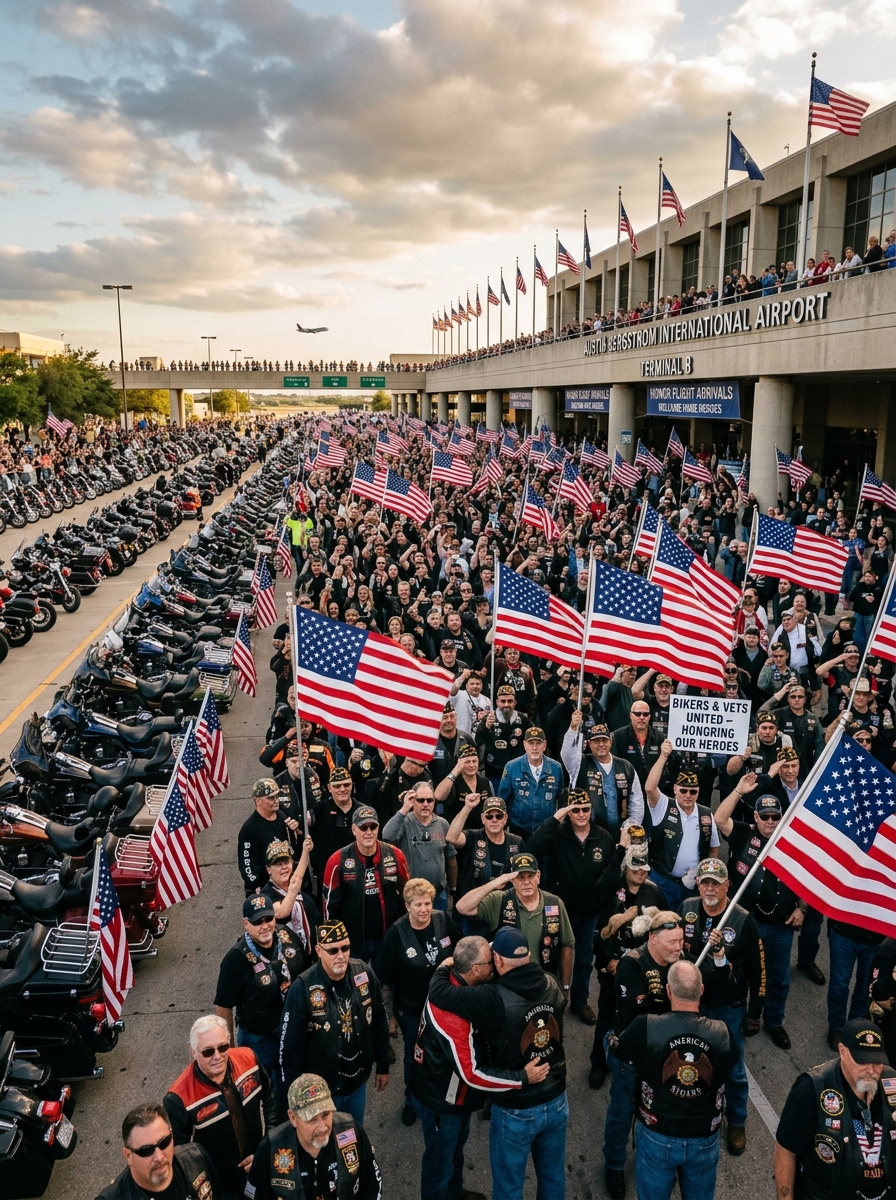
Hundreds of veterans. Leather vests marked with Patriot Guard patches. VFW caps. Young service members still in uniform. Harleys lined across the pickup lane, engines rumbling like a living force.
When the doors slid open, the sound hit like a wave.
No one cheered.
They stood at attention.
A synchronized salute rose across the entire crowd.
Sarah gasped, one hand rising to her mouth. Tears streamed down her face, but she straightened as much as she could and returned the salute—steady, proud, unbroken.
Then the police arrived.
Four Chicago PD cruisers and two Port Authority SUVs screeched to a stop. News vans crowded behind them, cameras flashing, reporters shouting into the chaos.
Sterling emerged from the terminal, pale and sweating, signaling to officers.
A side door opened.
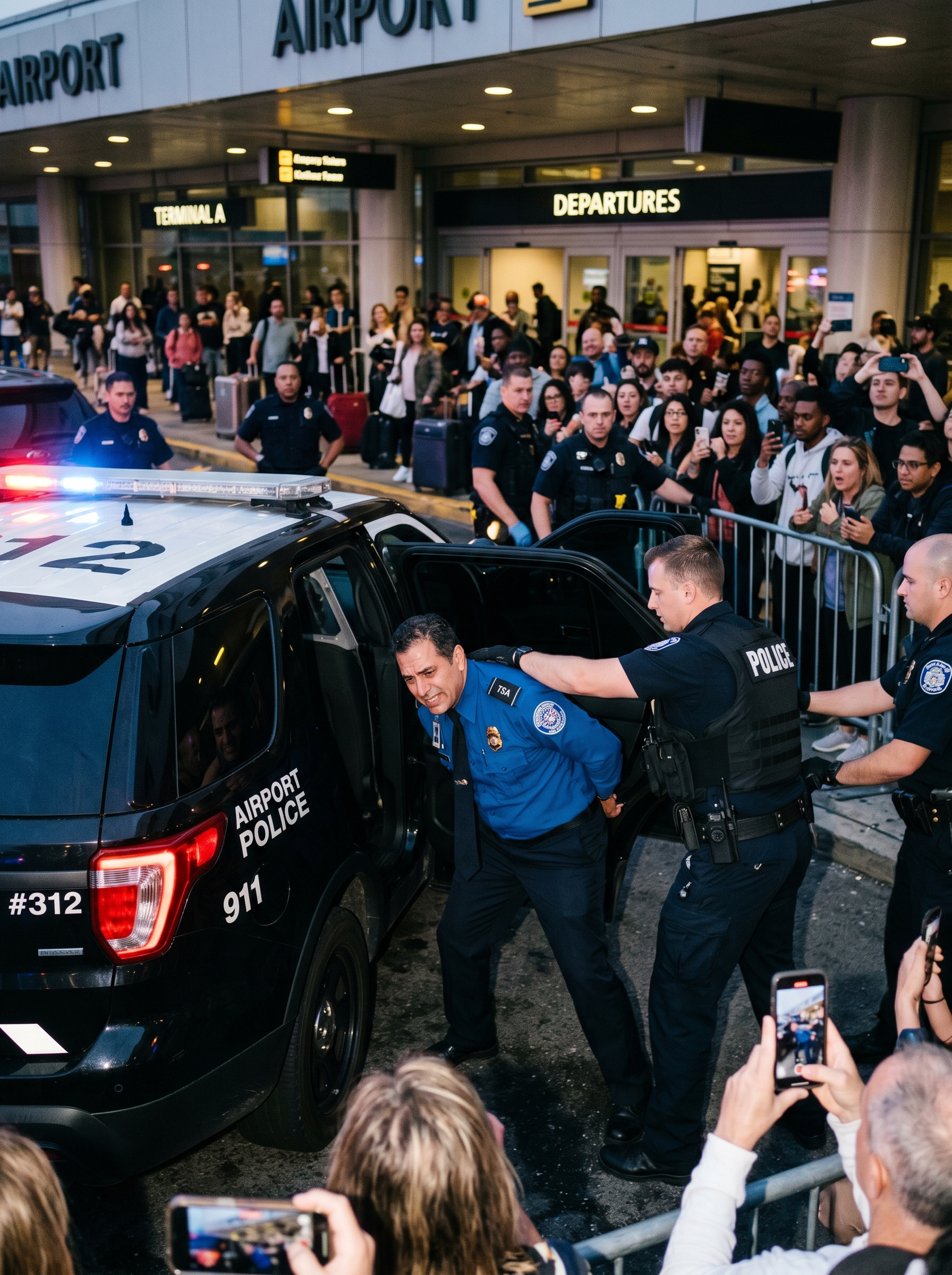
Two officers stepped out with Miller in handcuffs.
His TSA uniform was gone. He wore a plain white undershirt instead. Stripped of authority, he looked smaller. Hollow. Exposed.
The veterans let out a low, collective murmur of disgust.
The police led him forward. As he passed us, his eyes met mine. There was no arrogance left—only the realization of what he had done and what it had cost him.
Then he looked at Sarah.
Fear flickered across his face.
“Officer Miller,” I said sharply, my voice cutting through the noise.
The officers stopped.
Miller froze.
I leaned down until my face was inches from his.
“You told my wife to assume the position,” I said, my voice a low, controlled hiss. “Now you’re going to find out what that actually means inside a federal penitentiary. You didn’t just shove a woman today. You shoved every person who ever wore this country’s flag on their shoulder. And now the flag is pushing back.”
Miller tried to speak—some mix of apology and panic—but the officers didn’t let him finish. They forced him into the back of the cruiser and slammed the door shut.
I turned toward the cameras.
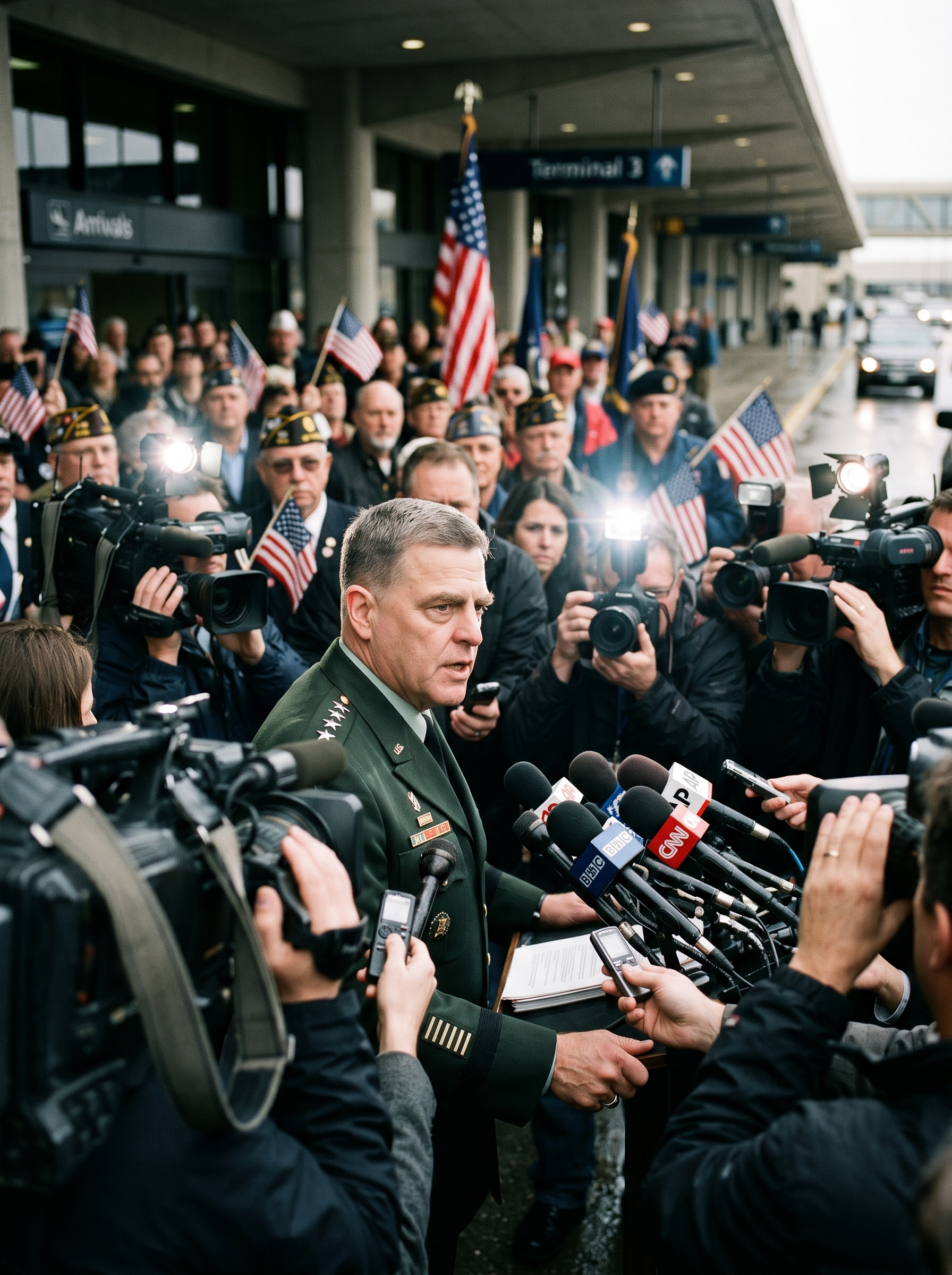
Reporters rushed forward, shoving microphones toward me. “General Vance! General! A statement!”
I inhaled slowly. I felt Sarah’s hand tighten around mine.
“My name is Thomas Vance,” I said, addressing the lead camera directly. “I have served this nation for thirty-four years. I have led soldiers into combat, and I have honored them when they didn’t return.”
I looked out across the gathered veterans, then back into the lens.
“Today, at Checkpoint 4, my wife—Major Sarah Vance—was assaulted by a government employee. Not because she posed a threat. Not because she broke the law. But because she was disabled. Because she was a veteran who refused to be intimidated.”
I paused, letting the silence settle.
“This is bigger than Sarah. This is about a system that has lost sight of who it serves. It’s about a culture that values procedure over human dignity. Today, that begins to change. I have already spoken with the Secretary of Defense. I have already spoken with the Director of the TSA.”
I gestured toward the terminal.
“From this moment forward, every airport in this country will implement a clear, respectful process for wounded service members. There will be no more humiliation. No more force. Because if it happens again—if even one more veteran is treated the way my wife was today—you won’t just be dealing with one General. You’ll be dealing with all of us.”
The reaction broke instantly. Veterans cheered, bikers revved their engines, flags snapped in the wind rolling through Chicago.
We didn’t wait for what came next.
An ambulance arrived to take Sarah to a specialist. As I climbed in beside her, I looked back at the terminal one final time.
The “Vance Reform” would be signed into law six months later. Miller would serve three years for felony assault. The TSA would undergo its most extensive civilian oversight reform in history.
But none of that mattered compared to the moment we finally made it home.
Sarah sat on our porch, her upgraded prosthetic resting against the railing. The sun dipped over the Illinois fields, painting the sky in gold and violet.
She looked at me and laughed—genuinely, deeply.
“You know, Tom,” she said, resting her head on my shoulder. “I think that guard was right about one thing.”
“What’s that?” I asked.
“He said I should assume the position.”
She smiled, gazing toward the horizon.
“I just don’t think he realized my position was already at the front of the line.”
I pulled her closer. We had won the fight at Checkpoint 4. But more importantly, we had reminded the world that a hero’s dignity cannot be broken—no matter how hard someone tries.
