

The alarm didn’t scare me.
That’s what people never seem to understand. When you’ve spent over twenty years in law enforcement—real investigative work, not assumptions built on convenience—you stop reacting to noise. You stop reacting to chaos entirely. What you start doing instead is reading patterns. Timing. Behavior. Deviations from procedure that most people never even notice.

So when that sharp electronic alarm cut through the grocery store, echoing off the aisles of canned goods and polished tile, I didn’t flinch.
I observed.
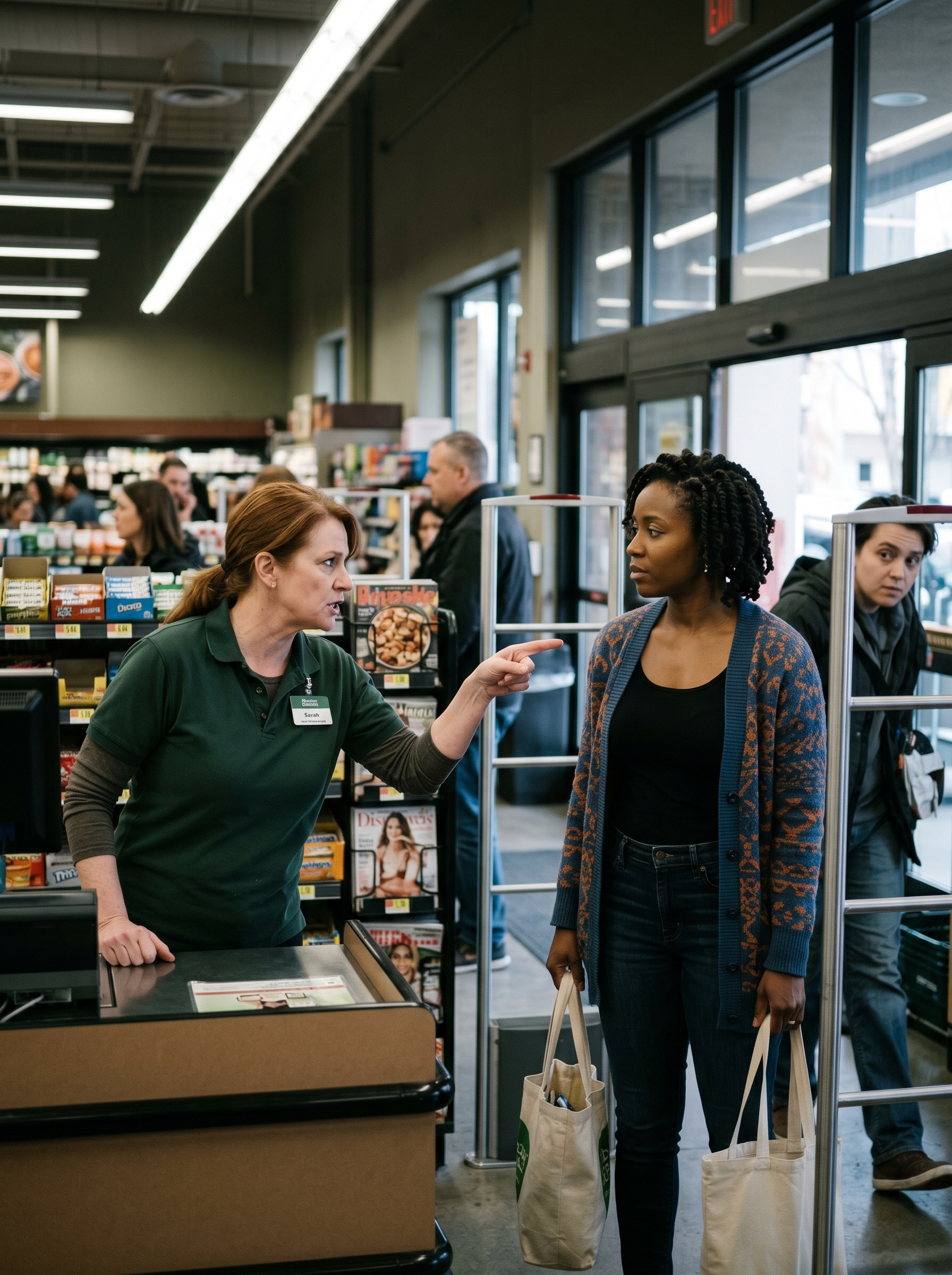
The cashier’s reaction came first. Too fast. His eyes widened before his hand even moved, before he looked at the register, before anything confirmed what he was about to accuse. His finger shot forward with certainty that had no foundation.
“That’s her!”
No hesitation. No verification. Just certainty manufactured in real time.
That alone told me everything I needed to know.
Then came the officers.
They didn’t approach like professionals assessing a situation. They advanced like they were following a script already written. No pause. No scanning the environment. No attempt to verify the accusation that had just been thrown into the air like bait.
That was the second mistake.
By the time they reached me, by the time their hands made contact, I already knew this wasn’t about a shoplifting alarm.
This was routine for them.
Just not the kind they thought it was.
“Ma’am, stop right there!”
I stopped.
Not because I was forced to.
Because I wanted to see how far the momentum of their assumption would carry them.
The cuffs came next. Cold metal snapped around my wrists with practiced efficiency. Tight enough to assert dominance. Controlled enough to avoid immediate visible injury. There was experience in the motion—repetition. But there was also carelessness. A belief that nothing here would ever be questioned.
Experienced.
But sloppy.
I adjusted my breathing as they guided me through the store entrance and into the harsh daylight outside. The sidewalk was already filling with onlookers. Phones raised. Eyes locked. People instinctively forming a circle around a moment they didn’t yet understand.
Good.
Witnesses are always useful.
“Shoplifting,” one of the officers announced loudly, projecting his voice as if volume could replace truth.
That was intentional. He wasn’t describing a fact. He was establishing a narrative.
I almost smiled.
Almost.
They tossed my groceries onto the ground as if scattering evidence made the accusation more convincing. Bread. Milk. Soup. Ordinary items pulled from an ordinary cart. The performance required normalcy—it made the accusation feel more believable.
Then they opened the small pouch they had pulled from my belongings.
I watched closely.
That was the moment everything changed in their eyes. A subtle shift. A flicker of satisfaction.
Not surprise.
Confirmation.
That was the third mistake.
“Well, well,” one of them said. “Possession too.”
I remained silent.
Most people misunderstand silence. They assume it means fear, confusion, or submission.
Silence is none of those things.
Silence is control. It is information management. It is allowing others to reveal more than they should.
While they spoke, I didn’t argue. I didn’t resist. I documented.
Badge number: 4729.
Second officer: no visible identification. Against protocol.
Body cameras?
Off.
That was the fourth mistake.
My phone was already recording inside my pocket. Audio clean. Voices distinct. Every procedural failure being captured in real time. Not selectively. Not interpreted. Just raw data.
Every word they spoke would later become evidence.
Every skipped step would become leverage.
“Name?” the officer demanded.
I lifted my gaze to him.
“Beverly Shaw.”
He wrote it down like it was irrelevant. Like I was irrelevant.
That, more than anything else, told me how confident they were.
And confidence built on assumption is the most fragile thing in any investigation.
They led me toward the patrol vehicle. Firm grips. Controlled movements. The kind of handling meant to communicate authority, not necessity. I could feel it in their posture—the certainty that this situation was already resolved in their favor.
They had done this before.
Too many times.
Same script. Same roles. Same expected ending.
But they hadn’t accounted for one thing.
This time, the script was being recorded from the inside.
The car door opened with a dull metallic groan. One of the officers leaned in slightly, close enough that I could smell the mix of coffee and breath on his words.
“You picked the wrong store, lady.”
I turned my head and looked at him.
Not as a suspect.
Not as someone beneath him.
But as a liability.
And that was when I allowed the smallest expression to form.
A controlled smile.
Just enough to register.
Because at that point, I already had everything I needed.
The door shut behind me with finality.
Inside the patrol car, the outside world dulled into a muffled hum. The chaos of the sidewalk, the voices, the cameras—all of it faded. My wrists rested against the cold partition, but my mind was already moving through layers of analysis.
Timeline.
Sequence.
Procedural violations.

Unlawful detention. Improper search. Potential evidence contamination. Possible planting.
And underneath all of it, something more important.
A pattern.
Because this was not random. It never is.
I leaned my head back against the seat and closed my eyes—not in surrender, but in calculation. Faces replayed in sequence. The cashier’s immediate accusation. The officer without identification. The synchronized movements that weren’t spoken but clearly coordinated.
That kind of alignment doesn’t come from coincidence.
It comes from repetition. From habit. From systems that assume no one is watching closely enough to notice.
I opened my eyes slowly.
That assumption is what destroys cases.
The radio in the front seat crackled to life.
“…bringing one in. Suspected shoplifting and possession.”
Suspected.
Not confirmed.
Even their language betrayed them.
I shifted slightly, feeling the phone still secure in my pocket. Still recording. Still documenting every word, every tone, every procedural gap.
Time mattered now.
Not because I was in danger.
But because everything they were doing was being preserved exactly as it happened.
And that changed everything.
This was no longer about a grocery store incident. It was no longer about a single accusation or a single arrest. It was about pattern recognition across multiple events, multiple actors, and multiple failures of procedure.
It was about how many times this same sequence had played out without being questioned.
How many people had been labeled, detained, processed, and dismissed without anyone ever reconstructing the pattern behind it.
I exhaled slowly.
Then I spoke clearly, evenly, deliberately.
“Officer, for the record, I do not consent to any searches beyond what has already been conducted. I am requesting legal representation.”
The front seat went quiet.
A shift in posture followed. A glance in the rearview mirror. A subtle recalibration.
They felt it.
Not fear.
Disruption.
Because I was not reacting like they expected me to react. I was not fitting the script they had rehearsed.
And when a script stops working, doubt enters the system.
Doubt is where structure begins to collapse.
The engine started.
The car pulled forward into traffic.
And for the first time since the alarm had sounded, I allowed myself to fully relax—not because the situation was safe, but because the mechanism I needed was already in motion.
They thought they were transporting a suspect.
But what they didn’t realize was that they were preserving evidence.
And they were delivering it straight into my hands.
