


“Fix This engine and I’ll marry you, recruit.” General Patricia Hawkins’s voice boomed across Fort Bradley’s motorpool as she seized Private Jamal Thompson by the uniform collar. She pushed the 20-year-old down to his knees beside the damaged M1 Abrams tank engine, his face just inches from the greasy steel compartment.
“What’s wrong, boy? Never seen real machinery before? Or are you too busy trying to figure out which end of a wrench to hold?” 200 soldiers stood watching in stunned silence. Hawkins snatched the cleaning rag from Thompson’s shaking hands and snapped it across his face. His dark skin flared with humiliation as uneasy laughter spread through the crowd.
“I’m serious,” she shouted, stepping back with her arms folded. “fix this million-doll piece of equipment and I’ll kiss you at the altar. Hell, you can even pick the dress.” Her aide captured every degrading second on video. Have you ever seen someone’s future shift because a superior chose the wrong person to humiliate? The shame rolled through Fort Bradley like wildfire.
Within an hour, whispers trailed Thompson through every corridor, every mess hall, every barracks. The footage of General Hawkins forcing him to his knees had already spread across the base’s social media, shared with cruel jokes and mocking remarks. Fort Bradley stretched across 50,000 acres of Georgia Pine Forest, housing the Army’s most advanced armored vehicle training center.
The motorpool alone contained over 200 tanks, Bradley fighting vehicles, and support equipment worth more than $2 billion. Vast concrete bays ran for half a mile, each capable of holding multiple main battle tanks. The air was heavy with diesel fumes, hydraulic fluid, and the metallic scent of strained steel.
Here among mechanical giants and their life sustaining systems, America’s armored soldiers trained their craft. Sergeants with grease-stained hands taught privates the difference between a seized bearing and a blown gasket. Officers studied tactical manuals while enlisted soldiers turned theory into reality.
Thompson moved through this mechanical cathedral like a shadow, noticed only when someone needed a scapegoat. For three months, he had cleaned tools, sorted parts, swept floors, and emptied trash while real soldiers handled real assignments. His olive green uniform carried no ribbons, no badges of achievement, no marks of distinction—only his name tape and the single chevron of the lowest rank.
The cause of today’s humiliation sat in Bay 7 like a resting giant. M1 A2 Abrams tank number 47 had suffered catastrophic engine failure during live fire exercises 10 days before. Its AGT1,500 turbine engine, capable of pushing 68 tons of steel at 45 mph across any terrain, now sat silent and cold as a tomb.
The breakdown had come at the worst possible time. Three Army mechanics had already lost sleep and sanity trying to diagnose it. Sergeant Martinez spent 6 days replacing electronic parts, convinced the issue was in the computer systems. Staff Sergeant Williams rebuilt the entire fuel injection system, sure that contaminated fuel was the cause.
Even Master Sergeant Rodriguez, with 22 years of experience and hands that could diagnose by touch alone, admitted defeat after four sleepless nights. Two civilian contractors from General Dynamics arrived yesterday, flown in from Detroit at great expense. They rolled in laptop computers worth more than Thompson’s yearly salary and ran diagnostics that returned only error codes and frustrated sighs.
Their reputation came before them. These were the engineers who designed the engine, who understood every bolt and circuit better than anyone. Their failure sent shock through the chain of command. The stakes could not be higher. NATO joint training exercises would begin in 72 hours. Allied commanders from 12 nations were already arriving at nearby Fort Benning, preparing to witness American military strength.
Tank 47 was set to lead the demonstration, showcasing new battlefield systems to potential buyers worth hundreds of millions in future contracts. Each day of delay drained credibility and money. Pentagon officials called hourly, demanding updates and backup plans. Defense contractors whispered about substitutes and alternate demonstrations.
Allied partners asked sharp questions about American reliability and maintenance standards. General Hawkins felt the pressure tightening in her chest like a vise. 26 years of military service had led her here. The first female general to command Fort Bradley’s armored division, she had fought for every star, endured doubts about her ability, and proved herself in Iraq and Afghanistan when others questioned women in combat roles. Failure here would end her career and unravel everything she had built. The whispers would begin immediately. Maybe they were right about women in leadership. Perhaps she was not ready for this responsibility. should have given the command to someone more experienced. Her answer was simple and familiar. Find someone to blame. “These diversity hires are killing us,” she told Colonel Morrison during their morning briefing in the climate controlled conference room overlooking the motorpool.
“We’re so busy checking boxes and meeting quotas that we forget to check actual competence. When did the army become a social experiment instead of a fighting force?” Thompson heard the remark as he emptied trash near the conference room door. It wasn’t the first time. Yesterday, she questioned urban recruitment standards during a staff meeting with visiting Pentagon officials.
Last week, she claimed certain demographics lacked the mechanical aptitude required for modern warfare during a video call with defense contractors. The pattern was obvious to anyone paying attention. Hawkins had systematically blocked three minority promotions since taking command 18 months earlier. Staff Sergeant Jackson, a skilled communications specialist with perfect evaluations and commendations from two combat deployments, was denied warrant officer advancement for unclear leadership concerns.
Specialist Rodriguez saw his application for signal corps training disappear from the system, only to be told he had missed the deadline when he followed up. Private Williams was assigned extra duties that conveniently kept him from leadership development courses. Each time, Hawkins cited vague readiness concerns or cultural fit issues that sounded reasonable on paper but felt empty in practice.
The Equal Opportunity Office received complaints, but nothing held. She was too careful, too politically aware to leave clear evidence of discrimination. Her wording stayed clinical, her reasoning plausible, her records detailed. Thompson understood the pattern well. He had seen it in civilian life, watched his uncle Marcus face similar barriers in the trucking industry, where contracts went to “reliable” companies, and reliability somehow always matched the owner’s background.
The difference was that Marcus owned his business and could fight back. Here, Thompson cleaned other people’s equipment and stayed silent, but he watched and listened and learned. While Martinez struggled with electrical diagnostics, Thompson noticed the fuel pressure readings on the screens. While Williams replaced injection parts, Thompson studied hydraulic flow patterns and fluid movement.
While Rodriguez searched databases for answers, Thompson recalled lessons from his uncle’s shop about turbine contamination and subtle signs computers missed. The issue wasn’t electronic failure despite the diagnostics. It wasn’t mechanical collapse despite the symptoms.
It was contamination in the fuel system. Likely microscopic sand intrusion from recent desert training. The particles were smaller than human hair but destructive to precision machinery, scraping the finely machined fuel injector surfaces like sand on glass.
Standard diagnostics missed it because computers measured electrical signals and pressures, not microscopic wear that actually caused failure. Human senses were needed. Ears that could separate normal engine sound from subtle damaged vibrations.
Hands that could feel the difference between smooth running and looming breakdown. Thompson knew because he had seen the same failure in civilian diesel engines during his uncle’s shop years. Heavy duty truck repairs involved turbo diesels under similar stress, and sand contamination was common in construction sites, quarries, and unpaved rural roads.
The symptoms were always consistent: intermittent power loss, abnormal vibration, and diagnostic codes that suggested electronic failure when the true problem was entirely mechanical. But who would take seriously a private who spent his days emptying trash cans and sweeping floors?
The answer came that afternoon when Hawkins arrived for her weekly motorpool inspection, accompanied by her aide and visiting Pentagon officials flown in to evaluate the situation firsthand.
The pressure showed in her stiff posture and clipped tone. Three calls from Washington had made one thing clear: fix the tank or end her career. Hawkins needed someone to blame, and Thompson was an easy choice. She assembled the entire motorpool company in Bay 7, under the pretense of a motivational address on discipline and readiness.
200 soldiers stood in precise formation between the towering vehicles, boots polished despite the industrial grime, uniforms pressed and aligned to regulation standards.
You won’t believe what Thompson decides to do when Hawkins calls him out in front of everyone. The foundation of Thompson’s quiet confidence traced back to a grease-stained garage in East Atlanta, where diesel fumes hung in humid air and the sound of air wrenches echoed through corrugated metal walls. Williams Auto and Truck Repair
occupied an entire city block. Its reputation rested on a single rule. If it had an engine, Marcus Williams could repair it.
Marcus wasn’t just Thompson’s uncle. He was his mentor, his hero, and the closest thing he had ever known to a father. A man who started with nothing and built something real, Marcus saved enough to buy a single hydraulic lift and a set of secondhand tools.
30 years later, his shop employed 12 mechanics and serviced everything from buses to long haul trucks.
“Son, an engine doesn’t care about your skin color,” Marcus told 8-year-old Jamal during his first visit. “It only tells the truth. You listen, you respect it, and it’ll run forever.
But if you lie to it, ignore it, or do sloppy work, it’ll fail every time.”
Those words became Thompson’s foundation. Listen first. Work with your hands. Let results speak.
Every summer from age 10, he learned the language of engines. Marcus taught him to recognize sound—the whistle of a failing turbo, the knock of worn bearings, the hiss of a cracked gasket.
By 12, Thompson could rebuild fuel systems blindfolded. By 14, he was diagnosing control modules that challenged seasoned mechanics.
The lessons extended beyond mechanics. Marcus demanded precision in everything. Measurements down to thousandths. Torque values followed exactly. Clean work like a surgical field.
“Sloppy work kills people,” he would say, tightening bolts Thompson had left loose. “A bad engine means someone doesn’t make it home.”
Thompson absorbed it completely. While others played, he studied manuals. While others wasted time, he learned systems. By 16, he earned his first ASSE certification.
By 18, he became a master technician—the youngest in Georgia.
The achievement meant everything to Marcus, who had spent his life fighting for respect.
“You’re going places I never could,” he said at the ceremony. “But never forget who taught you to listen.”
College followed—community college, all they could afford. Thompson studied mechanical engineering while working nights, textbooks stained with grease, assignments done between jobs.
Professors were stunned by his practical understanding. What others struggled to imagine, he had already repaired. His GPA reached 3.8.
Scholarships followed. University offers came next. But everything changed when his grandmother’s medical bills arrived.
Diabetes led to kidney failure, then dialysis, then crushing costs Marcus alone couldn’t handle.
Scholarship money went to treatment instead of tuition. His engineering path stopped abruptly.
That’s when the Army called.
They promised stability, benefits, education later. Thompson accepted it as temporary.
But instead of technical assignment, he got general duty at Fort Bradley.
His certifications were dismissed. His experience ignored. His requests denied for vague “readiness concerns.”
So he cleaned floors while others worked on engines he understood instinctively.
He watched mechanics struggle with problems he could solve instantly. He listened as preventable failures were debated for hours.
But Marcus had taught him patience.
Sometimes you have to prove yourself twice, his uncle once said.
Once to show what you can do. And again when they try to ignore it.
Thompson carried that through every day of silence and dismissal. Every insult, every oversight, every moment of invisibility.
He knew his time would come.
He just didn’t expect it to arrive with a general’s laughter and 200 witnesses waiting to see if he would break.
Marcus’ final lesson echoed again.
“When they doubt you, don’t argue. Show them work.”
The motorpool fell silent as Thompson chose his next move.
“Soldiers,” Hawkins began, voice cutting across the concrete like a command drill. “We face a crisis of competence. This tank represents American superiority. Its failure reflects all of us.”
Thompson stood in the back row, trying to remain unseen among the ranks.
The weight of humiliation pressed down, but something else rose beneath it.
A quiet anger, built over 3 months.
But maybe,” Hawkins continued, scanning the formation like a predator, “we’re asking the wrong question. Maybe the problem isn’t equipment.
Maybe it’s the people maintaining it.”
A ripple of unease moved through the soldiers. The pattern was familiar now. Someone would be blamed.
“I see soldiers who think service is entitlement. Who think showing up is enough. Who expect advancement without earning it.”
Her eyes locked onto Thompson.
“Who think diversity quotas matter more than competence?”
The words struck like impact rounds. Soldiers subtly shifted away. Even his squad leader avoided looking at him.
Pentagon officials stood nearby, phones and clipboards in hand, tension rising. The NATO demonstration was 48 hours away, and failure was unacceptable.
That’s when Hawkins escalated it.
Frustration turning into open confrontation, she stepped forward, voice rising over the motorpool.
“You know what?” she said, approaching the disabled tank like evidence in a courtroom. “I’m tired of excuses. I’m tired of failure. I’m tired of soldiers who can’t back up their paychecks with performance.
Hawkins stepped forward and slammed her hand against the tank’s armor plating, the metallic ring echoing through Bay 7 like a bell tolling judgment. “So here’s my offer to this entire company. Any soldier who thinks they have what it takes to fix this engine can step forward right now. Prove you deserve to wear the uniform.
Show me that American soldiers still have what it takes to solve problems instead of making them.”
Absolute silence answered her challenge. 200 soldiers stood frozen, barely daring to breathe.
“Come on.” Hawkins’s voice sharpened into a battlefield shout. “Where’s all that confidence? Where’s that military pride I keep hearing about in your performance evaluations? Or are you all just waiting for someone else to solve your problems while you collect your paychecks?”
Her gaze found Thompson again, and this time there was no escape from the spotlight.
“What about you, Private Thompson?” she called, her tone laced with mocking sweetness that made it worse. “You’ve been watching our mechanics work all week while you cleaned around them. Think you learned something useful? Ready to show us what you’re really made of?”
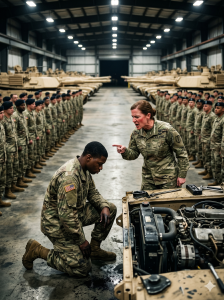
Every face in formation turned toward him at once, like flowers tracking the sun. 200 pairs of eyes waited to see if he would step forward or shrink away. The weight of their stare felt heavier than the tank itself.
“Well?” Hawkins pressed, taking another step forward. “Cat got your tongue again? Or are you going to stand there like a statue while real soldiers fix your mess?”
That’s when Master Sergeant Rodriguez pushed through the senior NCOs. His weathered face carried concern earned from 22 years of service and too many careers ruined by command politics.
“General,” he said carefully, voice steady with respect. “With all due respect, that engine has stumped our best mechanics for 10 days. It’s running classified specifications and adaptive fuel systems that require specialized training to—”
“Are you questioning my judgment, Master Sergeant?” Hawkins cut in sharply.
“No, ma’am. Just ensuring we understand the complexity—”
The interruption bought Thompson a breath. A moment to think. To remember Marcus, engines, and what it meant to prove yourself when no one believed you could.
Rodriguez met Thompson’s eyes and gave a small, deliberate nod. Not encouragement—permission.
Hawkins saw the hesitation breaking and tightened her grip on control.
“Fine,” she said coldly. “Let’s make this interesting. Real stakes.”
She raised her phone and activated a live stream. The red indicator light blinked on as soldiers around the bay began lifting their own devices.
“Fix this engine and I’ll marry you, recruit,” she declared, voice dripping with contempt. “That’s my promise to this entire base. Get it running by 1800 hours today and I’ll personally pin stars on your collar and kiss you at the altar.”
A few nervous laughs broke out—too loud, too sharp.
“But if you fail,” Hawkins continued, lowering her voice so it carried like a threat, “when you prove all your watching and learning meant nothing, you’ll spend the next month scrubbing every latrine on this base with a toothbrush. And everyone here will know exactly what happens when incompetence meets responsibility.”
The live stream count surged. Comments flooded in. The spectacle had gone beyond the motorpool now.
Pentagon officials shifted uncomfortably, exchanging looks but saying nothing. Intervening would be worse than watching.
Thompson felt his pulse hammering in his throat. His mind ran through every possible exit—refuse, disappear, survive. Every safe instinct told him to stay silent.
Then Marcus’ voice cut through memory like it always did: Show them work.
Thompson stepped forward.
The motion rippled through the formation. Soldiers straightened. Phones lifted. Hawkins’s expression flickered—surprise first, then satisfaction as the trap closed.
“I’ll do it,” Thompson said.
Hawkins recovered instantly, her smile sharp again. “Outstanding, Private. Let’s see what three months of observation has taught you.”
She gestured toward the tank. “You have until 1800 hours. Four hours to do what trained specialists failed to do in ten days. Master Sergeant Rodriguez will supervise so you don’t break anything expensive.”
Rodriguez leaned in slightly as Thompson passed. “You sure about this, son? That engine’s worth more than most people see in a lifetime.”
Thompson nodded once. “I’ve been listening to it.”
He selected basic hand tools from the rack—not the diagnostics the contractors relied on, but simple instruments that didn’t interpret the machine for him.
First move: understanding, not guessing.
He placed his hands on the engine casing and closed his eyes.
“What is he doing?” someone whispered.
“Praying,” another answered under his breath.
Thompson ignored them. He felt the vibration through his palms—subtle, uneven, wrong in a way no computer had flagged correctly.
He pulled out a compression gauge.
“Martinez already tested compression,” Williams called out. “Readings were normal.”
“Static compression?” Thompson asked without looking up.
“Yes.”
“I’m checking dynamic compression under load simulation.”
He ran the test. The gauge needle shifted in uneven patterns.
“There,” Thompson said quietly. “0.03 psi variation between cylinders.”
Rodriguez frowned. “That’s within tolerance.”
“For new components. Not for a turbine that’s been through desert conditions.”
He looked up briefly. “Sand contamination. Microscopic. Scoring injector surfaces. It doesn’t show in standard diagnostics because the system is measuring signals, not wear.”
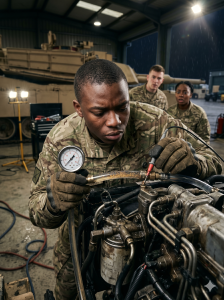
A murmur moved through the crowd.
Even the contractors leaned closer.
“How did you catch that?” Rodriguez asked.
“Because the engine has been telling you for ten days,” Thompson said. “Nobody was listening the right way.”
Second phase: mapping the system.
He moved to the fuel control interface, tracing lines, reading pressure data like a language.
“Everyone focused on electronic faults because that’s what the codes showed,” he continued. “But this system blends hydraulics and electronics. When the mechanical baseline is damaged, the electronics start compensating incorrectly.”
He pointed to the fluctuating pressure graph.
“See this? The system isn’t broken in one place. It’s fighting itself.”
General Hawkins stood motionless for a long moment, the repaired engine’s steady hum filling Bay 7 like an accusation that refused to fade.
The livestream counter kept climbing. The comments scrolling faster now—no longer confusion or curiosity, but recognition. Soldiers across bases were reacting in real time to what they had just witnessed.
“Impressive trick, Private,” Hawkins said at last, her voice carefully leveled, though the edge underneath was impossible to hide. “But anyone can get lucky once. One successful repair doesn’t prove competence. It proves you made a fortunate guess.”
Thompson remained at attention, hands still marked with grease, posture rigid.
“It wasn’t luck, General. It was diagnosis and field-proven repair procedure.”
“Prove it,” Hawkins snapped immediately, the pressure breaking through her control. “Anyone can repeat a solution after the fact. Explain how you actually knew—when trained professionals with decades of experience failed.”
A silence settled again, heavier this time.
Rodriguez stepped forward slightly, concern tightening his expression. “General, with respect—what Private Thompson accomplished is something our senior mechanics couldn’t resolve in ten days.”
“I wasn’t speaking to you, Sergeant,” Hawkins cut in sharply. “I want the explanation from him.”
Her eyes locked on Thompson. “Talk me through it. Exactly.”
Rodriguez raised his tablet, already recording. He understood what this moment had become—no longer a repair, but a turning point.
Thompson inhaled slowly, then nodded once.
“Ma’am, the issue wasn’t lack of skill. It was mismatch between failure mode and diagnostic assumptions.”
He stepped to the wall-mounted board, picked up chalk, and began drawing with steady precision.
“Standard protocols assume electrical or major mechanical faults because those are statistically common. But this failure wasn’t standard.”
His chalk lines formed a clean schematic of the fuel system—precise, structured, deliberate.
“This engine was contaminated during desert operations. Sand particles too small for filtration thresholds entered the system and caused microscopic scoring inside the injector assemblies.”
Hawkins watched, expression tightening as the diagram took shape.
“Where did you learn to draw schematics like that?” she asked.
“From studying systems during downtime, ma’am. And from prior civilian experience with similar diesel platforms.”
“Prior experience?” Hawkins repeated, sharper now. “Your file doesn’t show that.”
Rodriguez stepped in, holding up Thompson’s folder.
“General, I think you should see this.”
He opened it deliberately, revealing certifications and records that had been ignored.
“Master technician certification… mechanical engineering coursework… 3.8 GPA… specialized diesel systems training…”
The words landed one by one, each one widening the gap between assumption and reality.
Thompson continued drawing.
“The contamination didn’t trigger alerts because it didn’t affect electronics directly. It altered physical spray patterns, which then caused the control systems to compensate incorrectly.”
He traced the feedback loop on the board.
“Every mechanic here followed correct procedure—for the wrong category of failure.”
The explanation was simple. Clean. Devastating.
Hawkins’ face had gone still.
For the first time, she wasn’t managing a situation. She was inside one.
Thompson lowered the chalk.
“And this pattern won’t be isolated. We’ll see it across a large percentage of desert-deployed systems within months. I can draft a preventive maintenance update that will reduce failure rates significantly.”
No one spoke.
Even the engine seemed louder in the silence.
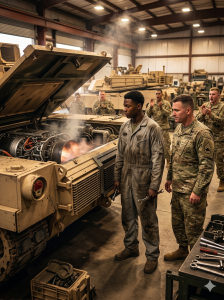
Pentagon officials exchanged quiet, uneasy looks—less about the repair now, and more about what it implied: institutional blind spots, missed expertise, and decisions made on incomplete understanding.
Hawkins opened her mouth, then stopped.
Anything she said now would be recorded, archived, and replayed—alongside evidence that contradicted every assumption she had acted on.
Thompson’s steady hand had drawn precise technical diagrams while General Hawkins stood rigid, realizing her career was collapsing in real time, broadcast live to the world.
Master Sergeant Rodriguez closed Thompson’s personnel file and looked straight into the live stream camera, his voice carrying the weight of 22 years of service.
“Based on demonstrated technical competence and problem-solving ability shown here today, I am immediately recommending Private Thompson for promotion to Specialist and transfer to Motor Transport MOS with advanced technical training.”
The motor pool broke into spontaneous applause. 57,000 viewers filled the live stream with supportive messages. Even the Pentagon officials nodded, recognizing clear performance when they saw it.
Within minutes, Thompson’s phone rang. Fort Bradley’s commanding general had been watching from his office.
“Son,” the general said, voice steady through the motorpool speakers, “I’ve seen your demonstration. Effective immediately, you are assigned as technical advisor to the NATO demonstration team. We need your preventive maintenance bulletin before Allied commanders see another failure.”
Thompson snapped to attention. “Yes, sir. I can have preliminary recommendations within 24 hours.”
“Good. Master Sergeant Rodriguez will coordinate your new assignment. And Thompson—the Army owes you an apology for not recognizing your capability sooner.”
Rodriguez stepped forward with a rare grin. “You’re also being fast-tracked for Warrant Officer training. The Army needs technicians who can think beyond standard procedures.”
The momentum didn’t stop there. Civilian contractors from General Dynamics approached with business cards and consulting offers. NATO representatives requested copies of his diagnostic methods for their own fleets.
Thompson stood overwhelmed, until Rodriguez placed a steady hand on his shoulder.
“You earned all of it, son. Your uncle would be proud.”
The live stream had reached 85,000 viewers. Across bases worldwide, soldiers shared stories of overlooked talent and missed potential.
General Hawkins remained silent, her face pale as she watched her authority unravel in real time. The investigation had already begun.
Within 48 hours, the video had surpassed 2.3 million views. Military outlets and national media ran the story. The hashtag spread nationwide as veterans shared similar experiences.
The Army responded immediately. An equal opportunity investigation was opened from Pentagon oversight, reviewing Hawkins’ personnel decisions in detail.
Patterns that once seemed isolated now formed a clear record. Promotion blocks, unexplained delays, and repeated “readiness concerns” were reclassified as systemic discrimination.
Staff Sergeant Jackson, Specialist Rodriguez, and Private Williams—all previously stalled—were immediately reprocessed for advancement.
Jackson entered warrant officer school within a week. Rodriguez was accepted into Signal Corps training with full recognition. Williams received leadership development placement and back pay.
For Hawkins, the consequences were irreversible.
A formal reprimand, signed at the two-star level, was entered into her permanent record. Promotion to full colonel was eliminated. Command of Fort Bradley ended within 30 days.
The reassignment arrived quietly: Pentagon administrative staff position, pending further review. In military terms, it was removal from command authority.
She would spend her remaining career in offices where decisions were recorded but no longer made by her.
The viral footage followed her everywhere. Colleagues avoided her in corridors. Within the institution, she had become irrelevant.
But the deeper impact was structural.
Fort Bradley implemented a new technical competency evaluation system within 60 days, allowing soldiers to demonstrate real mechanical skill for reclassification regardless of background.
Thompson helped design it.
The system spread across installations after commanders realized how much expertise had been overlooked.
Hundreds of soldiers were reassigned into roles aligned with their actual abilities. Maintenance failures dropped. Efficiency rose.
His contamination bulletin became standard across armored divisions. His repair method was formalized into technical manuals. Estimated savings reached $12 million in the first year.
Defense contractors offered Thompson civilian roles with salaries exceeding most officers.
He declined them all.
Instead, he committed to full service and Warrant Officer training.
His grandmother received full military dependent coverage. Marcus’ auto shop was awarded a military contract for technical training support, integrating civilian expertise into official instruction.
Bay 7, once the site of humiliation, became a quiet reference point. A small plaque marked the day a single demonstration changed how talent was recognized.
Hawkins’ name was removed from her office door. It now read: Administrative Services.
The change was subtle but symbolic. Power built on discrimination could vanish as quickly as it had been built.
Six months later, Warrant Officer Thompson stood in the same motorpool bay where General Hawkins had once forced him to his knees. Around him, M1A2 Abrams engines ran with steady precision, maintained by soldiers who now understood that preventing contamination was far simpler than repairing failure.
Thompson’s technical improvements had reduced desert-related engine failures by nearly 90% across the armored division. His diagnostic training program had already moved 43 soldiers into advanced technical roles. The motorpool that once burned through resources on repeated repairs now operated with consistent efficiency.
Hawkins’ former office remained vacant, her replacement still being selected through a process now emphasizing verified leadership ability over influence or appearance.
The live stream recording continued to circulate, still being studied in training environments and shared among soldiers who recognized its lessons. It had become a reference point for overlooked capability and misjudged potential.
Sometimes the person with the lowest rank holds the deepest understanding.
Thompson moved through Bay 7 with quiet purpose, checking readings, guiding newer technicians, and refining procedures that had become standard practice.
The system around him had changed—not because it was forced to, but because it finally recognized what it had ignored.
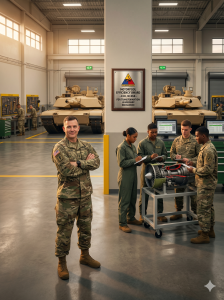
And for those willing to look closely, the lesson was simple: competence does not announce itself—it proves itself.
As for engagement, the story didn’t need extra framing or commentary. The outcome already spoke for itself.
