


Chapter 1
They believed they had me trapped the instant the accusation came out of his mouth.
Not one person in that crowded airport terminal paused to doubt him.
Because I didn’t look like someone who owned anything worth stealing.
The sharp metallic click rang through the air—loud, final, like a judgment already made.
Heads turned. Conversations broke off mid-sentence.
Every gaze fixed on me as three airport police officers moved in, forming a tight circle.
But the handcuffs weren’t on me. Not yet.
Suitcases rolled by, announcements echoed overhead, yet around us there was an odd, heavy silence.
The kind of silence where judgment fills every empty space.
At the center stood a man in a perfectly tailored suit, his fingers wrapped around the handles of my worn leather duffel bag as if even touching it offended him.
His lips twisted with certainty.
“He stole my luggage,” he said, loud enough for everyone to hear.
Next to him, the senior flight attendant—the same woman who had spent six hours acting like I didn’t belong in my own seat—stepped forward quickly.
Her smile was polite. Her eyes were not.
“I witnessed it,” she told the officers without hesitation.
A lie. Clean. Fast. Well-rehearsed.
The crowd shifted, whispers rising like a slow tide.
I could feel it—the judgment, the certainty.
To them, it all made sense.
A worn bag. A quiet man. A story that fit too easily.
My fingers twitched slightly as I looked at the duffel.
My grandfather’s duffel.
Old leather, cracked at the edges, holding more history than anyone here could understand.
And now it was being held like proof against me.
They expected me to react.
To shout. To argue. To lose control.
That’s what they wanted.
Because anger would make their version believable.
Instead, I didn’t move.
Calm. Silent. Still.
The officers noticed.
The lead officer stepped forward, his voice firm but controlled.
“Sir, can you prove the bag is yours?”
A simple question.
But behind it was everything.
I didn’t rush to respond.
Didn’t explain. Didn’t defend myself.
I only looked at him.
Then I spoke, quietly.
“Read the luggage tag.”
The officer hesitated for a brief second, then turned back toward the bag.
The man in the suit tightened his grip immediately.
Just a little. Just enough.
That was the first break.
The officer noticed it.
“Sir, I’ll need to check that,” he said, reaching forward.
With visible reluctance, the man released his hold.
The officer turned the tag over in his hands.
For a moment, his expression stayed flat.
Then it shifted.
His brows drew together, a flicker of confusion crossing his face.
He looked at me. Then at the bag again.
Then—without saying anything—he moved toward the side pocket.
The sound of the zipper sliced through the silence.
The flight attendant shifted beside him, uneasy now.
“What are you doing?” she asked, her voice no longer steady.
The officer didn’t respond.
He opened the pocket.
And whatever was inside—
It changed everything.
His posture snapped straighter.
His entire presence altered in an instant.
The crowd leaned in closer.
The man in the suit lost his confidence, replaced by something tense and uncertain.
“What is it?” someone whispered.
The officer slowly reached inside…
And pulled out something that made his partner recoil in shock.
The air went still.
Every sound in the terminal seemed to vanish.
And for the first time since it began—
No one was looking at me like I was the one at fault anymore.
Chapter 2
The lead officer raised a federal credentials wallet in gloved hands.
The gold seal caught the terminal lighting, flashing across stunned faces like a warning.
He opened it, studied the identification inside, then looked at me with an entirely different kind of fear.
“Sir…” he said, his voice lowering. “Why didn’t you say anything?”
Because men like Derek Crawford and women like that flight attendant relied on one thing.
They relied on people noticing my skin, my clothing, my silence, and filling in the rest.
So I had learned long ago that truth lands harder when arrogance is allowed to reveal itself first.
Derek tried to laugh, but it came out thin and fractured.
“This is ridiculous,” he snapped. “Anyone can fake a badge.”
The officer didn’t even look at him.
He reached back into the side pocket and pulled out a leather document sleeve, worn along the edges, with my grandfather’s initials embossed on the flap.
That was the moment my chest tightened.
Not because I was afraid.
Because that sleeve hadn’t been opened in public since the day my grandfather passed.
I stepped forward, and this time the officers moved aside for me.
The crowd parted the way people do when authority shifts so abruptly it becomes physical.
“That belongs to my family,” I said.
The senior flight attendant folded her arms, though her face had begun to drain of color.
“You still haven’t explained why you had to make a scene on my flight,” she said, forcing superiority into her tone.
I turned to her, and for the first time, I let her truly see me.
“You made the scene,” I said quietly.
Her jaw tightened.
Six hours earlier, she had checked my boarding pass three times before letting me into first class.
She had “accidentally” skipped my drink order.
She had removed my grandfather’s bag from the overhead compartment after Derek said it looked “suspicious.”
And every time I asked a calm question, she answered with that clipped, venomous smile.
As if politeness could wash cruelty clean.
The officer opened the sleeve and removed a stack of papers tied with an old black ribbon.
At the top was a letter.
The signature at the bottom made him sharply inhale.
“Call your supervisor,” he told one of the other officers.
“Now.”
Derek glanced toward the exit.
It was small. Almost unnoticed.
But I saw it.
So did the officer.
“Sir, don’t move.”
Terminal cameras were already aimed from every angle, and half the crowd had their phones raised.
Derek’s confidence had always been built on public humiliation.
Now he was trapped inside it.
Chapter 3
Within minutes, airport security supervisors, airline management, and a fourth officer arrived.
The terminal no longer felt like an ordinary delay.
It felt like a courtroom with polished floors and boarding announcements.
One of the supervisors approached me carefully.
“Mr. Vale,” she said, reading the badge. “We sincerely apologize.”
Derek blinked.
The flight attendant’s expression went completely blank.
They had expected me to be poor.
At most, unremarkable.
They had not expected my name to land like that.
My grandfather, Elijah Vale, had spent forty years as one of the country’s most respected investigators.
But that wasn’t what mattered most.
What mattered was what he became after retirement.
He created a private oversight foundation that quietly investigated abuse of authority in transportation, law enforcement, and public access systems.
Corruption in airports.
Profiling on airlines.
Security contracts designed to punish the vulnerable while protecting the powerful.
After he died, I inherited more than his bag.
I inherited the final case he never got to close.
And inside that duffel—beneath the badge wallet, beneath the document sleeve—was evidence he trusted only me to carry.
The lead officer pulled out a small recorder sealed in an evidence pouch.
Then an envelope.
Then a USB drive wrapped in my grandfather’s handwriting: FOR OPENING ONLY IF THEY FORCE THE LIE TOO FAR.
My blood went cold.
Because I had never seen that note before.
Derek saw it too.
And for the first time, he stopped pretending to be offended.
He looked terrified.
The airline station manager stepped beside the flight attendant.
“What exactly is this?” he asked.
I took the envelope from the officer and opened it carefully.
Inside was a letter written by my grandfather two weeks before he died.
His handwriting was weaker than I remembered, but still unmistakably his.
If you are reading this in public, it means the same people I spent years tracking have become bold enough to act in daylight. Let them. Their confidence is evidence.
My mouth went dry.
I read the next line silently first.
Then again.
Then I looked up at Derek Crawford.
He was not just any businessman.
He was the regional director of a private security contractor serving three major airports—including this one.
The same contractor my grandfather had been investigating for planting evidence, falsifying theft reports, and working with airline staff to remove passengers labeled “undesirable.”
The senior flight attendant whispered, “No…”
But it was already too late.
My grandfather had named them.
And Derek Crawford was one of them.
Chapter 4
The station manager insisted everyone move to a private security office.
I refused.
“No,” I said, loud enough for the crowd to hear. “We stay right here.”
The silence that followed felt electric.
They had tried to destroy me publicly.
They were not taking the truth behind closed doors.
The lead officer nodded once.
He understood.
He requested immediate access to the recorder, and I allowed it.
When he pressed play, my grandfather’s voice filled the terminal.
Thin. Aged. Steady.
“My name is Elijah Vale. If this recording is being played, then an innocent traveler has likely been targeted using one of the intimidation scripts documented in case file 47-C.”
A ripple moved through the crowd.
The flight attendant covered her mouth.
Derek went pale.
The recording continued.
My grandfather described the method in detail: isolate the passenger, seize the bag, fabricate witness confirmation, escalate with law enforcement, and rely on appearance-based assumptions to secure compliance before ownership could be verified.
The officer slowly turned toward Derek.
Then the flight attendant.
Then back to the recorder.
My grandfather even listed the language typically used.
“Suspicious.”
“Doesn’t belong.”
“Looks wrong.”
The exact words they had used on me.
Phones rose higher around the terminal.
The airline manager’s face glistened with sweat.
The senior flight attendant suddenly broke.
“It wasn’t supposed to go like this,” she said.
Derek snapped his head toward her.
“Shut up.”
But panic makes loyalty collapse faster than threats.
“He told me it was routine,” she blurted. “He said those reports protected premium passengers and kept complaints down. He said nobody ever checked.”
The crowd erupted into whispers.
The officer holding the recorder stared at her in shock.
“Nobody ever checked?” he repeated.
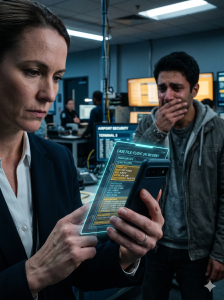
She began to cry.
“I just followed what we were trained to flag.”
Those words landed heavier than the accusation itself.
Trained to flag.
Not behavior.
Not evidence.
People.
And people who looked like me were at the top of that invisible list.
The station manager tried to intervene, but a new voice cut through the air.
“Don’t say another word.”
A woman in a dark coat stepped from the crowd, holding up a badge.
Not airport police.
Federal prosecutor.
My heart stopped briefly.
Then I recognized her.
Nina Torres.
My grandfather’s last legal partner.
I hadn’t seen her in over a year.
Chapter 5
Nina walked straight toward me, her expression firm, though her eyes softened for just a brief instant.
“Your grandfather thought this might happen,” she said.
I looked at her. “You knew?”
“I knew there was a failsafe,” she replied. “I didn’t know when it would trigger.”
She turned to the officers and identified herself.
Then she faced Derek, naming his full identity, title, and contractor number without glancing at a single document.
That shook him more than the credentials wallet ever had.
The real trap, I realized, had never been only inside the duffel.
It had been layered.
The bag was just the first proof.
The real collapse was elsewhere.
Nina immediately requested seizure of terminal footage, airline incident logs, and contractor communications.
When Derek objected, she gave a calm, unsettling smile.
“Mr. Crawford, the reason you’re panicking is because you think this started today.”
He didn’t respond.
“It didn’t.”
She opened her phone and displayed a folder of records.
Dates. Internal memos. Passenger complaints. Photographs.
Then something I never expected.
A passenger list from my mother’s final flight eight years earlier.
The air left my lungs.
My mother had died after being removed from a connection flight due to an alleged “security concern.”
They called it a clerical error.
They said the delay that kept her from boarding the next flight was unfortunate, but unrelated to the medical emergency that took her life hours later in another terminal.
My grandfather never accepted that explanation.
Neither had I.
But grief without proof is just pain dressed as doubt.
Nina watched me carefully.
“Elijah found the pattern after your mother died,” she said. “That case was the beginning.”
My legs nearly gave out.
So this wasn’t only corruption.
Not only profiling.
It was a system built on the same lie that took my mother from me.
Derek’s voice broke. “I didn’t know anything about that woman.”
Nina stepped closer.
“You approved the policy category that targeted her.”
The terminal felt like it tilted.
The flight attendant began sobbing uncontrollably.
The first officer reached for his cuffs.
But Derek made one last desperate move.
He pointed at me. “He staged this! He knew we’d open the bag!”
Then Nina delivered the final strike.
“No,” she said. “He didn’t.”
She turned to me, her expression shifting slightly.
“Because technically, Mr. Vale…” she said, pausing just long enough for the entire crowd to lean in, “that wasn’t even your grandfather’s bag.”
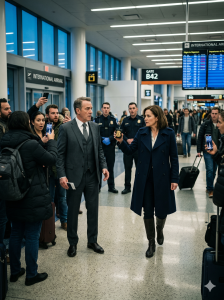
Chapter 6
For a moment, I forgot how to breathe.
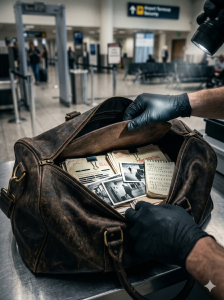
I looked at the duffel.
At the cracked leather.
At the initials I had known my entire life.
“Nina… what are you talking about?”
She lifted the bag carefully and turned it outward for everyone to see.
Then she pointed beneath the handle, where worn leather concealed something nearly invisible.
A second marking.
Faded. Pressed deep into the hide.
Not E.V.
U.S.M.
United States Marshal.
My grandfather had never been the original owner.
The bag had belonged to my father.
The father I had been told died before I was born.
The father my mother refused to speak about.
The father my grandfather once described as “the bravest man I ever knew.”
Nina lowered her voice.
“Your father was an undercover federal marshal investigating trafficking routes hidden through transportation contracts. Elijah took over after your father was killed.”
Killed.
Not lost. Not gone.
Killed.
The word split something inside me that had never fully healed.
Derek stumbled back.
Because now he understood what I did.
This wasn’t just corruption hiding in airports.
It was a shield for something far darker moving through the system under false reports and manufactured removals.
My father had gotten too close.
My mother had drifted into its shadow years later.
And my grandfather had spent the rest of his life turning himself into a quiet trap, waiting for the system to expose itself again.
Waiting for them to choose the wrong target.
Me.
Nina opened a hidden seam in the bag with a small blade from her keychain.
A hush fell over the terminal.
Inside was a second compartment none of us had known existed.
Photographs. Coded manifests. A sealed birth document.
She handed it to me.
My hands shook as I unfolded it.
And when I saw it, the world stopped.
My name wasn’t only Adrian Vale.
It was Adrian Elias Mercer Vale.
Mercer.
My father’s name.
And beneath it, in faded official ink, was his full identity:
U.S. Marshal Elias Mercer—deceased in the line of duty.
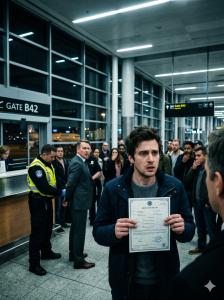
The officer cuffed Derek.
Another led the flight attendant away.
The crowd, once hungry for spectacle, now stood silent under the weight of something far heavier than scandal.
Truth.
Not the kind that embarrasses.
The kind that destroys systems, histories, and the lies people build entire lives around.
Nina placed a hand on my shoulder.
“Your grandfather wanted you to know only when the evidence could no longer be buried.”
I looked at the duffel.
At the hidden compartment.
At everything I had just lost and gained in the same breath.
Then I watched Derek Crawford being taken through the same terminal where he had tried to destroy me.
He had tried to frame me for stealing my own bag.
What he actually did was force open the last secret my family died protecting.
And as the handcuffs disappeared beneath the cold airport lights, I understood the truth at last:
They hadn’t humiliated a stranger in public.
They had exposed the son of the man they killed.
