


Chapter 1: The Dirt
The soil struck the sidewalk before her insult arrived.
A dark spray of earth scattered across the clean white pavement of Oakwood Estates, staining it like truth pressed against a lie.
Susan Whitmore’s designer heel hovered over the torn bag.
Her mouth curled.
Her eyes burned with the kind of disgust people refine over years until it resembles confidence.
“What are you doing here, boy?”
I remained kneeling beside the small oak sapling.
My hands were covered in dirt.
My jeans were worn and faded.
My shovel rested against my shoulder like an ordinary tool in an ordinary yard.
But nothing about that morning was ordinary.
Not the street.
Not the tree.
Not the woman standing above me.
And certainly not the folded document inside my jacket pocket.
I lifted my gaze slowly.
The sun hung high above rows of flawless houses.
Perfect lawns.
Perfect fences.
Perfect silence.
That was Oakwood Estates.
A neighborhood designed to appear untouched by pain.
A place where wealth buried everything ugly behind white columns and fresh paint.
“I’m planting a tree,” I said.
Susan laughed.
Not because it was amusing.
Because she wanted me to feel small.
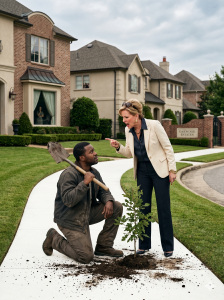
“You’re planting nothing here,” she snapped. “This is private property.”
“It is.”
Her smile sharpened.
“Then leave.”
I brushed soil from my palm.
“I have every right to be here.”
That sentence shifted something in her face.
Her anger deepened.
Her pride was challenged.
And people like Susan didn’t let that go.
“You people always say that,” she said, stepping closer. “You always think rules don’t apply to you.”
A curtain moved in the nearest window.
Then another.
Neighbors were watching.
Of course they were.
Susan noticed too.
She raised her voice just enough for them.
“I pay five thousand dollars a month in HOA fees to keep this neighborhood safe,” she said. “Not to watch some stranger dig holes in front of my property.”
“It isn’t your property.”
Her eyes flashed.
“What did you say?”
I stood then.
Slowly.
Not threatening.
Not afraid.
Just enough for her to realize I was taller than she expected.
“I said,” I repeated, “it isn’t your property.”
For half a second, doubt crossed her face.
Then pride took it back.
She pulled out her phone.
“Fine,” she said. “Let’s see what the police say.”
Chapter 2: The Call
She dialed 911 like she was placing an order.
Quick.
Casual.
Certain someone would arrive to remove the inconvenience.
“Yes, this is Susan Whitmore,” she said, her tone shifting immediately.
Softer.
Fragile.
Acting out fear.
“I’m the HOA president of Oakwood Estates. There is a man trespassing here. He’s aggressive. He has a shovel.”
I glanced down at the shovel.
Then back at her.
She smiled while she lied.
That was the moment something in me went cold.
Not because of the insult.
Not because of the dirt.
But because of how easily she reshaped the story.
How quickly calm became danger.
“He’s refusing to leave,” she continued. “Please send Chief Reynolds. He knows me.”
That name tightened something in my chest.
Chief Marcus Reynolds.
A man I had known for nineteen years.
A man who once sat beside me in a hospital hallway when my mother was dying.
A man who knew exactly why I was planting that oak tree.
Susan ended the call and lowered the phone.
“There,” she said. “Now we wait.”
I didn’t respond.
She paced in front of me.
Her handbag swung from her wrist.
Her bracelets clicked like small chains.
“You should have left when I told you to,” she said.
I looked at the sapling.
Its leaves trembled in the wind.
“My mother used to say the same thing about fear,” I said.
Susan blinked.
“What?”
“She said fear gets louder when it knows you’re not listening.”
She stared at me.
Then scoffed.
“You’re insane.”
Maybe I was.
Because standing there in that neighborhood, dirt on my hands and grief lodged in my throat, I could still hear my mother’s voice.
Not weak.
Not sick.
Not gone.
Alive.
Laughing.
Telling me not to let rich people make me forget who built their houses.
Chapter 3: The Estate
Twenty-five years earlier, my mother cleaned homes in Oakwood Estates.
Back then, the gates were new.
The trees were young.
The people inside only smiled when someone important was watching.
I was eleven when she first brought me there.
She told me to keep my shirt tucked in.
To speak quietly.
To never touch anything unless asked.
But she told me something else too.
“Look carefully, Daniel,” she said. “Never confuse expensive with powerful.”
I didn’t understand then.
I understood later.
When homeowners spoke to her like she was furniture.
When kids my age called her “maid” instead of Mrs. Cole.
When Susan Whitmore—young then, but already sharp-edged—accused my mother of stealing a pearl bracelet she had simply misplaced in her own drawer.
That accusation nearly destroyed us.
My mother lost three clients in a week.
We almost lost our apartment.
She cried once.
In the kitchen.
At midnight.
Then she washed her face and went back to work the next morning.
Years passed.
I studied.
Worked.
Built.
Failed.
Built again.
And eventually, Apex Real Estate Development became one of the largest private property firms in the state.
I bought warehouses.
Then apartment blocks.
Then commercial centers.
But I never forgot Oakwood Estates.
Especially after my mother died.
She left one request written in her worn Bible.
Simple.
Quiet.
Heavy.
“Plant me an oak where they said we did not belong.”
So I did.
Or tried to.
After buying the entire neighborhood through a holding company three days earlier.
Susan didn’t know that.
None of them did.
Not yet.
Chapter 4: The Sirens
The sirens cut through the gated silence.
Red and blue light washed over perfect houses.
Suddenly, the street didn’t look peaceful anymore.
It looked exposed.
Susan straightened immediately.
Victory returning to her posture.
“Finally,” she whispered.
The cruiser stopped hard at the curb.
The door opened.
Chief Reynolds stepped out.
Older now.
Silver at his temples.
Still broad-shouldered.
Still carrying that steady calm of a man used to deciding what matters in chaos.
His eyes moved across the scene.
Soil.
Shovel.
Me.
Susan stepped forward fast.
“Chief!” she called. “Thank God. Arrest him immediately.”
Reynolds didn’t respond.
“He destroyed HOA property,” she continued. “He threatened me. He refuses to identify himself.”
I almost smiled.
Almost.
She pointed at me.
“He is trespassing.”
The Chief looked at her.
“Did he touch you?”
“No, but—”
“Did he threaten you?”
“He had a shovel.”
“He was planting a tree.”
Her mouth opened.
Then closed.
Then opened again, searching for something stronger.
“You don’t understand,” she snapped. “He doesn’t live here.”
Chief Reynolds turned.
And walked past her.
Susan froze.
Her certainty cracked.
He didn’t slow down.
Didn’t acknowledge her.
Just kept walking until he stopped in front of me.
Then extended his hand.
“Good to see you again, sir.”
The neighborhood went still.
I took his hand.
“Thank you for coming, Chief.”
Behind us, Susan stood frozen.
Her finger was still raised.
But now it pointed at nothing.
Chapter 5: The Deed
“What is this?” Susan demanded.
Chief Reynolds released my hand.
“This is Daniel Cole,” he said. “Owner and CEO of Apex Real Estate Development.”
Susan’s lips parted.
A small laugh slipped out.
Forced.
Thin.
“No,” she said. “No, that’s impossible.”
I reached into my jacket.
Slowly.
Her eyes tracked my movement.
I pulled out the folded document and opened it.
“This is the master deed transfer for Oakwood Estates,” I said.
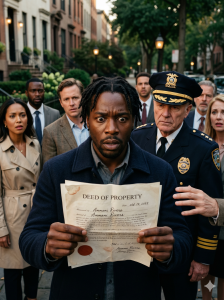
A neighbor gasped from a porch.
Another stepped outside.
Then another.
Susan stared at the paper like it had struck her.
“That can’t be legal,” she whispered.
“It is,” I said. “As of Tuesday, Apex owns the land, the clubhouse, the private roads, the security gates, and every shared HOA asset.”
Her face drained of color.
“But the board—”
“The board sold its controlling interest after the reserve fund audit.”
That word landed heavier than the sirens.
Audit.
Her expression shifted.
Not anger anymore.
Fear.
Real fear.
Chief Reynolds noticed.
So did I.
“You knew,” I said quietly.
Susan swallowed.
“I don’t know what you’re talking about.”
I stepped closer.
“Then I’ll explain it for everyone.”
Her eyes flicked toward the neighbors.
“Daniel,” she said, softer now. “Maybe we should discuss this privately.”
There it was.
The first crack.
Not remorse.
Not regret.
Strategy.
I looked at the people gathering in driveways and behind hedges.
People who had watched her humiliate delivery drivers.
Fine elderly residents.
Threaten families over children’s bicycles.
Fine widows over flowerpots.
And worse.
Much worse.
“No,” I said. “You made it public.”
Her jaw tightened.
“Then we’ll keep it public.”
Chapter 6: The Audit
My assistant arrived five minutes later.
Nadia stepped out of a black sedan holding a leather folder and a tablet.
Small.
Precise.
Dangerous in the way order can be dangerous.
Susan recognized it before she understood it.
Nadia handed me the folder.
“The preliminary audit is complete,” she said.
Susan’s knees seemed to weaken.
Chief Reynolds crossed his arms.
“What audit?” a neighbor asked.
I opened the folder.
“For eight years,” I said, “Oakwood Estates residents paid inflated HOA fees.”
Murmurs spread.
“Special assessments. Emergency landscaping charges. Security upgrades. Road repairs.”
A man in a tennis shirt stepped forward.
“We paid thirty thousand for those gates.”
“No,” Nadia said. “You paid thirty thousand. The gates cost nine.”
The street broke open with noise.
Susan’s voice cut through it.
“This is defamation!”
Nadia tapped the tablet.
“Payments from HOA accounts were routed through three vendor companies,” she said. “All registered to relatives of Susan Whitmore.”
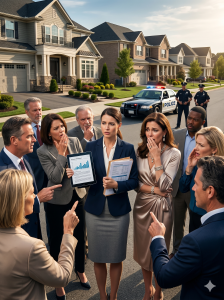
The color drained from Susan’s face completely.
A woman on the sidewalk covered her mouth.
“My husband delayed surgery because of those fees,” she whispered.
Another man shouted, “You stole from us?”
Susan spun toward him.
“I protected this neighborhood!”
“No,” I said. “You owned their fear.”
Her eyes snapped back to mine.
“You think you’re some hero?” she said, voice shaking. “You bought your way in like everyone else.”
I held her gaze.
“No. I bought the locks off the cage.”
Chapter 7: The Last Page
Chief Reynolds stepped forward.
“Susan Whitmore,” he said. “Based on the evidence provided and pending financial crimes review, I need you to come with me.”
Her mouth fell open.
“You are not arresting me.”
“I’m asking you to cooperate.”
“I know the mayor.”
“So do I.”
“I know judges.”
“So does Mr. Cole.”
She turned to me then.
For the first time, she didn’t look at me as a trespasser.
Not as staff.
Not as someone beneath her.
She looked at me like power had finally taken shape.
And she hated that most of all.
“You don’t understand what you’re doing,” she whispered.
“I understand perfectly.”
“No,” she said, stepping closer. “You don’t.”
Something in her voice shifted.
Not fear of prison.
Something deeper.
She looked toward the oak sapling.
Then at the folder in my hand.
“You didn’t read the last page,” she said.
Silence settled over the street.
Nadia frowned.
“What last page?”
Susan smiled faintly.
Broken.
Unsteady.
“The original land covenant,” she said. “Before the HOA. Before the gates. Before all of it.”
My stomach tightened.
Nadia flipped through the folder quickly.
Her expression changed when she found it.
“What is it?” I asked.
She didn’t answer.
She handed me the page.
I read the first line.
Then the second.
Then the name at the bottom.
My mother’s name.
Evelyn Cole.
The world narrowed.
The street.
The houses.
The watching faces.
All of it blurred at the edges.
“What is this?” I asked.
Susan’s smile trembled.
“Your mother didn’t just clean houses here,” she said. “She owned part of the land.”
My hands went cold.
“She inherited it from her father,” Susan continued. “A small share. Enough to block the original development.”
I stared at the page.
My mother’s signature sat beside three others.
Young.
Certain.
Alive.
Susan’s voice dropped.
“My father forced her out. Paid her nothing. Buried the covenant.”
Chief Reynolds looked stunned.
Nadia whispered, “Daniel…”
But I couldn’t move.
All these years, I thought my mother wanted that oak planted here because she had been humiliated here.
But it was deeper than that.
She had belonged here before any of them.
Before Susan.
Before the gates.
Before the lies.
Susan stepped closer.
Tears filled her eyes now.
Not polished tears.
Not strategic ones.
Real.
“I found the document after my father died,” she said. “I hid it.”
The confession hit like a strike of air leaving the room.
A neighbor shouted, “You what?”
Susan flinched.
“I was twenty-six,” she said. “My family would have lost everything.”
I looked at her.
“You let my mother die believing she had nothing.”
Susan covered her mouth.
No answer.
Because there wasn’t one.
Chapter 8: The Tree
The Chief reached for his cuffs.
But I raised a hand.
“Wait.”
Everyone turned to me.
Susan looked confused.
So did Reynolds.
I stared at the oak sapling.
Small.
Fragile.
Waiting.
My mother hadn’t asked me to destroy Oakwood Estates.
She had asked me to plant a tree.
That wasn’t surrender.
That was claim.
“Nadia,” I said, my voice rough. “Prepare a new trust.”
She nodded slowly.
“For whom?”
I looked at the neighbors.
At the widows.
The families.
The workers standing beyond the gate, watching in silence.
Then at Susan.
“For the residents,” I said. “And for every underpaid worker Oakwood Estates has used over the last thirty years.”
Susan blinked.
“What?”
“The stolen HOA funds will be recovered,” I said. “Your assets will be frozen pending litigation.”
Chief Reynolds nodded.
“And this land covenant?” Nadia asked.
I folded the page carefully.
“That changes everything.”
Because it did.
Apex owned Oakwood Estates.
But my mother owned its conscience.
And Susan had just handed me the key to something larger than revenge.
I turned to the gathered residents.
“Effective immediately, the HOA is dissolved.”
A ripple of shock moved through them.
“No more harassment fines,” I said. “No more predatory fees. No more intimidation through security gates.”
A woman began to cry.
An older man sank down onto the curb.
“And this section of land,” I continued, pointing to the open green space beside the street, “will become Evelyn Cole Memorial Park.”
Susan made a sound.
Half sob.
Half disbelief.
I looked at her one last time.
“You asked what I was doing here.”
Then I picked up the shovel.
Pressed it into the soil.
And planted the oak.
No one spoke.
Not even Susan.
The tree settled into the ground, straight and steady.
Its roots covered with the same dark soil she had once kicked across the sidewalk.
When I finished, Chief Reynolds stepped behind her.
This time, he didn’t ask.
He cuffed her gently.
She didn’t resist.
As he led her toward the cruiser, she turned back.
“I’m sorry,” she whispered.
I looked at the oak.
Not at her.
“No,” I said. “You’re caught.”
Chapter 9: The Letter
Three months later, the park opened.
No gates.
No guards.
No HOA signs.
Just grass, benches, and a young oak tree with a brass plaque beneath it.
Evelyn Cole Memorial Oak.
She belonged before they built the walls.
On opening day, hundreds came.
Residents.
Former workers.
Families once told they didn’t belong.
At sunset, Nadia handed me a final envelope.
Recovered from Susan’s seized documents.
My mother’s handwriting was on the front.
Daniel.
My hands shook as I opened it.
Inside was a single page.
“My son,” it began, “if you are reading this, then the truth has finally grown roots.”
I stopped breathing.
She had known.
Somehow, she had known.
“I did not tell you about the land because I did not want bitterness to become your inheritance,” she wrote. “But I planted the truth where greed could not kill it.”
My eyes blurred.
“The oak is not for me. It is for you. So you remember that power is not owning the ground. Power is deciding what grows from it.”
I folded the letter against my chest.
The sun slipped behind the houses.
Children ran laughing across grass where silence once ruled.
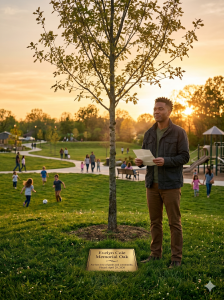
And for the first time, Oakwood Estates didn’t feel like a display of wealth.
It felt like it had finally exhaled.
Chief Reynolds walked up beside me.
“You okay?” he asked.
I looked at the oak.
Its leaves moved softly in the evening wind.
And I nodded.
Because the truth wasn’t that I had taken the neighborhood.
It was that my mother had quietly shaped it long before any of us understood.
And the woman who tried to erase her had, without meaning to, preserved the evidence that brought everything back.
Not out of kindness.
Not out of regret.
But because cruelty, in the end, rarely knows how to disappear without leaving records behind.
And this time, those records took root.
