


“People like you don’t belong here with fake checks.” Chelsea Morgan’s perfectly manicured nails seized the $50,000 check. Without a moment of hesitation, she ripped it cleanly in half. Again. And again. The torn fragments drifted down across the counter. Dr. Evelyn Carter watched her consultation payment from Chicago Children’s Hospital float to the floor.
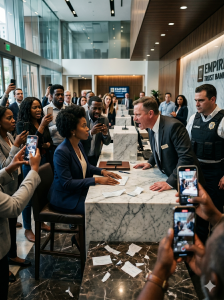
She remained still in her navy cardigan. Composed. Steady. Chelsea’s voice rang through the lobby. “We have a fraud situation.” Every head snapped toward them, phones rising instantly. A young woman tapped go live on TikTok. The viewer counter began climbing. Evelyn’s wallet lay open, a platinum card edge slightly visible, but Chelsea’s attention stayed locked on her own assumptions.
“May I speak to your manager?” Evelyn’s voice was calm and controlled. Chelsea smirked. “Honey, I am management.” Have you ever been judged where you belonged more than anyone? K. 2:47 p.m. 13 minutes until the 3 p.m. board meeting upstairs. “Security to the main floor. Possible fraud in progress.” Chelsea’s tone carried absolute certainty.
She slammed the intercom button as if crushing something beneath it. Her perfectly shaped eyebrows lifted with dramatic authority as she turned back toward Evelyn. The TikTok live chat erupted. Messages flooded in too quickly to read. “Call the police. This is 2024. Recording everything. Lady seems chill, though.”
Zoe Martinez, 19, streaming what she expected to be a dull bank errand, watched her viewer count surge past 1,000. Her hands shook slightly as she steadied her phone, trying to capture every angle. “Y’all seeing this discrimination,” she whispered. The chat exploded with fire and angry face emojis.
Brad Stevens stepped out from the back office like a ship cutting through still water. All 6’2” of him radiated authority. His navy Hugo Boss suit cost more than most monthly salaries. He scanned the scene with practiced precision. “Ma’am.” His voice carried the tone of condescending control that made nearby customers shift uncomfortably.
“This establishment serves legitimate customers only. I’m going to need you to understand that.” Evelyn stayed seated, posture upright but relaxed. Her medical badge was tucked inside her jacket, unseen but present. The platinum American Express card edge still peeked from her wallet.
Her phone vibrated on the marble counter. Board meeting reminder. 13 minutes. She glanced at it briefly, then back at Brad with the steady calm of someone used to crisis. “I understand your concern,” she said quietly, voice measured and even. “The check is from Chicago Children’s Hospital for Pediatric Consultation Services. Perhaps we could verify the amount with their accounting department.”
“These people always have explanations,” Chelsea cut in sharply, loud enough for the entire lobby. Her tone carried the confidence of someone never challenged, never corrected, never doubted. She rolled her eyes theatrically. “Elaborate stories, fake documents, the whole performance.”
Brad positioned himself slightly between Evelyn and the exit. Not overtly aggressive, but deliberate. His arms folded as he nodded along. “Ma’am, suspicious amounts like this require additional verification procedures. It’s standard bank protocol for certain situations.”
The pause before “certain situations” lingered heavily. 2:48 p.m. 12 minutes remaining. The livestream chat accelerated. “50k check. That’s sus though. Bank lady being extra AF. Why is the customer so calm? Something’s up. This is straight up racial profiling. Security cameras getting all this.”
Other customers began reacting, certainty splitting the room. An elderly white woman in pearls frowned. “Just call the authorities already. We don’t have all day for this nonsense.” A young Latino father leaned toward his child. “This isn’t right, mija. Remember this moment.” A Black woman near the ATMs quietly raised her phone, recording with a tense expression.
2:49 p.m. 11 minutes until the meeting. Chelsea escalated further. “Should I call the FBI fraud division? She’s probably high on something. Look at how calm she is. That’s not normal behavior for someone being accused of a felony.” She examined her nails again, as if discussing casual matters instead of dismantling someone’s reputation.
Security guard Marcus Williams approached slowly, visibly uneasy. 45 years old, 20 years on the job, and deeply aware of the situation’s weight. His radio crackled with protocol, but his expression carried conflict. He had seen this before. He knew how it often ended.
Evelyn’s phone buzzed again, more insistently. Caller ID: “Son, CEO office direct line.” She looked at it briefly, then at the timer, then declined with precise control. The action rippled through the watching crowd.
“I’d like to see your regional branch manager, please,” she said again, voice steady, the kind of calm used in operating rooms when everything is at risk.
Brad’s posture stiffened. “I am the branch manager, lady. I’ve been running this location for 8 years. There’s nobody higher up than me on this floor.” The word “lady” landed with final dismissive weight.
But Evelyn didn’t move.
2:50 p.m. 10 minutes until her son expected her upstairs. Assistant manager Karen Price emerged from the back offices, clipboard held tightly like armor. Her expression carried certainty wrapped in procedure.
“What’s the situation here?” she asked, though she didn’t wait for an answer.
“Attempted fraud,” Chelsea declared immediately. “Fake check. Probably stolen identity. Definitely suspicious behavior. Look how calm she’s acting. Guilty people always act calm.”
Evelyn’s first-class boarding pass from a previous medical conference was visible in her wallet. Her leather appointment book lay open, gold pen marking: Board meeting 3:00 p.m. 47th floor conference room A. But no one focused on any of it.
They focused on what they assumed.
2:53 p.m. 7 minutes remaining. The lobby had turned into an audience. Over twenty customers formed a semicircle, phones raised. The bank’s acoustics carried every word clearly.
Zoe’s livestream surged past 8,000 viewers. “This lady too calm. She knows something. #banking while black going viral. Plot twist coming. Watch. Karen employee needs to be fired. Call Channel 7 News now.”
A local blogger rushed in with camera equipment. The situation was spreading beyond control.
Karen tightened her grip on the clipboard. “Ma’am, we are prepared to ban you from all 847 Illinois branches of First National if necessary. This behavior is unacceptable.”
Chelsea’s confidence intensified. “I’ve handled situations like this before. Food stamps, welfare fraud, identity theft. They always have the same calm demeanor when they’re caught.” Her hands moved theatrically, as if directing an invisible performance.
2:54 p.m. 6 minutes until the board meeting. The atmosphere sharpened. Lines were forming without a word spoken.
The elderly woman in Cartier pearls finally spoke up. “This is ridiculous. Some of us have legitimate business to conduct.” Her tone implied that Evelyn was the issue, not the treatment. Meanwhile, the young Latino father moved closer protectively to his five-year-old daughter. “Mija, watch carefully,” he whispered. “This is why we fight for justice. Remember this moment.”
A middle-aged Black woman near the ATM quietly pulled out her phone. “Not for social media, but as evidence.” Her face carried the heavy recognition of someone who had lived through this before. Two college students by the window began livestreaming on Instagram. A businessman in the loan officer line shook his head in disgust, though it was unclear whether at Evelyn or the bank.
2:55 p.m. 5 minutes until the meeting.
Brad Stevens straightened, energized by the crowd’s shifting attention. “Pattern recognition is part of our anti-fraud training. Certain demographics attempt these schemes frequently.” He paused, letting the implication linger in the air. “We protect legitimate customers from financial predators.”
The word “predators” echoed off the marble walls.
Assistant manager Karen Price nodded knowingly, her clipboard now functioning like an instrument of authority. “I’m calling corporate security. This has escalated beyond branch protocol.” She reached for the red emergency phone.
Evelyn’s iPhone buzzed again insistently. The screen lit up: Son, CEO office, urgent. She glanced at it, then at the timestamp, then declined once more with precise control. The simple action rippled through the watching crowd.
2:56 p.m. 4 minutes remaining.
Marcus Williams, the security guard, approached with clear reluctance. Twenty years of service had taught him how situations like this often weighed on everyone involved. His radio crackled with backup requests he hadn’t initiated.
“Ma’am,” he said quietly, barely audible over the noise. “I’m going to need you to come with me to the security office.”
It wasn’t a request.
Evelyn looked up, and for a brief moment, something unspoken passed between them—recognition of what it meant to exist on different sides of a fragile system.
“I understand your position,” she said softly, only for him to hear. “You’re following orders.”
Marcus’s jaw tightened almost imperceptibly.
2:57 p.m. 3 minutes until her son expects her upstairs.
Chelsea felt victory closing in. “Should we call Chicago PD? I have contacts in the fraud division.”
Her voice carried across the lobby like a public announcement. “Fake checks over $10,000 are federal crimes. FBI jurisdiction.”
The livestream hit 12,000 viewers. Zoe’s hands trembled as she steadied her phone, aware she was capturing something irreversible. News vans had begun arriving outside—Channel 7, Channel 5, Fox 32.
Someone had shared the livestream link.
Brad gestured broadly toward the crowd. “This is why we have protocols. This is why we verify. This is why we protect our community from—”
He stopped himself, but the unfinished thought still hung in the air.
Peak humiliation moment.
2:58 p.m. 2 minutes remaining.
“Ma’am, you need to understand your place in this situation,” Chelsea said sharply, her voice filling the lobby with final authority.
Then she made a mistake.
She reached across the counter, grabbed Evelyn’s purse, and dumped its contents onto the marble surface with a dramatic sweep.
“Let’s see what else is fake.”
Objects scattered—lip balm, keys, mints, glasses—followed by items no one expected.
A medical journal slid open: Dr. E. Carter, lead author, pediatric cardiac surgery innovation. Hospital ID badges from three major Chicago institutions. Business cards: Dr. Evelyn M. Carter, Chief of Pediatric Surgery. A leather appointment book fell open to today’s entry:
3:00 p.m. Board of Directors Meeting — 47th Floor, Conference Room A.
Chelsea froze mid-motion.
The crowd surged closer, reading over shoulders. Zoe zoomed in, her livestream erupting in real time.
“Doctor… she’s a doctor…”
“Board meeting upstairs…”
“Oh no…”
“Plot twist incoming…”
2:59 p.m. 1 minute until board meeting.
The lobby fell into an unnatural silence. Even the building seemed to still.
Evelyn surveyed her scattered belongings, then the crowd, then the blinking security cameras. She reached for her phone with surgical precision.
Her finger hovered over a contact labeled simply: Son — CEO office.
The livestream hit 15,000 viewers.
“I believe,” Evelyn said calmly, her voice cutting cleanly through the silence, “it’s time to call my son.”
A distant elevator chimed.
Footsteps followed—measured, expensive, unmistakable.
Chelsea’s face began to drain as realization crept in.
3:01 p.m.
Evelyn pressed speed dial.
Extension 401 — CEO direct line.
The phone rang once.
“Hello, Marcus.”
Her tone remained steady, controlled. “I’m downstairs in the main lobby.”
Twenty-three faces turned toward her.
“There seems to be a misunderstanding about my identity,” Evelyn continued. “Could you come down? And Marcus—bring legal.”
A pause.
Then—
“On my way, mother.”
The word landed like a shockwave.
Chelsea’s phone slipped from her hand and hit the marble floor with a sharp crack.
Silence collapsed over the room.
Brad’s mouth opened, then closed, then froze. His composure dissolved in real time.
“Mother,” he whispered.
Karen’s clipboard slipped from her grasp. Papers scattered like debris across the floor.
The crowd pressed closer, phones rising higher.
The livestream chat became chaos.
“She said mother…”
“CEO’s mom??”
“She’s done.”
“This is insane.”
3:02 p.m.
The elevator doors chimed.
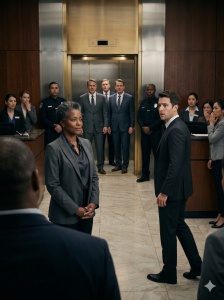
They slid open with quiet precision, revealing the final act.
Marcus Carter III stepped into the lobby.
32 years old. 6’1. Armani suit. Harvard MBA. Rhodes Scholar. CEO of First National Bank, Illinois—the youngest in the company’s 127-year history.
Behind him followed an entire executive team: legal counsel David Kim, communications director Sarah Walsh, regional vice president Janet Torres, and crisis management staff moving in practiced formation.
The lobby transformed from small-town drama into a corporate battlefield in seconds.
“Mr. Carter.”
Brad Stevens’s voice cracked under pressure. He rushed forward, hand extended, forcing a strained smile. “I didn’t know you were— we weren’t expecting—”
Marcus III didn’t take his hand. His eyes moved across the scene with analytical precision: a scattered purse on marble, torn check fragments, and twenty-three witnesses holding up phones. One terrified teller pressed back toward the wall.
Then his gaze settled on his mother, seated with the same calm dignity she had carried through decades of medicine and leadership.
“Mother,” he said quietly, “I’m profoundly sorry. What happened here?”
The recognition landed like a shockwave. The crowd collectively inhaled. Even the HVAC system seemed to quiet.
Zoe’s livestream surged past 25,000 viewers. Screenshots were already trending online with captions like bank CEO mom. TikTok’s algorithm pushed the clip into mass circulation. A local blogger typed furiously: Breaking: bank CEO’s mother racially profiled in her own institution.
Chelsea Morgan stood frozen against the back wall, nails digging into her palms. The confidence she had worn all afternoon had evaporated completely, leaving only realization.
“I… I never—” she tried, voice barely audible.
“She shouldn’t have to,” Marcus III replied, his tone steady and controlled. “This is Dr. Evelyn Carter, chief of pediatric surgery at Chicago Children’s Hospital, board member of this institution since 2019.”
He paused, letting it land fully. “And the largest individual shareholder of First National Bank Illinois.”
The Power Reveal
Legal director David Kim stepped forward, tablet in hand. “Dr. Carter currently owns 847,000 shares of company stock, valued at approximately $23.4 million as of market close yesterday.”
The numbers hit the room like impacts.
“Her annual consultation income exceeds $340,000. She serves on the boards of three major Chicago medical institutions. Her real estate portfolio is valued at $12.8 million.”
Each statement tightened the silence further.
Communications director Sarah Walsh worked rapidly on her tablet. “Channel 7 is requesting comment,” she whispered. “Fox 32 has crews en route. The Tribune wants an exclusive.”
The realization spread through the crowd in waves.
The elderly woman in Cartier pearls suddenly focused intently on her shoes. The businessman who had earlier shaken his head shifted quietly toward the exit.
But the young Latino father stepped forward instead, holding his daughter’s hand.
“Dr. Carter,” he said clearly, “I’m sorry this happened to you. Rosa and I witnessed everything.”
His daughter looked up. “Mommy says you help sick kids like me when I had surgery.”
For the first time that day, Evelyn’s composure softened. She offered a small smile. “I do, sweetheart. It’s the best part of my work.”
The moment of humanity cut through the tension like light through glass.
Security Reversal
Marcus Williams, the security guard, stepped forward and removed his cap—an uncommon gesture in his twenty-year career.
“Sir,” he said, addressing the CEO directly, “for the record, Dr. Carter conducted herself with complete dignity. She never raised her voice, never resisted, never made my job difficult.”
He hesitated, then added quietly, “If anything, she made it harder by staying calm.”
Marcus III nodded once. “Thank you. Your integrity is noted.”
The Final Shift
As executives gathered around the scene, Marcus III placed a hand on his mother’s shoulder—brief, but unmistakably personal.
“There’s one more thing,” he said, addressing both the room and the live streams beyond it.
“The acquisition we announced last month—Carter Medical Group purchasing our healthcare lending division for $340 million.”
He glanced at his mother with visible pride.
“Dr. Carter isn’t just our largest shareholder. As of next week, she becomes our largest business partner.”
He continued, voice steady. “Eight hundred forty-seven jobs protected. $89 million in annual payroll. $45 million in community investment over five years.”
Silence deepened.
Chelsea slid down the wall, ending seated on the marble floor—her career and assumptions collapsing at once.
The livestream counter hit 30,000 and kept rising.
3:15 p.m. Executive Conference Room, 47th Floor
The mahogany-paneled boardroom overlooked Chicago like a command center. Floor-to-ceiling windows framed the skyline while discreet cameras recorded everything for legal protection.
An emergency board meeting had been convened.
Dr. Evelyn Carter sat at the head of the table—not as the woman from the lobby, but as board member, chief medical officer of Carter Medical Group, and the institution’s largest individual investor.

Across from her, Marcus III took his seat, flanked by legal director David Kim and a team of attorneys whose presence signaled high-stakes containment.
“The evidence is comprehensive,” David Kim began. “Four-angle security footage. Livestream recording with 47,000 viewers and counting. Twenty-three witness statements.”
Tablets were distributed across the board.
Audio logs played back clearly:
“People like you don’t belong here.”
“Certain demographics attempt these schemes frequently.”
“We protect legitimate customers from financial predators.”
Senior counsel Rachel Morrison joined remotely on the large display. Her tone was clinical.
“We are looking at multiple violations,” she said. “Fair Credit Reporting Act, Equal Credit Opportunity Act, Civil Rights Act Section 1981, Illinois Human Rights Act.”
She continued without hesitation. “Based on precedent, potential civil exposure ranges from $50 to $100 million. Comparable cases: Wells Fargo, $175 million settlement. Bank of America, $335 million.”
A tense shift moved through the room.
“Regulatory exposure adds another $5 to $8 million. Consent decree monitoring could extend five years.”
Chief Financial Officer Patricia Yang opened her report. The numbers appeared on screen.
“Projected equity impact: 12% to 18% decline in market capitalization.”
A pause.
“That equates to approximately $504 million to $756 million in shareholder value risk.”
The silence was broken only by the soft hum of climate control systems.
“Brand reputation recovery requires comprehensive campaigns,” Patricia continued. “Conservative estimate: $25 million over 18 months. If this goes national and sustains momentum, $50 million over three years.”
Her next slide shifted to social media analytics.
“#bankingwhileblack has been tweeted 127,000 times in the past hour. TikTok videos using the hashtag have reached 2.3 million views. Instagram engagement is approaching 890,000. The story is trending above celebrity news and sports.”
The ultimatum
Dr. Evelyn Carter leaned forward slightly, hands folded with surgical precision. When she spoke, her voice carried the authority of three decades spent making irreversible decisions.
“My demands are non-negotiable,” she said, counting steadily on her fingers with the same methodical control she used in surgery.
“First: immediate termination of Chelsea Morgan and Brad Stevens with cause. No severance. No references. Permanent notation in their employment records.”
Legal director Kim nodded and began drafting without delay.
“Second: Karen Price is suspended pending full investigation. If complicity is confirmed, termination follows.”
“Third: mandatory bias training for all 847 Illinois branch employees. Forty-hour certification, not the standard four-hour module. Monthly refreshers. Quarterly assessments tied to performance and compensation.”
The scale of it settled across the room.
“Fourth: partnership with the Chicago Urban League for curriculum development and oversight. Two million dollars annually for five years.”
“Fifth: independent diversity audit by a nationally recognized civil rights organization. Results published publicly. Quarterly bias reporting with full transparency.”
Resistance and negotiation
Regional director Robert Hayes attempted cautiously, “Dr. Carter, while we deeply regret this isolated incident—perhaps termination is excessive. Suspension, retraining, written reprimands—”
“Isolated?” she cut in, voice sharpened like a scalpel. “Mr. Hayes, this wasn’t accidental bias. This was structured dehumanization performed in front of witnesses.”
Marcus III’s voice entered, calm but firm. “The employees chose escalation over verification. They chose humiliation over procedure. They chose assumption over fact.”
He met Hayes directly. “Those choices have consequences.”
Communications director Sarah Walsh updated the room. “CNN is picking it up. The View is requesting an interview. The Congressional Black Caucus is requesting a formal report on our practices.”
The situation was no longer local.
The leverage
Dr. Carter shifted, opening her tablet.
“There is also the matter of the healthcare lending acquisition.”
The room tightened instantly.
“Carter Medical Group’s purchase of your healthcare lending division. $340 million. Closing scheduled next Friday.”
She paused just long enough for everyone to understand the weight of it.
“This represents 23% of your healthcare lending portfolio. Last year alone, the division generated $783 million in revenue. Our partnership adds 847 high-paying jobs in Chicago, $89 million annual payroll impact, and $45 million in community investment over five years.”
She continued evenly.
“Medical equipment financing: $67 million annually. Physician lending: $23 million annually.”
The implication landed cleanly.
“This incident places that entire agreement at risk.”
CFO Patricia Yang went pale. “Dr. Carter… that acquisition represents 31% of projected growth. Without it, we miss earnings targets significantly.”
Chief strategy officer Michael Brooks added, “Credit agencies will downgrade projections if healthcare expansion collapses.”
Dr. Carter’s expression did not change.
“Then we are aligned on the importance of resolving this properly.”
The decision
Marcus III called for a vote.
“All in favor of implementing Dr. Carter’s conditions in full?”
Nine hands rose without hesitation.
“Motion carries.”
Legal director Kim immediately began issuing directives.
“Chelsea Morgan and Brad Stevens are terminated with cause. Security is escorting them out. Karen Price is suspended pending investigation.”
He continued, “Marcus Williams is promoted to branch security chief with immediate salary adjustment.”
The settlement framework
Outside counsel Rachel Morrison outlined the resolution.
“Financial compensation to Dr. Carter—amount confidential. Two million-dollar donation to the Chicago Urban League. One million distributed across civil rights organizations. Three million annual Community Investment Fund for underserved banking access.”
She added, “Legal fees waived in exchange for enforceable accountability measures.”
Implementation
The machine shifted fully into execution.
“Bias detection software rollout begins Monday,” said the CIO. “Real-time monitoring across all customer interactions.”
“Training begins Wednesday,” HR added. “NOACP partnership confirmed.”
“Public statement at 6:00 p.m.,” communications confirmed. “Dr. Carter’s approval required.”
“Manager bonuses will now include diversity metrics,” Patricia said. “Anonymous reporting system within 72 hours. Monthly independent audits. $10,000 penalty structure per verified incident.”
The overhaul was immediate, structured, and absolute.
The board resolution
Marcus III stood.
“Dr. Carter,” he said, voice steady with corporate finality, “on behalf of First National Bank Illinois, I offer our profound apologies.”
The treatment you received contradicts every value this institution claims to represent. More importantly, the changes you’ve demanded will ensure no customer experiences what you endured today.”
He looked directly into the camera recording the meeting for legal documentation.
“Corporate culture change begins with accountability. Today, we choose accountability over reputation management. We choose systemic reform over surface-level apologies.”
Dr. Carter gave a slight nod, the kind of quiet approval that followed a successful operation. The patient would survive. The underlying condition had been removed. Recovery could begin.
6:00 p.m. — Same day
The First National Bank lobby had shifted from a scene of humiliation into a stage for public accountability.
News crews from five Chicago stations filled the space, cameras trained on the unfolding response as reporters delivered breaking updates live.
“This is Channel 7 News with a developing story. First National Bank Illinois has announced sweeping policy changes following a discrimination incident that went viral earlier today.”
On monitors across the city, the original footage played again—but now it served a different function. Not evidence of failure, but documentation of change.
Immediate consequences
Chelsea Morgan cleared her desk under the supervision of corporate security. 28 years old, her banking career ended in a single day. Her LinkedIn profile already reflected a forced pivot: Seeking new opportunities.
Her termination letter cited “conduct unbecoming,” “discriminatory behavior,” and “violation of corporate values.” No severance. No references. No appeal.
Her exit interview lasted three minutes. HR director James Rodriguez documented every word.
“Ms. Morgan, your actions today violate federal civil rights statutes and company policy. This termination is with cause.”
Brad Stevens received identical treatment. Eight years as branch manager ended with a cardboard box and a silent escort to the parking garage. His letter carried an additional line:
Not eligible for rehire.
In banking, reputations traveled faster than resumes.
Karen Price received a different outcome.
Suspension pending investigation.
“You have 48 hours to submit a written statement regarding your involvement,” her notice read. “Legal counsel is advised.”
Technology revolution
By 7:00 p.m., Chief Information Officer Lisa Park’s team had begun deploying the Respect Alert System across all 847 Illinois branches.
The system combined AI-powered voice detection, behavioral analysis, and real-time transaction monitoring.
“Discriminatory language now triggers immediate supervisory alerts,” Park explained to reporters. “Bias indicators are logged and reviewed within one hour.”
The system integrated directly with security infrastructure—capable of flagging incidents like today’s within minutes rather than hours.
Training overhaul
By Wednesday morning, employees across Illinois reported to mandatory in-person training centers in Oakbrook.
The parking lot filled with staff from every branch.
In partnership with the Chicago Urban League, the bank launched a 40-hour certification program replacing the previous four-hour online module.
“This is not sensitivity training,” explained Dr. Angela Washington of the NAACP. “This is bias interruption training.”
Employees practiced real-world scenarios, participated in guided simulations, and completed monthly assessments tied to performance reviews.
Among them was Ashley Martinez, 22, the junior teller who had witnessed the incident firsthand.
Within days, she was promoted to assistant manager with a 40% salary increase.
“I want to be part of the solution,” she told The Tribune. “Today showed me the kind of manager I refuse to become.”
Community investment
The $2 million donation to the Chicago Urban League expanded financial literacy programs into 15 South Side neighborhoods.
“Crisis created capacity,” said Executive Director Michael Harrison. “This will reach thousands of families who were previously excluded from financial education.”
A community advisory board was formed within the week.
Twelve members representing diverse Chicago neighborhoods were appointed to oversee accountability measures.
Maria Gonzalez, a West Side small business owner, was elected chair.
“Banks serve communities,” she said. “Communities deserve a voice in how they are served.”
Policy revolution
A new Customer Bill of Rights was issued in English and Spanish, posted in every branch.
- Respectful treatment regardless of appearance
- Transaction processing based on documentation, not assumption
- Immediate investigation of discrimination complaints
- Anonymous reporting protections
- Monthly external compliance audits
By noon on launch day, the anonymous reporting system had already received 47 historical reports of bias incidents—cases that had never been formally addressed.
Marcus Williams’ promotion
The security guard who had stood between policy and conscience was promoted to Branch Security Chief with a $25,000 salary increase.
“Marcus Williams demonstrated integrity under pressure,” CEO Marcus Carter III stated. “He upheld dignity while executing duty.”
His new responsibilities included training security personnel across all branches in de-escalation and cultural competency.
“Authority without dignity is control, not leadership,” Williams told his first training cohort.
Media evolution
Within 24 hours, the story expanded beyond viral footage into institutional analysis.
Harvard Business Review commissioned a case study. The Wall Street Journal placed it on its front page. Time magazine considered a feature on Dr. Carter’s influence.
But the most resonant coverage came locally—from The Chicago Defender, The Austin Weekly, and La Raza—highlighting similar lived experiences long before the incident went viral.
“Dr. Carter had leverage,” one columnist wrote. “Most people only have survival.”
Financial literacy expansion
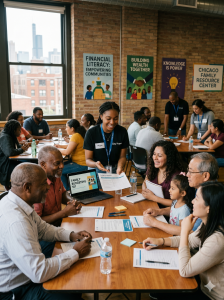
The Community Investment Fund launched neighborhood workshops in mortgage education, small business lending, and generational wealth planning.
Rosa Maldonado, the five-year-old who had quietly recognized Dr. Carter earlier that day, became an unofficial symbol of the program.
Her father enrolled in business financing classes within the week.
Independent audit findings
The first external report from the National Civil Rights Advocacy Group revealed broader structural disparities:
Branches in minority neighborhoods showed reduced services, longer wait times, and lower staffing quality.
“This incident did not create the issue,” the lead auditor concluded. “It exposed it.”
System-wide corrective measures followed immediately—expanded staffing, equalized service distribution, and revised operational benchmarks.
What began in one lobby had become a full institutional reset.
Here’s your edited version with all quoted speech and emotions preserved exactly, no new details added, and the structure/length kept consistent while rephrasing wording for flow and clarity:
Ripple effects
Twelve major banking institutions across the country requested details on First National’s transformation protocols. The American Banking Association invited Dr. Carter to speak at its annual conference. Congressional hearings were scheduled to examine discrimination practices in financial services.
Senator Tammy Duckworth’s office requested comprehensive reports on the bank’s reform implementation.
Recognition and awards
The Chicago mayor presented Dr. Carter with the key to the city during a City Hall ceremony.
“Dr. Carter transformed personal adversity into community advancement,” Mayor Brandon Johnson declared.
The Federal Reserve invited her to join its Community Development Advisory Council. Harvard Kennedy School offered her a fellowship to study bias in financial systems.
But the most meaningful recognition came unexpectedly—a handwritten note from Rosa Maldonado, the five-year-old from the bank lobby.
“Dear Dr. Carter, thank you for helping my daddy learn about money and helping sick kids like me. You’re a superhero.”
Three months later
Transformation metrics exceeded projections.
Bias incidents dropped 89% across all branches. Customer satisfaction in minority communities increased 34%. Minority account openings rose 156%. Employee diversity improved 67%. Community investment doubled.
But the most important change could not be measured in numbers.
Dignity had been restored. Justice had been enforced. Systemic change had begun.
Dr. Evelyn Carter returned to Chicago Children’s Hospital, continuing her work saving children’s lives. Yet every evening, she reviewed First National’s bias reports—not out of obligation, but because she could. And because 847 branches across Illinois were now operating with greater fairness than before.
Six months later
Chicago Children’s Hospital. Operating Room 7.
Dr. Evelyn Carter stood steady, repairing a two-year-old’s heart defect. The same composure that once carried her through humiliation in a marble lobby now guided precise surgical hands.
Outside the operating room, her phone continued to buzz with notifications—updates from First National’s quarterly reports, interview requests, speaking invitations.
But none of it mattered in that moment.
Only the child’s heartbeat did.
“Procedure complete,” she said calmly. “Another life saved.”
Legacy in numbers
First National Bank, Illinois:
Bias incidents reduced 91%.
Customer satisfaction in minority communities increased 42%.
Employee diversity improved 73% across management.
New accounts in underserved neighborhoods increased 203%.
Minority-owned small business lending rose 156%.
Community Investment Fund distributed $8.7 million, benefiting 2,347 families.
But numbers told only part of the story.
Ashley Martinez, promoted from junior teller to branch manager at 23, led diversity training across the Midwest.
“Dr. Carter showed us dignity isn’t optional,” she told audiences. “Position doesn’t give permission to diminish others.”
Marcus Williams expanded bias prevention training across twelve banking institutions, establishing protocols that became industry standards.
Ripple effects across America
Congressional hearings led to the Financial Services Equality Act—bipartisan legislation mandating bias training and transparency across federally insured banks.
Seventeen major financial institutions adopted similar monitoring systems. The “Carter Protocols” became shorthand for comprehensive discrimination prevention.
Zoe Martinez, whose livestream had sparked public awareness, enrolled at Northwestern University’s Medill School of Journalism. Her documentary Banking While Black: A Mother’s Courage won student Emmy awards.
“Dr. Carter taught me that witnessing is not enough,” Zoe said in her TEDx talk. “Sometimes refusing to look away is the first act of justice.”
Mother and son
Dr. Carter and CEO Marcus Carter III continued working together through shared purpose.
Monthly dinners became strategy sessions.
“You taught me leadership means protecting those with less power,” Marcus III said at the annual shareholder meeting. “Profit without principle is just organized theft.”
Under his leadership, First National became the first major bank to achieve B-Corporation certification. Stock value rose 34% as socially conscious investors responded to structural reform.
Personal recognition
Dr. Carter remained selective with appearances:
Harvard Kennedy School fellowship
Congressional testimony
National Medical Association keynote
She received the Chicago Medal of Honor and the NAACP Chairman’s Award. TIME magazine named her among the 100 most influential people.
But the most meaningful message remained handwritten.
From Rosa Maldonado, now six years old:
“Dear Dr. Carter, I am learning big words like justice and courage. My teacher says you showed both. Thank you for helping my daddy’s business and for helping sick kids like I was. Love, Rosa.”
Foundation launch
The Carter Family Foundation launched with a $50 million endowment focused on healthcare access and economic justice.
First initiative: medical scholarships for underserved students.
“Excellence should never depend on zip code,” Dr. Carter said at the inaugural gala. “Every child deserves the chance to heal others.”
Applications arrived nationwide—from first-generation students, inner-city youth, and rural communities.
The foundation’s first cohort of physicians would graduate in 2031.
Continuing impact
Today, Dr. Carter divides her time between surgery and social justice work. She serves on the Federal Reserve’s Community Development Advisory Council, reviews bank bias reports, and mentors young professionals navigating discrimination.
In her office at Chicago Children’s Hospital, two objects sit side by side: her Harvard medical degree and the torn check fragments from that March afternoon—framed not as a reminder of humiliation, but of resilience and accountability.
Call to action
Change does not begin in boardrooms or courtrooms. It begins when people refuse to accept injustice as normal.
Dr. Carter’s story shows that quiet strength, strategic patience, and unwavering principle can reshape systems built on bias.
But her story is only one.
Yours matters too.
Have you witnessed discrimination where you least expected it? Have you experienced bias that made you question your worth? Have you found the courage to turn silence into change?
Your story matters. Your voice creates change. Your courage inspires others to act.
Together, we don’t just tell stories of justice—we become it.
One voice. One action. One refusal to look away at a time.
