

He Str*ck Me In The Chow Hall Because He Thought I Was An Easy Target. My Five-Word Response Ended His Career.
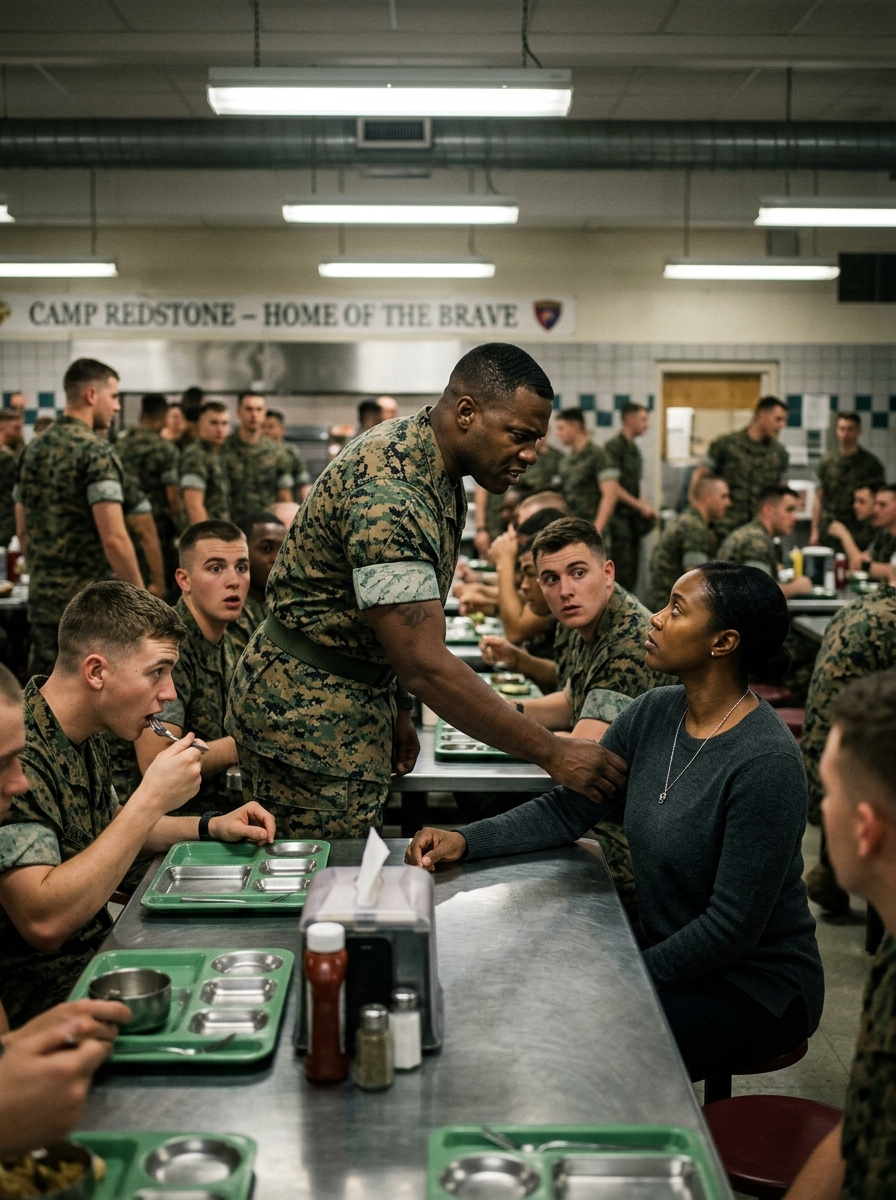
The midday rush at Camp Redstone always produced the same familiar sounds — metal trays clanging, heavy boots dragging across linoleum, and the low murmur of Marines wolfing down food before their next formation. But that afternoon, the small table near the window where I had settled became the center of the room for entirely the wrong reasons.
From the corner of my eye, I tracked Staff Sergeant Cole Mercer as he blew through the entrance like he commanded every square inch of the installation. He was built like a tank, his uniform razor-sharp, his jaw clenched tight as a sealed hatch. His reputation preceded him everywhere he went. He was aggressive, thunderous, and regarded as “untouchable” by the command structure. But the junior Marines and civilian workers who crossed his path daily understood the darker reality: Mercer had a terrifying gift for weaponizing his authority as pure, calculated intimidation. Beyond that, he carried deep-seated prejudices he’d never bothered to conceal. He deliberately went after people he viewed as inferior — particularly women, whom he fundamentally regarded as weak and ripe for targeting.
I was seated quietly across the aisle, a Black woman dressed in simple jeans and an unremarkable gray hoodie. My hair was tied back, my body language relaxed. I had deliberately crafted the appearance of an ordinary civilian contractor just passing through — precisely the profile Mercer enjoyed singling out.
Right on schedule, he marched straight to my table and stood over me, his expression radiating undisguised contempt.
“Seat’s for Marines,” he snapped, fully expecting me to scramble out of his way without a word.
I didn’t flinch. I looked up at him with complete composure. “There aren’t any signs,” I replied.
He let out a scornful laugh, making certain his voice carried far enough for neighboring tables to catch every word. He hurled cruel insults in my direction, banking on the certainty that a Black woman in civilian clothing wouldn’t dare push back against a decorated Staff Sergeant surrounded by his peers. He called me a “base bunny” and mocked me openly, working to strip away my composure. Several people looked away uncomfortably. Others went completely still. Not a single person moved to intervene.
I lowered my fork with deliberate, measured control. “You should step back,” I told him levelly, addressing him the way someone might warn a dog before it bites.
Rather than retreating, his ego surged. He closed the distance, his face contorted with contemptuous amusement. “Or what?” he challenged. Then, driven by his own prejudice and unchecked fury, he escalated beyond words. He didn’t just raise his voice. He raised his hand and crossed an irreversible line, str*king me violently in the middle of the packed cafeteria.
A chair toppled. Trays hung suspended mid-motion. The sound of the impact sliced through the ambient cafeteria noise the way a gunshot silences a room without the echo.
Mercer sneered, crowding into my space. He was absolutely certain I would dissolve into tears, shrink away, beg his forgiveness, and disappear — just like every other person he had crushed over the years.
But I didn’t go down. I found my footing, planting both feet firmly beneath me. The fear he was hunting for simply wasn’t there. My eyes sharpened into something cold and focused. I rose slowly, brushed off my shoulder, and held his gaze without blinking.
“Do you know who I am?” I asked, my voice cutting cleanly through the suffocating silence that had swallowed the room.
Mercer’s smirk cracked. A flash of genuine confusion moved across his face. What he couldn’t see was the tiny pinhole camera stitched carefully into the seam of my hoodie. What he had no way of knowing was that my actual identity — buried two classification levels deep — is Lieutenant Sofia Ramirez, a Navy officer attached to a federal task force operating in support of NCIS. My civilian appearance was a carefully constructed trap, and he had walked directly into it.
Behind him, three individuals rose simultaneously from separate tables, moving with the fluid precision of people who had rehearsed every step. One of them — a man in a relaxed jacket — reached slowly inside his coat. At that precise moment, Mercer’s phone lit up on the table with a notification from federal agents that drained every drop of color from his face.
Part 2: The Federal Badge, the Burner Phone, and the Takedown of a Tyrant
The silence following my question didn’t merely fill the cafeteria — it smothered it.
“Do you know who I am?”
Those six words drifted through the stale, food-saturated air of the Camp Redstone chow hall like a lit match suspended above dry kindling. For a fraction of a second, everything seemed to lock in place. I could make out the faint rhythmic hum of the industrial refrigerators idling in the back kitchen. I could hear the unsteady, shallow breathing of a young Lance Corporal two tables away, his eyes blown wide with disbelief. And above everything else, I caught the sharp, sudden hitch in Staff Sergeant Cole Mercer’s breath.
I held my position, spine straight, shoulders squared. The spot on my arm where he had shoved and struck me was radiating a dull, insistent throb — a physical record of his arrogance and his total inability to govern his own rage. But I didn’t reach for the shoulder. I didn’t drop my gaze. I let him look at me — genuinely look at me. I watched the initial expression of a man who believed he was confronting an easy mark — a Black woman in civilian clothes he assumed he could bully into submission — begin to fracture and give way to something entirely different.
Mercer’s smug grin faltered. You could practically see the gears seizing in his mind as his ingrained prejudice fought against his survival instincts. He had spent his entire career selecting his victims with surgical care. He preyed on junior enlisted personnel too frightened to go on record, and he targeted civilian workers he believed had no platform and no recourse. He had filed me neatly into that same category. He assumed my plain gray hoodie and jeans placed me beneath him in the rigid hierarchy he had spent decades worshipping.
“I… what?” Mercer stuttered, his voice stripped of the booming authority he routinely used to terrorize his subordinates. For the first time since he had blown into the room like he owned the entire base, he looked completely uncertain.
He didn’t get the opportunity to work it out himself.
“NCIS. Don’t move.”
The words hit the room like a physical force, bouncing off the linoleum and the high acoustic ceiling of the cafeteria. The command wasn’t shouted, but it carried such absolute, unshakeable authority that it arrested every single person in that room.
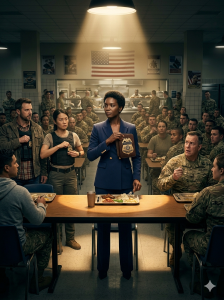
The man in the casual jacket and ball cap — Special Agent Derek Hall — had covered the distance between his table and ours in a matter of seconds. He was no longer the unremarkable stranger nursing a mediocre turkey sandwich. He held his gold and blue federal badge extended at chest height, the overhead fluorescents catching the metallic sheen of the emblem. His other hand rested deliberately near his hip — a quiet, unmistakable warning that any sudden movement would be met with swift and overwhelming force.
Two additional undercover agents, who had been woven seamlessly into the lunch crowd, flanked Mercer from opposite angles. They moved with predatory, synchronized efficiency, collapsing the tactical angle so rapidly it felt as though the room itself had contracted around him.
Mercer’s instincts — sharpened over years of unchecked aggression and a manufactured sense of invincibility — ignited. His broad shoulders twitched, muscles coiling as though he were genuinely considering swinging at the federal agents closing in around him. His eyes swept wildly across the room, calculating exits, calculating odds. There were no favorable odds. Not today.
Then a fourth figure stepped forward from the periphery near the serving line. A tall Marine Captain in full combat utilities, his expression carved from absolute stone. This wasn’t simply an outside agency inserting itself; this was his own chain of command, standing in alignment with the investigators.
“Staff Sergeant Mercer,” the Captain said, his voice precisely controlled, dropping into the silence like a judge’s gavel. “Step away from the lieutenant.”
Mercer blinked, his mind apparently unable to process the title. His eyes moved from the Captain, to Agent Hall, and finally, slowly, back to me.
“Lieutenant?” he whispered, the word sitting in his mouth like something toxic.
I didn’t smile. There was no satisfaction here, only the cold, deliberate execution of accountability. Slowly, with full intention, I reached across with my left hand and rolled the sleeve of my gray hoodie back to the spot where his fingers had dug into my skin during his second, more violent shove. A raw, angry red mark was already surfacing against my skin — unambiguous physical evidence of his unprovoked assault.
Then, with my right hand, I reached into the interior pocket of my jacket. I moved without urgency. I wanted him to experience every agonizing second of what was coming. I produced my federal credential wallet and flipped it open. The badge was clean, flawless, and entirely unmistakable.
“Lieutenant Sofia Ramirez,” I said, projecting my voice deliberately so that the civilians and Marines who had frozen in fear just moments before could hear precisely who was dismantling this man. “Attached to a joint federal task force. Acting under federal authority.”
I took one step toward him, closing the gap he had so aggressively invaded only minutes earlier. I looked up into his suddenly colorless face.
“You put your hands on me while I was conducting an official federal investigation,” I said, my tone flat and unsparing, like a clinician reading a result they already knew.
Mercer’s mouth opened. Nothing came out. The bravado, the toxic posturing, the arrogant certainty that his rank elevated him beyond consequences — all of it evaporated. His confidence drained in visible, incremental stages, like water bleeding from a fractured canteen. The man who had terrorized this base, who had reduced junior personnel to tears in their barracks and pressured civilian employees to resign rather than endure another day near him, was trembling beneath the cafeteria’s fluorescent lights.
Agent Hall stepped slightly closer, nodding toward the upper seam of my hoodie. “And you did it on camera.”
The cafeteria had gone completely silent, but it was far from empty. People were watching openly now, without pretense. The ambient fear that ordinarily governed every interaction with Mercer had been momentarily suspended by the sheer force of what they were witnessing. A civilian cashier near the register stood with both hands pressed tightly over her mouth, tears gathering in her eyes. At a corner table, the young lance corporal I had noticed earlier was staring at Mercer with an expression that was difficult to read — as though he were seeing the Staff Sergeant for the very first time, not as a terrifying force of nature, but as a deeply flawed, pitiable man who had finally been caught.
Desperation drives people to reckless places, and Mercer, watching his career dissolve in real time, made a frantic attempt to reclaim some semblance of authority. His face went a deep, furious red.
“This is b*llshit!” Mercer spat, his voice splitting as he grasped for his usual projection. He jabbed a trembling finger in my direction. “She provoked me! She was… she was just…”
“A civilian?” I finished for him, my voice cutting cleanly through the noise. “A Black woman in plain clothes who didn’t salute you? That’s what you assumed. And that’s exactly the point.”
I closed the remaining distance, holding his eye contact. “You thought I was someone without a voice. You thought I was someone who couldn’t fight back, someone whose account would never survive a command review against yours. You felt perfectly comfortable harassing and physically striking me because you believed your rank gave you unlimited license to act on your prejudice.”
Mercer swallowed hard, his throat working visibly. He was cornered, and he knew it.
Before he could construct another lie, Agent Hall raised his hand and signaled the other agents. One of the undercover investigators moved quickly toward the table where Mercer had been standing, next to the tray of food he had barely touched.
“Device stays exactly where it is,” Hall said sharply.
Mercer’s eyes snapped to the table, and for the first time, raw, undisguised panic broke across his face before he could suppress it. His reaction to the phone was far more visceral than anything he’d shown in response to the federal badges or the assault charges now accumulating against him.
And that reaction told me everything I needed to confirm. It validated every suspicion, every late-night tip, and every tearful, heavily redacted testimony I had absorbed across three months of case files. The rumors had circulated for months: the vile, wholly inappropriate comments directed at female Marines; the barely veiled threats issued when they refused to go along with his behavior; the “career guidance” that was functionally indistinguishable from extortion.
We knew formal complaints had been submitted in the past. But those complaints had a consistent habit of disappearing. Witnesses had recanted without explanation. The pattern was ancient and deeply ugly. Mercer had mastered the art of exploiting systemic blind spots, neutralizing his accusers before their accounts could ever reach the commanding officer’s desk.
But today, he had miscalculated. And his burner phone was sitting right there on the table.
I looked at him steadily, letting the silence stretch until it became physically uncomfortable. “We didn’t come here today just because of one sh*ve in a cafeteria,” I said quietly, keeping my voice low enough that only he and the agents could absorb the full weight of it. “We came because you kept doing it. Again and again. And you thought those stripes on your collar would protect you forever.”
The Marine Captain stepped forward again, breaking the perimeter the agents had held. “Staff Sergeant Mercer, you are being officially relieved of your duties pending a full federal investigation.”
Mercer’s voice climbed in pitch, any remaining military composure gone. “You can’t do this! My CO—”
“Your Commanding Officer signed the authorization for this sting operation,” the Captain cut in flatly, his contempt plainly visible. “And so did the base legal department.”
At that moment, Agent Hall snapped on a pair of blue latex gloves and reached toward the table. He lifted Mercer’s smartphone and dropped it cleanly into a clear, anti-static evidence bag. The screen was still illuminated.
Because I had coordinated the electronic surveillance warrant alongside the physical operation, I already knew what was displayed on that screen. A banner notification sat across the top of his locked display like a digital confession that couldn’t be walked back: an explicit, threatening message sent just minutes earlier to a junior female Marine who had repeatedly declined to meet him alone after her shift.
I looked at the phone, then back at Mercer. There was nothing to celebrate. The evidence spoke for itself.
“We have seventeen messages, Mercer,” I said, my voice dropping to a low, hard edge. “Seventeen. Thr*ats, brutal intimidation, and promises of career retaliation. Some were sent from your personal burner phone. Some were reckless enough to originate from base network computers. And we have sworn, corroborating statements from multiple victims who are no longer afraid of you.”
Mercer shook his head sharply, his breathing growing shallow and erratic. “They’re lying,” he hissed, retreating into the posture of a cornered animal. “Every single one of them is lying. They’re just mad because I’m a hard leader!”
Agent Hall didn’t take the bait. He simply angled his badge slightly so that the overhead light caught the gold emblem. “Then you’ll have plenty of chances to say that under oath, in front of a military judge,” Hall replied, his tone perfectly level.
With a quiet nod from Hall, the two flanking agents moved in unison. Mercer was turned around firmly but professionally. His wrists were guided behind his back. The cuffs clicked once, settling over his wrists, and locked shut with a sharp, final snap. That metallic sound carried further through the silent cafeteria than any order or threat he had ever thrown at the people beneath him.
The illusion of his power was officially over.
As the agents began walking him toward the exit, Mercer tried one final, desperate maneuver. He dragged his feet slightly, twisting his head to look back at the crowd of Marines watching him go. He arranged his face into something resembling wounded dignity — a performance of righteous indignation, an attempt to cast himself as a martyr. He was scanning for his loyalists, the ones who had laughed at his cruelest jokes and benefited from his poisonous favoritism, hoping someone would stand up and speak on his behalf.
The room held its silence for three long seconds.
Then, a young sergeant — a man I recognized from Mercer’s own squad, someone who had historically kept himself invisible to avoid becoming a target — pushed his chair back slowly and stood up from a nearby table.
The young sergeant’s hands were trembling slightly, knuckles white against the table edge, but his voice came out remarkably clear and steady.
“No,” the sergeant said, looking directly through Mercer. “We’re not.”
That single word — no — was the final blow. It broke something in Mercer that had no name. You could see the understanding wash over him in real time: the empire of fear he had constructed had crumbled. The people he believed he owned had never respected him; they had only feared him. And now that the fear was gone, nothing remained but disgust.
Mercer dropped his head, chin meeting his chest, and let the agents walk him toward the double doors.
I followed a few steps behind, the adrenaline beginning to drain, leaving behind a bone-deep exhaustion in its place. As we pushed through the heavy glass doors and stepped into the open air, the bright afternoon light hit us without mercy.
I stopped on the sidewalk, watching the agents conduct a pat-down beside the unmarked black federal SUV. For the first time in what felt like a very long stretch, I let my eyes close and released a long, uneven exhale. My shoulder was still throbbing where he had grabbed me — a persistent reminder of the risk the operation had required — but the sensation was eclipsed by the enormous weight lifting off my chest.
Agent Hall finished securing Mercer in the vehicle and swung the heavy door shut, sealing him inside. He turned and walked back toward me, lowering his voice so the gathering onlookers couldn’t catch the conversation.
“We’re not done here, Ramirez,” Hall said, his eyes moving across the perimeter. “You know how this game is played. His defense lawyer is going to immediately claim entrapment. They’ll say you baited him. His drinking buddies in the senior enlisted ranks will try to say this is a personal vendetta against a ‘tough but fair’ Marine. We’re going to need the entire chain of evidence completely clean, from top to bottom.”
I opened my eyes and fixed my gaze on the brick face of the cafeteria building as its heavy doors settled shut behind us. I thought about the victims I had interviewed. I thought about the young Black female Marine who had wept in my temporary office, terrified that Mercer would dismantle her career if she didn’t comply. I thought about the civilian contractor who had walked away from a well-paying position just to stop having to be in the same building as him.
“Then we keep it clean,” I said, my voice settling into something firm and resolved. “We keep every single piece of it meticulously documented. And we don’t let anyone on this base, no matter how many stars or stripes they have on their collar, bury it.”
I understood the terrain of the military justice system. I knew that the dramatic arrest in the chow hall was only the opening act — the inciting incident of a much longer story. The real work was going to be far harder than taking a hit and producing a badge.
The actual battle was just beginning. It would play out in cold, windowless interview rooms, in the construction of hundreds of pages of sworn statements, in resisting enormous institutional pressure to make the whole thing disappear quietly, and ultimately, in a military courtroom where Mercer’s defense would work to reframe his pattern of abuse as a culture war waged against a “tough but effective” Marine.
And I knew, without question, that somewhere on this installation, behind a heavy oak door in an executive suite, someone who had quietly protected Mercer’s behavior for years was already running the calculations. They were deciding whether to spend their influence saving their preferred Staff Sergeant one more time — or whether to cut him loose entirely and protect their own position.
But as I looked down at my federal badge, feeling the certainty of the digital evidence now secured in Agent Hall’s evidence bag, I made a private promise to the people whose lives Mercer had tried to wreck.
He had believed he was beyond reach. He had believed the rules simply didn’t apply to him. But he had finally put his hands on the wrong woman. The trap had closed, the predator was contained, and I intended to make certain the lock was never opened again.
I straightened the collar of my plain gray hoodie, turned, and walked toward the command headquarters. We had paperwork to file, and a tyrant to officially remove from power.
Part 3: The Echoes of Silence and the Weight of the Gavel
The military justice system doesn’t operate like a film. There are no swelling soundtracks, no single impassioned speech that transforms a courtroom in sixty seconds. What it does have is documentation, procedure, and the slow, relentless accumulation of facts — provided the people carrying those facts refuse to let them go.
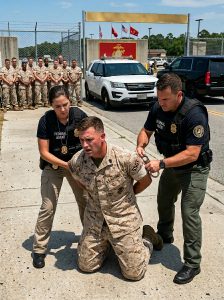
In the immediate wake of the chow hall takedown, the mood at Camp Redstone shifted from overt intimidation to a dense, paranoid quiet. Staff Sergeant Cole Mercer had been walked off the installation in federal restraints, his burner phone sealed in an evidence bag — but the toxic culture he had cultivated over the years didn’t simply dissolve with his arrest. It clung to the hallways, surfaced in hushed conversations outside the barracks, and persisted in the deeply conditioned fear of junior enlisted personnel who still half-expected him to materialize around the next corner, red-faced and screaming.
For the first forty-eight hours, my team and I functioned on almost no sleep. We secured a windowless conference room in the legal annex and converted it into an operational center. The walls filled quickly with printed transcripts, digital forensics reports, and heavily redacted personnel files. Agent Hall and I worked without stopping, sustained by stale coffee and the undeniable momentum of the digital evidence we had seized.
When our cyber forensics team broke through the encryption on Mercer’s confiscated burner phone, the scope of his cruelty was staggering. We weren’t examining a handful of inappropriate texts; we were staring into a meticulously self-documented record of sustained, systematic abuse.
The evidence expanded rapidly. The seventeen threatening messages we had initially flagged took on an entirely different weight when connected to real names, specific dates, and devastating real-world consequences. I spent hours working through the content. The prejudice he harbored wasn’t merely implied; it was deliberately deployed as a weapon in his messages. He specifically targeted women, and he expressed a vile, unfiltered hostility toward women of color who demonstrated any confidence or self-sufficiency in his presence.
He operated with the methodical patience of a predator managing a controlled environment. There was a young corporal who had requested an early transfer to an entirely different duty station just to remove herself from his squad. There was a highly decorated junior Marine who had completely withdrawn from leadership opportunities because Mercer had made it clear he would make her existence unbearable if she tried to outperform his hand-selected favorites. And there was a skilled civilian employee who had abandoned her contract mid-term, forfeiting substantial income, simply because walking past Mercer’s office door had become physically intolerable.
But reviewing the messages was the straightforward part. The real, grueling work began when we had to sit across the table from the individuals whose lives he had worked so hard to destroy.
In the weeks following the cafeteria arrest, Ramirez and Agent Hall worked through exhausting days of interviews that felt like navigating a minefield with no map. The victims were not eager to open up. The trauma he had inflicted ran deep, and the military’s embedded culture of managing problems internally had thoroughly convinced them that speaking out amounted to a betrayal of the service. Some were paralyzed by fear of retaliation, convinced that Mercer’s network of senior enlisted allies would redirect their anger inward. Others carried a profound, misplaced shame — blaming themselves for not being resilient enough to absorb his brand of leadership without breaking.
One interview stayed with me above all the others. Her name was Specialist Sarah Jenkins, a twenty-year-old mechanic who had been the recipient of the threatening message we intercepted just before Mercer’s arrest. When she entered the interview room, she carried herself like someone who had been invisible for a very long time. Her eyes stayed fixed on the scuffed floor, her hands clasped so tightly in her lap that the color had left her knuckles entirely.
“I don’t want to cause trouble, Ma’am,” she whispered, her voice unsteady. “I just… I just want to do my job. If I go on the record, the other NCOs will say I’m weak. They’ll say I’m a liability.”
I leaned forward, keeping my posture open and deliberately nonthreatening. I looked at this young woman and saw pieces of my own early career reflected back at me.
“Sarah,” I said quietly, using her first name to cut through the rigid formality. “You are not causing trouble. The trouble was already here. You are just helping us clean it up.”
She looked up, and a tear finally slipped past her lashes. A number of victims had previously attempted to report him, navigating the intimidating ladder of the chain of command, only to be turned away with the same tired reassurances: “He’s tough but effective,” “Don’t ruin a career over a misunderstanding,” “Are you sure you want to make this your reputation?”
I had heard those exact phrases echoed across every interview, and each time I kept my face entirely neutral. Internally, I noted every one of them in my notebook, inscribing each dismissal into memory. Because this investigation had long since expanded beyond Cole Mercer himself. It was about the entire enabling structure that had made him feel so completely untouchable.
We identified witnesses who had seen him physically trap people in the narrow corridors of the supply depot. We found witnesses who had been explicitly told by Mercer to look the other way when he berated female subordinates. We even located at least two junior Marines who admitted through tears that they had forced themselves to laugh along with his degrading, prejudiced commentary simply out of terror of becoming his next focus.
I never claimed I could undo the psychological damage with a single dramatic arrest in a cafeteria. Instead, I offered something more concrete: a clear, navigable path through the legal process. I sat with each of them for hours, carefully laying out the protected reporting mechanisms and explaining how federal oversight functioned. I coordinated directly with victim advocates to ensure access to psychological support. I made certain every account was captured properly, with legal counsel present when required, so that when we arrived in court, no one could argue the testimonies had been manufactured or emotionally manipulated.
And the pushback from Mercer’s camp arrived exactly as expected — swiftly, aggressively, and entirely predictably.
Mercer’s defense team, backed by a civilian attorney funded by an unnamed group of his “old guard” supporters, pursued exactly the strategy Agent Hall had anticipated on the day of the arrest. They launched a broad smear campaign immediately. They argued that I, as a federal officer, had deliberately manufactured the confrontation. They framed the entire operation as an illegal setup.
In preliminary hearings, his attorney practically performed for the presiding judge. They constructed Mercer as a highly decorated, combat-tested NCO operating under extreme institutional pressure — precisely the kind of demanding, battle-hardened Marine the Corps depended upon to function. They implied, sometimes subtly and sometimes not at all, that “outsiders” like me simply lacked the foundation to understand the rigors of infantry culture. They even attempted to leverage the fact that I am a Black woman, quietly building a narrative around a ‘woke agenda’ bent on dismantling traditional military discipline.
But the prosecution didn’t engage on culture. We refused to be pulled into philosophical arguments about what distinguished a demanding leader from an abusive one. We argued conduct — purely and specifically.
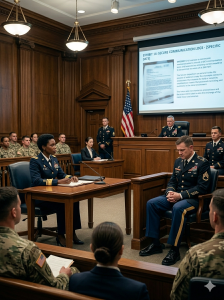
The court-martial convened on a sweltering Tuesday morning. The courtroom inside the Judge Advocate General building was at capacity. The air conditioning was losing the battle with the heat, adding a layer of physical discomfort to the already unbearable tension filling the space. Mercer was seated at the defense table in his meticulously pressed dress uniform, his chest covered in ribbons and medals he was clearly using as a visual shield. But the commanding arrogance he had carried into that cafeteria was gone, traded for a brittle, rigid stiffness.
I sat at the prosecution table, my own Navy dress uniform precise, my posture matching the composure I had held on the day I sat in that cafeteria. I was not going to let him see fatigue.
The trial was a grinding, exhausting series of legal maneuvers. The defense made repeated attempts to have the burner phone excluded from evidence, citing fabricated chain-of-custody concerns. The military judge — a stern, no-nonsense Colonel with no patience for legal theater — shut each attempt down completely.
Then came the undeniable evidence. At the center of the court-martial proceedings, the cafeteria surveillance footage played on a large screen with no narration from our side. The courtroom fell completely silent as the footage began to roll.
The timestamp on the lower portion of the screen blinked steadily. Everyone watched as Mercer walked purposefully toward my table. Though the main surveillance feed carried no audio, my undercover lapel microphone recording had been synced precisely to the video. Mercer’s cruel, prejudiced commentary was audible and clear, resonating off the wood-paneled courtroom walls. The initial physical contact was plain to see.
Then came the moment that drew an audible reaction from the gallery. The second strike — significantly more violent, fueled by unchecked ego — was beyond dispute. The video didn’t show a man cracking under the strain of combat or institutional stress. It showed someone who believed that public humiliation and physical force were simply perks of his authority. It showed him selecting a Black woman he had assessed as a defenseless, unprotected target.
Next, the prosecution introduced the digital evidence. The threatening messages were entered into the official court record. Not all seventeen — there were simply too many — but enough to change the temperature of the room. You could feel the shift in the jury panel’s bearing as the content was read aloud. The defense objected at nearly every line, growing increasingly frantic as their client’s actual character was laid bare, but the judge overruled each objection in turn.
We presented the data as I had constructed it: a timeline of sustained predatory conduct. The chronology attached to the messages established beyond reasonable doubt that this was a deliberate, long-running pattern — not a single lapse in judgment.
After three days of devastating testimony from victims, Mercer’s defense recognized the ground giving way beneath them. In a last, desperate gamble, they put Mercer on the witness stand.
When Mercer testified, he fought to hold the commanding physical bearing that had served him so reliably for years in front of subordinates. He kept his chin elevated, his gaze hardened, and his voice filled to the edges of the courtroom, working to dominate the space the way he had once dominated the chow hall.
He extended a thick, unsteady finger toward the prosecution table where I was seated. “I didn’t know who she was!” he declared, his tone drenched in defensive indignation. “She looked exactly like a civilian. She was in plain clothes. She challenged my authority in front of my Marines!”
He attempted to construct a narrative, positioning himself as someone upholding base decorum, asserting that civilians owed deference to the military personnel protecting them. He tried to characterize his physical assault as a measured response to what he called my “disrespectful attitude.”
I remained completely still. I showed nothing. I didn’t roll my eyes or tighten my jaw. I didn’t need to. Mercer was actively dismantling his own defense with every word.
The lead prosecutor — a meticulous Major who had absorbed every page of my case file — rose for cross-examination. He didn’t raise his voice. He didn’t move around the floor. He walked to the center of the room, faced Mercer directly, and posed a single, devastating question that cut through the entire performance.
“Staff Sergeant Mercer,” the prosecutor said, his voice carrying with clean, unwavering precision. “If she had indeed been a civilian — a Black woman simply visiting this installation, as you so clearly assumed — would your vi*lent behavior and your prejudiced language have been acceptable?”
The courtroom held its breath. Every molecule of air seemed to leave the space at once.
Mercer stared at the prosecutor. He opened his mouth to deliver a sharp answer, but his mind finally caught the trap. If he said yes, he confessed to assaulting a civilian. If he said no, the foundation of his entire defense — that he was enforcing appropriate military standards — collapsed entirely.
Mercer went quiet.
He looked at his defense attorney, who had developed a sudden and intense interest in a blank legal pad. He looked at the military judge, whose gaze was drilling into him with calm, unrelenting pressure. And finally, his eyes drifted across to me. I held the look, my expression unchanged, my mind returning to the exact moment I rose from that cafeteria seat and asked him, “Do you know who I am?”
That long, unraveling pause on the witness stand was the sound of truth searching for an exit and finding none.
“I… I was under a lot of stress,” Mercer finally offered, his voice thin and hollowed out. It wasn’t a defense. It was a collapse.
Closing arguments were brief. The defense appealed to his service record. The prosecution directed the panel’s attention to the back rows of the gallery — the victims who had found the courage to come, to sit in the same room as their abuser, and to let their presence speak.
The panel deliberated for less than four hours.
When the bailiff called the room to attention, the silence was complete. The verdict wasn’t a surprise to anyone who had sat through those proceedings — but it still arrived with historic weight.
Staff Sergeant Cole Mercer was found unequivocally guilty on multiple severe charges. He was convicted of systematic harassment, criminal threats, and multiple counts of assault. The panel also found him guilty of conduct wholly unbecoming of a non-commissioned officer, and of deliberate violations of lawful orders connected to his attempts to intimidate and interfere with witnesses.
The military judge was unflinching during sentencing. Mercer had built his entire identity on the authority his uniform carried, and the judge dismantled every component of it with precision. The sentence was severe and specific.
The judge ordered an immediate reduction in rank to E-1, Private — the lowest position on the military hierarchy. He ordered the total forfeiture of all pay and allowances. He sentenced Mercer to six months of hard confinement in a military prison facility. And most destructive to Mercer’s sense of self, he ordered an immediate involuntary separation from the armed services under Other Than Honorable conditions — a permanent mark that erased the military retirement and pension Mercer had spent years holding over subordinates as a measure of his own importance.
As the judge delivered the final sentencing, the courtroom remained entirely still. I watched Mercer’s face closely. I had prepared myself for the explosive anger — for screaming, for physical resistance against the military police officers flanking him, for his name hurled at me like a curse.
But Mercer’s face showed none of that.
What it showed instead was something far more unsettling — something closer to a complete and terrifying hollowness. His shoulders folded forward, the upright bearing of the “hard-charging Marine” collapsing inward on itself. His eyes went vacant. He looked like a man who had just understood, for the first time and without any remaining room for denial, that the world had permanently stopped bending around him.
He was handcuffed in the courtroom and escorted through the side door to begin his immediate confinement.
I stayed at the prosecution table, packing my legal pads and pens into my briefcase with slow, deliberate movements. Agent Hall crossed the room and placed a steady hand on my shoulder. We had done it. We had navigated the worst of the military bureaucracy, shielded the people Mercer had tried to silence, and removed a deeply embedded source of institutional toxicity from Camp Redstone.
But as I looked toward the back of the courtroom, where Sarah Jenkins and the other victims were holding each other and weeping quietly, I understood clearly that the real work was only beginning. The gavel had come down, and Mercer was gone — but the scars he had carved into that base, and into the people he had spent years tormenting, would take far longer than a court verdict to heal.
Part 4: The Echoes of Accountability and the Price of Silence
The heavy oak doors of the military courtroom swung closed behind me, cutting off the residual heat and tension from the trial. I stood in the long, sparsely decorated corridor of the Judge Advocate General building, my dress shoes producing soft, steady sounds against the polished terrazzo floor. For a moment, I simply stopped and breathed. The air in the hallway felt different from the air in that courtroom. Lighter. Less pressurized — as if the enormous, invisible weight of Staff Sergeant Cole Mercer’s poisonous ego had finally been lifted from the infrastructure of Camp Redstone itself.
I had spent months building the case against him — operating undercover as a Black woman in plain clothing, absorbing his prejudice and taking his unprovoked physical violence in a room full of witnesses. I had watched him try to manipulate every available lever of the system, sat through his highly paid defense attorney’s attempts to recast me as the antagonist, and endured days of raw, unflinching testimony from the people he had spent years targeting. The gavel had finally fallen. The tyrant had been stripped of his rank, his standing, his retirement, and his freedom. He was in a holding cell, waiting for transport to a confinement facility, with nothing left of the authority he had wielded like a weapon.
But as I looked down the hallway toward the small cluster of victims gathered near the exit — holding onto each other with the careful tenderness of people who had survived something — I recognized the deeper truth of what we were looking at. The real change didn’t happen in the courtroom, though. That sterile room was only the stage where the final act of his career was officially recorded. The actual change would happen afterward, in the quieter spaces where consequences take root and slowly grow.
The healing process for the base, and more critically for the individuals who had survived Mercer’s sustained campaign of harassment, was not going to unspool like a neat, cinematic recovery arc. Trauma inflicted by someone who holds absolute authority over your professional existence — and who specifically targets vulnerability as a tactic — doesn’t dissolve cleanly after a conviction. The victims didn’t all “bounce back” on a tidy schedule. That is a comfortable fiction constructed to make the reality of systemic abuse more tolerable to people who haven’t lived through it.
For a significant number of the junior enlisted personnel and civilian staff who had endured his psychological warfare, the path forward was slow and fragmented. Some needed transfers. They simply could not inhabit the same corridors, the same workspaces, or the same cafeteria where they had been systematically humiliated and made to feel worthless. Some needed therapy — intensive professional support to unlearn the coping mechanisms they had quietly constructed just to make it through each day without triggering his rage. Some needed time. Just open, unstructured, deeply quiet time to rediscover who they had been before he tried to reduce them to nothing.
But despite the weight of what lay ahead, the atmosphere at Camp Redstone was visibly and genuinely shifting. The heavy, suffocating cloud of institutional complicity that had protected a man like Mercer for years was beginning to lift. But something shifted: the belief that reporting was pointless began to erode. For years, the operating assumption on base had been to keep your head low, absorb whatever was directed at you, and never confront a “decorated” Marine, because the system would reliably insulate the abuser and punish the person who spoke up. Mercer’s highly public collapse — the sight of him being walked out of the chow hall in federal restraints by NCIS agents after assaulting a Black female undercover officer — shattered that calculus entirely.
I watched this transformation happen in real time, expressed in the everyday, ordinary acts of people he had tried to permanently diminish. One of the junior Marines Mercer had targeted applied for a competitive training program she had been avoiding for over a year. Specialist Sarah Jenkins, the young woman who had wept in my temporary office and told me she was afraid testifying would ruin her, submitted her application for the advanced mechanics program. Mercer had spent months telling her she wasn’t capable, that she didn’t belong in a discipline he considered exclusively male, and had threatened to undercut her evaluations if she attempted to advance. Seeing her name on the approved roster for that program was one of the most meaningful moments of my career.
The shifts extended beyond uniformed personnel, reaching the civilian workforce that frequently felt invisible and unprotected within the confines of a military installation. A civilian employee returned to base in a new role with clear protections and a supervisor who didn’t treat basic professional safety as an optional courtesy. She was the logistics contractor who had felt compelled to walk away from a well-compensated position because Mercer’s harassment had made every workday intolerable. She walked back through the front gates of Camp Redstone with her head held high, stepping into a senior advisory role. The command structure had been put on formal notice: the era of tolerating civilian staff abuse in service of the “good old boys” network was finished.
Perhaps the most unexpected and genuinely encouraging change came from among the bystanders — the individuals who had been complicit in Mercer’s dominance through their silence and their calculated efforts to stay invisible. A young sergeant who had once laughed along with Mercer’s dehumanizing commentary volunteered to mentor new arrivals, telling them plainly, “Rank is not a license.” This was the same young man who had pushed back his chair in the cafeteria on the day of the arrest, visibly shaking but steady in his voice, and told Mercer directly that no one was going to regret what was happening. He had since sat with his own role in enabling the climate, deeply ashamed of the times he had laughed along to avoid becoming a target himself. He was now actively working to interrupt the cycle, ensuring the Marines coming up behind him understood the real distinction between commanding respect and manufacturing fear.
While the base slowly rebuilt its fractured internal culture, the man responsible for the fractures was confronting the cold, indifferent consequences of his choices. Mercer served his confinement and came out changed in a way that wasn’t inspiring, exactly — more like sobering. Military detention is not engineered for comfort, and it is certainly not structured to accommodate the inflated egos of disgraced former Staff Sergeants. He spent six months stripped of his name, reduced to a number, entirely cut off from the power structures he had spent his adult life constructing and inhabiting.
When he was released — discharged under Other Than Honorable conditions, with nothing but the clothes he was wearing and a permanent record that followed him everywhere — he walked into a civilian world that had no interest in who he used to be. The swagger that had once filled every room he entered was simply gone. The aggressive, proprietary stride he had used to intimidate people in the chow hall had been replaced by the heavy, exhausted gait of a man who had been thoroughly broken.
More corrosive to his sense of self than the rank was the absolute, deafening silence from the people he had regarded as his loyal circle. So were the friends who liked him when he was powerful. The senior enlisted men who had previously buried his misconduct, who had spent weekends drinking with him and laughing at his cruelest stories — they vanished entirely the moment the federal cuffs closed around his wrists. He had become a liability no one wanted proximity to. He learned the hardest and most clarifying lesson of his life: their loyalty had always been to his power, never to him.
With nowhere substantial to go and a reputation ground to dust, he retreated to his hometown and took a job he didn’t discuss publicly. It was a long way from the authority and recognition he had commanded for years in the Marine Corps. He moved through his days like a ghost in his own life, stripped of the uniform that had served as his entire sense of identity. He kept his head down, avoided eye contact in public spaces, and lived with the full magnitude of what he had discarded.
But isolation, sustained long enough, eventually forces a reckoning. It compels a man to look inward — to face the unvarnished reality of who he actually is when every external source of validation has been taken away. I maintained monitoring access to his file through our post-conviction program, expecting him to fall into the predictable pattern of bitterness and self-destruction. He didn’t.
Then one afternoon, he walked into a Veterans Transition Center asking how to apply as a volunteer. It was a modest, chronically underfunded facility near his hometown that helped struggling veterans navigate housing instability, medical benefits, and basic employment. It was a place for people who had run out of other options, and Mercer — having finally arrived at a similar destination — walked through the door.
He didn’t arrive projecting authority. He didn’t lean on his former rank or deploy war stories as social currency. He simply asked to help. The coordinator recognized the name immediately. Military communities have long memories, and the nature of his federal court-martial — and the story of the Black female undercover lieutenant who had taken him down — had given him a particular kind of notoriety. The account had traveled.
The coordinator, a direct and experienced woman who had encountered every variety of damaged ego the system could produce, crossed her arms and regarded him with open skepticism. She didn’t soften it.
“People here won’t be impressed,” she told him. “Some won’t forgive you.” She made it entirely clear that his history was known, widely condemned, and that he would find no comfort or absolution within those walls.
Mercer stood there for a long moment, the accumulated weight of his record pressing down on him from every angle. He didn’t get defensive. He didn’t attempt to revise or minimize what he had done the way he had tried to do from the witness stand. Mercer swallowed. “I’m not asking them to,” he said. “I’m asking for something useful to do.”
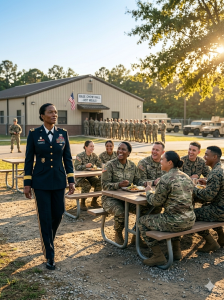
And so, the former tyrant became a servant. He started at the bottom — moving donated furniture, scrubbing out break rooms, transporting boxes between buildings. The man who had once screamed at junior Marines over minor uniform details was now sweeping floors without comment and hauling heavy boxes of donated clothing in the heat. He declined leadership roles. He actively stepped back from any opportunity to direct or oversee other volunteers. He had finally arrived at the understanding that he had no business holding authority over other human beings.
He didn’t offer speeches or position himself as a reformed mentor dispensing hard-won wisdom to younger, struggling veterans. When they vented about unfair systems, Mercer didn’t co-sign their grievances or pour fuel into their frustration with the world, understanding with unpleasant clarity where that unchecked resentment ultimately leads.
Instead, when pressed for guidance by young men who were adrift and furious, he offered the only authentic insight he had managed to pull from the wreckage of his own decisions. He only said, “If you have power, be careful with it. It can disappear faster than you think.”
While Mercer quietly swept floors far away, working in some small, insufficient way to balance a debt that could never fully be repaid, my time at the base was drawing to a close. Meanwhile, Ramirez didn’t stay at Camp Redstone. The undercover operation was concluded, the convictions were secured, and the federal task force had new objectives on the horizon. The task force moved me to Okinawa for a new assignment focused on command climate evaluation and misconduct prevention.
It wasn’t dramatic work. There would be no hidden cameras, no chow hall confrontations, no courtroom revelations played out before a packed gallery. It was slow, painstaking, and entirely necessary — auditing broad systemic failures, reviewing volumes of command policy, and working proactively to construct environments where people like Mercer couldn’t establish themselves in the first place. That work mattered more than the dramatic moments that preceded it.
But before I packed my bags and boarded the flight across the Pacific, I had one final obligation. Before she left, she met privately with several of the victims, not to congratulate them, but to acknowledge what they’d done.
I sat in a small coffee shop just off base with Sarah Jenkins and the civilian logistics contractor. They looked completely different from the people who had sat across from me in those initial interviews months earlier. The heavy, ambient fear had left their eyes, replaced by something more guarded and hard-won — a cautious resilience that had been earned rather than inherited. We didn’t celebrate. We didn’t raise glasses or exchange speeches. We simply sat together — three women who had gone up against a deeply entrenched system of prejudice and institutional abuse — and recognized honestly what it had cost to get there.
Sarah looked at me, turning her coffee cup in her hands, and said quietly, “I still get scared sometimes. I still worry that someone else like him is going to show up and try to ruin my life just because I stood up to him. I don’t feel like a hero, Ma’am. I didn’t win a medal. I just survived.”
I reached across the table and rested my hand over hers. I needed her to understand, fully and without qualification, what she had actually done. “Courage isn’t winning a fight,” she told one of them. I held her gaze and spoke slowly, wanting each word to land. “Anyone can throw a punch when they’re angry. Anyone can shout when they feel safe.”
“Courage is telling the truth when the system makes it expensive.” I held her hand steady. “You knew he could end your career. You knew his allies would try to damage your reputation. You knew the entire command structure was designed to protect him and absorb people like you. And you sat in that courtroom, looked him in the face, and told the truth anyway. That is the bravest thing I have ever witnessed.”
They both nodded, tears surfacing quietly, finally allowing themselves to acknowledge the strength they had been carrying all along. We embraced — a long, wordless moment that contained more than any formal statement could — and then went our separate ways, bound permanently by the truth we had together refused to let be buried.
On her last day, Ramirez walked past the same cafeteria window where Mercer had decided she was an easy target. I stopped on the sidewalk outside, the afternoon sun warm on my face, and looked through the large glass panels. I was in my Navy dress uniform this time, the gold lieutenant’s bars catching the light — no gray hoodie, no civilian disguise.
The tables were unchanged. The scuffed linoleum was unchanged. The noise was the same familiar layering of metal trays and overlapping voices and boots on a hard floor. It was the same physical space where a prejudiced, self-assured man had shoved me, entirely convinced that my race, my gender, and the absence of a uniform gave him the right to treat me as less than human.
But the room felt different — like people had learned that silence was a choice, not a rule.
I watched a senior NCO quietly correct a junior Marine’s posture — with patience, without theater, without the performative cruelty that had been Mercer’s signature. I watched female Marines at lunch together, laughing without looking over their shoulders, unburdened by the constant, low-grade dread of wondering whether a Staff Sergeant was going to find them alone somewhere and whisper something that could end their career.
The culture of fear had been broken. The spell had been shattered.
As I stepped away from the window and moved toward my waiting transport, I allowed myself a moment of honest reflection on the full arc of what had just unfolded. I understood clearly what accountability does and doesn’t accomplish. Taking down one toxic individual — stripping his rank, removing him from the institution, sending him to a confinement facility — does not erase the underlying prejudices of the world, and it doesn’t instantly restore what years of sustained abuse have taken from people.
It never does. But it drew a line that others could point to later.
We had taken an institution of enormous complexity and deeply embedded hierarchies and compelled it to stop and remove a predator from its own ranks. We had demonstrated that the chain of command, even when heavily compromised by personal loyalty and institutional inertia, could still be redirected toward justice — if you bring enough undeniable, irrefutable evidence and refuse to release it.
It created a record that couldn’t be erased by charisma or rank. Cole Mercer could no longer shelter behind his deployments, his pressed uniform, or the volume of his voice. His actual character — his cowardice, his violence, and his deeply embedded prejudice — was now permanently inscribed in federal court records. He was a convicted abuser, and no military anecdote or performance of toughness would ever rewrite that.
And for the people who had been shrinking themselves to survive, it offered something simple and rare: proof that speaking up could actually change the outcome.
That is the lasting truth of what happened at Camp Redstone. Not the dramatic undercover operation, not the hidden cameras, not the striking image of a Black woman producing a federal badge in a crowded cafeteria. The lasting truth was simpler and more durable than any of that. It was proof that you do not have to endure the darkness indefinitely. It was proof that your voice — even when it’s shaking, even when the forces aligned against you seem impossibly large — carries the capacity to bring down people who have convinced themselves they are beyond reach.
I got into the back of the transport vehicle. The engine turned over and we began moving. I took one last look at the sprawling base in the rearview mirror as we passed through the main gate. The work was done. I had taken the hit, asked the question, and watched the tyrant fall. Now it was time to go to Okinawa and begin again.
Because the bullies are always out there, sheltering behind their rank and their presumed immunity. But so are the people holding the cameras. And we are never, ever going to stop holding the line.
THE END.
