


“Don’t move.”
The order rang out across Greenfield Family Market, sharp enough to hush the entire store. One moment, Vivien Ashford stood in aisle seven holding a bag of apples, with eggs and bread already paid for, and the next she was thrown to the floor with such force that the cold linoleum stole the air from her lungs. A deputy’s knee drove into her back. Her cheek was pressed hard against the ground. Close by, eggs shattered and smeared across the tile. A child started crying. And before Vivien could fully grasp what had happened, phones were already lifting in every direction, tiny red recording lights blinking beneath the harsh fluorescent glow.

She did not scream. She did not plead. She did not struggle under the weight crushing her ribs. She counted. Badge number. Time. Witnesses. Cameras. The receipt lay inches from her face, timestamped, fully paid, but Deputy Earl Sutter didn’t bother to pick it up. Instead, he leaned in and muttered words laced with coffee, tobacco, and disdain. “You people always got a story.”
That was when Vivien realized this had never been about groceries.
She kept her tone steady, even as her lungs strained for air. She told him she had paid. She told him the receipt was right there. He told her to be quiet. Around them, the ordinary pieces of a Saturday afternoon turned into evidence: flattened bread, apples scattered across the floor, lipstick spilled from her purse, cracked reading glasses, a silk blouse smeared with egg yolk and dirt. Deputy Kyle Jennings stood a few feet away, his hand hovering near his holster, clearly uncertain, but not enough to step in.
All around, people watched through their screens. A college student named Marcus Webb held his camera steady despite the tremor in his hands. A young mother angled her cart so her toddler wouldn’t see, yet she kept recording. An older man raised a flip phone. A woman in yoga clothes filmed with tears in her eyes. The entire aisle felt tense, like the charged air before a storm breaks.
When Sutter took out the handcuffs, Vivien heard the metal before she felt it. The sound struck deep inside her. She had heard that rattle in courtrooms, on evidence recordings, in testimony, in the aftermath of other people’s worst days. Never her own. He yanked her wrists behind her back and snapped the cuffs on too tightly. She felt the intention in the way the metal cut into her skin. He recited her rights like someone putting on a show rather than following protocol.

Then, cutting through the stunned silence of the store, another voice spoke.
“This isn’t right.”
Dorothy Clemens, seventy-three, a retired teacher who had lived through injustices many preferred to forget, stood near the dairy section holding a carton of milk. She said she had watched Vivien pay. She said the woman had done nothing wrong. Sutter told her to step back. Dorothy refused. Then she raised her own phone and began recording as well.
Vivien was pulled to her feet and led through the store in handcuffs. Her face was bruised, her lip split, her wrists bleeding, yet she walked upright, her chin lifted. They could take her comfort, her privacy, even her freedom for a few hours, but they could not take the dignity she chose to hold onto.
After the deputies forced her outside, Dorothy bent down to pick up one of the bruised apples from the floor. Her hand brushed against something else tucked beneath a shelf. It was a small black leather case edged in gold. She opened it, and the color drained from her face.
Inside was a judicial badge.
Honorable Vivien M. Ashford. Circuit Court Judge. State of Georgia.
In a single moment, the entire situation shifted. They had not just humiliated an innocent Black woman in public. They had placed handcuffs on a sitting judge.
By then, Vivien was already seated in the back of a cruiser, her wrists secured behind her, forcing herself to breathe through pain that radiated from her shoulder down both arms. Sutter looked at her through the rearview mirror with the confidence of someone convinced he still controlled the narrative. He had no idea Marcus Webb had already uploaded the video. He had no idea the footage was spreading across the internet faster than the cruiser was heading to the station. He had no idea the woman sitting behind him handled police misconduct cases for the entire district.
At the station, the system behaved exactly as it does when it believes it will never be challenged. Sutter escalated the charge from shoplifting to something more severe before the booking process was even complete. Vivien listened as one false claim after another was entered into the record: unpaid merchandise, resisting detention, assaulting store staff. She corrected him calmly, but the process continued unchecked.
They took her purse, her watch, her glasses, and finally her wedding ring—the one she had worn every day since her husband Marcus passed away. That was when the ache in her chest deepened into something sharper than anger. Standard procedure, they called it.
But “standard procedure” sounded very different when it was used to justify cruelty.
She was fingerprinted, photographed, reduced to an inmate number, and placed alone in a holding cell with concrete walls and a steel bench. There, finally without the handcuffs but not free from their pain, Vivien sat and did what she had always done in moments of crisis. She recorded everything in her mind.
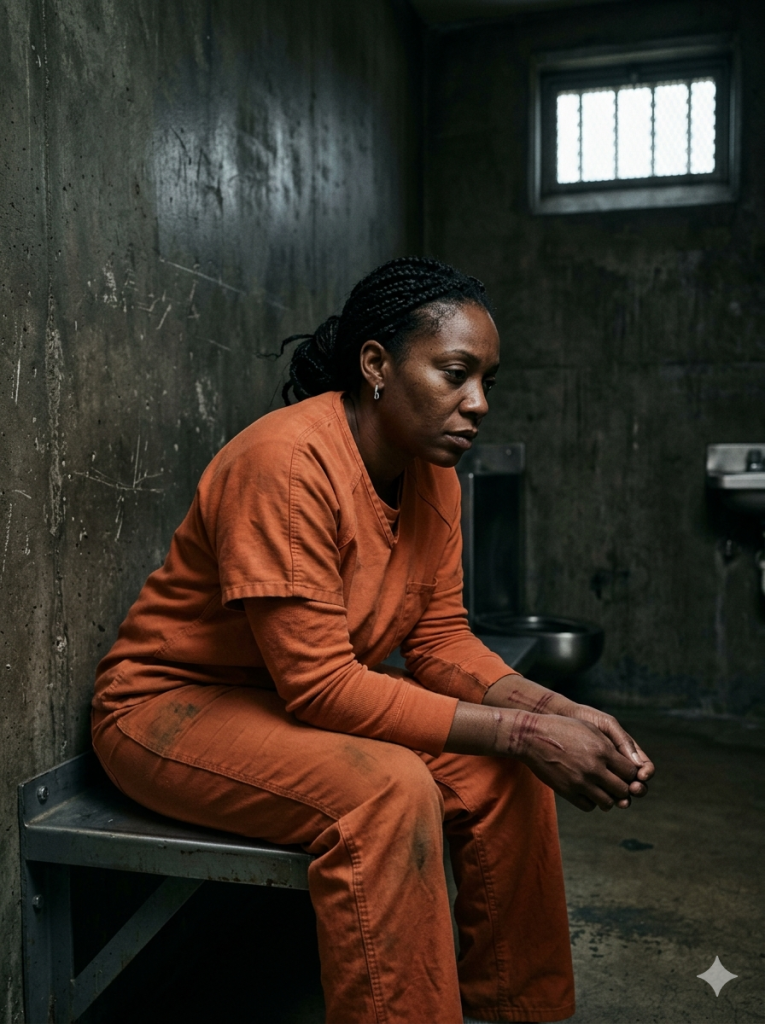
Time passed. Outside, events were moving faster than anyone inside the station understood. The video had reached hundreds of thousands of views, then more. Reporters began to arrive. Protesters gathered. Chants started to rise beyond the station walls. A young deputy named Maria Vasquez, unsettled by what she had witnessed, quietly slipped Vivien a handwritten note through the slot in her cell door. It listed names, times, badge numbers, radio statements. At the bottom, underlined twice, Vasquez had written: No probable cause observed. No evidence of theft. Receipt visible at scene.
That note became the first fracture in the barrier they believed would shield them.
Later, Captain Raymond Torres brought Vivien into an interview room and attempted to soften the situation with carefully chosen words. He called it a misunderstanding. He suggested things had gotten out of hand. He implied it could all disappear if she cooperated, if she stayed silent, if everyone agreed to move forward.
Vivien listened. Then, in a voice so controlled it unsettled him more than anger ever could, she reminded him she had already requested counsel, reminded him of the law, reminded him that delaying access to an attorney could compromise everything that followed.
Torres stared at her.
“You seem very familiar with the legal system,” he said.
Vivien met his gaze and said she would answer no questions without her lawyer present.
By then, attorneys were already at the front desk demanding access. Emergency petitions had been filed. News outlets were turning the footage into the lead story of the night. The chant outside had shifted from outrage to demand.
When Vasquez finally came to escort Vivien to the conference room, she asked quietly, “Who are you?”
Vivien thanked her for her kindness and kept walking.
Inside the conference room, three attorneys outlined the scale of the fallout. Millions of views. National coverage. Offers from the sheriff’s office to drop all charges immediately if she would agree not to take action. Confidentiality clauses. Quiet release. Silence in exchange for freedom.
Vivien almost smiled.
When powerful people ask for silence, it is usually because they know the truth is louder than they can withstand.
Then she told Lorraine Mitchell, senior counsel from the NAACP Legal Defense Fund, exactly who she was.
She was not merely a respected lawyer. Not merely a citizen wrongfully arrested. She was Judge Vivien Ashford, a circuit court judge with twenty-three years on the bench, the very judge who oversaw the police misconduct docket in the seventh judicial district. She knew the names. She knew the prior complaints. She knew Earl Sutter’s file.
Lorraine went pale.
“They arrested a judge,” she whispered.
Vivien replied with the calm of someone who had already recognized the shape of what came next. Yes. On camera. In public. With a receipt they never even examined.
The panic inside the station escalated after that. Calls came in from higher offices. The governor was informed. State investigators were ordered to step in. Federal attention followed soon after. Torres returned, visibly shaken now, no longer projecting confidence, only trying to contain the damage. He attempted to explain that he had not known who she was.
Vivien gave him the only answer that mattered.
It should not have mattered.
That was the true indictment, sharper than any headline: it should never take status, title, or power for someone’s humanity to be acknowledged.
When she walked out of the station that night, there were no handcuffs on her wrists. Flashing cameras captured her this time not in humiliation, but in emergence. The crowd fell silent as Lorraine stepped to the microphone and revealed what the public had not yet fully confirmed.
Their client was the Honorable Vivien M. Ashford, Circuit Court Judge, State of Georgia.
The quiet that followed felt almost sacred before it broke into shock.
At the edge of the crowd, Dorothy Clemens raised the badge she had carried all afternoon and held it up to the cameras like proof that truth can endure even when dropped, kicked aside, and forgotten on a grocery store floor. Vivien saw her and felt something within her composure soften just enough to allow gratitude in.
Then Vivien stepped forward to the microphone.
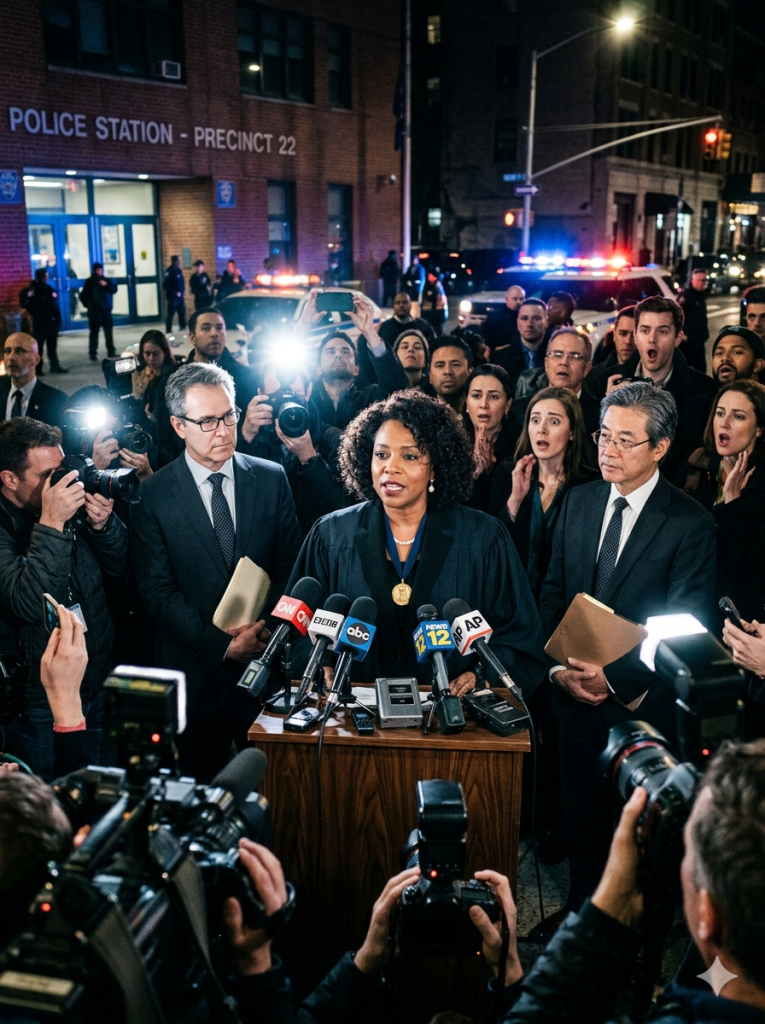
She spoke about buying eggs and bread on an ordinary Saturday. She spoke about being thrown to the ground by a deputy who never asked her name and never checked her receipt. She spoke about being reduced to a number, separated from her wedding ring, and placed in a cell. Then she delivered the line that transformed a personal injustice into a public reckoning.
This was not only about her.
It was about every person who had been treated this way without the protection of a title, a platform, or lawyers rushing to their defense. Every person judged by appearance before evidence. Every person who never went viral. Every person whose dignity had been treated as expendable.
She called for a federal investigation. She demanded a review of arrests, patterns, complaints, training, and departmental culture. She named Sutter. She named the corruption of assumptions. She refused the offer of silence in exchange for release.
“I don’t disappear,” she said. “And neither does the truth.”
From that moment on, the case ceased to be one woman’s ordeal and became a reckoning no one in that department could escape.
The consequences came quickly. Within days, Sutter was charged. Torres was pushed out. The sheriff resigned. Internal files were opened. Evidence once dismissed became central. The receipt, that small crumpled strip of paper the deputies had treated as insignificant, entered federal court as a powerful piece of proof. Jennings, who had stood by without acting, began cooperating. Holloway stepped down. Vasquez, who had chosen conscience over convenience, was later promoted.
Vivien recovered her belongings by court order. Her watch was returned first. Her glasses, cracked. Then her ring. She held it in her palm before slipping it back onto her finger, feeling not only relief but restoration, as if a part of herself had been released from evidence storage and returned where it belonged.
The country moved on the way it always does, toward the next scandal, the next outrage, the next cycle. But Vivien refused to let the meaning of that day shrink into a headline. She turned it into something greater. Reform efforts followed. Oversight expanded. Policies changed. Her name became tied not only to a humiliation caught on video, but to an initiative built on dignity, accountability, and structural change.
Months later, standing before a packed community center, she raised the faint scars left by the cuffs and did not hide them. They were not marks of defeat. They were evidence. Evidence that she had been pushed down and still rose. Evidence that pain could become testimony. Evidence that a moment meant to diminish her had instead revealed an entire system.
She thanked Dorothy, who had picked up what others overlooked and carried the truth until the right moment. She honored Marcus, whose memory continued to steady her when the house grew quiet at night. And she told the room what the entire story had been building toward from the beginning:
Dignity does not come from a robe, a courtroom, a badge, or a title. It belongs to a person before any institution chooses to recognize it.

That night, when the speeches ended and the crowd had gone home, Vivien stood by her window with her wedding ring catching the last of the fading light. The bruises had healed. The headlines had moved on. But the truth remained.
They had tried to make her small in aisle seven.
Instead, they revealed just how small their own power became the moment someone finally refused to bow beneath it.
