


PART 1: THE MORNING HE FINALLY SAW ME
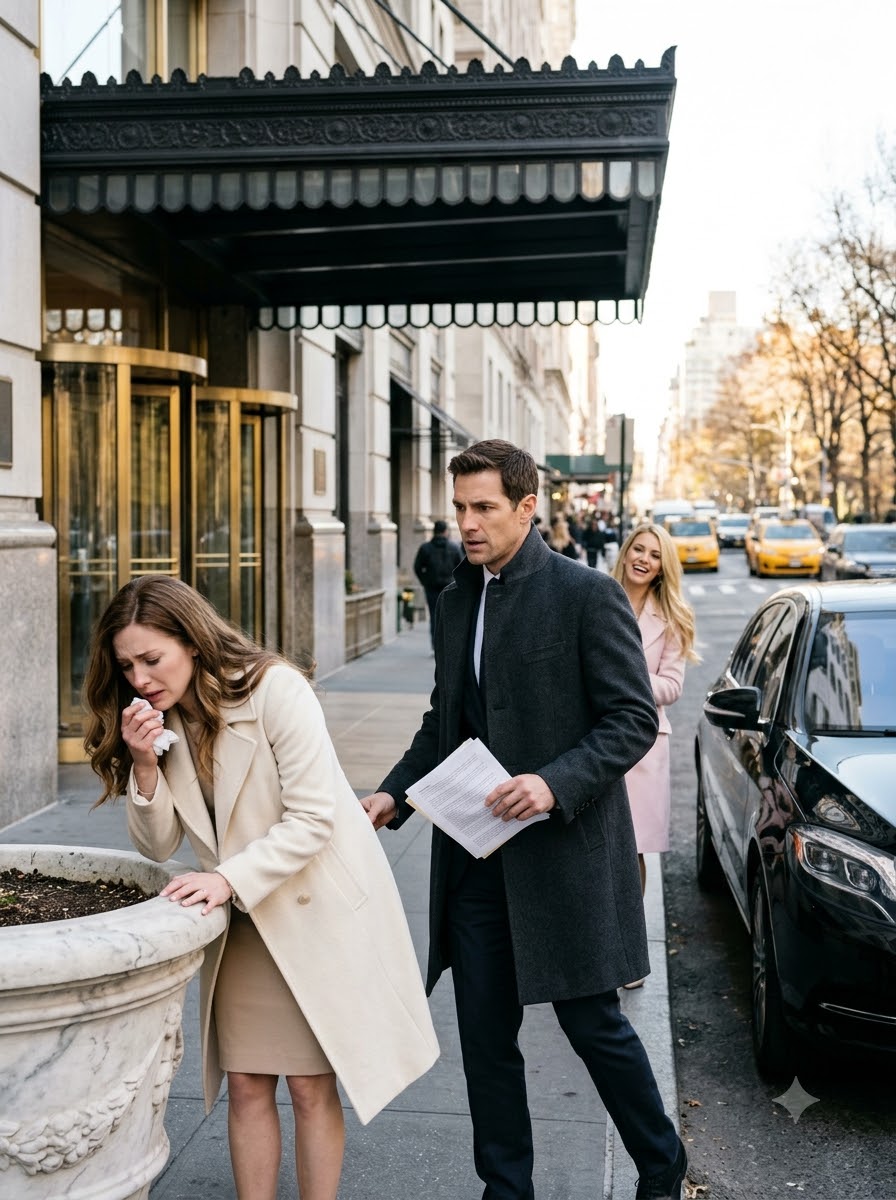
My husband’s mistress laughed while I threw up into a marble planter, ten minutes before our divorce signing.
Across the driveway of Mercer Tower, Adrian stood beside his black Maybach, holding the papers that would pay me twenty-six million dollars to disappear.
“Maybe she’s allergic to divorce papers,” Vanessa Reed said lightly. She leaned against the car in a pale pink coat, her glossy hair lifting in the November wind. She looked beautiful, expensive, and completely comfortable standing exactly where I used to stand.
I wiped my mouth with a damp tissue. “I’m just carsick.”
For three months, Adrian had barely looked at me. Now he looked at me for three long seconds. Then he turned to his driver.
“Cancel the lawyers.”
Vanessa stopped smiling. “Adrian—”
“We’re going to the hospital.”
“No,” I said. “I make my own medical decisions.”
“Then make a sensible one. When did you last eat?”
“Last night. Soup.”
“And this morning?”
“Tea.”
“Claire, you’re shaking.”
I almost laughed. My husband had spent ninety days making the worst decisions of his life, and now he wanted to lecture me about being sensible.
Above us, thirty-eight floors of blue glass reflected the pale Manhattan sky. Inside, six attorneys waited around a conference table. Twelve signatures would end seven years of marriage. I would receive the money, a Boston townhouse, and our lake house in Vermont. Adrian would keep his empire and his freedom to build a new life with Vanessa. I would hand over my company keycard, leave the foundation I had helped create, and promise to stay silent about what had happened between us.
His lawyers called it generous. I called it the price of being replaced quietly.
Until that morning, I had decided the price was acceptable. I wanted peace more than revenge. I wanted to stop checking whether my husband had come home. I wanted to stop recognizing other women’s perfume on the coats hanging beside mine. Most of all, I wanted to stop wondering what was wrong with me.
I reached for the planter to steady myself. The marble was cold under my fingers.
Then the pavement tilted.
The buildings slid sideways, and a strange roaring filled my ears. My knees gave out. Before I hit the ground, Adrian caught me around the waist.
“Claire!”
He sounded frightened. I hadn’t heard that in years.
For one terrible second, I was pressed against his chest, breathing cedar and expensive soap. Memories came uninvited. Our first apartment. Rain on the windows. Adrian carrying in takeout because he’d forgotten groceries. I hated that my body remembered him so easily.
Vanessa appeared at his elbow. “This is getting ridiculous.”
“Get back,” Adrian said, without turning his head.
She froze. I had heard him use that tone on executives who disappointed him. I had never heard him use it on her.
When the dizziness faded, I made myself look at him. “I’ll go to the hospital because I need medical care. But afterward, we’re still getting divorced.”
His fingers tightened against my back.
He didn’t answer. That silence told me more than any promise could have.
At the hospital, he became the Adrian I remembered from the beginning. He gave the nurse my full name. He remembered my medication allergy. He knew the date of my ankle injury and the name of the specialist who treated it. When someone asked whether he was my husband, he answered before I could speak.
“Yes.”
One word, carrying seven years of promises.
Dr. Bennett came in with a tablet and a gentle, professional smile. She asked about the nausea, the exhaustion, the sudden hatred of coffee. Adrian leaned forward at every symptom I mentioned. For months I had competed with conference calls and late dinners and a woman who seemed to know his schedule better than I did. Now he hung on every word.
Then Dr. Bennett glanced at her screen.
“Mrs. Mercer, when was your last menstrual period?”
I opened my mouth. Nothing came out.
I counted backward. The foundation’s autumn dinner. The argument afterward. The morning I blamed the coffee. My hands went cold.
“Is there a chance you might be pregnant?”
The room went silent. I couldn’t look at Adrian.
“I suppose it’s possible,” I whispered.
He stood immediately. “I’ll wait outside.”
When the door closed, a memory I had buried came rushing back. Eight weeks earlier, Adrian had come home unexpectedly. He had looked exhausted. He had asked whether we could talk without arguing. We had sat up for hours, with apologies and tears and a fragile belief that we weren’t beyond saving. For one night, I had let myself trust the man I married.
The next morning, he left before breakfast. Two weeks later, I learned he was still seeing Vanessa.
The nurse took my sample. The wait felt endless.
When Dr. Bennett returned, she closed the door with care. Not frightened. Not dramatic. Just careful.
“Claire,” she said, “your pregnancy test is positive.”
The words floated somewhere above the white walls and the folded blanket on my knees. Eight weeks. One night I had been foolish enough to believe in.
And just outside that door, a man who had never once accepted losing something he believed belonged to him was waiting for me to walk out.
PART 2: THE WOMAN WHO WANTED MY PLACE
I told him myself.
I could have let Dr. Bennett say it, and watched the news arrive like another decision made by someone else. Instead, I straightened my spine.
“Adrian, I’m pregnant.”
His face went blank. Then I watched shock, disbelief, and something that looked painfully like joy move across it, and then fear.
“We’re having a baby,” he breathed.
I flinched. He saw it, and the smile died.
“This doesn’t change what happened,” I said. “You cheated. You lied. You let another woman stand beside you while I was still your wife.”
“I know.”
“You don’t get to say ‘please’ and make three months disappear.”
He stared at the floor. “Are you frightened?”
The question almost undid me. He hadn’t asked whether I was happy. He hadn’t asked whether the baby could save us. For once, he had asked about me.
“Yes,” I admitted. “And I’ll decide what I need. Then we can discuss what comes next. You’re the father, and I’m not pretending otherwise. But that doesn’t make you my husband in every way that counts.”
In the car, he said quietly, “Do you remember Vermont? The weekend we talked about having children.”
Of course I did. Our fourth anniversary. Rain across the lake. Adrian burning breakfast while I laughed so hard I spilled orange juice everywhere. He had kissed my forehead and promised our child would grow up knowing love could be dependable.
“Then why didn’t you live like it?” I asked.
He closed his eyes. No answer came.
His phone lit up with Vanessa’s name. He didn’t pick up. At the penthouse, as we waited for the elevator, the screen lit again, and this time I saw the message.
DID SHE FINALLY SIGN?
Adrian went pale. I understood something then. Vanessa was still waiting for me to vanish, and he hadn’t found the courage to tell her the plan had changed.
I stepped into the elevator alone and raised a hand when he moved to follow. “Not yet.”
Through the narrowing doors, I watched him stand motionless in the lobby. For the first time in ninety days, he was the one left behind.

I packed that night. I took my mother’s silver bracelet, my parents’ photographs, and my favorite books. I held the pearl earrings Adrian gave me on our second anniversary and put them in their velvet case. I wasn’t ready to decide about those.
The next morning, I walked into Mercer Tower to collect my things.
Vanessa was waiting in reception, smiling. “You’re looking so much better.”
“Good morning, Vanessa.”
“Adrian was beside himself yesterday. He barely answered my calls.”
“That must have been difficult.”
She followed me down the corridor. “He’s not going back to you, Claire.”
The old humiliation flickered in my chest. Then it faded. I was too tired to compete, and too aware of the life quietly beginning inside me.
“I didn’t come here to ask him to,” I said. “The difference is that I’m finally choosing not to participate.”
My office was already packed. Three cardboard boxes sat by my desk. My books were gone from the shelves. My wooden nameplate lay in the top box. Seven years of work, reduced to cardboard.
Maya, who had worked with me for three years, stood in the doorway with tears in her eyes. “Nobody wanted to do it,” she whispered.
“Thank you for being careful with it.”
Outside, I heard Vanessa’s voice. “Surely there’s a way to make this less theatrical.”
I opened the door. “You seem very concerned about how long it takes me to pack.”
Her cheeks flushed. She said it loudly enough for the whole corridor to hear. “You have twenty-six million reasons to stop complaining.”
“Money can replace a home,” I said. “It can’t replace trust.”
“Vanessa.” Adrian stood by the elevator, alone, no assistant, no phone. “What is going on?”
She rushed to him and touched his sleeve. I didn’t wait to watch him choose. I had spent three months waiting for Adrian to choose me, and now I made my own choice. I went back into my office and closed the door.
He knocked a minute later. He looked at the boxes and the empty shelves. “I didn’t think about what it would look like.”
“You didn’t have to,” I said. “You weren’t the one being asked to leave.”
“I can stop the resignation.”
“What I want is for you to stop treating the consequences of your choices as problems you can solve by giving me permission to stay.”
I placed my nameplate back on the desk. Then my phone rang. Eleanor Brooks, my attorney.
“Claire, are you sitting down? I’ve gone through the settlement line by line. There’s a clause on page thirty-one. A full waiver of all claims, known or unknown, arising from the marriage or its dissolution. It specifically names any claim connected to a pregnancy.”
My blood ran cold.
“It was added eleven days ago,” Eleanor said. “The revision request came from V. Reed.”
I looked up. Adrian was standing three feet away, and he had heard every word.
PART 3: THE LIFE I REFUSED TO LOSE
Adrian took the phone from my hand. His voice was low and dangerous.
“Send me the document. Now.”
Within a minute, it was on his screen. I watched him find page thirty-one. I watched his jaw lock.
“I never read this.”
“That,” I said, “has always been the problem.”
He didn’t defend himself. He didn’t say he’d trusted his lawyers or that he’d been busy. He looked at the page for a long time, then walked out of my office and straight to Vanessa.
I didn’t follow. I heard only fragments. His voice, level and cold. Hers, rising into protest and then into fury. A door. The elevator. Then silence.
That afternoon, Adrian dismissed the attorneys who had drafted the clause. By evening, the waiver was gone, along with the confidentiality language that would have gagged me about my own child. Eleanor rewrote the settlement. I kept the financial terms, because I didn’t want to spend a year fighting over numbers. But the new agreement gave me a voice about my health, my child, and my own history. It also gave me my name back at the foundation, as a consultant on my own terms.
I moved into a small furnished apartment on the Upper East Side. The kitchen barely fit two people. The heater clicked every time it started. I loved it immediately. Nobody had chosen it for me. I had signed the lease myself.
Adrian came to see me a week later, carrying soup in a paper bag.
“I thought about what you said,” he told me across my tiny dining table. “I kept telling myself our marriage had become difficult. The truth is that Vanessa didn’t ask hard questions. She admired me. And you knew me. You knew when I was making excuses.” His voice cracked. “So I punished you for it.”
I laughed once, and it wasn’t a happy sound. “Did you love her?”
“I thought I did. I think I loved how I felt when I was with her.”
It hurt. But it was honest, and honesty was something I could finally work with.
“I’m sorry, Claire,” he said. “I don’t expect forgiveness tonight.”
“Good.”

When he stood to leave, he paused at the door. “If you still want the divorce, I won’t stop you.”
For the first time, I believed that he meant it.
The divorce went through quietly, with my own signature on every page. And I read every word.
Seven months after the morning outside Mercer Tower, I went back to the hospital. There was no cream wool coat this time, no lawyers waiting, and no woman in pink laughing while I fought to stay on my feet. My mother held my hand through the long hours. I had called Adrian that morning, and he arrived and asked what I needed, then did exactly that.
When the cry finally came, it changed everything.
“Hello, June,” I whispered. I had chosen the name weeks earlier, after the month she was due and the season I had always loved at our lake house. Her small fingers curled around mine.
Adrian came in and stopped at the door. His eyes went from my face to the bundle in my arms, and his hand flew to his mouth.
“Come meet your daughter.”
He held her as if she were made of glass. Tears ran down his face, and he didn’t hide them. “Hello, sweetheart. I’m your dad.”
“I’m going to do better,” he told me later.
“Don’t tell me what you’re going to do,” I said gently. “Just do it.”
He nodded. And in the months that followed, he did. He came on the days we agreed. He learned her sounds and her routines. He stopped bringing expensive toys she was far too young to want, and brought himself instead.
In early autumn, I took June to Vermont. The trees had turned gold and red, and the lake lay still beneath a pale blue sky. The silence in the house no longer felt like something missing. It felt peaceful.
That evening, Adrian stood beside me on the porch. “I think about that morning outside Mercer Tower,” he said. “I hadn’t looked at you in months. I was so busy telling myself I deserved to be happy that I forgot what I was doing to you.”
“I spent a long time wondering why I wasn’t enough,” I told him. “But I finally understood that I could never make you faithful by becoming easier to betray.”
He closed his eyes. “I’m so sorry.”
“I know. I don’t need you to keep apologizing. I need you to remember, so you never teach our daughter that love is something people can neglect until they’re afraid of losing it.”
He nodded slowly. Then he walked to his car without asking for another chance.
I stood on the porch with June warm against my chest and watched his headlights vanish between the trees. Inside, the old green notebook lay open on the coffee table. The promises we had written years ago were still there. Tell the truth when it’s difficult. Come home when you say you will. Never make someone beg for ordinary love.
I turned to a clean page and wrote the last sentence myself.
The life I lost was not worth more than the life I was finally free to build.
I had believed my greatest achievement was helping Adrian Mercer build an empire, and then that my greatest failure was being unable to save our marriage. Both beliefs were wrong. My worth had never depended on what I built for him, and my future had never depended on whether he chose me.
The man who once stood outside a glass tower with twenty-six million dollars in divorce papers believed our marriage could end with twelve signatures. He was right about the marriage.
He was wrong about what would happen to me afterward.
I didn’t disappear. I came home.
THE END
Note: This story is a work of fiction inspired by real events. Names, characters, and details have been altered. Any resemblance is coincidental. The author and publisher disclaim accuracy, liability, and responsibility for interpretations or reliance. All images are for illustration purposes only.
