

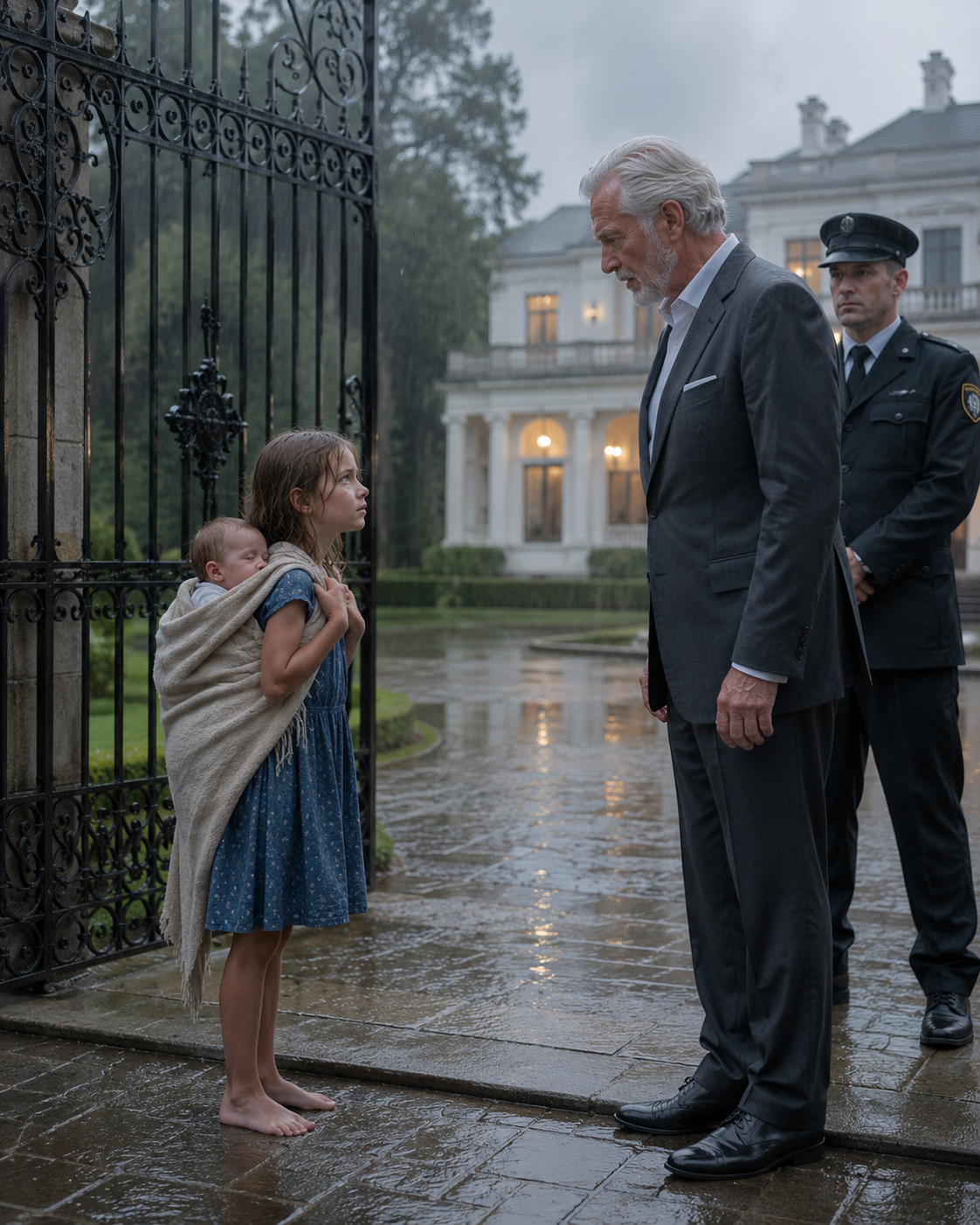
MIRA VALE stopped a billionaire right at his own gate because the baby strapped to her back hadn’t eaten since the day before.
Rain had polished the black iron of Hawthorne House until the tall gates gleamed like glass. Mira stood before them barefoot, her faded blue dress soaked dark at the hem, one hand steadying the cloth sling that held little Leni asleep against her back. The guard had already told her to move along. She stayed anyway, because waiting there felt easier than going back to the room with no bread and no word from the landlord.
When the silver-haired man in the charcoal suit appeared on the drive, she stepped forward before fear could silence her. His hand rested on the gate latch, his expression distracted, like a man used to having every problem handled by someone else. Mira took in the polished car, the house glowing warmly behind him, and then noticed the small chance that he might actually listen.
“Sir, do you need a maid?” she asked.
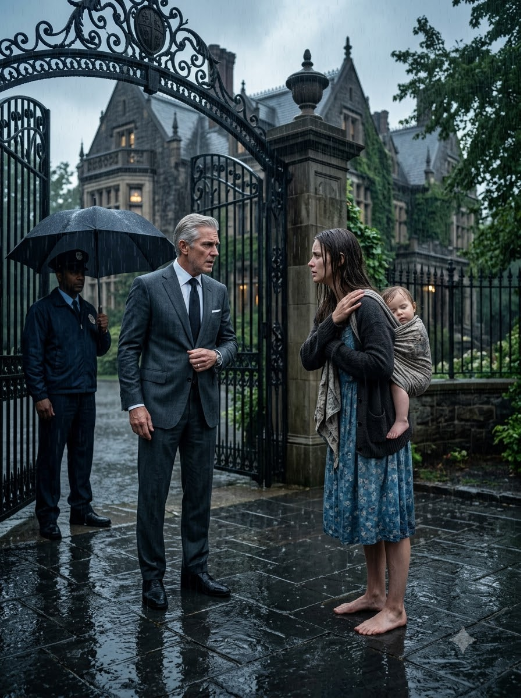
ADRIAN HAWTHORNE paused. The guard reached for Mira’s elbow, but Adrian raised two fingers without turning around. Mira swallowed and pressed on, forcing out the words that had been circling in her mind all morning.
“I’ll do anything, please!”
Leni stirred in the sling, her cheek resting against Mira’s shoulder. Mira felt the baby’s breath, too shallow and too warm, and the shame she’d been carrying sharpened into something else.
“Don’t let my little sister go hungry.”
The drive fell quiet except for rain tapping against stone. Mira wasn’t asking for pity. She was offering the only things she believed were still hers: her hands, her time, and whatever strength she had left after crossing the city on foot.
“I’ll feed her, wash her clothes.”
The guard glanced away. Adrian finally looked straight at Mira — not at her soaked shoes or the bundle on her back, but at her face. She hated that attention almost as much as she needed it.
“I’ll do all the housework!”
For a long second, Adrian’s expression didn’t shift. Then a small hand slipped out of the sling and caught the chain at Mira’s throat. A tarnished half-moon locket swung free in the rain. Adrian’s breath caught as though he’d been struck.
“My God!” he said.
Mira covered the locket with her palm. It was the only thing their mother had left her, and it had never once opened. Adrian took a step closer, then stopped himself at the gate. His eyes stayed fixed on the shallow scratch beside the clasp — a mark Mira had traced since she was a child without ever understanding it.
“Where did you get that?” he asked, his voice suddenly unsteady.
Mira pulled Leni closer. No wealthy stranger had any right to ask about their mother. And yet Adrian wasn’t looking at her like a girl asking for work anymore. He was looking at the locket as if it had come back from a grave.
Rain streamed down Mira’s face as she made a choice that scared her more than hunger ever had. She gave him her mother’s name. Adrian went pale, and the gate between them started to swing open.
Adrian didn’t invite Mira inside right away. He sent the guard for dry towels and a bowl of soup to the small gatehouse, then stood in the doorway as though he didn’t trust his own memory. Mira kept Leni on her lap, watching his every move. Hunger had taught her that kindness could change its price without warning.
He set an old photograph on the table. In it, a younger Adrian stood beside a woman with Mira’s eyes and the same stubborn tilt to her chin. The woman wore the half-moon locket. On the back, in fading ink, was a single name: Elara Vale.
“She was my sister,” Adrian said.
Mira stared at him. Her mother had never once mentioned a brother. Elara had only ever said that some doors were safer left shut, then had died two winters earlier, leaving Mira with a single instruction: protect Leni, no matter the cost.
Adrian explained that he and Elara had fought after she refused a marriage arranged to save the family company. He had chosen the company, telling himself there would be time later to make things right. By the time he went to find her, she was already gone. The locket had been their childhood signal — inside its hollow moon, they used to hide notes whenever their father made the house feel unsafe.
Mira gripped it tighter. “It doesn’t open.”
“It opens with a pin,” Adrian said. “There’s a seam beneath the scratch.”
He didn’t reach for her. Instead, he set a small sewing pin on the table and slid it toward her. That restraint was what made Mira listen. With shaking fingers, she found the seam. The locket clicked open. A thin folded strip of paper, wrapped in waxed thread, slipped into her palm.
The handwriting was her mother’s. It wasn’t a confession of wealth or a promise of rescue. It was a warning: If Adrian ever finds you, let him prove he has changed before you give him your trust. The final line named a woman called Celeste Marr, the housekeeper who had helped Elara leave and had kept a box for Mira, waiting until she was old enough to ask for it.
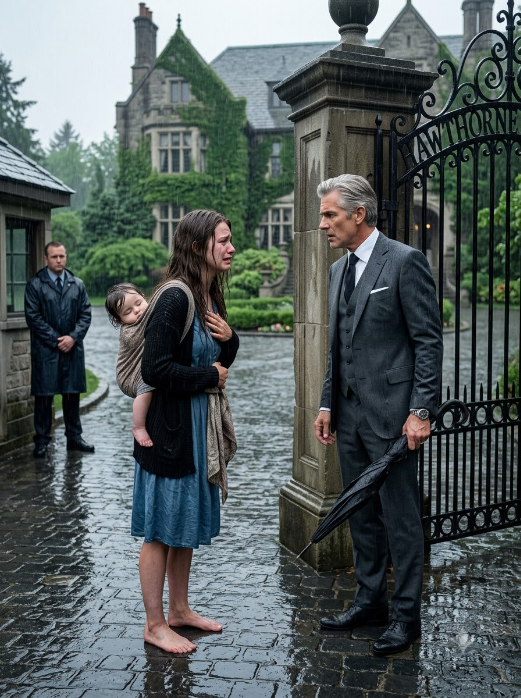
Adrian read none of it. Mira only told him it mentioned a box. His face tightened at the name Celeste. She had retired years ago to a narrow street near the river, he said, though he’d had no idea she was holding on to anything.
Mira looked over at Leni, now awake and sipping soup from a spoon. A warm room and a famous surname could still turn out to be a trap. She told Adrian she would go to Celeste on her own.
“You won’t,” he said, then caught himself. “I mean, you shouldn’t have to go alone. But it’s your call.”
That small correction mattered. Mira left the gatehouse with the address tucked in her pocket, two bus tickets from the guard, and Adrian’s card, with no promise she’d ever use it. At the street by the river, Celeste opened her door before Mira could even knock, as if she’d been waiting for the rain to finally bring Elara’s daughter home.
Behind Celeste’s chair sat a wooden box with Mira’s name burned into the lid. On top of it rested a second half-moon, broken away from the first. Celeste touched it gently and said, “Your mother wanted you to know why she ran.”
