

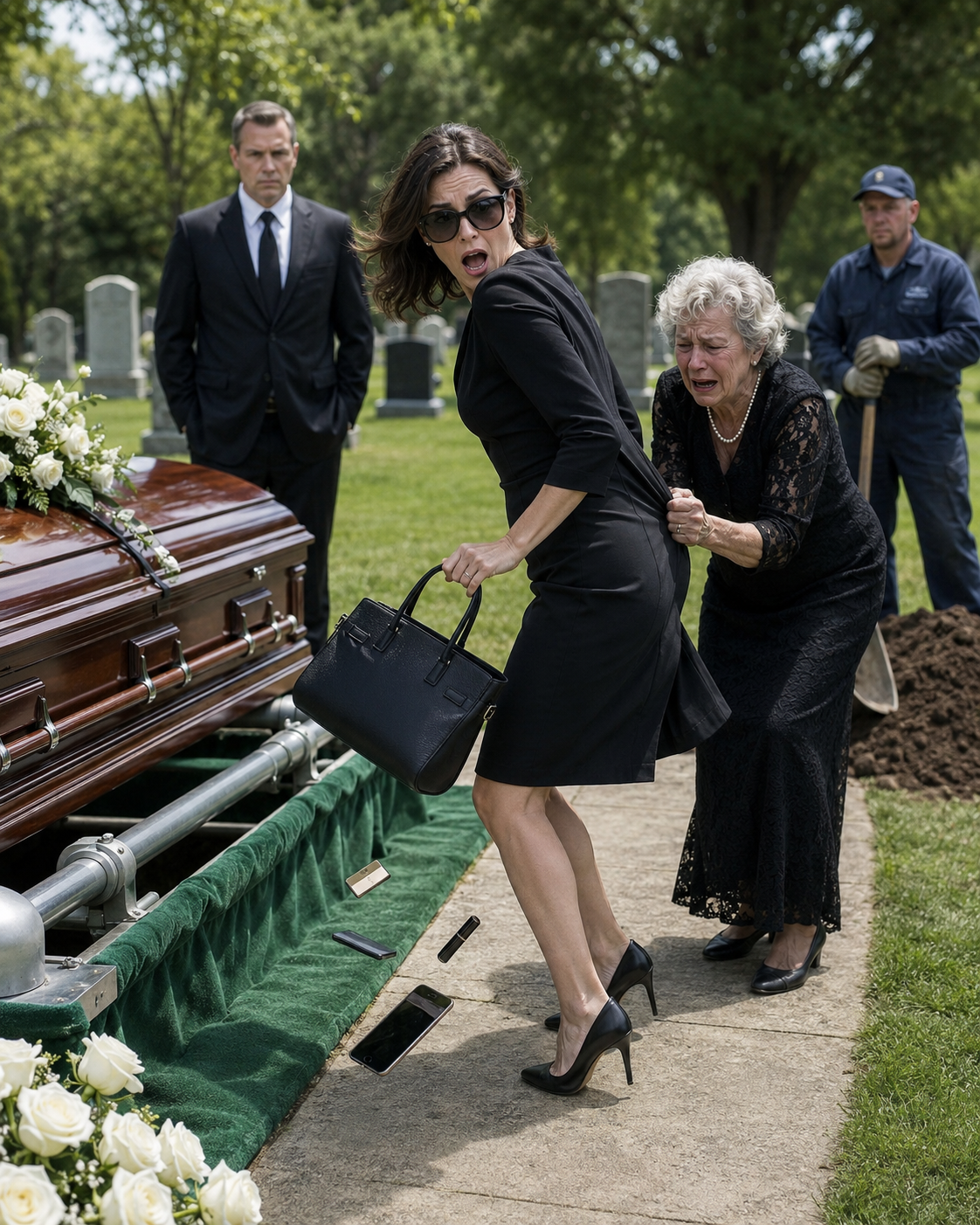
The Wrong Casket
Marguerite pushed through the crowd before anyone could stop her, and by the time her son-in-law’s hand shot out to grab her arm, she already had both fists wrapped around the strap of her purse like it was a shield.
She had not slept in two days. Not since the phone call.
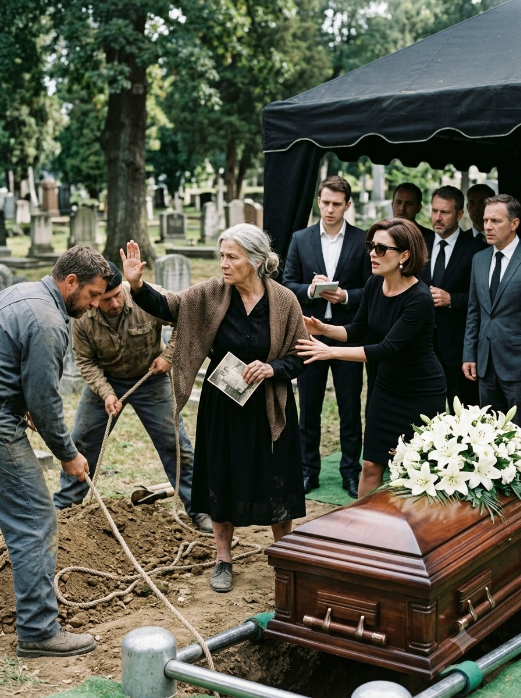
“Ma’am, please,” the young man said, though he was not young at all — just younger than her, which at seventy-one covered most of the world. “The service is about to start.”
“The service can wait,” Marguerite said. “I want to see my daughter.”
Her daughter was Rosalind. A marine biologist. A woman who used to send her postcards from research stations in places Marguerite couldn’t pronounce, who called every Sunday at eleven without fail — until three weeks ago, when the calls stopped, and then yesterday, when a cousin twice removed had messaged her a photograph of a memorial program with Rosalind’s face on the front.
No one in the family had told her. Not her son-in-law. Not Rosalind’s employer. Not even Priscilla, Rosalind’s research partner, who Marguerite had always trusted like a second daughter.
She had taken three trains and a taxi she couldn’t afford to get here.
The chapel was small, wood-paneled, smelling of white lilies that had started to brown at the edges. A closed casket sat at the front, draped in a white cloth with a single photograph propped beside it — Rosalind, laughing, sunburned, standing on the deck of a research vessel.
Marguerite had taken that photograph herself.
“Why is it closed?” she asked, louder than she meant to.
Priscilla appeared at her elbow, dressed in black, her eyes red-rimmed. “There was an accident on the boat. The propeller — it wasn’t a clean thing, Marguerite. You don’t want that as your last memory of her.”
“I want to see my daughter,” Marguerite said again, and this time her voice cracked down the middle.
A murmur went through the gathered mourners. Someone’s chair scraped the floor.
Marguerite walked to the front of the chapel alone. No one moved to stop her a second time — perhaps because grief has a certain authority that even lies struggle to override.
She placed both hands on the lid.
“Marguerite, don’t,” Priscilla said, but there was something wrong in the way she said it. Not sorrow. Urgency.
The lid came up heavier than she expected.
Inside lay a woman, dressed in Rosalind’s favorite green blouse, a shell necklace Marguerite had never seen resting against her collarbone. The face had been arranged with careful cosmetics, but even from a foot away, Marguerite could see the truth in the shape of the nose, the set of the jaw.
“That is not my daughter.”
“The accident—” Priscilla started.
“I carried that girl for nine months,” Marguerite said. “I know the back of her hand better than I know my own. This is not her.”
The chapel had gone utterly silent.
Marguerite reached into the casket and turned the woman’s left hand palm-up. No burn scar along the wrist — the one Rosalind had earned at fourteen, reaching for a pan of hot oil to save the family cat.
“Who is this woman,” Marguerite said, “and where is my daughter?”
Priscilla’s composure finally slipped. She looked toward the back doors, toward her own coat draped over a chair, toward every exit in the room at once.
“You need to let this go,” she said quietly. “For your own safety.”
“Tell me where she is.”
It was the son-in-law who broke first — not Priscilla, but the husband, Desmond, who had said barely a word since Marguerite arrived. He sank into a pew and put his face in his hands.
“She found something on the last expedition,” he said. “Data that wasn’t supposed to exist. The funding board wanted it buried. She wanted to publish it.”
“So they buried her instead,” Marguerite said.
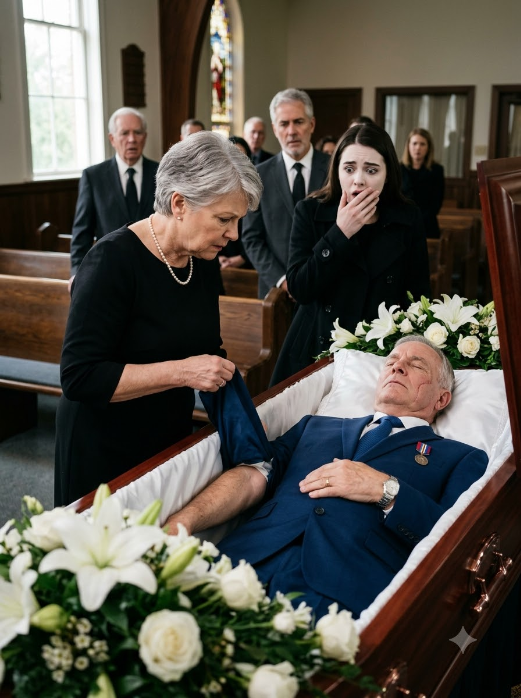
“No,” Desmond said, and looked up, and for the first time she saw something like hope cracking through his exhaustion. “They tried. But it went wrong. She’s alive. She’s hiding, and I haven’t been able to reach her in nine days, and I didn’t know what else to do but let them stage this, so whoever’s looking for her would stop.”
Marguerite’s grip on the edge of the casket tightened until her knuckles went white.
“Then we’re not done here,” she said.
At that moment, a phone began ringing from inside Priscilla’s coat pocket, sharp and insistent in the hush of the chapel. Priscilla lunged for it, but Marguerite was faster, closing the distance in three strides and pulling the phone free before Priscilla’s fingers could close around it.
The screen read: UNKNOWN — SAT LINE
Marguerite answered before anyone could stop her.
For a moment there was only static, then wind, then a voice — thin, tired, unmistakably her daughter’s.
“Priscilla? Are they gone yet? I need—”
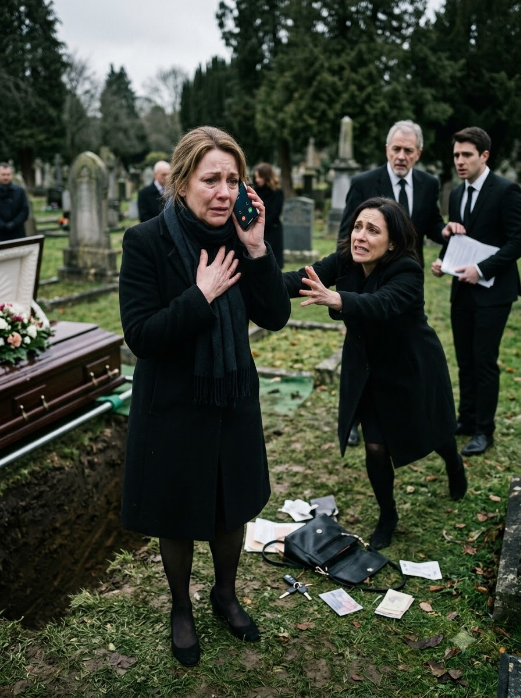
“Rosalind,” Marguerite breathed. “It’s Mama.”
There was a silence on the line so complete that Marguerite thought the call had dropped. Then a sound that might have been a sob or a laugh, she couldn’t tell which.
“Mama? Mama, you shouldn’t be there. It isn’t safe—”
“I don’t care what’s safe. Tell me where you are.”
“I can’t, not on this line, they might—” Rosalind’s voice dropped to something urgent, almost frightened. “Mama, listen to me. Before anything else, you need to know who’s in that casket. She wasn’t just some stranger they used to fake it. She was one of us — she was on the boat. And what happened to her wasn’t an accident at all.”
Marguerite looked back at the closed lid, at the woman in her daughter’s green blouse, at Priscilla frozen mid-reach with her hand still outstretched.
“Then tell me,” Marguerite said. “Tell me everything. Starting with her name — and who gave the order.”
