


It was a stifling cathedral of gilt, velvet, and unrestrained vanity. A thousand of the city’s elite — senators with rehearsed smiles, tech billionaires in bespoke tuxedos, old-money heirs draped in inherited lace — sat beneath twelve enormous crystal chandeliers. Each fixture cost more than the public hospital where I had been born, casting a cold, manufactured glow that made the diamonds in the room glint like danger signals.
I sat at Table 92, at the far edge of the event. My chair was wedged behind a thick marble column near the kitchen entrance, where drafts carried the smell of roasted meat and the scramble of overworked staff. My dress was a plain vintage piece of charcoal silk I’d altered myself. Next to the twenty-thousand-dollar gowns sweeping the dance floor, I was practically invisible — a footnote in the room. My mother-in-law, Judith Kesler, had made sure my invitation arrived marked “casual cocktail,” while every other woman received a formal “black-tie gala” notice. It was a small, deliberate cruelty meant to make me feel like a trespasser in my own life — her favored method of attack.
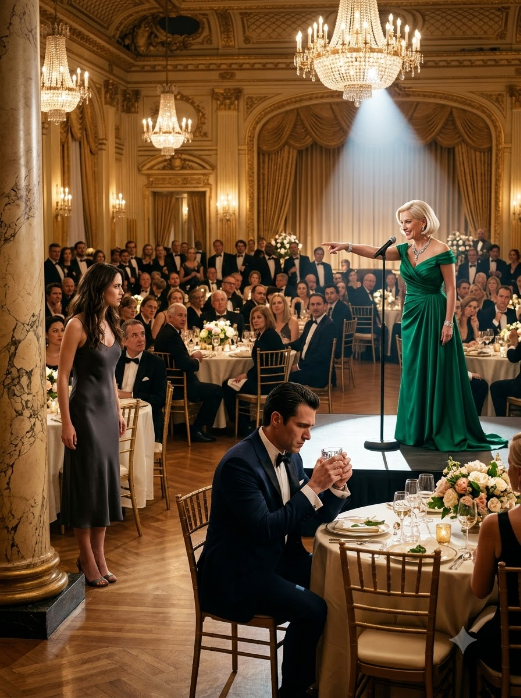
My husband Grant sat at the head table, surrounded by the city’s most influential people. He had the look of a silver-spoon prince, but as I watched him finish his fourth glass of aged scotch, I could see the decay underneath the polish. He hadn’t looked at me in three hours. To the Keslers, I wasn’t a wife or a partner. I was a living trophy of their “charity” — the grateful girl they’d “rescued from poverty” to show their circle just how generous the Kesler name truly was.
The lights dimmed. A single spotlight found the stage. Judith stepped up with the poise of a woman who had never once been refused, and tapped the microphone. The sharp noise cut through the anticipatory hush of a thousand guests.
“Motherhood,” Judith began, her tone dripping with sugary venom, “is about more than biology. It’s about the architecture of the soul. It demands a foundation of pedigree, a lineage of refinement, a devotion to excellence. It isn’t a title just anyone from the gutters of the working class gets to claim.”
She turned to face Table 92, her eyes bright with cruel satisfaction.
“We see women today who call themselves mothers while crammed into one-bedroom tenements, doing translation work for scraps, unable to give their children even a shred of dignity. They think hard work can stand in for class. It cannot. You cannot raise a thoroughbred in a pigsty, no matter how hard you scrub the floor.”
A ripple of refined, quiet laughter moved through the ballroom. My pulse didn’t quicken. It slowed, each beat landing like a war drum. For three years I had swallowed the comments about my shoes, the jabs about my background, the endless reminders that I was “fortunate.” But she had just called my mother — the woman who worked double shifts in a steam-choked laundromat for twenty years so I could attend top schools and learn three languages — a pig.
I rose from my seat.
The screech of my chair against the marble floor rang out in the silence — a jarring note that shattered the room’s polished calm.
I walked down the center aisle, my heels striking the floor in a slow, deliberate rhythm. A thousand pairs of eyes followed me. I didn’t glance at Grant, who was staring into his glass, or at the senators averting their eyes. I stopped only when I reached the foot of the stage, facing the matriarch of the Kesler dynasty.
“Judith,” I said, my voice icy and clear, cutting through the room without any microphone. “My mother never needed a trust fund to teach me what a promise is worth. She never needed a sham charity gala to bankroll a life she couldn’t otherwise afford. And she certainly never taught me that refinement means funneling five million dollars in children’s medical donations into offshore accounts in the Cayman Islands — using the very translation skills you mocked to crack the encrypted ledgers you were too arrogant to think I could read.”
What followed was total silence. Judith’s face didn’t just pale. It went a sickly, translucent gray.
Grant shot up from the head table, moving faster than I’d ever seen him move without a drink in hand. He seized my shoulder, his fingers pressing hard enough to bruise.
“You’ve lost your mind!” he bellowed, his face contorted with drunken rage and public shame. “You’re going to apologize to her, and you’re going to leave this building before I have security drag you out like the garbage you are!”
“I’m not going anywhere, Grant,” I said, my voice barely above a whisper but sharp as a blade. “And I will never apologize to a thief who steals from dying children.”
His arm swung in a blur of white silk and navy wool.
CRACK.
The blow sent me to the floor, my hip slamming against the marble. The sound carried through the podium microphone and blasted out of every speaker in the room. A thousand people gasped in unison. My cheek throbbed with white heat. I could taste blood.
I didn’t cry.
I stayed on that cold marble floor a moment, pressed a white silk handkerchief to my split lip, and looked up at the man I had once loved. He stood there panting, chest heaving, his eyes wide with shock at what he’d just done — and beneath that shock, a lingering, ugly pride that he’d “defended” his mother.

“Get out,” he spat. “You’re nothing but a mistake we made.”
I stood, smoothed my dress with hands that trembled but held steady, and picked up my phone.
“Mom,” I said, my voice completely level. “Please come. It’s time to close the books on the Keslers.”
An hour later, the gala lay in ruins. Grant was scrambling to salvage the auction, his voice fraying as he tried to talk over the restless murmurs of the guests. The slap was already spreading across social media, and the room reeked of a dynasty in freefall.
Then the heavy oak doors of the ballroom slammed open with enough force to strike the stone walls.
A woman stepped through, backlit by the hallway lights. She was flanked by six men in dark charcoal suits moving with military precision, trailed by the State Attorney and a team of four federal agents.
The woman was Catherine Thorne.
The woman Judith had dismissed as a peasant and a laundress.
The room erupted. Because Catherine Thorne wasn’t a translator, or a working-class mother in the way the Keslers had imagined. She was the founder and CEO of Thorne Global Investigations — the top forensic accounting firm that governments and international courts hired when they needed to trace money buried under mountains of lies.
My mother didn’t spare a glance for the crowd, the moguls, or the chandeliers.
She walked straight to me.
She rested a cool hand against the bruise forming on my cheek, her eyes carrying a quiet, unshakable promise of reckoning. Then she turned toward the stage, where Judith and Grant stood like two people who had just realized the ground beneath them had turned to glass.
“Judith,” my mother said, her voice quiet but heavy with judgment. “For three years I let my daughter play this game because she wanted to believe your son was better than the blood he came from. I sat in my ‘run-down apartment,’ as you called it, and I watched. I listened. And I waited for you to prove me wrong.”
She stepped onto the stage, closing the distance until Judith took an involuntary step backward.
“The translation work you mocked so gleefully? My daughter wasn’t translating literature. She was decoding the encrypted transaction records of the Kesler Foundation’s consultancy payments. Every bribe, every kickback, every dollar stolen from children’s clinics — she documented all of it, cross-checked against bank records spanning three continents. And tonight, I’m not here as your poor mother-in-law. I’m here as the primary creditor of this hotel, which I bought outright at nine o’clock this morning.”
She turned to the federal agents waiting at the base of the stairs.
“Take them. The house in the Hamptons, the vehicle fleet, and the foundation’s assets are seized as of now. They have nothing left but the clothes on their backs and the debt they owe society.”
In front of a thousand of their peers, the great Keslers were led away in handcuffs.
Grant looked at me as the agents closed in — his eyes pleading, hollow with the sudden realization that the wife he’d spent three years belittling had been, the entire time, the one orchestrating this moment.
I didn’t look back as I walked out of the ballroom, following the woman who had taught me that the most powerful move is letting your enemy believe they’ve already won.
Real power is what you accomplish in silence. I lived like a ghost in their house for three years, soaking up their contempt like a sponge. While they busied themselves proclaiming their own importance, I was quietly and methodically taking their foundation apart from the inside. Never underestimate someone who listens more than they speak. They’re the ones mapping out your weaknesses.
Arrogance works like a blindfold. The Keslers were so convinced of their own superiority that it never occurred to them to check who I really was. They assumed my mother was poor because she lived modestly and valued hard work. They never understood that real power doesn’t announce itself. It only moves when the moment is right.
Grant thought he was silencing me with that slap — one final act of dominance to put a “peasant” back in her place. Instead, he marked the definitive end of his family’s legacy. Every act of violence is a debt that eventually comes due, always collected with interest.

As we walked to the waiting car, I handed my mother the last document I’d pulled from Grant’s private safe the night before. It had nothing to do with money. It was proof that Grant’s own father had tried to hire my mother’s firm ten years earlier to investigate Judith for embezzlement.
The Keslers hadn’t only been tearing me down. They’d been tearing each other apart for decades, held together by nothing but gold leaf and buried secrets.
I didn’t destroy their family legacy.
I simply switched on the lights so everyone could finally see the rot that had already hollowed it out.
