

THE RED LIGHT HE DID NOT SEE
Officer Sophia moved her body between Leon and the tablet so smoothly it took me a moment to realize she’d done it deliberately.
“Sir,” she said, quietly, “stay where you are.”
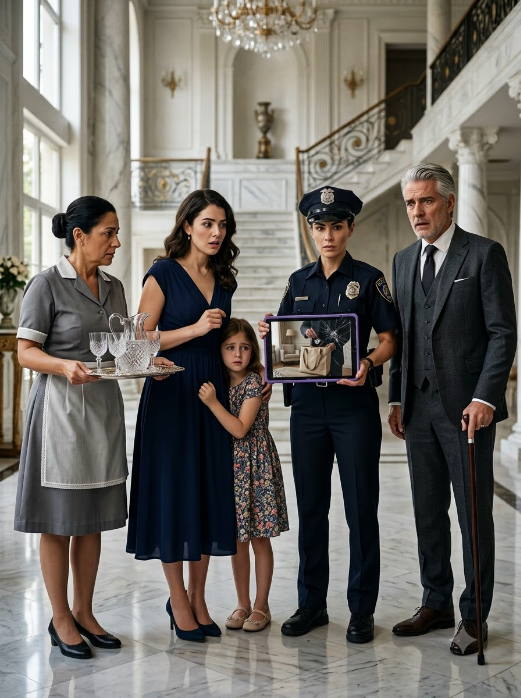
Leon stayed still because men like him know when compliance can be made to look like a choice. His hand returned to the top of his cane. His composed expression came back, though not fully. Standing three feet behind him near the umbrella stand, still holding a serving tray I’d forgotten was in my hands, I could see what the others couldn’t. The pulse at his throat had begun to jump.
Maya was still curled tightly around Isabella’s waist, her small fingers knotted into the fabric of her dress. One officer had eased his hold, unsure now, while the other glanced between Sophia and Leon as if waiting for someone to tell him which version of events was official. That was where the power in that house really lived. Not in truth. In who got to be official.
Sophia tilted the screen so the girl could see it. “Maya, can you tell me the password?”
Maya shook her head hard and hid her face again.
Isabella leaned down as far as the officers would allow and said softly, “You do not have to say it if you don’t want to, sweetheart.”
That should have made Sophia doubt Isabella, if the accusations against her were true. Someone manipulative would have pushed the child harder. Isabella did the opposite. She looked like she’d rather be pulled from the house than let Maya say a word before she was ready.
Sophia lowered herself to the child’s eye level. The authority left her voice. “Okay. You don’t have to tell me. Can you show me with your fingers? On your arm, maybe? No one else needs to hear.”
Maya glanced up over a tear-streaked cheek. Children can tell an order from an invitation. Slowly, fingers trembling, she tapped four spots on her forearm. Two together. A pause. One. One. Sophia watched closely.
“Two, one, one?” she asked.
Maya shook her head and tapped again. This time I understood. Not numbers — shapes. Two small circles, then one line, then one line.
Sophia looked back at the screen. “Two O’s and two ones?”
Maya nodded quickly.
Sophia entered it. The tablet unlocked.
Everyone in the foyer seemed to stop breathing at once.
The home screen wasn’t what Leon had described. No children’s games lined up. No dance app open. The first thing visible was a folder of recordings, sorted by date, some labeled in a child’s uneven spelling. MOVIE HALL. STAIRS. GRANDPA MAD. BELLA KEEP.
Sophia didn’t touch anything right away. She just looked up at Leon.
He laughed lightly. “This is ridiculous. A child pressing record at random doesn’t erase theft.”
No one responded.
Sophia opened the most recent file.
The first clip was tilted and unsteady — marble floor, the bottom half of a bench. One of the officers let out a disappointed breath, but then the image steadied. The tablet had been tucked low, angled toward the corridor outside the study. A timestamp sat large in the corner. 3:14 p.m. Today.
Maya made a small sound against Isabella’s dress. Not fear this time. Recognition.
On the screen, Isabella crossed the hall with a stack of folded laundry. Nothing unusual. She moved out of frame. Twenty seconds later Leon came out of the study alone. He looked both ways down the hall, reached into his jacket, and slipped something small and glittering into the side pocket of a tote bag hanging near the kitchen door.
The whole foyer leaned in.
He walked off.
Ten seconds later Isabella came back, towels balanced against her hip. She stopped by the bag because Maya’s little rain boots had toppled over beside it. She stood them upright, lifted the tote so they wouldn’t fall again, and continued on.
Sophia played it back without being asked.
On the second watch, even the younger officer murmured, “That’s the pendant.”
Leon’s voice didn’t rise. It hardened. “That proves nothing except that I found my family’s property where she’d hidden it and returned it to a common area.”
“No,” I said, before I could stop myself.
Every head turned toward me.
I’d worked in that house six years as senior housemaid. Staying unseen had kept me safe — doing double the work, saying half as much. But once I’d watched that clip, invisibility was no longer possible. The tray trembled in my hands.
“The tote bag wasn’t in the hall at three fourteen,” I said. “I hung it there after snack, once Maya spilled applesauce on the breakfast room chair. That was after three twenty-five, because the school car arrived at three eighteen, and I remember checking the oven clock when I put the kettle on.”
Leon looked at me the way one looks at a stain. “You’re confused.”
“I am not confused, sir.”
Sophia’s eyes sharpened. “Your name?”
“Rosa Alvarez.”
She nodded once. “Rosa, stay here.”
That was Leon’s first real misstep. He turned to the younger officer instead of Sophia, as though he could sidestep the woman actually in charge. “This household is being thrown into chaos by hysterics and staff loyalty. Remove the nanny now, secure the tablet, and let my attorney handle the rest.”
Sophia stood. “No one is being removed until I understand the timeline.”
The foyer shifted again.
Not resolved. Not safe. But different.
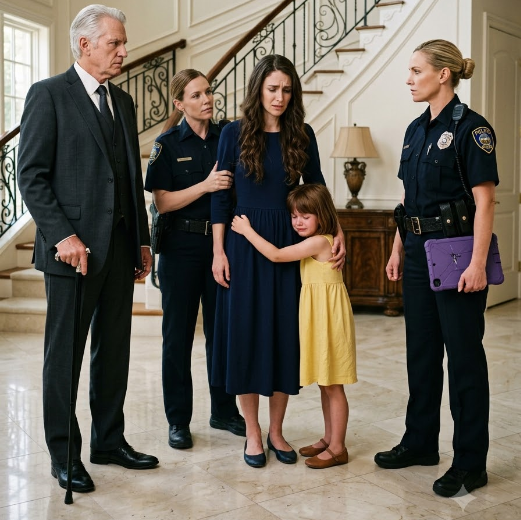
She asked one officer to step fully away from Isabella. The other loosened his hold to a light touch at her elbow. Maya felt the change instantly and repositioned herself partly in front of Isabella, one arm still wrapped around her waist, the other gripping a fistful of dress.
Sophia checked the file details. “Recorded at three fourteen,” she said. “Modified at three seventeen.” She looked at Leon. “What time did you report the theft?”
“Around three thirty.”
Sophia glanced at the younger officer, who checked his notes. “Call came in at three thirty-two.”
A faint crease appeared between Sophia’s brows. “Where exactly did you find the pendant?”
“In her bag,” Leon said.
“In this tote?” Sophia asked, turning the screen toward him.
“No. In her personal bag, upstairs.”
That contradicted what he’d told the officers minutes before. I’d heard him say, loudly enough for the whole hall, that the pendant had fallen from “the nanny’s things by the kitchen.” He’d wanted the accusation heard immediately, a stain that would spread to every employee before evening.
Sophia caught the contradiction too. I watched it register.
“Which is it, sir?”
Leon gave a small shrug, as though details were beneath his attention. “There are several bags in this house. The point still stands.”
“The point changes when the location does,” Sophia said.
Maya raised her head. Her face was blotchy and wet, but her eyes had steadied. “He moved it,” she whispered.
Leon smiled at her, and for the first time it looked openly unpleasant. “Sweetheart, adults are talking.”
Maya flinched so hard Isabella had to steady her shoulders.
Sophia noticed that too.
She didn’t press Maya further right away. Instead she turned to me. “Rosa, where’s the security console for this floor?”
Leon answered before I could. “Offline. We’ve had updates running all day.”
I pointed toward the side corridor. “Security room by the mud entrance, behind the pantry.”
Sophia nodded to the second officer. “Check it, please. No one touches anything.”
He left.
Leon’s stare at me had turned to pure dislike, but I’d already crossed the invisible line. Once you speak up in a house like that, there’s no going halfway back.
The next clip on the tablet was shorter, darker. Same hallway, a later timestamp. 3:27 p.m. The camera caught a faint reflection of the study door in a gilded mirror across the corridor. A child had hidden the tablet low again, the angle imperfect. Only slivers were visible — a trouser leg, the shadow of a doorway. Then sound.
That was the real evidence.
Maya had started the recording because she couldn’t control what was happening, but she’d known enough to capture voices.
Leon, low and annoyed, on the recording: “If she won’t leave willingly, we’ll make it theft.”
Another voice, female, uneasy, hard to make out fully. “Sir, that’s too far.”
“Then stay out of it.”
The second voice wasn’t Isabella’s. I knew every voice in that house. It belonged to Jenna, one of the afternoon tutors, who had quit two weeks earlier without explanation and never returned for her final pay.
In the foyer, Isabella shut her eyes.
Sophia played that line back twice.
Leon scoffed. “That could be anyone. The audio’s distorted.”
“It is your voice,” Maya said.
She didn’t shout it. That made it land harder.
A little girl in a yellow dress, cheeks wet, standing amid all that marble and money, speaking with the tired certainty of a child who’s been doubted too many times.
Leon didn’t look at her. He looked at Isabella instead. “This is exactly what you’ve done. Turned her against her family.”
Isabella’s reply was quiet, immediate. “No. I taught her to notice when adults say one thing and do another.”
The younger officer came back from the security room with an expression that told us something before he even spoke.
“Console wasn’t offline,” he said. “Main hall camera feed’s active, but there’s a twenty-minute gap in the saved footage — three ten to three thirty. Manually deleted.”
Sophia’s jaw tightened. “Who has delete access?”
Leon answered without pause. “My property manager. Security chief. Myself.”
“Who else is in the house?”
“Only household staff and my granddaughter.”
He said it that way. Not Maya. My granddaughter. Ownership before relationship.
Sophia asked me to gather the rest of the staff into the foyer. I set down the tray and went. Cook arrived first, flour still on her sleeve. Then Tomas from the grounds, then Elaine from laundry, then Mrs. Peebles the night nurse, who’d come early and had been lingering in the side hall, sensing trouble. They formed an uneven half-circle, eyes lowered, because staff in wealthy households learn that truth is whatever the employer says it is.
Sophia held up the tablet. “I need to know if anyone saw this device in the hall this afternoon.”
Silence.
Leon let it stretch. Silence had always worked in his favor.
Then Maya did something no one expected. She stepped away from Isabella.
Just one step. Then another. Her knees shook, but she crossed the foyer to the marble table, lifted the cracked tablet with both hands, and hugged it to her chest the way she’d been holding on to Isabella.
“He hates when it sees,” she said.
She turned — not to Sophia, not to the officers, but to us. The staff. The people who had watched and cleaned and kept our jobs, telling ourselves that staying meant protecting her.
“I put it by the flowers,” Maya said. “Rosa said flowers drink slow. Bella said if I was scared I could make a movie. Grandpa took my door star away.”
Cook made a broken sound.
Because we all knew about the door star. A small silver stick-on star from the children’s craft drawer, usually placed on Maya’s bedroom door when she wanted privacy for dress-up or reading. It had vanished the week before. I’d assumed housekeeping had removed it by accident.
Sophia’s eyes moved to Isabella. “Why would she need to record?”
Isabella exhaled like she’d been holding her breath for months. “Because he kept going into her room after I told him not to. Because every time I tried to document it, some part of the record would disappear.”
The room didn’t erupt into gasps. In real life, horror tends to arrive quietly. People stare at the floor. They start recalculating everything they failed to stop.
Leon lifted his cane slightly. “Careful.”
Sophia turned to him. “No, sir. You be careful.”
That was the first real crack. But the house still belonged to him, and power doesn’t surrender just because one clip exists.
Sophia separated everyone. One officer stayed with Leon in the foyer. Another remained by the security room. Isabella wasn’t free to leave yet, but she was no longer being taken out. Maya wouldn’t let go of her hand, so they sat together on the bottom stair while Sophia held short interviews in the morning room, door left open.
She started with me.
I told her about the tote bag’s timing, the security console, how Leon had spent the past year dismissing staff one by one over “carelessness” whenever someone questioned his changes to household routines. I told her how Isabella had quietly begun keeping written notes on Maya’s nightmares and refusal to eat, on how sick the child became each time she was told to spend evenings alone in her grandfather’s wing. I told her about untouched apples left on trays, late-night requests for milk that Maya never used to make, and how she’d started insisting on sleeping in the dressing room next to Isabella’s quarters instead of her own bedroom.
Sophia didn’t rush me, but she didn’t let me wander either. “Specific dates, if you have them.”
“I can’t give all of them. But the night nurse can.”
Mrs. Peebles could. She kept logs — not originally out of suspicion of a crime, but because good nurses record when a child stops sleeping, refuses baths, or starts wetting the bed after years of being dry. That was the second solid trail, unconnected to any theft.
Sophia spoke with Mrs. Peebles next. Through the open door, I watched her pull a folded notebook from her bag, her hands steadier than mine. She listed dates, times, symptoms. “Recurring distress after Wednesdays and Sundays, when grandfather insisted on private story time,” she said. “Asked me to stop charting it. I refused.”
When Leon heard that through the doorway, he stood.
The officer near the foyer entrance stepped instantly into his path. “Sit down, sir.”
“I will not be treated like a suspect in my own home.”
Sophia didn’t even glance up from the notebook. “That depends on what the next recording shows.”
Twelve files sat on the tablet. The child had recorded them over three weeks. Most were the kind of footage children’s secret recordings usually are — floorboards, doll voices, half a song. But patterns hide in fragments, and Sophia understood that.
We gathered around the breakfast room television, its screen larger, so everyone who needed to see the evidence could see the same evidence together. She connected the tablet with a cable from the game console. The grand house, with its imported wallpaper and silver-framed portraits, became, briefly, a viewing room for a little girl’s raw archive.
Reviewing the timestamps became the spine of everything.
File one, last Tuesday, 8:06 p.m.: Leon, in the upstairs hall, telling Isabella she was “overstepping” by changing Maya’s bedtime routine.
File two, Wednesday, 8:41 p.m.: dark audio, from inside what sounded like a closet or under a bed. Maya, whispering, “He took my rabbit because I said no stories.” Then Isabella’s voice, farther off, calling for her. Leon’s footsteps passing the door.
File three, Friday, 4:12 p.m.: the front hall reflection again. Leon lifting the child’s silver star from her bedroom tray, pocketing it after telling Mrs. Peebles the adhesive was “cheap clutter.”
File four, Sunday, 7:58 p.m.: mostly ceiling, but clear audio. Isabella: “You do not enter without her permission.” Leon: “I enter any room in this house I choose.”
The room went very quiet.
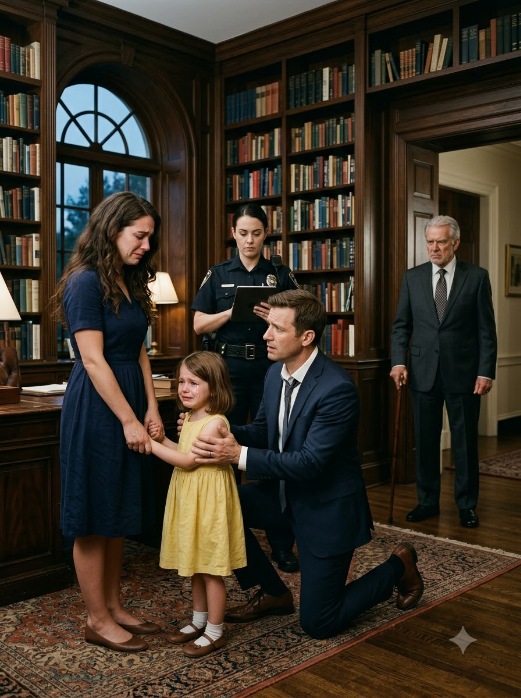
Even the officer who’d seemed most doubtful at the start no longer looked bored or simply dutiful. He looked angry.
Leon shifted tactics. The offended patriarch vanished. In his place came the reasonable old man reacting to modern overreach. “You’re twisting discipline into abuse because a servant overidentified with a child who needed structure.”
Sophia switched off the television. “No one here is talking about discipline.”
He spread his hands. “A granddaughter resisting family time isn’t a police matter.”
Maya, curled against Isabella in the armchair, whispered, “I told Bella the watch heard.”
Every adult in the room turned to look at her.
The watch.
Leon wore a heavy silver watch every day, but Maya wasn’t pointing at his. She reached instead for Isabella’s left wrist.
Isabella hesitated. Then slowly unfastened a plain black smartwatch and handed it to Sophia.
“I forgot,” she said, her voice rough with self-blame. “When they started pulling me out, I forgot.”
Sophia looked at the device. “It records?”
“Voice notes,” Isabella said. “Not always. Only when I thought he’d corner us and I couldn’t reach the tablet.”
That was the second real crack. A backup source.
The watch needed a fingerprint to unlock. Isabella pressed it with a shaking thumb. Only six voice files, each named by date. Sophia opened the most recent.
The room filled with the rustle of fabric, footsteps, a child’s breathing close to the microphone, then Leon’s unmistakable voice.
“She needs to stop saying no to me.”
Isabella: “She’s six. She’s allowed to say no.”
Leon: “Not in this house.”
Then Maya, tiny and breathless: “Bella, can we go pantry way?”
A pause. A door closing.
The recording ended.
No confession. No explicit act. Nothing dramatic. But enough to sketch the outline of fear.
Sophia didn’t perform certainty. She called for a child services specialist and a detective from family crimes. That mattered to me. She understood exactly what the house was trying to do — force everything back into private, unofficial language until it blurred past the point of proof or protection. Instead, she widened the circle of witnesses.
Leon saw the danger in that immediately.
He asked for his attorney.
Sophia told him he could call one once she’d secured the relevant devices and statements.
He demanded the tablet back as family property.
She logged it into evidence.
He threatened complaints, lawsuits, ruin.
None of it slowed her down.
But power fights through delay as much as through force. By the time the detective arrived, evening had come. The house lights had shifted from soft afternoon gold to cold electric white. Maya had cried herself down to hiccups, then silence. She wouldn’t leave Isabella — not for food, not for the bathroom, not even for Mrs. Peebles. So they built a nest of blankets in the library where the child could stay in view while the adults worked.
I brought tea no one touched.
The detective, Elena Cho, didn’t begin with Leon. She began with the layout of the house.
“Show me the rooms,” she said.
That was the third real crack: the pattern in the locked rooms.
We walked the route from Maya’s bedroom to her grandfather’s suite, to the hall mirror, to the breakfast room, to the service corridor where the tote bag had hung. She noted what each camera could see, which doors latched quietly, which reflected into the mirror at angles a child might catch by accident. In houses like that, the architecture often serves whoever holds power. Long sightlines meant to impress. Side passages for staff. Private wings tucked behind elegant paneling. What looked graceful by daylight turned into a map of control after dark.
At Maya’s door, Detective Cho stopped.
No silver star.
But on the floor beneath the radiator, where dust had gathered along the baseboard, she found the adhesive backing — freshly peeled, folded in half.
Maya, holding Isabella’s hand, pointed at the bare spot on the door. “He said stars are for babies.”
Cho crouched down. “Who put it there first?”
“Bella. So people knock.”
That sentence moved through the room like a current. So people knock. A six-year-old’s marker for privacy — small, ordinary, easy to understand. Gone.
In Leon’s suite, they found nothing dramatic. No hidden room, no forbidden chest, no cinematic drawer of evidence. Real control rarely announces itself that clearly. But they found the empty pendant box in his valet, with a note card inside listing where it belonged in the safe. The safe’s log showed it had been opened at 3:11 p.m. using Leon’s code.
He said he’d checked the jewelry after noticing the pendant was missing.
Cho asked why, if he noticed it missing at 3:11, he waited until 3:32 to call police, and spent that time accusing only Isabella instead of searching the house or alerting other adults.
He had no good answer.
Then the estate’s security officer arrived, red-faced and sweating. Leon had apparently reached him privately through a separate line. Another tactic — flood the scene with loyal men, blur the lines of authority. But Sophia caught him in the hall and brought him into the library, in full view of everyone.
“Tell the detective about the deleted footage,” she said.
His eyes flicked to Leon and away. “I was told there’d been a privacy concern. Family matter. Delete from three ten to three thirty.”
“On whose order?” Cho asked.
He swallowed. “Mr. Voss.”
Leon finally lost the last of his composure. “You incompetent fool.”
That outburst caused more damage than anything before it. Innocent grandfathers don’t call their own security chief a fool for answering a police question truthfully.
Maya flinched at the sound. Isabella pulled her close and murmured something into her hair that eased the child’s grip, just slightly.
The protected testimony that followed was handled better than I expected. The child services specialist, Dr. Fallon, didn’t seat Maya under harsh lights and ask pointed questions. She sat on the rug with crayons and a notepad and said, “I heard there are people in this house who don’t always listen when you say stop. I want to be someone who listens.”
Maya drew first. Children often can, when words won’t come.
She drew the foyer, a large yellow dress, a dark gray figure beside it. Then herself, small, standing between the dark figure and a blue rectangle on a table. The rectangle had a red dot.
“The red light?” Dr. Fallon asked.
Maya nodded.
“What does the red light mean?”
“It means the tablet remembers.”
“And who doesn’t like it when it remembers?”
Maya pressed the red crayon so hard it snapped. She didn’t answer out loud. Instead she drew a watch — black band, tiny square face.
Later, when words did come, they came in short, repeated phrases. “Pantry way.” “No stories.” “Knock first.” “Bella said no secrets with grown-ups.”
That last one nearly broke me.
Because there it was — the thing Isabella had been quietly teaching all along, right under our noses: body boundaries, inside a house built entirely on hierarchy. Not defiance. Protection.
By then, Maya’s father had arrived from Boston.
No one had called him right away when the accusation started, because Leon had told staff he was “in meetings and not to be disturbed.” Detective Cho noted that on its own. But Sophia insisted on reaching him once the theft story fell apart. He came through the front doors after nine, tie askew, coat unbuttoned, his face caught somewhere between panic and disbelief.
He was decades younger than Leon, though he carried some of the same bearing. Money teaches posture. But the moment Maya saw him, she didn’t run to him first.
She looked at Isabella.
Only after Isabella nodded did Maya cross the rug.
That was the detail her father couldn’t explain away.
A child manipulated and endangered by a beloved nanny wouldn’t ask that nanny’s permission before going to safety with a parent. A child under real coercion wouldn’t cling to the accused and eye the grandfather with dread.
His name was Daniel. He picked Maya up carefully, as if she might break, and she whispered something too quiet for me to hear. But his expression changed. A man can mask uncertainty. It’s harder to hide the moment his child tells him something he should have caught months earlier.
He asked to speak alone with Sophia and Cho. They declined a private conversation but let him into the study, door open, both officers present. Through the threshold I heard enough.
“My father said she stole from us.”
“The current evidence contradicts that.”
“My daughter says Bella sleeps on the floor outside her room when I’m away.”
“Did you know that?”
A long silence.
“No.”
When he came out, he didn’t look at Leon. He went straight to Isabella.
“Why didn’t you call me?” he asked — not an accusation so much as a plea from a man arriving late to his own child’s danger.
Isabella stood, though Maya still held her hand. “Because every time I tried to reach you, your father answered first. Because the one time I said I was worried, you told me he was old-fashioned, not dangerous. Because I needed proof before he fired me and left Maya here alone with him.”
Daniel closed his eyes.
That was the fourth crack: a parent’s belief shifting.
He didn’t turn into a hero in a single sentence. He became a father in stages, and it clearly hurt. Shame first. Then anger. Then the harder part — choosing his child over the structure of his own family.
He turned to Detective Cho. “What do you need from me right now?”
“A safe place for your daughter, and no interference.”
“You have it.”
Leon laughed from the library doorway, but the sound had gone brittle. “You’re going to let household staff and a frightened child destroy this family over discipline and imagination?”
Daniel faced him. “If it’s imagination, why did you delete the footage?”
Leon had no answer that still fit the old story.
Cho asked him not to leave the property before a formal interview. Sophia told him the theft allegation against Isabella was no longer being pursued, and that attempted evidence tampering was now part of the investigation. The language was dry and official, but in that house, it landed like an earthquake.
For the first time all day, Isabella sat down without an officer directing her to.
Maya climbed straight into her lap.
No one moved to separate them.
It was nearly midnight before the scene finally settled. Child services arranged for Maya to spend the night with her father at a hotel, away from the house. Daniel asked Isabella to come too, not as staff, but because Maya wouldn’t sleep otherwise. Isabella hesitated. That hesitation mattered — she wasn’t stepping back into the same dependency without thought. She looked first to Dr. Fallon, then to Sophia.
“You’re not under arrest,” Sophia said. “You’re the reporting adult now, whether you meant to be or not.”
Maya touched Isabella’s cheek. “Pantry way over now?”
Isabella made a sound halfway between a laugh and tears. “Yes, sweetheart. Pantry way is over.”
Before they left, Detective Cho asked me one last question. “Why now? Why do you think he pushed the theft accusation today?”
I knew the answer.
Wealthy families let news travel downward through their staff long before they admit anything publicly. I’d overheard the attorney on speakerphone the previous afternoon — custody review, summer placement, questions about whether Maya should stay primarily with her father once some estate matter was finalized. Leon was about to lose access, or at least sole control.
“He needed Isabella gone before any formal interviews with the child,” I said. “And he needed the staff frightened enough not to contradict him.”
Cho nodded. “A control move.”
Exactly that.
That was the real shape of it. The theft accusation was never truly about a pendant. It was a timed removal — get rid of the adult who’d taught the child to say no, discredit her publicly, isolate the child before outside eyes arrived.
A custody battle disguised as a household crisis.
The days that followed moved more slowly than that scene in the foyer, but every hour still counted. Daniel gave a full statement. Mrs. Peebles handed over her notebook. The estate’s security chief produced the deletion log from the console. Jenna, the former tutor whose voice had turned up in the tablet audio, was tracked down in New Jersey and agreed to talk once she learned police were involved. She said she’d quit after overhearing Leon tell Isabella she was “replaceable” if she kept “making the girl difficult.” She also confirmed hearing him discuss staging a theft if “the nanny forced his hand.”
Still no dramatic confession. Still no single decisive moment. Just pieces lining up until denial started to look absurd.
The pendant turned up the next morning in an evidence bag, because Sophia had required every bag to be searched under documented conditions. Not among Isabella’s things. It was in the drawer of the hall sideboard, wrapped in a linen napkin — exactly where someone might set it briefly while staging a discovery.
When told, Leon claimed the staff had sabotaged him.
By then, he’d run out of room to maneuver.
Protection came before vindication, and that order mattered to everyone involved. Maya wasn’t pushed into a detailed statement that first night. Daniel, to his credit, followed the guidance he was given for once. He didn’t press her with “What happened?” or “Why didn’t you tell me?” Instead he learned to ask, “Do you want the lamp on?” and “Who do you want in the room?” and “Should Bella stay by the door or by the bed?”
Maya’s answers shifted by the hour. Sometimes his lap. Sometimes a chair. Sometimes the hallway. Control returned to her in small pieces.
Isabella spent two nights at the hotel with them, then, on Dr. Fallon’s suggestion, moved into a guest suite down the hall instead of staying in the same room. Boundaries were being rebuilt carefully, not out of sentiment but for safety. She remained the person Maya trusted most, but part of healing meant making that trust visible and clear rather than desperate.
I visited on the third afternoon, at Daniel’s invitation. I found Maya in the corner of the suite, crayons scattered across the carpet. She’d drawn a new door.
This one had the silver star back on it.
“Who lives there?” I asked.
“Me,” she said.
“Who knocks?”
“Everybody.”
She thought about it, then added, “Bella too. But she says my yes counts.”
That sentence, more than any police report or evidence log, told me what had truly been defended in that foyer.
Not just a nanny’s job. Not just her reputation. A child’s right to have her no mean something.
The formal consequences unfolded over the following month. Leon was charged with filing a false report, evidence tampering, and witness intimidation, pending review of the broader child-protection findings. His attorney called it a misunderstanding stirred up by resentful staff. The recordings undercut that narrative before it could take hold. The timestamps, the safe log, the missing camera window, the recovered pendant’s placement, Jenna’s account, and the nurse’s notes formed a line too coherent to dismiss.
The mansion didn’t stay home. Daniel sold it before the season ended. He said he couldn’t walk through the foyer without hearing Maya cry. I believed him. Some houses are too deeply shaped by the person who once controlled them. Paint and flowers can’t undo that.
He and Maya moved to a smaller place across town — still well beyond ordinary means, but human in scale. One staircase. No west wing. No hidden service corridor. No mirrors angled to make hallways look grander than they were. The first thing Maya did in the new house was pick out hooks for the mudroom. The second was put a star on her own bedroom door.
Isabella didn’t return as a live-in nanny. That would have been the easy, sentimental ending, and the wrong one. Instead, Daniel hired her as a daytime caregiver under a formal contract, with clear hours, outside oversight, and direct communication that no longer ran through family hierarchy. She agreed only after meeting with the attorney herself and adding her own terms. Sundays off. Her own apartment nearby. The authority to contact Daniel directly, any hour, about Maya. Written boundaries covering all relatives.
Her hands still shook a little when she signed.

Healing comes last. Always last.
I stayed with the family another six months to help with the transition, then left on my own terms, for the first time in years. At our last tea together, Isabella and I talked less about the case than about the strange guilt of having survived it. She said, “I keep replaying the moment they were pulling me out, thinking I should have gotten proof sooner.”
I told her what I believe now. “You got it the first day a child trusted you enough to whisper.”
Not all proof comes as a recording. Some of it is simply where a frightened child runs, when everyone who matters is watching.
Months later, after a preliminary hearing, Daniel invited the staff who’d spoken up to lunch at the new house. Nothing elaborate — sandwiches, lemonade, too many napkins. Maya opened the door herself, a gap-toothed grin and a serious expression that made her look older and younger at the same time.
She wore the same yellow dress from that day, washed and mended.
When she saw me, she hugged my waist, then pointed up at a shelf in the entryway.
The cracked tablet sat there, still in its purple case.
Not hidden. Not tucked in a drawer. Not treated like a shrine. Just visible.
“What’s it doing there?” I asked.
She said, matter-of-fact, “It remembers for people.”
Then she took my hand and led me inside.
From the kitchen, I could hear Isabella telling Daniel that Maya had slept through the night three times that week. A small miracle, said in an ordinary tone. Mrs. Peebles was arguing with Cook over how much sugar belonged in the iced tea. The house sounded alive, not managed.
At lunch, no one mentioned Leon until Maya left the table to draw. Then Daniel set down his glass and said quietly, “I built my whole adult life around not seeing what upset my father. I thought keeping the peace was maturity.” He glanced toward the hallway where his daughter had gone. “It was cowardice.”
No one argued, because nothing needed softening.
But Isabella did say this: “Seeing late isn’t the same as never seeing.”
That was true too.
The final hearing barely made a headline beyond a short metro item. Wealth protects even in disgrace. No cameras on courthouse steps, no public unraveling. Just orders, filings, conditions, supervised restrictions, and a record that would outlast charm. Vindication often looks smaller than the humiliation that came before it. Unfair, maybe, but still a win.
What outlasted all of it were the new habits in that house.
Knocking. Open doors. Direct phone calls. Written schedules. No closed-door story time. No one outranking a child’s discomfort.
One evening near Christmas, I stopped by to drop off a scarf I’d promised Maya for her doll. She met me at the door, marker in one hand, the black smartwatch in the other.
“It still works,” she announced.
“Does it?”
She nodded solemnly. “But now we don’t need secret movies.”
I glanced past her. Isabella stood in the kitchen doorway, not hovering, just nearby. Daniel sat at the table helping with scissors and wrapping paper. The room smelled like cinnamon, tape, and ordinary family chaos.
“No,” I said. “You don’t.”
Maya thought about that, then held up the marker. On the back of the silver star on her bedroom door, she’d written a new rule in sprawling six-year-old letters:
PLEASE KNOCK FIRST
She was still learning that safety could be asked for in daylight. We all were.
And every time that little star caught the hall light, I thought of the red recording dot on the cracked tablet in the mansion foyer, glowing at the exact moment two officers tried to pull the wrong woman out the door, and a child made the whole beautiful lie stop long enough to be seen.
