

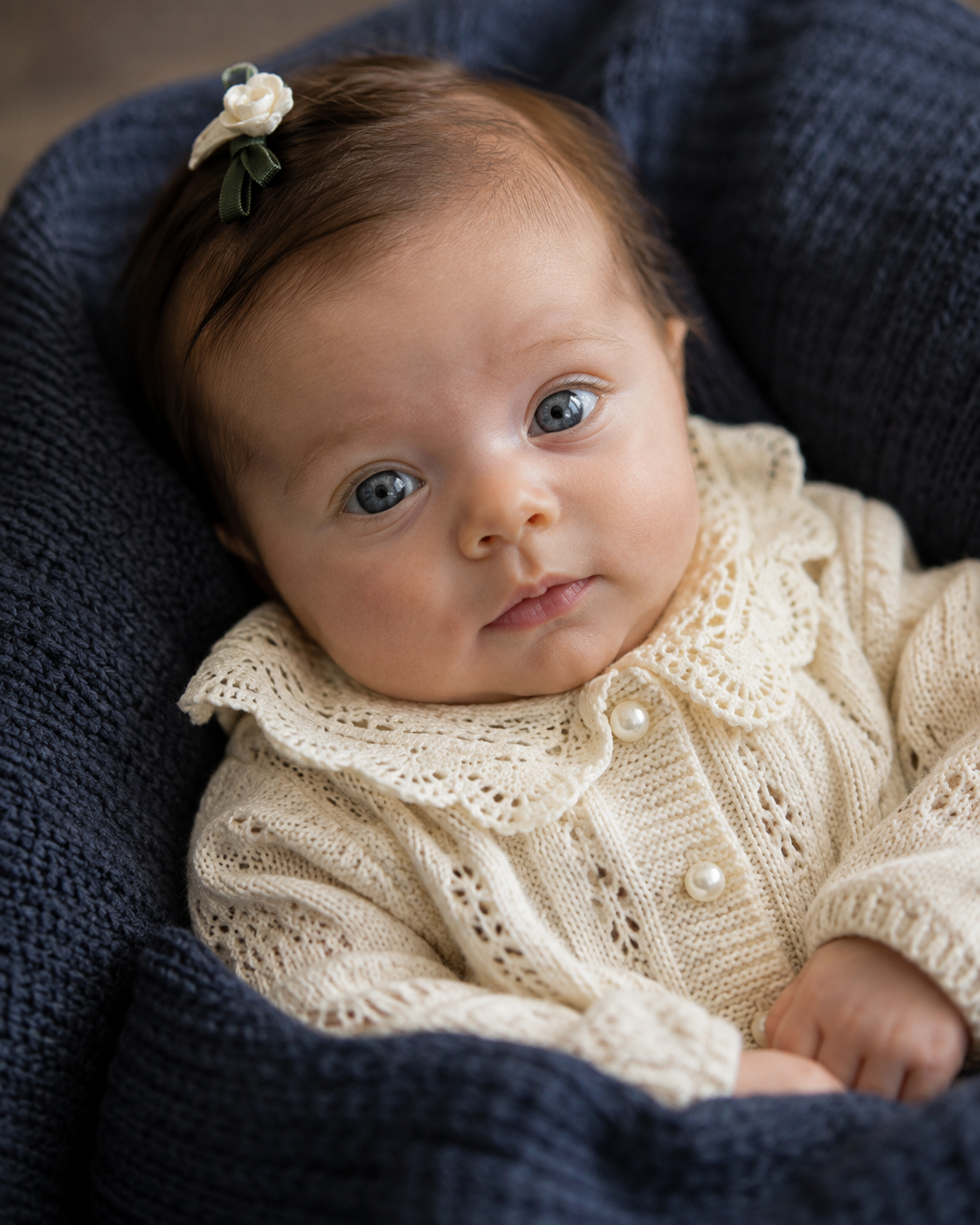
The first moment Caleb looked at our newborn daughter, his face held the expression of someone confronting a memory he’d spent seventeen years trying to keep buried. By the third night, he’d begun slipping away from home.
That Look on His Face
Bringing Sophie into the world nearly cost me my life. The delivery room was chaotic, filled with blaring monitors and voices rushing around me too fast to follow. I remember gripping Caleb’s hand, trying hard to fix my attention on his face instead of the chaos surrounding us.
Then everything faded into darkness.
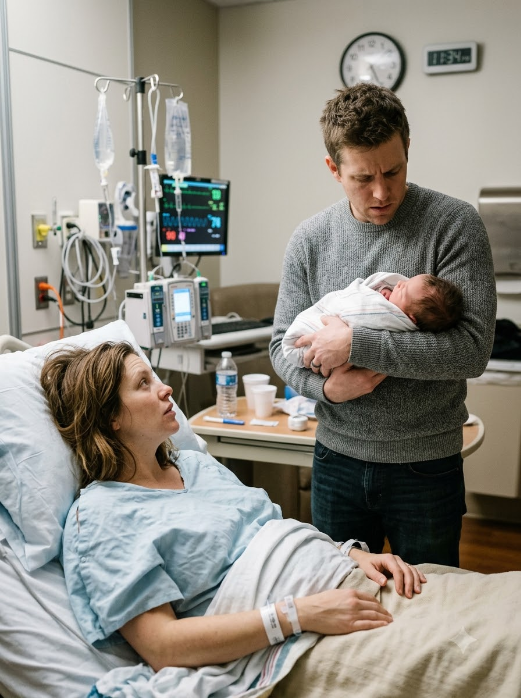
When I came to, I felt weak, shaky, and disoriented. A nurse stood next to me cradling a small bundle. “You have a beautiful baby girl,” she murmured, laying Sophie against my chest. The tears came instantly. She was small and warm, with rosy cheeks and dark hair, her tiny fingers wrapping around mine as though she already recognized me.
Caleb stood beside the bed, ashen and utterly quiet.
Caleb wasn’t someone who rattled easily. I’d expected him to laugh, or well up, or crack one of his nervous jokes to break the tension, the way he always did. Instead, he looked at Sophie as though she genuinely unsettled him.
“Do you want to hold her?” I asked.
He nodded slowly. When I set her in his arms, his gaze traced over her face — her dark lashes, her small mouth, the faint furrow between her brows. Then his expression shifted so fast I nearly convinced myself I’d imagined it. Shock came first. Then dread. And beneath both, something that looked unmistakably like guilt.
Caleb bent down and pressed a kiss to my forehead. “She’s perfect,” he said softly. But his voice seemed to come from someplace far away.
I had no idea at the time that our daughter’s face had cracked open a door inside him that he’d kept sealed for almost twenty years.
A Stranger Came Home
Once we brought Sophie home, something in Caleb shifted. At first I chalked it up to exhaustion. We were both running on scraps of sleep, and Caleb was juggling caring for me, the newborn, the house, and his job all at once. But tiredness alone didn’t explain the particular distance behind his eyes.
He’d go silent whenever he looked at Sophie. He’d linger by her crib watching her sleep, or hold her with a tenderness so intense I could feel the fear rolling off him from across the room. The laughter that used to fill our house faded away, replaced by something guarded and careful.
One evening, while I nursed Sophie, Caleb’s phone rang. He stepped into the kitchen and murmured, “I’ll come as soon as I can.” When I asked who it was, he simply said, “Nobody important.”
Hours later, once he assumed I was asleep, I heard the front door open. The clock on the nightstand showed 11:47 PM. From the bedroom doorway, I watched him pull on his coat. He stopped by Sophie’s crib and looked down at her.
“I’m sorry,” he whispered.
Then he was gone.
The next morning he claimed he’d needed some fresh air. That excuse repeated itself every night after that. I tried telling myself it was new-father stress and my own shaky recovery, but suspicion doesn’t vanish just because you ask it nicely. Instead it grows, quietly, in every silence you allow it to fill.
The Secret Between Us
Within days I noticed Caleb never let his phone out of reach, was pulling unexplained cash from our account, and kept a toolbox, insulation, and groceries in his trunk. When I spotted a receipt for lumber from a store almost an hour away, he told me he was helping out a friend.
“What friend?” I asked.
His jaw clenched. “Why are you interrogating me?”
I stopped voicing the questions after that, though they kept piling up in my head regardless. By the third week, he was leaving nightly and returning past midnight, smelling of rain, sawdust, and somewhere I’d never once set foot.
The night I finally trailed him, a storm was sweeping through town. Wind drove rain hard against the windows while thunder rattled the walls. Sophie had just drifted off after an hour of crying when I heard Caleb grab his keys.
Something in me finally snapped. I phoned my sister, Leah, who lived a few blocks over. She showed up in under ten minutes and took Sophie into her arms without asking a single question.
“Where are you headed?” she asked.
I stared out at the rain sheeting down the window. “To find out who my husband has turned into.”
The House at the End of the Road
I trailed Caleb’s car through the storm. He drove past the town’s last gas station and onto a narrow road bordered by dark, empty fields. Eventually the asphalt turned to gravel, and his taillights vanished beyond a stand of trees up ahead.
Nearly an hour later, he pulled up in front of a small, weathered house. The porch sagged to one side. Paint flaked off the window frames. A blue tarp draped part of the roof, snapping loose in the wind.
Caleb got out of his car and rushed toward the house. I parked behind a cluster of trees and followed on foot, drenched by the time I reached the porch, barely able to hear anything over my racing heartbeat and the rain pounding down.
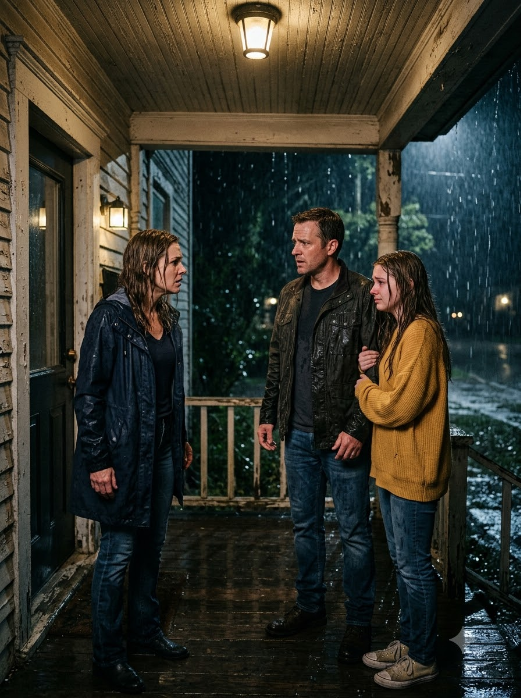
The front door swung open. A teenage girl stood in the doorway — maybe seventeen, long brown hair, wearing an oversized yellow sweater, with eyes that struck me as unmistakably, impossibly familiar.
She looked at Caleb with the guarded hope of someone who’d waited a long time for permission to believe in him. “You came back,” she said.
Caleb nodded. Then he spotted me.
For a moment, neither of us moved. Rain streamed off the roof’s edge into the space between us.
“Nora,” he whispered.
I looked at the girl, then back at him. “Who is she?”
The girl stepped backward. Caleb’s face fell apart. “Nora, please.”
“Who is she?” I asked again, my voice rising.
He glanced at the teenager. She lowered her eyes as if suddenly embarrassed to simply be standing there. Caleb moved out onto the porch. “Her name is Audrey.”
The girl’s fingers curled tighter into her sweater sleeve. Caleb swallowed hard.
“She’s my daughter.”
The words seemed to dissolve straight into the rain. I shook my head, sure I’d somehow misheard him. “Your what?”
“My daughter.”
All the strength drained from his body at once. He doubled over, covering his face with both hands, then dropped onto the wet porch, trembling so hard I genuinely thought he might be seizing. Audrey cried out and rushed to his side.
I stood there, frozen. The husband I loved was on the ground in front of me. A teenage girl knelt beside him as though she’d done it many times before. And suddenly the mysterious lumber, the late-night drives, the fear I’d noticed in his eyes for weeks — all of it began forming into a shape I never could have guessed.
The Truth He’d Kept Buried
I helped Audrey bring Caleb inside. The living room was small and worn but tidy, a space heater humming against the wall, a framed photo on a side table showing Audrey as a little girl standing next to an older woman.
Audrey had the same crease between her eyebrows as Sophie. The same serious eyes. The same faint dimple at the left corner of her mouth. Caleb sank into a kitchen chair, head in his hands.
“Start from the beginning,” I said.
He looked up at me, tears still streaking his face. “I was eighteen when Audrey was born.” Audrey stood near the doorway, listening without a word. “Her mother, Rachel, and I had been together since high school. We were young and terrified. When she got pregnant, her parents said they’d take care of everything because we were too immature to raise a baby.”
“And you just agreed to that?”
“I didn’t know how to stand up to them.” His voice broke. “Rachel went into labor early. Her parents brought her to a different hospital and told me the baby hadn’t survived. They had paperwork to prove it. They said Rachel needed to leave town to recover. I believed every word.”
“For seventeen years?”
“I tried calling Rachel’s house, but her parents told me never to reach out again. My own father shipped me off to college and told me to put it behind me. I was eighteen, humiliated, confused, and scared. Eventually I talked myself into believing the baby really was gone.” He glanced toward Audrey. “Four months before Sophie was born, Audrey tracked me down.”
The room fell silent except for the rain drumming on the roof.
Audrey spoke up for the first time. “I used one of those ancestry sites,” she said quietly. “It matched me with Caleb’s aunt. I messaged him.”
Caleb nodded. “We met at a diner. She asked if I’d ever thought about her. I told her I’d thought about her every single day.”
Audrey’s eyes welled up. “He didn’t know if I even wanted anything from him. I didn’t know if he wanted to know me. So we took it slow.”
I looked at Caleb. “And you never said a word to me.”
He hung his head. “I should have told you the first night I met her. I should have told you before we got married. I should have told you before Sophie was born. There’s no excuse for it.”
That answer stung precisely because it was true. “So why did you wait?”
“Because I was scared.”
He reached into his coat pocket and pulled out a small, worn photograph — a baby wrapped in a pink blanket. On the back, someone had written a date along with the name Audrey.
“When I held Sophie, I recognized her face — not because they’re identical, but because I knew that look. It brought back this photo, and the daughter I thought I’d lost.” He held it against his chest. “I realized I was holding one daughter while my other daughter was living in a house with a leaking roof and a broken heater. I couldn’t stop thinking about how Audrey had spent her whole life believing I never wanted her.”
“So you kept coming out here every night.”
“I came to fix the roof, the heater, her bedroom window. I helped her with college applications. I wanted her to know I wasn’t going to vanish on her a second time.” His eyes found mine. “But I was still keeping her hidden from you. I told myself I was protecting our marriage until I’d figured everything out. Truthfully, I was protecting myself from how you’d react.”
Anger rose hot in my throat. “You let me believe you were cheating while I was still recovering from nearly dying.”
“I know.”
“You let me lie awake wondering what was wrong with me.”
“I know.”
“You hid your own daughter from me.”
Caleb nodded, tears falling again. “I know. And I’ll spend the rest of my life making up for what I broke.”
The Girl Who Was Never the Secret
Audrey wiped her eyes with her sleeve. “You don’t have to stay,” she told me. “I’d understand if you hated him. I’m sorry you had to find out like this.”
Her words stopped me cold. She was seventeen. She hadn’t deceived anyone or abandoned anyone. She’d simply been born into a story written entirely by frightened adults who never thought to ask her opinion.
I stepped toward her. “I don’t hate you,” I said.
She looked genuinely startled. “You’re not the secret,” I went on. “You’re a person. You deserved to know your father, and I deserved to know the truth about my own family. The adults made their choices. You didn’t make any of them.”
Audrey began crying in earnest. After a moment she stepped forward and hugged me. We were strangers, and there was too much grief between us for the moment to feel fully comfortable, but I held on anyway.
Over her shoulder, I noticed the older woman from the photograph standing in the hallway, dressed in a gray cardigan and leaning on a cane. “I’m Mrs. Hart,” she said. “Audrey’s grandmother.”
She looked at Caleb with something close to sorrow. “I made so many mistakes. I thought I was protecting my daughter, but keeping you away just left all of you carrying the loss instead.”
Caleb rose to his feet. “You told me she died.”
Mrs. Hart shut her eyes. “I was wrong.”
There was no grand excuse offered — just an old woman finally admitting that fear had steered her choices for far too many years.
No More Secrets
I looked at Caleb. “I can’t pretend everything’s fine tonight.”
“I don’t expect you to.”
“I’m angry. I’m hurt. I don’t know what our marriage looks like after this.”
“I understand.”
“But I also don’t want Audrey to lose another family because we’re too afraid to be honest.”
His face tightened with emotion. “What are you saying?”
I took a breath. “I’m saying we’re going to talk. We’ll get help. We’ll start making decisions honestly from now on. But no more secrets.”
Audrey glanced between the two of us. “Does that mean I still get to see him?”
I turned to her. “It means you should never have had to ask that question.”
The First Honest Morning
I didn’t go home with Caleb that night. I went back to my sister’s and held Sophie until the sun rose over the fields. I loved my husband, but love didn’t erase what he’d done. I’d spent weeks recovering from childbirth genuinely believing I was losing him to another woman. He needed to fully own that before anything else could move forward.
The next morning, Caleb showed up at Leah’s. He didn’t try to defend himself or ask for forgiveness on the spot. He told my sister the whole truth, then handed me his car keys, his phone, and every document tied to Audrey’s existence.
“You shouldn’t have to uncover anything else,” he said. “Ask me anything you want.”
We spent the following months in counseling. There were hard conversations, and days I genuinely wondered whether trust could ever feel natural between us again. Caleb learned that an apology has to be a pattern of behavior, not a single line you say once and move on from. He became transparent about his schedule, included me in every conversation with Audrey, and stopped making decisions alone.
Audrey began visiting our home on Saturday afternoons. The first time she held Sophie, her hands shook. “She’s so tiny,” she whispered.
“You were that size once,” Caleb said.
Audrey looked at him. “You remember?”
“I remember everything I can.”
She gave him a small, careful smile. Sophie opened her eyes and grabbed one of Audrey’s fingers, and Audrey laughed through fresh tears. That was the first moment I saw the actual girl beneath all that sorrow.
A Family Built in the Light
Over time, the old house changed along with the rest of us. Caleb repaired the roof properly, replaced the windows, and put in a real heating system that actually worked. My sister donated furniture. My mother brought curtains. Audrey painted her bedroom walls a soft green she picked out herself. I helped her pick out a desk for her college applications.
The house was still old, but it no longer felt abandoned. Neither did Audrey. She enrolled at the local community college to study early childhood education, wanting to work with children who felt overlooked the way she once had.
Mrs. Hart eventually moved into a nearby assisted living facility, where she got the care she needed for her age. She and I didn’t grow close overnight — not even close — but we learned to speak honestly with each other. Sometimes forgiveness starts with a single conversation neither person actually wants to have.
As for Caleb and me, we rebuilt our marriage slowly, one ordinary choice at a time. He understood that trust wouldn’t return just because he felt sorry. He earned it back through the unglamorous, daily work of telling me the truth, showing up when he said he would, and letting me be angry without rushing me past it before I was ready.
Sophie’s First Birthday
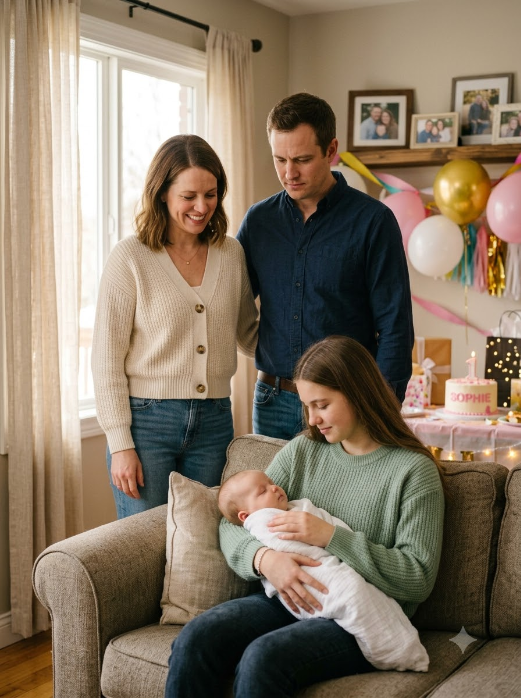
On Sophie’s first birthday, we all gathered at the old house. Balloons lined the porch railing. A chocolate cake sat on the kitchen table. Toys were scattered across the living room floor, and Audrey had made a banner reading Happy Birthday, Sophie in carefully painted letters.
When Caleb lifted Sophie into his arms, she reached toward Audrey. He smiled and passed the baby to her sister.
I watched my two daughters together — one who’d known Caleb since her very first breath, and one who’d spent seventeen years wondering whether he’d ever wanted to know her at all. Our family wasn’t perfect. It had started in fear, silence, and betrayal. But it was slowly becoming something honest instead.
Caleb came and stood beside me. “I’m sorry,” he said quietly.
“I know.”
“I should have told you.”
“Yes.”
He nodded, accepting the truth without softening a single edge of it. Then he took my hand. Across the room, Audrey laughed as Sophie tugged at the corner of the birthday banner, nearly pulling it down.
I squeezed Caleb’s fingers. The truth hadn’t erased the pain. It hadn’t rewritten the past, or given Audrey back the seventeen years she’d lost waiting for a father who never knew she existed. But it had opened the door. And once that door was finally open, we could stop living in separate rooms of the same exact story.
That night, driving home, Caleb didn’t slip away into the dark. He sat beside me in the front seat while Sophie slept in the back, and Audrey followed behind us in her own car, her headlights steady in my rearview mirror the whole way home.
For the first time in months, the road ahead didn’t feel frightening. It felt like the start of something that finally deserved to be called home.
Sometimes people bury the truth because they’re afraid it will destroy the life they love. But secrets don’t actually protect a family. They just leave everyone standing out in the rain, waiting for someone, anyone, to finally open the door.
Our family made it through because, eventually, Caleb did open it. And because, once I saw the frightened girl standing on the other side of that door, I understood she had never been the reason our family started falling apart.
She was one of the reasons we finally learned how to become whole.
