

Michael Harrison woke at 6:00 a.m. without needing an alarm. He hadn’t relied on one in years. At forty-two, he functioned purely on discipline — even though his heart had felt frozen for a long time.
He stared up at the flawless white ceiling of his bedroom in his sprawling Beverly Hills estate. Perfect. Spotless. Silent.
Empty.
Three years earlier, his wife Danielle had walked out with two suitcases, half of his fortune, and every shared dream of building a family. The divorce had gone smoothly — no shouting, no broken glass. Only paperwork, transfers, and a stillness that had settled into the house like a permanent fixture.
He went downstairs to a kitchen bigger than most apartments. Marble countertops. High-end appliances. A refrigerator someone else kept stocked. He made himself an espresso and stood before the floor-to-ceiling windows, watching Los Angeles wake up.
Traffic. Movement. Urgency.
He had built a commercial real estate empire through sixteen-hour days. Now he had more money than he’d ever spend — and no one to sit across from at breakfast.
That’s when he heard soft movement coming from the service hallway.
Elena Ruiz had arrived.
Every Saturday at 7:00 a.m., she showed up, cleaned for six hours, and left with little more than a courteous “Good morning, Mr. Harrison.” Michael barely knew anything about her. She lived somewhere in East L.A. She always wore the same worn-out sneakers. She never asked for a thing.
But something had shifted recently.
Her hands trembled as she worked. Her eyes were swollen and red from lack of sleep. She’d grown gaunt — not from choice, but from shouldering something too heavy to carry alone.
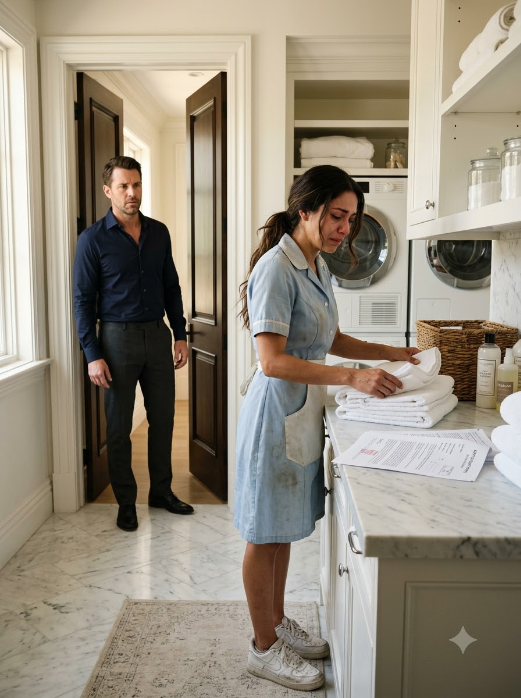
Michael found himself heading toward the laundry room without really knowing why.
For illustrative purposes only
Maybe loneliness recognizes its own kind.
He paused in the doorway.
Elena stood with her back turned, folding towels without a word. On the washing machine lay legal documents. The heading jumped out at him instantly:
SUPERIOR COURT OF CALIFORNIA COUNTY OF LOS ANGELES FAMILY DIVISION
His stomach sank.
“Elena,” he said gently. “Is everything all right?”
She turned around sharply, caught off guard. A forced smile crossed her lips but didn’t reach her eyes.
“Yes, sir. Just tired.”
Michael’s eyes moved from the papers to her shaking hands.
“I saw the documents,” he said softly. “You don’t owe me an explanation. But if you ever want someone to listen… I’m here.”
The quiet between them grew heavier.
She gripped a towel like it was the only thing keeping her upright.
“I have a son,” she murmured. “Gabriel. He’s four months old.”
Michael was stunned. In two years, she’d never once mentioned a child. And he’d never bothered to ask.
“My mother is ill,” Elena went on. “Advanced diabetes. Heart trouble. She needs treatment I can’t pay for.”
Her voice cracked.
“I clean four houses. I sleep maybe three hours a night. I eat once a day so there’s enough left for her medicine and his formula. And it’s still not enough.”
Michael stood frozen, taking in every word.
“Gabriel’s father disappeared the moment he learned I was pregnant,” she said. “The papers…” She forced herself to continue. “I’m signing him over for adoption on Monday.”
The room felt unbearably heavy.
“Do you love him?” Michael asked before he could hold the question back.
Elena fell apart.
“More than anything I have. But love doesn’t cover rent. Love doesn’t buy insulin. Love doesn’t keep a baby warm. He deserves better than what I can give him.”
Michael shut his eyes.
He had watched his own shot at fatherhood slip past him in boardrooms and business deals. He’d convinced himself he didn’t need it.
But this — a mother giving up her child not from indifference but from an overwhelming love — cracked something open inside him.
“How much time is left?” he asked.
“Forty-seven hours,” she said. “Monday at 2:00 p.m.”
Forty-seven hours.
Barely two days before a baby would lose his mother — over a sum Michael might drop on a single night out.
“Go home today,” he said abruptly. “Spend the weekend with your son. Don’t sign anything until we talk Monday morning.”
She looked at him, unsure.
“Why?”
He didn’t have a clean answer.
“Because I can’t stand here and act like I didn’t see this.”
That afternoon, Michael sat by himself in his living room. The leather couch felt colder than usual. He researched medical expenses, long-term care, and what it would take to raise a child.
To Elena, the numbers were impossible.
To him, they were nothing he couldn’t handle.
The real question had nothing to do with money.
It was whether he was actually willing to let life into his tightly controlled world.
Down the hall sat a guest room he’d never set foot in — once meant to be a nursery. It had stayed untouched for years.
He stood at the entrance and pictured a crib. Toys. Noise.
Life.
Sunday morning, he called Elena.
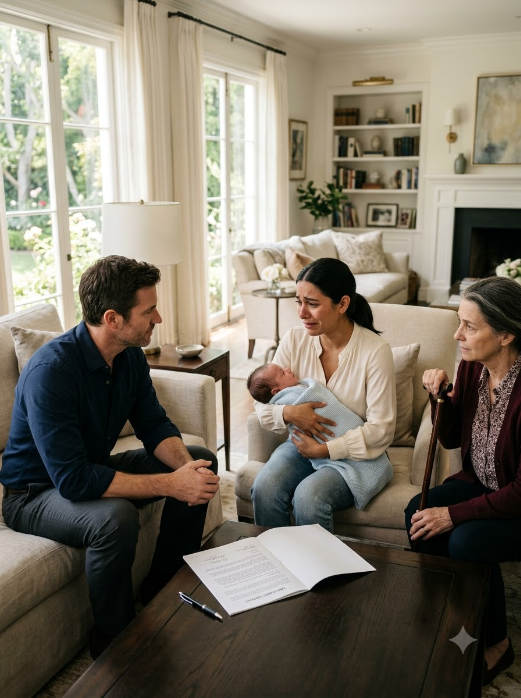
“Come over at ten,” he said. “Bring Gabriel. And your mother.”
At ten sharp, a battered Toyota pulled into the driveway.
Elena got out first, cradling baby Gabriel wrapped in a thin blanket. Her mother followed behind, slowly, leaning on a cane.
The difference was obvious — his polished look against their carefully mended clothes.
Inside, they sat down together.
“You’re giving up Gabriel because you can’t take care of him and your mother at once,” Michael said. “What if you didn’t have to pick one?”
Elena looked at him carefully.
“You can’t fix this, sir.”
“I can’t fix everything,” he answered. “But I can fix this.”
He gathered himself.
“This house has rooms sitting empty. You could work here full-time — legally, with a contract, benefits, a real salary. You and your mother could live here. Your mother’s care would be covered by insurance. Everything on paper. No favors. No charity.”
Mrs. Ruiz stiffened. “We don’t want pity.”
“This isn’t pity,” Michael said firmly. “It’s a fair deal. You work. I pay. Your son stays with his mother.”
Elena’s voice shook. “Why would you do this?”
This time, he answered without holding back.
“Because I always wanted to be a father,” he said quietly. “And I won’t stand by and watch a child lose his mother over something I have the power to fix.”
Elena cried — but this time it wasn’t despair, it was the sheer weight of hope.
“I need something in writing,” she said later. “A contract. Real employment. If you ever change your mind, we’ll need time to find somewhere else to go.”
“You’ll get six months’ notice,” he promised. “All of it in writing.”
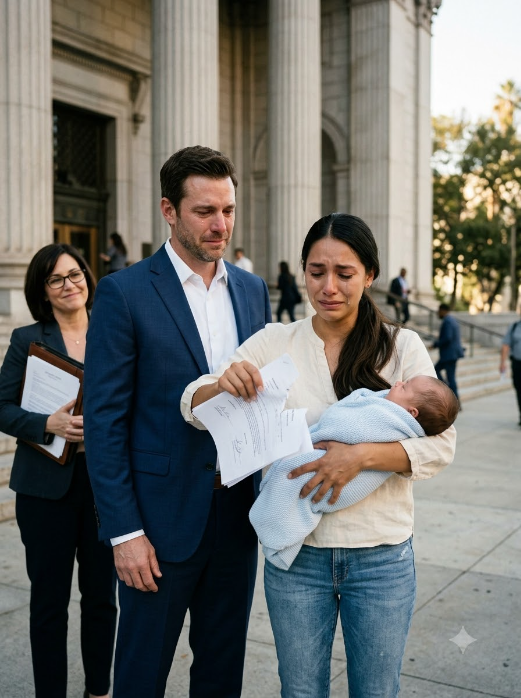
Monday at 1:45 p.m., Elena stood outside the courthouse, the adoption papers in her hand.
Michael showed up with his lawyer — not to push her, but to make their agreement official.
Medical care arranged. Insurance active. Employment contract signed.
Elena looked down at Gabriel.
Then she ripped the papers in two.
Months passed.
For illustrative purposes only
The house changed completely. Bottles piled in the sink. Soft cries at night. Laughter echoing through rooms that had once felt like a museum.
Mrs. Ruiz had surgery and slowly regained her strength.
Elena rebuilt her own strength and sense of self. She started night classes. Every paycheck came with dignity attached.
One afternoon, Gabriel reached out toward Michael and mumbled something that sounded like “Da.”
Michael went still.
Elena covered her mouth, tears running down her face.
Five years later, the house was nothing close to silent.
Gabriel raced through the hallways, toy cars left scattered behind him. Elena ran the household while working toward her business degree. Mrs. Ruiz kept a garden going in the backyard.
Michael — once a man with endless wealth and no reason to live for it — had finally understood something simple.
He hadn’t saved them with money.
They had saved each other through presence.
One evening, he stood at the top of the stairs, watching Gabriel sleep with a stuffed bear tucked against him.
He thought back to those forty-seven hours.
To the papers left on the washing machine.
To how fate sometimes arrives without any fanfare at all.
Sometimes it shows up quietly — as a woman folding towels and a man deciding, for once, to open the door.
He leaned against the frame and whispered into the quiet:
“In this house, no one gets left behind.
Not ever again.”
