

Part 1 – The Ticket He Thought Would Remove Me
The black sedan pulled up outside our townhouse on a bright, rain-washed autumn afternoon, and my husband stepped out onto the pavement wearing the composed smile of a man who believed everyone useful to him could be relocated, handled, or quietly swapped out whenever it suited his timing.
Julian Ashford had always looked flawless whenever he was lying, which was probably why so many investors believed in him, why so many journalists spoke well of him, and why I had spent three years telling myself his tenderness was mine alone rather than a performance he staged for anyone watching. His charcoal suit sat perfectly on his shoulders, his dark hair was combed with expensive care, and his hand rested on my suitcase the way it might if he were still the kind of husband who worried whether something was too heavy for me to lift.
“Vivian,” he said, dropping his voice as the driver kept his gaze politely forward, “before you go, I want you to know how sorry I am that work took over so much of our marriage.”
Around us the city gleamed — wet brick, spotless windows, the hushed wealth of a neighborhood skilled at concealing rot beneath polished brass. Julian drew an envelope from his coat and pressed two first-class tickets to Rome into my hand, though only one of us would use them that day. By his account, I was going ahead to finally take the honeymoon we’d never managed, while he stayed behind to close a financing deal meant to secure Ashford Global’s future.
By the account of the receipt I’d found tucked inside his dinner jacket, he was staying behind to marry a twenty-three-year-old named Serena Vale aboard a private yacht two mornings later.
I lowered my eyes — not because I felt small next to him, but because men like Julian grow careless once they believe a woman is still soft enough to be steered.
“Rome by myself feels odd,” I said, letting a thread of uncertainty color my voice, exactly what he’d expect to hear.
He moved closer and settled his jacket over my shoulders, his fingers grazing the small gold locket at my throat before pulling back. It had been my mother’s, sentimental enough that he’d never thought to question why I wore it daily. What he didn’t know was that a hidden recorder had been tucked inside it two weeks before, so every gentle word he gave me on that sidewalk became one more stone laid into the foundation of his own ruin.
“You won’t be alone for long,” he promised. “I’ll wrap up the negotiations with Redwood Capital, then I’ll join you, and we’ll finally have the life I should have given you from the start.”
Redwood Capital. The name almost made me smile.
Julian had spent months chasing that investment fund because Ashford Global was sinking under hidden liabilities, undisclosed loans, and financial arrangements built to look respectable only from far away. He assumed Redwood’s founder, Bennett Hayes, was just another hard-edged billionaire who could be won over with charm, access, and confident bluffing.
He had no idea Bennett was my brother.
My mother had remarried quietly after my father was lost to the scandal that destroyed Harrow Development — the company he’d spent his life building before Julian’s father helped bury it under forged obligations and convenient paperwork. Bennett and I hadn’t grown up under the same roof, yet blood keeps a patient memory, and when I’d called him seven months earlier with the first proof that Julian had married me for access to what remained of my family’s assets, he hadn’t asked whether I was ready.
He’d only asked, “How cleanly do you want the old world removed?”
On the sidewalk, Julian lifted my hand and kissed my knuckles with rehearsed tenderness.
“Use the black card,” he said. “Buy whatever you like, Vivian. You deserve something beautiful.”
I smiled at him then, because there are moments when kindness is at its most powerful right after it has stopped being real.
“Be careful,” I answered. “I might spend enough to ruin you.”
Julian laughed, plainly relieved that I’d accepted the plan.
“Then ruin me beautifully.”
He settled me into the car, watched the driver shut the door, and stood beneath the gray sky like a husband sending his beloved wife off toward romance — not like a man clearing an inconvenient witness out of the city before his second bride walked down an aisle funded with company money.
As the sedan pulled away, I glanced back once and saw him already checking his phone. That was the last image I kept of Julian Ashford before the truth began collecting what it was owed.
Part 2 – The Receipt And The Dress
At the private terminal, Julian’s chief assistant, Oliver Reed, was waiting with my boarding pass and the blank expression of a man who’d survived years near powerful people by knowing exactly when to disappear. Oliver knew Julian’s calendar, his hidden accounts, his fake vendor invoices, his private hotel bookings, and the careful lies that had kept investors calm while the company rotted from within.
He also answered to me.
His father had been one of the mid-level managers ruined when Harrow Development fell apart, and while money could rent loyalty for a season, memory could build something far sturdier. As he handed me the boarding documents, a folded note slid beneath them into my palm.
Inside the first-class lounge, I opened it next to an untouched glass of champagne.
The yacht confirmed.
Saturday, ten o’clock.
Serena’s final dress fitting today at four.
Across the room sat Mara Ellison in dark glasses and black cashmere, carrying the calm bearing of a woman who designed wedding gowns for people rich enough to believe fabric could rewrite morality. Mara had been my closest friend since college, and though she looked serene in any public room, she grasped strategy with the precision of a trial lawyer.
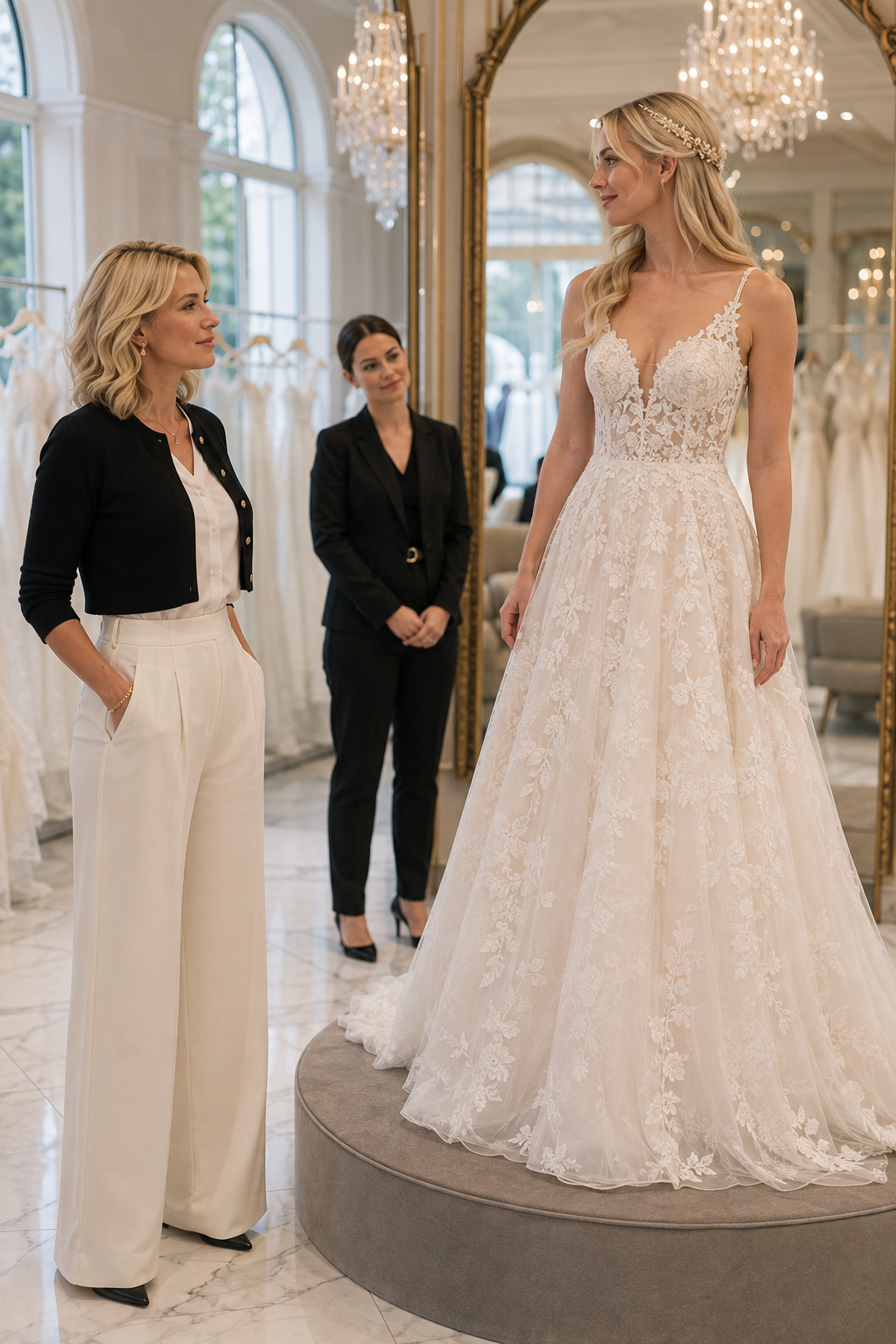
She slid a photograph across the table. Serena’s gown was ivory silk, hand-sewn pearls, a dramatic train, and enough youthful fantasy to convince its wearer she was stepping into a fairy tale rather than into evidence.
“It’s worse in person,” Mara said.
“She knows he’s married,” I replied, studying the picture.
“She knows enough,” Mara said, “but she’s still young enough to think being chosen by a powerful man means she’s won something.”
I opened my handbag and set a small velvet pouch on the table. Inside was a platinum cufflink engraved with the letter H — one of the few things I had left from my father’s life before the Ashfords and their allies turned his name into a cautionary whisper. Julian had once mistaken it for one of his own, and I’d let the mistake stand, because arrogant men rarely question where a beautiful thing came from once they’ve decided it belongs to them.
“Sew this into the waist lining,” I said. “Not visible right away, but secure enough that pulling it out would ruin the dress.”
Mara studied me for a long moment, then the corner of her mouth curved upward.
“That’s merciless.”
“No,” I said, closing the pouch. “It’s accurate.”
Before boarding, I called Bennett from a quiet corridor overlooking the runway. His voice came through even and unhurried, the voice of a man who’d learned early that power never needs to raise itself.
“Are you sure?” he asked.
I watched ground crew loading luggage beneath the plane’s silver belly.
“Julian sent me away so he could marry another woman while our marriage was still legal, while using company funds, while hiding corporate debt from investors, and while assuming I’d be too ashamed to ever challenge him publicly.”
Bennett went quiet for a moment.
“Then we move Saturday morning.”
“Pull the financing at ten.”
“And the tender offer?”
“File it at ten fifteen.”
He let out a slow breath.
“Once that happens, Ashford Global won’t survive under Julian’s control.”
I looked down at the locket resting against my chest, thinking of my mother’s final weeks, when she’d handed me my father’s sealed letters and told me never to turn cruel — but never to let thieves keep what they’d stolen just because time had made the theft look respectable.
“It was never meant to survive under his control,” I said.
Part 3 – Rome Was Only A Hiding Place For Him
Rome met me with pale morning light, church bells, and the kind of beauty that should have belonged to a woman starting a honeymoon rather than ending a war. Julian had booked a well-known presidential suite under my married name, but I never set foot in it. Bennett’s security team moved me instead to a quiet boutique hotel under a different reservation, where no Ashford employee, driver, concierge, or paid watcher could report my movements back to the man who thought he’d tucked me safely out of reach.
In the room, I opened the secure tablet Oliver had hidden in my luggage. Six live feeds appeared: the bridal suite, the yacht entrance, the hotel lobby, the service corridor, the underground garage, and the executive elevator. Julian believed ownership and access were the same thing, which was one of many reasons men like him eventually become vulnerable.
For two days I watched the machinery of his deception assemble itself.
Serena arrived with three bridesmaids, a garment bag, and the glowing self-importance of a woman certain she was about to quietly replace someone discarded. She laughed too loudly, touched her ring finger too often, and practiced her smile in every reflective surface she passed. I didn’t hate her, though I wouldn’t call her innocent either. The messages proved she knew about me — one of them called me “the old version” Julian would soon outgrow.
At eight on Saturday morning, Julian walked into the waterfront hotel in a custom suit, looking less like a groom than an executive about to close an acquisition. He called me fifteen minutes later, and I let the phone ring long enough to make him uneasy.
“Did I wake you?” he asked.
On the tablet, I watched him pace beneath a crystal chandelier.
“A little,” I said, softening my voice.
“How’s Rome?”
“Beautiful.”
“Good. Buy something expensive today.”
“I will.”
He smiled at whatever version of me still lived in his imagination.
“I miss you.”
For one brief second I wondered whether some broken, selfish corner of him actually believed that. Then I remembered the dress, the receipt, the buried debt, and the way his father had smiled at our wedding like a man watching stolen property finally come home.
“I know,” I said.
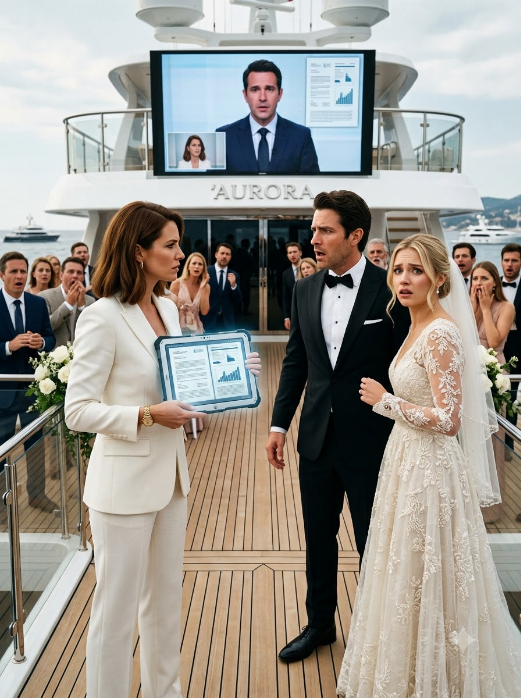
At nine, Oliver’s anonymous packets reached the reporters he’d chosen. By nine twenty, journalists were gathering near the original rooftop venue. By nine thirty, an engineered maintenance failure forced staff to relocate the whole event, creating enough confusion that guests followed new instructions without asking questions. By nine forty, board members, investors, socialites, reporters, and Serena’s wedding party were all being guided onto a luxury yacht owned by a Redwood Capital subsidiary.
Everyone boarded, because authority wearing a headset and holding a clipboard is rarely made to explain itself.
At ten, the yacht pulled away from the dock.
At ten, Julian reached the pier and understood that the event he’d built no longer belonged to him.
At ten, every screen on the yacht went black, then lit up with the first document: the invoice for Serena’s wedding gown, paid through an Ashford Global consulting account.
The second document followed: my valid marriage certificate.
The third was a timestamped photo of Julian and Serena entering her apartment together.
Then came the words that silenced the whole yacht.
This is not a wedding.
This is evidence.
Every guest understood at once that they weren’t attending a ceremony anymore. They were standing inside a disclosure event.
Serena’s expression broke first, the rehearsed brightness sliding off as murmurs moved through the crowd. A gust of wind lifted part of her skirt, and the camera caught the platinum cufflink stitched into the lining.
Harrow.
My father’s name returned to public view, sewn inside the gown Julian had bought for my replacement.
Reporters pushed forward, asking whether Serena knew Julian was still married, whether company money had paid for the event, whether Ashford Global had misled its shareholders, and whether the whole ceremony had been staged to hide a personal scandal from investors. Serena clawed at the lining, but Mara’s stitching held, and the harder she pulled, the more visible the symbol became.
Then Bennett appeared on the main screen from Redwood Capital’s boardroom, seated before a wall of glass, his navy suit as unruffled as his expression.
“Effective immediately,” he said, “Redwood Capital is ending all financing negotiations with Ashford Global, due to undisclosed liabilities, reputational risk, and evidence of possible financial misconduct.”
Phones came out across the deck. Investors started calling their lawyers. Board members went pale. Julian, stranded on the pier, tried to shove past security and couldn’t.
Bennett took off his glasses and looked straight into the camera.
“On a personal note — any action taken against my sister, Vivian Harrow, will be met with an equal response.”
That was when the crowd grasped the second truth. I wasn’t simply Julian Ashford’s wife.
I was the daughter of the man his family had helped destroy.
Part 4 – The Call He Should Not Have Made
My phone rang twelve minutes later.
Julian.
For several seconds neither of us said anything. I could hear wind, shouting, cameras, security, and the strange, animal sound of a man realizing the world no longer answered to him.
“Vivian,” he finally said.
Not darling. Not sweetheart. Not my wife.
Just my name.
“Julian.”
I looked out at Rome glowing under the late-morning sun.
“Stop what?”
“Don’t play games with me.”
“I’m in Rome,” I said. “You sent me here, remember?”
His breathing turned sharp.
“Why didn’t you tell me Bennett Hayes was your brother?”
There it was. Not remorse. Not an apology. Not recognition. His first instinct was to treat my private truth as a bigger betrayal than his public lies.
“When were you going to tell me about Serena?”
Silence answered, because silence was all he had left.
“You used company money for a wedding while your legal wife was still alive, while your company was unstable, and while your investors were trusting disclosures you knew were incomplete.”
“You have no idea what you’ve done,” he snapped. “If Ashford Global falls, your shares fall with it.”
I smiled faintly.
“No, Julian. If Ashford Global falls, you lose control. I’m simply changing the name on the building.”
His voice went cold, and in that coldness I finally heard the sentence sitting beneath our whole marriage.
“You were nothing before my name protected you.”
I closed my eyes — not from pain this time, but from the strange relief of hearing a truth that no longer had any power to wound me.
“My name outlasted men better than you,” I said. “And now it will outlast you too.”
A firm voice cut in from his side, asking him to come along for questioning. I ended the call before Julian could decide whether pride or panic would speak next.
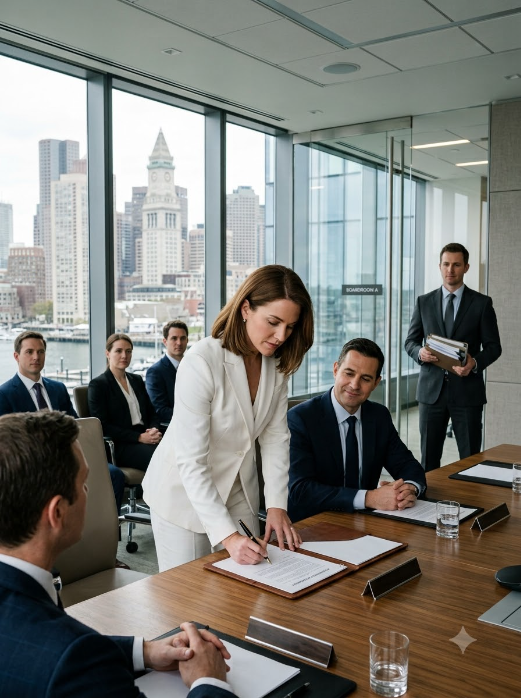
By Monday morning I was back in Boston, crossing the lobby of Ashford Tower in a white suit, no wedding ring on my hand, while employees who used to look straight through me now stepped aside as if the marble under their feet had changed owners. In the boardroom, Bennett sat to my left, Oliver stood near the door, and the company’s legal counsel laid the finalized voting agreements in front of me.
The market panic, the creditor pressure, the emergency proxy shifts, and the tender offer had done exactly what they were built to do.
I signed my name as Vivian Harrow.
Then I looked around the table at the executives who had mistaken my silence for absence.
“Julian Ashford is removed as CEO, effective immediately,” I said. “A full forensic audit starts today, and anyone who took part in concealed liabilities, false invoices, unauthorized transfers, or misuse of company funds has seventy-two hours to cooperate voluntarily.”
No one interrupted.
“I’m not here to destroy this company,” I went on. “Julian did enough of that on his own. I’m here to save what can still be saved and cut away what’s been left to rot.”
That afternoon, Julian’s father, Everett Ashford, walked into the office like an aging king arriving after his own gates had already been opened from inside. His silver hair was combed back, his suit was costly, and his fury looked almost staged until I slid a folder across the desk.
Inside were copies of my father’s letters, old transfer records, shell-company paperwork, and the private evidence my mother had guarded for years after Harrow Development was dismantled under the polite language of finance.
Everett’s face changed.
For the first time, he looked less powerful than old.
“You should have left the past where it was,” he said.
“The past was never buried,” I answered. “It was only waiting for someone with the standing to read it out loud.”
Part 5 – What The Ledger Remembered
The first court hearings began months later, and I attended only the opening day, because I didn’t need to sit through every hour to know that documents, properly arranged, could speak more clearly than grief ever could. Julian looked thinner, aged in a way that had nothing to do with his face, and when he saw me walk in beside Bennett, something flickered across his expression, as if he’d expected the woman he sent to Rome to stay there forever.
The evidence didn’t need theatrics. There were payment records, undisclosed obligations, falsified vendor files, private messages, improper transfers, and communications proving the wedding had been arranged while our marriage was still legally intact. Serena sat apart with her attorney, no longer glittering, no longer triumphant — just another person discovering that borrowed power can vanish faster than it arrived.
Outside the courthouse, reporters packed the steps. One raised a microphone and asked whether everything I’d done was revenge.
I paused under the pale winter sky, thinking of my father’s cufflink, my mother’s locket, Bennett’s steady voice, Oliver’s quiet loyalty, Mara’s precise stitching, Serena’s collapsing smile, Julian’s last accusation, and the look on Everett’s face when he recognized papers he’d assumed would never resurface.
“No,” I said. “Revenge is emotional.”
The cameras clicked.
“This was accounting.”
A year later, Harrow Group opened its first community housing project, on land my father had once planned to develop before the Ashfords and their partners took it from him. It wasn’t our largest building, or our most profitable, but it had sunlight in every apartment, a childcare center on the ground floor, a small public garden, and a bronze plaque in the lobby bearing my father’s name.
I didn’t turn cruel once everything ended. Cruelty isn’t strength — it’s fear dressed in expensive clothes. What I became was careful.
I learned to read contracts, pauses, apologies, gifts, and promises with the same close attention. I learned that love without honesty is only performance, and power without integrity is only a structure waiting for the right wind to find it. I keep three things on my desk: my father’s cufflink, my mother’s locket, and the first page of the tender offer that removed Julian Ashford from the throne he built out of other people’s trust.
Empires don’t fall in a single day. Neither do marriages. The ending starts with small choices no one challenges soon enough — one hidden account, one false invoice, one polished lie, one plane ticket, one dress, one husband convinced the quiet woman beside him will never lift her head.
Julian was wrong.
I had been quiet because I was watching.
And when I finally looked closely enough, I saw everything.
THE END
