

PART 2
What I felt first wasn’t fear.
It was pressure.
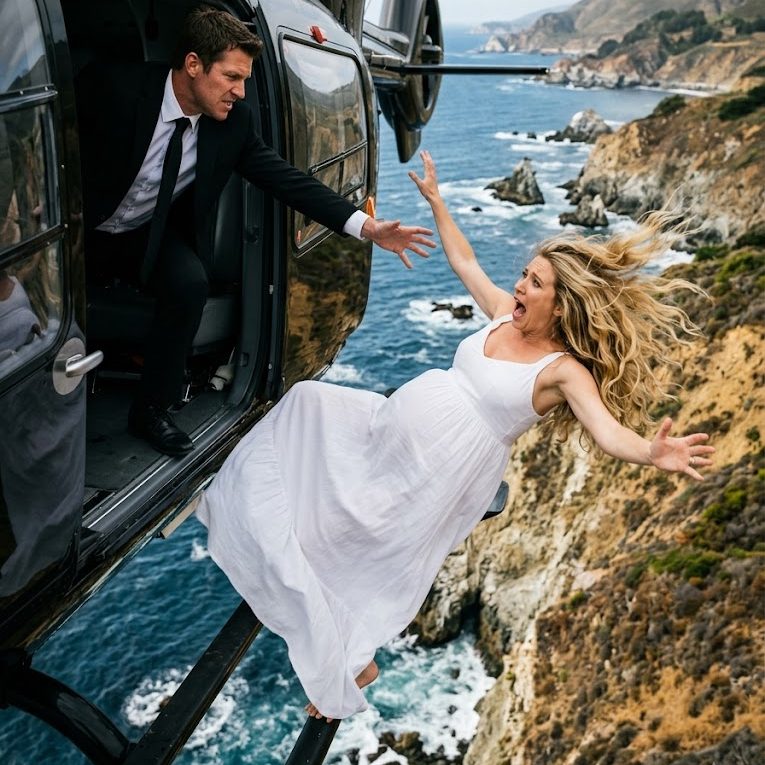
The wind flattened my clothes to my body, ripped the air from my lungs, and turned the blue Pacific beneath me into a spinning sheet of glass. The helicopter climbed away with frightening speed, shrinking as I dropped.
For one impossible moment, I saw Richard leaning out through the open door.
He was watching.
Not reaching.
Not shouting.
Then the helicopter turned inland and vanished behind a wall of white sunlight.
My hand found the small red handle hidden under my jacket.
I pulled.
Nothing happened.
Panic hit harder than the fall itself.
I pulled again, with both hands this time.
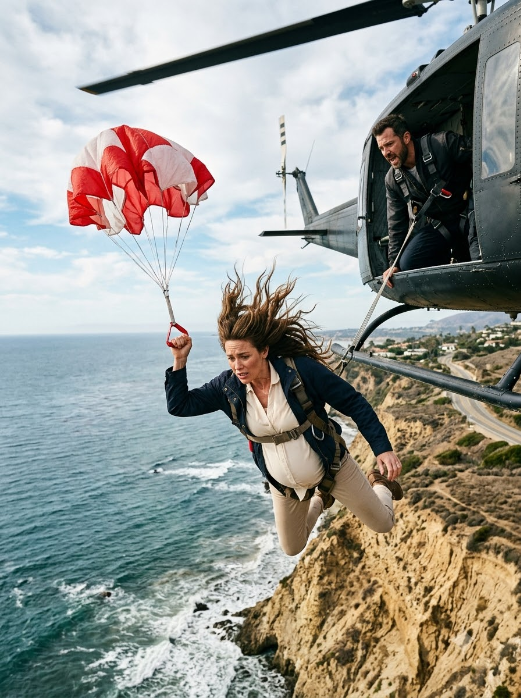
A sharp crack sounded above me. Fabric burst from the compact pack under my coat, lines snapped into the air, and my body jerked so hard that pain shot across my shoulders.
Then I wasn’t falling anymore.
Not quite.
The emergency parachute opened crookedly, one side twisting in the wind. I spun above the water, fighting nausea while the harness cinched tight around my ribs.
“Come on,” I gasped. “Come on.”
Weeks before, a former military rescue specialist named Lena Ortiz had shown me how to steer the small canopy.
I had hated every single lesson.
I had hated the warehouse where we drilled. I had hated the bruises, the straps, and the flat certainty in Lena’s voice when she told me, “Preparation only works if you can act while terrified.”
Now her words were the only steady thing in my mind.
I pulled the left control line.
The spin eased.
Below, waves broke against a narrow strip of rocky beach. Farther in, steep cliffs rose, covered in dry grass and coastal shrubs. I couldn’t place exactly where Richard had flown us, but I recognized the isolated stretch north of Santa Barbara.
The wind pushed me toward the cliffs.
That was bad.
Landing in the ocean would be risky, but hitting rock would be far worse.
I worked the lines, aiming for open water close to shore. Every motion sent pain through my arms. My baby shifted inside me, a small, sudden flutter that nearly shattered my focus.
“I’m here,” I whispered, not sure if I was speaking to the child or to myself. “I’m still here.”
The surface rose to meet me.
I crossed my arms over my stomach the way Lena had taught me and hit the water feet first.
Cold swallowed everything.
The parachute crumpled down on top of me, dragging across my face. Saltwater filled my mouth. I kicked up, found only tangled fabric, and fought the urge to panic.
My fingers searched out the harness releases.
One buckle gave way.
The second wouldn’t budge.
I yanked until my nails bent, then remembered the knife tucked into my sleeve. I pulled it out, sliced through the strap, and broke the surface under a sky that felt almost too bright to look at.
I gulped in air.
The helicopter was nowhere in sight.
For several minutes I could do nothing but float. My legs had gone weak, and the soaked jacket weighed down my shoulders. The shore looked close enough to reach, but the current kept dragging me sideways.
I shrugged out of the jacket and let it sink.
Underneath, I had on a lightweight flotation vest hidden beneath a loose cream blouse. Richard had teased me that morning for picking such a plain top.
“You’re dressing like someone’s nervous aunt,” he’d said.
I’d smiled and told him pregnancy shifted a woman’s priorities.
He’d kissed my forehead.
Now the memory made me shiver worse than the cold did.
I started swimming for shore.
Every stroke felt slow and leaden. The waves shoved me forward, then dragged me back. I kept my eyes on the dark sand between two rock clusters and refused to look up at the cliffs.
A wave lifted me and carried me farther than the rest. My knees hit bottom. I crawled until the water no longer reached my waist, then dropped onto wet sand.
For a long stretch, I just listened to myself breathe.
I touched my stomach.
No pain.
No bleeding.
The baby moved again.
A sob broke out of me, small and raw.
I’d spent months picturing Richard trying to hurt me. Even after I’d arranged the parachute, the flotation vest, the tracking beacon, part of me had still believed the precautions were overkill.
Maybe that was exactly why I’d gotten on that flight.
I’d needed to find out whether the man beside me was still my husband, or just someone waiting for his chance.
Now I knew.
There was no triumph in knowing.
Only grief.
I rolled onto my side and pressed my palm into the sand.
“Beacon,” I whispered.
The tracker was strapped to my ankle. I reached under my damp trousers and hit the activation button three times.
A green light blinked.
Lena would get the signal.
So would Daniel Cho, my chief legal officer, the only other person who knew the full plan.
My father once told me that wealth made secrecy easy and trust hard to come by. I’d thought he was talking about business.
I understood him differently now.
I got to my feet, carefully.
The beach curved along the base of the cliffs, empty apart from driftwood and seabirds. No houses in sight. My phone was gone, lost in the water, though I’d expected that.
A waterproof pouch under my blouse held a second phone, a small medical kit, and a memory card with copies of every suspicious financial record Richard had ever touched.
I opened the pouch.
The phone powered on.
No signal.
I tried emergency services anyway. The call didn’t go through.
The beacon would have to carry the weight.
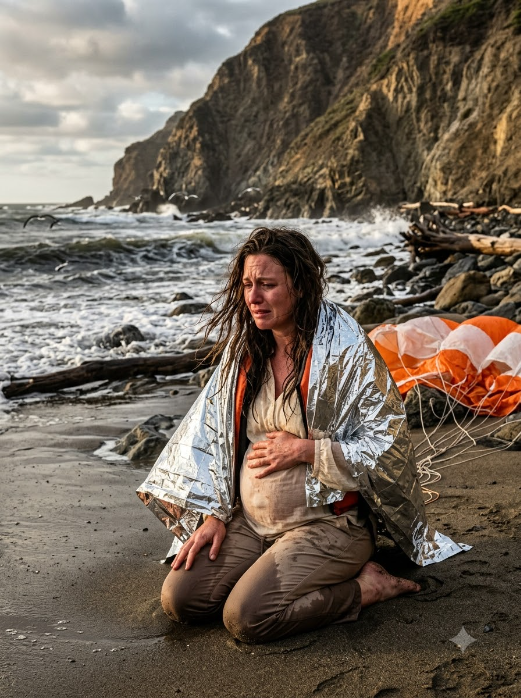
I made my way toward the base of the cliffs, where a shallow overhang cut the wind. My body had started shaking hard. I peeled off my wet blouse, wrapped myself in the emergency blanket from the pouch, and checked my pulse.
Fast, but even.
My left shoulder ached from the parachute’s opening, and a bruise was spreading across my hip. Otherwise, I seemed absurdly lucky.
I didn’t feel lucky.
Richard’s face kept surfacing every time I shut my eyes.
Empty.
Cold.
Resolved.
But underneath those images, another one rose up.
Richard painting the nursery at midnight because he hadn’t liked the first shade of blue.
Richard kneeling next to me after our first ultrasound, tears in his eyes over a grainy photograph.
Richard murmuring, “I didn’t know I could want anything this much.”
Had any of that been real?
I hated that I still wondered.
The phone rang.
The sound startled me so badly I nearly dropped it.
Lena’s name lit up the screen.
I picked up.
“Amelia?”
“I’m alive.”
Her breath rushed out through the speaker.
“Are you hurt?”
“Bruised. Cold. I’m on a beach, under some cliffs. The beacon’s on.”
“We’ve got your location. Rescue’s coming in from the north.”
“How long?”
“Not long. Stay where they can see you, but don’t try to climb.”
I leaned back against the rock.
“Richard pushed me.”
A short silence.
“Did you see anyone else on board?”
“No. The pilot’s seat was empty.”
Richard had gotten his private pilot’s license two years back. He’d called it a hobby.
Lena’s voice gentled.
“Are you sure you want to go into this now?”
“I need you to know exactly what happened.”
“I’m recording.”
I walked her through the flight, the route, the open door, Richard’s final look. Saying it out loud made it real.
When I finished, she asked, “Did he say anything before he pushed you?”
“Just that I deserved the view.”
“That could matter.”
“Everything matters now.”
A faint engine hummed above the cliffs.
I stepped out from under the overhang.
“Someone’s coming.”
“Rescue’s coming by boat, not by road.”
My skin went tight.
A dark vehicle appeared briefly along the cliff edge.
Then it stopped.
“Lena,” I whispered.
“Get out of sight.”
I dropped behind a rock formation.
The engine cut out.
No one showed up at the edge.
Maybe it was a hiker. Maybe a ranger. Maybe Richard had come back to see for himself what the ocean had done.
I pictured him standing up there with binoculars.
The thought felt overdramatic, but so had the parachute when I’d packed it under my coat.
“Can you see the car?” Lena asked.
“Not anymore.”
“Stay down.”
Minutes crawled by.
I could hear gulls, waves, and my own ragged breathing.
Then a second engine came in from the water. A rescue boat appeared past the surf, bright white against the deep blue sea.
Two figures waved.
I stepped out from the rocks and lifted the silver blanket.
The dark vehicle started up above me.
By the time the rescue crew reached the sand, it was gone.
Lena got to the hospital before the doctors had even finished with me.
She walked into the room in a charcoal suit, hair pulled back, expression locked down. Only her eyes gave away how scared she’d been.
“You look awful,” she said.
I laughed once, then started crying.
She held me carefully, working around the monitors and my bruised shoulder.
“You made it,” she whispered.
“The baby?”
“Doctor said the heartbeat’s strong.”
“I need to hear it again.”
“You will.”
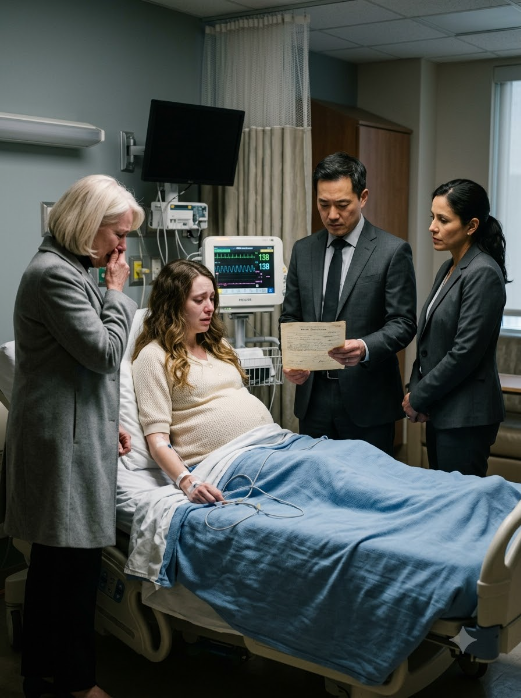
She sat down beside the bed while a nurse repositioned the fetal monitor. The quick, steady rhythm filled the room.
My child’s heartbeat.
I shut my eyes.
For the first time since the fall, I let myself believe we might both make it through the day.
Daniel showed up twenty minutes later, laptop and folder in hand. He was in his forties, quiet, usually unshakeable. Today his tie was crooked.
“They found the helicopter,” he said.
“Where?”
“A private airfield outside Santa Maria.”
“And Richard?”
“Gone.”
I glanced at Lena.
“He thinks I’m dead.”
“We haven’t said otherwise,” she said.
A doctor came in before I could respond. She said I had mild hypothermia, strained muscles, and bruising, but nothing serious. She wanted to keep me overnight because of the pregnancy.
Once she left, Daniel set the folder down.
“We need to figure out what comes next.”
“I go to the police.”
“Yes. Carefully.”
“Carefully?”
“Richard’s legal team has already reached out to the sheriff’s department.”
I stared at him.
“How?”
“He reported an aviation accident.”
Lena’s jaw tightened.
“What kind of accident?”
Daniel opened his laptop.
“Richard’s version is that the helicopter hit sudden turbulence. He’s claiming your safety harness failed and you fell before he could grab you.”
“He pushed me.”
“I believe you.”
“He opened the door himself.”
“I believe that too.”
“Then why does his version matter at all?”
“Because he had it ready before the flight.”
Daniel showed me a digital maintenance report filed that morning. It flagged a possible defect in the passenger harness and recommended it be replaced.
My signature was at the bottom.
It wasn’t mine.
“He forged this,” I said.
“Or someone did it for him.”
“Who had access?”
“Richard, the aviation manager, and your executive assistant.”
“Clara?”
Daniel nodded, reluctant.
Clara Bennett had worked for me for seven years. She knew my schedule, my passwords, the fine print of my estate planning. She’d also been the first to congratulate me when I announced the pregnancy.
“Where is she?”
“Called in sick yesterday.”
The room seemed to tilt.
Lena shut the laptop.
“That can wait.”
“No,” I said. “It can’t.”
“Your body’s just been through a trauma.”
“My whole life has been through a trauma.”
Daniel leaned in.
“Amelia, Richard thinks the search is still going. He doesn’t know you made it to shore. That gives us a small window.”
“What’s he doing?”
“He went back to the estate.”
“Our house?”
“Yes.”
My stomach clenched.
“Why?”
“He met with two trustees and asked for emergency authority over your personal holdings.”
“That fast?”
“He’s claiming urgent business decisions can’t wait.”
The speed of it stung almost as much as the betrayal. Richard hadn’t gone home to grieve. He’d gone home to collect.
“Did they give it to him?”
“No. Your updated trust blocked it.”
Months earlier I’d restructured my estate. If I died or was incapacitated, control would shift temporarily to an independent committee. Richard would keep the house, personal funds, and a generous allowance, but no say over Hayes Technologies.
That change had sparked our worst fight.
He’d accused me of shutting him out.
I’d apologized.
I wished now I hadn’t.
“What did he say when the trustees said no?” I asked.
Daniel’s expression shifted.
“He’s saying the updated documents are invalid because you weren’t mentally sound when you signed them.”
The words settled like stone.
“He planned for both outcomes.”
“Looks that way.”
“If I died, he got what was left outside the trust. If I lived and accused him, he’d say I was unstable.”
Lena nodded.
“Two stories, ready either way.”
I looked down at my hands.
“What happens if I stay hidden?”
“Richard keeps operating as if you’re missing,” Daniel said. “We watch who reaches out to him, who moves money, who backs his story.”
“That’s using my death as bait.”
“It’s risky,” Lena said. “Not physically, if security holds — but emotionally, legally.”
“My mother’s going to hear I’m missing.”
Daniel hesitated.
“She already has.”
Pain went through me.
My mother lived in Boston and had a heart condition. We talked every Sunday. She’d never trusted Richard but had accepted him for my sake.
“Tell her.”
“We’d have to explain why she can’t reach out to anyone.”
“Tell her anyway.”
“I will.”
“What about the company?”
“Your board thinks rescue efforts are still underway. I’ve asked them to hold off on any statement.”
A television in the corner ran silent footage of the California coastline. A red banner along the bottom carried my name.
BILLIONAIRE TECH EXECUTIVE MISSING AFTER HELICOPTER ACCIDENT.
I turned it off.
For years, papers had reduced my life to numbers. My inheritance. My company’s value. My donations. Even my pregnancy had been framed as the arrival of an heir.
Now my possible death was just another market event.
“What does Richard get personally?” Lena asked.
Daniel pulled up the trust summary.
“Roughly twelve million in liquid assets, the primary residence, and a few jointly owned properties.”
“Enough for most people,” I said.
“Not what he was expecting, though,” Daniel said.
I studied him.
“Meaning?”
“Three months ago, Richard asked for an informal valuation of your private shares.”
“How do you know that?”
“The valuation firm contacted me after realizing he had no authorization.”
“Why didn’t you tell me?”
“I did. I sent the report to Clara and asked her to file it in your confidential review folder.”
The room went quiet.
“I never saw it.”
Daniel’s eyes hardened.
“Then Clara held it back.”
Lena stood.
“We need to find her.”
Daniel’s phone rang.
He glanced at it.
“Estate security director.”
He answered, listened.
“What time?” he asked.
His eyes moved to me.
“Send me the footage.”
He hung up.
“What happened?” I asked.
“Someone got into your private office last night.”
“At home?”
“Yes.”
“Richard?”
“No. Clara.”
He turned the laptop toward us as the video came through.
The footage showed Clara moving through the dark hallway just past midnight. She used her employee code, went into my office, and stayed inside eighteen minutes.
When she came out, she was carrying a slim metal case.
I knew it instantly.
It held the original handwritten codicil my father had added to his estate plan not long before he died.
“What was inside it?” Lena asked.
“A letter, some certificates, and a sealed file my father told me not to open until my child was born.”
Daniel frowned.
“Why was it at your house?”
“My father didn’t trust digital storage. He said some truths belonged on paper.”
“Did Richard know?”
“He knew a case existed. Not what was in it.”
“Clara did,” Daniel said.
I thought back to the day I’d brought it home. Clara had handled the insurance paperwork and logged it into my private inventory.
“What did your father’s letter say?” Lena asked.
“That the sealed file concerned the original ownership of Hayes Technologies.”
Daniel went completely still.
“Original ownership?”
“My father founded the company with another engineer, but the partnership fell apart before the first public investment. He never talked about the details.”
“Who was the partner?”
“I don’t know.”
Lena turned to Daniel.
“Could the file affect control of the company?”
“It’s possible.”
My phone rang.
Only four people had this number.
Lena checked the screen.
Unknown caller.
She answered without saying anything.
Richard’s voice came through the room.
“Amelia?”
Every muscle in me tensed.
Lena muted the call and looked at me.
“How does he have this number?”
“No one outside this room should have it,” Daniel said.
Richard spoke again.
“I know you’re alive.”
Those words wiped out whatever advantage we’d had.
I took the phone.
“How?”
His breath caught.
Neither of us spoke for a moment.
Then he said, “I saw the parachute open.”
His voice sounded nothing like the one I remembered from the helicopter. Strained, almost shaky.
“You watched me fall.”
“Yes.”
“You left.”
“I had to.”
“You had to?”
“People were tracking the aircraft.”
“You pushed your pregnant wife into the ocean.”
“I pushed you because they were listening.”
The excuse was so ridiculous I nearly hung up.
“Don’t insult me with another lie.”
“It’s not a lie.”
“Then explain it.”
“Not on the phone.”
“Of course not.”
“Amelia, Clara has the file your father left.”
“We know.”
“Then you also know she isn’t working for me.”
I looked at Daniel.
“Who is she working for?”
“I don’t know. She came to me six months ago with documents claiming your father hid the company’s real ownership.”
“And you believed her?”
“I believed enough to look into it.”
“By digging into my trusts?”
“I needed to know what would happen if the ownership claim went public.”
“So you were setting yourself up to inherit before anyone could challenge it.”
“No.”
“You forged a safety report.”
“I didn’t.”
“You took me out over the ocean.”
“Because Clara said the people following us would force the helicopter down if I stayed on the planned route.”
My anger sharpened.
“Why would anyone believe that?”
“Because the controls had been remotely compromised.”
Daniel motioned for quiet and started typing.
Richard kept going.
“I lost steering near the cliffs. The door opened on its own. I realized someone was recording inside the cabin.”
“The door didn’t open on its own. You opened it.”
“To make them think their plan was working.”
“And then you pushed me.”
“I saw the shape of the parachute under your jacket.”
I stopped breathing.
He’d known.
“You knew I was prepared?”
“I found Lena’s invoice.”
Lena muttered a curse.
Richard’s voice dropped.
“I figured the parachute was your last line of defense. I thought if I made it look convincing, they’d stop steering the aircraft long enough for me to land it.”
“You could have warned me.”
“I tried.”
“When?”
“When I said you deserved the view.”
“That meant nothing.”
“It was the phrase we agreed on in Monterey.”
A memory rose from two years back.
Richard and I had gone sailing. Before we left the harbor, we’d joked about a phrase for warning each other if one of us sensed danger and couldn’t speak freely.
You deserve the view.
At the time it had seemed silly.
A private joke made over wine.
I’d forgotten it entirely.
Richard hadn’t.
My certainty cracked, though it didn’t vanish.
“You still pushed me without knowing if the chute would open.”
“I knew staying on board was worse.”
“Why?”
“Because the fuel line had been tampered with. The helicopter caught fire four minutes after I landed.”
Daniel’s fingers flew across the keyboard.
He pulled up a local report.
A private helicopter had gone up in flames at an airfield outside Santa Maria. No cause had been released yet.
Richard was telling at least some of the truth.
“Where are you now?” I asked.
“I can’t say.”
“Why should I believe anything you tell me?”
“You shouldn’t.”
The honesty threw me off.
“Then what do you want?”
“To keep you away from the estate.”
“Clara already has the case.”
“She took a copy.”
I looked at Daniel.
“What?”
Richard went on.
“Your father never trusted just one hiding place. The real file is somewhere else.”
“Where?”
“I don’t know. But Clara thinks you do.”
A sound came through the phone — a door opening.
Richard lowered his voice.
“Amelia, someone inside your company helped alter that helicopter.”
“Who?”
“I have one name.”
The line went quiet.
“Richard?”
A woman’s voice replaced his.
“Mrs. Hayes.”
I recognized Clara at once.
Her flat, even tone scared me more than shouting would have.
“Where is my husband?”
“Safe for now.”
“What do you want?”
“The file your father left.”
“You already took it.”
“I took what he meant for us to find.”
“Us?”
Clara paused.
“My family helped build Hayes Technologies.”
Daniel leaned toward the phone.
“State your full name.”
She laughed softly.
“You already know it isn’t Bennett.”
The line went dead.
I stared at the screen.
Daniel pulled up the company’s earliest incorporation records while Lena got the security team on the phone.
My body suddenly felt heavier, as if the fall had only just caught up to me.
“Amelia,” Daniel said.
He turned the laptop to face me.
The original partnership agreement listed my father, Samuel Hayes, next to another name.
Dr. Evelyn Bennett.
Clara hadn’t picked her fake surname at random.
“She’s related to the cofounder,” I said.
“Maybe,” Daniel said.
Lena’s phone buzzed.
She read the message and frowned.
“What is it?”
“Security searched Richard’s study.”
“And?”
“They found a hidden safe.”
I’d expected financial records, forged papers, or evidence of some other life.
Instead, the photo showed a bundle of letters tied with blue ribbon.
Every envelope was addressed to my father.
The handwriting was my mother’s.
Daniel zoomed in.
One envelope had never been sealed. A page stuck out of it, showing a single line.
Samuel, Richard has agreed to marry Amelia, but only if you keep the truth about the baby buried.
My hand went to my stomach without thinking.
“That can’t be about this baby,” Lena said carefully. “The letter’s old.”
I checked the date.
Twenty-eight years back.
The year I first met Richard, at a summer program in London.
“That doesn’t add up,” I whispered. “Richard and I didn’t marry until ten years after that.”
Daniel flipped the photo of the page.
Something else had been written on the back.
Not in my mother’s hand.
In my father’s.
Tell Amelia when she is ready to learn why Richard was chosen for her long before she ever met him.
The hospital room seemed to fall away around me.
Richard hadn’t walked into my life by accident.
My parents had known him.
They’d chosen him.
And whatever they’d buried was tangled up not only in my marriage, but in the child I was carrying.
Before any of us could say another word, the fetal monitor changed rhythm.
The nurse rushed in, the doctor right behind her.
While they adjusted the sensors, a new email landed in Daniel’s inbox.
From Richard.
The subject line held six words:
DO NOT LET THEM TEST THE BABY.
Part 3: The Truth My Family Buried Before I Was Born
The fetal monitor settled before any of us found the nerve to breathe normally again.
The nurse repositioned the sensor on my stomach, then offered a reassuring smile.
“Your baby’s heartbeat is strong,” she said. “That change was probably just stress and movement. We’ll keep watching both of you.”
I nodded, but my hands stayed cold.
On Daniel’s laptop, Richard’s message was still lit up.
DO NOT LET THEM TEST THE BABY.
Lena stood near the door, one hand on the back of a chair. Daniel had stopped typing. Even the doctor, who knew nothing about the tangled trail of letters and forged papers around my family, seemed to sense something had changed.
“What test?” I asked.
Daniel gave me a careful look.
“He didn’t say.”
“Then call him.”
“He might not pick up.”
“Call him anyway.”
Daniel tried Richard’s number. It rang once, then went to voicemail.
I tried the private line.
Nothing.
Lena crossed the room and dropped her voice.
“Amelia, we need to slow down.”
“I’ve spent months slowing down. Watching, waiting, checking accounts, rewriting my trust, strapping a parachute under my clothes because I was scared of my own husband.”
My voice broke on the last part.
“I’m done letting everyone else decide what I get to know.”
The anger didn’t make me feel any stronger. Just tired.
Still, I straightened.
“Find out what test he meant.”
Daniel pulled up the medical portal.
“Nothing unusual on your chart. Standard bloodwork, fetal monitoring, ultrasound.”
“What about the hospital itself?”
Lena frowned.
“What do you mean?”
“Could someone order something without my okay?”
“Not legally,” Daniel said. “But we’ve already seen someone forging signatures.”
The doctor, still near the monitor, stepped closer.
“My staff won’t run anything you haven’t authorized,” she said. “I’ll flag your chart. No samples leave this room without my sign-off.”
Her tone was steady and direct. For the first time all day, certainty came from someone who didn’t know my fortune, my family history, or the weight carried by my name.
“Thank you,” I whispered.
Once she’d left, Daniel looked over Richard’s message again.
“Most likely he means genetic testing,” he said.
The word landed softly.
Genetic.
I thought of my mother’s letter.
Richard has agreed to marry Amelia, but only if you keep the truth about the baby buried.
The date had been twenty-eight years earlier.
Long before I was pregnant.
Long before my marriage.
The baby in that letter hadn’t been mine.
It had been me.
I put both hands over my stomach.
“Richard wasn’t warning us about my child,” I said.
Daniel looked up.
“He was warning us about what testing my child might reveal about me.”
Lena pulled a chair closer and sat by the bed.
“Your parentage?”
The question should have felt unthinkable.
Instead it felt like a door I’d been walking toward my whole life without noticing it was there.
My father had loved me without question. I knew that much. He’d shown up for every school performance, taught me to drive, waited outside my first board meeting because he knew I’d be nervous. He’d been proud of me in a way that never felt like an act.
But love and biology weren’t the same thing.
I understood that.
What I didn’t understand was why he’d hidden the gap between them.
“Daniel,” I said, “find my original birth certificate.”
He didn’t move.
“The one filed at the hospital. Not the copy at home.”
“That’ll take time.”
“Then get started.”
He nodded and started making calls.
Lena’s phone buzzed.
She read the message, then turned the screen my way.
A security camera image showed Richard’s car pulling into a parking garage in downtown Los Angeles.
“That was flagged twelve minutes ago,” she said.
“Was he driving?”
“The image isn’t clear.”
“Send someone.”
“Already done.”
A new message came through almost immediately.
Vehicle empty.
I closed my eyes.
Richard had spent years staging entrances people remembered. He knew how to command a room, how to pause before he spoke, how to make people feel singled out.
Now he’d vanished without a trace.
I wanted to be furious with him.
I was furious with him.
But under the anger sat something smaller, more dangerous.
I wanted him to be alive.
That thought brought tears to my eyes.
Lena noticed.
“You can care what happens to him and still hold him accountable,” she said.
I looked at her.
“How do you always know what I’m thinking?”
“I don’t. I know what fear looks like when it’s got nowhere to go.”
She rested her hand over mine.
“You don’t have to decide today whether Richard was protecting you, using you, or both. You just have to decide what keeps you and the baby safe right now.”
The baby shifted under my palm.
Small, steady, a reminder that there was still a future.
“I want to talk to my mother,” I said.
Daniel ended his call.
“She’s on her way from Boston.”
My head turned toward him.
“You told her?”
“I told her you were alive and safe. Nothing else.”
“When does she land?”
“Late tonight.”
I looked toward the window. The afternoon light was starting to turn gold over the distant hills.
For years my mother had steered clear of my father’s early business life. When I asked how they’d met, she gave me a polished story about a charity event in Cambridge. When I asked about the company’s first investor, she changed the subject.
I’d mistaken her silence for grief.
Now I wondered if it had always been fear.
“Move me,” I said.
Lena frowned.
“Where?”
“Somewhere outside the hospital system.”
“You need to be monitored.”
“Then find a private facility with secure access.”
Daniel and Lena traded a glance.
The kind people give each other when they want to argue without making you feel fragile.
“I’m not asking to leave medical care,” I said. “I’m asking not to stay somewhere anyone with enough pull can locate my room.”
Lena stood.
“I know a place.”
Two hours later I was moved by private ambulance to a small women’s health clinic tucked behind tall eucalyptus trees in Montecito. It belonged to a physician Lena had once protected during an overseas aid mission.
No news vans out front, no public front desk, nothing tying my name to a directory anywhere.
My room looked out over a courtyard full of lavender.
The calm of it felt almost like an insult.
How could flowers sway in the evening breeze while my whole life had come apart?
A nurse brought soup and bread. I managed a few bites before the nausea came back.
Daniel set up at a small desk by the window. Lena checked every entrance twice.
At nine seventeen, my mother arrived.
Margaret Hayes walked in wearing a gray travel coat over black trousers, her white-blond hair loose around her face. She looked smaller than I remembered.
For a second she just stood in the doorway, staring.
Then she crossed the room and wrapped both arms around me.
“You’re alive,” she whispered.
Her voice cracked.
I held on tight.
“I’m alive.”
She touched my face, my hair, my arms, like she was checking each piece was really there.
“And the baby?”
“Safe.”
She pressed a hand to her mouth.
Only after a few minutes did she seem to notice Daniel and Lena.
“What happened?” she asked. “The news said accident. Daniel told me not to trust it.”
I looked at Daniel.
“Give us the room.”
My mother stiffened.
“Amelia—”
“Please.”
Daniel shut the laptop. Lena hesitated, then followed him out into the hall.
Once the door closed, quiet settled between us.
My mother took off her coat and folded it over the back of a chair.
She’d always been precise with small things. Napkins lined up with plates. Shoes placed side by side. Hard feelings tucked behind useful little gestures.
“Richard pushed me out of the helicopter,” I said.
Her hands stopped.
“No.”
“Maybe he thought he was saving me. Maybe he was trying to make someone believe I was dead. I don’t know yet.”
She dropped into the chair.
“Where is he?”
“Missing.”
Her eyes closed briefly.
The reaction was too layered to be simple shock.
“You knew something,” I said.
She looked at me.
“About today? No.”
“About Richard.”
Her fingers tightened on the edge of her coat.
“Amelia, you’ve been through something horrific. This isn’t the time—”
“It’s exactly the time.”
I lifted Daniel’s laptop and turned it to face her.
The photo of her letter filled the screen.
Samuel, Richard has agreed to marry Amelia, but only if you keep the truth about the baby buried.
My mother read the line.
The blood left her face.
“Where did you get this?”
“Richard’s safe.”
She stood and walked to the window.
“Mother.”
She didn’t answer.
“Was Samuel Hayes my biological father?”
Her shoulders lifted on a slow breath.
“No,” she said.
The word didn’t land like an explosion.
It landed like the quiet that comes after one.
I looked at the woman who’d raised me, who’d picked out my birthday cakes and taught me to write thank-you notes, who’d sat by my bed when I had my appendix out at ten.
“Who was?”
She turned back around.
“I don’t know.”
I nearly laughed.
“You expect me to believe that?”
“I know how it sounds.”
“Then tell me how it happened.”
Shame tightened her face.
“When I was twenty-three, I worked at an early biotechnology company in Boston. We were developing fertility treatments. The work was experimental, barely regulated, moving faster than the law could follow.”
I said nothing.
She sat down again.
“Samuel and I had been married three years. We wanted children. After two miscarriages, doctors said another pregnancy might be difficult.”
Her hands shook in her lap.
“One of the researchers offered us a spot in a private trial.”
“What kind?”
“Embryo screening. Genetic selection, they called it.”
My skin prickled.
“We were told the embryo came from Samuel’s genetic material and mine. Screened for a handful of inherited conditions.”
“Was that true?”
“I carried you. You were born healthy. For years we thought everything had gone exactly as promised.”
“What changed?”
“Samuel got a letter when you were six.”
She looked down.
“The company had folded. Records vanished. A former employee claimed donor samples had been mislabeled, swapped, or handpicked without anyone’s consent.”
I felt the baby shift.
“Handpicked for what?”
“That part was never clear.”
“Intelligence? Disease resistance? Looks?”
My mother flinched.
“I don’t know.”
“You keep saying that.”
“Because it’s true.”
She stood and started pacing.
“Samuel became fixated on finding the records. He hired investigators. He tracked down several children born through the same trial.”
“Children like me?”
“Yes.”
“How many?”
“At least twelve.”
The room felt suddenly too warm.
“What happened to them?”
“Most grew up ordinary lives. Some never learned any of this. A few families dropped off the public record entirely.”
“Dropped off?”
“Changed names. Moved away. Cut off contact.”
“And Richard?”
My mother stopped moving.
“He was one of them.”
For several seconds, all I could hear was the soft hum of the equipment.
“Richard was part of the same trial?”
“Yes.”
I stared at her.
“That’s why my parents picked him?”
“We didn’t pick him.”
“The letter says he agreed to marry me.”
“Not right away.”
She looked toward the dark courtyard.
“Samuel wrote that letter after Richard came to us and said he wanted to propose. Your father accused him of mistaking love for obligation.”
I held my breath.
“Richard left that night. Two weeks later he came back and told Samuel he’d marry you, but only if Samuel promised never to use the truth to control your choices.”
I thought of the letter again.
Richard has agreed to marry Amelia, but only if you keep the truth about the baby buried.
Not because he’d been paid.
Not because he’d been assigned to me.
Because he’d insisted my father stop manipulating my life.
The meaning shifted under me.
“Why keep the letter?” I asked.
“Samuel kept everything.”
“No. Why did Richard keep it?”
My mother’s eyes welled up.
“Maybe because it proved that, once, he tried to protect your freedom.”
The room went quiet.
I wanted relief.
Instead I felt grief for the young man Richard had been, and anger at the man he’d become.
Protecting me didn’t excuse the secrecy.
Loving me didn’t excuse the control.
But betrayal didn’t erase every good thing that had come before it, either.
That was the hardest part of all.
The door opened quietly.
Lena stepped in.
“I’m sorry,” she said. “We found Richard.”
I pushed myself upright.
“Where?”
“An abandoned rental house near Ventura.”
“Is he alive?”
“Yes.”
My chest loosened before I could stop it.
“He’s being brought here under guard,” Lena went on. “Head injury, dehydration, but conscious.”
“Who took him?”
“He says Clara.”
My mother stood.
“We need to go.”
“No,” I said.
She stared at me.
“Amelia, you don’t understand what these people can do.”
“I understand that running has kept everyone safe except me.”
“Your father was trying to protect you.”
“And he kept me blind while he did it.”
I reached for her hand.
“I’m not blaming you for what happened before I was born. But I need you to stop treating ignorance like it’s the same thing as safety.”
Her eyes filled.
For a moment she didn’t look like my mother — she looked like a frightened young woman who’d once signed up for a medical trial because she wanted a child.
“I was afraid you’d think I wasn’t your real mother,” she whispered.
The ache in her voice loosened something in me.
I squeezed her hand.
“You carried me. You raised me. You loved me.”
A tear slid down her cheek.
“No test changes that.”
She bowed her head and pressed my hand to her face.
For the first time since she’d walked in, the distance between us started to close.
The door opened again.
Daniel came in with a folder.
“I got a copy of the hospital record,” he said.
“My birth certificate?”
“Not quite.”
He set a faded document on the table.
The certificate listed Margaret Hayes as my mother.
The line for father didn’t have Samuel’s name.
It had a code.
DONOR 7-C.
“What does that mean?” I asked.
Daniel turned to another page.
“The hospital used donor codes for the trial. I found a partial index buried in an old court filing.”
He looked at my mother.
“Donor 7-C shows up in records tied to three children.”
“Three?” she whispered.
“Yes.”
My pulse jumped.
“Who are the others?”
“One identity’s sealed. The second one’s dead.”
“And the third?”
Daniel met my eyes.
“Richard.”
No one said anything.
The possibility filled the room before any of us dared put it into words.
My mother’s hand tightened on the table’s edge.
“That can’t mean what it sounds like.”
Daniel shook his head.
“Not necessarily. Donor codes got reused, altered, sometimes assigned to whole sample groups instead of individuals. We need the original records.”
I stared at the paper.
Richard and I had both been told we came from the same trial.
Now the records suggested something much worse.
Could we share a biological father?
Could that put our child at risk?
Was that why he’d warned us against testing the baby?
The clinic’s physician came in after Lena filled her in. She listened closely, then spoke with the kind of steadiness that calms panic without brushing it off.
“We don’t draw conclusions from incomplete archive codes,” she said. “There are safe, confidential tests that can clarify biological relationships.”
I looked at my mother.
Then at Daniel.
Then at the message glowing on the laptop.
DO NOT LET THEM TEST THE BABY.
“Can we test Richard and me without involving the baby?” I asked.
“Yes.”
“Then let’s do it.”
My mother shut her eyes.
Daniel nodded slowly.
Lena spoke up first.
“Only with a lab we control.”
The physician agreed.
A nurse took my sample.
Richard arrived a little before midnight.
They wheeled him in through a private entrance. A bandage covered his temple. His face looked pale under several days’ worth of stubble.
When he saw me, he stopped.
For a second, the room fell away around us.
He looked at my stomach, then at my face.
“You survived,” he whispered.
I’d pictured this moment plenty of times since the fall.
In some versions I shouted.
In others I turned away.
Instead I said, “You knew about the parachute.”
“Yes.”
“You knew about the trial.”
“Part of it.”
“You knew my father wasn’t my biological father.”
“Yes.”
The word stung, even though I’d braced for it.
“Why didn’t you tell me?”
Richard glanced at my mother.
“Because Samuel convinced me the people behind the trial were still watching the families.”
“That wasn’t your call to make.”
“No.”
He didn’t try to defend it.
“You pushed me out of a helicopter.”
His eyes closed briefly.
“I thought the aircraft was going down. I thought you had the only working way out.”
“You could have jumped with me.”
“I had to land it before it hit the highway.”
The picture shifted again.
Not innocence.
Not certainty.
Something more tangled.
“I still don’t know whether to believe you,” I said.
“You shouldn’t. Not yet.”
He looked at Daniel.
“Did you find the donor code?”
Daniel said nothing.
Richard’s expression told me he already understood.
“You knew,” I said.
“I found a reference two days ago. Clara showed me.”
“That’s why you sent the warning.”
“Yes.”
“Were you scared we were related?”
“I was scared someone wanted us to think we were.”
That stopped me.
“What?”
Richard gripped the arms of the wheelchair.
“The old records were manipulated. Clara wanted me to panic. She wanted me to stop the birth, disappear, or turn on you.”
My mother sank into her chair.
“Why?”
“Because fear would split us apart before we could compare what each of us knew.”
Daniel leaned in.
“What do you know?”
Richard looked at me.
“Your father’s real file isn’t about donor identities.”
“Then what?”
“Ownership of the embryos.”
The room stilled.
He kept going.
“The trial didn’t produce twelve children.”
“How many?” I asked.
“Hundreds.”
My mother covered her mouth.
Richard’s voice thinned.
“Most never made it to term. Some embryos were stored. Some got transferred to other clinics. Samuel found out the research archive held genetic profiles, family histories, and legal claims tied to every child born through the program.”
Daniel’s face hardened.
“Claims to what?”
“Patents. Trusts. Companies. Inheritance.”
I stared at him.
“You’re saying we were chosen based on the families we’d be born into.”
“Yes.”
Not children.
Assets.
Connections.
Future leverage.
The idea was so cold I could barely hold it in my head.
“And Clara?” I asked.
“Her family believes the children — and everything they inherited — belong to the original research foundation.”
“They think they own us?”
“They think they own the design.”
The baby moved under my hand.
A fierce calm settled over me.
“No one owns my child.”
Richard’s eyes found mine.
“No.”
For the first time that night, we agreed without hesitation.
The physician took Richard’s sample. He winced when the swab caught the cut near his mouth but didn’t say anything.
The results would take hours, even at a private lab moving fast.
They moved Richard to a room across the hall, under guard.
Before he left, he stopped in the doorway.
“Amelia.”
I looked at him.
“There’s one thing Samuel never knew.”
“What?”
“The donor code on your file was changed after you were born.”
“By who?”
Richard’s eyes moved to my mother.
“Margaret.”
My mother went still.
I turned slowly.
“Is that true?”
She looked between us.
Then she opened her handbag and took out a small brass key.
The same kind that used to open my father’s private archive.
“I changed the code,” she said. “But not to hide your father.”
My throat tightened.
“Then what were you hiding?”
She pressed the key into my palm.
“Your sister.”
The word seemed to change the air in the room.
“I don’t have a sister.”
My mother’s eyes filled.
“Yes, Amelia. You do.”
Daniel stood.
“Where is she?”
My mother looked toward the window, where the first thin line of dawn was starting to brighten the sky.
“I haven’t seen her since the day you were born.”
She closed my fingers around the key.
“But Clara has.”
I stared at her.
“What’s her name?”
My mother drew a shaky breath.
“Evelyn.”
Across the hall, an alarm went off from Richard’s room.
Lena bolted for the door.
Daniel followed.
I tried to get up, but my mother held my shoulders down.
A nurse rushed past us.
Then Lena came back, her face tight.
“Richard’s gone.”
“That’s not possible,” Daniel said. “There were guards.”
“He didn’t go through the door.”
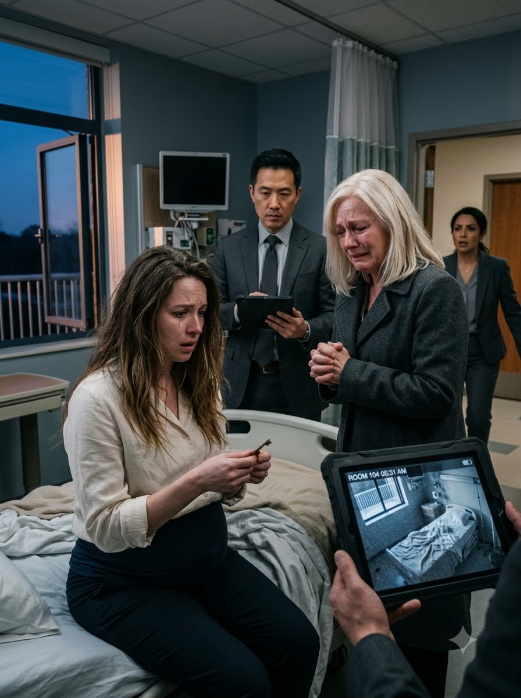
She held up the tablet from the security desk.
The camera feed showed Richard’s empty bed, an open window, and a folded page on the pillow.
Daniel zoomed in.
The handwriting wasn’t Richard’s.
It was mine.
Seven words, written across the page:
AMELIA, YOUR SISTER HAS BEEN WITH YOU ALL ALONG.
