

PART 1
“Your daughter needs to learn how to control her body before it’s too late!” my mother-in-law snapped at me, as if she were talking about a grown woman instead of a six-year-old child.
I only learned she’d said that later. Before I drove over to her house, before I tucked my phone into my coat pocket with the voice memo running, before I found out exactly how far Victoria was prepared to go once she was convinced no one would ever challenge her, my daughter, Elena, came into our bedroom, shut the door behind her, and murmured:
“Mom, promise you won’t get mad at me.”
It was December 27th. Our suburban house still had the Christmas lights glowing, and unopened gifts were still piled beneath the tree. My husband, Julian, and I had both pulled long shifts that day, so Victoria had volunteered to look after Elena. I’d hesitated. Months before, I had told her to stop commenting on how much Elena ate, whether she went back for seconds on dessert, or whether she was “getting a little chubby.” Victoria had just laughed it off and told me I was overreacting.
Still, we’d given her one more chance.
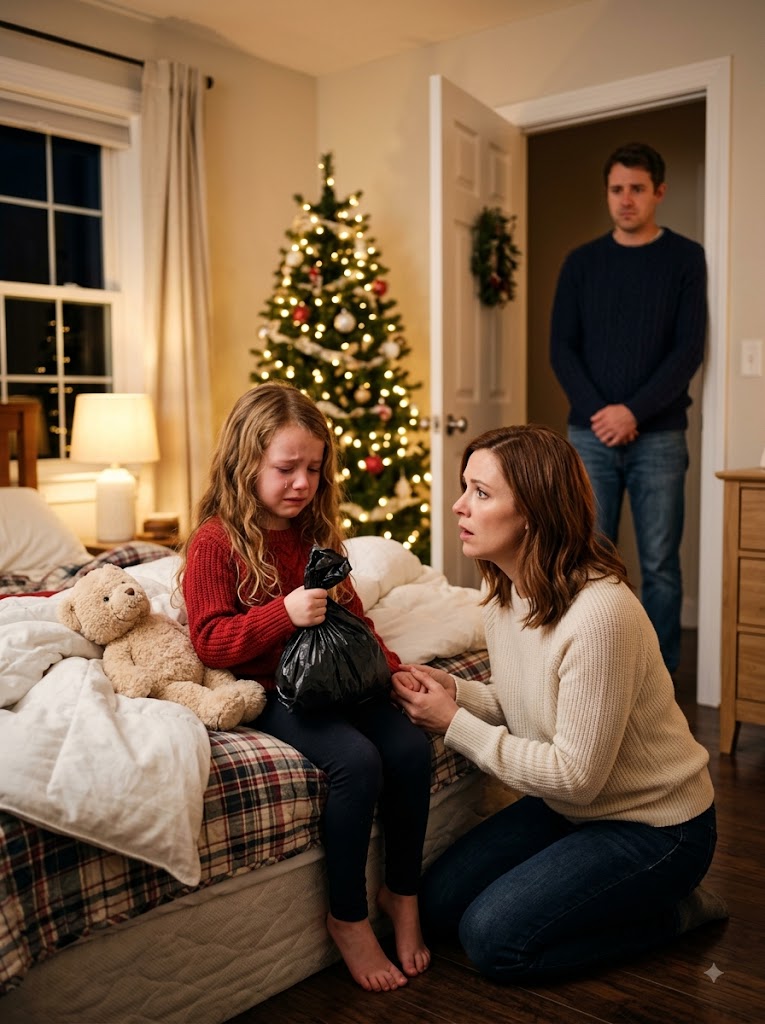
When Elena got home that afternoon, she didn’t come running in to show off the crafts she’d made. She moved stiffly, her arms held tight against her sides. She told us she was tired and went straight to her room.
I went after her.
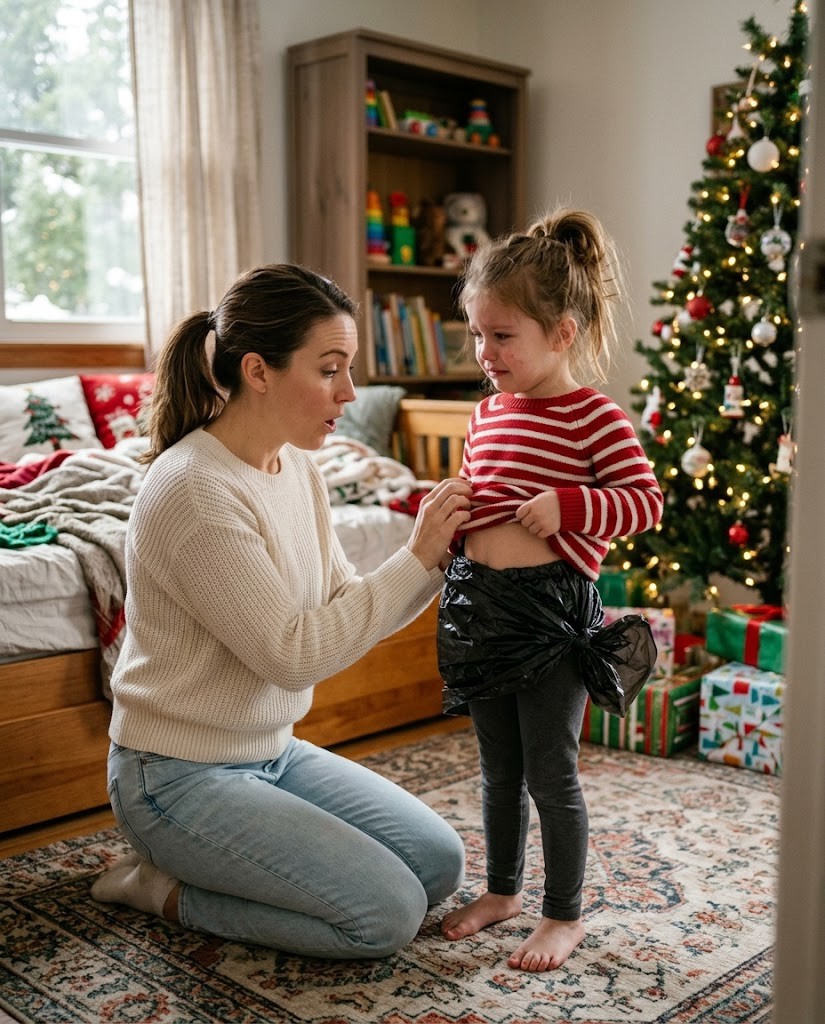
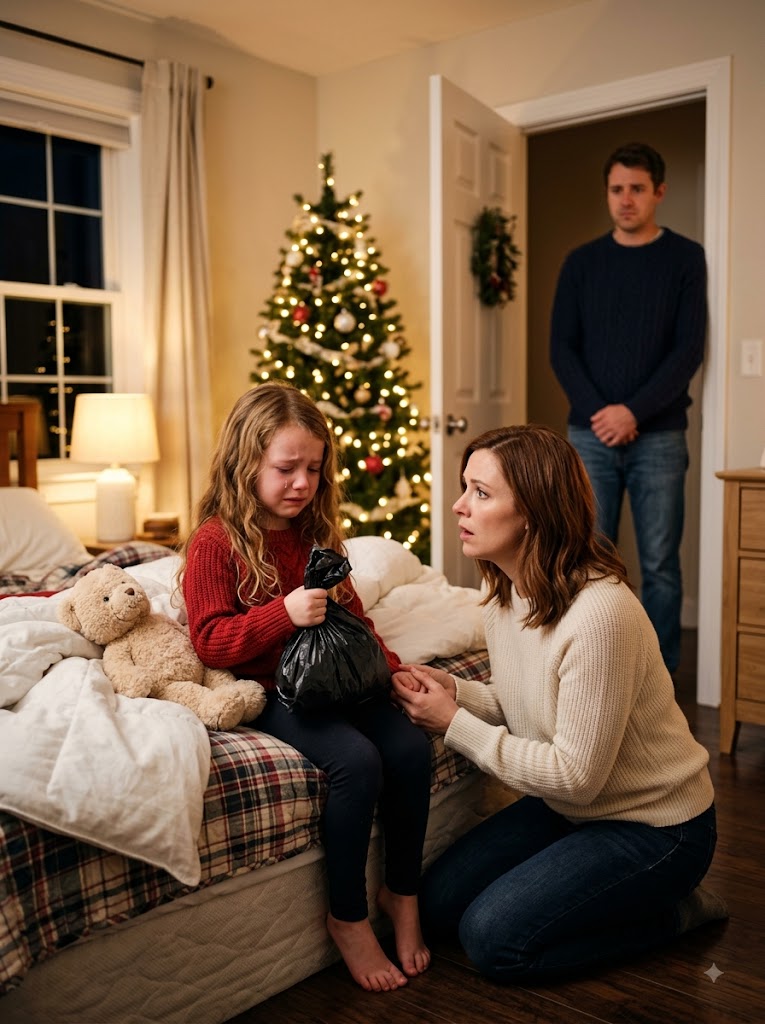
Elena raised her red sweater.
Underneath her t-shirt was a heavy-duty black trash bag, cut and shaped into a makeshift piece of clothing — a hole for her head, two more for her arms. The plastic clung to her skin, damp with sweat. As I carefully pulled it away, I found her shoulders and waist raw and irritated. Then she lifted her arm, and I saw deep bruising running along her ribs. Across her lower back were several straight, dark red marks — too even and deliberate to have come from any fall.
“Who did this to you?” I asked, my stomach dropping.
“Grandma,” Elena whispered.
“Why?”
Elena swallowed hard. “Because I ate cookies. She said I had to sweat them out so I wouldn’t get fat.”
Something inside me broke in that instant.
“And these marks?”
Elena stared at the floor. “I tried to take the bag off because I was too hot. Grandma got mad… and got out her belt.”
Julian appeared in the doorway just as she finished speaking.
I’d never seen my husband go so white.
He knelt down in front of Elena, his voice trembling. “You didn’t do anything wrong, sweetie.”
I took clear, high-resolution photos of her injuries right away, sealed the trash bag and shirt into separate containers to preserve them as evidence, and noted down the exact time Elena had gotten home. Julian called pediatric urgent care for an emergency slot.
Then I grabbed my keys.
“Where are you going?” Julian asked.
“To your mother’s.”
“Chloe, you’re furious—”
“Yes,” I said, my voice flat. “Which is exactly why I’m not going to argue with her. I’m going to ask what she did before she finds out Elena already told me.”
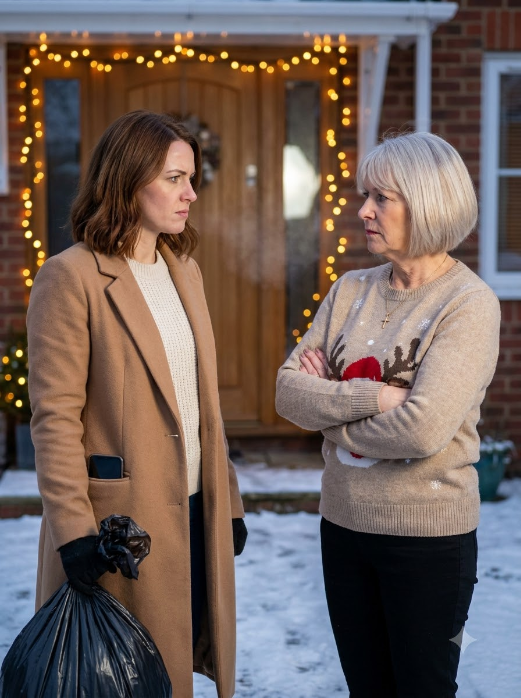
Twenty-five minutes later, I was standing on Victoria’s front porch. I hit record on my phone and dropped it into my pocket.
Victoria opened the door in a beige Christmas sweater, a gold cross around her neck.
I held up the plastic bag. “Why was my daughter wearing this under her clothes?”
Victoria didn’t even bother looking surprised. She crossed her arms. “She ate far too much sugar today. I taught her that choices have consequences.”
“She’s six years old!”
“And six is a perfectly good age to learn discipline.”
“Did you hit her with a belt?”
Victoria’s mouth pressed into a thin line. “I gave her a few licks with the belt because she got defiant. It’s nothing I didn’t do to Julian and Sarah growing up. And they turned out just fine.”
In that single moment, I understood that what had happened to my daughter wasn’t some rare lapse.
Victoria had just confessed that she’d spent decades calling something far worse “discipline.”
And what Julian was about to find out that very night was going to tear our entire family apart.
PART 2
By the time I got to the medical clinic, Julian was sitting next to Elena, who was in a small hospital gown, holding a cup of water in shaking hands. The doctor noted severe heat-related friction and chafing, mild dehydration, deep bruising, and welt patterns consistent with a heavy leather belt. A hospital social worker then came in and explained that, since a minor was involved, mandatory child protection procedures were now in motion.
Julian didn’t push back. He just stared at the wall, completely gutted.
Later, while a nurse rechecked Elena’s vitals, I passed Julian an earbud.
“Your mother admitted to all of it,” I whispered.
I pressed play on the recording.
Victoria’s voice came through, unsettlingly sure of herself — describing the heavy trash bag, making Elena run up and down the basement stairs, the forced exercise, the belt.
Then came the line that stopped Julian cold:
“I used to do the exact same thing to Julian whenever he put on weight. And look at him—he turned out perfectly fine.”
Julian stopped the audio.
“Play that again,” he said quietly.
He listened to the whole recording a second time. Then he got up, walked to the window, and pressed his forehead against the glass.
“I remembered the basement stairs,” he murmured. “But I’d buried the trash bags.”
I watched him, not sure what to say. “How old were you, Julian?”
“Seven, maybe eight. My father knew. He always said discipline was Mom’s department.”
That’s when it finally clicked for me why Julian had always found excuses for Victoria’s controlling behavior. It wasn’t only about avoiding conflict. He’d been raised to believe that keeping the peace meant never naming abuse for what it was.
By the time we left the clinic, fourteen missed calls were waiting on our phones.
Victoria had already rewritten the story for the extended family group chat: Elena had joined in on a “fun summer workout game,” I had shown up screaming, and the marks on Elena’s back came from a fall in the yard. An uncle texted Julian telling him to “get his wife under control” before I wrecked Victoria’s standing at her church. A cousin added that kids always exaggerate when they want attention.
Then came a message from Sarah, Julian’s sister:
“Please don’t make this public. Mom made a mistake, but we can handle this privately within the family.”
Julian read it twice. “No,” he said, quietly.
The next morning, Julian recorded a voice message and sent it to the whole family chat. No shouting. No name-calling.
He said, calmly, that Elena had been telling the truth. He explained that he’d heard his mother’s full confession himself, on tape. And for the first time ever, he told them that Victoria had punished him as a boy with trash bags, forced exhaustion, and belts.
Then he left the group chat.
That evening, Sarah showed up at our door.
“You’re turning Mom into a criminal!” she said the second I opened it.
“She whipped a six-year-old with a belt, Sarah,” I said, flat.
“You don’t understand how she gets when she feels attacked—”
Julian stepped out from behind me. “Then listen to how she sounds when she thinks she’s completely in the right.”
He played her the part of the recording where Victoria named both of her kids by name.
Sarah went still. Hearing her own name come out of her mother’s mouth, she lowered her phone.
“She didn’t do it to me all the time…” Sarah whispered.
Julian looked at her steadily. “Did she do it to you too, Sarah?”
Sarah didn’t answer right away. She sank down onto the porch step, hands over her face.
“I used to change my clothes in the middle school bathroom so no one would see the marks,” she said softly, crying.
Then she looked up, fear spreading across her face, and said something that changed everything:
“My eight-year-old son stayed at her house last month.”
Sarah’s voice was terrified. “For weeks, Mom’s been telling him he’s getting too big…”
The next morning, Sarah called the child protective investigator on our case.
But before hanging up, she told us there was one more thing. Something neither Julian nor I had ever known.
And when she told us, Victoria stopped being just a grandmother who’d crossed a line.
PART 3
It took Sarah almost a full minute to get the words out.
“Mom didn’t start with us,” Sarah said, quiet. “She did the same kind of thing to young girls when she taught dance.”
Years earlier, Victoria had run a youth dance program. Sarah remembered helping out at the studio as a teenager, watching her mother make certain young dancers wear heavy plastic wrap or trash bags under their leotards during practice to “sweat off weight” before competitions. She remembered harsh food restrictions and humiliating public weigh-ins.
Sarah wasn’t claiming she’d witnessed physical beatings at the studio, and none of us wanted to turn guesses into facts. She simply gave the investigator the names she could recall and described what she herself had seen.
It was enough to establish that Victoria’s fixation on body image and physical punishment hadn’t started with Elena.
Elena went through a specialized, child-friendly forensic interview at an advocacy center. Julian and I waited outside. The specialists had told us not to ask leading questions or push her to repeat her story, and we did exactly as they said. We wanted her to know she didn’t have to perform or convince anyone.
When she came out, she was holding a small box of crayons.
“Can we go home now, Mommy?” she asked quietly.
“Yes, baby,” I said, pulling her in close. “We’re going home.”
That afternoon, Julian gave his official statement to the police. He described the trash bags, the forced stair runs, the belts, and the times Victoria had withheld dinner because she’d decided he’d eaten too much at lunch. He also talked about his late father, who had ignored it and turned the TV up louder to drown out the noise.
When Julian finished signing his statement, he broke down in the police station parking lot.
He wasn’t crying as a son. He was crying as a father.
“I left her alone with my mother,” he sobbed.
“Victoria is the one responsible, Julian,” I told him, holding his hand.
“But you warned me.”
“And you grew up in a house that brainwashed you into thinking her behavior was normal.”
Julian wiped his face and took a deep breath. “That explains why it took me so long to see it. But it doesn’t excuse it.”
It was the first time I’d heard him take responsibility without trying to carry the weight of his mother’s crimes.
The weeks that followed were draining. Some relatives reached out with real concern for Elena; others pushed us to drop the report to protect Victoria’s reputation in the community. One cousin even had the nerve to ask to see Elena’s medical photos.
“My daughter’s medical records aren’t up for family debate,” I told her, and blocked her number right away.
From then on, anyone who doubted Elena, tried to relay messages from Victoria, or pressured us to stay quiet was cut off entirely. Our family circle shrank a lot — but it got much safer.
The first real sign of Elena healing came at breakfast a few weeks later.
She looked up from her plate and asked, timidly, if she could have a whole slice of toast.
“The whole thing?” she asked softly.
“Of course, sweetie,” I said gently.
“Won’t it make me fat?”
Julian shut his eyes, swallowed hard, and dropped to his knees next to her chair.
“Food gives your body energy to grow, play, and run around,” he told her, meeting her eyes. “You never, ever have to earn your food. Ever.”
Elena looked at her father. “Really?”
“Really,” Julian said. “Grandma told you things that were completely wrong.”
Elena took the toast — but still tore it into tiny pieces before eating any of it.
Watching that broke my heart all over again. The deepest wounds weren’t the ones in the medical photos.
For months afterward, she’d ask permission before opening the fridge. She’d leave half her dessert untouched, watching our faces closely as she ate. One afternoon, when Julian pulled a black trash bag out of a box to clean the kitchen, the crinkling sound made Elena drop her glass.
We didn’t make a scene or push her to explain. Julian just put the bag away, threw the box out to the garage, and went and bought clear, white trash bags instead.
He also stopped wearing leather belts around the house. He never announced it or made it a big deal — he just noticed what scared his daughter and quietly adjusted his habits so she’d feel safe.
Meanwhile, Victoria kept changing her story for anyone who’d listen.
First it was a “fun fitness game.” Then she said Elena had insisted on wearing the bag herself. Once the recording proved she’d explicitly described it as punishment, she claimed she’d exaggerated because I’d provoked her. When the medical report confirmed the welts on Elena’s back, she said the belt had struck her by accident, just once.
Then came the formal statements from Julian and Sarah.
Victoria lashed out, calling her children ungrateful and accusing me of “planting fake memories” in their heads.
But she couldn’t undo the evidence. Her original, unfiltered confession was right there on tape — recorded on her own porch before she even knew police were involved. She’d admitted to making Elena “burn off the cookies.” She’d acknowledged the forced exercise. She’d admitted to the belt. And she’d bragged about raising her own kids the same way.
The court handed down a permanent protective order: Victoria was barred from going near Elena, from visiting her school, from contacting her directly or through anyone else.
Victoria responded by telling relatives I’d stolen her granddaughter from her. Some family members believed her. Others finally started asking hard questions.
Sarah sat her eight-year-old son down for an open, gentle talk. He told her Victoria had already started giving him tiny portions and telling him “strong boys don’t ask for seconds.” Thankfully there’d been no physical abuse, no trash bags — but it was a chilling sign. Sarah cut off all unsupervised visits right away and got him into counseling.
Both Julian and Sarah started going to therapy together to work through their childhoods. They began unpacking memories they’d spent years explaining away as “strict parenting.” They remembered hiding bruises under long sleeves at school. They remembered their father walking past the basement door while Julian cried on the stairs, and choosing to keep walking.
Sarah carried a heavy weight of guilt. “I saw things growing up,” she admitted to me one afternoon. “I thought staying quiet was how you protected a family.”
“You’re doing something different now,” I told her gently.
“I should have done it sooner.”
“You’re doing it now,” I said again, firmly. Guilt that doesn’t lead to change is just another way of staying stuck.
Two former dance students eventually came forward too, confirming that Victoria had used humiliating weight-control methods and forced plastic-wrap workouts at her studio. Their experiences weren’t identical to Elena’s, but together they showed a clear, lifelong pattern: Victoria believed she had the right to control children’s bodies through shame, pain, and physical distress — and called it “discipline.”
Victoria was removed from her volunteer roles at her church and community center. I never posted the recording or the photos anywhere. All my energy went into my daughter’s recovery.
Elena started seeing a specialized pediatric therapist. They worked through drawing, play therapy, and rebuilding her sense of control over herself. The therapist told us healing wouldn’t mean Elena would suddenly forget her grandmother or stop loving her overnight.
That was hard to sit with. Elena missed her grandmother. She missed the crafts at her kitchen table. She missed the twinkling Christmas lights. She missed having her hair braided.
One evening, Elena looked up at Julian and asked, “Can Grandma come over if she promises not to use the belt?”
Julian sat beside her and took her small hand. “No, sweetie.”
“Because she’s in trouble?”
“Because she hurt you, and she still doesn’t understand that what she did was wrong.”
“What if she says sorry?” Elena whispered.
Julian took a breath. “A real apology only counts when someone understands the harm they caused and actually changes. We haven’t seen that happen.”
Elena went quiet for a moment. “Is she all alone?”
“Maybe,” Julian said softly.
“Is it my fault?”
“No, baby. Not at all. It’s the result of her own choices.”
Protecting Elena didn’t erase the love she’d felt for her grandmother. It just made sure that love could never again be used as an opening for more abuse.
Eventually, the case was resolved through a formal plea agreement. Victoria accepted legal responsibility for child abuse, agreed to court-mandated psychological treatment, accepted strict restrictions around minors, and agreed to a permanent, legally binding no-contact order with Elena.
Before sentencing, the prosecutor asked if we wanted to submit a Victim Impact Statement.
I wrote about my daughter.
I didn’t call Victoria a monster. I didn’t pretend our family had ever been perfect. I just described who Elena had been before December 27th.
A little girl who ate without fear.
A child who asked for a cookie without scanning an adult’s face for anger.
A girl who could hear a trash bag rustle without freezing in terror.
Then I described who she’d become afterward.
A child who tore her bread into tiny crumbs before eating.
A little girl who asked if telling the truth meant her grandmother was lonely now.
A six-year-old carrying adult-sized emotions long before she should have had to.
Julian submitted his own statement. He wrote that surviving childhood abuse doesn’t make the abuse okay. He wrote that for years he’d mistaken blind obedience for respect, and toxic silence for family loyalty. He admitted that by making excuses for his mother, he’d let her believe she was untouchable.
He closed his statement with one line:
“My delay in seeing the truth was my failure. But the abuse she inflicted was entirely her choice.”
When the legal process finally wrapped up, I didn’t feel any sense of triumph. I felt a deep, worn-out relief.
We lost family members along the way. Julian lost the image of the mother he’d spent decades trying to protect. Sarah lost her role as the family’s peacekeeper. And Elena lost a grandmother she had loved.
None of that got undone by the legal system. It just let us grieve those losses without ever putting a child back in danger.
Almost a year later, Christmas came around again.
We didn’t throw a big, chaotic family gathering. We decorated slowly, quietly. Elena hung three ornaments on the very same branch, and Julian left them exactly where she put them. Sarah came over with her son to make paper snowflakes. No one brought up Victoria in front of the kids. No one turned the holiday into a courtroom.
Christmas morning, the house was full of quiet warmth. Elena opened her presents in a soft cotton t-shirt she’d picked out herself.
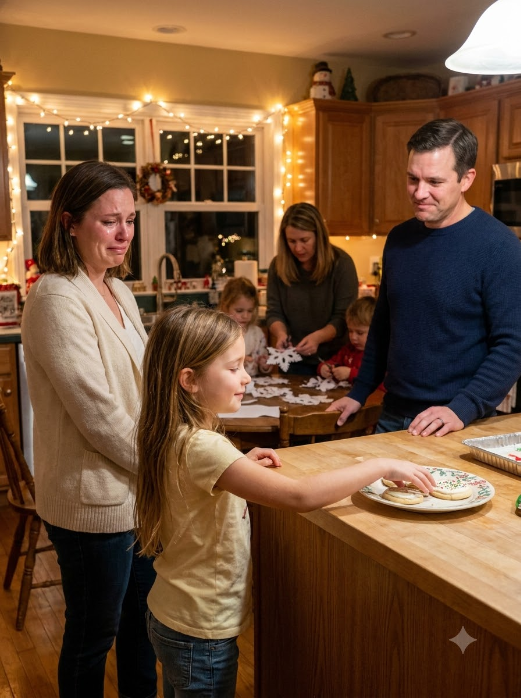
That afternoon, she played music while taping paper snowflakes to the window. A plate of sugar cookies with white frosting and red sprinkles sat on the kitchen counter.
I was folding up wrapping paper when I saw her heading toward the counter.
For months, whenever she wanted something sweet, she’d stop, hesitate, and ask:
“Am I allowed?”
“Have I eaten too much today?”
“Will this make me big?”
That afternoon, she didn’t ask a single thing.
She walked up to the plate, picked up a cookie, took a happy bite, and went right back to her snowflakes.
Julian looked at me from across the kitchen island. Neither of us said anything.
We didn’t need to.
The deepest wounds hadn’t fully healed, but something precious in our daughter was coming back to her.
Her appetite.
Her voice.
Her body.
Her absolute right to say no.
Her right to speak the truth, even when it makes an adult uncomfortable.
I understood then that a family doesn’t break when someone exposes abuse. A family breaks when everyone already knows the abuse is happening and forces the smallest, most vulnerable person to stay quiet to protect the one causing it.
We lost a family that demanded toxic silence.
But Elena got something far more important back: the unshakeable certainty that whenever she asked for help, her parents would always believe her.
