

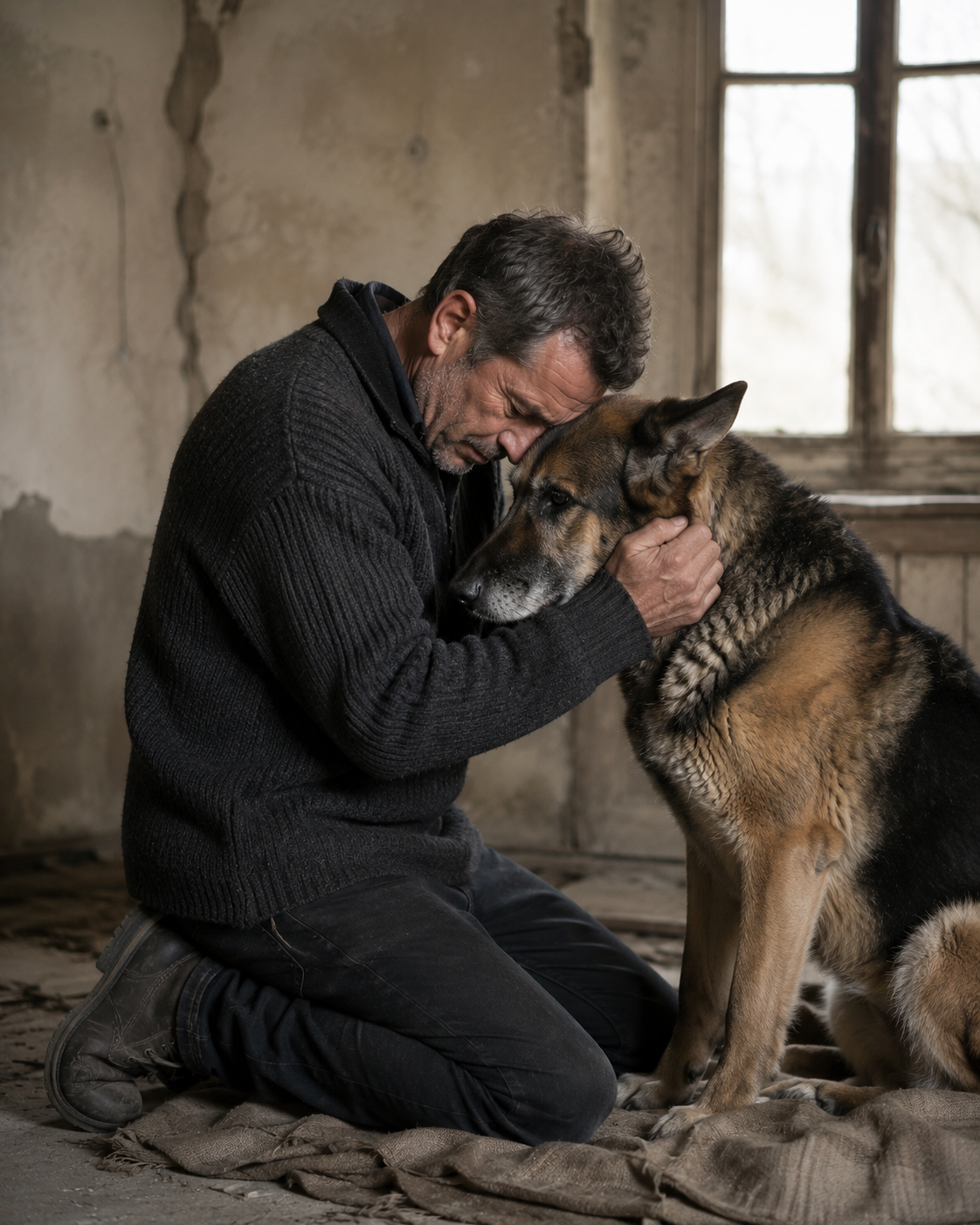
They had to use a catch pole just to get him out of the transport van, because he wasn’t simply scared—he had already been labeled extremely dangerous. For three weeks, Bane stayed in isolation, and unlike the other dogs, he never barked; he only watched. Every time someone approached his kennel, a low growl rolled from his chest while his eyes tracked their every movement. On his file, in bold black letters over bright orange paper, it read: SEVERE AGGRESSION. DO NOT ENTER. UNADOPTABLE.
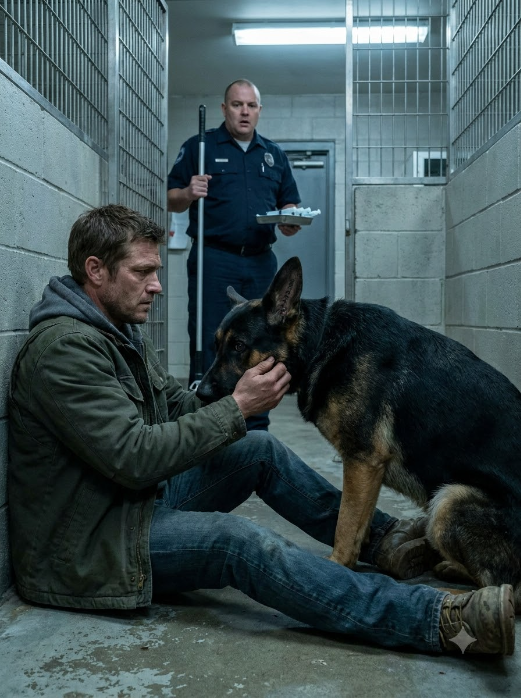
At the shelter, the rules were clear: when a dog was considered a liability, there was no second chance, only a date—Tuesday, 10:00 AM.
I arrived at 8:30. The air outside was cold, but inside felt colder, because the dogs always knew when it was a Code Red day, and the usual barking had been replaced by a quiet, uneasy tension.
“It’s Bane today, isn’t it?” I asked Sarah.
She nodded, her eyes red. “He’s too dangerous, David.”
I clenched my jaw, because even though I had passed his kennel many times and yes, he looked terrifying, I had never once seen a monster in him—only something broken.
“Will he be alone?” I asked.
She nodded. “Catch pole. Sedation. Then injection.”
That hit me hard, so I said, “I’m going in.”
After arguments and a signed waiver, they gave me ten minutes, and at 9:45 I stepped into Room 4, where he looked small and terrified. I didn’t approach; instead I sat down on the floor and avoided eye contact, letting the minutes pass. When I tossed a piece of chicken, he didn’t move at first, but then slowly stepped forward—one step, then another—until soon he stood just a few feet away.
Up close, I realized something: he wasn’t aggressive, he was shaking, violently. I raised my hand slowly, and he hesitated before leaning his head into my palm. I swallowed hard and whispered, “I’m sorry. I’m so sorry.” As I stroked his fur, I felt something rough and too precise tucked inside his ear, so I pulled it back, and everything stopped: M-4-X-7-2-USMC. Not a scar—a military tattoo. This wasn’t a stray. This was a Marine Corps working dog, a combat veteran.
At 9:58, the door handle turned, and Mike stepped in holding the catch pole and a tray of syringes. “Time’s up.”
“Wait!” I shouted. “He’s not a stray!”
Mike frowned as I showed him the tattoo, and when he leaned closer, he froze. “USMC…” he whispered, and silence filled the room.
“If he’s military, where’s his handler?” Mike asked.
“I don’t know. But we can’t kill him.”
“The order is signed,” Mike said.
“Give me until five,” I begged. “If I can’t find someone… I’ll stay with him.”
Mike hesitated, then nodded. “Five o’clock.”
I called my brother Mark, a veteran, and an hour later he called back. “I found him,” he said. “His name is Max. Explosive detection dog. Three deployments.”
I looked down at him. Three deployments.
“Handler?” I asked.
“Corporal Thomas Miller.”
“Then why was he abandoned?”
Silence.
“Thomas… has been missing for four weeks.”
My blood ran cold, because Max wasn’t abandoned—he was waiting.
I drove to where he was found, a deserted stretch of highway with a forest beside it, and went down into the woods. After searching, I found torn military fabric caught on branches, and I followed the trail until it led to a hidden drainage pipe. I climbed inside and found a pile of blankets that moved, and when I looked closer, a little girl looked up at me—six or seven years old, dirty, weak, terrified.
“Are you alone?” I asked softly.
She nodded, then handed me something: dog tags. MILLER, THOMAS USMC.
“Where is he?” I asked.
“He saved me,” she whispered. “He told me to hide. He said his best friend would come. His name is Max.”
My chest tightened, because Thomas had rescued her, then led the kidnappers away.
It was 4:05 PM, less than an hour left, and I carried her out of the woods. Climbing the hill nearly broke me—I slipped, bled, and struggled, but I didn’t stop. At 4:25 I called 911, but I couldn’t wait, because Max had less than thirty minutes, so I drove like my life depended on it.
At 4:57, I burst into Room 4, where Mike stood with a syringe in hand and Max lay still on the table. My knees gave out. “No…”
Mike shouted, “Look at the tray!” Two syringes: one empty, one full. “I couldn’t do it,” he said, shaking. “I only sedated him.”
Max was alive. The police arrived, and the girl was brought in. As Max woke slowly, he smelled her, then her jacket, his handler’s jacket, and he stepped forward and gently licked her face. She wrapped her arms around him. “He said you’d come…” No one in the room stayed dry-eyed.
That night, search teams found Thomas alive, badly injured but alive; he had fought until the end, and the kidnappers were dead.
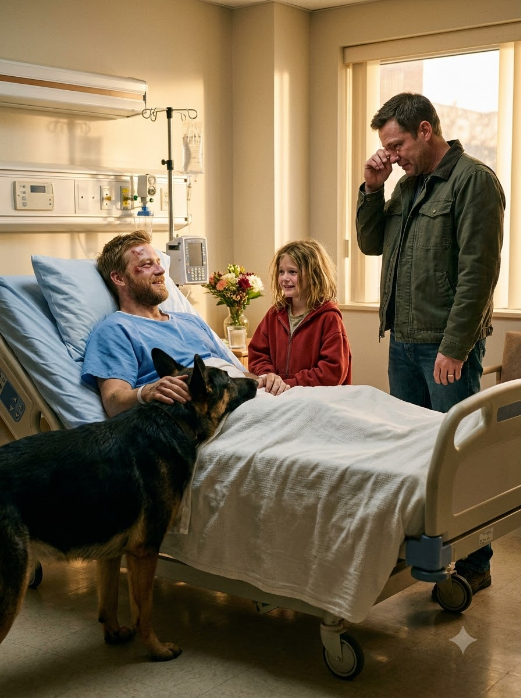
Three days later, I brought Max to the hospital, where Thomas lay in bed. “Max…” he whispered, and Max moved carefully, placing his head against his chest—a soldier reunited with his partner.
Six months later, everything changed: Thomas recovered, and Max now lives peacefully with him. The shelter changed its policies. And as for me, I learned something I’ll never forget—never judge a soul by its scars, because sometimes the ones who look the most dangerous are the ones who have loved, and lost, the most.
