

The Road He Could Never Leave Behind
Every Sunday before dawn, Gideon Rusk steered his motorcycle along the silent mountain roads outside Helena, Montana.
He always took the same path.
He rode by the deserted silver mine near Canyon Ferry Road, followed the thin stretch alongside the Missouri River, and turned toward a small cemetery ringed by pines and weathered wooden fencing.
Gideon never asked anyone to join him.
The members of the Granite Hawks Motorcycle Club knew not to ask. Sunday mornings belonged to a part of his life he almost never spoke of.
His motorcycle carried him through the cold with a steady growl. The wind pushed against his broad shoulders, crept beneath the collar of his leather jacket, and stung his eyes.
He told himself it was only the wind.
Four years had gone by since his eleven-year-old daughter, Maisie, had died in a winter road accident. Four years should have dulled the sharpest memories.
They hadn’t.
Gideon could still hear her laughter from when he let her sit on his motorcycle in the driveway. He remembered how she covered her ears when he started the engine, even though she always begged him to rev it louder.
Most of all, he remembered their final conversation.
Maisie had stood by the front door in her red raincoat, holding a folded blanket.
“Dad, somebody needs this more than we do.”
Gideon had been worn out after a long shift at the repair shop. Freezing rain was falling, and the roads had already started to glaze with ice.
He’d told her they’d deliver the blanket in the morning.
Maisie had looked let down, but she’d nodded.
That was the last ordinary moment of his life.
Now, every Sunday, Gideon brought white daisies to her grave because they’d been her favorite. She used to gather them along hiking trails and tuck them into the pockets of his leather vest.
When he arrived at Meadow Ridge Memorial Park that morning, fog hung between the trees like pale smoke. Gideon parked near the entrance, cut the engine, and sat still for several seconds.
The silence came instantly.
It always did.
He took the flowers from his saddlebag and walked the gravel path toward the eastern part of the cemetery.
That’s when he spotted someone near Maisie’s headstone.
The Stranger Kneeling in the Mud
At first, all Gideon could make out was the back of a gray sweatshirt.
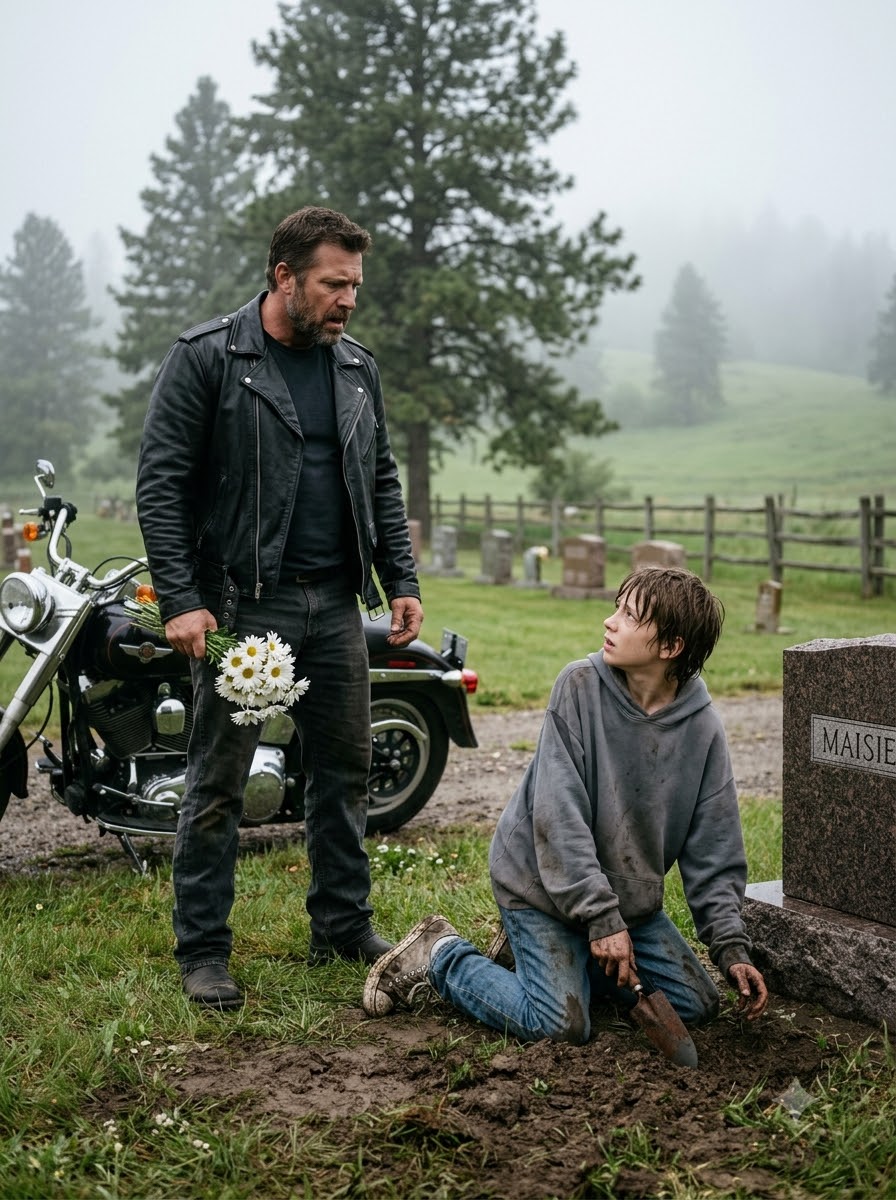
A small figure knelt beside the headstone, clawing through wet soil with both hands.
Gideon froze.
The flowers nearly fell from his grip.
For four years, that spot had been the one thing he protected more fiercely than anything else. Seeing a stranger disturb the ground around Maisie’s memorial stirred an anger he hadn’t felt in years.
“Step away from there!” Gideon shouted.
The person spun around and toppled backward into the mud.
It wasn’t a grown man.
It was a boy.
He looked about thirteen, though his thin build made him seem younger. His brown hair was damp from the fog, and the sleeves of his sweatshirt hung well past his hands. His shoes were cracked along the sides, and his face carried the worn-out look of someone who hadn’t slept properly in a long time.
The boy scrambled back until his shoulders hit a pine trunk.
“I wasn’t trying to ruin anything,” he said breathlessly. “Please don’t be angry. I was putting something back.”
Gideon stepped closer, his boots sinking into the soft ground.
“What were you putting back?”
The boy closed both hands around something and pressed it to his chest.
“It belongs to her.”
Gideon’s anger gave way to confusion.
“How do you know anything about the girl buried here?”
The boy dropped his eyes.
“Her name was Maisie.”
Hearing his daughter’s name spoken by a stranger stopped Gideon cold.
Almost no one visited Maisie’s grave anymore. Her school friends had grown up. Her teachers had moved on. Even relatives who’d once sworn they’d never forget had drifted back into their own lives.
But this frightened boy knew her name.
Gideon’s voice dropped.
“Open your hands.”
The boy hesitated, then unfolded his trembling fingers.
In his palm sat a small silver keychain shaped like a bird. One wing was painted yellow, though most of the color had worn away. On the back, two tiny letters had been scratched into the metal.
M.R.
Gideon knew it at once.
He’d given the keychain to Maisie for her ninth birthday. She’d clipped it to her backpack and carried it everywhere.
Gideon had placed it beside her during the private family goodbye.
It shouldn’t have been in the boy’s hand.
The Keepsake Beneath the Earth
Gideon slowly dropped to one knee.
“Where did you find that?”
Tears welled in the boy’s eyes.
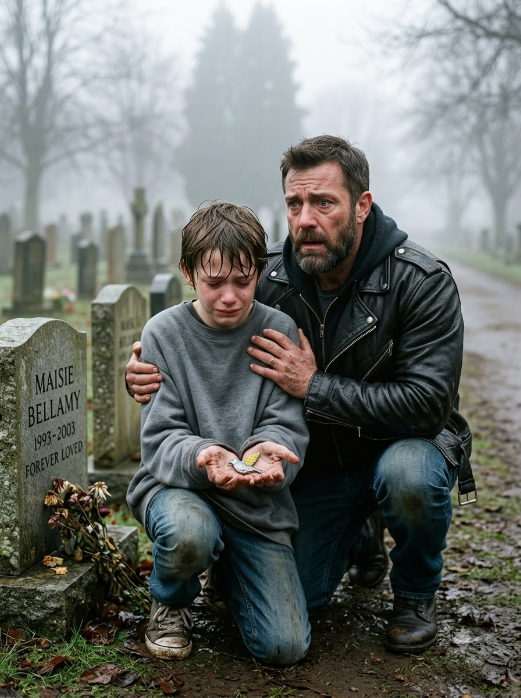
“After the heavy rain last spring, part of the dirt near the stone washed away. I saw something shining. I picked it up because I didn’t want anyone else to take it.”
He glanced at the small hole beside the headstone.
“I came back today to bury it deeper. I thought it should stay with her.”
Gideon reached for the keychain but stopped short of touching it.
“What’s your name?”
“Evan Bellamy.”
“How did you know Maisie?”
Evan looked down at the mud on his knees.
“She used to bring me food.”
Gideon’s chest tightened.
Evan explained that his mother had spent years struggling to hold together a stable home. They’d moved between temporary apartments, spare rooms, and cheap motels. After she entered a long-term recovery program, Evan was sent to live with distant relatives outside Helena.
It didn’t last.
Eventually he started spending evenings behind a small grocery store near Maisie’s elementary school. He tried to stay unnoticed because he was afraid someone would ship him off somewhere even farther away.
Maisie noticed him anyway.
The first time she came over, she was carrying half a turkey sandwich and a carton of chocolate milk.
“She asked if I was waiting for somebody,” Evan said. “I told her I was, even though I wasn’t.”
The next afternoon, Maisie came back with another sandwich.
After that, she kept coming whenever she could. Sometimes she brought fruit, crackers, or a pair of socks. Other times she just sat a few feet away and talked about school, her father’s motorcycle, and the dog she hoped to have someday.
“She never made me explain everything,” Evan went on. “She just said nobody should have to eat alone.”
Gideon turned toward his daughter’s headstone.
The words sounded exactly like Maisie.
She’d always noticed the kid sitting alone at lunch. She gave her birthday money to animal shelters and kept granola bars in her backpack in case someone needed one.
Gideon had been proud of her kindness.
He’d never realized how far it had reached.
The Blanket Maisie Tried to Deliver
Evan pulled his knees to his chest.
“The last time I saw her, it was really cold.”
Gideon already knew which night he meant.
The freezing rain.
The red coat.
The folded blanket.
Evan explained that he’d been holed up inside an old storage shed at the edge of town. The roof leaked, the door wouldn’t shut all the way, and the temperature had dropped hard after dark.
Maisie found him there, shivering, after school.
“She gave me her gloves and told me she’d come back with a blanket,” Evan said. “I told her not to go because the roads were getting bad.”
He wiped his sleeve across his face.
“She promised she’d be careful.”
Gideon looked away as a painful truth settled over him.
Maisie hadn’t been asking to leave the house out of boredom or stubbornness. She’d been trying to keep a promise to a scared child.
Gideon had finally agreed to drive her after finishing a call from the repair shop. Before they could leave, Maisie had slipped outside, thinking she could make it to the shed on foot quickly.
The weather turned faster than anyone expected.
She never got there.
For years, Gideon had held on to anger over that last decision. He’d wondered why she’d ignored him and why she’d taken the risk of going alone.
Now he understood.
His daughter hadn’t been running away from home.
She’d been running toward someone who needed her.
Evan’s voice cracked.
“I waited for her until morning. I thought she’d forgotten me.”
He looked at the name carved into the stone.
“A few days later, I saw her picture outside the school. That’s when I found out she wasn’t coming back.”
Gideon pressed a hand over his mouth.
For the first time in four years, the final chapter of Maisie’s life made sense.
It didn’t take away the pain.
But it replaced confusion with something gentler: pride.
The Question Gideon Could Not Ignore
Gideon sat down beside Evan in the wet grass.
Neither spoke for several minutes.
Finally, Gideon nodded toward the keychain.
“Have you been coming here often?”
“Whenever I can.”
“From where?”
Evan hesitated.
“Different places.”
Gideon recognized that answer, having heard similar words from men who’d passed through the clubhouse looking for temporary work. “Different places” usually meant there was no safe place to name.
“Where did you sleep last night?”
Evan looked at the ground.
“There’s an empty greenhouse behind a garden supply store.”
Gideon’s jaw tightened.
“Does anyone know you’re there?”
Evan shook his head.
“People ask too many questions. Then they make decisions without listening.”
Gideon understood that fear.
He also understood that walking away from this boy would mean walking away from the one person Maisie had tried hardest to protect.
He gently folded Evan’s fingers back around the silver bird.
“Keep it.”
Evan shook his head at once.
“It belongs here.”
“It belonged to Maisie,” Gideon said. “And she wanted you to know that somebody saw you. I think she’d want you to carry that reminder.”
Evan stared at the keychain.
“You’re not angry?”
Gideon looked toward the headstone.
“I was angry because I didn’t understand what I was looking at. I’ve spent too many years being angry at things I didn’t understand.”
He stood and held out his hand.
“Come with me.”
Evan didn’t move.
“Where?”
“First, we’re getting you breakfast. Then we’re figuring out what needs to happen so you don’t spend another night in an empty greenhouse.”
Fear crossed Evan’s face again.
“You don’t even know me.”
Gideon kept his hand out.
“My daughter did.”
The Ride Toward Something New
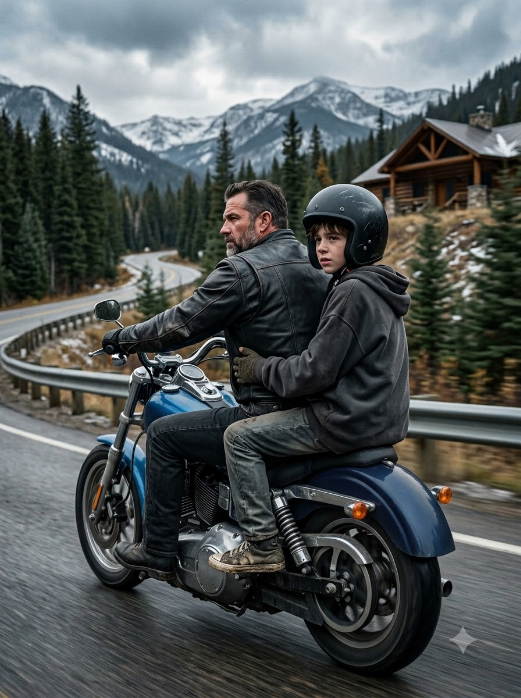
Evan had never ridden a motorcycle before.
Gideon set an extra helmet on his head, tightened the strap, and showed him where to hold on.
At first, Evan gripped the sides of the seat instead of Gideon’s jacket.
“You’ll feel safer holding on to me,” Gideon said.
After a moment, Evan carefully wrapped his arms around Gideon’s waist. They rode to the Granite Hawks clubhouse, a converted brick warehouse on the edge of Helena. The building held a workshop, a kitchen, a meeting room, and a few small bedrooms used by members passing through town.
When Gideon walked in with Evan behind him, every conversation stopped.
The riders were used to seeing Gideon show up alone on Sundays. They weren’t used to seeing a nervous boy in an oversized helmet and muddy clothes.
Wyatt Sorenson, the club’s president, stepped forward.
“Gideon, who’s your passenger?”
“This is Evan,” Gideon said. “He knew Maisie.”
That was enough to change the room.
The men pulled out a chair, warmed up leftover pancakes, and found dry clothes. No one crowded Evan or pressed him for answers. They let him eat at his own pace while Gideon quietly filled Wyatt in on what had happened.
One rider called a youth advocate he trusted. Another reached out to a family services attorney who’d helped other club members through guardianship questions. A third went out for toiletries, a winter coat, and new shoes.
Evan watched it all with suspicion.
“Why are they doing this?” he whispered.
Gideon set a mug of hot chocolate in front of him.
“Because looking tough and having a hard heart aren’t the same thing.”
The Long Path Toward Home
Gideon couldn’t just take Evan home and call him family. There were interviews, records, evaluations, meetings, and court dates.
Evan’s mother was eventually tracked down at a supervised recovery residence. She loved her son, but admitted she wasn’t yet able to give him the stability he needed.
During a quiet meeting, she looked across the table at Gideon.
“Can you give him the kind of home I can’t give him right now?”
Gideon answered honestly.
“I can give him patience, safety, and a room where no one will ask him to leave. I’m still learning how to live with my own mistakes, but I will never make him carry them for me.”
Temporary placement turned into long-term guardianship.
The first weeks weren’t easy.
Evan hid food under his mattress, afraid the kitchen might be empty one morning. He slept in his clothes and kept his shoes by the bed in case he needed to leave in a hurry. He apologized whenever he dropped a glass, used too much hot water, or left a lamp on past midnight.
Every time, Gideon gave him the same answer.
“You live here, Evan. You don’t have to earn another day.”
Slowly, the hidden food disappeared.
The shoes moved from beside the bed into the closet.
Evan started going to school regularly. He joined an after-school science program and discovered a knack for building small machines. At the clubhouse, Gideon taught him how engines worked, while Evan showed the riders how to use the new scheduling software none of them could figure out.
The Granite Hawks eventually gave him a denim riding vest. A small patch on the back showed a yellow-winged bird.
Below it, one word:
HOME.
The Night Evan Finally Believed
Nearly a year after they first met, Gideon found Evan sitting on the porch after midnight.
The silver bird keychain sat in his palm.
Gideon sat down beside him.
“Bad dream?”
Evan nodded.
“I dreamed I was back in the greenhouse. I kept calling, but nobody heard me.”
Gideon stayed quiet until Evan was ready to keep going.
“Sometimes I still think this is temporary,” the boy admitted. “I think I’ll wake up and all of this will be gone.”
Gideon looked through the window at the warm kitchen, the schoolbooks on the table, and Evan’s jacket hanging beside his own.
“I can’t promise life will never change,” he said. “But I can promise you won’t face those changes alone.”
Evan’s eyes filled with tears.
“Maisie told me tomorrow could be different.”
Gideon nodded.
“She believed that about everyone.”
“Do you think she knew you’d find me?”
Gideon looked out toward the distant mountains.
“No. But I think she trusted kindness to keep moving, even after she couldn’t carry it anymore herself.”
Evan leaned against his shoulder.
For the first time, Gideon didn’t feel like loving another child meant leaving Maisie behind.
It felt like carrying her love forward.
The Sunday Ride That Grew
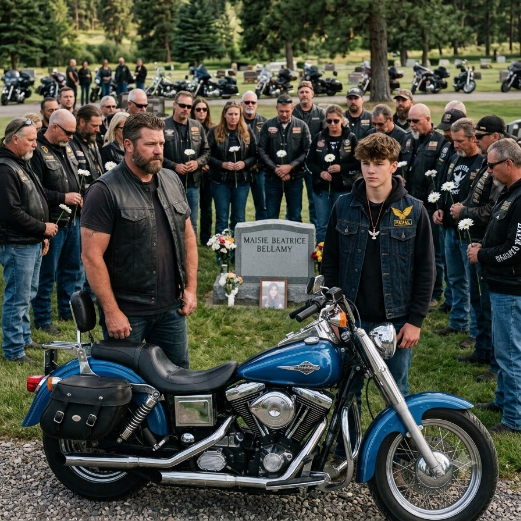
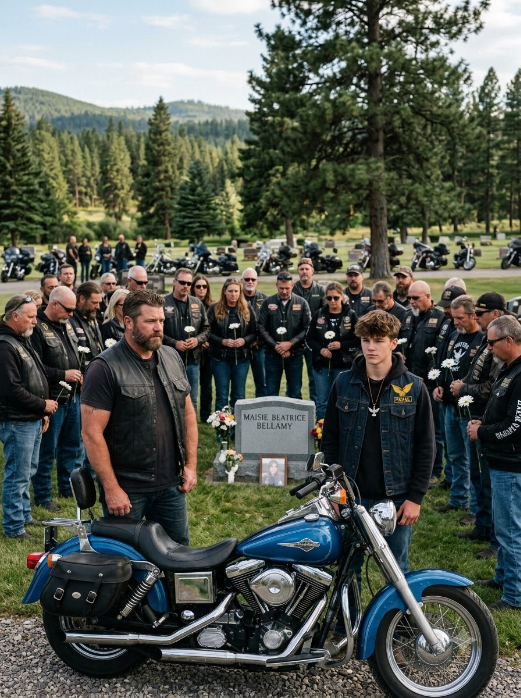
Three years later, the narrow road to Meadow Ridge Memorial Park filled with motorcycles.
Riders came from Montana, Idaho, Wyoming, and North Dakota. Each one carried a single white daisy.
Evan, now sixteen, rode behind Gideon on a restored blue motorcycle they’d repaired together. He sat with confident posture, and the yellow-winged bird patch still marked the back of his vest.
At Maisie’s resting place, the riders formed a wide circle.
Evan stepped forward with the silver keychain hanging around his neck.
“Maisie once promised to bring me a blanket,” he told them. “For a long time, I thought that promise had been broken.”
He looked at Gideon and the men standing behind him.
“But she gave me something warmer than a blanket. She gave me proof that I mattered, and that proof eventually led me to a family.”
Gideon set a daisy beside the headstone.
The grief was still there.
It would always be there.
But it no longer felt like an empty room with no door. It had become a place where memory, purpose, and new love could exist side by side.
As the motorcycles pulled out of the cemetery that afternoon, Gideon didn’t feel like he was riding away from his daughter.
He felt like Maisie was still guiding the road ahead.
A small act of kindness might seem minor to the person offering it, but to someone who has gone unnoticed for too long, it can become the first real proof that their life still matters.
Grief doesn’t always get lighter with time, but it can grow more meaningful when the love behind it is used to protect someone who still needs a reason to believe in tomorrow.
We should never judge a frightened person only by the place we find them in, because their circumstances in that moment may say nothing about their character, courage, or future.
Family isn’t defined only by shared names or familiar faces; it’s also built when someone chooses to stay patient, dependable, and present after everyone else has walked away.
The people who look strongest may still be carrying private sorrow, and sometimes helping someone else is the first step toward healing their own wounded heart.
Children often notice loneliness that adults have learned to look past, a reminder that compassion begins when we stop guarding our own comfort and start paying attention to the people around us.
A promise made in genuine love can outlast the person who first made it, because kindness carries forward through every heart willing to pass it on.
No child should have to earn food, warmth, safety, or affection, because real care isn’t a reward for good behavior — it’s a foundation every young person deserves.
Healing doesn’t ask us to forget the person we lost; it asks us to carry their best qualities forward and let their memory inspire life instead of only sorrow.
Sometimes the road back to hope starts in the place we most fear returning to, where an unexpected person may be waiting with the missing piece of a story we never understood.
