

PART 1 — THE SLAP THAT SILENCED TWELVE FAMILIES
The slap rang out against the marble.
My daughter moved in front of me.
Then the most feared man in Milan heard the smallest voice in the room speak the truth.
“You can’t tell my mommy what to do.”
Emma said it with both arms wrapped around her blue wool rabbit, her cheeks flushed and her small chin raised as though she’d stepped into a battle and decided no one had properly taught these adults manners.
She was three.
She still said “pasghetti” instead of spaghetti.
She still believed the moon trailed our bus home every night.
She still pressed her lips to the cracked screen of my phone whenever an old photo of her father appeared, because, as Emma put it, “Daddy can feel love through glass.”
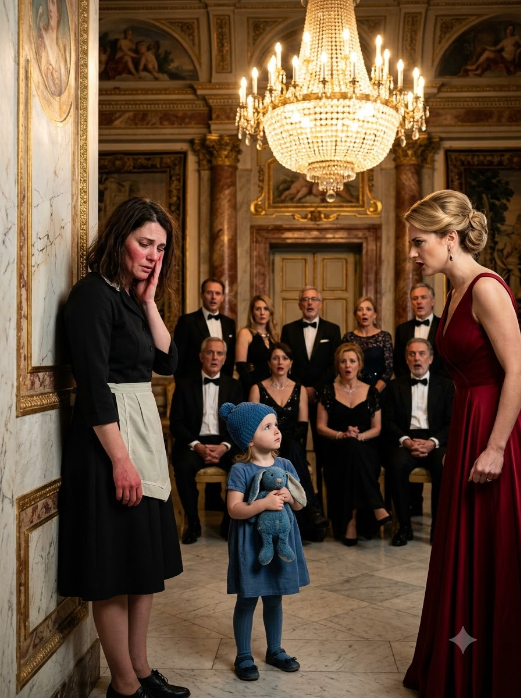
And that night, standing barefoot at the edge of the service corridor inside Villa Moretti, she planted herself between me and Vivian Romano’s raised hand.
The grand hall went still.
Not quiet.
Still.
There’s a difference.
Quiet is what happens once people stop talking.
Stillness is what happens when a room realizes something dangerous has just shifted hands.
Light from the chandeliers pooled across the polished floor. Twelve old Italian families sat in the salon beyond the wide archway — men in black suits with costly watches and watchful eyes, women draped in silk and diamonds, wine glasses frozen halfway to lips that had stopped moving.
The jazz quartet trailed off one instrument at a time until the double bass went silent and even the violinist’s bow hung motionless above the strings.
A splash of orange juice marked the Persian rug between us.
My cheek still stung from Vivian’s first strike.
Her diamond-studded hand hovered, ready for a second.
Vivian Romano was twenty-eight, blonde, flawless, dressed in red Versace. She was engaged to Alessandro Moretti and used to rooms bending to her the moment she walked in.
I’d seen wealthy women act cruelly before.
I cleaned their homes.
I polished their mirrors.
I gathered their champagne flutes after they laughed too hard at jokes that left other women quietly wounded in service corridors.
But Vivian’s cruelty was different.
It wasn’t careless.
It was rehearsed.
She looked down at Emma the way people look at a stain, deciding the housekeeper hadn’t scrubbed hard enough.
“You should teach your child,” Vivian said, “to know her place.”
Emma held the rabbit tighter.
“My mommy works harder than anyone in this house. And you only know how to make people cry.”
Someone drew a sharp breath.
My whole body went cold.
“Emma,” I whispered.
Too late.
Vivian’s expression shifted.
Not dramatically — women like her never gave away the satisfaction of being offended too fast.
The corners of her mouth pulled tight. Her gaze slid past my daughter to the guests, weighing witnesses, power, and how useful humiliation might be.
Then her hand rose again.
A voice came from behind her.
“Vivian.”
No shout.
No fury.
Just a single name, spoken so coldly the marble itself seemed to remember winter.
Alessandro Moretti stood at the far end of the corridor.
He wore a black evening jacket and a silver-gray silk tie. His face belonged to a man whose anger needed no performance, because everyone present already knew what it could turn into.
In his right hand sat a glass of red wine.
He set it down on the console table.
The soft click sounded like a verdict.
Vivian’s hand dropped.
“Alessandro.” She tried a smile that had worked on lesser men. “Amore, this isn’t—”
“Apologize to Mrs. Bennett.”
The room held its breath.
Vivian blinked.
“What?”
“Now.”
“You cannot be serious.”
“I am very serious.”
“She’s only a housekeeper.”
His gaze never left her face.
“She’s a member of my household, and you struck her under my roof.”
I stood against the wall, one hand pressed to my cheek, the other reaching toward Emma without daring to move.
The rabbit swung from my daughter’s fist, one gray ear folded over her wrist.
It had once been entirely blue.
My husband, Noah, had mended the torn ear with a scrap from his old winter scarf not long before he died.
Emma glanced between Vivian and Alessandro with the solemn focus of a child watching grown-ups fail some important test.
Vivian turned to the guests.
She was hunting for rescue.
None came.
Not from her friends.
Not from the wives.
Not from the men whose alliances had helped position her a single step from becoming mistress of Villa Moretti.
At the long table, Don Salvatore Ricci — the oldest man present and the only one with enough weight to make Alessandro pause — set his wine glass on the marble.
The soft chime of crystal cut through the silence.
“Moretti is right,” Ricci said. “In a man’s house, that man’s law rules. You struck a member of his household in front of twelve families. That is not a small matter.”
Vivian went pale under her makeup.
She turned to me.
“I apologize.”
The words were colder than the floor beneath my feet.
Alessandro gave a slight nod.
Enough to accept the formal gesture and keep the night from tipping into something worse.
Then he did something no one in the hall had witnessed him do in twelve years.
He knelt.
The black wool of his trousers met the marble.
He lowered himself until his face was level with Emma’s.
The most feared man in northern Italy knelt before a three-year-old in a crooked blue wool hat.
“Are you all right, sweetheart?” he asked.
Emma studied him.
Then she asked the question no one had put to Alessandro Moretti in years.
“Are you all right?”
He froze.
For one moment, the man who commanded ports, debts, shipments, men, rooms, and silence itself looked as though my daughter had cracked open a door no guard had ever managed to protect.
Then he answered gently.
“I am all right. Thank you.”
He pulled the black leather glove from his right hand.
Slowly, with the gravity of a king greeting another king, he touched two fingers to the rabbit’s felt paw.
“A great pleasure to meet you, sir.”
Emma laughed.
That laugh transformed the room.
Small and bright and wildly out of place among dark suits and old debts, it struck the marble, the chandeliers, the wine glasses, and the faces of men who’d forgotten children could exist without fear.
I pressed a hand over my mouth.
Tears came without a sound.
For the first time in two years of widowhood, I didn’t feel alone on my side of the room.
Then Alessandro’s gaze shifted.
Not toward me.
Toward the rabbit.
His hand hovered above its gray ear.
A line had been sewn into the fabric with faded silver thread — three short stitches crossing one longer one.
Noah had told me it was just a repair.
Alessandro looked like he’d seen a ghost.
“Where did she get this?” he asked.
The warmth drained from his voice.
“Her father made it,” I said.
“What was her father’s name?”
“Noah Bennett.”
Behind us, a chair scraped.
Don Ricci had risen from the table.
Only slightly.
Only enough for a careful observer to notice.
Alessandro noticed.
So did I.
“Bennett,” he repeated.
“He worked at the Moretti shipping office near Porta Genova,” I said. “Before the accident.”
Alessandro’s eyes went back to the rabbit.
“What accident?”
The question angered me.
“You don’t remember?”
His gaze lifted to my face.
“No.”
“My husband died in one of your warehouses.”
The words landed on the salon like another slap.
Two years before, a nighttime fire had gutted Warehouse Seventeen near the canal.
Noah had been found beneath a collapsed steel platform.
The official report blamed faulty wiring and called it an industrial accident.
The papers labeled him a suspected thief because encrypted company files had turned up on his personal computer.
Villa Moretti’s estate manager delivered the final payment in cash and warned me against discussing it publicly.
I took the money because Emma needed food.
I took the housekeeping job six months later because grief sometimes looks like surrender from the outside, when really it’s a woman waiting patiently for the right door to open.
Alessandro rose.
“Who investigated the fire?”
Don Ricci answered before anyone else could.
“I did.”
His tone stayed even.
“The evidence was clear. Bennett copied shipping records and tried to destroy the archive once he realized security was closing in.”
“He wasn’t a thief,” I said.
Ricci looked at me for the first time.
His eyes carried the kind of kindness a locked door wears before someone tries to force it open.
“Grief often protects the image of the dead, signora.”
“My husband did not start that fire.”
“You weren’t there.”
“No. But I knew the man who came home to me every night.”
Ricci’s face softened with rehearsed sympathy.
“We all believe we know the people we love.”
Alessandro turned to him.
“Why wasn’t I given the report?”
“You were in Geneva after Sofia’s memorial.”
At the name Sofia, the salon grew tense.
Sofia Moretti had been Alessandro’s wife.
She and their unborn child had died in a car explosion seven years earlier.
People in Milan still lowered their voices when her name came up.
Ricci went on.
“You’d handed internal security matters to me.”
Alessandro’s jaw tightened.
“I handed over the investigation. Not the memory.”
Vivian stepped forward.
“This is absurd. Are we really derailing an alliance dinner because a maid’s criminal husband owned a toy?”
Emma’s small fingers gripped my skirt.
Alessandro faced Vivian.
“The dinner is over.”
Her lips parted.
“Excuse me?”
“You heard me.”
“Our fathers spent months arranging tonight.”
“My father is dead.”
“And mine brought half the southern families here.”
“Then he’ll understand why you’re leaving.”
Something sharp flashed in Vivian’s eyes.
“You’d humiliate me over her?”
She pointed at me.
Alessandro’s voice softened.
“No. You humiliated yourself.”
The engagement ring on her hand caught the chandelier’s light.
For a second, raw hatred crossed her face.
Not aimed at Alessandro.
At Emma.
My body moved before I thought.
Alessandro saw it.
“So did I,” he said quietly.
Vivian slid off the ring.
I expected her to hurl it.
Instead, she set it carefully beside Alessandro’s untouched wine glass.
The restraint made the gesture more menacing.
“You have no idea what you’re breaking,” she whispered.
Then she walked past the twelve families with her chin up, her humiliation trailing her like perfume.
The guests left soon after.
No one finished the meal.
No one asked about dessert.
By midnight, only household staff, security officers, and the men Alessandro trusted most remained at Villa Moretti.
Or believed he trusted.
Emma had fallen asleep on my shoulder.
Her cheek rested against the blue rabbit.
Alessandro found us near the servants’ staircase.
“Come to my study.”
“She needs sleep.”
“You may bring her.”
“I’d rather go back to our room.”
“Mrs. Bennett.”
His tone wasn’t harsh, but command lived naturally in it.
I looked at him.
“My daughter just defended me from a woman who thought being your fiancée meant owning everyone under this roof. Don’t make that same mistake.”
One of his guards glanced away, maybe to hide his surprise.
Alessandro weighed my words.
Then he inclined his head.
“Will you please come to my study?”
“Yes.”
The room smelled of leather, cedar, and old smoke.
Emma slept on the sofa under Alessandro’s suit jacket, the rabbit still tucked under her arm.
He poured water instead of whiskey.
“Tell me about Noah.”
“He was thirty-two. He fixed security systems and hated olives.”
“That’s not what I meant.”
“It’s who he was.”
Alessandro looked toward Emma.
“Did he grow up in England?”
“In foster homes outside Manchester. He came to Italy for work.”
“Did he remember his parents?”
“No.”
“Did he have that rabbit as a child?”
“Yes.”
My pulse changed.
“How did you know?”
“The stitching on the ear.”
He unlocked a drawer and drew out a flat wooden box.
Inside sat a small wool rabbit.
Once white, though age had grayed its edges. One ear was gone entirely.
The silver stitching across its chest formed the same mark as Emma’s rabbit.
Three short lines crossing one long one.
“What is that symbol?” I whispered.
“My mother’s.”
He touched the old toy with unexpected tenderness.
“She made two rabbits. A white one for me, a blue one for my younger brother.”
The room seemed to tilt around me.
“What happened to him?”
“He vanished when he was five.”
Alessandro’s voice stayed controlled, but his fingers tightened on the box’s edge.
“My father’s car was attacked outside Lake Como. The driver was killed. My brother disappeared. No ransom demand ever came.”
“What was his name?”
“Luca.”
On the sofa, Emma stirred in her sleep.
The gray ear of her rabbit slipped loose.
Something inside it made a faint metallic sound.
Alessandro heard it.
So did I.
He reached for the rabbit.
I stepped between them.
“No.”
“If that belonged to Luca—”
“It belongs to Emma.”
“I won’t damage it.”
“Men told me the same about my husband’s reputation before they buried him as a thief.”
He stopped.
Then he stepped back.
“Wake her and ask.”
I knelt beside my daughter.
“Emma, sweetheart.”
Her eyes opened slowly.
“Is it morning?”
“Not yet.”
Alessandro lowered himself several feet away.
“May I look at your rabbit?”
Emma hugged it close.
“Why?”
“I had one like him when I was small.”
“Was yours blue?”
“White.”
She thought this over.
“Was he lonely?”
“Yes.”
The answer seemed to satisfy her.
She held out the rabbit.
Alessandro accepted it as though receiving something sacred.
He examined the stitched ear.
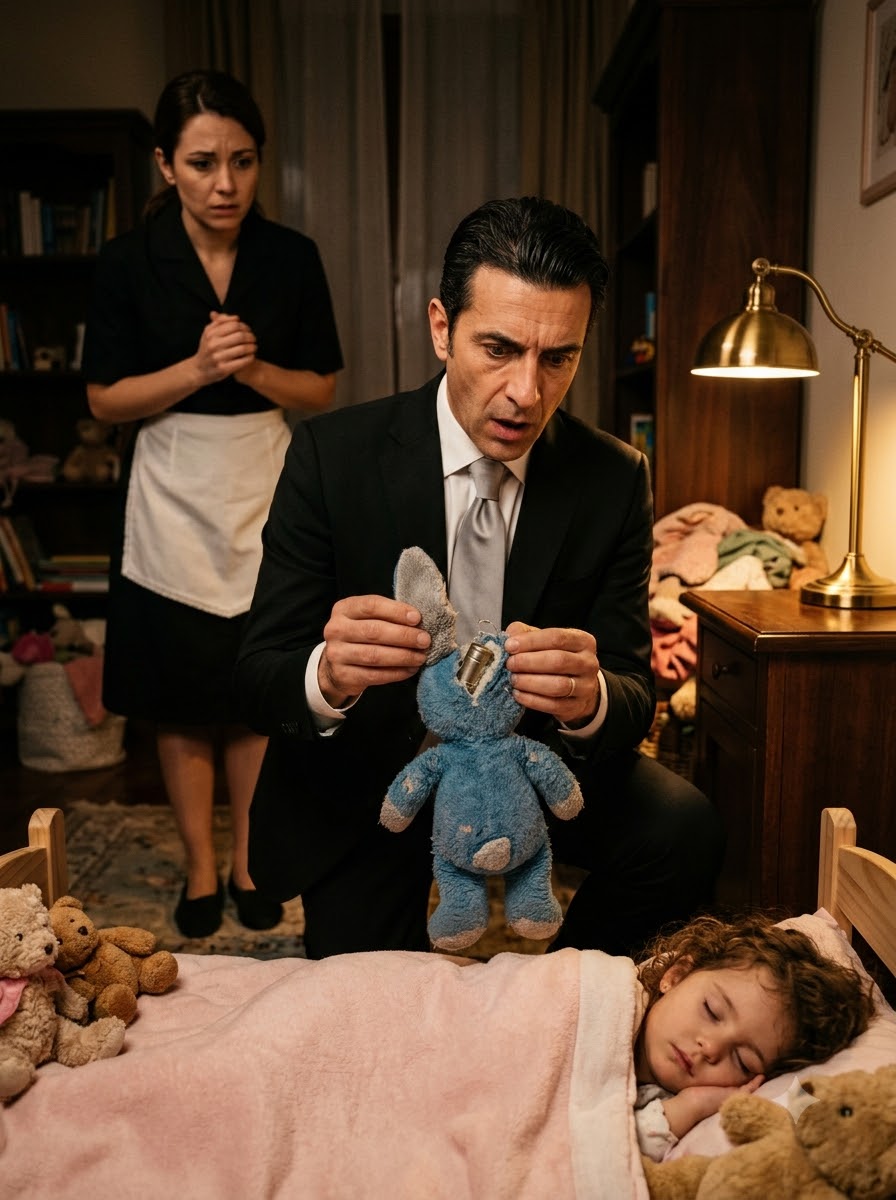
Near its base, hidden beneath the wool, sat a tiny brass fastener.
He turned it carefully.
The gray patch opened.
Inside was a narrow metal capsule.
My breath caught.
Noah’s voice returned from the last night I saw him alive.
If anything happens, don’t trust the reports.
Trust what I left with Emma.
I’d believed he meant the rabbit itself.
A memory of her father.
Not this.
Alessandro set the capsule on his desk and opened it.
Inside sat a small digital storage card.
The study door swung open.
Don Ricci walked in without knocking.
“What have you found?”
Alessandro’s hand closed over the card.
Ricci spotted the rabbit.
For one brief second, the oldest and calmest man in the Moretti organization forgot to hide his fear.
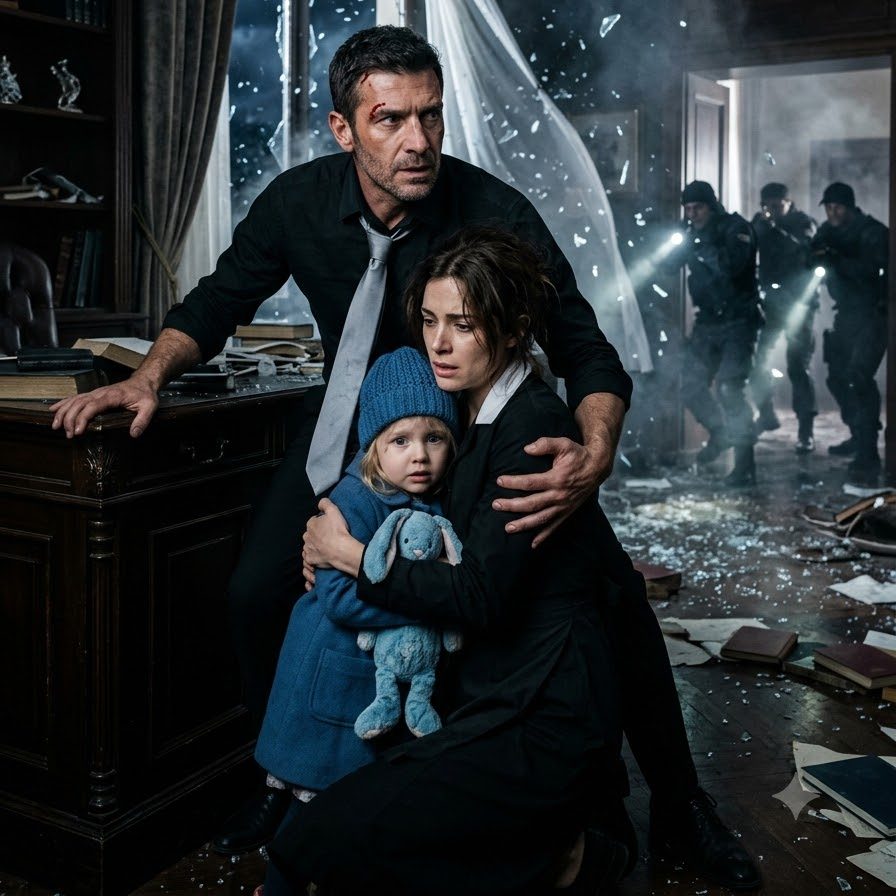
Then the lights cut out.
A woman screamed in the corridor.
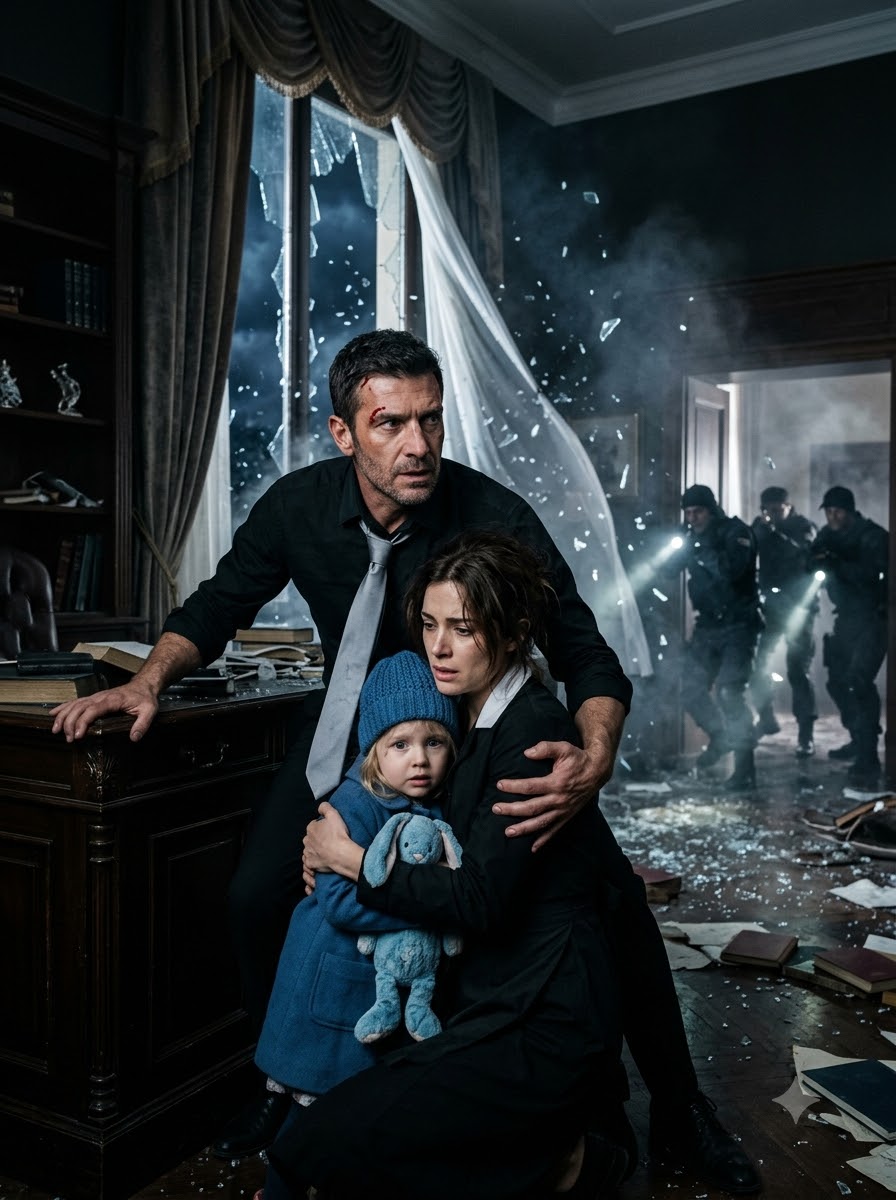
The study windows shattered.
Alessandro threw himself over Emma and me as bullets ripped through the curtains.
Security men shouted beyond the door.
Glass rained across the desk.
In the dark, someone tore the rabbit from Alessandro’s grip.
By the time the emergency lights flickered red, Don Ricci was gone.
So was the memory card.
On the floor by the shattered window lay the blue rabbit.
Its gray ear had been ripped open.
Emma crawled toward it.
She picked up the damaged toy and began to cry.
Alessandro stood amid the broken glass, blood running from a cut above his eyebrow.
He stared at the empty doorway.
Then he said the words that turned my grief into fear.
“The attack didn’t come from outside the estate.”
PART 2 — THE DEAD MAN’S VOICE
Villa Moretti turned into a fortress before dawn.
Steel gates sealed off every entrance. Guards combed through rooms, vehicles, and service passages. The twelve families received calls warning them to stay in Milan.
Don Ricci answered none of Alessandro’s messages.
His house sat empty.
His private plane remained in its hangar, but two vehicles registered to his security company had vanished.
Emma and I were moved into rooms beside Alessandro’s private suite.
I objected.
He ignored me.
“You said you wouldn’t order me around.”
“I asked politely before someone fired through my study window.”
“I’ve survived my whole life without armed guards.”
“You weren’t carrying evidence that could frighten Don Ricci.”
“I’m not carrying it anymore.”
Alessandro looked at the damaged rabbit in my hands.
“I don’t think Noah trusted a single memory card.”
I thought of my husband.
Noah labeled leftovers with dates.
He backed up photographs in three places.
He double-checked the front door lock every night, then laughed when I teased him about it.
Alessandro was right.
Noah would never have hidden his only copy inside a child’s toy.
Emma sat on the bed while I patched the rabbit’s gray ear with a hotel sewing kit.
“Is Mr. Blue hurt?” she asked.
“A little.”
“Daddy fixed him before.”
“I know.”
“Can Daddy fix him again?”
The needle stilled in my hand.
Children asked questions grief never answered correctly.
“Daddy isn’t here, sweetheart.”
“He can feel love through glass.”
“Yes.”
“Maybe he can feel it through wool too.”
I pressed the rabbit to my mouth.
Alessandro stood in the doorway.
He’d changed into a black shirt. The cut above his eye had been closed with three stitches.
He looked away to give my grief room.
A small mercy.
I noticed it.
By afternoon, his security team pulled footage from the mansion.
The gunfire had come from an interior balcony linked to a sealed guest wing.
A guard named Pietro Bellini had disabled the cameras and gone missing.
Pietro had worked for Don Ricci for nineteen years.
The torn memory card turned up crushed beneath the rear tire of a security vehicle.
Its data was unrecoverable.
“Then Noah’s evidence is gone,” I said.
Alessandro stood over the conference table.
“No.”
“How can you be sure?”
“Ricci wouldn’t have exposed himself to destroy something meaningless.”
“What was on it?”
“We find out by learning what Noah was investigating.”
Company records showed Noah had been hired as an external security engineer three years before he died.
His job included upgrading the digital systems behind Moretti warehouses, shipping manifests, and private communications.
Six months before the fire, he filed a report warning that someone was altering cargo records after Alessandro had approved them.
The report never reached Alessandro.
It got redirected to Ricci’s office.
A second report accused an unnamed senior adviser of moving weapons through humanitarian shipments.
That report vanished.
Two weeks later, Noah died.
“Why didn’t he come to you directly?” I asked.
Alessandro stared at the screen.
“Maybe he tried.”
A technician restored an archived voicemail log.
Seven calls from Noah Bennett to Alessandro’s private number surfaced from the month before the warehouse fire.
All had been rerouted to Ricci’s security office.
The final call lasted eleven seconds.
The audio file had been deleted.
Emma played with colored blocks on the carpet while we listened to the damaged recording.
Only static remained.
Then a man’s voice broke through.
Noah.
“If Moretti hears this, tell him the tower has been empty for years. The bell is ringing from underneath.”
The recording cut off.
Alessandro replayed it.
“The tower,” I said.
“The Ricci family symbol.”
A black tower marked Ricci’s signet ring, his vehicles, and his private documents.
“What did he mean by empty?”
Alessandro pulled up old ownership records.
Salvatore Ricci had controlled the eastern docks before the Moretti family consolidated Milan’s criminal alliances.
Officially, Ricci gave up those operations to Alessandro’s father forty years earlier and became his closest adviser.
In truth, money had kept flowing through companies quietly tied to Ricci.
Noah had uncovered the original network.
A kingdom hidden beneath another kingdom.
That evening, Vivian Romano arrived at Villa Moretti through the south gate.
The guards tried to turn her away.
She demanded to see Alessandro and threatened to expose every family from the alliance dinner if he refused.
He met her in the drawing room.
I stayed near the service entrance with Emma.
Vivian saw me.
“You’re still here.”
“Apparently.”
Alessandro stood by the fireplace.
“Why did you come?”
Vivian pulled a folder from beneath her coat.
“Because your guards are searching my father’s property, and I’d rather know why before someone ruins the antique floors.”
“Where is Ricci?”
“I don’t know.”
“You spoke with him after leaving the villa.”
Her eyes narrowed.
“You track your former fiancées?”
“I track people tied to armed attacks inside my home.”
“He called me.”
“What did he want?”
“To know if the maid’s child still had the rabbit.”
My stomach clenched.
Alessandro’s face gave nothing away.
“What did you tell him?”
“That I had no idea what he was talking about.”
“Why didn’t you warn me?”
Vivian laughed, bitter.
“You’d just ended our engagement in front of twelve families.”
“A woman and child were in danger.”
“You think I cared?”
Emma ducked behind my skirt.
Vivian caught the movement.
Shame crossed her face, briefly.
“I didn’t know anyone would attack the villa,” she said.
“What do you know?”
She set the folder on the table.
“My father didn’t arrange our engagement.”
“Your father negotiated it.”
“Because Ricci threatened to expose Romano debts and push us out of the southern ports.”
Alessandro opened the folder.
Inside were bank statements, messages, and photos of Ricci meeting privately with men from rival families.
“Why give me this now?”
“Because he called again this morning.”
Vivian’s composure cracked.
“He said the marriage alliance wasn’t useful anymore. Then he told me accidents happen to women who outlive their purpose.”
“You’re afraid.”
“Yes.”
The honesty sounded strange coming from her.
She looked at me.
“I’m also cruel. Both things can be true at once.”
“You struck me because you were scared?” I asked.
“No. I struck you because I was angry and entitled.”
Emma frowned.
“That’s bad.”
Vivian closed her eyes.
“Yes.”
When she opened them, she knelt a careful distance away.
“I’m sorry I hurt your mother.”
Emma hugged the rabbit.
“You already said sorry.”
“I didn’t mean it then.”
“Do you mean it now?”
“Yes.”
Emma weighed the answer.
“Okay. But you still can’t order her around.”
Something fragile crossed Vivian’s face.
“No. I suppose I can’t.”
The folder held proof that Ricci controlled hidden shipping accounts, bribed officials, and financed attacks blamed on rival families.
But it didn’t prove he’d killed Noah.
It didn’t explain the blue rabbit.
And it didn’t explain why Noah Bennett, an English foster child, had owned a toy made by Alessandro’s mother for a missing Moretti son.
Alessandro requested Noah’s childhood records.
Most had been destroyed in a flood at the foster agency.
One document survived.
A medical admission form from thirty years back.
Male child.
Roughly five years old.
Found wandering near a train station in northern France.
No surname.
No reliable memory.
A crescent-shaped scar behind the right ear.
I stopped breathing.
Noah had the same scar.
He’d always claimed it came from a childhood fall against a radiator, though he never remembered the accident.
The record included one photograph.
A frightened boy clutching a blue rabbit to his chest.
His hair had been cut unevenly.
His face was thin.
But the eyes were Noah’s.
Alessandro sat down.
The powerful man who made others tremble sank into a chair as though his bones had forgotten how to hold him up.
“Luca.”
The name cracked in his throat.
Emma looked up from her blocks.
“Who’s Luca?”
No one answered.
Alessandro stared at the photograph.
“My brother had that scar. He fell off a horse when he was four.”
He looked at Emma.
“Your husband was my brother.”
I shook my head.
“Noah didn’t know.”
“Maybe he found out.”
“When?”
“Before he died.”
The thought was unbearable.
Noah had lived his whole life without parents, siblings, or a past.
Had he found his family only to be killed before he could come home?
Emma walked over to Alessandro.
She held out the blue rabbit.
“Mr. Blue can be your brother too.”
Alessandro looked at her.
His eyes filled.
He touched the rabbit’s paw.
“Thank you.”
“You can hold him.”
His hands trembled as he took it.
He turned the toy over.
Near the seam beneath the tail ran a line of newer blue thread.
Not gray.
I’d never noticed it — the colors matched too well.
Alessandro pressed the seam.
A small panel opened.
Inside sat a tiny sound module.
Emma clapped.
“Daddy’s song!”
“What song?” I asked.
She squeezed the rabbit’s belly.
Static crackled out.
Then Noah began to sing.
His voice was warm, a little off-key, and alive enough to break me open.
“Little blue rabbit, don’t be afraid. Moon in the window, home has been made…”
Emma smiled.
“Daddy sang that.”
Alessandro covered his mouth.
“My mother sang the same lullaby.”
The recording continued.
Noah stopped singing.
A door closed somewhere behind him.
Then his voice changed.
“Clara, if you hear this, I was right about the records.”
My whole body locked up.
A hidden message beneath the song.
“I know who I was before England. Luca Moretti. I confirmed it through hospital files and an old photograph Ricci kept in his private archive.”
Alessandro’s grip tightened on the rabbit.
“I wanted to tell you. I wanted to walk into Villa Moretti and demand why my brother never found me.”
His breath caught unevenly on the recording.
“But Alessandro did search. Ricci falsified every lead.”
Alessandro bowed his head.
“Ricci arranged the attack that killed our driver. He took me across the border and paid a couple to keep me hidden. When they panicked, they left me at the station.”
Emma climbed into my lap.
Noah’s recorded voice went on.
“He needed one Moretti heir, not two. A grieving older brother was easier to control than a united family.”
Alessandro looked as though each word were stealing years off his life.
“I found out something worse. Ricci arranged the explosion that killed Sofia. She’d learned he was stealing from the families and meant to tell Alessandro.”
The room fell silent.
Vivian stepped back.
Noah’s voice softened.
“He kills anyone who threatens the world he built beneath the Moretti name.”
A pause.
“If I don’t come home, don’t tell Emma her father was brave. Tell her I was scared and did the right thing anyway.”
I started crying.
Noah had known.
He’d known he was going to die.
“I copied the final proof to the one place Ricci would never search.”
The audio crackled.
“Not the rabbit.”
Alessandro raised his eyes.
“Where?” Vivian whispered.
Noah answered from two years in the past.
“Inside the house that raised my brother.”
The recording ended.
Villa Moretti.
The proof had been inside the mansion the whole time.
But where?
Emma tugged the rabbit’s gray ear.
“Daddy said houses remember footsteps.”
A phrase Noah used often when testing security systems.
Houses remember footsteps.
Alessandro stood.
“The original floor sensors.”
During a renovation thirty years earlier, Moretti security had installed pressure-based movement recorders beneath the private corridors. The system had supposedly been stripped out.
Noah had discovered it was still there.
The old control unit was hidden beneath the nursery wing.
The nursery had stayed sealed since Sofia’s death.
Alessandro hadn’t set foot in it in seven years.
We walked there together.
The door opened reluctantly, releasing the scent of dust and faded lavender.
A wooden cradle stood by the window.
Tiny clothes still sat folded inside a cabinet.
On a shelf sat an unfinished wool rabbit.
Blue.
Missing one gray ear.
Sofia had been making another toy before she died.
Alessandro stopped in the doorway.
His grief filled the room without a sound.
I took his hand.
Not because he was powerful.
Because grief recognizes grief.
Behind the rocking chair, Noah had opened the wall and fitted a digital drive into the old sensor control box.
It held decades of recordings.
Ricci meeting with rival families.
Ricci ordering Luca’s abduction.
Ricci arranging the warehouse fire.
Ricci instructing men to plant stolen records on Noah’s computer.
And finally, Ricci discussing Sofia.
Her death hadn’t been collateral damage.
It had been ordered.
Alessandro listened without moving.
When the recording finished, he turned to his guards.
“Bring Ricci to me.”
The estate manager stepped forward.
“We found his vehicle near Lake Como.”
“Where is he?”
A telephone rang inside the nursery.
The old landline hadn’t been used in years.
Alessandro answered.
Ricci’s voice filled the room.
“You found the archive.”
“Yes.”
“I wondered whether Luca would choose the nursery.”
“You murdered my wife.”
“I protected your position.”
“You stole my brother.”
“I created the man you became.”
Alessandro shut his eyes.
Ricci continued.
“Bring the drive to the old bell tower outside Monza. Come alone, or the Romano girl dies.”
Vivian’s face went white.
A guard reached for her.
Too late.
A red laser point appeared over her chest through the nursery window.
The shot shattered the glass.
Vivian fell.
Emma screamed.
I covered her body.
Blood spread across Vivian’s dress.
Alessandro dropped beside her.
The bullet had gone in below her collarbone.
She struggled to breathe.
“Ricci knew,” she whispered. “He knew I came here.”
Paramedics rushed into the room.
Vivian caught my wrist.
“Don’t let Emma remember me only as the woman who hit you.”
I looked at her pale face.
“Then survive long enough to become someone else.”
She managed a small smile.
“Still giving orders.”
“Yes.”
Vivian was carried away.
Alessandro stared through the broken window into the dark beyond the villa.
“He wants the drive,” I said.
“No. He wants me.”
“What will you do?”
His face took on the look twelve families feared.
“I’ll give him exactly what he created.”
Emma broke free from me and walked toward him.
“No.”
Alessandro looked down.
She held the blue rabbit against her chest.
“You can’t make people cry because you’re mad.”
“Emma—”
“My daddy said being scared doesn’t make you bad.”
Her voice shook.
“But doing bad things because you’re scared still counts.”
The feared man of Milan looked at his niece.
The child of the brother he’d lost twice.
Slowly, the coldness drained from his face.
“You’re right.”
He turned to his men.
“No executions.”
One guard blinked.
“Boss?”
“Contact the authorities.”
The room shifted.
Moretti men didn’t contact authorities.
They avoided them, bought them, or scared them off.
Alessandro set the recovered evidence drive on the table.
“Send copies to the national anti-mafia prosecutor, the financial police, and every family Ricci betrayed.”
“You’ll expose our operations too,” the estate manager warned.
“I know.”
“You could lose everything.”
Alessandro looked at Emma.
“I already did.”
PART 3 — THE HOUSE THAT REMEMBERED
The old bell tower stood past a ruined monastery outside Monza.
Rain swept across the broken courtyard.
Ricci had picked the spot because the tower symbol had belonged to his family for generations. It marked his rings, his documents, his hidden accounts.
Alessandro arrived carrying the evidence drive.
I went with him.
He’d ordered me to stay at the villa.
I reminded him what Emma had said about ordering her mother around.
He didn’t argue twice.
Emma stayed under armed guard with Vivian at the hospital.
Before I left, she pressed the blue rabbit into my hands.
“Mr. Blue knows the way,” she said.
Ricci waited inside the tower.
Pietro Bellini stood beside him, armed. Four more men watched from the stairs above.
The great bell hung overhead, black with age.
“You brought the maid,” Ricci said.
“Her name is Clara.”
“Names don’t change what people are.”
“No,” Alessandro said. “Choices do.”
Ricci looked at the drive.
“All copies?”
“Yes.”
He smiled.
The lie was necessary.
Copies were already spreading through government servers and private family networks.
“Put it on the floor.”
Alessandro complied.
Ricci picked it up.
“You could have ruled Europe.”
“I ruled rooms full of men too scared to tell me I was blind.”
“I gave you loyalty.”
“You gave me grief and called it loyalty.”
Ricci’s face hardened.
“Your brother was weak.”
“He was five.”
“He would have split the organization.”
“He was a child.”
“He grew into a man who stole from you.”
“No. He grew into a man who found the truth.”
Ricci glanced at me.
“Your husband begged before the warehouse burned.”
The words hit me like ice.
Alessandro moved.
I grabbed his arm.
Ricci smiled.
“Yes. Control him, maid. Everyone else failed.”
I stepped forward.
“What did Noah say?”
Ricci tilted his head.
“Why?”
“You want me broken. Do it right.”
Uncertainty crossed his face for a moment.
Then vanity won out.
“He said Alessandro would learn the truth eventually.”
Ricci gave a soft laugh.
“He still believed his brother would save his family.”
My grief sharpened into something clear.
“He was right.”
Ricci’s smile disappeared.
Sirens sounded beyond the monastery walls.
His men turned toward the windows.
“You betrayed me,” he said to Alessandro.
“No. You mistook my silence for consent.”
Ricci raised his weapon.
Alessandro stepped directly in front of me.
The same way he’d shielded Emma and me in his study.
“Move,” I whispered.
“No.”
“You have guards.”
“So did Sofia.”
Ricci aimed at Alessandro’s heart.
“You’d give up everything for a maid and her child?”
Alessandro’s voice stayed even.
“For my brother’s wife and daughter.”
Ricci looked at me.
Then at the rabbit in my hands.
Hatred crossed his face.
“That ridiculous thing survived thirty years.”
The rabbit had survived a kidnapping.
Foster homes.
A warehouse fire.
A bullet attack.
It had carried Noah’s voice home after his body couldn’t.
Ricci fired.
The tower bell rang at that exact moment.
The sound was massive.
Stone shook.
Birds burst from the ruined roof.
Alessandro staggered.
Blood spread across his shoulder.
Pietro turned his gun on Ricci.
The old man froze.
Pietro’s hands shook.
“My father died in Warehouse Seventeen,” he said. “You told me Bennett caused it.”
Ricci’s eyes narrowed.
“He was collateral.”
Pietro lowered his weapon only after police stormed the tower.
Ricci looked around at the armed officers, the Moretti guards, and the men whose loyalty had finally left him.
“You think prison changes what you are?” he asked Alessandro.
“No.”
“You’re still your father’s son.”
Alessandro pressed a hand against his wound.
“And Emma’s still Luca’s daughter.”
He looked at the blue rabbit.
“That’s enough to change what comes next.”
Ricci was arrested.
He didn’t resist.
Men like him rarely believe consequences are real until the door shuts behind them.
The evidence inside Villa Moretti exposed four decades of murder, corruption, extortion, and manufactured wars between criminal families.
It exposed Alessandro too.
His name appeared on shipping agreements, payments, and orders.
Some he’d authorized.
Some Ricci had altered.
Alessandro refused to separate the two publicly.
“I benefited from the empire,” he told prosecutors. “I won’t claim innocence because I didn’t inspect every grave beneath it.”
He dismantled the Moretti organization.
Legal businesses went under independent management.
Properties were sold to compensate victims’ families.
Records were handed over.
Men who refused the transition fled or were arrested.
The twelve families called Alessandro a traitor.
He accepted the label.
Vivian survived.
The bullet damaged her left shoulder and ended the flawless posture she’d spent years perfecting.
She visited us three months later in a simple black dress.
No diamonds.
No assistants.
Emma answered the door.
Vivian held a gift box.
“I brought something for Mr. Blue.”
Inside was a tiny red scarf.
Emma examined it.
“Did you make this?”
“Yes.”
“It’s crooked.”
“I’m not very good at sewing.”
“My mommy can teach you.”
Vivian looked at me.
The request carried no demand.
Only uncertainty.
I invited her in.
Forgiveness didn’t arrive that afternoon.
But tea did.
Sometimes that’s where forgiveness starts.
Alessandro got a reduced sentence for his cooperation, but he still went to prison.
The judge gave him seven years.
The morning officers came for him, he ate breakfast with us in the small kitchen at Villa Moretti.
Emma wouldn’t eat.
“Are you going away like Daddy?”
“No.”
“Daddy didn’t come back.”
“I will.”
“How do you know?”
Alessandro looked at me.
Because adults had already broken promises to Emma, he chose honesty.
“I don’t know what will happen. But I’ll do everything I can to come back.”
Emma slid off her chair.
She placed the blue rabbit in his arms.
“He gets scared at night.”
Alessandro held the toy.
“So do I.”
“You can share.”
He closed his eyes.
When he opened them, tears sat there without shame.
“I’ll take care of him.”
“And he’ll take care of you.”
The prison allowed the rabbit in after weeks of inspection.
For seven years, Mr. Blue sat on a narrow shelf above Alessandro’s bed.
Every Sunday, Emma mailed a drawing.
She drew the moon trailing buses.
She drew Noah with wings because she believed fathers needed wings to visit children in dreams.
She drew Alessandro inside a square building with too many windows.
In every picture, the blue rabbit stood beside him.
I visited twice a month.
At first, Alessandro and I talked about Emma.
Then about Noah.
Then about Sofia.
Eventually, we talked about ourselves.
He told me he hated pears.
I told him I sang when nervous.
He admitted he’d ordered men hurt and spent years pretending responsibility felt lighter once violence was handed off to someone else.
I told him I’d taken the job at Villa Moretti planning to steal evidence and expose him if I found he’d caused Noah’s death.
“Why didn’t you?” he asked.
“Because the evidence showed you were guilty of many things.”
“And?”
“You weren’t guilty of that.”
He accepted the answer without asking for absolution.
Love didn’t arrive like lightning.
It grew in visiting rooms under fluorescent lights.
It grew through apologies that didn’t ask for a reward.
It grew when he remembered Emma’s school performance date without needing a reminder.
It grew when I stopped reading his silence as a threat and started recognizing the grief inside it.
Three years into his sentence, Noah’s final recovered file arrived.
Technicians had pulled additional data from the mansion archive.
It held a video recorded two days before the warehouse fire.
Noah sat in his workshop.
The blue rabbit rested on the table.
He looked worn out.
Behind his right ear, the crescent scar showed.
“Clara,” he began, “there’s one thing I didn’t tell you.”
I held Emma’s hand as we watched.
“I remembered Alessandro before I found the records.”
Alessandro went still beside us.
“A white rabbit. A locked nursery. A boy holding my hand through a storm.”
Noah smiled sadly.
“I knew I had a brother somewhere. Once I found out who he was, I watched him from a distance.”
The video showed a photo of Alessandro leaving a courthouse years earlier.
“I wanted to walk up to him.”
Noah lowered his eyes.
“But I had a wife. A daughter. A life untouched by the Moretti name.”
Alessandro covered his mouth.
“I was afraid finding my old family would put the new one at risk.”
The confession hurt him more than anger would have.
Noah had known.
He’d chosen to stay away.
“I thought I had more time,” Noah went on. “I thought I could expose Ricci first, then decide whether Alessandro was still the brother I remembered.”
His voice softened.
“If he finds this, tell him I didn’t stay away because I hated him.”
Alessandro began to cry.
“I stayed away because I loved Emma more than I missed the past.”
Emma leaned closer to the screen.
Noah looked straight into the camera.
“And if Alessandro protects her after I’m gone, tell him he became my brother again before he ever knew I was alive.”
The recording ended.
No one moved.
The prison visiting room held other families, guards, and the hum of old ventilation.
Yet for a moment, we existed alone inside Noah’s last words.
Alessandro pressed both hands to his face.
Emma climbed off her chair and wrapped her arms around his neck through the gap beside the partition.
“You’re Daddy’s brother.”
“Yes.”
“So you’re my uncle.”
“Yes.”
She pulled back.
“Can uncles be family even if they’re late?”
Alessandro looked at me.
“Sometimes.”
Emma nodded.
“Then don’t be late again.”
He was released after five years and eight months.
Good behavior and continued cooperation shortened the sentence.
The morning he walked out through the prison gates, Emma was nine.
She wore a blue coat and carried the rabbit, faded almost gray now from years of being passed between us.
Alessandro stopped when he saw her.
“You grew.”
“You got older.”
“That happens.”
“Your hair’s more silver.”
“So is Mr. Blue.”
She ran to him.
He crouched.
She hit him with enough force to make him stagger, both arms locked around his neck.
I stood a few steps back.
Alessandro looked at me over her shoulder.
No empire waited outside.
No convoy.
No armed men.
Only an old station wagon Vivian had helped me buy after the villa was sold.
Only three people and a worn-out toy.
We moved into a farmhouse outside Bergamo.
Alessandro joined a legal shipping cooperative that employed families affected by Moretti operations.
Vivian started a foundation for domestic workers abused inside wealthy households.
She never married.
She claimed men disappointed her.
Emma claimed it was because Vivian liked having the whole bed to herself.
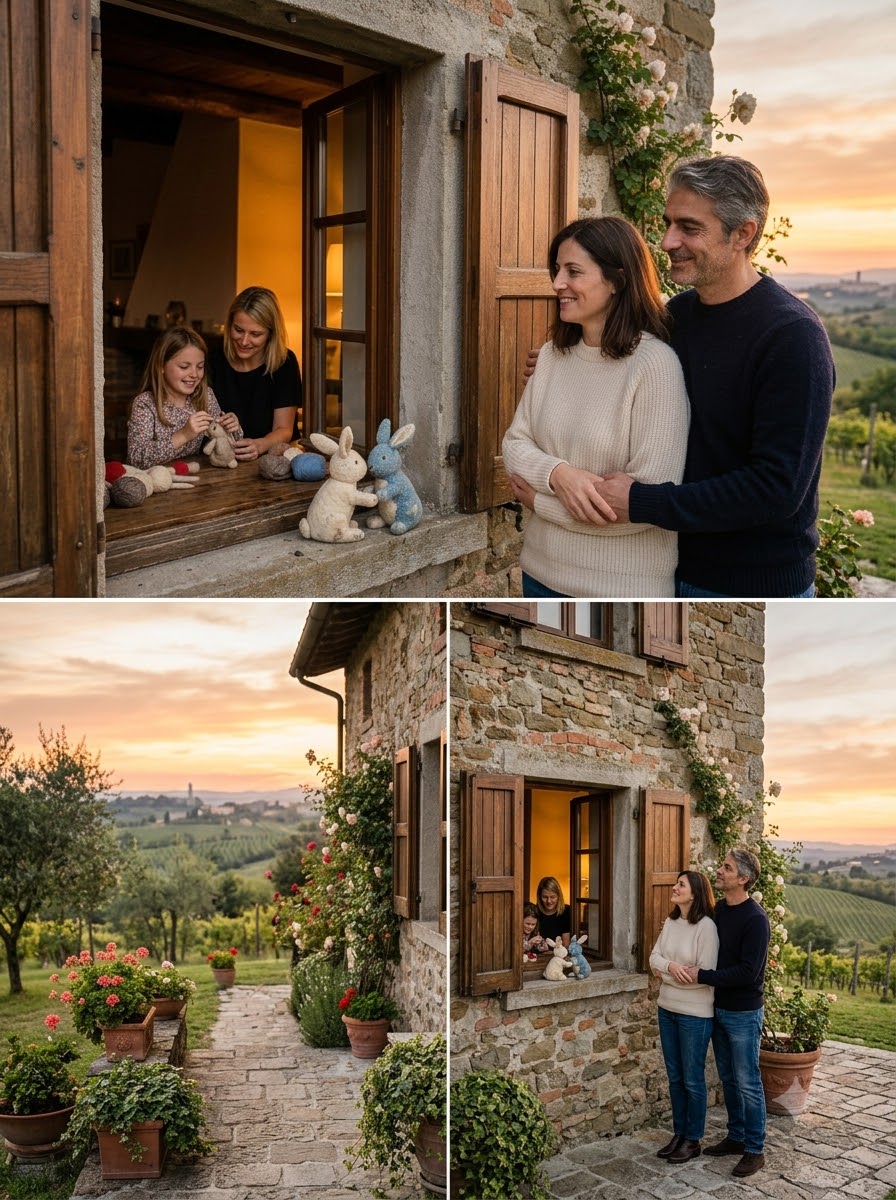
On Noah’s birthday, we set two wool rabbits on the farmhouse windowsill.
The old white rabbit from Alessandro’s childhood.
The blue rabbit Noah had carried across countries, names, and lives.
Their paws touched.
Alessandro stood beside me as evening settled over the fields.
“Do you think he’d forgive me?” he asked.
“No.”
He turned.
I went on.
“I think Noah understood forgiveness was the wrong question.”
“What was the right one?”
“Whether you’d become someone Emma could safely love.”
He looked through the window.
Emma sat at the kitchen table, teaching Vivian to braid wool into a new rabbit.
Alessandro’s eyes softened.
“And did I?”
“She’ll spend her whole life answering that.”
He took my hand.
The gesture stayed careful, even after all those years.
Inside, Emma held up the unfinished toy.
“This one needs a name!”
Alessandro opened the door.
“What color is it?”
“Half white and half blue.”
He smiled.
“Then maybe it already has two.”
Emma frowned.
“That makes no sense.”
“Families rarely do.”
She laughed.
The sound carried through the farmhouse, out into the darkening fields, past all the empty years men like Ricci once believed could stay buried under silence.
On the windowsill, the two old rabbits leaned together as the evening wind drifted in through the open door.
One had waited for a missing brother, the other had carried him home — and between their touching paws lay the tiny gray thread that had survived long enough to stitch a broken family back together.
