


My husband’s 30th birthday was meant to be a story our family would retell and laugh over for years to come.
Everyone we cared about had gathered in the backyard. Burgers hissed on the grill, music floated out through the open windows, and our three-year-old daughter, Maisie, sat in the grass lining up her plastic dinosaurs one by one.
I stood on the patio, watching my husband, Grant, welcome our guests.
For one perfect instant, I thought, This is everything.
By the time the sun went down, I would learn how little I actually knew about him.
“You did too much,” Grant murmured as he passed me.
He kissed my temple.
“You only turn 30 once,” I said. “Let me spoil you.”
“You always do.”

He smiled, though something underneath it looked tense. I figured the party was just getting to him.
Grant’s best friend, Colin, showed up right as we finished at the grill, a wrapped present tucked under one arm and a pricey bottle of bourbon in the other.
“There’s the birthday boy!”
He yanked Grant into a hug.
“You’re late,” Grant said.
“I’m fashionable.”
“That’s what late people say.”
They both laughed, but the moment Colin pulled back, something unspoken flickered between them.
Grant shook his head at him, barely.
Colin’s smile faded for a beat before he glanced away.
“Everything okay?” I asked.
Grant spun around too fast.
“Of course.”
“You both looked serious.”
“I was just realizing how ancient I am now.”
His laugh came out strained, but before I could push further, Maisie sprinted across the lawn and threw her arms around Colin’s leg.
“Uncle Colin!”
“There’s my favorite person.” He lifted her into his arms. “Did you save me any cake?”
“Mama says we have to wait.”
“Your mama is very wise.”
Colin had been in our lives since college. He’d stood up for Grant at our wedding, pitched in when we moved into our house, and often tagged along on Grant and Maisie’s Sunday park outings.
I’d always thought of him as family.
Hours later, Grant blew out his candles with Maisie perched on his hip. Everyone cheered as I snapped a photo of the two of them.
After the cake, Colin sank into a patio chair and stretched his legs out. He had on polished brown leather boots, and my brother-in-law Peter noticed them right away.
“Those must have cost a fortune.”
“Every man deserves 1 irresponsible purchase,” Colin joked.
Maisie, back to playing with her dinosaurs, suddenly froze.
She stared at Colin’s right boot, got to her feet, and crossed the patio.
Then she pointed straight at it.
“Daddy cried on Uncle Colin’s shoe,” she announced.
Everyone laughed.
I knelt down next to her.
“What do you mean, sweetheart?”
“Daddy cried there.”
She touched the tip of Colin’s boot.
“Daddy was on the floor.”
The laughter died out.
I glanced at Grant.
The color had drained out of his face.
Colin had frozen entirely.
Neither of them looked puzzled.
“When did this happen?” I asked.
“Before the park.”
Every Sunday morning, Grant took Maisie to the park, and sometimes they swung by Colin’s house beforehand.
“What did Daddy say?”
Maisie dropped down onto her knees.
“Please don’t tell. More time.”
A cold weight settled in my chest.
“He said that to Uncle Colin?”
She nodded.
“Daddy cried here.”
Colin started to speak, but Grant cut him off with a shake of his head.
Colin said nothing.
That wordless exchange scared me more than anything Maisie had said.
“Go show your dinosaurs to your cousin,” I told her.
She skipped off, with no idea she’d just upended the whole afternoon.
I stood up slowly.
“Grant, explain.”
“Kids misunderstand things.”
“Did she misunderstand seeing you on the floor, crying and begging Colin not to tell me something?”
Grant swallowed.
“I tripped.”
“You’re lying.”
He looked at Colin, fear plain on his face.
For one horrible second, my thoughts leapt to the worst kind of betrayal. The hidden meetings, the begging, the glances between them—all at once it looked like it could only mean one thing: an affair.
Colin caught the suspicion crossing my face.
“No,” he said immediately. “Claire, it isn’t that.”
Grant closed his eyes.
Colin stood beside him.
“You have to tell her.”
“Not here.”
“You promised you would tell her tonight.”
“Colin, please.”
“No. I gave you 2 weeks. Then you begged me not to ruin your birthday, so I agreed to wait until the guests left. I’m not giving you another day.”
“What truth?” I demanded.
Grant dropped his eyes to the ground.
Colin rested a hand on his shoulder.
“I love you like a brother,” he said quietly. “But if you don’t tell her now, I will.”
Everyone nearby had gone quiet.
I looked at my sister, Natalie.
“Please take the children inside and ask everyone else to go home.”
No one objected.
Within minutes the music had cut off and the yard had cleared out. Only Grant, Colin, Grant’s mother Teresa, Natalie, Peter, and I were left.
We sat down together around the kitchen table.
Grant kept his eyes on his hands.
“It’s about money,” he finally said.
“What money?”
He looked over at Teresa.
“After Dad died, I became executor of his estate. When I went through his records, I discovered he had been gambling for years.”
Teresa frowned.
“Your father never gambled.”
“He hid it from everyone.”
Grant went on to explain that his father, Howard, had kept secret gambling accounts, used credit cards to cover what he lost, and taken out more loans every time he talked himself into believing one big win would fix everything.
By the time he passed away, he had left behind roughly $140,000 in debt.
Around $70,000 of it was secured against Teresa’s house. Another $45,000 was made up of credit cards and personal loans. What remained was absorbed by the estate.
“He borrowed against my house?” Teresa whispered.
“There’s a lien on it.”
“No. I never agreed to that.”
“He told you the papers were part of refinancing.”
Teresa’s expression shifted.
“I remember signing something. He said it would lower our payments.”
“I think he lied about what you were signing.”
She covered her mouth.
Grant turned his attention back to me.
“Because I was handling the estate, every creditor called me. Some of them made it sound as if I was personally responsible. They said Mom could lose everything and that they could come after the family.”
Peter frowned.
“They could pursue the estate, not you.”
“I know that now.”
“You should have called a lawyer.”
“I panicked. Mom had just buried Dad. I couldn’t tell her what he had done.”
“So what did you do?” I asked.
“At first, I paid $20,000 from our savings to some of the unsecured creditors.”
My stomach lurched.
That account had held our emergency fund, our repair money, and part of what we’d set aside for Maisie.
“You used our savings without telling me?”
Grant nodded, his eyes welling with tears.
“I kept thinking I could solve it before anyone found out.”
“What else?”
“The house and original mortgage were still only in my name because I bought it before we married.”
I already knew that much. We’d always treated it as our shared home no matter what the paperwork said.
“I used it as collateral for a $45,000 loan.”
For a moment, words wouldn’t come.
“You borrowed against our house?”
“Yes.”
“Without telling me?”
“Yes.”
He looked sick.
“The creditors kept demanding more. Then the loan payments became too high, so I used money from the mortgage account to cover them.”
“Are we behind on our mortgage?”
“By 3 payments.”
The room felt like it tilted.
“How did I not see any notices?”
Grant dropped his gaze.
“I’ve always handled the mortgage. I changed the statements to paperless delivery and moved the warning emails into a separate folder.”
That stung nearly as much as the money itself.
This wasn’t one panicked choice. He had chosen, again and again, to bury the truth.
“You risked our daughter’s home and then concealed the evidence from me.”
“I thought I could fix it.”
“That is not protection.”
“I know.”
“No, you don’t. You made decisions about our future without giving me a voice.”
Teresa leaned forward.
“You should have told me.”
“You were grieving,” Grant said.

“And now I have to grieve him again because I’ve learned that the man I trusted for 32 years had an entire life I knew nothing about.”
Grant covered his face.
“I couldn’t let you lose your house because of him.”
“You nearly sacrificed your own.”
Colin spoke up at last.
“Grant called me 2 weeks ago and asked to borrow $20,000.”
I turned to face him.
“That was when you found out?”
He nodded.
“I made him show me everything. I refused to lend him money and told him to speak to a lawyer and tell you.”
Grant wiped his eyes.
“Last Sunday, I took Maisie to Colin’s house before the park. We argued in the kitchen.”
Colin looked down at his boot.
“Grant became overwhelmed. His legs gave out, and he sank to the floor beside my chair. He started crying and begged me for more time.”
“I asked Colin to wait until after my birthday,” Grant whispered. “I didn’t want the party ruined.”
Colin’s face hardened.
“I agreed only because you promised to tell Claire as soon as the guests left.”
“And Maisie saw you,” I said.
Grant nodded.
Nobody spoke for several seconds.
Then Teresa reached across the table and took hold of her son’s hand.
“You tried to protect your father’s reputation by repeating his worst mistake.”
Grant looked at her.
“What mistake?”
“Believing secrecy could save a family.”
I wiped the tears off my cheeks.
“We will deal with the debt,” I said. “But that does not mean I forgive you.”
“I understand.”
“You will show me every account, every document, and every message. There will be no more hidden money and no more decisions made without me.”
He nodded immediately.
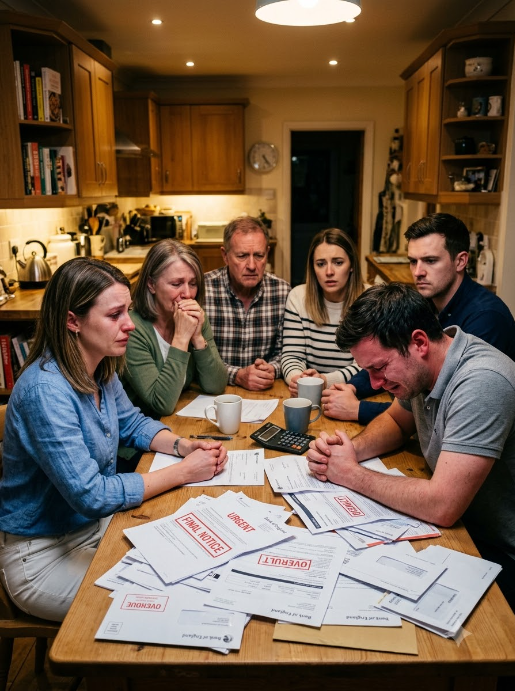
The following morning, Grant laid out every statement, loan agreement, and password on the kitchen table.
On Monday, we met with an attorney.
The attorney confirmed Grant had never actually been personally liable for Howard’s unsecured debts, and that some collectors had used misleading language to pressure him into paying anyway.
Unfortunately, the $45,000 loan Grant had taken out under his own name was legally ours to deal with.
The attorney also uncovered serious issues with the lien on Teresa’s house. Several signatures didn’t match up, and the lender may have overlooked clear signs that Howard had misrepresented the loan.
Nothing was fixed overnight, but there was a way ahead.
In the end, Teresa chose to sell the house. She didn’t want to keep living in the place where Howard had buried so many secrets. The sale paid off the legitimate lien and let her move into a smaller home without giving up the rest of her savings.
Grant sold his truck along with several inherited valuables. We worked out payment plans, trimmed our spending, and got the mortgage caught back up.
Colin never handed over the $20,000.
Instead, he helped us sort through the records and covered the cost of our first legal consultation.
Our family stood by us, but nobody could undo the consequences of what Grant had done.
Fixing our marriage took a lot longer.
I got full access to every account, and my name was added to the house title. Grant and I started counseling.
He had to learn that shouldering everything alone wasn’t strength.
I had to figure out whether trust could ever regrow after being shattered so completely.
Almost a year later, we were still living in our home.
The debt hadn’t disappeared, but it had become manageable. Grant hadn’t missed a payment since, hadn’t hidden another letter, and hadn’t made another financial decision without me.
One Sunday morning, I found him at the kitchen table with our bank statements spread out openly in front of him.
His eyes were damp.
“What happened?” I asked.
“We made it through the first year,” he said.
Maisie wandered in carrying one of her plastic dinosaurs.
She studied him for a moment.
“Daddy’s crying again.”
Grant wiped at his cheeks.
“I’m okay, bug.”
“Sad tears?”
“No. Relieved tears.”
She climbed up into his lap and patted his cheek.
“Daddies can cry.”
Grant pulled her in close.
I looked down at the papers spread out between us.
I still loved him, but that love hadn’t erased what he’d done.
His father’s lies had wrecked two homes. Grant’s secrecy had nearly cost us a third.
In the end, it was our three-year-old who cracked the truth open, with just six simple words:
“Daddy cried on Uncle Colin’s shoe.”
