

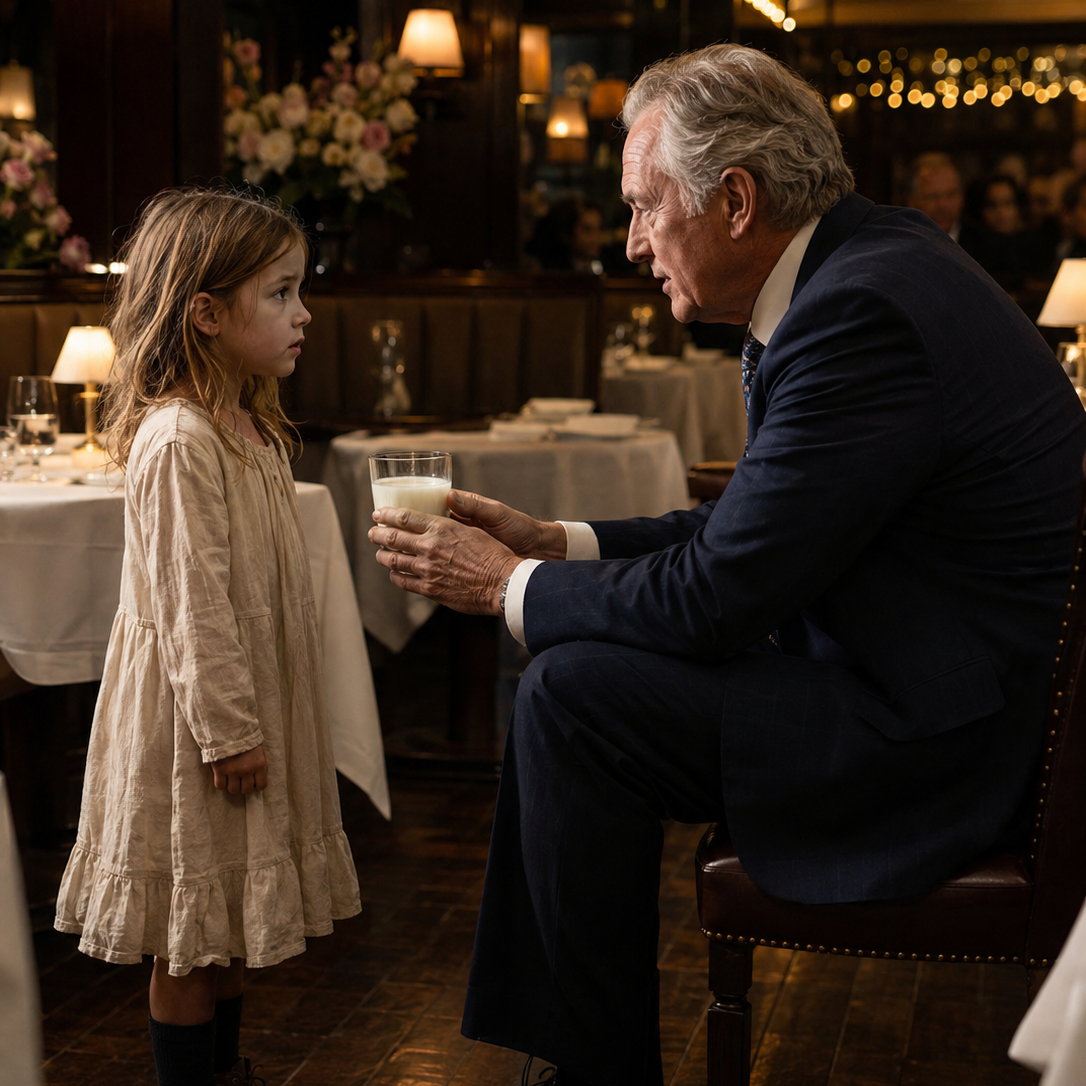
A homeless little girl approached a wealthy man in a restaurant and said, “Don’t eat THAT. I saw your wife put something in it.” He didn’t believe her, but within seconds, the entire room froze in TERROR…
Emily’s mind was on warmth and food. Maybe she’d find a scrap of bread, or maybe fortune would favor her again. Her feet led her toward a place she knew well—the alley behind the restaurant, where kitchen scraps often ended up. The air there always carried the scent of fried meat and fresh bread, giving her the sense that life could feel a little kinder.
She resolved to get there, whatever it took.
Making her way into the restaurant’s back lot, Emily knew this corner of the city by heart. The dumpsters were always there, giving off the comforting smell of leftover food.
This spot felt like a small refuge of hope. Even worn out as she was, a spark of happiness stirred in her—maybe today would be a good day. She checked around to be sure no one was watching.
Kitchen staff often ran off kids like her, yelling and threatening, sometimes shoving them away. Emily knelt beside one of the bins, tugging her worn hood down over her face to avoid attention. She started rummaging through the trash.
Her fingers touched damp paper, plastic wrap, and bits of leftover food. After a while, something solid met her hand. Emily drew out a small piece of bread.
It was still wrapped, almost untouched. Her pulse quickened, and she let out a breath of relief. It was a chance to quiet the hunger inside her.
She tucked the bread quickly into her pocket, worried someone might snatch it away. She knew other children wouldn’t think twice about stealing it if they spotted it. Eyeing the bin again, she considered staying a bit longer—there might be more to find.
Then, all at once, her happiness dimmed. She had the sense that someone was watching her. Her eyes flicked nervously to the restaurant window.
A warm yellow glow spilled from behind the glass, and shapes moved in time with the bustling kitchen. Emily went still, catching the clink of dishes and the footsteps of the staff. None of them glanced outside, yet something about the scene left her uneasy.
Her instincts sharpened when she noticed the kitchen window was cracked open. She edged closer and looked in. Inside, everything was spotless, lit under bright lights.
Chefs in white aprons worked among simmering pots. At first it all seemed ordinary, but Emily’s earlier relief was now tangled with a strange dread. She flattened herself against the cold brick wall, watching through the open window.
Inside, the kitchen was alive with activity: chefs bent over the stoves, arranging plates on long counters, waiters hurrying by with trays balanced high. The clang of pots and clatter of knives mixed with fragments of talk. Everything looked routine.
Then, without warning, a woman stepped into the kitchen. Emily’s attention snapped to her at once.
Her red dress set her apart from the plain uniforms of the staff.
Her heels tapped against the tile, and she carried herself with unmistakable confidence.
It was Victoria Adams, wife of the well-known businessman Robert Adams.
Emily recognized her from tattered magazines she’d once found while dumpster diving.
Emily went rigid. She couldn’t fathom what someone like her was doing in a hot, chaotic kitchen. People of her standing didn’t wander into places like this, let alone pay attention to the workers rushing around.
But Victoria moved with clear purpose. She strode confidently toward a table where a chef was adding the finishing touches to an elegant plate. Emily watched her scan the room, checking whether anyone was paying attention.
When the chef stepped aside to speak with a waiter, the woman slipped a small bottle from her purse in that instant.
It caught the light, glass glinting darkly in her hand.
Emily leaned forward, straining to see what she was up to.
Victoria twisted off the cap and let a few drops of dark liquid fall onto the food. Her hands were steady, unhurried. She then sealed the bottle, tucked it back into her purse, and walked off as if nothing had happened.
Her expression stayed composed—even pleased. Something in Emily’s chest tightened.
She understood she had just witnessed something awful.
This was no accident.
She had witnessed poison.
She was certain Victoria had poisoned the dish—and this was no small matter.
The plate—an artfully arranged serving of meat and garnish—still looked appetizing, but Emily now knew it hid a deadly danger.
“It’s poison,” she murmured, feeling a chill spread through her.
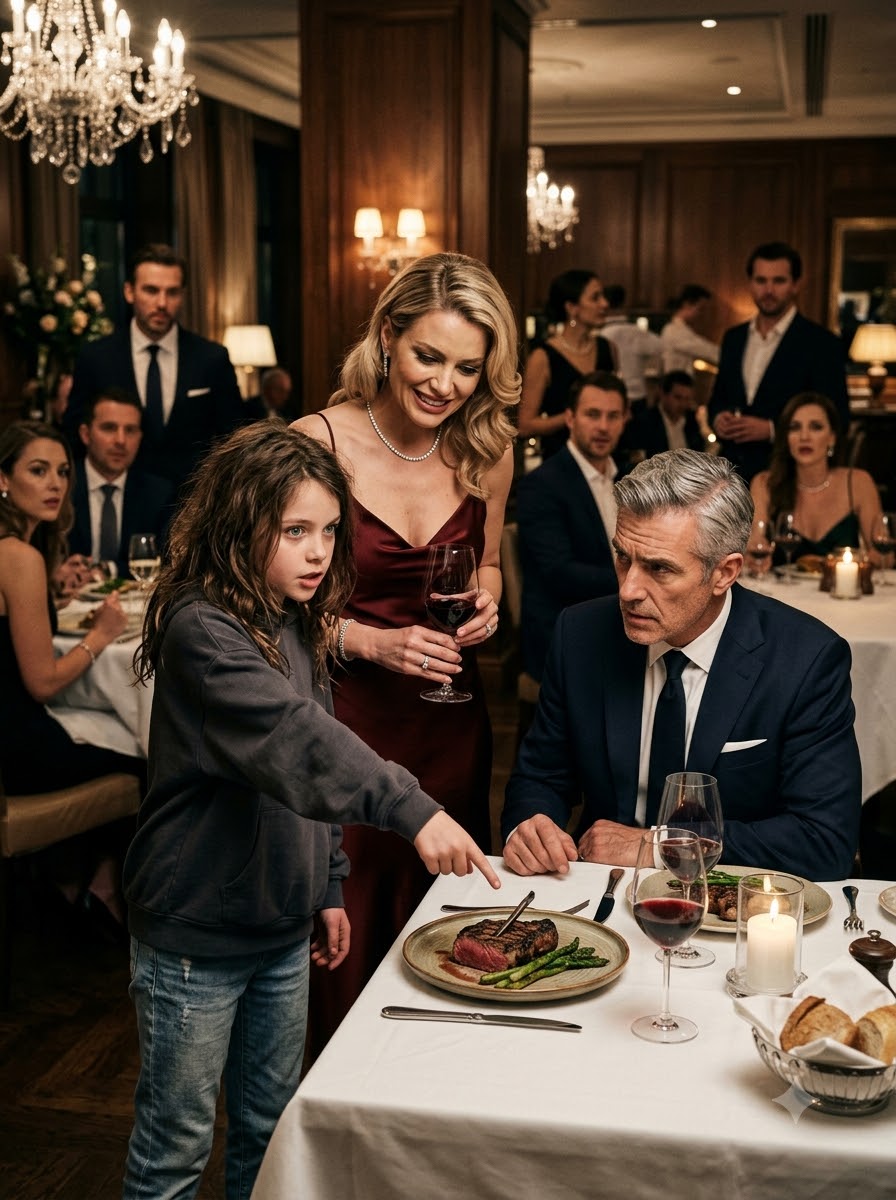
Robert Adams glanced down at the disheveled little girl standing beside his table.
She looked no older than ten, her hair a mess, her cheeks streaked with grime—but her wide green eyes carried a gravity he couldn’t dismiss.
“What are you saying, child?” he asked, his voice dropping.
Around them, the well-dressed diners carried on, glasses clinking and cutlery tapping against china.
“Your wife put poison in that food,” Emily said again, gesturing at the plate with its carefully arranged steak.
“I saw her through the kitchen window. She poured something from a little black bottle.”
Robert turned toward Victoria, who was just coming back from the restroom, moving gracefully between the tables.
She appeared flawless, as usual—the red dress fitted perfectly to her figure, her makeup precise, her smile bright as she exchanged greetings with people she knew.
“I think you’ve made a mistake,” he said, easing the girl aside. “You’d better go before I have security called.”
But Emily didn’t budge, her hands balled into fists.
“Please,” she pleaded. “Don’t eat it. I saw what she did.”
Just then, Victoria arrived at the table. For a split second, her gaze landed on the girl—and her smile stiffened.
“Who is this… child?” she asked, plastering a sweet expression back onto her face.
“A beggar,” Robert answered, though his tone had shifted slightly.
His eyes moved back and forth between the plate and his wife’s expression.
“Someone should call security,” Victoria said, waving toward a waiter. “I can’t believe they’d let street children pester the guests.”
Emily met her stare directly.
“Why did you poison his food?” she asked, her voice clear enough for nearby tables to hear.

The chatter around them stopped.
A waiter nearby froze mid-motion.
“What is this nonsense?” Victoria laughed, though it sounded hollow. “Robert, tell her to go!”
Robert’s eyes stayed fixed on his plate, doubt creeping into his expression.
He’d never thought of his wife as affectionate—theirs had always been more a practical arrangement—but poisoning him?
“Perhaps we should trade plates,” he said, sliding it toward her.
“Don’t be ridiculous,” Victoria said, pushing the dish away.
“You’d take a street kid’s word over your own wife’s?”
“Then have it yourself,” Robert said, pushing the plate even nearer.
The room had gone completely silent.
Every eye was on them.
“I’m not touching your steak,” Victoria snapped, her hands trembling now. “I already ordered a salad.”
“I insist,” Robert said, cutting off a piece of the steak and holding it out on his fork.
“Just one bite. Show me the girl is wrong.”
Victoria’s expression shifted.
Color drained from her face, and her eyes widened with panic.
“Don’t be absurd,” she whispered, pulling back from the fork.
Robert rose slowly, now standing over the table.
“How long have you been planning this, Victoria? How long have you wanted me dead?”
“I have no idea what you’re talking about!” she shouted, standing as well, her chair toppling behind her.
Robert waved a waiter over.
“Call the police,” he said evenly. “And keep this plate as evidence.”
Victoria tried to bolt, but two men at nearby tables stepped into her path.
One of them, as Emily would later find out, was the city’s chief inspector, who happened to be dining there that evening.
Amid the commotion, Robert turned to Emily, who was still standing there, shaking.
“What’s your name, child?”
“Emily,” she whispered.
“Do you have any family, Emily?”
She shook her head.
“Anyone at all?”
Another shake of her head.
Robert looked at the little girl who, without meaning to, had just saved his life.
He took out his wallet and handed her a business card along with every bill inside it.
“You’re brave, Emily,” he told her. “Come to this address tomorrow morning. I believe I can offer you something better than digging through trash.”
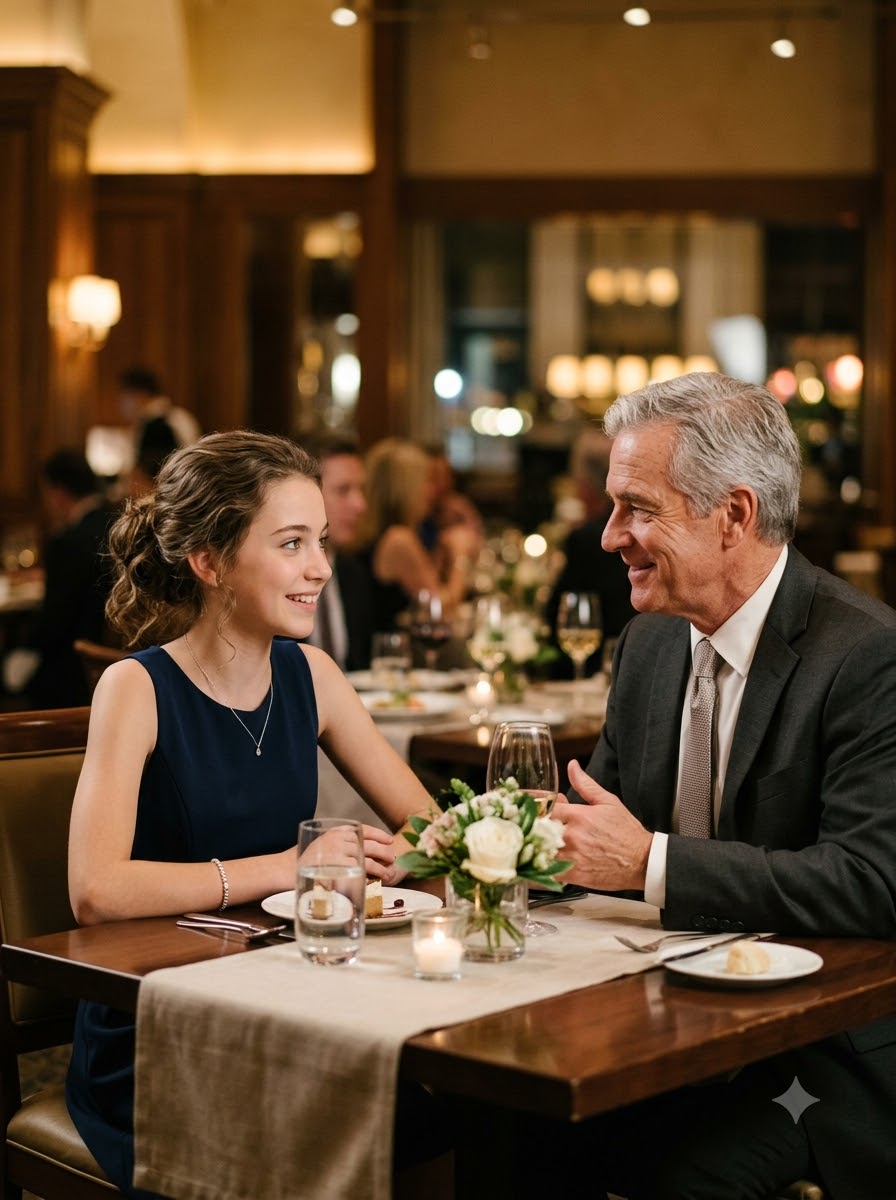
Three years later, Emily was seated at a table in that same restaurant—this time as a guest, not an outsider.
She wore a simple but elegant dress, her once-tangled hair now neatly pulled back.
Robert Adams, who had since become her legal guardian, smiled at her from across the table.
“Did I ever mention I grew up in an orphanage?” he said with pride. “Maybe that’s why, the night I saw you, something about it felt familiar.”
Emily smiled. She’d heard the story before, but she never minded hearing it again.
“You didn’t just save my life,” Robert went on. “You reminded me to look at people for who they truly are—not what they’re wearing.”
Somewhere in the restaurant’s memory, Victoria Adams had become little more than a name—now serving a sentence for attempted murder.
And Emily, who had once picked through garbage for crumbs, was now a top student at the city’s finest high school—and heir to Robert’s business empire.
“You never know where salvation will come from,” Robert liked to say.
“Sometimes, it comes from the very people the world chooses to ignore.”
And Emily, taking in the restaurant where she had once been unwelcome, surrounded now by people greeting her with respect, knew her life had changed forever that night—when her courage outweighed her fear.
