

The Boy Who Refused to Stay Silent
“Tomorrow morning, I’ll sell the house, and your mother won’t know anything until the deed belongs to someone else.”
Thirteen-year-old Tyler McKenna froze in the hallway, one sneaker still in his hand, his backpack hanging off one shoulder.
He’d gotten home early after a pipe burst inside his middle school in Asheville, North Carolina. The office had sent everyone home before lunch, but Tyler hadn’t reached his mother. Rebecca McKenna worked twelve-hour shifts at a regional distribution center, where staff had to lock their phones away during work hours.
She wouldn’t have gotten the call regardless.
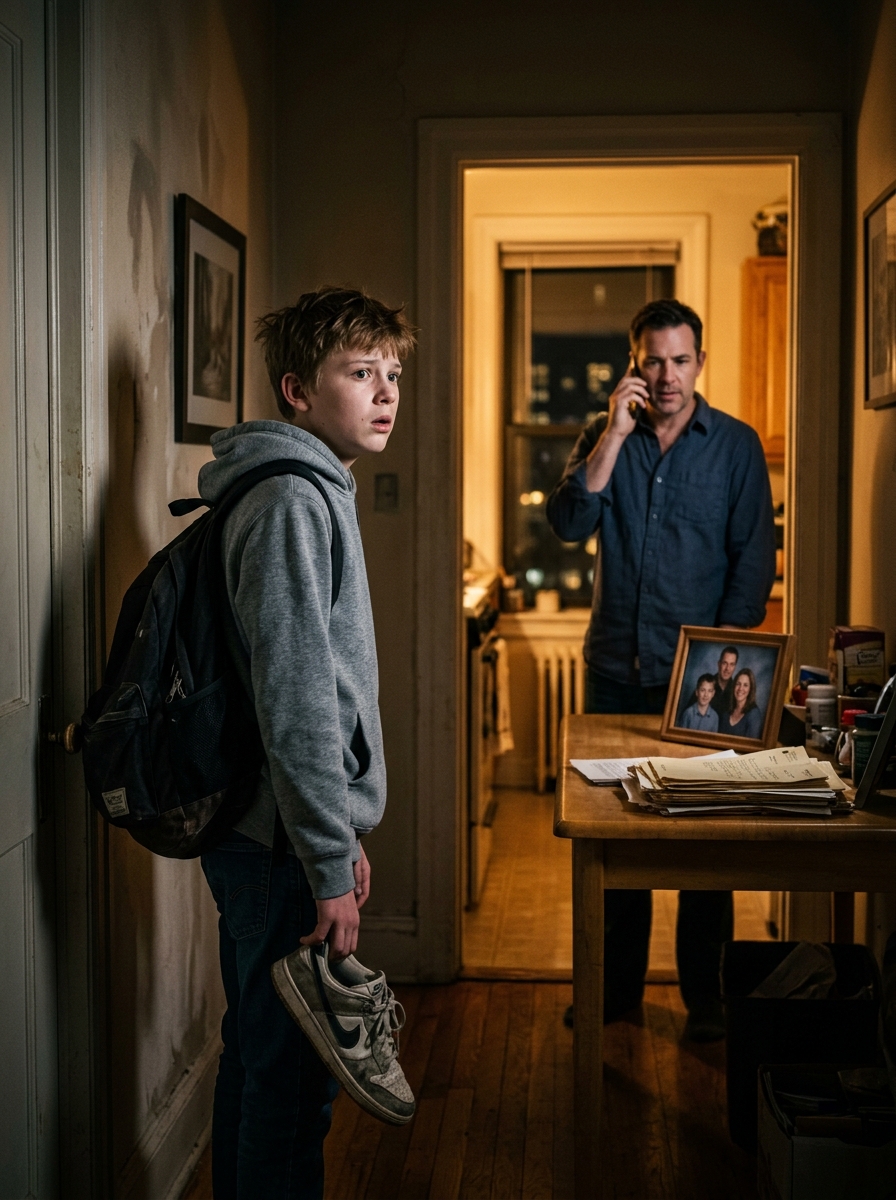
Tyler had expected an empty apartment. Instead, he heard his stepfather’s voice coming from the kitchen.
Russell Pike stood near the window, back to the door, speaking low into his phone.
“Four hundred and eighty thousand dollars, Martin. Nearly three acres, a solid farmhouse, and that new highway exit less than two miles out. Once construction starts, the value doubles.”
Tyler didn’t move.
Russell laughed.
“Rebecca already signed the power of attorney. She thinks it’s for taxes and upkeep. Tomorrow, ten a.m., we’re at the closing office. Once it’s recorded, there’s nothing she can do.”
The breath went out of Tyler.
The farmhouse outside Hendersonville had belonged to his great-grandmother, Mabel McKenna, who’d died less than three months before, leaving the house and land to Rebecca.
Mabel had also left a note tucked in an old wooden recipe box.
“This house is where our family learned to begin again. Never let anyone convince you it isn’t yours.”
Rebecca had cried reading it.
She’d loved her grandmother, though life had kept them apart in the later years. Between long shifts, rent, raising Tyler, and choosing which bill could wait each month, there hadn’t been much room left over.
Russell had seemed helpful after the funeral.
He talked taxes, insurance, repairs, county forms, deadlines. He’d laid papers in front of Rebecca after one of her longest shifts and pointed to a few marked lines.
“Sign here, Becky. This just lets me handle the paperwork while you’re working. You trust me, right?”
Worn out and afraid of losing the house over some rule she didn’t understand, Rebecca had signed.
Now Tyler understood what she’d actually put her name to.
Not permission to manage the house.
Authority to sell it.
A Decision No Child Should Have to Make
Tyler backed quietly toward the stairwell, hands shaking.
His biological father had left when Tyler was five and hadn’t been in touch since. Great-grandmother Mabel was gone. Rebecca’s parents had both died. No uncle nearby, no neighbor who understood legal matters, no way to reach his mother.
He thought about calling emergency services but worried someone would tip off Russell first.
He thought about going to the distribution center, but security would never let a kid inside.
Then he remembered a law office he passed every day on the bus.
Camden Property Law.
The sign said the firm handled estate disputes, property transfers, financial deception.
He put his sneaker on, slipped out the door, and ran.
A cold spring rain had started over Asheville. By the time he reached the office, his sweatshirt was soaked and his hair was plastered to his forehead.
A guard stood in the lobby.
“Can I help you?”
“I need to talk to a lawyer. Someone’s trying to sell my mom’s house.”
The guard glanced at the empty waiting room.
“Is your mom with you?”
“She’s at work. She doesn’t know.”
“You can’t meet an attorney without an adult. Go home and call your mother.”
“I can’t call her. She doesn’t have her phone.”
The guard shook his head.
“Sorry, son. You can’t stay here alone.”
Tyler stepped back outside and stood under the awning of a nearby coffee shop, cold, angry, terrified that no one would take him seriously until it was too late.
Then the office door opened.
A tall man in his early forties came out with a leather briefcase, charcoal suit, thin glasses. He glanced at Tyler and headed for the parking lot.
Tyler ran after him and caught his sleeve before fear could stop him.
“Please tell the guard I’m your son.”
The man turned sharply.
“What?”
“Just for five minutes. Please. My stepfather’s selling my mom’s house tomorrow and she doesn’t know. If nobody listens to me now, we lose it.”
The man studied his face, and something in his expression shifted.
“What’s your name?”
“Tyler McKenna.”
His grip tightened on the briefcase.
“And your mother?”
“Rebecca McKenna.”
He said nothing for several seconds.
The color drained from his face.
“Rebecca?” he whispered. “Your mother’s Rebecca?”
Tyler nodded.
The stranger looked at him like a door he’d spent twenty years keeping shut had just swung open.
The Attorney Who Recognized His Past
The man’s name was Elliot Camden.
He was a property attorney who focused on disputed estates and fraudulent transfers, known for helping families reclaim homes lost to misleading paperwork, forged signatures, and dishonest deals.
But before asking Tyler anything personal, he acted like an attorney first.
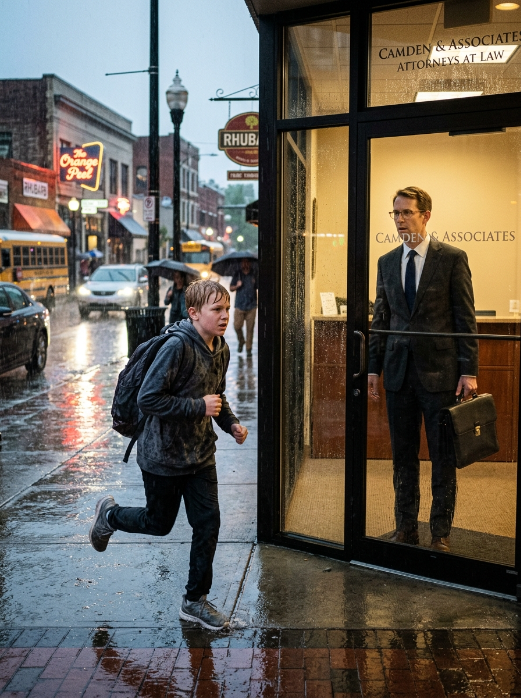
He brought Tyler in, handed him a towel, and had the receptionist bring hot chocolate.
“Start from the beginning,” Elliot said. “Tell me exactly what you heard. Nothing you’re not sure about.”
Tyler told him everything — Mabel’s death, the inherited farmhouse, the papers Rebecca signed, Russell’s phone call.
Elliot wrote it all down.
“Did Russell say the buyer’s full name?”
“Just Martin.”
“Where’s the closing happening?”
“Blue Ridge Title, ten tomorrow.”
Elliot called the closing office right away.
The attorney there confirmed Russell Pike was set to sign using a durable power of attorney from Rebecca McKenna, for a farmhouse and nearly three acres near Hendersonville.
“I’m flagging a credible dispute about the validity of that authority,” Elliot said. “The owner may not have understood she was authorizing a sale.”
The attorney grew cautious.
“You understand I can’t cancel a closing over an allegation from a child.”
“I’m not asking you to cancel it. I’m asking you to hold everything until Rebecca McKenna shows up and confirms her intent herself.”
The attorney agreed to freeze the file.
Elliot then called Rebecca’s workplace. After several transfers and a tense back-and-forth with a supervisor, someone finally pulled her off the floor.
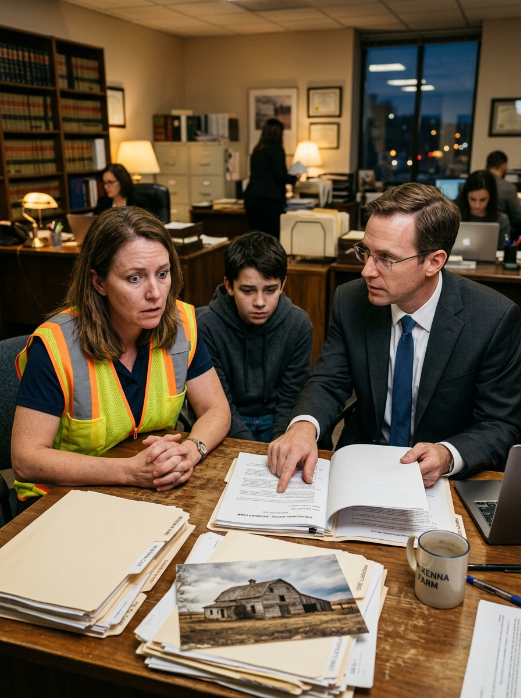
Forty-five minutes later, Rebecca rushed into the office in a reflective work vest over a plain navy shirt, her badge still clipped to her pocket.
She saw Tyler and pulled him into her arms.
“Tyler, what happened? Why’d you leave school alone?”
“Mom, Russell’s selling Great-Grandma’s house.”
Rebecca looked at Elliot, her face shifting from fear to confusion.
He’d changed over the years — shorter hair, a more serious face, none of the uncertainty she remembered in the young man he’d once been.
But she knew him.
“Elliot?”
He stood slowly.
“Hello, Rebecca.”
The Signature That Nearly Cost Her Everything
Rebecca stared at him, speechless.
Tyler looked between them.
“You two know each other?”
“We did,” Rebecca said quietly. “A long time ago.”
Elliot didn’t let their history distract from the danger at hand.
He showed her a copy of the power of attorney tied to the pending sale.
“This isn’t just permission for taxes or repairs,” he explained. “It gives Russell broad control over the property, including the right to sell it.”
Rebecca’s face went white.
“He told me it was for maintenance.”
“Did you read the whole thing before signing?”
She looked down.
“I’d just finished a double shift. He said there were county deadlines. I thought I could trust my husband.”
Elliot’s voice gentled.
“Trusting your husband isn’t something to be ashamed of. Him abusing that trust — that’s his choice, not your failure.”
He explained she could revoke the power of attorney immediately — sign it, deliver it to the closing office, and record it with the county to stop any further use.
Within the hour, the paperwork was ready.
This time Rebecca read every page before signing, slowly.
Once it was done, Elliot sent formal notice to the title company, the buyer’s representative, and the county register of deeds.
Russell no longer had any authority to sell the house.
Rebecca clutched the folder to her chest.
“What do I owe you?”
“Nothing today.”
“Lawyers don’t work for free.”
Elliot glanced at Tyler.
“Your son stopped something that could’ve taken years to undo. Call this step one in making sure he was heard.”
Before Rebecca could respond, her borrowed phone rang. Russell’s name on the screen.
She picked up.
“Where are you?” he demanded. “Someone told me you revoked the power of attorney. Who put that idea in your head?”
Rebecca looked at Tyler, then Elliot.
“The real question is why you were trying to sell my grandmother’s house behind my back.”
Silence. Then his voice went falsely calm.
“Rebecca, you’re not understanding. It was an investment for our family.”
“Our family doesn’t start with you lying to me.”
She hung up.
The First Lie Was Older Than Her Marriage
That evening, Rebecca laid the revocation papers on the kitchen table.
Russell walked in acting as if nothing had happened.
“This is being blown way out of proportion.”
“You told me I was signing tax forms.”
“I was protecting the property.”
Tyler stepped forward.
“You said she wouldn’t find out until the deed was in someone else’s name.”
Russell’s expression cracked.
Tyler repeated the whole call — the price, the highway plans, Martin’s name.
Russell didn’t deny any of it. Instead he blamed Tyler for eavesdropping, called Rebecca ungrateful, and insisted he deserved a cut for “managing the opportunity.”
Rebecca pointed toward the bedroom.
“Pack your things. You’re leaving tonight.”
He stared at her.
“You have no idea who you’re up against.”
“For the first time, I know exactly who I’m standing against.”
Three days later, Rebecca and Tyler went back to Elliot’s office to file a formal complaint.
While he prepared the paperwork, Rebecca noticed an old photo on a shelf behind his desk.
A nineteen-year-old girl standing under an apple tree next to a young man with messy hair and a nervous smile.
The girl was Rebecca.
She picked it up.
“Why do you still have this?”
Elliot shut the office door and opened a drawer, setting six unopened letters on the desk.
“Because I never understood why you disappeared.”
Rebecca stared at the envelopes, each addressed to the apartment she’d shared with her mother more than twenty years back.
“You never wrote to me.”
“I wrote six times.”
The truth came out slowly.
Rebecca’s mother had never liked Elliot — a college student without money. She’d hidden the letters and told Rebecca he’d shown up with another woman and lost interest.
She’d told Elliot that Rebecca was engaged and didn’t want to see him.
Each of them had spent years believing the other had walked away.
“I checked the mailbox every single day,” Rebecca said, eyes filling.
“I waited outside your building for almost three hours.”
“My mother told me you’d forgotten me.”
“She told me you wanted something more stable.”
Twenty-two lost years sat in the silence between them.
Elliot didn’t reach for her hand. He didn’t ask her to make up for lost time.
He only said, “We were both handed a lie and told to build a life around it.”
A Pattern Hidden Behind a Marriage
The investigation into Russell turned up far more than one attempted sale.
Martin Kepler, the supposed buyer, was Russell’s business partner. Their scheme: sell Rebecca’s farmhouse well under value, funnel the money into a private account, then resell the land once the highway project went public.
Investigators found Russell had run this before.
He’d targeted women who’d inherited homes or land, offered to “handle” the taxes and paperwork, and steered them into signing documents broader than they realized.
One woman had nearly lost a lakeside cabin from her father. Another discovered her inherited land had been put up as collateral for a business loan.
Rebecca’s complaint gave investigators the link they’d been missing.
Russell tried to claim Rebecca had approved everything, accused Elliot of manipulating her, and insisted Tyler had misheard an ordinary business call.
But Tyler remembered the exact time, the exact price, the buyer’s first name, Russell’s exact words.
Asked by a child specialist why he’d gone to the law office alone, Tyler said:
“Adults always tell kids to ask for help. The first one wouldn’t listen, so I kept looking until someone did.”
That statement shifted the whole case.
A search of Russell’s rented office turned up property records, powers of attorney, private agreements, and files tied to several other families.
Facing the evidence, Martin agreed to cooperate.
Russell eventually admitted to misusing Rebecca’s legal authority and taking part in deceptive property deals.
At the final hearing, Russell looked across the room at her.
“You ruined my life.”
Rebecca held his gaze.
“No. You made that choice the moment you decided my exhaustion was something to exploit.”
Returning to the House That Waited for Them
The legal process dragged on for nearly a year.
When it finally ended, Rebecca and Tyler drove out to the farmhouse near Hendersonville.
It needed work — weeds choking the garden, a cracked window, water stains creeping across the kitchen ceiling.
But the walls were still solid.
Mabel had replaced the roof before she died and left her garden tools neatly lined up in the shed.
Tyler threw open every window.
Fresh mountain air moved through the rooms, carrying the smell of wet earth and apple blossom.
“Are we gonna live here?” he asked.
“Maybe someday,” Rebecca said, then reconsidered. “But we’ll spend the summer here. We’ll fix it up together.”
In a kitchen cabinet, she found embroidered tablecloths, faded photos, and Mabel’s handwritten recipe book.
On the last page, her grandmother had written:
“Old trees aren’t useless just because they bear less fruit. Their roots hold the ground steady for everything that grows after them.”
Rebecca sat down on the kitchen floor and cried — for Mabel, for the letters she never got, for the years she’d spent believing she was easy to leave, and for the shame she’d carried for trusting the wrong person.
Tyler sat beside her, didn’t tell her to stop, just leaned his head against her shoulder.
Later that afternoon, a car pulled up at the gate.
Elliot got out carrying two young trees from a local nursery.
“Brought an apple tree and a peach tree,” he said. “Nursery owner said spring’s the best time to give them a start.”
Tyler ran over.
“Which one’s mine?”
“The apple tree. If you help dig.”
Rebecca picked a spot near the old tree where she and Elliot used to sit as teenagers.
The three of them worked together — Tyler holding the trunk steady, Elliot digging, Rebecca spreading the roots and covering them with fresh soil.
Nobody called it a fresh start.
They didn’t need to.
While Tyler went to fill the watering can, Elliot turned to Rebecca.
“I don’t want you thinking that helping Tyler means you owe me a place in your life.”
“I don’t owe you anything,” she said.
“I know.”
She looked toward the farmhouse.
“But I also don’t want to spend the rest of my life assuming everyone’s out to deceive me.”
She held out her hand.
It wasn’t a promise to undo the past, or forgiveness for years neither of them could get back.
It was just an invitation to walk with her to the porch.
Elliot took it gently.

That evening, the three of them sat under the old apple tree. Rebecca poured lemonade into mismatched glasses. Elliot told Tyler an embarrassing story about his first day of law school, and Tyler laughed so hard a bird startled off the roof.
The farmhouse stood quietly behind them.
It wasn’t just a valuable piece of land near a future highway anymore.
It was proof that deception could steal years from a person, but it didn’t get to keep the ending.
It was the place where a boy saved his mother because he refused to believe his voice was too small to matter.
It was also the place where a woman finally understood that trusting someone had never made her weak — letting someone else make every decision for her would have.
When Tyler asked if they could come back the next weekend, Rebecca didn’t say “someday” or “once things settle down.”
She looked right at him.
“Yes. This time, we’re coming back.”
For the first time in years, going back didn’t mean reopening an old wound.
It meant choosing the place where their new life would start.
A child’s voice can sound small in a crowded room, but when adults are willing to really listen, that voice can uncover a truth everyone else missed.
Trusting someone you love doesn’t make you foolish — the blame for deception always belongs to the person who chose to abuse that trust.
Important papers should never be signed under pressure, exhaustion, fear, or urgency, because honest people will always give you enough time to understand what you’re agreeing to.
Family property is more than land, money, or walls — it carries the sacrifices, memories, and hopes of the people who worked hard to leave something behind.
The years a lie steals can’t be fully returned, but discovering the truth can still stop that lie from ruling every year after.
Asking for help takes courage, especially when the first person turns you away and you have to keep searching until someone takes your fear seriously.
People who’ve been deceived shouldn’t carry shame for someone else’s actions — trust and kindness are human qualities, not weaknesses that deserve punishment.
A painful past doesn’t have to become a permanent home; people can honor what happened without letting it dictate every relationship, choice, and hope that follows.
Real support doesn’t demand instant gratitude or repayment — genuine care gives people room to rebuild their confidence and make their own choices again.
Sometimes starting over doesn’t mean forgetting the old roots — the strongest new lives often grow from finally understanding where those roots were damaged, and choosing to protect them better this time.
