

Part One: The Morning Before
I have a ritual for the mornings before hard hearings.
I get up at five-thirty. I brew coffee — the same Ethiopian beans I’ve bought from the same shop on Meredith Street for eleven years, ground the evening before, measured exactly, because the exactness is part of the ritual. I spend twenty minutes with the coffee and the case files, not going over them again — I’ve already read them, more than once — but simply sitting with them, letting the day’s arguments find their proper weight before I carry them into court.
I am not someone who rattles easily.
People have told me this over the years, sometimes as praise, sometimes not. A former colleague once called me the calmest person he had met in thirty years of practicing law. He meant it as admiration. My ex-husband used the same description, but differently, which was part of why he became my ex-husband.
On the morning of the fourteenth — a Thursday in November, one of those gray, cold mornings the city produced in abundance that time of year — I was sitting with my coffee and my files at six-fifteen when I felt the particular sharpening of focus that came before hearings that carried real weight. The Williams case was not a small one. It was a police misconduct hearing involving claims against four officers from the third district, claims that had been recorded, backed up, and disputed in ways that would demand the careful, steady attention I’d spent twenty years learning to give.
The irony of what followed didn’t hit me until later, when I was recounting it to my sister and she covered her mouth and said: you’re serious. I was. The universe, I had come to think as a judge, had a strange gift for timing.
I left home at seven forty-five. I took my usual route to the courthouse — down Carver Boulevard, over the Meridian Bridge, south on Federal to the parking garage. Fourteen minutes on a good morning. My mind was already in the hearing — running through the procedural issues I expected in the first hour, the arguments I anticipated from each side, the points where precision would matter most.
I was thinking about procedure.
I was, as always, thinking about procedure.
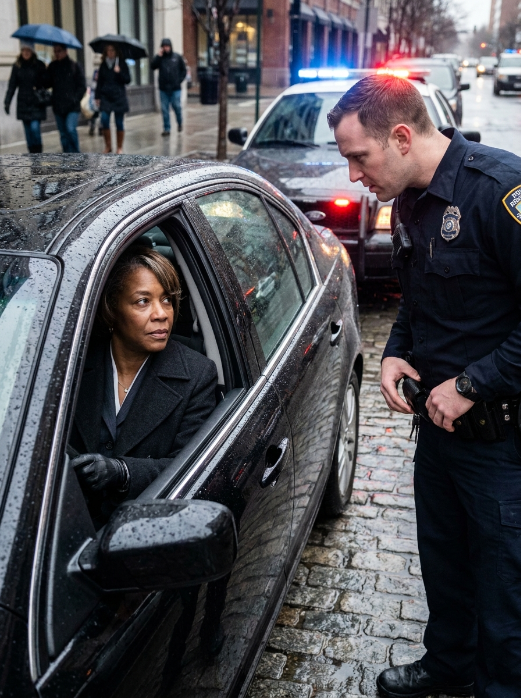
The lights showed up in my rearview mirror on Carver Boulevard, before the bridge. Red and blue, the same combination I’d seen thousands of times from the bench and maybe a hundred times from behind the wheel, and each time from behind the wheel it produced the same reaction: a glance at the speedometer, a pull toward the curb, a calm, practiced readiness to cooperate.
I pulled over.
I shut off the engine.
I put my hands on the wheel.
I waited.
Part Two: Officer Brentwood
He was out of his car before I’d fully registered what was happening.
In twenty years of ruling on police conduct cases, I’d built a mental catalog of what an officer’s first thirty seconds at a traffic stop revealed about what was coming — the pace, the posture, where the hands went, whether the officer was assessing a situation or already committed to a conclusion reached before he ever reached the window.
Brentwood had already reached his conclusion.
His hand hovered near his weapon from his first step out of the car. His stance wasn’t the careful readiness of someone approaching the unknown; it was the fixed, determined posture of a man walking toward confirmation of something he’d already decided. He crossed the distance from his cruiser to my window too fast for a routine stop and too purposeful for one still being investigated.
My window was already down by the time he reached it.
“This vehicle is reported stolen,” he said. Not license and registration, please. Not do you know why I pulled you over. This vehicle is reported stolen — delivered like a verdict, before he’d glanced at a single document or said a word to me.
I kept my hands where he could see them, on the wheel.
“Officer,” I said, “I believe there may be a mistake. This is my car. I can show you identification and registration.”
“Step out of the car.”
“I will. I’m going to reach for my ID first. My name is Elaine Washington. I’m a federal judge.”
Something passed across his face. I’ve replayed that moment many times since, trying to name it. It wasn’t recognition. It wasn’t reconsideration. It was closer to the reverse — a hardening, as though the information should have slowed him but instead pushed him further in. As if being told something that ought to have given him pause made him move faster instead.
“Step out of the car,” he repeated.
I opened the door. I got out. My hands stayed visible the whole time. I held my identification wallet in my right hand — the federal judicial ID, seal, photo, unambiguous language and all. I held it at a height where it was plainly visible and clearly no threat.
He looked at it.
He didn’t take it.
“Hands on the vehicle,” he said.
I put my hands on the hood.
The morning was cold. The hood was already warm from the engine, and that contrast — cold air, warm metal, my palms flat and in plain sight — is one of those details that fixes itself permanently in memory. I noticed everything: the traffic on the bridge, the pedestrians slowing to watch, the second cruiser that had pulled in behind at some point.
I wasn’t afraid.
I want to be exact about this, because fear is usually the emotion at the center of stories like this, and what I actually felt was something else. It was a specific, sharp, clarifying awareness — the awareness of someone who understood exactly what was unfolding and what it meant, who had every relevant piece of context, who had spent twenty years building the very framework this moment existed inside of, and who now, against all reasonable expectation, stood outside that framework.
It was the awareness of someone who understood the system completely and was, in that moment, entirely at its mercy.
When Brentwood’s hand closed on my arm, harder than it needed to be, I felt the first fracture. Not in my composure — that held. In my understanding of the moment. This was no longer a mistake being made. It was a decision being upheld.
Then the handcuffs.
Part Three: Thomas
The click of the handcuffs was — I’ve tried to find the right word for this, and the closest one is final. It carried the weight of a ruling. Of something closing.
I stood against my car, wrists bound behind me, and looked across the street.
Thomas Chen was standing on the far sidewalk.
I had known Thomas for six years. He’d clerked for me for two years after his time at the circuit court, so I knew what he was capable of, his work ethic, how he carried himself in a difficult moment. He had a quality I valued and tried to instill in every clerk: the ability to see what was actually in front of him, not what should be happening or what he expected. The ability to read a room, or in this case, a street.
He read this one in about four seconds.
I watched his expression shift — confusion, then recognition, then alarm. I watched him lift his phone. I watched him step back three times, putting distance between himself and anything that might be read as interference. And I watched him start dialing, with the focused urgency of someone who already knew exactly who he needed to call.
I thought: good.
I thought: let them see.
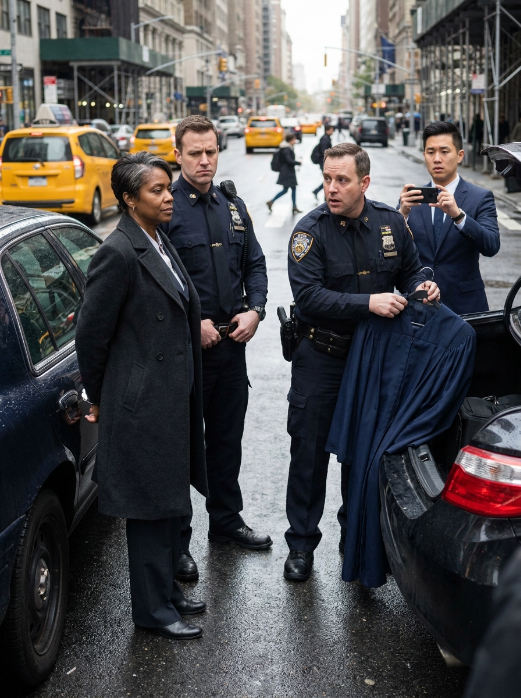
Behind me, I could hear Reynolds — the officer from the second cruiser, whose approach had been slower, more deliberate from the start — moving around my car. The glove compartment opening. Papers rustling. A pause.
“Brentwood,” he said. His voice had the particular carefulness of someone who’d found something and was trying to work out how to bring it up without setting off a bigger reaction.
Brentwood didn’t answer.
Reynolds moved to the back of the car. The trunk popped open with its metallic sound. Then a longer silence, one with a different weight to it.
My judicial robes were in the trunk.
I always kept them there, hanging from a small hook I’d attached to the coat anchor. Every morning they went in when I left home and came out at the courthouse. It had become just another logistical habit.
They were hanging there now, in the dark blue garment bag, clearly labeled, waiting for a courtroom I was going to reach late.
“Anyone can buy a costume,” Brentwood said.
His voice had changed.
The certainty was still on the surface, but underneath it, for the first time, something had cracked. He knew it was a weak thing to say. He said it anyway, because he was still inside the decision he’d made and hadn’t yet found a way out of it.
I took a breath.
I spoke clearly, at a volume meant for the phones now openly recording from several angles.
“I am invoking my right to counsel,” I said. “And I am documenting this unlawful detention in full.”
The words weren’t for Brentwood. They were for the record. I’d spent twenty years thinking about what the record required, about the moments when language does the work of establishing what actually happened, and this was one of them. Every word I spoke from that point on was being preserved somewhere — in phones, in memory, and in the formal documentation that would follow this morning.
I chose each word with that in mind.
Part Four: The Arrival
The vehicles arrived within twelve minutes of the handcuffs going on.
I knew Thomas moved quickly — he always had, one of the more efficient clerks I’d had — but twelve minutes still said something about the network an assistant district attorney could mobilize when it mattered. I later learned he’d made four calls in six minutes, two to numbers he’d never dialed before and two he called often.
Two black sedans rounded the corner at the pace of vehicles driven by people who don’t need to hurry because they already know they’ll get there in time.
The doors opened.
The people who stepped out weren’t in uniform.
Brentwood turned. I didn’t need to see his face to sense what moved through him. I’d sat in enough courtrooms during verdicts to recognize the particular quality of the moment someone realizes the situation isn’t what they believed it was. It has a sound, even when nothing is said — something in the air shifts.
Reynolds had been standing beside me for several minutes by then, silent, holding the specific stillness of someone who understood he needed to be present, careful, and quietly assessing. When the officials stepped out, showed their credentials to each other and then to Brentwood, Reynolds reached for my wrists without waiting to be told.
There was a brief hesitation.
Then the cuffs came off.
The mark of the metal stayed. A long, faint line on my left wrist where the cuff had been just slightly too tight — not a wound, not permanent, but present for the rest of that day, a record on my own body of what had happened.
I turned.
Brentwood was facing me.
He wasn’t the man he’d been twenty minutes before, stepping out of his cruiser with that rigid certainty. He was someone who had just arrived at the understanding that the ground beneath him wasn’t the ground he’d assumed, and who was still working out what that meant.
“You didn’t listen,” I said.
I want to be careful about the tone here, because the story of what I said has circulated in versions I didn’t say. I wasn’t angry. Anger hadn’t been what I felt through any of it — what I’d felt was the sharp, clarifying awareness I described, and beneath it something closer to sadness — the specific sadness of someone who had spent twenty years working inside a system and had hoped it was better than what she’d just lived through.
I said it plainly, as a fact already proven.
Not as punishment. As a conclusion.
“You thought this was just another stop,” I said. “It wasn’t.”
Then I straightened my sleeve and walked toward the officials, because there was work to do and a courtroom waiting and a case that needed the kind of attention I’d spent twenty years learning to give it.
Part Five: The Courthouse
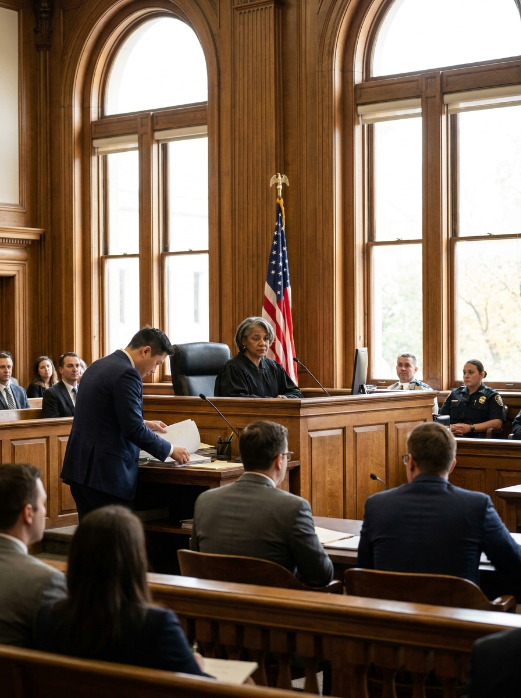
I arrived forty-three minutes late to the Williams hearing.
My clerk, a first-year named Priya with a quality of unshakable competence I found genuinely reassuring, had told the courtroom there’d be a delay without saying why. Counsel for both sides waited with the professional patience of people used to judges running late and knowing better than to make an issue of it.
When I walked in, I was aware — I was always aware, it came with the job — of the particular attention that filled the room. The attorneys, the court reporters, the gallery, each registering my arrival in their own way. I took my seat.
I should note: I was in full judicial robes.
I’d changed in the courthouse parking garage, standing next to my car, pulling the robes from the garment bag with the same calm I try to bring to everything. I understood that what I wore in a courtroom wasn’t incidental — it was the uniform of the institution. That institution had just been part of something that would demand my full engagement going forward, and I intended to bring its full weight to whatever came next.
“We are in session,” I said.
The Williams hearing went forward.
I want to be clear: it proceeded with the same level of attention I’d have given it on any other morning. What happened on Carver Boulevard didn’t change what the Williams case required. It required a careful weighing of evidence, precise application of the law, and the kind of sustained focus that leaves no room for distraction. I gave it that.
What the morning also gave me — and I’ve thought hard about whether it’s right to say this, and decided it is, because it’s true — was a kind of lived counterpart to the written record I was evaluating. The case in front of me involved claims of officers forming conclusions ahead of time, escalating past what a situation called for, and specifically failing to listen in ways that turned a manageable moment into one that wasn’t.
I had just spent the morning inside exactly that kind of moment.
It didn’t change the legal analysis. That stayed the legal analysis. But it confirmed, in the way only direct experience can, that the pattern described in the Williams case was real, was recognizable, was something that happened the way the evidence said it happened.
I ruled carefully and fully on the Williams case.
Part Six: What Came After
The investigation into the Carver Boulevard incident moved quickly, reflecting a specific combination of factors: my seniority, the volume of footage from multiple sources, the presence of a district attorney’s office representative who had independently documented the sequence of events, and the plain legal analysis of what had taken place.
I want to be careful here about what I say.
I am a judge. I’m not the one investigating or prosecuting events involving myself. I gave my statement, in full, to the investigators, with the same care and specificity I would bring to documenting any legally significant event — because the situation called for it, and because I understood, with a new sharpness now, that the line between accountability and its absence often comes down to the quality of the documentation.
Thomas’s recording became part of that record. So did footage from three phones on the street, two business security cameras, and the dashcam in Reynolds’s cruiser.
People have asked, since then, whether I felt vindicated by what the footage showed.
Vindicated isn’t quite right for what I felt.
What I felt was the specific, complicated feeling of someone who has lived through something that confirmed what she’d spent her career working on — real confirmation, but nothing triumphant in it, because what was being confirmed was that a problem was real. And the reality of a problem is not a victory. It’s a problem.
The right response to confirming a problem is real is to address it.
That’s what I tried to do.
Part Seven: Reynolds
I asked to meet with Reynolds the Friday of that same week.
He came to my chambers — not the courtroom, nothing formal, just the working space where I spend the hours between hearings reviewing briefs and taking notes, and having the quieter conversations the work sometimes requires.
He was, as I’d sensed on the street, different from Brentwood. Not in every respect — same department, same training, same institutional culture. But different in the way some people inside a system are different from the system itself: aware of the gap between what the system demands and what’s right, and not entirely comfortable with that gap.
He walked into my chambers already braced for a hard conversation.
“Judge Washington,” he said.
“Officer Reynolds,” I said. “Please, sit.”
He sat.
“I want to hear what you saw,” I said. “Your account, in your own words, as much detail as you can give me.”
He told me.
He told me more than his formal statement had included. He described the radio call before the stop — the reported stolen vehicle, the partial and possibly misread description. He described arriving and seeing the identification already in my hand, the federal seal visible. He described the trunk, the robes, the moment he understood exactly what was happening and said Brentwood’s name twice and was cut off both times.
“Why didn’t you stop it?” I asked.
He was quiet for a moment.
“I was trying to find the right moment,” he said.
“How long were you looking for the right moment?”
He didn’t answer right away. Then: “Too long.”
“Yes,” I said.
We sat with that.
“What would have happened,” I said, “if Thomas Chen hadn’t been across the street? If no one had been recording, no one calling anyone?”
He looked at me.
“The cuffs would have come off,” he said slowly. “Maybe a few minutes later, once your identity came back verified. There would’ve been an apology.”
“And the report?”
A pause.
“The report would have described a vehicle stop that resolved without incident.”
I nodded.
“That’s the problem I want to talk about,” I said. “Not the incident itself. The report. The gap between what actually happens and what gets written down. The culture that gap creates.” I looked at him. “You were willing to step in. You said his name twice. That matters. What did you do with that?”
He thought it over.
“I didn’t insist,” he said.
“No,” I said. “You didn’t.”
We talked for an hour. I asked questions, he answered them, and by the end we’d arrived at the same territory I’d worked in for twenty years from the bench, now approached from a different angle: where individual conduct meets institutional culture, where the question of what one person could have done differently opens onto the larger question of what the institution produces.
Reynolds wasn’t a bad officer. That was the hard part. He was an officer who had seen something wrong and found a reason — protocol, hierarchy, the specific discomfort of challenging a colleague in the field — not to insist.
The institution had made it easy for him not to insist.
That was what needed to change.
Part Eight: The Testimony
Three weeks after the incident, I testified before the city’s police oversight board.
I’d been asked to testify, and I agreed, voluntarily. I want to be precise about that, because it’s been described as a confrontation, a power move, an act of institutional payback. It was none of those. It was the appropriate response of someone with direct, documented, first-person experience relevant to an ongoing policy discussion, someone with an obligation, after twenty years spent building an understanding of these issues, to offer that experience where it could actually help.
I testified for two hours.
I described the stop. I walked through each decision point. I described what I’d felt — carefully, because my feelings weren’t evidence of anything beyond themselves, but they were relevant to how these encounters are experienced by the people on the receiving end. I described the accumulation of small choices that made up the event: the conclusion reached in advance, the failure to verify, the escalation, the specific moment Brentwood was handed clear information that contradicted his assumption and responded by pushing further into it instead.
I described Reynolds. I repeated what I’d told him in chambers — that his willingness to step in had mattered, that his failure to insist had also mattered, and that the institutional culture making silence the path of least resistance was the actual problem to solve.
I described standing against my own car with my hands on the hood.
I described the sound of the cuffs closing.
I described looking across the street at Thomas Chen and thinking: let them see.
The board members listened closely throughout. Several asked questions — good ones, the kind aimed at understanding the actual mechanics, not just the summary. I answered each with the same care I try to bring to everything.
At the end, the board chair — a woman I’d known professionally for twelve years, a former public defender with her own long history in these issues — looked at me and asked, “Judge Washington, what do you think needs to change?”
I’d thought about that question before I arrived.
“The documentation culture,” I said. “The gap between what happens and what gets reported has to close. And it will only close if the people who see what happens — the Reynolds of the department — have institutional backing to insist. Right now, insisting costs something. That cost needs to come down.”
She wrote it down.
Part Nine: What I Told My Sister
My sister Carolyn called the evening of the incident, once the story had started circulating the way stories with video tend to. She’d already seen the footage on two different news sites before she called.
“Are you all right?” she said.
“Yes,” I said.
“Your wrists.”
“Fine.”
“Tell me what happened.”
I told her — the way I tell her most things, straight through, in order, the specifics and the bigger picture together. She listened the way she always has, fully present, not composing her answer while I was still talking.
When I finished, she was quiet for a moment.
“You know what gets me,” she said.
“What?”
“You spent the whole morning thinking about procedure. About what the law requires. About doing everything correctly.” She paused. “And you did. The whole morning. You followed every step. And none of it mattered.”
“It mattered,” I said. “It’s what made everything after that work. The footage matters because I’m shown complying. The testimony holds up because the conduct is unambiguous. The procedure mattered.”
“But it didn’t protect you in the moment.”
“No,” I said. “It didn’t.”
She was quiet again.
“Are you angry?” she asked.
I thought about it.
“I’m clear,” I said. “I know what happened, and why, and what it means. Whether that counts as anger or something else, I’m not sure it matters right now.”
“It might matter later,” she said.
“Maybe,” I said. “I’ll let you know.”
She laughed — the same laugh she’s used to defuse things since we were kids.
“You were on your way to a police misconduct hearing,” she said.
“I know.”
“The day you get handcuffed, and you’re headed to a police misconduct hearing.”
“I know.”
“The universe,” she said, “has a real sense of timing.”
“An unfortunately precise one,” I said.
Part Ten: The Courtroom That Hadn’t Changed
I want to close with something true, which isn’t always the same as something satisfying.
The courtroom I walked into that morning — after Carver Boulevard, the handcuffs, the officials arriving, the cuffs coming off — was the same courtroom it had always been. The Williams case was still the Williams case. The legal standards that applied to it hadn’t shifted. My job in that room was what it had always been: weigh the evidence carefully, apply the law precisely, and reach a ruling that was correct.
The case hadn’t changed.
But something had.
I’d spent twenty years evaluating cases like this one from the bench — from the elevated, distanced vantage point that position provides. I’d been thorough. I’d been fair, as fair as I knew how to be. I’d tried to see what the evidence showed and rule accordingly.
What I hadn’t been able to do, from the bench, was inhabit what the evidence described.
Now I could.
That’s not a simple thing to sit with. It would be tidier to say the morning gave me something — insight, understanding, renewed purpose — and stop there. But what it actually gave me was messier than that. It gave me the full weight of what the system feels like from outside it. The specific, sharp, clarifying awareness of someone who knew every procedural protection available and could feel none of them working. The experience of holding up identification and watching it be ignored. The experience of the handcuffs.
I was both the judge and the evidence.
What I did with that came down to whether I had the discipline to use it well — not as a grievance, not as a platform, but as information. As something that made my understanding more complete.
I think I had that discipline. I think I’d been building it for twenty years.
I know that the afternoon I sat with Reynolds in my chambers, asking him about not insisting, something in the room was different than it would have been before Carver Boulevard. Not because I was angrier. Not because I had a score to settle. But because the abstract had become specific, the documented had become lived, and the distance between the bench and the evidence had closed.
The courtroom hadn’t changed.
I was more present in it.
That, I decided, was the obligation.
Not triumph. Not vindication.
Presence.
The kind that sees what’s actually happening.
The kind that insists.
Elaine Washington continues to serve as a federal judge in the district where she has presided for twenty years. In the year following the incident, she took part in developing revised documentation standards for the city police department, contributed to a working group on officer accountability culture, and delivered the keynote address at the National Association for Court Administration’s annual conference, speaking on the relationship between institutional authority and institutional responsibility.
Her address was titled: “The Distance Between the Bench and the Evidence.”
Officer Reynolds was commended in the revised incident report for his conduct after his initial arrival on scene.
Officer Brentwood’s case was referred to the departmental review board.
The Williams hearing concluded with rulings issued on every contested matter.
The judicial robes are still in the trunk.
Every morning.
