

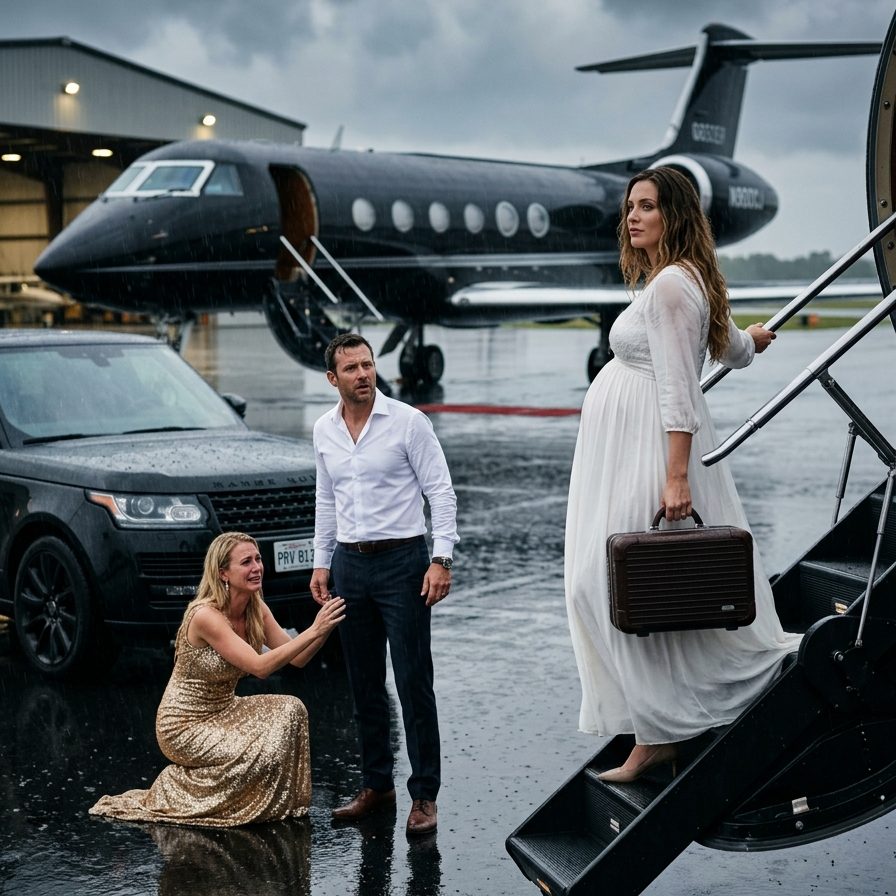
He arrived at the gala with his mistress on his arm and lifted his glass to “the woman who truly understood him.”
His pregnant wife stood a mere ten feet away, smiling because every camera was trained on them.
By dawn, his fortune, his reputation, and the perfect lie he had constructed would all lie in ruins because of the proof concealed inside her purse.
Clara Donovan felt that something was wrong even before Richard turned his eyes away from her.
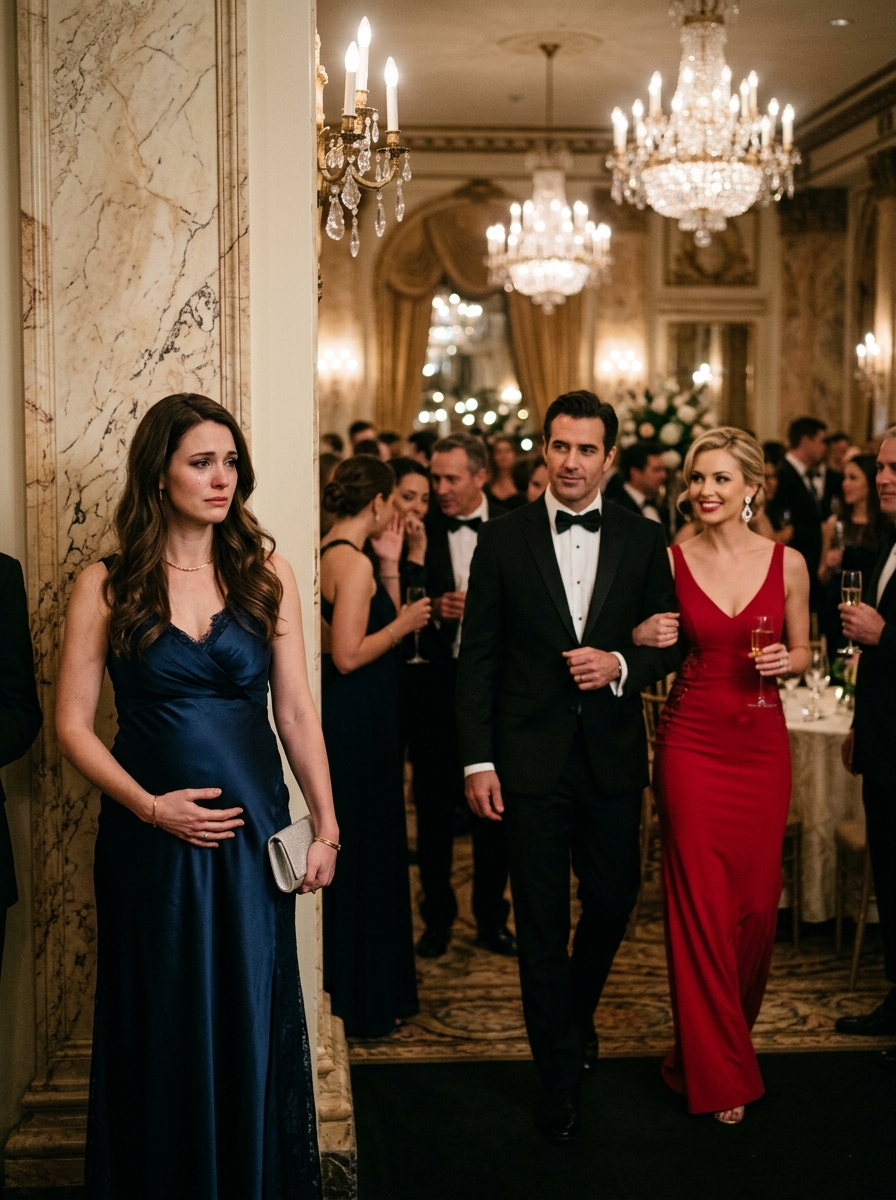
It started with the ballroom going quiet in pieces, not all together. First, the women clustered near the champagne tower stopped their laughter. Then the older men near the marble bar slowly turned their heads with that eager, almost ravenous curiosity the wealthy reserved for scandal arriving dressed in diamonds. Then the photographers past the arched doors raised their cameras once more, even though official arrivals had wrapped up twenty minutes before.
Clara stood next to a column wrapped in white orchids, one hand resting beneath the curve of her six-month pregnant belly, the other clutching a silver evening clutch so hard her fingers throbbed.
Around her, the Grand Whitmore Hotel glittered as if the room itself felt no shame. Crystal chandeliers spilled golden light across polished marble. Waiters moved like shadows, bearing trays of champagne and small spoonfuls of caviar. Women in silk gowns tilted toward each other, feigning interest in the charity auction while their eyes kept sliding toward the entrance.
Clara followed their stares.
Richard Donovan walked in with Sabrina Cole on his arm.
Not beside him.
On his arm.
There was a difference, and everyone in the ballroom knew exactly what it meant.
Sabrina wore a crimson dress that looked designed less to flatter her than to declare triumph. Her hair spilled in glossy waves over one shoulder. Diamonds glimmered at her ears. One hand rested on Richard’s sleeve with ownership, her fingers hooked into the black fabric of his tuxedo as though she had already claimed the life Clara was still supposed to represent.
Richard showed no shame.
That was the detail Clara would remember afterward.
Not the whispers. Not the cameras. Not Mrs. Harrington’s small, cutting laugh near the bar.
Richard looked proud.
He guided Sabrina through the entrance beneath the winter benefit banner, his smile broad, his shoulders squared, his polished public mask tuned perfectly for donors and board members and anyone rich enough to accept whatever version of reality he offered first.
Clara felt the baby shift beneath her palm.
A small, quiet motion.
A reminder.
She took one breath, then another. The air carried the scent of lilies, perfume, melting wax, and costly wine. For a moment the room seemed to close in until all she could see was Richard’s hand resting against Sabrina’s lower back, steering her forward with an ease he hadn’t shown Clara in months.
“Darling,” Mrs. Harrington murmured as she drew near, pearls gleaming against her powdered throat. “You look radiant. Pregnancy suits you.”
Clara turned to her with the practiced smile she’d perfected over years beside powerful men. “Thank you.”
Mrs. Harrington’s eyes glimmered. “How brave of you to come tonight.”
There it was.
Not sympathy.
Amusement wearing the mask of kindness.
Clara’s smile held steady. “It is my foundation as well.”
The older woman blinked, as though she’d forgotten Clara possessed anything beyond a wedding ring and a pregnant body.
Across the room, Richard accepted a glass of champagne from a passing waiter. Sabrina took one too, though she scarcely drank from it. Her attention stayed locked on Clara.
Their eyes met.
Sabrina smiled.
It wasn’t broad. It didn’t need to be. It was the small, satisfied smile of a woman convinced she had claimed not only the man, but the whole stage besides.
Clara had pictured this moment countless times over the last six weeks. The rumors had begun quietly, wrapped in false concern. A friend of a friend had spotted Richard leaving the Langford Residences with a younger woman. A donor had dropped Sabrina’s name too casually. A florist had billed her for arrangements she’d never requested. Then came the night Clara phoned Richard at eleven, asking when he’d be home, and heard a woman’s laughter behind him before he said, “Don’t wait up,” in a voice colder than the February rain against the glass.
Even then, some desperate corner of her had still hoped it might be a lie she could survive. A misunderstanding. A business connection. A mistake he would eventually confess.
But there he stood, before two hundred guests, Sabrina’s fingers curled around his arm and not a flicker of shame on his face.
Richard moved to the center of the ballroom, took the microphone from the event coordinator, and tapped it once.
The sound cracked through the room.
Every conversation died.
Clara felt the baby move again, harder this time, as if the sudden silence had startled him.
Richard’s eyes swept the crowd. For one brief moment they landed on Clara. His gaze was blue, clear, and unreadable.
Then he looked away.
“Thank you all for coming tonight,” he said, his voice deep and warm, the voice donors trusted and journalists admired. “The Donovan Foundation has always stood for family, loyalty, and the courage to build a better future.”
Clara nearly laughed.
It rose in her throat like a blade.
Family.
Loyalty.
Future.
Beside him, Sabrina lowered her lashes and leaned in closer.
Richard continued, “There are people in our lives who understand us on a level others never could. People who stand beside us not out of duty, but out of truth.”
The room seemed to go still around him.
Clara could hear her own pulse hammering in her ears.
Richard raised his glass slightly toward Sabrina.
“To the people who truly understand us.”
The gasp was faint. Wealthy people rarely allowed themselves anything so unguarded. But Clara still caught it moving through the ballroom, tucked beneath the light ring of crystal and the soft shift of someone adjusting in their seat.
Sabrina smiled as though a crown had just settled on her head.
Clara stood perfectly still.
Her knees felt uncertain. Her skin had gone cold beneath the silk of her midnight-blue gown. Near the auction table, a woman murmured, “My God,” and another answered, “In front of his pregnant wife.”
Clara’s phone buzzed inside her clutch.
She opened it with fingers that felt oddly distant from her body.
A text from Richard.
Smile. Stay put. Don’t embarrass me.
The words hit the screen like a slap.
Not “I’m sorry.”
Not “Let me explain.”
Not even the denial of a coward.
Smile.
Stay put.
Don’t embarrass me.
Clara raised her eyes.
Richard still held the microphone, still smiled, still owned the room. Sabrina’s face tilted toward him, glowing with victory. The donors watched. The board watched. The city watched.
And something inside Clara, something that had been quietly giving way for months, finally stopped giving way.
She did not cry.
She did not scream.
She did not throw the glass Mrs. Harrington had pressed into her hand.
She simply set the untouched champagne on the nearest table, tucked her phone back into her clutch, and walked toward the exit.
The whispers followed her like a draft of cold air.
“Clara?”
“Is she leaving?”
“Poor thing.”
“Richard won’t like that.”
At the door, the event coordinator grabbed for Clara’s arm in alarm. “Mrs. Donovan, is everything all right? The press is still outside.”
Clara looked at the young woman’s hand until she withdrew it.
“Everything is exactly as it should be,” Clara said.
Then she stepped into the hotel corridor, where the noise of the ballroom fell away behind her, softened by velvet doors and money.
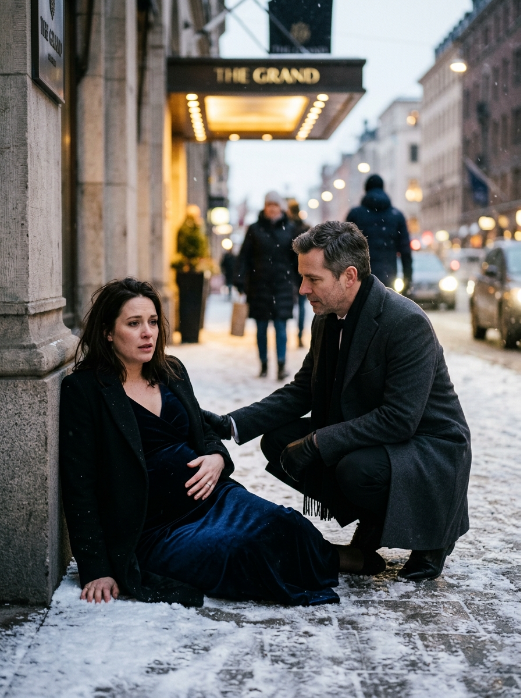
Outside, winter struck her face with raw force.
Snow fell in thin white threads beneath the hotel awning. Fifth Avenue gleamed with headlights and wet pavement. Her driver was nowhere near the curb. Richard had arranged the cars that night, and all at once Clara realized he’d likely made sure she’d be stranded there, exposed, dependent, waiting until he decided whether she could go.
She nearly laughed again.
Instead, she started walking.
Her heels hit the stone steps, then the sidewalk. The cold cut through her gown instantly. Her coat remained in the hotel checkroom, but going back felt impossible. She wrapped one arm around herself and kept the other over her stomach, moving past the row of town cars, the doorman calling after her, and a photographer who lifted his camera before pausing at the sight of her face.
She kept walking until the hotel lights blurred behind her.
At the corner of 54th Street, she stopped beside a restaurant window to catch her breath.
Then she saw them.
Richard and Sabrina were inside.
They’d left the gala through a separate exit.
They sat at a private table near the back, close enough for Clara to see Richard’s hand covering Sabrina’s, his head bent toward hers at that intimate angle that had once belonged to Clara in another life. A waiter poured red wine. Sabrina laughed, her crimson gown vivid under the dim amber light.
Richard had humiliated her in public, told her to stay behind, and then vanished with his mistress before Clara had even reached the street.
Her body reacted before her mind caught up.
The sidewalk seemed to tilt.
Her fingers pressed against her stomach.
A sharp pain twisted low in her abdomen, not unbearable, but frightening enough to steal her breath. The restaurant lights smeared into long golden streaks. Someone nearby said, “Ma’am?”
Clara tried to answer.
The baby.
That was the only thought remaining in her mind.
Not Richard.
Not Sabrina.
The baby.
Her knees buckled.
A man caught her before she hit the ground.
When Clara came to, she was in the back seat of a car that smelled faintly of leather, cedar, and rain. The interior was warm. Her hands lay folded across her stomach. A dark coat had been draped over her shoulders.
A man sat across from her, keeping his distance, his posture calm and measured.
“You fainted,” he said. “We’re five minutes from Lenox Hill. I called ahead.”
Clara tried to sit up straighter. “Who are you?”
“Alexander Graves.”
The name drifted through the fog in her mind before recognition caught up.
Alexander Graves. Shipping, real estate, private equity. A man people discussed in hushed tones, not out of cruelty, but because his silence unnerved loud men. Clara had spotted him across ballrooms at benefits before. He rarely showed up. When he did, board members straightened their jackets.
“I don’t need—”
“You do,” he said, without any harshness. “You’re pregnant, you passed out, and you were alone on a winter sidewalk. Pride can wait fifteen minutes.”
There was no flirtation in his voice. No pity either. Only fact.
Clara glanced down at the coat over her knees. It was black cashmere, heavy and costly, but its warmth made her throat tighten.
At the hospital, everything turned fluorescent and exacting. Nurses moved around her. A doctor checked her vitals, asked careful questions, and ran a monitor across her belly. Clara lay still, waiting for the only sound that mattered.
Then it arrived.
Fast, steady, alive.
Her baby’s heartbeat filled the room.
Clara turned her face away and wept silently into the paper sheet beneath her cheek.
Alexander waited outside the examination area. He didn’t hover. He didn’t perform concern for a stranger’s benefit. When the doctor finally told Clara that she and the baby were safe, but that stress and dehydration were serious concerns, Alexander stood near the doorway with his hands folded before him, his expression unreadable except for a slight tension around his eyes.
“Is there someone I should call?” he asked once they were alone.
Clara looked down at the wedding ring on her finger.
It felt loose.
“No.”
He didn’t ask why.
That restraint unsettled her more deeply than curiosity would have.
“I knew your father,” Alexander said after a pause.
Clara looked up sharply. “My father?”
“Thomas Whitaker. He invested in my first shipping company when everyone else said I was too young and too stubborn. He told me once that his daughter was the bravest person he knew.”
Clara’s throat closed.
Her father had been gone for seven years. Richard rarely mentioned him anymore, except when referencing the inheritance that had helped sustain the foundation in its early days.
“He said that?” she whispered.
Alexander’s gaze softened. “More than once.”
The room blurred.
For months, Clara had felt herself shrinking. Richard’s coldness had worked like water against stone, gradually wearing her down, smoothing every edge until she barely recognized herself. He had missed doctor appointments, forgotten dinners, dismissed her worries, and then punished her with silence whenever she dared to ask if there was someone else.
And now this stranger, this quiet man in a dark coat, had handed back to her a version of herself her father had once known.
“Your husband is Richard Donovan,” Alexander said.
It wasn’t a question.
Clara’s face tightened with shame. “You saw?”
“I saw enough.”
“He brought her to our foundation gala.”
“I know.”
The honesty in his answer was sharp and clean. It made no attempt to cushion the wound.
Clara stared at the monitor, at the paper strip curling from the machine’s tray, at the small confirmation of life growing within her.
“He told me not to embarrass him,” she said.
Alexander’s jaw tightened. “Men who rely on silence often mistake it for consent.”
The words stayed with her.
Later, when Alexander’s driver brought her home, the penthouse sat dark. Richard hadn’t returned. The envelope Clara had written weeks earlier still sat inside her desk drawer, sealed and waiting. Once, she had meant it as a goodbye letter. Now it felt far too small.
Words would never be enough.
Over the days that followed, Clara stopped expecting Richard to come home and began instead to notice the traces he’d left behind.
At first, they were small.
A jeweler’s receipt tucked in his tuxedo pocket. A hotel key card left in a drawer. A missed call from Sabrina lighting up his phone while he showered. Clara documented everything with a steadiness she didn’t truly feel. She photographed it all, made copies, and forwarded files to an email account Richard didn’t know existed.
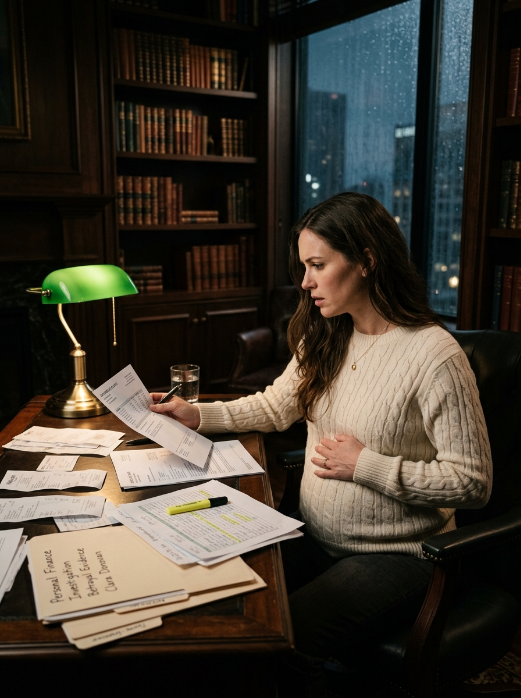
Then, on a rainy Thursday night, she found the statements.
They hadn’t even been well hidden. Later, that stung more. Richard had grown careless because he assumed she was too broken to search.
The envelopes had been shoved into the back of the library desk, buried under a stack of foundation invitations. Clara sat alone beneath the green-shaded lamp, the baby pressing against her ribs, and opened the first envelope.
At first, the numbers made no sense.
Transfers to shell companies.
Consulting fees.
Rent for a luxury apartment.
A car lease under Sabrina Cole’s name.
Jewelry.
Travel.
Then the foundation account.
Clara read the line three times before its meaning finally settled.
Donor money had been funneled through “development expenses” into accounts controlled by Richard.
Not merely betrayal within a marriage.
Not merely public disgrace.
Theft.
Her father’s money had helped build the Donovan Foundation. Clara had hosted benefits, spoken with donors, written thank-you letters, and listened to widows describe scholarships and hospital wings and children who needed grants. Richard had been draining that polished machine to fund Sabrina’s apartment and diamonds.
The baby kicked hard.
Clara placed one hand over her stomach and the other on the page.
“Oh, Richard,” she whispered. “What have you done?”
The next morning, she didn’t call Alexander.
She called Evelyn March, her father’s former attorney.
Evelyn was seventy-two, sharp as broken crystal, and still intimidating enough to make junior partners rise when she walked in. She welcomed Clara into an office lined with legal books, orchids, and no visible tolerance for foolish men.
Clara set the documents on the desk.
Evelyn read without a word.
That silence felt worse than any gasp.
Finally, she removed her glasses. “How far are you willing to go?”
Clara’s mouth went dry. “What does that mean?”
“It means if we act, we act correctly. We protect you. We protect the child. We protect your inheritance. We notify the board before Richard can shape the story. We freeze accounts. We preserve records. We prepare for him to lie.”
Clara dropped her gaze to her hands. They trembled.
“I don’t want revenge,” she said.
“Good,” Evelyn replied. “Revenge makes people careless. You want protection. Protection is cleaner.”
For the first time in months, Clara took a full breath.
Evelyn built the plan in stages.
First came the forensic accountants.
Then notification to the board.
Then a divorce petition with emergency financial limits.
Then a quiet inquiry into the misuse of foundation funds.
“Do not confront him alone,” Evelyn said. “Do not warn him. Do not threaten. Men like Richard hear a warning as an invitation to negotiate.”
Clara nodded.
But that night, Richard came home early.
She sat at the dining table with a cup of tea she hadn’t touched. The documents were no longer in the apartment; Evelyn’s team had collected them that afternoon. Still, Clara felt their presence in the room like a second heartbeat.
Richard walked in smelling of rain and Sabrina’s perfume.
He loosened his tie as though the penthouse still belonged entirely to him. “Why are you sitting in the dark?”
Clara looked at him.
For the first time in a long while, she wasn’t afraid of what he might say.
“I saw the accounts.”
Richard went still.
Not dramatically. Not like a guilty man in a film. Only a brief pause in the motion of his hand as he removed his cufflink.
“What accounts?”
“The foundation transfers. Sabrina’s apartment. The car. The jewelry.”
His face didn’t crack right away. Richard was too practiced for that. His first response was indignation.
“You went through my private documents?”
“They weren’t private,” Clara said. “They were stolen.”
His eyes sharpened. “Be careful.”
The old Clara would have flinched.
This Clara didn’t.
“You brought your mistress to our foundation gala while I stood there carrying your child,” she said quietly. “You told me to smile. You told me not to embarrass you.”
Richard’s jaw hardened. “This emotional display is beneath you.”
“No,” Clara said. “What’s beneath me is funding your affair with my father’s legacy.”
There it was.
The first crack.
It showed at the corner of his mouth, in the sudden tightness beneath one eye.
“You have no idea what you’re talking about.”
“I do.”
“You’re pregnant and unstable.”
Clara stood slowly, one hand braced on the table, the other beneath her belly.
Richard smiled then, but the smile had turned thin.
“You think anyone will believe you? You barely leave this apartment. You cry at charity events. You faint in public. I can make this look like stress, Clara. I can make it look like confusion.”
A chill passed through her.
Not fear.
Recognition.
This was the man beneath the tuxedo. Beneath the speeches. Beneath the foundation portraits and donor dinners. A man who had already rehearsed the words he’d use to bury her.
Clara studied him for a long moment.
Then she said, “Try.”
He let out a short laugh. “There she is. The dramatic little heiress.” “No,” Clara said. “There I am.”
The following week unfolded with the precision of a legal blade.
Evelyn’s team froze three accounts before Richard even noticed. Sealed packets reached the foundation board at eight on Monday morning. By noon, Richard’s assistant had stopped answering his calls. By two, the board chairman had called an emergency meeting. By four, Richard’s credit card was declined at the restaurant where Sabrina sat waiting with a shopping bag at her feet.
At five, Clara stood in the Donovan Foundation boardroom in a charcoal maternity dress, her hair pinned low, her face pale but composed.
The room smelled of coffee, paper, and panic.
Richard arrived ten minutes late.
This time, Sabrina wasn’t with him.
He stopped when he saw Clara seated beside Evelyn March.
“Clara,” he said, forcing a smile. “This isn’t necessary.”
The chairman, Samuel Price, looked exhausted. “Sit down, Richard.”
“I won’t be ambushed by my wife’s pregnancy emotions.”
No one spoke.
That was the first sign he’d misread the room.
Evelyn opened a folder.
“Mr. Donovan,” she said, her voice dry and polished. “For the record, Mrs. Donovan’s pregnancy is not responsible for falsified invoices, unauthorized transfers, or donor funds routed through shell accounts tied to your mistress’s residence.”
Richard’s face lost color.
Clara watched it as though from a distance.
Sabrina’s apartment lease appeared on the screen, every name and number redacted for privacy, but still enough for the board’s attorney to confirm. Then the car. The jewelry. The hotel charges. The “strategic development” expenses that had covered weekends in Miami, Palm Beach, and Aspen.
Richard tried to interrupt.
Evelyn let him speak for exactly twelve seconds.
Then she laid Sabrina’s signed delivery receipt for a diamond bracelet on the table.
It had been purchased the very same day Clara sat alone in an exam room, listening to her baby’s heartbeat.
Richard went quiet.
Samuel Price removed his glasses and rubbed the bridge of his nose.
“Richard,” he said quietly, “you’re suspended from all foundation operations pending formal investigation.”
“You can’t do that.”
“We just did.”
“I built this foundation.”
Clara heard her own voice before she’d planned to speak.
“No,” she said. “You stood in front of it.”
The room fell silent.
Richard stared at her with a hatred so raw it nearly looked like honesty.
“You’ll regret this.”
Evelyn smiled without any warmth. “That sounded very close to a threat. I’d advise against improving on it.”
The fallout didn’t arrive in one violent burst.
It came like winter.
Steady.
Merciless.
Reporters started calling once the board issued its preliminary notice. Donors demanded audits. Richard’s business partners distanced themselves in language so polished it wounded more than insult ever could. Sabrina posted one vague statement about “protecting her peace,” then scrubbed every photo of Richard from her social media within a day.
Richard called Clara thirty-seven times in a single night.
She didn’t answer.
His first texts were furious.
Then accusing.
Then nostalgic.
Remember our first apartment?
Remember the roses?
Remember who loved you before all of this?
Clara sat on the bed, one hand resting on her stomach, reading the messages without crying.
That was how she knew something essential had shifted.
The wound was still there.
But it no longer steered her hands.
Three weeks later, the divorce petition was filed. Emergency orders protected Clara’s inheritance and limited Richard’s access to shared assets. The foundation inquiry became official. Sabrina, facing subpoenas with no financial cushion, released a statement through her own lawyer claiming she hadn’t known where the money came from.
Richard called her a liar in front of two reporters.
It didn’t help him.
By spring, the city had settled into its version of the story.
Not fully. Cities never settle cleanly. There were still people who pitied Richard, people who called Clara cold, people who insisted pregnant women shouldn’t destroy families, as though Richard hadn’t set the house on fire and then complained when she opened a window.
But documents outlasted gossip.
Paper had more patience than lies.
The final hearing came on a rainy April morning.
Clara wore navy. Evelyn wore black. Richard wore a suit that no longer fit him quite right. His face looked thinner, his charm fraying at the seams. When he entered the courthouse, he scanned the room as if expecting Sabrina to appear.
She didn’t.
Alexander did.
He sat in the back row, not beside Clara, not playing the rescuer, simply present. When Clara noticed him, he gave a small nod. It steadied her more than she wanted to admit.
The judge reviewed the financial misconduct, the misuse of donor money, the depletion of marital assets, and the emotional and reputational harm. Richard’s attorney tried to frame the affair as private, the transfers as sloppy bookkeeping, and the foundation expenses as “executive discretion.”
The judge listened.
Then she looked at Richard.
“Mr. Donovan, discretion is not a synonym for theft.”
Clara lowered her eyes.
Not to hide tears.
To hide relief.
The divorce was granted. Clara retained her inheritance, her prenatal trust, and the penthouse purchased with family funds. Richard was ordered to return significant marital assets. The foundation referred the remaining matter to state investigators. Within the week, his suspension became permanent.
Outside the courthouse, rain tapped against black umbrellas.
Richard approached Clara on the steps.
Evelyn shifted slightly, but Clara raised one hand.
“I can speak to him.”
Up close, Richard looked older. Less like a villain than a man who’d realized too late that charm wasn’t a foundation. It couldn’t hold weight. It couldn’t carry a life.
“Clara,” he said, his voice rough. “I made mistakes.”
She looked at him.
“No,” she said softly. “You made choices.”
His mouth tightened. “I loved you.”
“I believe you loved what I made possible.”
That struck him. She saw it.
Good, some old wounded part of her thought.
Then she let go of even that.
Richard’s gaze dropped to her belly. “Will I be allowed to see the baby?”
The question landed carefully.
She had braced for anger. She had braced for pleading. She had braced for blame.
She hadn’t braced for that.
Clara placed both hands over her child.
“That will depend on the court, your conduct, and whether you learn to tell the truth without needing applause.”
His expression twisted. “You sound like your lawyer.”
“No,” Clara said. “I sound like my father’s daughter.”
She walked away before he could answer.
The months after everything fell apart weren’t glamorous.
That was the part nobody wrote about.
Freedom didn’t arrive with music. It came with sleepless nights, swollen ankles, legal bills, doctor appointments, boxes stacked in hallways, and mornings when Clara stood in the nursery holding a tiny folded onesie and cried because grief didn’t care how right her decisions had been.
Some days, she missed Richard.
Not the man who’d brought Sabrina to the gala.
The man from before.

The one who’d carried coffee to her in bed after her father died. The one who’d danced barefoot with her in the kitchen of their first apartment. The one who had once covered her hand with his during a thunderstorm and said, “Whatever happens, we’re on the same side.”
She grieved him like someone who had died.
Maybe he had.
Maybe he had never fully existed as the person she’d needed to believe in.
Alexander didn’t force his way into her life. That was the reason she let him stay near it.
He drove her to one doctor’s appointment when Evelyn was in court. He sent soup when she caught a cold. He recommended a security consultant after a reporter tracked down her building. He sat beside her one afternoon in the park while the trees began turning green and said nothing for twenty minutes because she had no energy left for conversation.
“You don’t have to be useful to deserve company,” he told her when she apologized for her silence.
Clara looked at him then, truly looked.
At his steady hands. The gray at his temples. The restraint of a man powerful enough not to perform power.
“I don’t know how to trust kindness anymore,” she admitted.
Alexander nodded. “Then don’t rush it. Let it prove itself.”
In June, Clara gave birth to a boy.
She named him Thomas.
When the nurse laid him against her chest, wet and furious and impossibly alive, Clara felt something inside her open — not the old kind of breaking, not the kind that left shards behind in the dark.
This was something else.
This was a door.
Thomas cried with his whole body. Clara laughed through her tears. Evelyn cried too and immediately denied it. Alexander waited in the hallway with flowers he didn’t bring in until he was invited.
Clara held her son and whispered, “You were never unwanted. Not for one second.”
Richard sent a message two days later.
Congratulations.
Nothing more.
Clara stared at it for a long moment, then replied with a single sentence.
Thank you. All communication about Thomas will go through the agreed legal channel.
She waited for the old ache.
It came, but faintly.
Like distant thunder.
A year later, the Donovan Foundation carried a new name, a new board, and a new grant program for women rebuilding after financial abuse and public humiliation. Clara didn’t set out to become a symbol. Symbols were heavy things. They flattened people into lessons.
But when she stood at the first luncheon after Thomas’s birth, dressed in a cream suit and a small gold necklace that had belonged to her mother, she spoke anyway.
Not about Richard.
Not about Sabrina.
Not about scandal.
She spoke about paperwork. About silence. About how humiliation survives when people mistake dignity for consent. About how leaving isn’t a single moment, but a series of small doors opened in the dark.
At the back of the room, Evelyn watched with quiet satisfaction. Alexander stood near the windows holding Thomas, who slept against his shoulder with one small fist curled into his jacket.
Clara looked at them, then back at the crowd.
“I used to believe strength would feel like anger,” she said. “I thought it would roar. I thought it would burn. But for me, strength sounded like a baby’s heartbeat in a hospital room. It looked like a folder of documents laid neatly on a lawyer’s desk. It felt like walking out of a ballroom while everyone whispered and choosing not to turn around.”
The room stayed still.
Clara breathed.
“What saved me wasn’t revenge. Revenge would have kept my life bound to the person who hurt me. What saved me was truth. Truth, recorded carefully. Truth, protected legally. Truth, spoken at the right moment, in the right room, with no need to shout.”
Afterward, women approached her quietly.
Some were wealthy. Some weren’t. Some wore diamonds. Some had trembling hands. One older woman simply held Clara’s fingers and said, “I thought I was the only one.”
Clara squeezed her hand in return.
“You weren’t.”
That evening, after the guests had left and the tables had been cleared, Clara stepped out onto the terrace. The city below glimmered in the early summer light. Thomas slept inside under Evelyn’s watchful eye. Alexander joined her at the railing, keeping a respectful distance.
“You were extraordinary today,” he said.
Clara smiled faintly. “I was terrified.”
“Both can be true.”
She looked out over Manhattan. For once, the city didn’t feel like it was mocking her. Its lights no longer seemed like witnesses to her loneliness. They looked like windows — thousands of lives, thousands of endings and beginnings. People leaving, returning, surviving, rebuilding.
“I used to think my life ended that night at the gala,” she said.
Alexander rested his arms on the railing. “Did it?”
Clara thought of Richard raising his glass. Sabrina smiling. The message on her phone. The frozen sidewalk. The heartbeat monitor. The documents. The courthouse rain. Her son’s first cry.
“No,” she said finally. “That was the night I stopped mistaking endurance for love.”
Alexander looked at her, and this time there was something gentle in his eyes that she didn’t turn away from.
Inside, Thomas stirred and made a soft sound.
Clara turned immediately.
Before stepping back inside, she paused at the terrace door and looked once more toward the skyline.
There had been a time when she waited for Richard’s keys in the lock as though her entire life depended on someone coming home.
Now home wasn’t a man.
It wasn’t a penthouse.
It wasn’t a foundation name or a courtroom order or a headline that finally told the truth.
Home was the child sleeping in the next room. The woman she had become. The silence she no longer feared. The future that no longer required her to smile through pain.
Clara stepped inside, leaving the city lights behind her.
And this time, no one had to tell her to stay.
