


Part 1
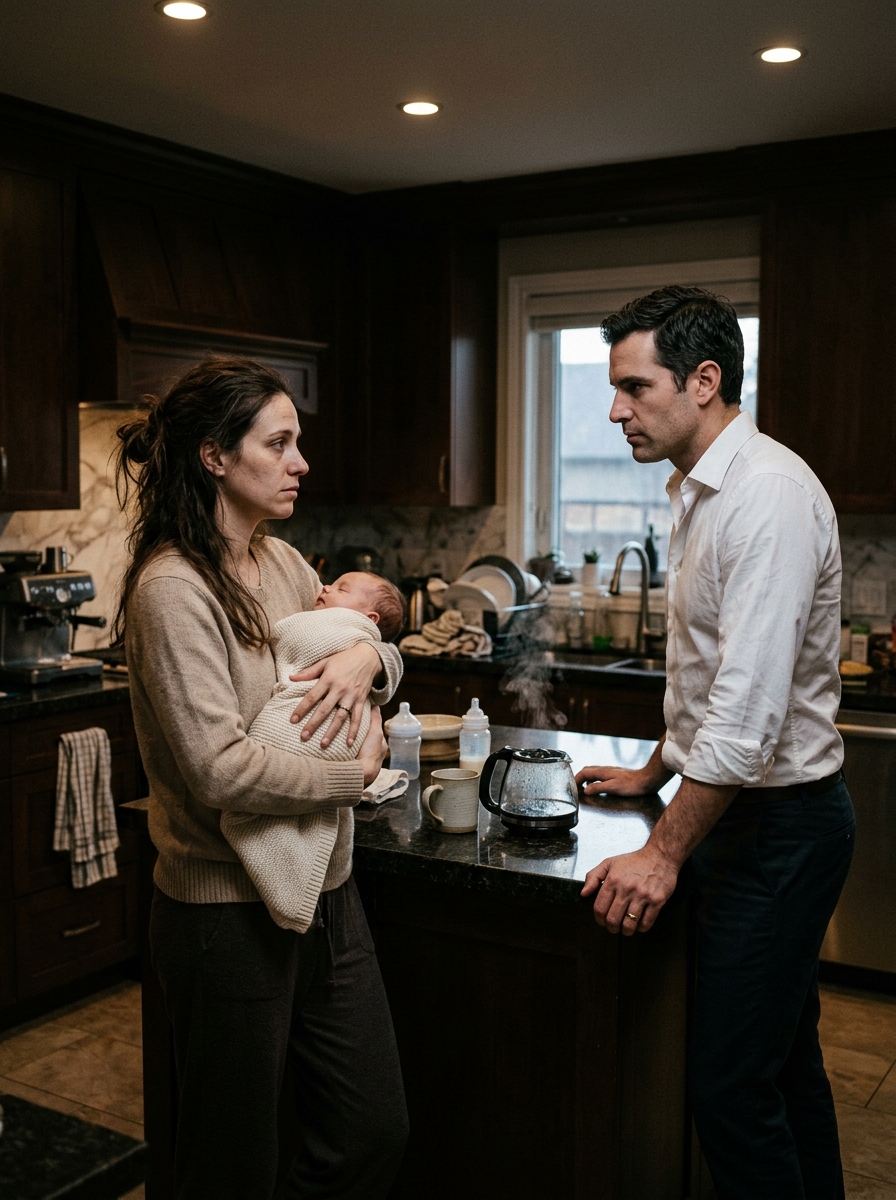
It was 4:30 in the morning, and Mariana had her baby cradled in one arm while she stirred a pot of beans with the other when Andrés walked into the kitchen and said it as casually as if he were asking for water:
“I want a divorce.”
The Robles family home, set in a wealthy part of Querétaro, was still quiet.
The only sounds were the coffee bubbling, the tortillas warming on the griddle, and the weary whimpers of Valentina — her three-month-old daughter — nestled against her chest.
She’d been up since 2:15.
At first it was the baby’s colic.
Then it was the note her mother-in-law, Doña Mercedes, had left on the kitchen table:
“Breakfast ready before 6. Eggs without onions for your father-in-law. Smoothie for Fabiola. Strong coffee for Andrés. Don’t forget to iron his blue shirt.”
Mariana had read it without any surprise.
No one in that house asked for things.
They issued them.
Andrés walked in with damp hair, his shirt misbuttoned, and the scent of an expensive perfume that belonged to neither of them.
There was a faint stain on his collar, like makeup.
She noticed it.
He knew she’d noticed.
Yet there wasn’t a hint of shame on his face.
“Did you hear me?” he pushed.
Mariana switched off the burner.
The baby stirred in her arms.
For five years she’d pictured this moment countless times. She’d assumed she would cry. That she’d plead with him. That he’d drop to his knees, terrified of losing it all.
But that morning, not a single tear came.
She simply straightened Valentina’s blanket and said:
“Yes, I heard you. I’m just surprised you waited until I was making breakfast for your mother.”
Andrés gave a hollow laugh.
“Don’t start with your drama, Mariana. Ever since the baby you’ve become unbearable. My mother was right. You’re not the calm woman I married anymore.”
She met his eyes without flinching.
Of course she wasn’t the same.
The quiet version of her had believed that swallowing humiliation was simply part of being married.
The woman standing there now had spent two months gathering screenshots, receipts, audio recordings, and contracts, all stored on a memory card tucked inside a box of powdered milk.
Andrés folded his arms.
“The best thing is to end this quietly. Take the baby to your mother’s for a few days, and we’ll sort out the rest later.”
Mariana gave a thin smile.
“A few days?”
“Yes. This house belongs to my family. The car’s in my name. I pay the credit cards. Don’t make this harder than it has to be.”
The words hit like a slap.
Not because they were true.
But because he was so certain she knew nothing.
Mariana walked toward the bedroom, Valentina still in her arms. She pulled a black suitcase from the closet and packed diapers, the baby’s clothes, her own documents, two changes of clothing, a green folder, and a USB drive hidden inside a sock.
Andrés trailed after her.
“What are you doing?”
“Leaving.”
He laughed again, though this time his confidence wavered.
“Where, exactly, Mariana? Think about it. You have no job. No money. No way to support a baby.”
She zipped the suitcase shut.
“That’s what you’re meant to believe.”
He paced across the room. Framed on the walls were large photographs of the Robles family — weddings, trips, graduations, elegant dinners.
Mariana barely appeared in any of them.
Always at the edge of the frame.
Always holding plates.
Always looking like a guest passing through.
When she pulled open the front door, the cold morning air hit her face. The street was dark, the city only just stirring awake.
Andrés followed her outside, his anxiety now plain.
“Mariana, don’t make a scene. My father’s still asleep. My mother will be upset.”
She buckled Valentina into her car seat and set the suitcase in the back.
Only then did he understand something that turned his blood cold.
Andrés wasn’t mourning the loss of his wife.
He was afraid of what she might say.
Before climbing in, Mariana turned back.
“Tell your mother breakfast is burning.”
She drove off without a glance behind her.
What Andrés didn’t know was that she’d tracked every peso of his inheritance that had gone into renovating that house, every suspicious transfer routed through a shell company, and every message in which his family had discussed taking her daughter from her.
And when Doña Mercedes discovered the green folder left on the dining room table, no one in that house would ever eat breakfast in peace again.
Part 2
Mariana reached her brother Esteban’s apartment while the sky was still gray.
He lived modestly, near an avenue lined with tamale carts, taxis, and people rushing into their day.
He answered the door in sweatpants, looking like he hadn’t slept.
But the moment he saw her — the baby, the suitcase, her mouth set in a hard line — he didn’t ask a thing.
He just stepped back to let her in.
“Come in, sis. You’re family here.”
Mariana hadn’t cried when Andrés asked for the divorce.
She hadn’t cried during the drive alone with the baby asleep behind her.
But those words cracked something loose in her chest.
The Robles house had marble floors, crystal fixtures, expensive art, and a sprawling kitchen.
But Mariana had never once had a space that felt like her own.
Doña Mercedes controlled everything — what the baby ate, even against the pediatrician’s advice; whether Mariana could see her own mother; how she dressed, because “a Robles daughter-in-law doesn’t walk around looking like a market woman.”
Fabiola, Andrés’s sister, had mocked her body after the birth.
“That’s intense, Mari. You look like you’ve aged ten years.”
Andrés would just listen and smile.
He never once stood up for her.
Sometimes he’d even chime in: “Mariana let herself go ever since she got pregnant.”
But the money hurt worse than any comment.
When Mariana’s father died, he left her a small inheritance — nothing extravagant, but enough to change her life.
Andrés talked her into putting it toward “their shared future.”
First it went to expanding the family home.
Then a new kitchen.
Then the nursery.
Then a “temporary” loan to bail out his father’s business.
“All of this is yours too,” Andrés told her every time.
But none of the paperwork ever changed.
No contract carried her name.
And whenever Mariana raised the question, Doña Mercedes delivered her venom with a serene smile:
“Women who truly love don’t go around asking for favors.”
What they didn’t realize was that before her marriage, Mariana had spent seven years as an accounting assistant at a construction company.
She knew how to read an invoice.
She knew how to spot an inflated cost.
She knew when a company was legitimate and when it was only a front for hiding money.
And the Robles family had too many shadows.
Esteban listened through all of it in silence as he heated water for coffee.
Then he said: “We’re going to see a lawyer. Today.”
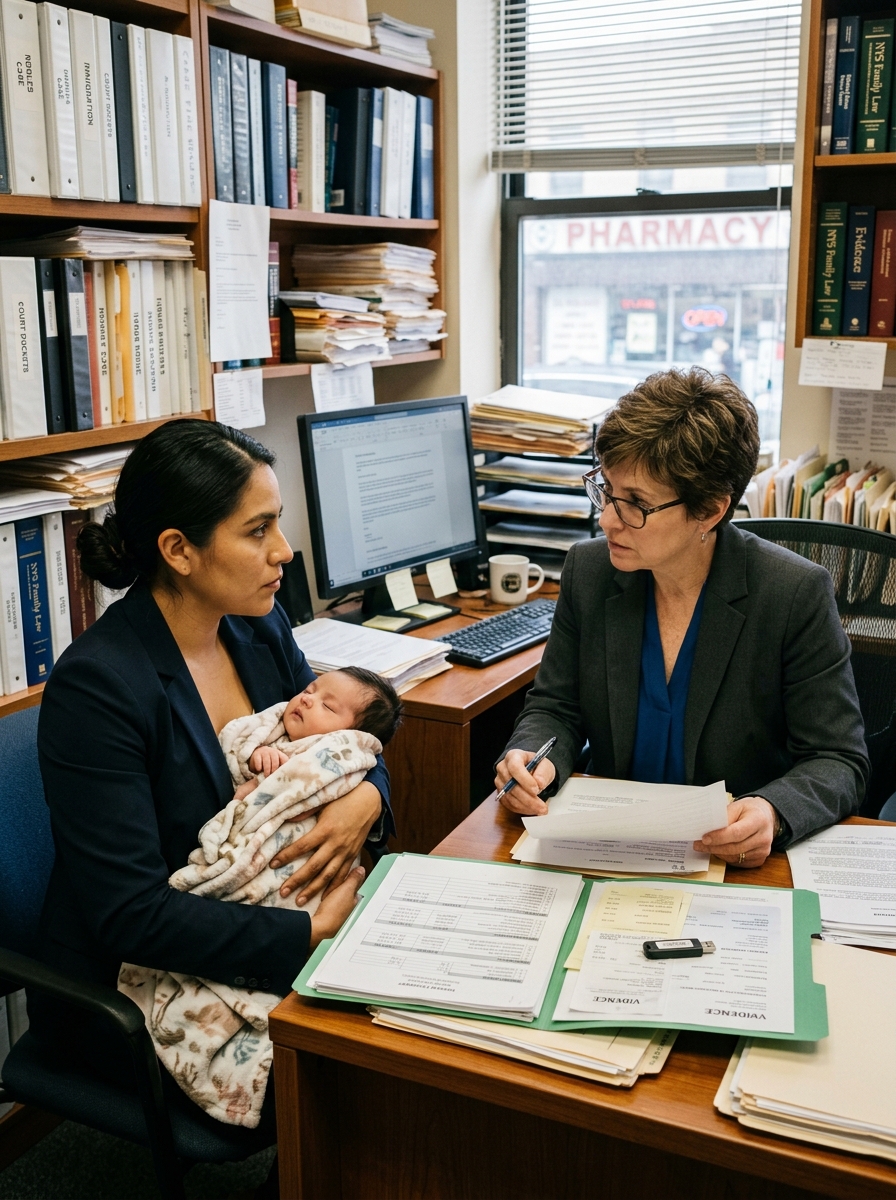
The lawyer’s name was Teresa Aguilar.
Her office was small, tucked above a pharmacy, but her eyes missed nothing.
Mariana handed over the green folder.
Receipts. Transfer records. WhatsApp screenshots. Voice messages from Doña Mercedes. Bank statements. Renovation photos. Contracts under the name of a company called Grupo Alborada.
Teresa read through it all for nearly forty minutes without looking up.
Then she exhaled slowly.
“Mariana, this isn’t just a divorce.”
Mariana pulled Valentina closer.
“Then what is it?”
“Financial abuse, possible fraud, hidden assets, and threats tied to custody. And there’s something even more concerning.”
“What?”
Teresa tapped several of the transfers.
“This company, Grupo Alborada, took in money from your inheritance indirectly. But it has no employees, no physical address, and no verifiable operations.”
A hollow feeling opened in Mariana’s stomach.
“What does that mean?”
“They may have used your money to funnel funds elsewhere. And if that’s the case, someone else was on the receiving end.”
The lawsuit was filed within the week.
Andrés started calling every ten minutes.
At first he was gentle.
“Mariana, my love, don’t blow this out of proportion. We were just tired. Come home and let’s talk.”
Then his tone shifted.
“You’re out of your mind. No judge is going to rule for a woman with nothing to her name.”
Then came more calculated messages.
“My mother says if you keep this up, we’re going for full custody. You don’t have a home. You don’t have a job. You don’t have anything.”
Mariana said nothing back.
Every message became one more piece of evidence.
On Friday afternoon, Doña Mercedes showed up at Esteban’s apartment.
She looked immaculate — white slacks, dark sunglasses, a designer bag, and the expression of a woman used to being obeyed.
Esteban opened the door but didn’t move aside.
“I’ve come to speak with my daughter-in-law.”
“Ex-daughter-in-law, if things go the way they should,” he said.
Doña Mercedes looked at him as though he’d tracked mud across her living room.
Mariana came to the door with Valentina in her arms.
Her mother-in-law lowered her voice.
“You’re making a complete fool of yourself. In our family, we don’t drag problems into a courtroom.”
“In your family, you bury them.”
Doña Mercedes clenched her jaw.
“This isn’t going to end well for you. Andrés can give you a monthly allowance. A modest apartment. A used car. But you have to sign and keep quiet.”
Disgust moved through Mariana.
“Keep quiet about what?”
The woman stepped closer.
“About things you don’t understand. You were only ever the wife. Don’t start thinking you’re something more.”
Esteban lifted his phone, unnoticed.
He was recording.
Doña Mercedes kept going:
“And you’d best stop poking around Grupo Alborada. There are people who don’t forgive nosy women.”
Mariana didn’t move.
But something inside her caught fire.
Not fear this time.
Certainty.
The Robles family wasn’t only trying to silence her over the divorce.
They were shielding something bigger.
When Teresa listened to the recording, her smile carried no warmth.
“Perfect. She just handed us a threat.”
The judicial audit was requested right away.
Then came the first revelation.
Grupo Alborada wasn’t a service company.
It was a front.
Its registered address was an abandoned house in Celaya.
No employees, no equipment, no real clients.
But it had taken in transfers from Andrés, from his father, and from a woman named Daniela Castañeda.
Mariana recognized that name.
Daniela was “the family friend.” A polished woman who turned up at every gathering, baptism, and important dinner. Doña Mercedes treated her like a daughter. Fabiola called her “godmother.” Andrés described her as a consultant.
But Mariana remembered the way Daniela used to look at him.
She also remembered a night when Andrés came home late, wearing the same perfume on his shirt as that morning.
Still, what Teresa uncovered next was worse than the affair.
A life insurance policy had been taken out in Mariana’s name a month before Valentina was born.
The original beneficiary was the baby.
But fifteen days after the birth, the beneficiary had been switched.
Now it was Andrés.
Mariana stared at the page.
“I don’t understand. Why would they do that?”
Teresa studied her carefully.
“Maybe it was only meant as financial protection. Or maybe they planned to have you declared unfit, take your daughter, and keep everything. Combined with the messages, this looks very serious.”
The messages were crueler still.
In one, Andrés had written to his mother:
“Mariana is acting strangely because of her depression. If she gets difficult, we say she’s not well enough to care for the child.”
Doña Mercedes had answered:
“Exactly. An unstable mother doesn’t win custody.”
In another, Fabiola had written:
“Have him sign quickly before I review the paperwork.”
And Daniela — the so-called consultant — had sent:
“The important thing is that Grupo Alborada is cleared before the hearing.”
Mariana didn’t cry.
Not yet.
The tears came when she heard a voice message Andrés had sent to Daniela.
His tone was calm, almost bored.
“She’s almost broken. She doesn’t sleep because of the baby, my mom has her on a short leash, and she doesn’t even know what’s coming. Once I get her signature, everything will be finalized.”
That was when her legs gave out.
Not because Andrés had a lover.
She’d already suspected as much.
What broke her was realizing that her exhaustion, her motherhood, her sleepless nights had all been used as a calculated weapon against her.
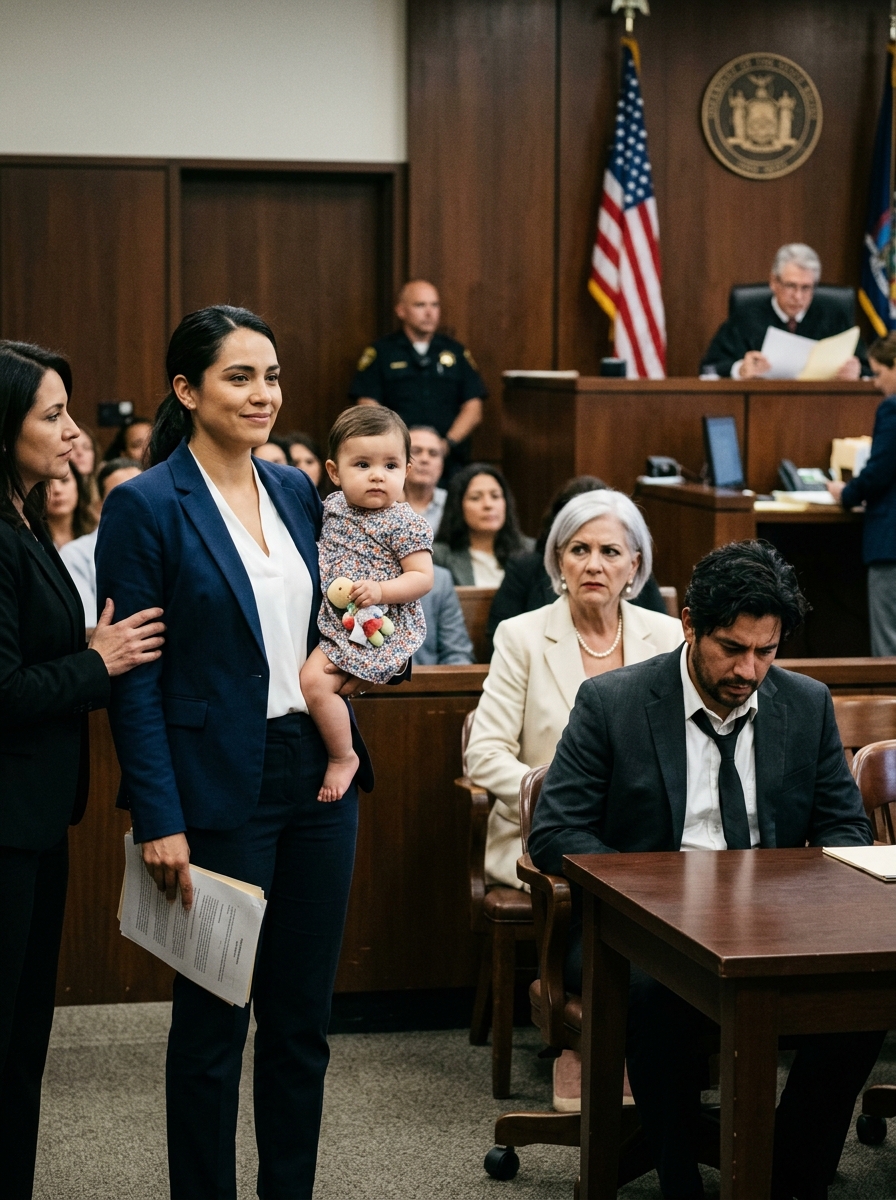
The hearing came three weeks later.
Andrés arrived in a dark suit, shadows heavy under his eyes.
Doña Mercedes walked in like royalty, though her usual certainty had thinned.
Don Ernesto, the father-in-law, avoided Mariana’s gaze entirely.
Fabiola wore oversized sunglasses even inside the courthouse.
Daniela didn’t show up.
But her name was everywhere in the proceedings.
Teresa laid out the evidence piece by piece.
The transfers. The receipts. The voice messages. The texts. The insurance policy. The recorded threat from Doña Mercedes.
Andrés tried to paint Mariana as confused.
“She’s been very sensitive since giving birth. She’s not thinking clearly.”
Mariana lifted her head.
For the first time in years, she didn’t look away.
The judge asked for a recording to be played.
Andrés’s voice filled the courtroom.
“She’s almost broken…”
What followed was total silence.
Doña Mercedes shut her eyes.
Don Ernesto swallowed hard.
Fabiola stopped pretending to check her phone.
The judge’s ruling came down firmly.
Mariana was granted full provisional custody of Valentina.
Andrés’s visits with Valentina would be supervised.
An investigation into Grupo Alborada’s dealings was opened.
Mariana’s financial contribution to the renovation of the family home was formally acknowledged.
Protective measures were put in place over the recorded threats.
As they left the courthouse, Doña Mercedes finally cracked.
“You’ve ruined us, you ungrateful woman!”
Mariana stopped walking.
She looked at her with a calm that stung more than any shout could.
“No, ma’am. I simply stopped serving your breakfast.”
Andrés tried to close the distance between them.
“Mariana, please. I didn’t know my mother would take it that far.”

She nearly laughed.
“Don’t ask me to believe you were just some frightened kid. You signed documents. You sent messages. You changed the policy. You watched me cook for your family while you were already planning to erase me from my own life.”
He dropped his gaze.
For the first time, Andrés had nothing to say.
Months later, Mariana rented a two-bedroom apartment.
No marble floors.
No sprawling garden.
No expensive furniture.
But in that small kitchen, no one left humiliating notes on the fridge.
No one told her how to raise Valentina.
No one walked in at 4:30 in the morning smelling of someone else.
The first morning she made coffee there, she stood by the window and watched the sunlight spread across the table.
Valentina laughed in her little chair, banging a plastic spoon.
Mariana cried.
But not over Andrés.
She cried because she could finally breathe.
With the money she recovered, and Teresa’s help, she opened a small counseling service for women trapped in marriages that had convinced them they were worthless.
Many came in frightened.
Others came in saying: “I don’t have any proof.”
Mariana always gave the same answer:
“Then start today. Save everything. Even silence needs to be organized.”
Andrés kept seeing Valentina under supervision.
Doña Mercedes stopped showing up at the events where she’d once paraded her perfect family.
The Robles family didn’t just lose money.
They lost their mask.
And Mariana came to understand something it takes many women years to learn:
Sometimes a divorce doesn’t destroy a family.
It only exposes that the family was already broken.
What saves you isn’t staying.
It’s finding the courage to walk out with the truth in your hands.
