

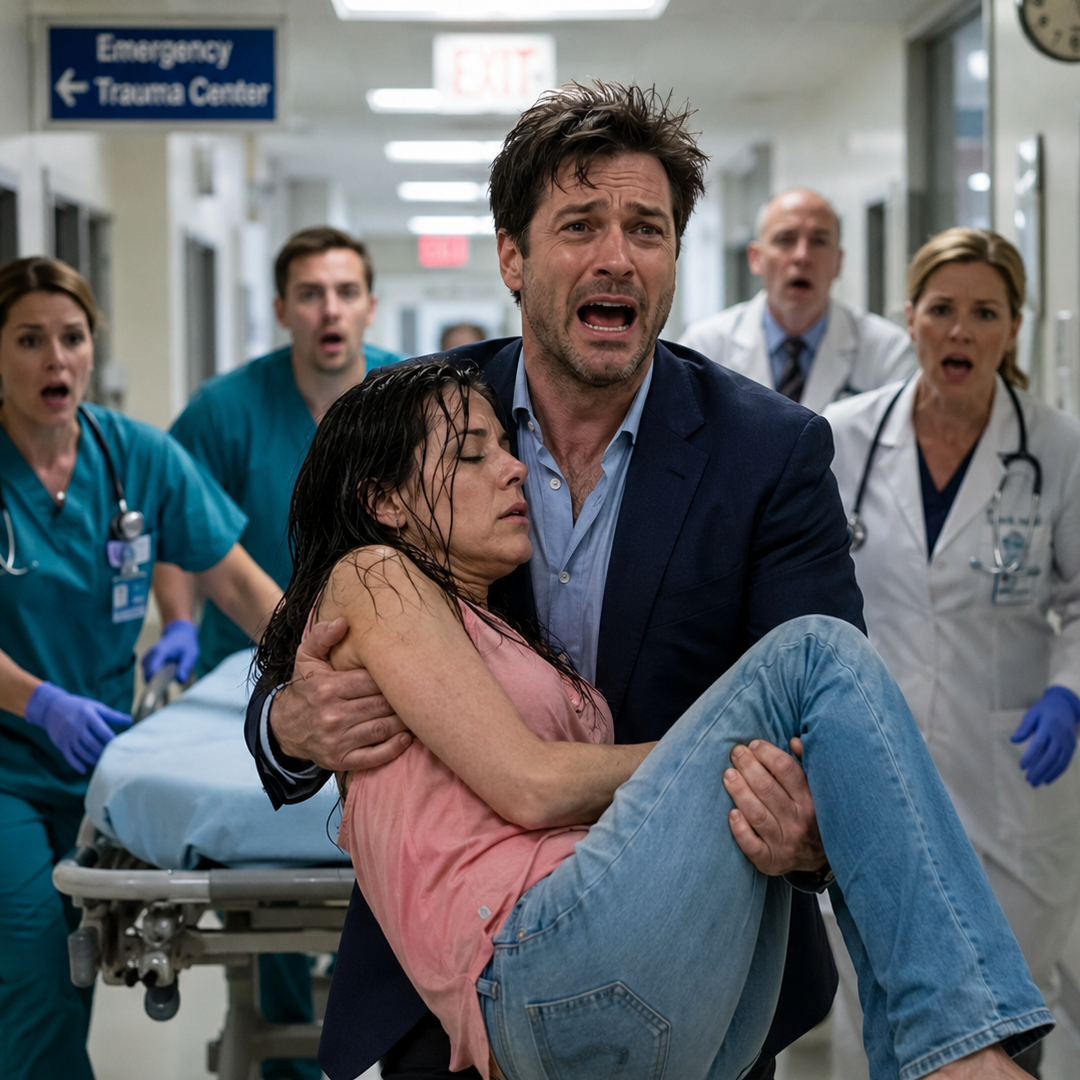
The night my husband rushed me to the emergency room, he was shaking more than I was. Not because he cared what happened to me — but because, for the first time, someone else was watching.
“She slipped and fell in the bathroom,” Daniel said quickly, his hand closing tighter around my limp fingers like a threat. “I found her like this.”
The doctor — a composed woman with silver hair and tired eyes — checked the bruises across my arms, ribs, and neck. Her face stayed calm, but her voice dropped.
“Call the police right now.”
Daniel went still.
For three years, he had mastered the act of the charming husband. In public, he kissed my forehead, opened doors, laughed with the neighbors, and called me “my delicate little wife.” Behind our bedroom door, he turned into someone completely different. He was certain no one would ever take my word over his, because he was Daniel Hale — successful developer, generous donor, the golden son of the town’s most powerful family.
His mother, Evelyn, helped keep up the act. “A wife should know when to stay quiet,” she once said, offering me concealer. “Daniel is under a lot of pressure. Don’t embarrass him.”
So I smiled through dinner parties with bruises hidden under makeup. I thanked guests who praised our “perfect” marriage. I let Daniel rest his hand on my waist, knowing his fingers pressed into marks he himself had left.
But there was one thing about me he never understood.
Before I married him, I’d worked as a forensic accountant for the state attorney’s office. I knew exactly how men like him hid money, how they buried their crimes under contracts, charities, and carefully built reputations. When Daniel made me quit, he thought he’d erased that side of me.
He was wrong.
For eight months, I kept records of everything. Medical photos saved under coded file names. Voice recordings triggered by a damaged pendant on my necklace. Transfers from Daniel’s company to shell vendors. Texts from Evelyn telling me to “cover the marks before the gala.” Every insult. Every threat. Every time he told me, “No one will believe you.”
The hospital lights swam above me as nurses hurried around the room. Daniel leaned in and murmured, “Say you fell.”
I turned my head slowly.
For the first time in years, I smiled.
Then I looked at the doctor and said, hoarse but clear, “I didn’t fall.”
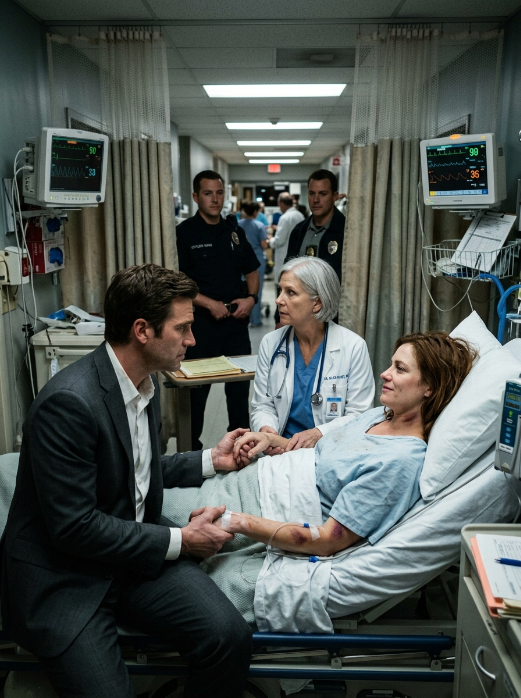
Daniel’s grip loosened.
Beyond the curtain, police radios crackled to life.
And somewhere underneath the pain, I felt my first real taste of freedom.
Part 2
Daniel pulled himself together fast — men like him always assumed panic was something that happened to other people.
By morning, his lawyer was already there. Evelyn arrived at the hospital wrapped in pearls and cold perfume, looking less like a worried mother-in-law and more like royalty come to inspect damaged goods.
“My son is under enormous stress,” she told the detective. “Mara is emotional. She bruises easily.”
Daniel stood next to her, eyes reddened from rubbing them raw for effect. “I love my wife,” he said. “She’s confused.”
The detective glanced my way.
I stayed quiet, pale and still, letting them play out their performance.
That was their first mistake. They read my silence as surrender.
When the nurse stepped out, Evelyn bent close to my bed. Her smile was soft enough for cameras, sharp enough to cut.
“Think carefully,” she whispered. “Divorce costs money. Accusations get ugly. And women who cross powerful families end up alone.”
I glanced at her pearls. “Those from the Hale Foundation fundraiser?”
Her smile slipped.
Good.
The Hale Foundation was their crown jewel — their cover, their shining image. Children’s hospitals. Women’s shelters. Scholarship galas. Daniel loved standing on stage promising to protect the vulnerable while his bruised knuckles healed under designer cufflinks.
What he didn’t know was that I’d spent months tracing foundation funds into shell companies. What Evelyn didn’t know was that the “fragile wife” she looked down on had already sent copies of every ledger, recording, and medical file to three places: my lawyer, a journalist I trusted, and a federal investigator who owed me a favor.
The first crack showed that afternoon.
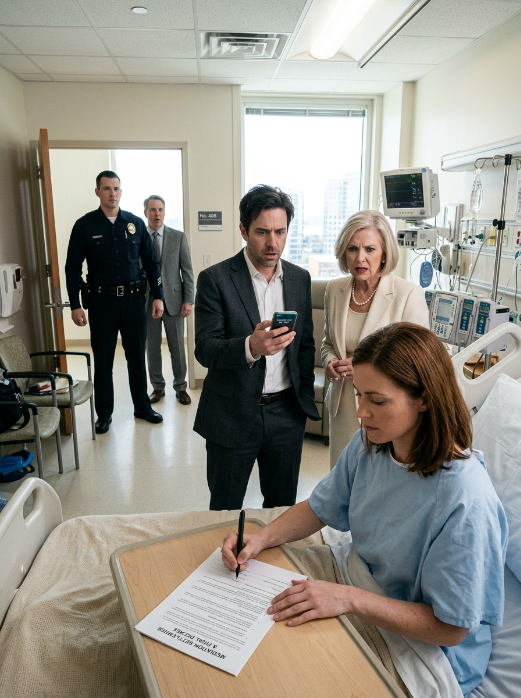
Daniel’s lawyer set a document on my hospital tray. “Just a simple statement,” he said. “You confirm the fall was an accident. Mr. Hale agrees to private counseling for marital stress. No charges. No scandal.”
Daniel gave me his gentle public smile. “Sign it, Mara. Come home.”
Home.
The word nearly made me laugh.
Instead, I picked up the pen with shaking fingers.
Daniel eased back. Evelyn’s eyes lit up.
Then I wrote three words on the page.
Check your email.
Daniel blinked. “What?”
His phone buzzed first. Then his lawyer’s. Then Evelyn’s.
The article was already live.
Not everything. Just enough.
Hallway footage from the camera I’d hidden in a smoke detector. Audio of Daniel saying, “I can break every bone and still make them believe you’re crazy.” Financial records linked to the Hale Foundation. Photos of my injuries, timestamped and documented.
The headline showed no mercy.
LOCAL PHILANTHROPIST ACCUSED OF ABUSE AND CHARITY FRAUD.
The color drained from Daniel’s face.
Evelyn grabbed his phone, hands shaking as she scrolled. “You stupid girl,” she hissed.
A police officer walked into the room before she could say more.
“Daniel Hale,” he said, “you need to come with us.”
Daniel stepped back. “This is a misunderstanding.”
I finally pushed myself upright, every part of me aching.
“No,” I said. “It’s evidence.”
For the first time since I’d known him, Daniel looked at me and didn’t see weakness, property, or something to control.
He saw the wrong woman entirely.
Part 3
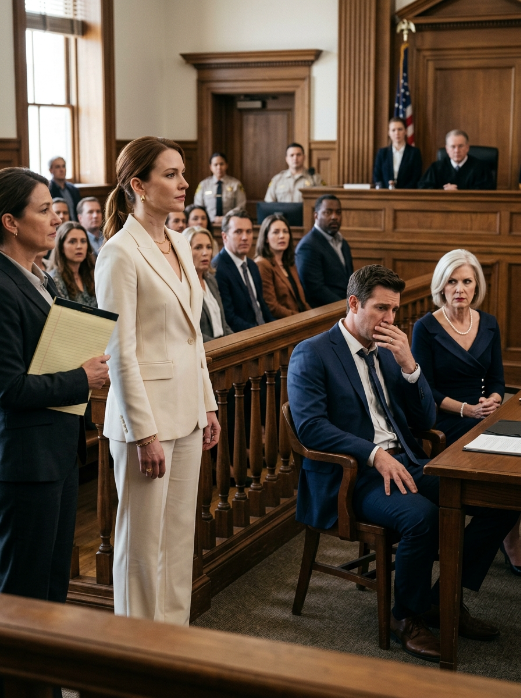
Three months later, the courtroom was packed.
Daniel wore a navy suit and the wounded expression of a man unused to facing consequences. Evelyn sat behind him, chin raised, still trying to command the room with diamonds and silence. Their social circle filled the rows, murmuring behind polite smiles.
They expected me to crack.
I walked in wearing a cream suit, hair pulled back, my scars on full display.
The prosecutor opened with the recordings.
Daniel’s voice filled the room, smooth and vicious. “Cry louder. No one’s coming.”
A woman in the back gasped.
Then came Evelyn’s messages.
Cover the marks before the gala.
Don’t ruin Daniel’s image.
A wife protects the family.
Evelyn kept her eyes forward, but color rose up her neck.
Daniel’s lawyer tried to twist the narrative. He called me unstable. Greedy. Bitter. He claimed I’d staged my injuries to get at Daniel’s fortune.
I waited.
Then my attorney rose and laid out the financial records.
“Mrs. Hale had no need to steal anything,” she said. “Before this marriage, she was a senior forensic accountant. During this marriage, she uncovered a fraud scheme moving over eleven million dollars through charitable accounts controlled by the defendant and his mother.”
The courtroom broke into noise.
Daniel jumped up. “That’s not true!”
The judge struck the gavel. “Sit down, Mr. Hale.”
But it was already over.
The final blow came from Daniel’s own mouth.
The prosecutor played one last recording — captured the night before the hospital.
Daniel’s voice was low, drunk, and full of himself. “Even if you leave, Mara, I’ll take everything. The house, the accounts, your name. My mother knows judges. You’re nothing without me.”
On the tape, my voice answered quietly, “Are you sure?”
Then Daniel laughed.
That laugh finished him.
By the end of the trial, Daniel was convicted of assault, coercive control, obstruction, and financial crimes. Evelyn faced charges of fraud, intimidation, and conspiracy. The Hale Foundation was seized. Their mansion was sold. Their names came down from hospital walls. Their allies vanished quietly.
Daniel was sent to prison.
Evelyn lost everything she’d spent a lifetime building.
And me?
Six months later, I stood on the balcony of my new apartment overlooking the ocean, a cup of coffee warming my hands as the sun touched my face. My ribs had healed. My hair had grown out. My laugh felt strange at first — then it felt real again.
I went back to work, not quietly this time, but out in the open. I helped start a legal fund for women trapped by abuse, money, and powerful names. The first donation came from selling Daniel’s favorite sports car.
I framed the receipt.
Some nights, I still woke up reaching for shadows. But now they were only shadows.
One morning, a letter came from Daniel in prison. I never opened it. I fed it straight into the shredder and listened to the blades tear through every word he still thought he had the right to say.
Then I walked outside.
The air felt bright, clean, and finally, entirely mine.
