

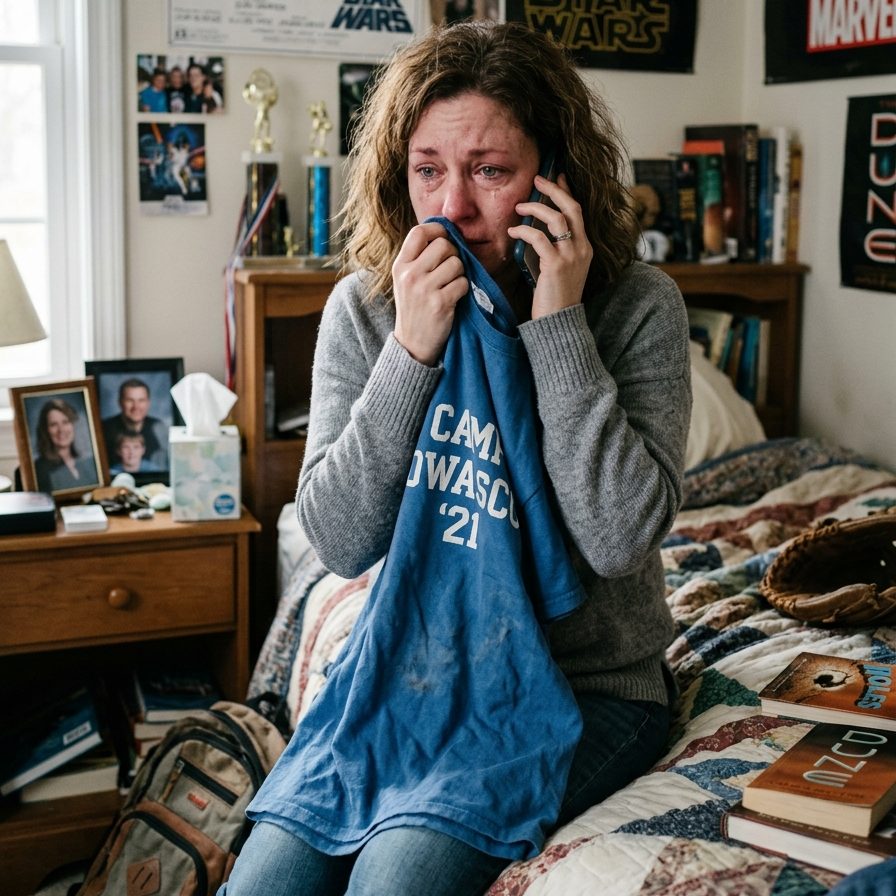
I was on my late son’s bed, clutching one of his T-shirts, when his teacher called to say he’d left something for me at the school. My boy had been gone for weeks. I hadn’t heard his voice or seen his face one last time, and now, out of nowhere, someone was telling me he still had something left to say.
I had Owen’s blue camp shirt pressed against my face when the phone rang.
It still carried a faint trace of him. I sat in his room every day now, surrounded by textbooks, sneakers, and baseball cards, wrapped in a silence that didn’t feel empty so much as cruel.
Some mornings I could still picture my son in the kitchen, flipping a pancake too high and laughing when it landed half on the burner. That was the last morning I saw him alive.
He’d looked exhausted, though he still managed a smile and told me not to fuss when I asked if he was getting enough sleep.
Owen had battled cancer for two years by then. Charlie and I had staked our entire hope on the belief that he would pull through it. That’s why the lake took more than just our son that day. It took the future we had already begun to promise ourselves.
Owen left that morning with Charlie and a few friends, headed to the lake house. By afternoon, my husband was on the phone in a voice I barely recognized. He told me Owen had gone into the water. A storm had rolled in too quickly. The current had swept our son away.
That was the last morning I saw him alive.
Search crews searched for days. They found nothing. They explained what strong currents can do, and eventually resorted to the words families are expected to accept when reality leaves them with nothing solid to hold onto.
Owen was declared gone. No body. No face for me to kiss goodbye.
I broke down so completely they kept me for observation. Charlie handled the funeral because I could hardly stand through it. When there’s no real goodbye, grief never feels finished. It just keeps circling back.
The phone rang again, pulling me out of my thoughts. I finally checked the screen: Mrs. Dilmore.
Owen had adored Mrs. Dilmore. Math was his favorite subject because she made it feel like a game, and he mentioned her at dinner more often than half his friends.
“Hello?” My voice came out thin when I finally picked up.
“Meryl, I’m so sorry to call like this,” Mrs. Dilmore sounded rattled. “I found something in my desk drawer today, and I think you need to come to the school right away.”
“What are you talking about, Mrs. Dilmore?”
“It’s an envelope,” she said. “It has your name on it. It’s from Owen.”
My grip tightened around the shirt. “From Owen?”
“Yes. I don’t know how it ended up there. I only found it today. But it’s in his handwriting.”
I don’t remember hanging up. I just remember rising too quickly and feeling my pulse rush into my throat.
I found my mother in the kitchen, rinsing out a mug. She’d been staying with us since the funeral because I still wasn’t eating enough and still woke in the night calling my son’s name.
“What’s wrong?” she asked.
“His teacher found something. Owen left me something, Mom.”
Her expression shifted with that gentle, grief-stricken recognition only another mother could carry without turning away.
Charlie was at work. Work had become his refuge since the funeral. He left early, came home late, and barely spoke in between. He wouldn’t even let me hold him anymore. The distance between us no longer felt like grief alone. It had started to feel like a locked door I couldn’t open.
At a red light, I glanced at the little wooden bird swinging from my rearview mirror and began to cry. Owen had built it for me last Mother’s Day in shop class. The wings were lopsided. The beak was crooked.
I had called it beautiful, and he’d rolled his eyes and said, “Mom, you’re legally required to say that!”
The school looked just the same when I pulled in. That was unbearable.
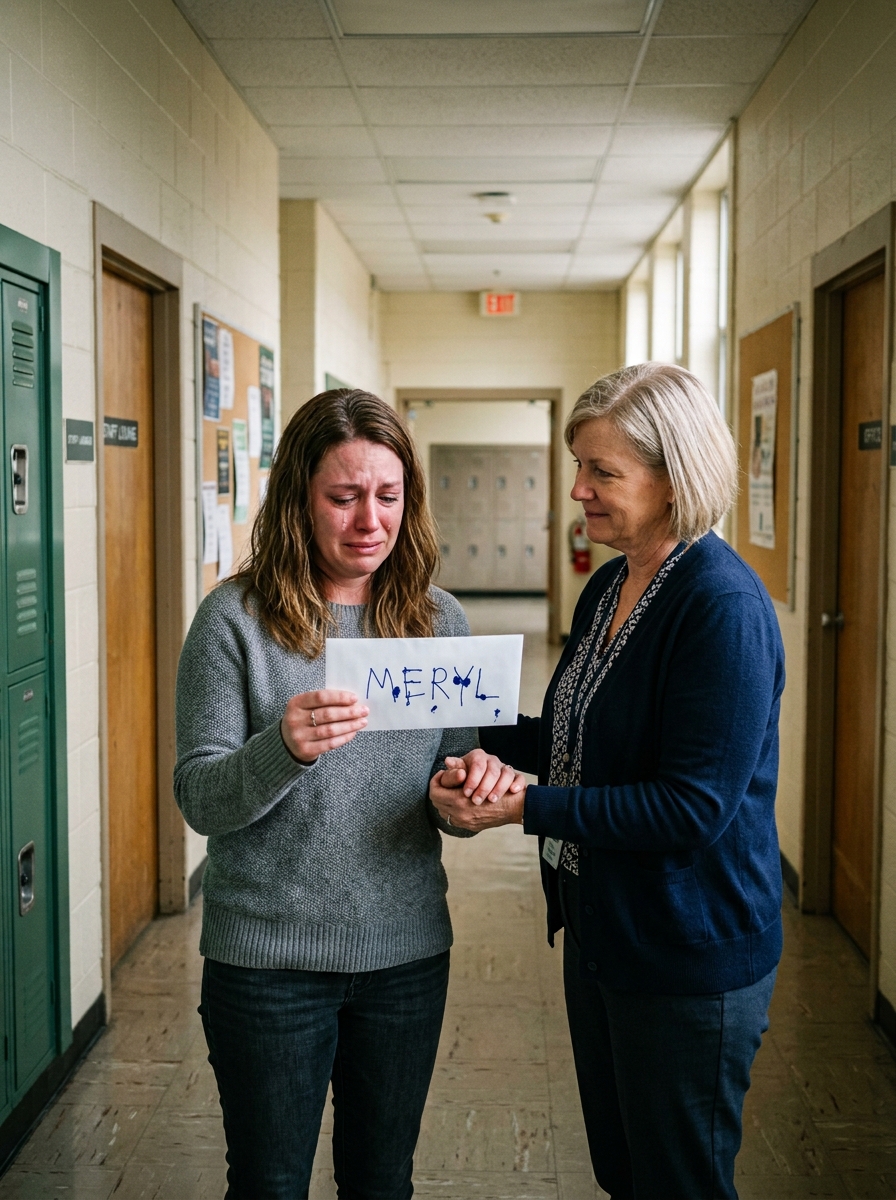
Mrs. Dilmore was waiting by the front office, her face pale. With shaking hands, she offered me a plain white envelope. “I found it tucked in the back of my bottom desk drawer. I don’t know how I missed it before.”
I took it gently, as though the paper might bruise. On the front, in Owen’s handwriting, were two words: For Mom.
My legs nearly buckled right there.
“Would you like to sit?” Mrs. Dilmore asked.
“Please,” I whispered.
She led me to an empty side room with a single table, two chairs, and a window overlooking the field where Owen used to cut across the grass when he thought I wasn’t watching.
Some part of me sensed that whatever was inside would change something, and I was suddenly frightened of yet another change I hadn’t asked for.
I slid a finger beneath the flap. Inside was a folded sheet of notebook paper. The moment I recognized my son’s handwriting, my chest ached so sharply I had to press a hand over it.
“Mom, I knew this letter would reach you if something happened to me. You need to know the truth. The truth about Dad and what has been going on these past few years…”
The room seemed to thin around me. It felt heavy, like a boy trying to say something he’d never found the courage to say while he still could.
Owen had written that I shouldn’t confront Charlie first. He told me to follow him. To witness something myself. Then to go home and check beneath the loose tile under the small table in his room.
No explanation. No tidy answer. Just a trail to follow.
I folded the letter and looked at Mrs. Dilmore. For the first time since the funeral, doubt had entered the room, wearing my son’s handwriting.
I thanked her and rushed to my car. For a moment I almost called Charlie. But the letter had been clear: Follow him. See for yourself.
So I drove to his office and parked across the street.
I sent a text: “What do you want for dinner?”
Charlie’s reply came three minutes later. “Late meeting. Don’t wait up. I’ll grab something out.”
My stomach twisted.
After twenty minutes, Charlie stepped out carrying only his keys, his shoulders slightly hunched in a way I had mistaken for grief alone. I pulled out behind him.
The drive took nearly forty minutes. Then he turned into the parking lot of the children’s hospital across town, a place I knew all too well since it was where Owen had received his cancer treatment. Charlie carried bags and boxes from his trunk inside.
He moved with the ease of someone who knew exactly where he was headed. He nodded at a nurse behind the desk. She smiled warmly and directed him toward the far wing. He ducked into a supply room and shut the door.
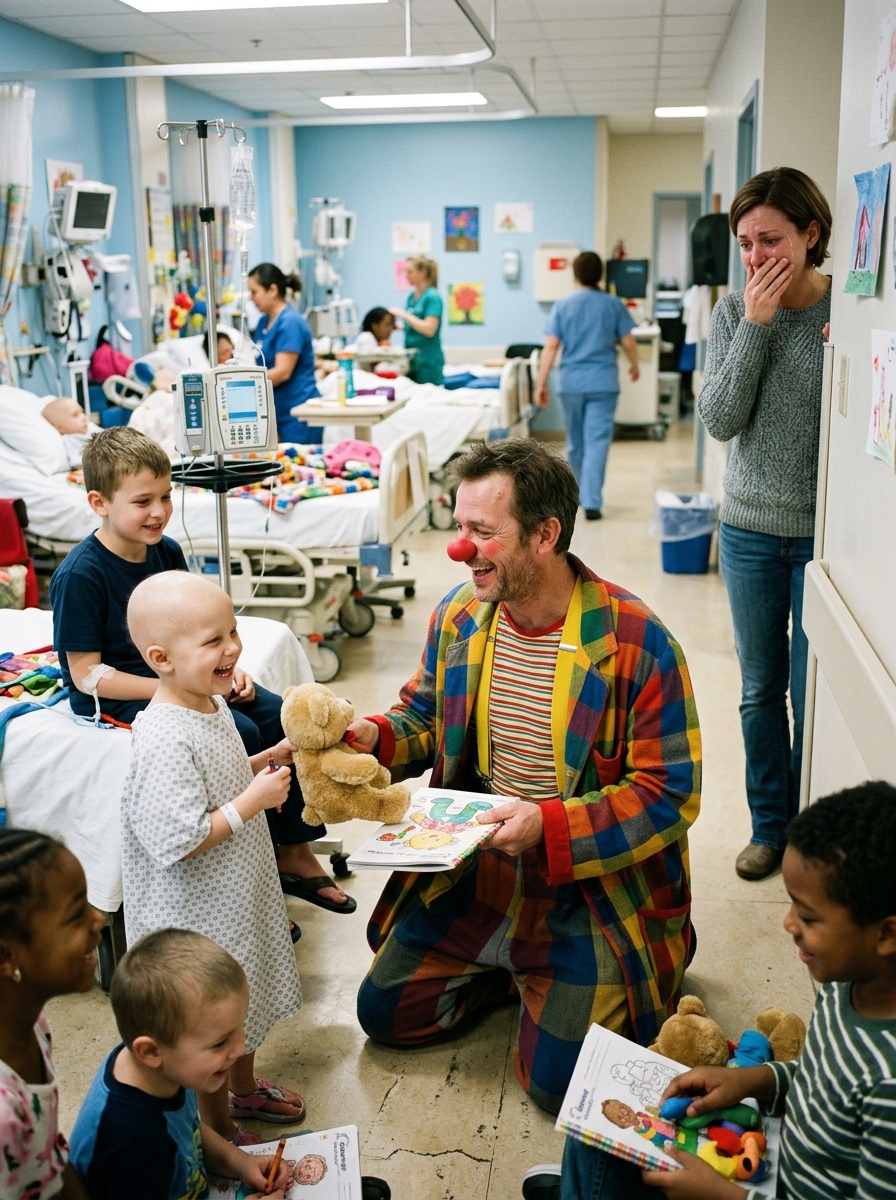
I peered through the narrow window. Charlie was pulling on bright oversized suspenders, a ridiculous checkered coat, and a round red clown nose. Then he drew a deep breath, gathered the bags, and walked back into the hallway.
I quickly ducked behind a wall and watched him step into the pediatric ward. Children were smiling before Charlie even reached the first room. He pulled toys from the bags, passed out coloring books, and did a fake stumble that sent one little girl into fits of laughter.
A passing nurse grinned. “You’re late, Professor Giggles!”
Charlie smiled back.
I stood frozen. Nothing about what I was witnessing matched the suspicion Owen’s letter had sparked in me. I finally stepped into the ward, unable to hold back any longer.
“Charlie,” I called softly.
He froze mid-joke, the smile slipping from his face the instant he spotted me. For a stunned moment, he didn’t move at all. Then he crossed the hall and pulled me into a quiet corner.
Charlie tore off the nose and stared at me. “Meryl… what are you doing here?”
“I should be asking you that,” I shot back. “What’s going on?”
I pulled Owen’s letter from my bag. Charlie saw the handwriting, and all the strength seemed to drain from his face at once. Whatever wall he’d built between us, my son’s handwriting split it wide open.
“Owen wrote to me,” I said. “He told me to follow you.”
“I should’ve told you,” Charlie began.
“Then tell me now.”
He wiped at his eyes. “I’ve been doing this for two years now. Coming here after work, putting on that ridiculous outfit, bringing toys and small gifts, doing whatever I could to make those kids laugh, even just for an hour.”
“Why?” I breathed.
“Because of Owen.”
The words struck me so hard I forgot how to breathe for a second.
“During one of his treatments, Owen told me the hardest part wasn’t the pain. He said it was watching the other kids there looking scared, trying not to cry in front of their parents. He said he wished someone would just make them smile for one hour.” Charlie glanced toward the ward. “So I started coming here after work. Dressed up. Brought presents. I never told Owen. I wanted it to be for him, not because of him.”
I glanced at the letter. “Apparently he found out anyway. And you kept this from me too.”
“I know.” Charlie’s voice trembled. “Those two years felt like one long attempt to keep us both from falling apart. Then, after the lake, I didn’t know how to say anything that wouldn’t sound insane, or too late.”
“You let me think you were just pulling away from me, Charlie.”
“I wasn’t pulling away,” he said. “I was drowning in private.”
I handed Charlie the letter without a word.
He read it right there in the hallway, still half-dressed as a clown, tears falling onto the page before he’d even finished the first paragraph. For the first time since the funeral, I understood his distance hadn’t been rejection. It had been shame, grief, and a secret too heavy to carry without it hollowing him out.
Charlie pressed the paper to his mouth, then looked back toward the ward. “I need to finish in there.”
So he went back. I watched him spend another twenty minutes on jokes and silly dances, his face still swollen from tears. The children laughed. They didn’t care that his eyes were red. They cared that he’d shown up.
When he came back, the coat and nose were gone, and he looked ten years older than he had that morning.
“Let’s go home,” I said.
We went straight to Owen’s room.
Charlie knelt and pried up the loose tile beneath the small table with a butter knife. A small gift box slid into view.
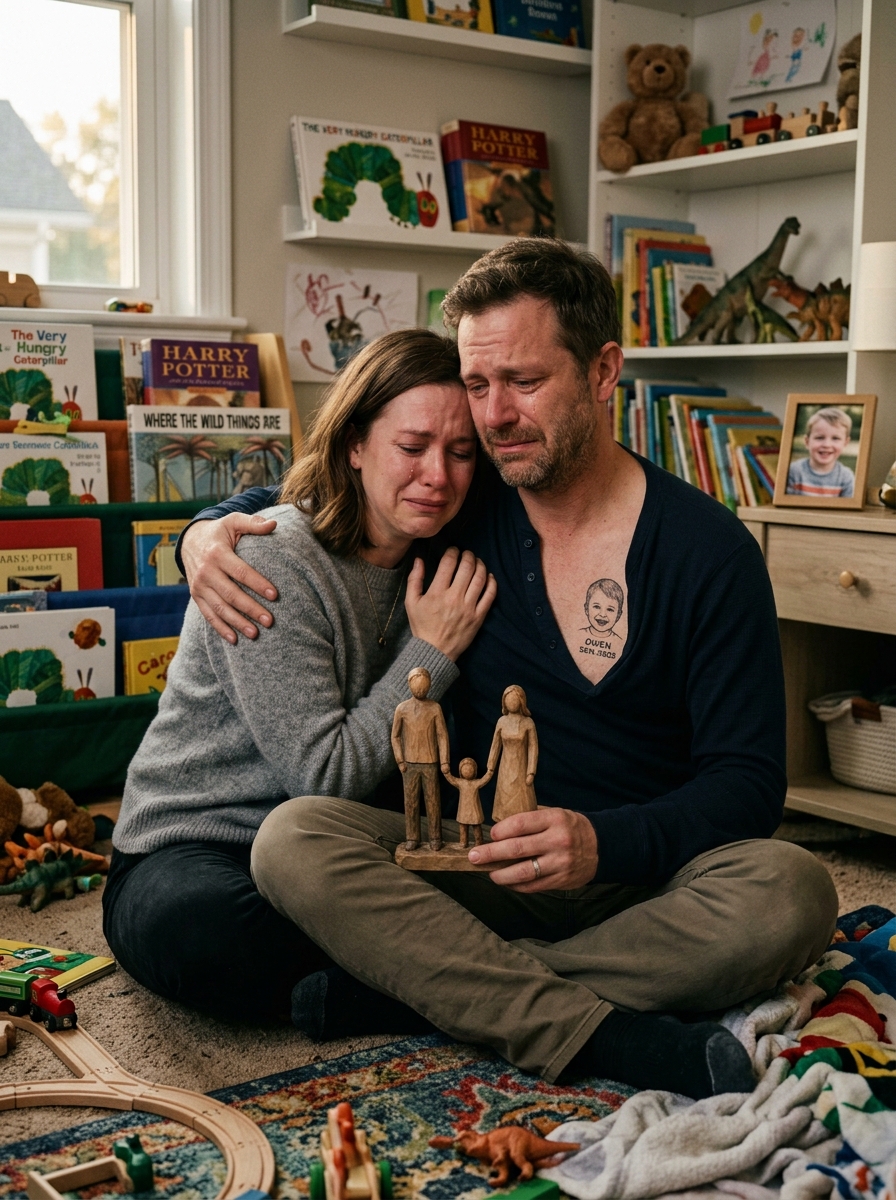
Inside was a wooden sculpture. Three figures: a man, a woman, and a boy standing between them. Smooth in places, rough in others, so unmistakably shaped by Owen’s hands that I had to shut my eyes before I could look again.
Beneath it was another note. We read it together:
“I’m sorry I didn’t just tell you the truth straight out, Mom. I wanted you to see Dad’s heart for yourself before a letter did the talking for me. I know you’ve both been trying, even when it was messy and hard. I also need you to know I was lucky. Not every kid gets parents who love the way you and Dad do. I love you both more than you know.”
I read it twice before I could cry. Then I did. Charlie did too.
We sat on Owen’s floor, holding each other for the first time since the funeral, and this time when I reached for him, Charlie didn’t pull away. He held on like a man who had run out of places to hide.
After a while, Charlie drew back and said, “There’s something else.”
He unbuttoned his shirt. On his chest was a tattoo of Owen’s face, small and detailed, placed right over his heart.
“I got it after the funeral,” Charlie admitted. He looked down at the tattoo, then back at me. “I didn’t let you hug me because the skin was still healing. And I didn’t show you because you hate tattoos, and I couldn’t stand one more thing done wrong.”
I laughed through my tears. The first real laugh since before the lake.
“It’s the only tattoo I’ll ever love,” I told him.
The moment didn’t undo what grief had done to us. But Owen had still found a way to bring us back into the same room, under the same truth, holding the same love.
And for a boy of thirteen, that was one more miracle from a child who had already given us everything.
