

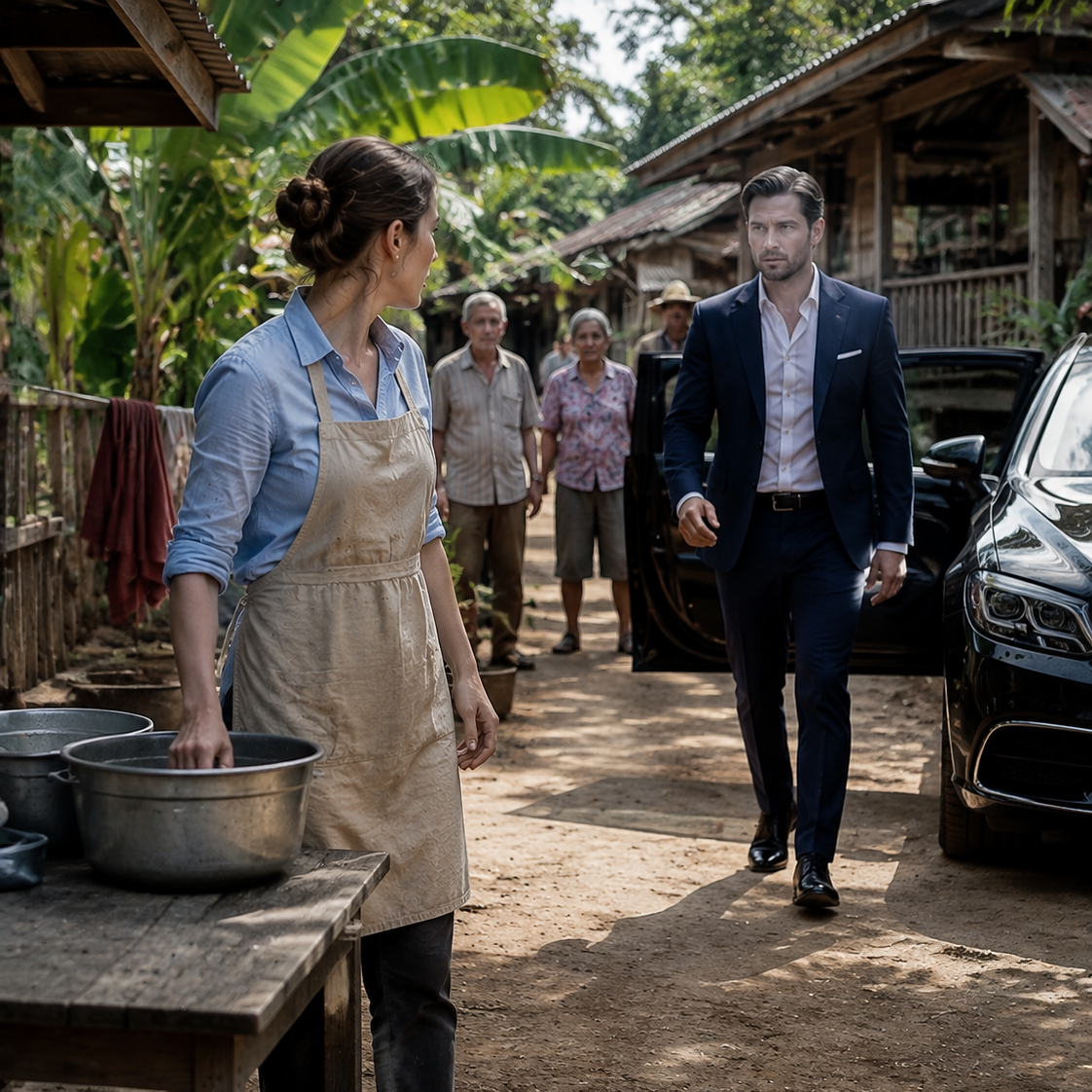
The black car arrived with such quiet ease that, for a heartbeat, Elena Ward thought she’d imagined it.
She was standing in her yard, elbows damp, hands raw from soap and water, hunched over a dented metal basin of laundry when the shadow slid across the ground. One instant there was only the thick summer heat, the drone of cicadas, and the familiar weight of village eyes on her back. The next, a sleek black car with windows dark as polished stone rolled to a stop outside her broken front gate.
In a place like this, a car like that was never just a vehicle. It was a statement.
Elena straightened slowly, water running down her wrists. Across the road, a curtain shifted. Then another. A neighbor who’d spent years dressing cruelty up as politeness leaned far over a fence post, watching.
The village never needed much to feel alive. For ten years, Elena and her son Jamie had been enough on their own.
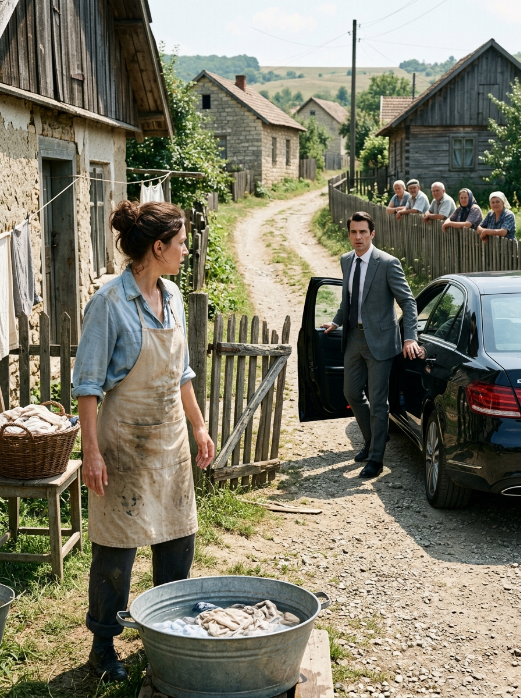
She could already feel the whispers gathering, like insects swarming.
“Who’s that for?”
“Maybe she finally hooked some rich fool.”
“Or maybe her past caught up with her.”
Elena ignored them the way she’d learned to ignore hunger, exhaustion, and pain. Silence had become her armor. It had carried her through a decade of stares, sharpened smiles, and murmurs that always died down a beat too late.
She had endured all of it for one reason.
Inside the house, a boy’s laugh briefly drifted through the open window.
Jamie.
Ten years old. Slim, bright, endlessly curious. He carried Elena’s stubbornness and a face that had unsettled her since the day he was born, though she’d never once spoken that truth out loud.
Every morning she walked him to school with her chin held high, even as the road behind them filled with pity twisted into judgment.
“Poor kid.”
“No father in the picture.”
“She still won’t say who the man was.”
They never said it to her face. Villages never did. Cowardice always wore the mask of concern.
Elena pushed through all of it. At dawn she opened the small café in the square, wiping down tables before anyone arrived. By noon she was hauling trays until her wrists ached. At night she scrubbed floors in homes far grander than her own, polishing the comfort of people who wouldn’t let their daughters sit too close to Jamie.
And every night she came home worn out, Jamie would look up at her with that open, trusting face and ask, “Are you tired, Mom?”
Her answer never changed.
“A little. But not from anything that matters.”
Because as long as he smiled, she believed she could carry anything.
At least, she believed that until the day he asked the question she’d dreaded since the moment she first held him.
It happened the previous winter. Snow pressed against their small windows, the stove ticking softly in the corner while Jamie worked through math problems at the table. He’d been unusually quiet.
Then he looked up.
“Mom,” he asked, “why don’t I have a dad like the other kids?”
The room went utterly still.
Elena felt something inside her chest crack—not loudly, not dramatically, but with the slow inevitability of ice giving way under a weight it had held too long.
She crossed the room and knelt in front of him. She smiled the way mothers do when they’re closest to breaking.
“Your dad had to go far away, sweetheart,” she whispered. “But he loved you even before you were born.”
Jamie studied her with that unsettling seriousness kids sometimes carry, as if he could sense the fragile spots where grown-ups hide their truths.
“Will he come back?”
And Elena—who could bear labor, shame, exhaustion, and loneliness without a word—nearly broke in front of her own child.
“I don’t know,” she said.
What she never told him was that ten years earlier, she hadn’t even known the man’s full name.
She’d been twenty-two, driving home through a violent autumn storm after a late shift at the café. Rain hammered the windshield so hard the road dissolved into streaks of white. Then the engine died.
Fear came first. Her phone was dead. The road was empty. The night swallowed everything past the glass.
Then headlights appeared behind her.
A man climbed out of an old truck, walking through the rain with a flashlight slicing through the dark. Even after ten years, the first thing she remembered wasn’t his face, but the calm in his voice.
“You alright?”
He’d been young then, though not boyish. Tall. Dark-haired. Composed, but never arrogant. There was a carefulness about him, like every word was weighed before it left his mouth.
He got her car running just enough to reach a roadside diner a few miles off—the only place still lit against that storm. The weather stranded them there until morning.
It should have meant nothing.
It should have been forgettable.
But sometimes two worn-out strangers sit across from each other over cheap coffee and end up speaking more honestly than they do in entire lifetimes elsewhere. Elena told him about her mother’s illness, about debt, about feeling invisible. He listened fully, without cutting in, as though her life actually mattered.
He gave away less. She remembered that clearly. He spoke vaguely of travel, business, mistakes he couldn’t take back. When she asked where he was from, he brushed it off with a faint smile. When she asked about family, something dark crossed his face.
But when dawn finally broke, pale and trembling through the windows, he looked at her as if he’d found something rare in the middle of ruin.
In that gray morning light, something unspoken passed between them—tenderness born not of recklessness, but of recognition.
And then he left.
He gave her enough money to fix the car, nothing more. No number. No address. Only a name, spoken once, softly, as though it might never matter again.
Adrian.
Weeks later, Elena found out she was pregnant.
She searched until hope curdled into humiliation. The diner had no record of him. The truck had been borrowed. No one remembered enough. The world beyond the village had swallowed him whole.
By the time Jamie was born, she understood the truth: whatever had happened that stormy night belonged to the kind of miracle that doesn’t circle back.
So she built a life out of what was left.
And now, ten years later, a luxury car sat outside her gate.
The driver’s door opened.
A man stepped out in a perfectly tailored gray suit, sunlight catching on his watch. Older. Sharper. Composed in a way that spoke of years spent far from the man she remembered.
But memory is loyal in its cruelty.
The line of his jaw. The eyes. The stillness before he spoke.
Elena’s breath caught.
It was him.
“Elena?” he said.
Hearing her name in his voice after ten years hit her harder than anything she’d ever had to endure.
The village went quiet in that hungry, collective way crowds do when they sense something irreversible about to unfold.
Elena couldn’t move.
The man stared at her, his shock plain—not polite recognition, but something deeper, as if he too had been haunted by that single night.
“I’ve been looking for you,” he said.
The words tore through the afternoon like an open wound.
Before Elena could answer, the front door creaked.
Jamie appeared in the doorway, blinking into the sunlight. His cream shirt was buttoned slightly askew, his hair mussed from restless fingers. He looked first at the car, then at Elena, then at the stranger.
“Mom?”
The man turned.
And froze.
It happened fast enough that even the neighbors caught it. His expression shifted like lightning exposing what had been hidden in the dark.
His eyes traced Jamie’s face and stopped there.
The resemblance was impossible to miss. Undeniable.
Same eyes. Same brow. Same mouth when uncertain.
He stepped forward without seeming to realize it.
“Is…” His voice cracked. He tried again. “Is he my son?”
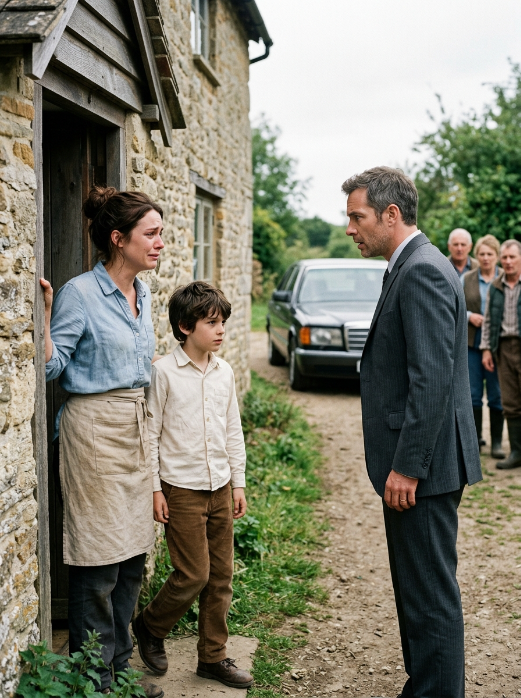
Elena’s throat tightened. Ten years of isolation surged up all at once—every insult, every night spent afraid, every illness endured alone, every school meeting where other parents stood together while she stood apart.
Tears welled in her eyes.
“Yes,” she whispered.
A sound escaped the man—not quite a laugh, not quite a sob. He covered his mouth with his hand and turned away as though even the sky had tilted.
Jamie frowned. “Mom… who is he?”
Elena opened her mouth, but the man spoke first.
“My name is Adrian Vale,” he said slowly, weighing every word. “And I think… I think I’m your father.”
The road went dead silent.
Then every whispered insult Elena had carried for ten years seemed to turn back on the ones who’d spoken them. The women at the fences stared openly now. The men on the porches shifted, uneasy. A black luxury car, a tailored suit, a name some of them clearly recognized—suddenly their version of Elena’s story no longer made them feel superior. It made them feel small.
Jamie looked from Adrian to Elena and back again. “You’re my dad?”
Something raw broke across Adrian’s face.
“If she says I am,” he said, “then yes.”
Jamie stood frozen. He’d imagined this moment before, Elena knew. Not like this, not with dust and onlookers and a car gleaming at the gate like something out of a dream—but he’d imagined it. Children always do.
“Why didn’t you come before?” he asked.
Some questions shouldn’t be spoken in front of strangers. Yet there, in front of everyone, a child’s voice cut cleanly through ten years of shame.
Adrian closed his eyes for a moment.
“When I left that morning,” he said, “I was put on a plane within hours. My father had a stroke. Everything in my life fell apart after that. By the time I came back to find you, the diner had new owners. No one remembered your name. I never stopped looking.” He looked at Elena then, and for the first time she heard helplessness in a wealthy man’s voice. “I never stopped trying.”
Elena wanted to believe him.
And that was exactly why fear came first.
Because hope, after long suffering, can feel more dangerous than despair.
The villagers were creeping closer now, unable to help themselves. One of the women who’d once joked that Elena had made the whole thing up pressed a hand to her chest in exaggerated shock.
Adrian noticed.
His expression changed.
Not hardened—clarified.
“May I come inside?” he asked Elena.
She hesitated.
Jamie, to her surprise, answered before she could. “Yes.”
So Adrian stepped through the gate.
That simple movement felt like it split Elena’s life in two.
Inside, everything suddenly looked smaller. The faded curtains. The mismatched chairs. The peeling wallpaper in one corner now read like proof of failure she’d never noticed until a wealthy man stood in the middle of it.
Adrian seemed oblivious to all of it.
He took in Jamie’s drawings on the table. The mended schoolbag by the door. Elena’s one pair of work shoes drying by the stove even in summer, because the sole had torn that morning and she’d washed off the mud. He looked at their life like he was examining a wound he’d unknowingly caused.
They sat.
Jamie perched on the edge of his chair, afraid that breathing too deeply might shatter the moment.
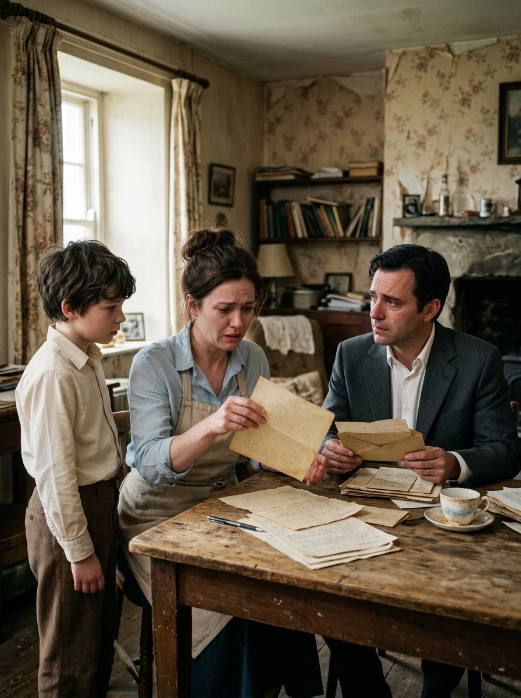
Adrian reached into his jacket and pulled out an envelope.
“Elena,” he said, “I know how this looks. I know I have no right to ask anything of you. But I need you to hear me out before you decide what happens next.”
He slid the envelope across the table.
Inside was a photograph.
Elena stared at it, and the room seemed to tilt.
It showed Adrian, ten years younger, standing beside another woman. Beautiful. Elegant. Dark-eyed. One hand resting on a pregnant belly.
Beneath it, a newspaper clipping: MISSING HEIRESS FOUND DEAD AFTER CAR PLUNGES INTO RIVER.
Elena slowly raised her eyes.
Adrian had gone pale.
“That was my wife,” he said. “Or rather, the woman my family forced me to marry. She vanished the same week I met you. They told me she’d died. Months later I learned she’d given birth before the crash.” His voice dropped almost to nothing. “The child disappeared.”
Elena frowned, confusion tightening her face. “What does that have to do with Jamie?”
Adrian looked at her with an expression she would never forget for the rest of her life.
Everything in him seemed caught between collapse and revelation.
“Because,” he said, “I came here today to ask whether you ever heard from me.”
Elena blinked.
“What?”
He swallowed. “A letter was sent to your village ten years ago. With money, my full name, everything. It never reached you.”
The ground under Elena seemed to shift.
“I never got any letter.”
“I know. Because three months ago my lawyers found it in my late father’s private files. Unopened. Hidden.” Adrian’s hands began to shake. “He’d had me watched after that storm. When he found out about you, he made sure you were erased from my life.”
Elena felt nausea rise.
Jamie looked between them now, confused and unsettled.
Adrian leaned forward.
“There’s more.” His eyes shone with tears he no longer tried to hold back. “The woman in that photo—my wife—didn’t die in that river.”
No one spoke.
“Elena,” he said hoarsely, “she survived. She took our newborn daughter and ran.”
The words hung in the air like a curse.
Then, softly, with an almost surgical precision, he added:
“Three weeks ago, she died in a clinic two towns away.” He looked at Jamie, then back at Elena. “Before she died, she told them the daughter she’d taken from me had been living under another name for years.”
Elena’s heartbeat turned violent, like it might break through her chest.
Adrian’s next words shattered everything.
“Her name,” he whispered, “was Elena Ward.”
Silence exploded.
Elena stared at him, unable to process it.
“No,” she said. “No. That’s impossible.”
Adrian reached back into the envelope and pulled out one last document—a birth record, worn and yellowed, bearing a name she’d never seen.
A female infant. Missing. Illegally placed through a village midwife connected to Adrian’s father’s estate.
Elena’s hands trembled as she read.
Then she saw it.
A note attached, in shaking handwriting:
She never knew. I took her from you, and years later fate brought you together again. The boy is yours twice over. Forgive me.
Elena couldn’t think. Couldn’t speak. Couldn’t cry.
Across the table, Adrian looked as broken as a man can look while still standing upright.
Jamie, small, frightened, unaware of the abyss beneath him, whispered, “Mom?”
Elena lifted her eyes to Adrian.
In them she saw no victory, no deceit—only the same devastation tearing through her own soul.
The man from the storm.
The father of her child.
And now, if the document was true, the man who had unknowingly fathered a son with the daughter stolen from him ten years before.
Outside, the village still waited for gossip.
Inside, something far heavier had already arrived.
And as the paper slipped from Elena’s shaking fingers and fell to the floor, she understood with chilling clarity that the whispers that had once destroyed her life were nothing compared to the truth that had just walked in the door.
