


— That comes to 18,760 pesos and 50 cents.
The cashier said it courteously, though she couldn’t keep her eyes from drifting to the overflowing cart.
Imported Serrano ham, canned salmon, European cheeses, gourmet chocolates, a French cookware set, pricey perfumes, and even a designer handbag my sister-in-law had picked up “just to look at” before quietly setting it on the belt.I was standing between my mother-in-law and sister-in-law in an upscale Polanco supermarket, watching the receipt spool out of the machine like an endless white ribbon.
Doña Soledad pressed a hand to her chest and opened her purse with dramatic slowness.
— Oh, what a shame, — she said. — I left my wallet at home.
Marisol, my sister-in-law, did the exact same thing.
She checked her pockets, opened a tiny designer clutch, and let out a light laugh.
— I don’t have a card on me either. So embarrassing.
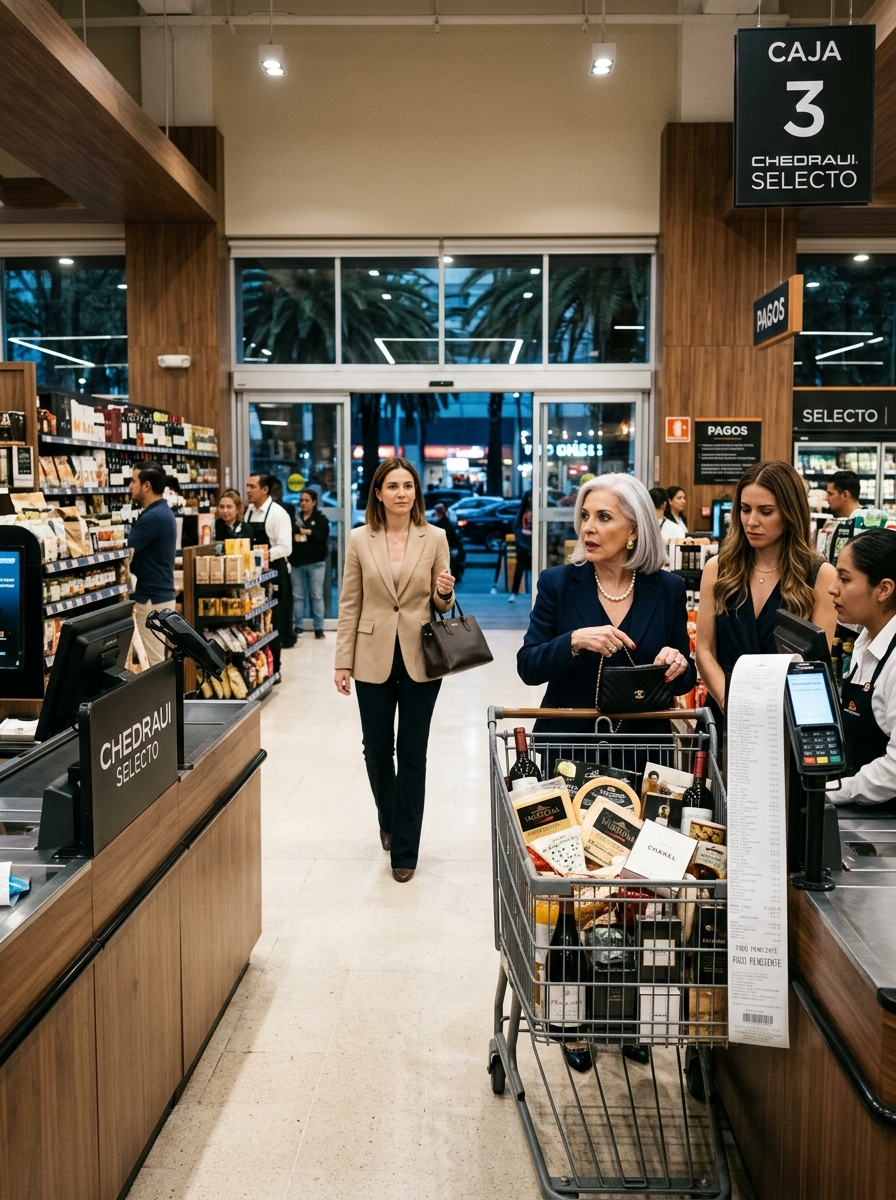
Then both of them turned toward me.
They didn’t say “pay.”
They didn’t have to.
Four years into my marriage, that look alone had always been enough.
A dinner where my mother-in-law “forgot” her cash. A new phone for Marisol she’d “pay me back for later.” A perfume, a manicure, a blowout, a family meal, a made-up emergency. It always ended the same way: Renata paid.
Renata Salazar — the daughter-in-law with a bank job, a “solid income,” who shouldn’t be cheap because “family looks out for each other.”
But that Saturday, standing at the register with a line forming behind me and the cashier waiting, something inside me shut for good.
I didn’t raise my voice.
I didn’t argue.
I didn’t explain myself.
I simply smiled.
— One moment, — I said. — There’s something I need to take care of first.
Doña Soledad frowned.
— What thing? Just pay already. People are waiting.
— I’ll be right back.
I grabbed my bag, turned, and headed for the exit.
— Renata! — Marisol called after me. — What are you doing?
I didn’t respond.
The automatic doors slid open and the warm street air met my face.
Outside, Mexico City carried on as if nothing had happened — cars, honking, people carrying shopping bags, street vendors on the corner.
I lifted my hand and hailed a taxi.
— Coyoacán, please, — I told the driver.
As we pulled away, I glanced back at the glowing supermarket.
Inside, my mother-in-law and sister-in-law were still standing beside a bill of nearly nineteen thousand pesos, everyone around them watching.
For once, I wasn’t the one left to smooth over someone else’s embarrassment.
My phone started buzzing before I even got home.
Soledad. Marisol. Soledad. Marisol.
I silenced it.
When I got to the apartment I shared with my husband, Iván, I set my bag down on the table and exhaled like I’d just left an airless room.
Everything around me carried a trace of my money: the dining set I’d paid for, the TV I’d financed, the living room furniture my mother-in-law had picked out using my credit card because “it was for the family.”
I sat and called Iván.
— Done with the shopping? — he asked, casual.
— Get to the Polanco supermarket. Your mother and sister have something you need to deal with.
— What happened?
— You’ll see when you get there.
— Renata, don’t be cryptic. My mom’s calling me nonstop.
— Then hurry.
I hung up.
I already knew what he’d try. He’d ask me to come back, cover it “for now,” and promise to talk to his mother afterward. That phrase — “I’ll talk to her later” — was where every complaint I’d ever raised had gone to die.
When I married Iván, I believed a woman with her own career and income would be treated as an equal. I was a bank account executive — organized, reliable, driven. But just weeks after the wedding, Doña Soledad called me into the kitchen.
“There’s a family fund in this house,” she said. “Now that you’re one of us, you hand over your salary and I’ll manage it.”
I assumed she meant a fair contribution.
I asked how much.
— Bring me your payslip and I’ll decide.
I stood there, frozen.
I looked at Iván.
He only said:
— Just listen to my mom. She knows how to run this house.
That first month I transferred almost my whole salary, keeping just enough for transport, food, and basics. After that, whenever I asked for money for a course, work clothes, or a night out with friends, Doña Soledad made me feel like a thief.
Marisol, meanwhile, never asked for anything.
She was showing up with new phones, boots, hair extensions, facial treatments — every few weeks something new.
I asked once:
— Where’s all that coming from?
Doña Soledad’s eyes went cold.
— From wherever it needs to. Don’t question what isn’t your business.
I understood perfectly.
It came from me.
At first I put up with it out of love for Iván. Then out of exhaustion. Then out of fear of becoming “the difficult daughter-in-law.”
Until one afternoon I came home early and overheard Doña Soledad tell Marisol from down the hallway:
— Let Renata cover it. She won’t do anything about it.
That sentence woke me up.
From then on, I started keeping records — receipts, screenshots, transfers. Not to pick a fight, but to remind myself just how long my patience had been tested.
And that day at the supermarket, I finally did something about it.
I didn’t pay.
PART 2
Iván called twenty minutes later.
His voice had lost all its composure.
— Did you really leave my mother at the register with eighteen thousand pesos of groceries? — he asked.
— I didn’t put a single thing in that cart.
— Renata, everyone’s staring at them.
— Exactly why it’s on you to fix. You’re her son, her brother. Handle it.
A pause, full of swallowed anger.
— Just transfer the money and we’ll talk about it at home.
— No.
— Don’t be stubborn. My mom says she really did have the money, she just forgot it.
— Then she can go home for it, or leave the items behind. Not my problem.
I could hear Doña Soledad’s voice through the phone.
— Tell her to come back. What kind of daughter-in-law leaves her mother-in-law standing there like a beggar?
I smiled, bitterly.
— Hear that, Iván? Your mother still thinks I’m the problem. Not the bill she can’t cover.
I hung up.
That night Iván walked in with his face flushed. He dropped his keys on the table without a word of greeting.
— You humiliated her.
I’d already prepared a folder.
I set it in front of him.
— Go through this. Then we’ll talk.
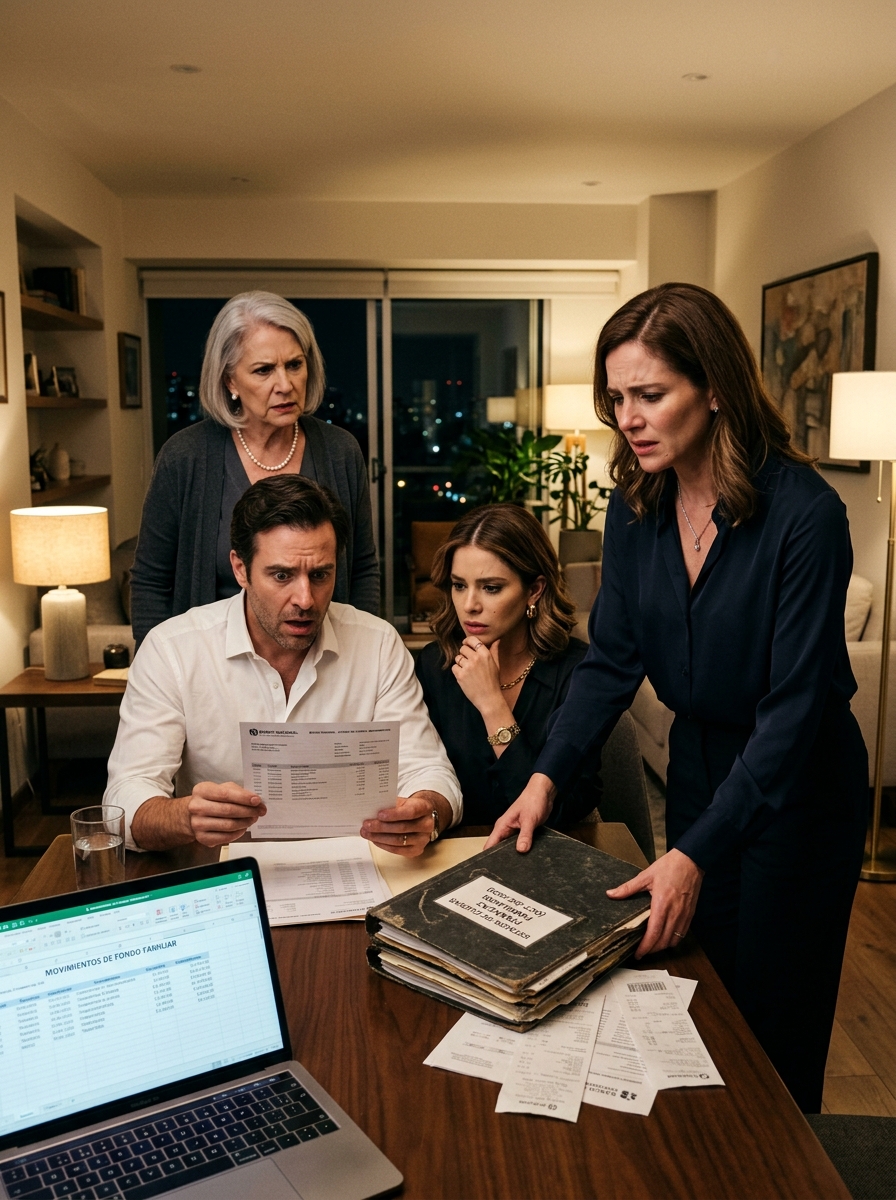
Inside were four years of bank statements — transfers to the so-called family fund, restaurant charges, receipts for Marisol’s phone, bills for perfume, clothes, and loans that were never paid back.
Iván flipped through the pages fast at first, then slower.
— What is all this?
— My money.
One figure was circled in red: one million one hundred twenty thousand pesos.
Not exact to the peso, but enough to change the look on his face.
— I didn’t realize it had added up to this much.
— You didn’t realize because you never wanted to.
Right then Doña Soledad walked in, Marisol trailing behind her. They came in outraged, still dressed in what they’d worn to the supermarket, minus the bags.
— The nerve! — my mother-in-law snapped. — After humiliating us, you come home to settle scores?
I stood up.
— What was actually shameful was filling a cart with luxury items and no way to pay for it.
— I told you, I forgot.
— And I’m telling you, I’m done covering for your forgetfulness.
Marisol let out a sharp laugh.
— Honestly, sister-in-law, so dramatic. Your mask is slipping over a few pesos.
I looked at her.
— It’s not a mask. The blindfold just came off.
I picked up the remote and connected my phone to the TV.
The full history of the family fund appeared on screen.
One transfer stood out: two hundred forty thousand pesos into Marisol’s account.
Iván didn’t move.
— What is this?
Marisol went white.
Doña Soledad answered for her:
— I lent it to her. She’s my daughter.
— With money I put in, — I said.
— That money belonged to the household.
— Then the household deserves to know what happened to it.
For the first time, Iván raised his voice at his mother.
— What was two hundred forty thousand pesos for?
Marisol started crying.
— A nail and beauty business. I was going to pay it back.
— Where’s the shop? — I asked.
Silence.
— Where’s the contract? The invoices? The business plan?
Nothing.
Doña Soledad slammed her fist on the table.
— You have no right to interrogate my daughter.
— I have every right to know what happened to my money.
The silence turned heavy.
Iván stared at the screen like he was seeing his own home for the first time.
I knew that confrontation alone wouldn’t save the marriage, but it would be enough to break a lie wide open.
“Starting today,” I said, “I’m not putting another peso into that fund. I manage my own salary. If there are real shared expenses, we discuss them with receipts. Anyone who wants perfume, imported ham, or handbags can buy it with their own money.”
Doña Soledad pointed a finger at me.
— In this house, daughters-in-law don’t give orders.
— I’m not giving orders. I’m just done taking them.
I thought that night marked the end of it.
I was wrong.
Three days later, while I was at the bank, a colleague from the credit department called me over to her desk.
— Renata, I need to confirm something with you. There’s a personal loan application under your name for three hundred eighty thousand pesos.
The color drained from my face.
— I never applied for any loan.
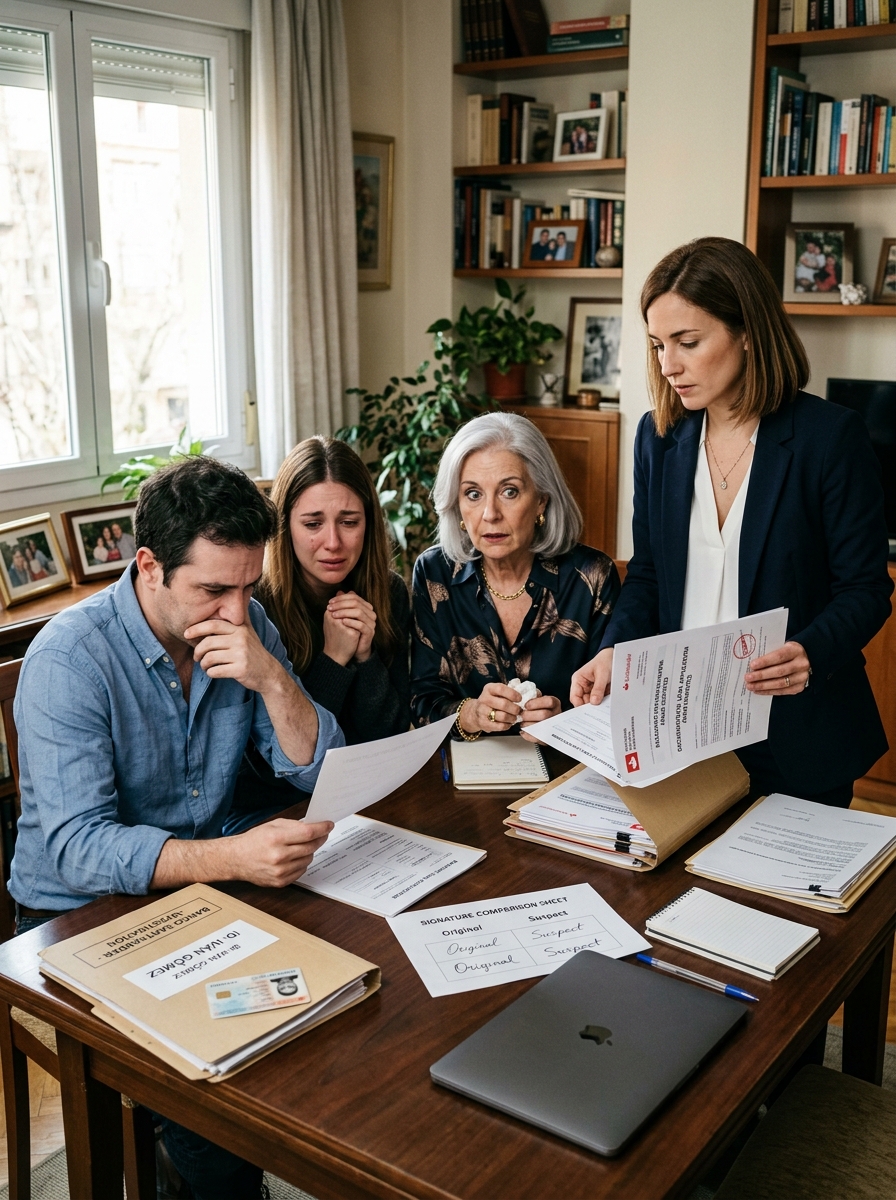
She showed me the file: my information, a copy of my voter ID, proof of address, a bank statement, and a signature that looked like mine but wasn’t.
Marisol’s name was listed as guarantor.
That’s when I realized the supermarket had only been the surface of it.
I brought a copy of the file home.
I laid the papers on the table.
— Who used my documents to apply for a loan?
Doña Soledad denied everything.
Marisol was shaking.
“I have no idea what you’re talking about,” my mother-in-law said.
I pointed to Marisol’s name.
— Then ask your daughter why she’s listed as guarantor.
Iván walked in at that exact moment.
He read the file and went pale.
— Mom… what did you do?
Marisol broke down.
— It was only supposed to be temporary. Mom said Renata would never find out. We were going to pay it off before the first due date.
Doña Soledad shouted: “Be quiet!”
There was no undoing it now.
I pulled out my phone and opened an email addressed to the bank’s legal department.
— If I send this, it opens a formal investigation.
Iván grabbed my wrist.
— Renata, please. Let’s handle this at home.
I looked him straight in the eye.
— Handling it at home means covering it up while I’m the one stuck with the debt?
He said nothing.
I pulled my hand free.
— Two bank officers are coming tomorrow to verify my signature. This time there will be witnesses.
And if my mother-in-law had believed she could turn a crime into a family squabble, the next day she’d learn that paperwork doesn’t cry — it convicts.
FINAL PART
At ten in the morning, two bank employees arrived with badges and a sealed folder.
Doña Soledad, who’d spent the whole night insisting it was all “a misunderstanding,” rearranged her expression the second she saw them.
She turned gracious, almost sweet.
— Oh, there was really no need to come all this way. We can sort this out as a family.
I offered them water and answered before she could keep going.
“We’ve been sorting things out as a family for four years. That’s exactly how my signature got forged.”
Iván looked at me, stung.
— Renata…
— Don’t soften it.
The employees compared my real signature to the one on file. They checked dates, pulled recorded authorization calls, and reviewed the submitted documents.
When the officer asked who had access to copies of my ID, I looked straight at Doña Soledad.
— She kept my documents so they “wouldn’t get lost.”
Marisol covered her face.
The officer didn’t mince words: “If Mrs. Renata confirms she didn’t sign this, the bank has to cancel the transaction and refer it to legal. Depending on the investigation, there could be criminal consequences.”
At the word “criminal,” Doña Soledad’s breath caught.
“No need to blow this out of proportion,” she said. “Nobody stole anything. We only wanted to help Marisol.”
— Using my name, — I replied.
— You’re part of this family.
— I’m not a signature up for grabs.
That line ended the conversation.
After the employees left, Doña Soledad started calling relatives. Within the hour the living room was packed with outraged aunts and cousins. She wept in the center of it all like a dethroned queen.
An aunt pointed at me.
— A good wife doesn’t tear down her husband’s mother.
I laid out the file, the statements, and played the recording where Marisol admits “Mom said Renata wasn’t going to find out.”
The room went silent.
No one apologized.
They just started studying the floor.
That’s how family shame works: loud when it thinks the truth is on its side, silent the moment evidence shows up.
That night Iván came into our room. His eyes looked hollowed out.
— I’m sorry, — he said. — I never thought they’d go this far.
I was packing a suitcase.
— What are you doing?
I set the divorce papers on the bed.
— I had these ready the moment I understood you were never going to protect me.
His voice cracked.
— I can change. I’ll ask my mom to move out. I’ll shut down the fund. I’ll set boundaries.
— You want boundaries now, because the law walked in. Not because you watched me bleed money for four years.
— Renata, I love you.
I looked at him, worn out.
— Maybe. But you loved your own comfort more.
Just then Doña Soledad appeared in the doorway.
— If you walk out, you leave with nothing but the clothes on your back. Everything you gave was voluntary.
I pulled out my phone and played another recording.
Her own voice filled the room: “Renata’s salary belongs to the household. If she earns well, she should contribute. That’s what a daughter-in-law is for.”
Doña Soledad had nothing to say.
Iván stepped between us when she lunged for the phone.
— Enough, Mom!
It was the first time I’d seen him take my side against her.
But it came too late.
I calmly zipped my suitcase shut.
— I’m not leaving angry. I’m leaving because I don’t trust any of you anymore.
I walked out of that house without a single tear.
Not because it didn’t hurt — but because I’d already cried plenty when no one was paying attention.
The bank canceled the loan before any money went out.
Marisol was flagged in the bank’s internal risk system and had to sign, alongside her mother, a legal agreement to answer for the forged documents.
Doña Soledad never went to prison, but she lost something that stung more: her authority. No one in the family could hear her complain again without remembering the case file.
Iván reached out weeks later. We met at a neutral café.
— My mom moved in with a cousin. Marisol’s working at a beauty salon now. Everything fell apart.
— It didn’t fall apart because of me.
— I know.
— It fell apart because you all built a household where one person paid and everyone else decided.
He lowered his head.
— Is there any chance for us?
I looked at him with a quiet kind of sadness. In front of me stood the man I’d once loved — not a monster, just something harder to forgive: a coward who’d woken up too late.
— I can’t go back to a house where I needed the bank to be believed.
We signed the divorce papers without much of a fight. He knew that if he pushed back on anything, I had more than enough evidence to make it far bigger than he wanted. I wasn’t trying to destroy him. I just wanted a clean exit.

Six months later, my life looked completely different.
I rented a small apartment in Narvarte, with a window that let in the morning light.
I stopped bankrolling other people’s luxuries and finally paid for the specialization course Doña Soledad had blocked me from taking so many times. At the bank, I was promoted to deputy branch manager.
The day my first raise came through, I took my parents out to dinner.
My mother asked if I was okay.
“I’m learning,” I told her.
— Learning what?
— Not to feel guilty for taking care of what’s mine.
She squeezed my hand.
With part of my savings, I bought my father a proper chair for his back and my mother a new refrigerator.
Not because anyone asked.
Not because I’d be called selfish otherwise.
But because I wanted to.
That’s when I finally understood the difference.
Helping out of love feels light. Paying out of obligation feels like a chain around your neck.
Sometimes I still picture Doña Soledad and Marisol standing at that register, surrounded by expensive items and other people’s stares.
Plenty of people would say I should’ve just paid to avoid the scene. That a daughter-in-law is supposed to protect the family’s image. That eighteen thousand pesos isn’t worth a divorce.
But it was never about eighteen thousand pesos.
It was four years.
It was my salary, my canceled courses, my quiet nights, my name used without my permission, and my dignity laid out on the counter for the taking.
I didn’t abandon my mother-in-law that afternoon.
I got myself back.
And if there’s a woman out there reading this while sitting next to an account that isn’t hers, I want her to know one thing: you don’t always have to raise your voice to draw a line.
Sometimes all it takes is a smile, your own bag, and letting everyone pay for what they chose.
