

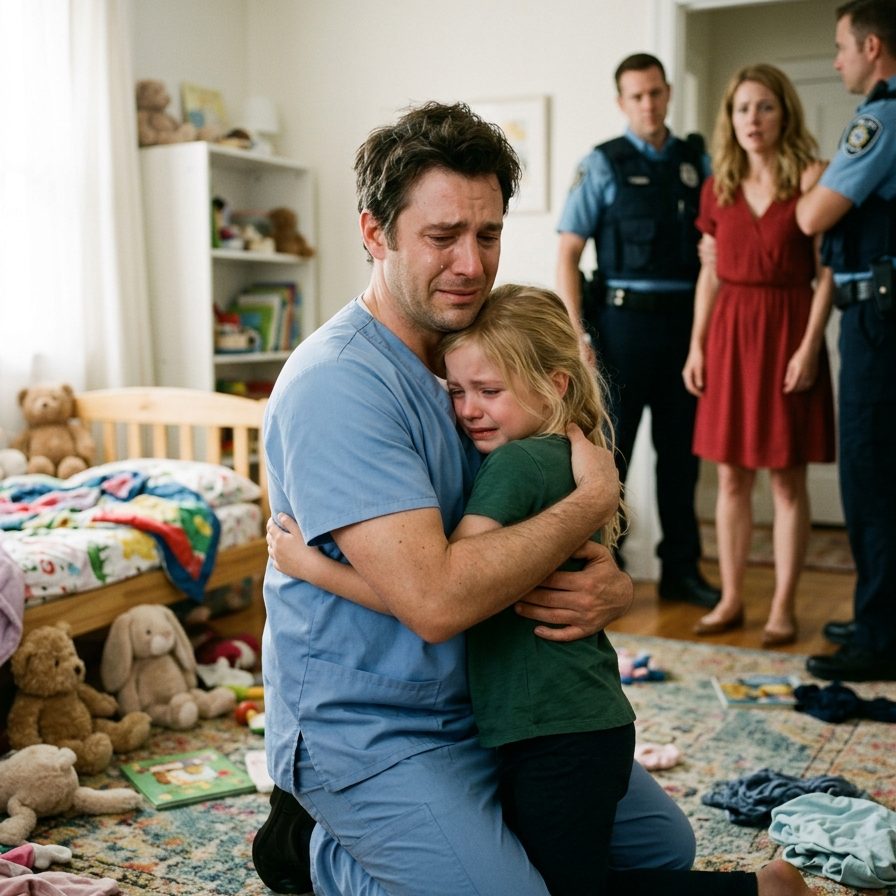
The first time Harper cried when we were alone, I told myself it was just the strain of adjusting to a brand-new life.
That’s the comforting lie adults tell themselves when a child stands in front of them with glassy eyes, rigid shoulders, and an expression far too controlled for her age. I’d married her mother only three weeks before. At seven, a child can sense that her world has changed, but she’s still much too small to steer any of it.
A strange man in the hallway. A different last name on school paperwork. A new adult making promises, when she may have already learned that promises vanish.
I worked as an ER nurse in the trauma unit at the University of Colorado Hospital. Years of reading pain before patients could even voice it had sharpened my instincts. I recognized the jagged panic of accident victims, the hollow calm of domestic abuse survivors, the way fear settles into a body. I thought I was hard to deceive.
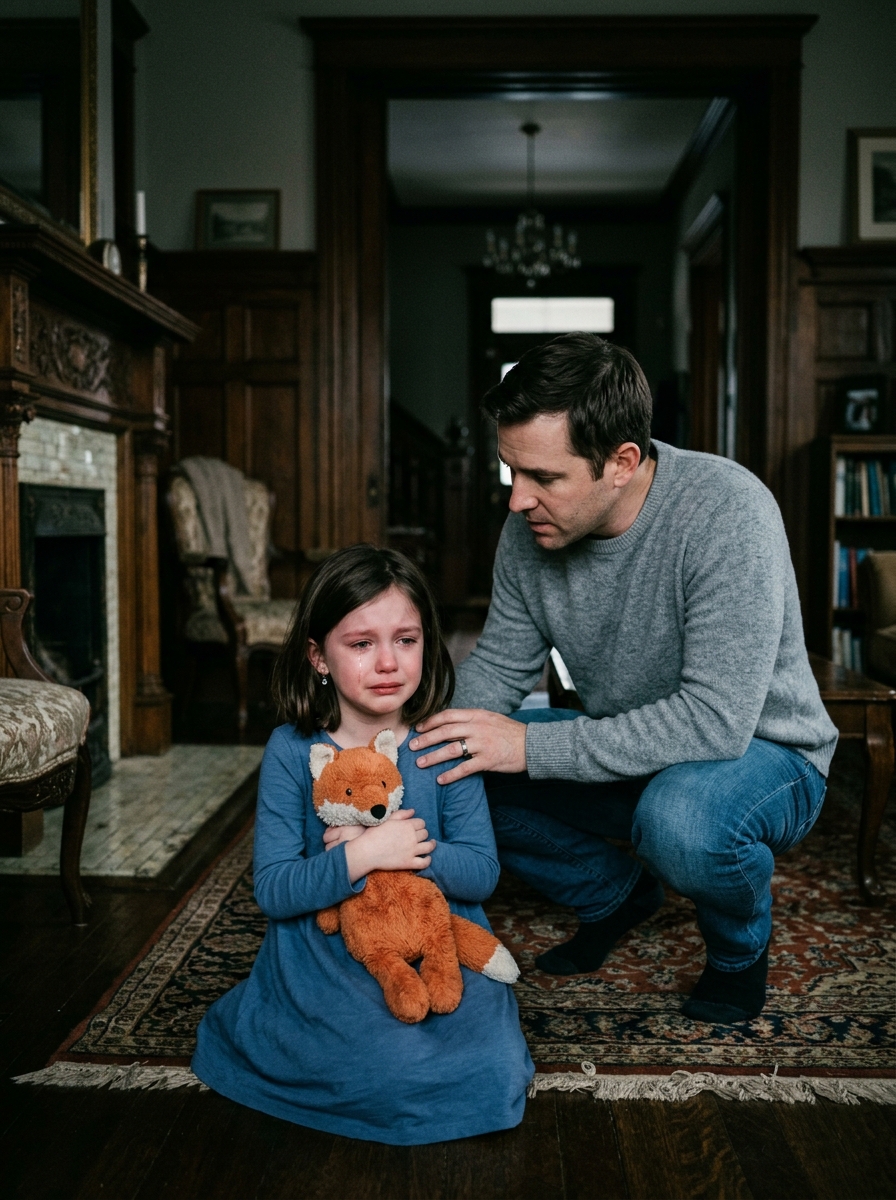
I knelt down in front of Harper and softened my tone. “What’s wrong, sweetheart?”
She shook her head fast — not the way a child denies sadness, but the way someone flinches when they’re afraid of what might happen if they admit the truth. Her eyes darted toward the hallway, searching for something I hadn’t yet learned to notice.
Before Clara Monroe walked into my life, I lived alone — double shifts, burnt coffee, laundry running past midnight. Then Clara showed up: a medical technology sales rep with auburn hair, bright hazel eyes, and a voice that made the future sound safe and certain. She spoke of holidays, quiet Sunday mornings, a home where I’d finally belong.
I wanted to believe her.
Our wedding at the Denver courthouse was small and tidy. My brother Noah stood next to me, smiling, though doubt still flickered in his eyes.
“Six months, Ethan,” he murmured. “You’re sure?”
“When you know, you know,” I said.
It sounded so certain. Later I’d learn that certainty can just be another disguise.
Clara wore cream silk and looked immaculate, but it was Harper who caught my heart. She trailed behind her mother clutching a small bouquet of daisies, dressed in a blue gown with pearl buttons, her dark eyes far too old for her small face. She looked less like a flower girl and more like a witness.
“Welcome to the family,” Clara whispered once we’d been pronounced husband and wife.
Two hours later we stood outside 219 Hawthorne Avenue, a Victorian home with steep rooflines, narrow windows, and the cold polish of a house built to be admired rather than lived in. Inside, everything gleamed — glossy floors, crystal chandeliers, pricey abstract art. Even the silence felt staged.
“Harper,” Clara said, her voice already distant and businesslike, “show Ethan where to put his things. I have emails to answer.”
Harper led me upstairs. At the master bedroom door, she eyed my suitcase and two boxes — the modest remnants of my old life.
“Are you staying?” she asked. “Or just visiting?”
“I’m staying,” I said, crouching to her level. “I’m your stepdad now. I’m not going anywhere.”
She nodded, but her expression went carefully blank — the way children learn to guard themselves against good news they don’t trust.
Three weeks later, Clara left for a work trip to Salt Lake City. She stood at the door in a black suit, her perfume sharp and costly.
“Be good for Ethan,” she told Harper, her eyes pinning the girl in place. “Remember what we talked about.”
Harper nodded, clutching a worn stuffed fox with one frayed ear.
The instant the front door shut, the house seemed to exhale. The tension that always gripped the rooms whenever Clara was home disappeared completely — I could almost feel it lift.
“Cereal?” I asked.
“Whatever you’re having,” Harper said.
We ate at the marble kitchen island, sunlight pooling across the counter. She kept peeking at me over her bowl.
“I heard there’s a new animated movie streaming,” I said. “Want to waste a few hours and rot our brains?”
For the first time since I’d known her, Harper smiled — a real smile. “Mom says TV makes your thoughts weak. But… okay.”
We spent the morning curled on the sofa under a knitted blanket. Slowly, Harper let her guard down. She laughed. She asked questions. She told me her fox was named Scout. For a few hours she was simply a seven-year-old, and I let myself believe the family Clara had painted might actually become real.
Then, around noon, I noticed the tears.
The movie kept playing, bright cartoon animals crossing the screen, but Harper had gone completely still. Tears slid silently down her cheeks as she clutched Scout to her chest.
I paused the film. “Hey. What happened?”
“Nothing,” she whispered, wiping her face too fast.
“Harper, talk to me. We’re a team, remember?”
She stared at the floor for a long stretch. Then she said, so softly I nearly missed it, “Mom says you’ll get tired of us. She says men always get tired because I’m too much work. She says once you see the real me, you’ll leave.”
My chest clenched. Telling a child she’s to blame for being abandoned is a cruelty that leaves no mark anyone can see.
“Look at me,” I said, gentle but firm. “I’m an ER nurse. I know what ‘too much work’ actually looks like. I’ve seen people at their absolute worst, and I don’t walk away. I married your mom, but I signed up for your life too. I’m here, Harper. I promise.”
She sank into me, small and exhausted. We finished the movie without another word, but my mind had already started racing. Abandonment wasn’t the only fear haunting that house — it was simply the only one she’d dared to speak aloud.
That night, I heard crying.
Not loud sobs. Not a child calling out for help. It was soft, muffled, rhythmic — crying deliberately shaped to go unheard.
I slipped out of bed and followed the sound to Harper’s room. She sat on the floor by the window, moonlight catching the tears falling onto Scout.
“Bad dream?” I whispered.
She shook her head.
“Can’t sleep?”
Another shake.
I sat on the edge of her bed, leaving distance between us. “Sometimes secrets get heavy. You can tell me if something’s hurting you.”
“I can’t,” she said, breath hitching as she gripped the fox tighter. “Mom says it isn’t true anymore. She says that was the old Harper. If I talk about it, the old Harper will come back and you’ll hate her.”
Cold dread pooled in my stomach.
“What happened to the old Harper?”
Her eyes met mine, wide with fear. “I’m not supposed to tell. She said the fire would come if I told.”
Before I could push further, headlights swept across the wall from outside. Harper scrambled into bed and yanked the blanket to her chin.
“I’m tired now, Ethan,” she whispered.
I stood in the doorway until her breathing evened out. But I didn’t sleep. Something inside 219 Hawthorne Avenue was fractured, and the cracks were starting to show.
Clara came home two days later with designer luggage, silk blouses, and a flawless smile. She’d brought me a watch and Harper a stiff pink dress that looked more like a costume than a gift. She looked every bit the successful, devoted mother. But I’d started watching her differently now.
I noticed how Harper’s shoulders caved the moment Clara stepped through the door. I noticed how Clara’s smile never quite reached her eyes.
At dinner, Clara asked, “Did Harper behave?”
“She was perfect,” I said.
“No tantrums? No emotional scenes?”
Harper’s fingers tightened around her fork. “No, Mom.”
It was a lie, and we both knew it. But I understood then that Harper survived through silence, and if I wanted to protect her, I couldn’t move against Clara carelessly. I needed to learn the rules of her game first.
Two days later, while helping Harper into her sweater for school, I saw the bruises.
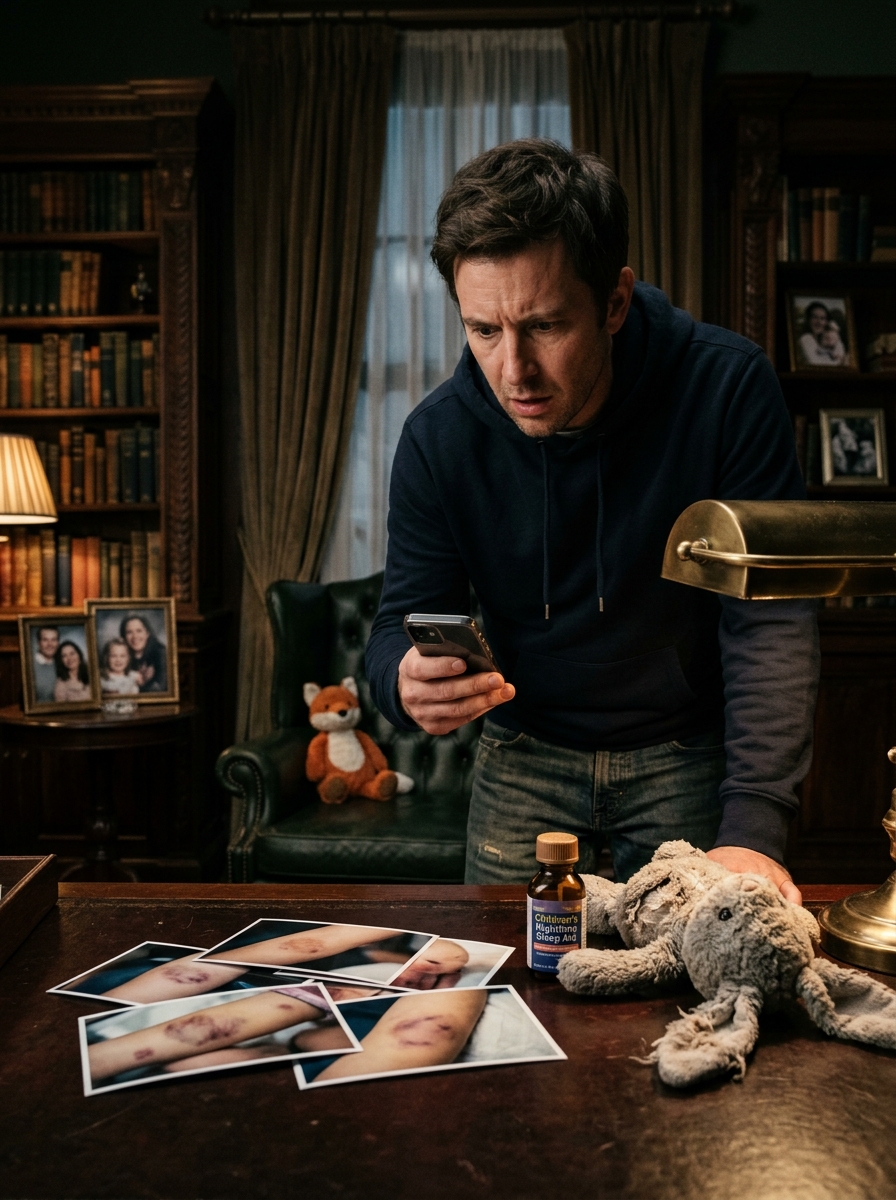
Four purple-yellow ovals marked her right upper arm. A larger thumbprint darkened the left. I recognized the pattern instantly. Someone had gripped her hard enough to burst blood vessels beneath the skin.
“Harper,” I said, keeping my voice level. “How did this happen?”
She yanked her sleeve down. Her face went empty. “I fell.”
“These aren’t fall bruises. These look like someone held you very tightly. Did someone hurt you?”
Fear crossed her eyes. “I fell off a bike at school. Please, Ethan. I just fell.”
She didn’t own a bike.
That afternoon, with Clara at work and Harper at school, I searched the house. I hated myself for it, but my training wouldn’t let me look away from the signs.
In Clara’s office, I found a locked filing cabinet. In the kitchen, tucked behind the espresso machine, I found children’s sleep medication. Harper had no prescription for it, and the bottle had been hidden like contraband.
Then, in the playroom, I found the thing that made my hands tremble.
At the bottom of a heavy wooden toy chest, buried beneath blocks and dolls, sat a small stuffed rabbit. One ear hung by a thread. The fabric around the tear was stiff with a dark stain.
Dried blood.
I photographed everything — the medicine, the toy, the bruises I’d already seen. Every instinct screamed at me to call child protective services right then. But Clara had money, beauty, and a polished public image. If I acted without solid proof, she’d explain it all away, and Harper would pay for it.
That evening, Harper barely touched her plate.
“Not hungry?” Clara asked pleasantly.
“My stomach hurts,” Harper whispered.
“Maybe you’re coming down with something.” Clara glanced at me. “Ethan, bring her the pink pills from the kitchen.”
I walked to the kitchen but instead of opening the cabinet, I started recording on my phone.
“The sleep medicine?” I called out.
“Yes,” Clara said. “Two tablets should help her sleep through whatever this is.”
I came back with the medication, pulse hammering. I watched Clara make Harper swallow the pills.
Why sedate a child over a stomachache?
Late that night, once Clara was asleep, I found Harper in the playroom sitting in the dark with the torn rabbit in her lap.
“What happened to it?” I asked gently.
The wall inside her finally gave way.
“Mom said I was too loud,” she whispered. “She pushed it against my face and told me to bite down so the noise wouldn’t get out. I bit too hard. I broke him.”
The words hit like a blow.
I pulled her gently into my arms. “Harper, that was not your fault. You’re allowed to cry. You’re allowed to make noise. No one should ever force you to stay that quiet.”
“She said if the neighbors heard, they’d think we were bad. Then strangers would take me away.”
Clara had wrapped her in terror so thoroughly that Harper believed her own pain was the dangerous thing.
“Can I see your arms again?”
She lifted her sleeves. The bruises had deepened.
“Who did this?”
Harper glanced toward the stairs. Toward the bedroom where Clara slept.
Then she looked back at me and whispered, “I fell, Ethan. I always fall.”
The lie was her armor. But I was ready to hand her something stronger.
The next morning, I called in sick. I wasn’t heading to the hospital. I was going to find help.
I drove to the University of Denver, straight to Dr. Maya Bennett, a pediatric trauma specialist I trusted more than almost anyone. We’d worked together on several emergency cases. She was sharp, direct, and fierce when a child was at risk.
“Ethan?” she said when I appeared at her office door. “You look wrecked.”
“I need you to see something.”
I showed her the photos. The bruises. The hidden medication. The blood-stained rabbit. I told her about the forced silence, the “old Harper,” the threat of fire.
Maya’s expression hardened. “Those marks aren’t accidental. This is coercive abuse. If I examine Harper and confirm what I already suspect, I’m required to report it.”
“I know,” I said. “But Clara is careful. We need more than bruises.”
Three days later, Clara left on another trip. The house grew quiet, but not peaceful. It felt like a countdown.
That Friday night, Harper and I built a blanket fort in the living room. Inside that small, soft cave, she whispered, “Ethan?”
“Yeah?”
“Can someone be two people?”
“What do you mean?”
“Like a mom who buys you dresses, but also a mom who makes you bite the rabbit?”
My throat tightened. “Some people carry shadows inside them. But that doesn’t mean the shadow gets to hurt you.”
Harper went upstairs and returned with Scout, her stuffed fox. She held him for a long moment, then held him out to me.
“I want you to have him.”
“I can’t take your favorite toy.”
“Yes,” she insisted. “Look at his back.”
I turned the toy over. Hidden in the fur was a tiny zipper. Inside was a small silver flash drive.
“Mom was watching videos on her laptop,” Harper whispered. “She was crying and drinking wine. When she went to the bathroom, I saw the little stick in the side. I took it because she was looking at me in the video, and it scared me.”
I plugged the drive into my laptop with shaking hands.
The files loaded.
The first video had been recorded in Harper’s bedroom a week before my wedding.
Clara knelt beside Harper’s bed, her face arranged into a theatrical show of tears.
“Say it again,” Clara snapped. “Tell me what Ethan did.”
“But he didn’t do anything!” Harper cried.
“Don’t lie!” Clara grabbed her shoulders, exactly where the bruises had formed. “I saw him touch your hair. I saw the way he looked at you. All men are monsters. They want to take you away from me. Tell the camera what he did, or I’ll burn your drawings. I’ll burn everything you love.”
I watched, breathless, as Clara coached her seven-year-old daughter to level a false accusation at me. She made Harper rehearse it. She made her cry on cue. She was building a trap with my name stamped on it.
I didn’t sleep that night. I kept watching. Each file was worse than the last.
There were folders predating my arrival. One labeled “R” showed Harper being coached to accuse another man — Ryan Cole.
At midnight, I called my cousin Lucas, a detective with Denver PD.
“Ethan?” he answered, groggy.
“I need you at my house. Bring someone who can handle digital evidence.”
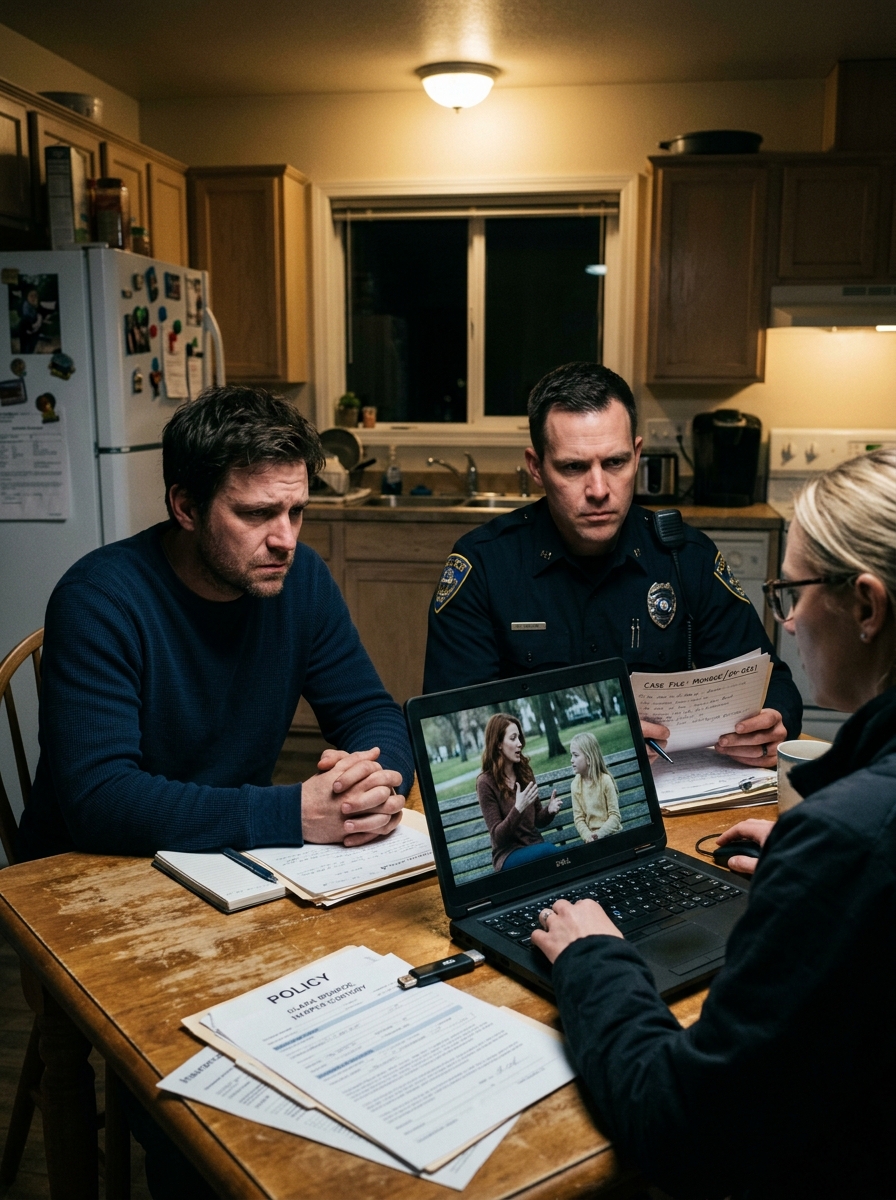
Lucas arrived within thirty minutes. He sat at my kitchen table watching the videos, his face hardening with every passing minute.
“She’s not just abusive,” he said. “She’s running a long con. She uses the child, destroys the man, and profits from the wreckage.”
“There’s a man named Ryan Cole,” I said. “Find him.”
Lucas dug in. A few minutes later he looked up, grim.
“Ryan Cole. Married Clara in 2019 in Arizona. Reported dead in 2020 after a hiking accident. Body pulled from a river. She collected a $600,000 life insurance payout.”
The pattern was no longer a suspicion. It was a trail.
The next morning, I combed through our financial documents. Buried deep in an online folder was a new life insurance policy — on me.
One million dollars.
Attached to it was a forged psychological evaluation claiming I suffered from severe depression and suicidal ideation.
Clara wasn’t only preparing to frame me. She was preparing to kill me and stage my death as shame-driven suicide.
I called the insurance company’s fraud department and flagged everything — the policy, the forged document, the suspicious history.
But Clara moved first.
At 3:00 a.m. the next night, I woke to a smell.
Chemical. Hot. Wrong.
The garage was on fire.
I grabbed Harper from her bed, wrapped her in a blanket, and ran. Smoke poured through the vents as we hit the sidewalk. Firefighters arrived within minutes.
Then Clara pulled into the driveway.
She stumbled from the car, face twisted into flawless panic. “Oh my God! Ethan! Harper! Are you okay?”
She wrapped us in a hug, sobbing against my shoulder. Her tears felt toxic.
Later, the fire marshal pulled me aside.
“We found accelerant,” he said. “Paint thinner poured near the door leading into the house. This wasn’t electrical. Someone wanted the fire to spread.”
Clara stood nearby, shaking. “Who would do this to us?”
I looked at her and saw the truth beneath the act.
“I don’t know,” I said. “But the police will.”
I called Noah right away. “I’m bringing Harper to your ranch. She stays there until this is over.”
As I drove away from the smoldering house, Harper whispered, “Mom said the fire would come if I told secrets. She said it would eat the bad people.”
“The fire didn’t eat us,” I said, hands steady on the wheel. “And it never will.”
With Harper safe at Noah’s ranch under protection Lucas had arranged, I went back to Hawthorne Avenue. The house looked like a scorched monument to a lie.
Lucas met me outside.
“We found Clara’s fingerprints on the paint thinner can,” he said. “But she’ll claim she used it for cleaning. We need her next move.”
“She thinks I’m still trapped,” I said. “She thinks the policy is active. She’ll try again.”
So we laid the trap.
Lucas invented a fictional contact — a fixer named Grant Hale — and made sure Clara spotted the name on my laptop.
She took the bait within hours.
Using a burner phone, she reached out to Grant. The messages were cold enough to stop blood.
“My husband is dangerous,” she wrote. “He abused my daughter and set the fire to kill us. I need him gone before he takes custody. It has to look like suicide. I can pay $50,000 cash. There is a million-dollar policy.”
Lucas and I watched the words appear on the screen.
“She choreographs misery,” he muttered.
They set up a meeting at a quiet park near Red Rocks. Officers hid in the trees while an undercover detective waited on a bench.
Clara arrived at 10 p.m. in a trench coat, carrying a leather bag with $25,000 in cash.
“Make it fast,” she told the undercover officer. “I need to prepare the grieving-mother act. And make sure the kid stays traumatized enough to keep quiet.”
The arrest came in a wash of blue lights and shouted commands.
Clara didn’t scream. She simply went rigid as the handcuffs closed. Then she looked across the police line at me.
“You’re a dead man, Ethan,” she whispered. “You just don’t know it yet.”
I looked back at her. “No, Clara. For the first time, I think I’m finally alive.”
The FBI joined the case the next morning. Agent Rebecca Shaw arrived with a thick file and a colder truth.
“Clara Monroe is not her only name,” she said. “She’s operated under multiple identities for the last fifteen years. She targets men with assets or high insurance value, uses a child to control the narrative, then engineers a domestic tragedy. Ryan Cole wasn’t the first. We have ties to cases in Texas and Florida.”
Clara wasn’t only dangerous. She was a pattern.
The trial turned into a national spectacle. Clara cried on camera, insisted I’d framed her, claimed the videos were fabricated, claimed the fire was my doing. But the prosecution had the flash drive, the messages, the cash, the insurance policy, the forged psychiatric report, and the fire evidence.
Then Harper testified.
She sat with Scout in her lap, feet not reaching the floor. Her voice trembled at first, but it never broke. She told the jury about the rabbit. About being told to bite down so no one would hear her cry. About the rehearsed lies. About the night her mother promised the fire would come for bad secrets.
The jury deliberated for two hours.
Guilty.
Arson. Conspiracy to commit murder. Insurance fraud. Child abuse. Evidence tampering. Multiple charges tied to the earlier cases.
When Clara was sentenced to sixty-eight years in prison, she turned to me one last time. The beauty had drained from her face. Only bitterness remained.
“I’ll find you,” she said.
I had no rage left for her.
“You already found us once,” I said. “That was your mistake.”
Three months later, I sat on the porch of a small farmhouse outside Boulder.
The Hawthorne Avenue house had been seized and sold for restitution. I didn’t want that museum of fear. I wanted a home where shoes could sit by the door, where dishes could wait in the sink, where laughter didn’t need permission.
Harper ran through the yard with the golden retriever we’d adopted. Her laughter rang loud now, wide open and free. She saw Dr. Bennett twice a week. The bruises had faded, replaced by ordinary childhood scrapes from climbing, running, falling, and getting back up.
“Ethan!” she shouted from near the creek. “Scout says there’s a frog!”
I walked down to her. Together we watched a small green frog cling to a mossy stone.
“Do you think he’s scared?” Harper asked.
“Maybe,” I said. “But he knows where home is.”
She slipped her hand into mine. Her grip was steady. Trusting.
“Ethan?”
“Yeah, kiddo?”
“Mom thought she was burying us, didn’t she?”
I looked at the daughter I’d chosen, the little girl who’d saved my life with a flash drive hidden inside a stuffed fox.
“She did,” I said.
“But she forgot something?”

I smiled. “She forgot we were seeds. And when you bury a seed, it grows.”
A year later, I opened Scout House, a residential center for children who’d survived coercive control, emotional abuse, and family manipulation. I built it with my savings, donations, and a grant from the Whitaker Foundation. It became a place where children learned that silence wasn’t safety, that their voices mattered, and that no shadow was stronger than the truth.
Harper became its first ambassador. She greeted new children with Scout in her arms and told them they were safe now.
On the day of the ribbon cutting, I stood in the garden watching children move through sunlight. My years in the ER had taught me how to keep bodies alive. Harper had taught me how to help a soul breathe again.
The old house on Hawthorne Avenue was gone. But what we built in its place could not be burned, bought, or broken.
By the front door, a plaque read:
“For every child who cried in silence. We heard you.”
I sat on the porch swing and, for the first time in my life, I wasn’t listening for danger.
I was listening to laughter.
