

Marcos Almeida could never pinpoint the precise instant his world broke apart. He remembered rain hammering the windows. He remembered his phone buzzing on the kitchen table. He remembered a stranger’s voice saying “Rodovia dos Imigrantes.”
His wife, Ana Clara, had left that afternoon to take care of a family matter and pick up a few last things for Miguel. She was two months away from delivering. Back home, an unassembled crib still leaned against the wall.
Miguel’s room carried the scent of fresh wood, baby soap, and new paint. Ana Clara had folded the first set of linens with a tenderness that touched Marcos deeply. Every tiny sock felt like a small, almost naive promise.
When they told him the car had skidded on the slick road, Marcos felt the caller’s voice fade into the distance. They mentioned impact, a barrier, instant death. Clinical language. Sterile phrases.
Nothing about hearing that your pregnant wife will never come home again is gentle.
Ana Clara and Marcos had crossed paths eight years before in a bank queue in São Paulo. She laughed freely, though not for anyone. He claimed he fell for her the instant he saw her stand up for an older woman who’d been pushed out of line.
Their wedding was modest — a simple gathering, a table crowded with relatives offering unsolicited advice. Ana Clara was someone who held onto receipts, sonograms, medical records, and cards, believing each scrap of paper might rescue a memory from fading.
That was why the blue folder existed. It held Miguel’s sonogram images, the results from her final prenatal visit, the Hospital das Clínicas name jotted on paper, and a list of remaining things to buy before the baby arrived.
Gustavo, Ana Clara’s brother, had long been woven into their lives. He shared their meals, borrowed small sums, and maintained that family was meant to support one another. Marcos never warmed to him, but Ana Clara believed in him.
That belief would eventually cause harm no one could have foreseen.
Trust doesn’t always shatter with noise. Sometimes it shatters through a borrowed key, a private matter shared too freely, and an unspoken debt — until blood meets pavement.
The night of the crash, Gustavo phoned Marcos twice before officers did. The first time, he only wanted to know if Ana Clara had gotten home. The second call, his tone was tense — though not shocked.
Marcos didn’t notice that at the time. Grief narrows the world down to one sentence: she’s gone. Everything else has to wait.
Ana Clara’s remains went through standard processing. Paperwork, signatures, a cremation permit, a time set for the next day. Every part of it kept moving forward, though her husband could hardly draw breath.
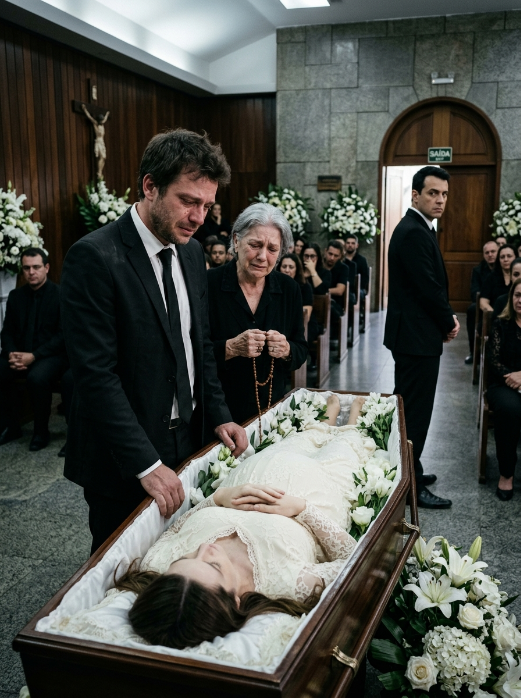
Inside the Vila Alpina Crematorium in eastern São Paulo, the air felt heavy and strange. The flowers were almost sickly sweet. The white lighting gave everything a clinical look, as if grief needed formal illumination.
Marcos stood by the casket, pressing his hands into the dark wood. Ana Clara lay within, still and pale, tended to by hands that had never known her. Beneath the fabric, her seven-months-pregnant belly rose slightly.
Ana Clara’s mother cried, rosary beads threaded through her fingers. Gustavo leaned against the wall, arms folded, eyes bloodshot. From afar he resembled a man in mourning — as long as no one studied him too closely.
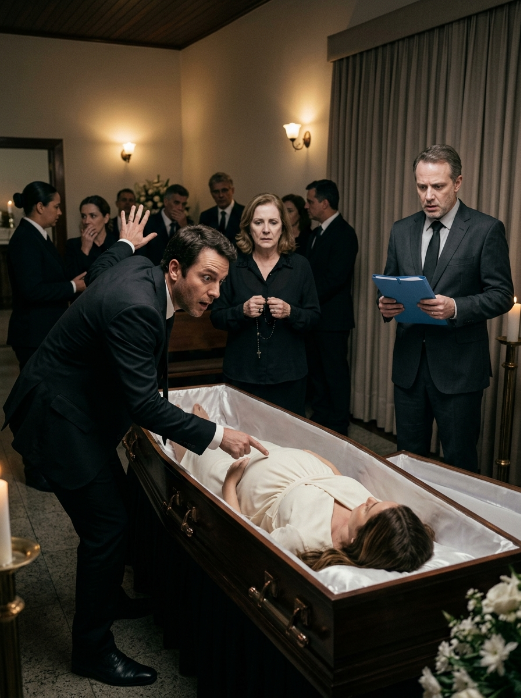
A staff member came forward with the authorization papers. The scheduled time sat written in the corner. Marcos watched the pen, watched the blank line waiting for his signature, and felt something feral stir inside him.
“I need to see her one more time,” he said.
The employee paused, trying to walk through the process with what might have been meant as kindness. Marcos didn’t catch the rest of it. He kept repeating himself. One last time. Please.
When the lid lifted, the whole room seemed to freeze in place. Ana Clara’s mother halted her prayer mid-sentence. An aunt froze with a glass partway to her mouth. A staff member stared down at his own shoes.
No one stirred.
Marcos bent toward Ana Clara. He meant to say he was sorry, though he couldn’t say for what exactly. For not being in the car with her. For not fighting harder to stop her from driving in the storm.
Then he noticed her belly shift.
It was faint. A flicker anyone loving her less might have overlooked entirely. Marcos blinked, swallowed hard, and waited.
It happened once more.
A slight movement. Faint. Alive.
“Stop!” he shouted. “Stop everything right now!”
Staff attempted to offer explanations — muscle spasm, trapped gas, phenomena that occur after death. Marcos heard words that sounded practiced, and something within him turned to ice.
He bent close to Ana Clara and spoke her name. Nothing. Her eyes remained shut. No breath. But within her, a child was still struggling against every decision the adults around him had already made.
“Call an ambulance!” Marcos yelled. “My son is alive!”
Pandemonium erupted at once. Someone bolted for the office. Another staff member dialed emergency services. Ana Clara’s mother stood, weeping, and Gustavo took one step forward before freezing — a pause Marcos would never forget.
In moments of anguish, certain details lodge themselves like proof.
Gustavo’s gaze never went to the belly. It went to the exit. Then to the blue folder. Then to Marcos, the way one person studies another while trying to measure how much they’ve already figured out.
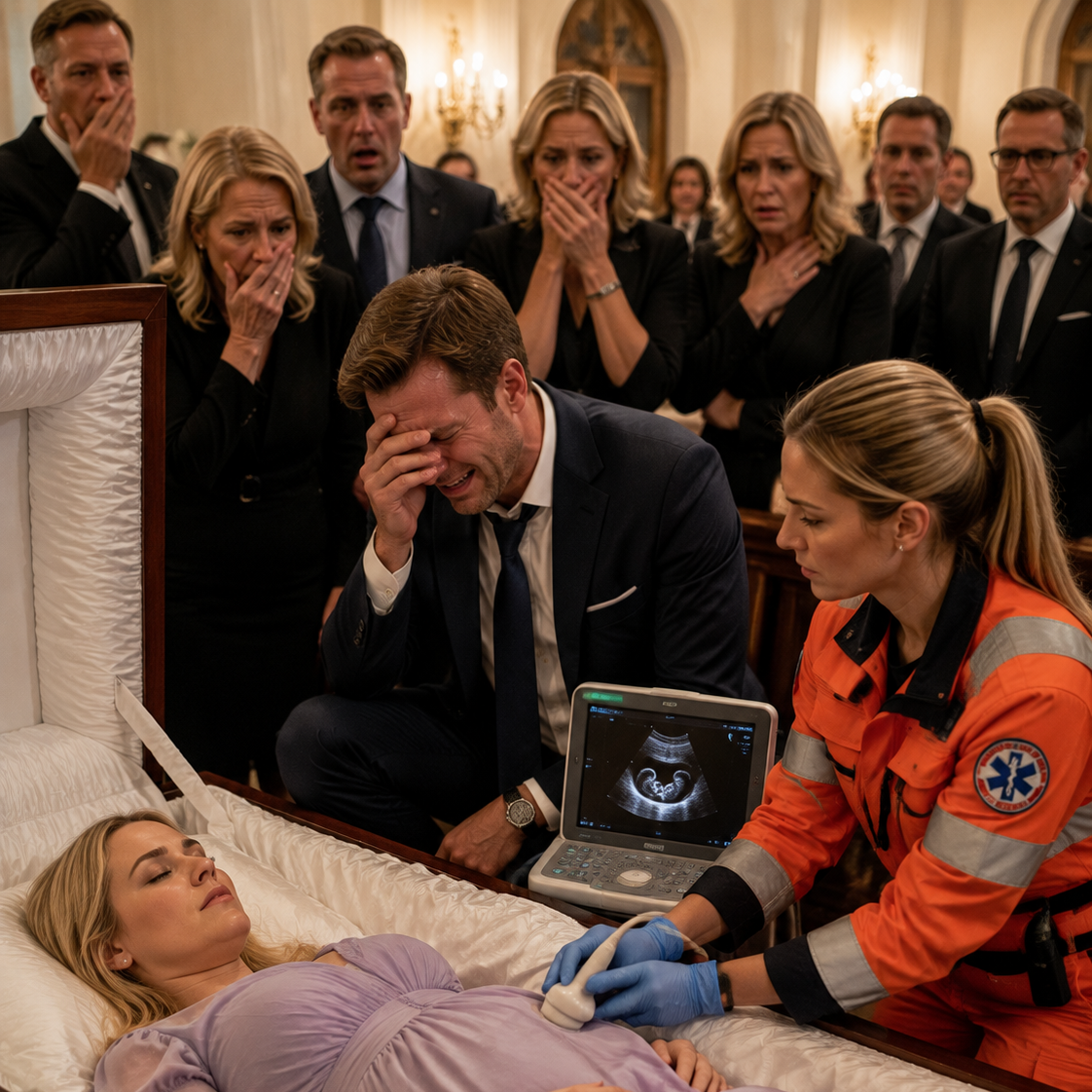
Sirens arrived within minutes, slicing through the glass doors into the room. The SAMU crew rushed in with equipment, gloves, and an urgency that turned the funeral into a medical crisis.
One of them called for room and pressed a sensor to Ana Clara’s abdomen. For several seconds — nothing. Just static, suspended breath, and the drone of the lights.
Then came the heartbeat.
Faint. Quick. Nearly impossible to believe. But there.
“The baby is alive,” the paramedic said.
Marcos collapsed against the casket’s edge, gripping his own head. Ana Clara’s mother released a sound that was less grief than terror knotted together with hope. Gustavo backed away.
Civil Police were summoned, since the body could no longer proceed to cremation — not with a living infant inside her, not with a signed permit resting on a table, not with so many unanswered questions surfacing at once.
An officer looked over the basic documents, careful not to disturb anything connected to the forensic file yet. Inside the blue folder sat sonogram photos, a copy of the preliminary crash report, and a medical note Marcos couldn’t quite make sense of.
The dates and times didn’t align.
It wasn’t evidence of wrongdoing yet. It wasn’t an accusation. But it was a fissure. And sometimes an investigation starts exactly this way — with a single figure that won’t add up.
Ana Clara was rushed to Hospital das Clínicas. Marcos climbed into the ambulance without waiting for permission. No one tried to stop him. The entire ride, he clutched his wife’s cold hand and murmured to Miguel.
“Hang on, son,” he whispered. “Your dad is here.”
The engine droned beneath the wailing siren. Every turn felt like a threat. Every red light stretched the gap a little wider between Ana Clara’s death and any chance of saving her son.
At the hospital, the team was ready and waiting. Doctors, nurses, and obstetricians wheeled Ana Clara down the hallway with a speed that left no room for explanation. Marcos tried to keep pace but was halted at the surgical center’s doors.
“Sir, you have to wait here.”
“I can’t lose them both,” he said, his voice barely there. “I already lost her. I can’t lose him too.”
A nurse gripped his arm. She made no promise of a miracle. She only assured him they’d do everything they could. To Marcos, that was the harshest and most needed sentence of the entire night.
The doors shut.
The corridor smelled of antiseptic, old coffee, and damp cloth. Marcos still wore his suit from the crematorium, creased and stained with incense. He sat down, stood, walked, sat again.
At 6:32 p.m., a doctor emerged asking for urgent consent. At 6:41 p.m., a nurse hurried by with blood on her gloves. By 6:49 p.m., silence had swallowed everything.
Then a cry pierced through.
Weak at first. Sharp, uneven, impossibly small. But it sliced through the corridor like light spilling into a shut room.
Miguel had survived.
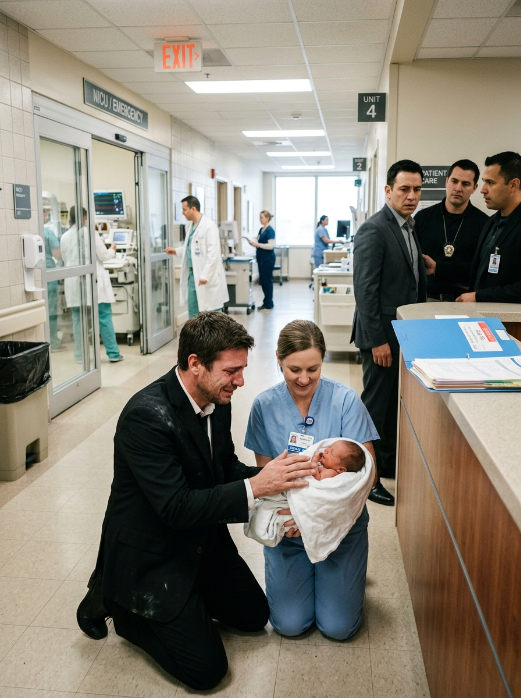
A nurse emerged carrying the baby wrapped in white. He was small. Red-faced. Furious. He struggled for air with a strength that seemed too large for something so tiny. Marcos fell to his knees.
They allowed him only a few seconds with her before rushing her off to the neonatal intensive care unit. He didn’t protest. Those few seconds told him enough — that a piece of Ana Clara still endured in the world.
But the miracle didn’t end the story. It began a new one.
During the operation, doctors found a small mark on Ana Clara’s body, somewhere the crash couldn’t explain. They also noted a skin reaction that didn’t match the wounds from the accident.
The discovery was logged in the medical file. Civil Police called for the body to be preserved, for a toxicology test, and for the vehicle to be examined. The cremation was halted at once.
The word “accident” started to feel less certain.
Investigators went through Ana Clara’s wrecked car. They combed through calls, texts, and schedules. Footage from a gas station near the Rodovia dos Imigrantes showed her car stopped before the section of road where she supposedly lost control.
Gustavo turned up on the footage.
He wasn’t shoving the car. Nothing in the recording appeared outright violent. But he could be seen in an argument with Ana Clara through her driver’s-side window, in the rain, just minutes before the crash.
When investigators pressed him for a complete account, Gustavo claimed he only wanted to talk over family business with his sister. He said she seemed on edge. He said he had no further knowledge.
He said quite a lot.
Toxicology results turned up a sedative at levels unsafe for pregnancy and out of step with Ana Clara’s usual habits. Marcos recalled that Ana Clara never touched medication of any sort without checking with her obstetrician first — not even a common painkiller.
The case didn’t hinge on one piece of evidence alone. It was built from many small pieces: the mismatched timestamp, the mark on her body, the gas station recording, partially erased messages, and a debt Gustavo had hidden from the family.
Investigators recovered a deleted exchange on Ana Clara’s phone. In it, she told Gustavo to stop demanding money and stop feeding Marcos lies. She told him that once Miguel arrived, she planned to tell their mother everything.
That message changed the course of everything.
Gustavo hadn’t just lost his source of money. He’d lost his grip. He’d lost his ability to keep casting himself as the victim within a family growing weary of bailing him out.
Investigators concluded that Gustavo had confronted Ana Clara in the rain, argued with her, and given or administered something that dulled her reflexes before the crash. What follows now belongs to the courts.
Marcos felt no sense of victory when Gustavo was taken into custody. There was no clean sense of relief. He watched him in handcuffs and thought back to that step backward against the crematorium wall — the precise way fear had crossed his face.
Grief doesn’t always dull a person. Sometimes it hones them.
Miguel spent weeks in neonatal care. Born at seven months, he’d entered the world in a way no child should have to. Marcos came to know the language of monitors, feeding times, and the anguished patience of parents keeping vigil before incubators.
Every bit of progress was small — another gram gained, one less tube, a louder cry. The first time Marcos got to touch his son’s hand without gloves between them, he wept in silence.
Ana Clara’s mother came to see the baby, rosary looped around her wrist. Sometimes she sat with Marcos without a word passing between them. She’d lost a daughter and nearly lost a grandson too. Their silence no longer felt hollow. It had turned into something like companionship.
At trial, the report from Hospital das Clínicas proved crucial — along with the gas station footage, the phone records, and the gap between the recorded time of death and the missing prenatal exam.
The court didn’t require a flawless account of how Ana Clara died. It only had to demonstrate that this hadn’t been the tidy accident someone had hoped to erase with flame.
Gustavo was found guilty for his part in Ana Clara’s death and in endangering Miguel’s life. The verdict restored nothing. Verdicts never do.
But it stopped the lie from getting the last word.
Years on, Marcos still holds onto the blue folder. Inside are the sonogram images, Miguel’s first hospital bracelet, and a copy of the report that stopped the cremation. He rarely brings it out. He doesn’t have to.
Miguel is growing up aware that his mother loved him before she ever saw his face. Marcos speaks to him about Ana Clara without reducing her to a mere memory — how readily she laughed, how she stood up for those who couldn’t stand up for themselves, how she folded those first small clothes with such deep patience.
Sometimes, once Miguel has fallen asleep, Marcos finds himself back at the Vila Alpina crematorium. The scent of incense. The dark wood. The low hum of the lights. The exact second a belly moved when everyone in that room had already accepted death as the end.
As his pregnant wife’s body was being readied for cremation, he asked to open the casket once more.
That choice saved Miguel — and exposed a truth someone else had hoped to burn away.
Because not every miracle arrives with angels.
Some arrive through a broken man who refuses to sign the last page.
