


PART 1
Rodrigo Santillán chose to invite his ex-wife to his wedding, and it wasn’t kindness driving him — it was spite, plain and simple.
He wanted to watch her walk in without anyone beside her.
He wanted to watch her squirm surrounded by costly gowns, sparkling stemware, and perfumed women eyeing her like she was a stain on the tablecloth.
He wanted Mariana Beltrán to see for herself just how far he’d climbed.
That’s how he described it to his friends, chuckling on the terrace of a hacienda in Valle de Bravo as he went through the guest list.
“Let her come. So she understands what she threw away.”
Not one of them pointed out how empty that sounded.
Because men like Rodrigo tend to surround themselves with people who cheer them on while their pride slowly rots from the inside.
Mariana got the invitation at her small apartment in the Narvarte neighborhood, right as she was helping her nine-year-old son, Mateo, put together a school project. Her seven-year-old daughter, Renata, sat nearby on the floor, sketching a house with four windows and a big sun overhead.
The envelope was ivory-colored, with gold script.
Mariana recognized who it was from before she even tore it open.
Rodrigo had always had that polished way of inflicting pain.
Inside was the invitation.
Rodrigo Santillán and Verónica Aranda were getting married at an exclusive hacienda, complete with a formal dinner, live music, and three hundred guests.
But the worst part hadn’t been printed at all.
The worst part was a note in his handwriting.
“Come, Mariana. I want you to see what a woman who knows how to stand beside a successful man actually looks like.”
Mariana didn’t cry.
That was the first thing that caught Mateo off guard.
In the past, any word from his father would leave her ashen, silent, and shattered for hours afterward.
But that afternoon, his mother simply folded up the invitation and tucked it into a drawer.
“Are you going?” Mateo asked.
Mariana looked at him with tenderness.
“Yes.”
Renata glanced up from her drawing.
“Are you going to dress up nice?”
Mariana almost smiled.
“No, sweetheart. I’m going to be myself.”
For eleven years, Rodrigo had told her, over and over, that herself wasn’t enough.
Back when they married, Mariana was a primary school teacher in Guadalajara — upbeat, direct, with a real gift for patiently listening to children. Rodrigo was a real estate developer, eight years her senior, confident, with that smooth talk that had first felt like shelter.
First he asked her to quit her job.
Then to stop seeing her friends.
Then to stop speaking her mind at dinner parties.
“Don’t say anything odd, Mariana. Just smile.”
And so, piece by piece, the vibrant woman she’d once been faded away.
When Rodrigo took up with Verónica, he barely tried to cover it up.
Mariana came across messages on his phone one early morning.
“Just leave her. She’s not enough for you.”
Rodrigo never apologized.
He only said this:
“I’m tired of carrying you.”
The divorce turned into an emotional massacre.
He held onto the house, the connections, the pricey lawyers, and the version of the story he told publicly — one where Mariana was the unstable one.
She walked away with two children, two suitcases, a bank account that was practically empty, and a sense of dignity that, somehow, was still intact.
What Rodrigo never found out was what Mariana did afterward.
She started building online courses for mothers.
She began offering school tutoring.
She launched a small platform called Casa Raíz, meant to help single mothers build skills and find remote jobs.
At the start, two hundred women joined her.
Then two thousand.
Then fifty thousand.
And once an international foundation took notice of her project, Esteban Luján entered the picture.
CEO of Grupo Luján. A quiet man with serious wealth. A widower. He owned educational companies across Mexico, Colombia, and Spain.
Esteban didn’t look at her with pity.
He treated her like an equal.
Like someone sharp-minded.
Like a whole woman.
And two weeks before the wedding, when he spotted the invitation sitting on Mariana’s table, something in his face changed.
“That man wants to humiliate you in public?”
“Seems that way.”
Esteban set the invitation back down without a word.
“Then you won’t be walking in by yourself.”
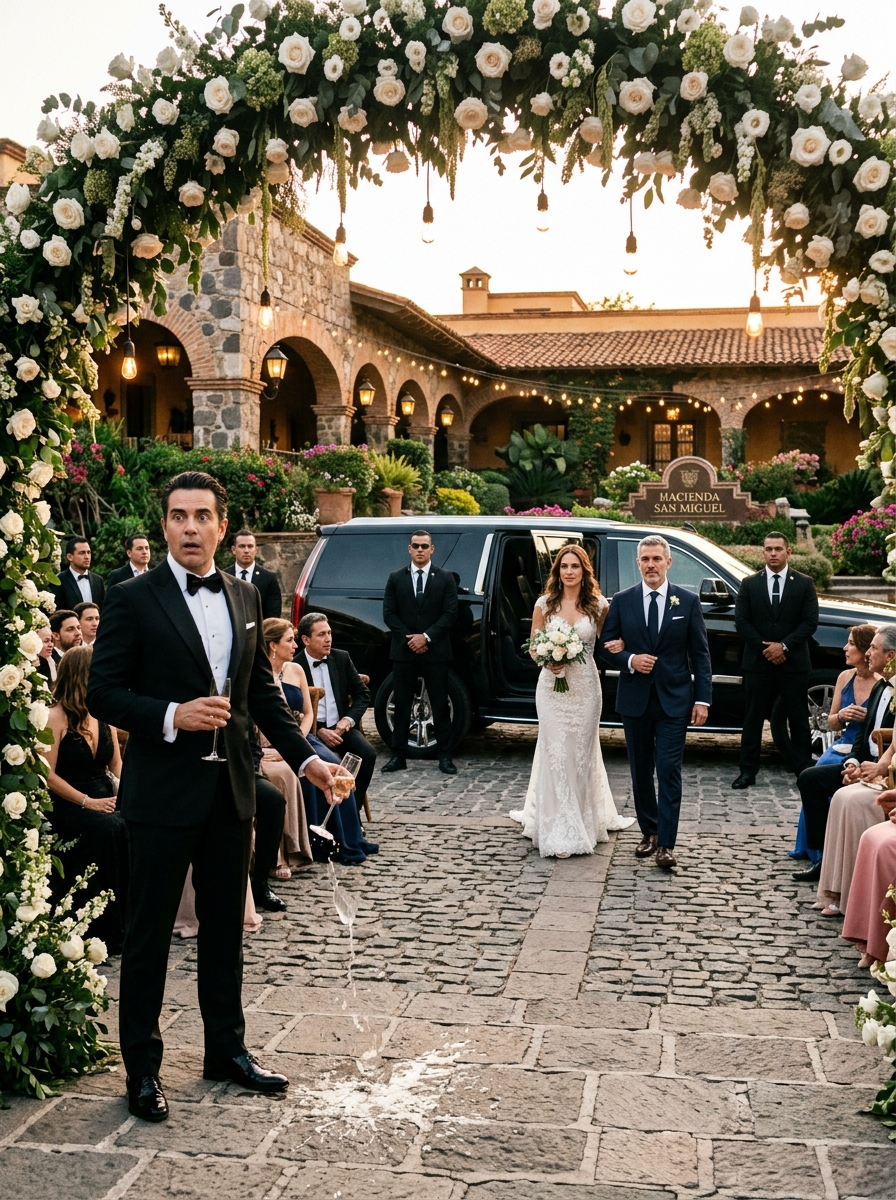
On the day of the wedding, Rodrigo stood at the hacienda’s entrance, grinning like a petty king.
Then the whispers started rippling through the crowd.
A black SUV rolled up beneath the flower-covered arch.
Then a second one.
Then a third.
Four bodyguards in dark suits stepped out.
Then Mariana stepped down.
She wore a pearl-white dress, her hair down, her expression calm and unwavering, moving with a presence that seemed to clear a path in front of her.
Esteban Luján walked beside her.
Rodrigo’s glass slipped from his hand.
But what really knocked the wind out of him wasn’t her beauty.
It was noticing that one of the bodyguards was holding a folder stamped with the seal of the Public Prosecutor’s Office.
PART 2
For a long moment, no one said a thing.
Not the band.
Not the waitstaff.
Not even the gossiping aunts who always had something to pick apart.
Every eye was on Mariana, as if she’d stepped into a completely different story than the one Rodrigo had scripted for her.
He’d braced himself for a humiliated ex-wife.
Someone in a plain dress, eyes down, smile forced.
Instead, Mariana carried herself like someone who’d already survived the worst of it and wasn’t about to ask anyone’s permission to show up as herself.
Verónica emerged from the main terrace in her fitted, elaborate, heavily beaded wedding gown.
She was all smiles — until she caught sight of Esteban.
Then her expression froze.
Not from jealousy.
From fear.
Mariana caught that detail immediately.
Rodrigo tried to take back control.
He walked over wearing a rehearsed smile — the kind that bares teeth but holds nothing genuine behind it.
“Mariana, what a surprise. I didn’t think you’d have the nerve.”
Her voice stayed level.
“You were the one who insisted I come.”
Rodrigo’s eyes flicked to Esteban, then to the bodyguards.
“And all this theater? You think you’re important now?”
Esteban stepped in.
“This isn’t theater. It’s security.”
Rodrigo laughed dryly.
“Security from who?”
Mariana met his eyes.
“From you.”
The whispering around them grew louder.
Verónica gripped her bouquet so hard several flowers snapped.
Rodrigo dropped his voice.
“Don’t make a scene, Mariana. I only invited you out of politeness.”
“No, Rodrigo. You invited me to embarrass me.”
He gave a faint smile.
“Well, if we’re being honest, nobody forced you to show up.”
Mariana took a slow breath.
For two seconds, she thought back to the nights she’d cried without a sound so her children wouldn’t hear.
She thought of selling her earrings just to cover rent.
She thought of the evening Rodrigo told her, right in front of Mateo, that she “couldn’t even manage to keep a husband.”
Still, her voice held steady.
“I came because I’m sick of watching you tell this story like you’re the trophy in it.”
A murmur rippled from one of the tables.
Rodrigo’s face flushed.
“Watch what you say next.”
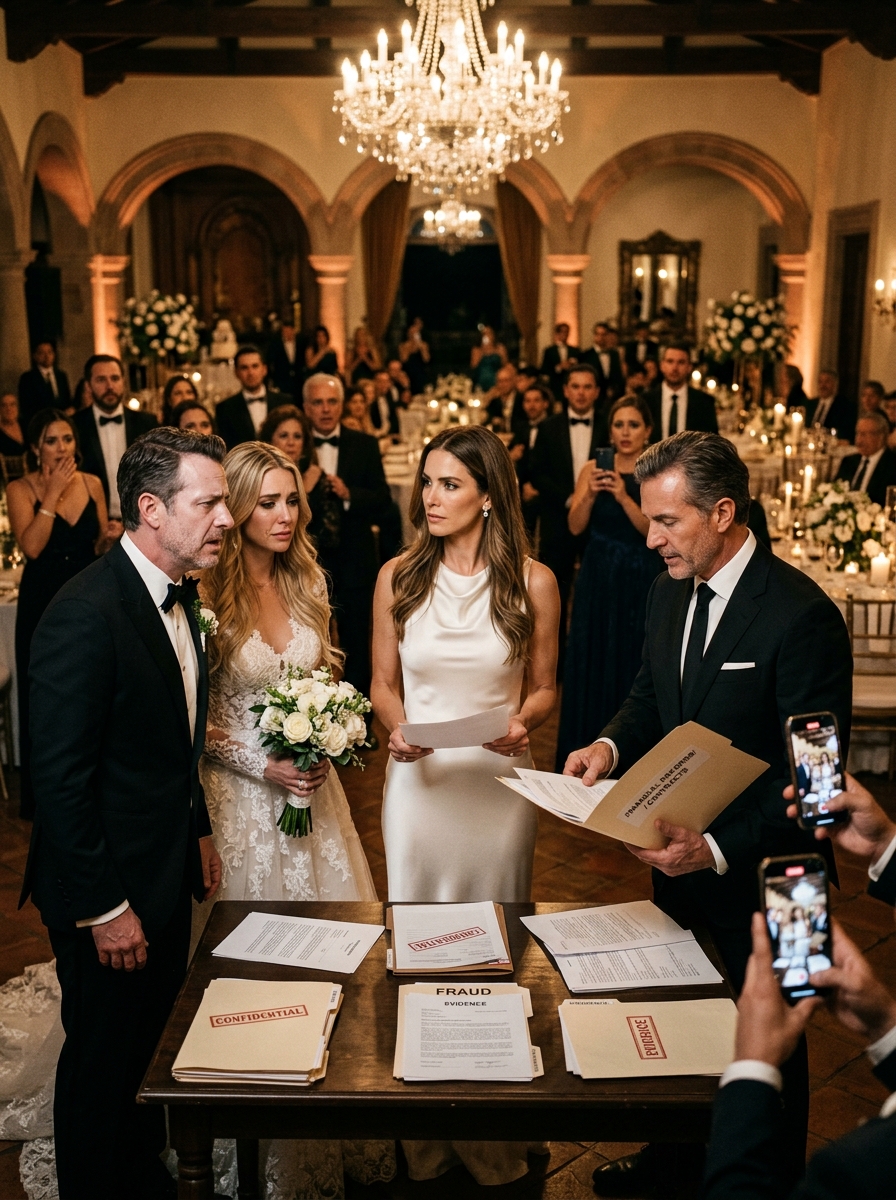
Esteban opened the folder.
“You’d be wiser to watch yourself, Mr. Santillán.”
The air went still.
Esteban pulled out several papers and laid them on a nearby table.
Contracts.
Wire transfers.
Signatures.
Photographs.
“Eight months ago,” Esteban said, “Grupo Luján was approached about investing in real estate projects tied to your business. We backed out after finding irregularities.”
Rodrigo’s throat tightened.
“I don’t know what you’re talking about.”
“You know exactly.”
Esteban tapped one of the pages.
“Shell companies. Padded invoices. Land sold to two different buyers. And above all — Mariana Beltrán’s forged signature on a joint account she never even opened.”
Mariana felt her chest constrict.
She’d already known Rodrigo had taken money from her.
She’d already known he’d left her with almost nothing.
She hadn’t known he’d also used her identity.
“What?” she whispered.
Rodrigo threw up his hands.
“That’s completely made up.”
But Verónica wasn’t watching Mariana anymore.
She was staring at Rodrigo like she’d just realized the monster had been sleeping beside her all along.
Esteban went on.
“Mrs. Beltrán wasn’t just a victim of financial abuse. She was used as legal cover. When my team found her name in the paperwork, we reached out to warn her.”
Mariana shut her eyes for a moment.
Everything clicked into place.
The odd phone calls.
The emails she’d never been able to open.
Rodrigo’s obvious unease whenever she mentioned her growing platform.
It had never just been hatred.
It had been fear.
Because Mariana, without realizing it, was the one piece that could bring him down.
Verónica stepped backward.
“Rodrigo… you told me she’d signed everything.”
He spun toward her, his expression hardening.
“Be quiet.”
For the first time, someone else was seeing what Mariana had witnessed behind closed doors for years.
The polished groom disappeared.
What was left was a desperate, controlling man with none of his composure remaining.
Verónica let go of her bouquet.
“You also told me the properties were clean.”
Rodrigo clenched his jaw.
“Don’t be stupid.”
The words hit her like a physical blow.
Guests started recording on their phones.
Verónica’s cousin covered her mouth with her hand.
Rodrigo’s father stood up from his seat, face drained of color.
Then three agents came through a side entrance.
No yelling.
No struggle.
Just the specific, heavy stillness of justice arriving at last.
One of them held out a warrant.
“Rodrigo Santillán is under arrest for fraud, forgery, and handling funds of illegal origin.”
Rodrigo turned to Mariana.
There was no mockery left in his eyes.
Only hatred.
“You did this.”
Mariana didn’t look away.
“No. You did this. I just stopped keeping quiet.”
The officers closed in on him.
Rodrigo tried to twist free.
“This is my wedding! You can’t do this here!”
Somewhere in the crowd, a woman muttered:
“Well. How humiliating.”
Nobody laughed, though plenty were thinking it.
As the cuffs clicked shut around his wrists, Rodrigo searched for Verónica.
“Say something.”
She shook her head, tears streaking her face.
“You know what the worst part is? You convinced me she was nothing.”
She turned to look at Mariana.
And for the first time, there was no rivalry between them.
Just an uncomfortable truth.
“I’m sorry,” Verónica said, her voice breaking. “I judged you too, without ever knowing who you were.”
Mariana didn’t smile.
She didn’t pull her into a hug.
She didn’t perform forgiveness for the sake of the crowd.
She only said:
“I hope you never have to hit rock bottom before you understand another woman.”
That line moved through the room like a spark catching fire.
Rodrigo was led away toward the exit.
As he passed her, he lowered his voice.
“Without me, you were nobody.”
She held his gaze with a calm that cut deeper than any insult.
“Without you, I finally became somebody.”
That was the last moment Rodrigo would ever manage to make her feel small.
Once he was gone, the wedding ground to a halt.
The band packed up their instruments.
The waitstaff cleared away the open bottles.
The guests stood frozen, unsure whether to leave, cry, keep filming, or act like they’d shown up for a different reason entirely.
Verónica sank into her chair, still in her wedding dress, mascara running down her face.
Her mother tried to arrange her veil over her, but she brushed it away.
“Don’t cover me up. I’ve hidden enough already.”
Mariana was turning to leave when Esteban gently held her back.
“There’s one more thing.”
She looked at him, worn out.
“More?”
Esteban nodded and pulled out another document.
“The investigation confirmed that several properties bought during your marriage were purchased through an account where your signature was forged. Legally, that entitles you to compensation and damages for emotional harm.”
Mariana opened her mouth, but no words came.
“This isn’t a handout,” he added. “It’s justice.”
For years, Rodrigo had told her she’d contributed nothing.
That everything belonged to him.
That she only ate because of him.
And now, in front of everyone, it was plain that he’d built part of his success on her signature, her silence, and her fear.
The months that followed were slow to get through.
Hearings. Depositions. Lawyers. Leaked video clips. Endless comments online — people saying Mariana had done the right thing, that Verónica was a victim too, that Rodrigo was a hypocrite, that this was exactly why you shouldn’t humiliate anyone, because life eventually hands back what you gave out.
But Mariana wasn’t living for the comment section.
She was living to rebuild.
With the money she recovered, she bought a modest house with a yard for her kids.
Renata planted bougainvillea.
Mateo set up a crooked goalpost against the wall.
Casa Raíz grew into a full foundation supporting women who had left violent, abusive, or controlling marriages.
Esteban stayed by her side.
Not as her rescuer.
Mariana never would have allowed that.
But as her partner.
The kind of man who doesn’t need to make a woman feel small in order to feel important himself.
A year later, at a Casa Raíz event in Puebla, Mariana stood on stage in front of eight hundred women.
She wasn’t wearing anything formal.
Just white pants, a blue blouse, and her grandmother’s earrings.
Mateo and Renata sat in the front row.
So did Esteban.
Mariana talked about work, fear, money, raising kids, shame, and that one phrase so many women hear until they start to believe it:
“You can’t do this alone.”
Then she paused.
She scanned the crowd.
And she said:
“The day my ex-husband invited me to his wedding, he expected to see me broken. Instead he saw something he couldn’t stand: a woman who no longer needed his approval to exist.”
The room rose to its feet.

Women who’d cried in bathrooms without knowing exactly why were clapping.
Women who’d signed papers without fully grasping what was in them.
Women who’d learned to ask permission just to breathe.
Women who, for the first time in a long while, felt like maybe there was still time left for them.
That night, Mariana got home and found Renata asleep on the sofa, a drawing still in her hand.
It showed a woman in a white dress, surrounded by purple flowers, with four large figures in dark glasses beside her.
At the top, in uneven handwriting, it read:
“My mom wasn’t afraid.”
Mariana sat down on the floor and cried quietly.
But these weren’t tears of defeat anymore.
They were the tears of a woman who had finally understood something — later than she should have, but completely:
Sometimes the person who invites you to be humiliated has no idea they’re building the very stage on which you’ll take your name back.
