


When my husband boarded a luxury cruise just three days after my doctor put me on strict bed rest with high-risk triplets, I convinced myself he was just being selfish, not that he was putting us in danger. I had no idea the trip was only the start of what he’d already taken from us.
The shiny cruise brochure sat on our kitchen counter for three days before it felt real.
Daniel kept picking it up, rereading the letter. He claimed he’d won the trip through a sales contest at work — four months on a luxury liner, meals covered, island stops included, the kind of vacation people like us usually only watched on TV.
“We finally caught a break,” he said.
Two weeks later, we sat in Dr. Evans’s office staring at an ultrasound screen.
I never saw the company announcement myself — only the printed letter Daniel kept rereading.
Two weeks later, we were back in that office, staring at the screen.
“Helen,” she said, angling it toward me, “you’re carrying triplets.”
Daniel let out a stunned laugh. “Triplets?”
“Yes,” she said. “And your blood pressure is dangerously high. With multiples, this pregnancy turns high-risk fast.”
“If we want these babies to stay where they belong as long as possible, strict bed rest gives us the best shot.”
My mouth went dry. “What does that mean?”
“It means getting off your feet immediately,” she said. “You’re twenty-four weeks today. If we want these babies to stay put as long as we can, bed rest is our best chance.”
Daniel leaned in. “For the whole rest of the pregnancy?”
“For as long as she can safely carry them,” Dr. Evans said.
“We need to cancel the cruise,” I said.
He just stood there, staring at the brochure still tucked in his briefcase pocket.
Daniel loosened his tie. “We don’t have to decide right this second.”
“I do,” I said. “I’m twenty-four weeks pregnant with triplets. There is no trip.”
He kept staring at that brochure.
“I already cleared the time off,” he said finally.
I looked at him. “Daniel.”
“I’m just saying I need a minute.”
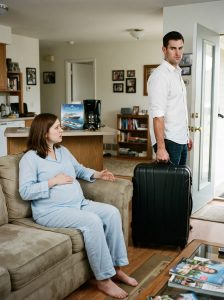
Instead, an hour later, I heard the closet door slam and zippers being pulled.
He came into the hallway, suitcase in hand.
I pushed myself up on the couch. “What are you doing?”
He kept coming, suitcase in hand.
“Packing.”
I honestly didn’t understand at first. “For what?”
“The cruise leaves in three days.”
I just stared at him.
He set the suitcase down and rubbed his face.
“You can’t be serious.”
“Helen, listen before you start crying.”
“Before I start crying?”
“This was supposed to be our one good thing,” he said. “It’s been nothing but expenses and problems, and now this—”
I put a hand over my belly. “These are our babies.”
“Maybe I go, come back rested, and then we handle everything.”
He looked away. “Maybe I just need time to clear my head. Maybe I go, come back rested, and then we deal with all of it.”
“You need me calm more than you need me stuck here panicking,” he added.
“You want to leave your pregnant wife on bed rest so you can clear your head?”
“I’ll call. I’ll check in. It’s not like I’m vanishing.”
“Who’s going to help me?” I asked. “Get groceries? Drive me if something goes wrong? Cook?”
My water broke just after midnight, and by dawn I was in surgery.
He just shrugged helplessly. “You always figure things out.”
“Please don’t go,” I said.
“I need this trip, Helen.”
Then he walked out.
My water broke just after midnight, and by dawn I was in surgery.
I called Daniel from the hospital. No answer. I left him a voicemail.
“My water broke,” I said. “They came early. Please call me back.”
He didn’t.
Later, once I was wheeled into the NICU, I snapped a photo of the three incubators and sent it to him.
He did respond to that one.
Cute.
That was the whole message.
I stared at that word until Nurse Sarah gently took the phone from my hand and set it facedown on the blanket.
What I actually had was three daughters in the NICU. Bills piling up in thick white envelopes. And a husband who saw my messages and barely bothered to reply.
When he did write back, it was in short, indifferent scraps.
How are they? You okay? Busy right now.
I asked once if he’d told anyone on the ship that the girls had been born.
Don’t start, Helen.
The typing dots appeared. Disappeared. Came back.
Don’t start, Helen.
That was when it hit me — he wasn’t just absent. He was hiding us.
One afternoon, I held up Daniel’s latest post without a word. He was on a boat again, grinning next to a woman whose face he’d cropped out sloppily enough that I could still see part of her hair.
Sarah studied it, then looked at me. “You know this isn’t confusion anymore,” she said.
I spent the next three months learning each baby’s cry, filling out insurance forms, pumping milk in hospital bathrooms, sleeping in chairs that weren’t built for sleeping.
Then I found the first bank notice. It was buried in Daniel’s desk drawer under a stack of sales reports. Then another. Then another.
By the time I got to the loan documents, one baby was dozing in a bouncer next to me and my hands had gone ice-cold.
My name was on the final page. Except I’d never signed it. My signature was forged too.
I sat on the floor and kept reading. There had been no company prize. Daniel had taken out a second mortgage on our house months before — and used that money to bankroll the cruise.
That was the moment something in me shifted. I didn’t turn fearless overnight, but I knew I had to stand up for myself.
The brochure still sat in the kitchen drawer, glossy and bright, like a lie printed on expensive paper.
I called a lawyer the next morning. Then the bank. Then I stopped leaving Daniel voicemails that sounded like prayers.
When he finally texted that he’d be back Sunday and “needed to talk,” I already knew more than he realized.
I brought the girls home from the hospital two days before he returned. They were still tiny, still waking every couple of hours.
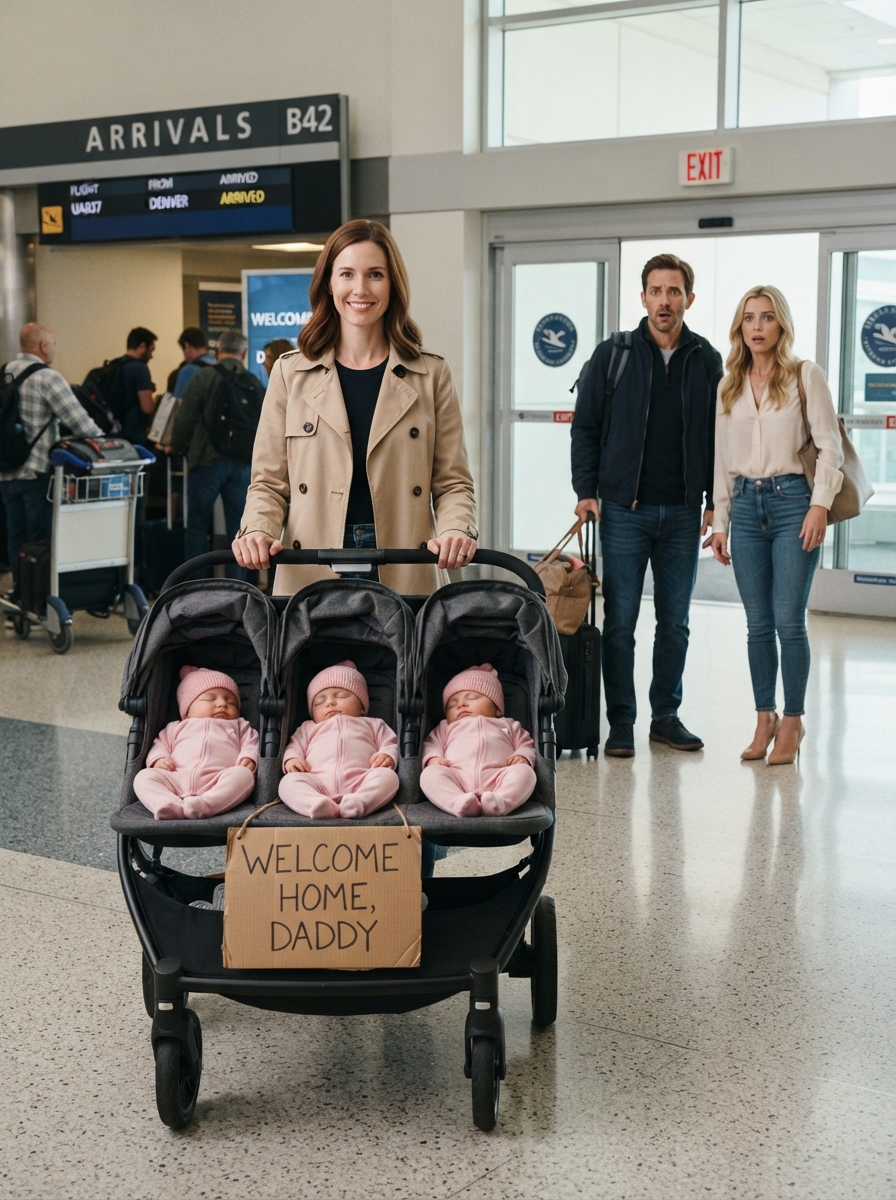
Sunday morning, I dressed them in matching pink onesies and loaded the triple stroller into the car. I also made a sign.
Welcome Home, Daddy.
That part wasn’t fake — I wanted him to see exactly what he’d walked away from.
The automatic doors slid open. Daniel spotted me first. Then the stroller. Then he froze.
“Helen,” he said. “I didn’t know you were coming.”
“I thought your daughters might want to meet their father.”
The woman beside him turned. “Daughters?”
“I’m Claire,” she said slowly. “He told me you two were separated.”
“We weren’t,” I said, looking straight at her. “You didn’t know about them, did you.”
Daniel jumped in too fast. “Can we not do this here?”
“You left me on bed rest and stayed gone through a high-risk delivery and three months in the NICU,” I said. “Here works fine.”
Claire stepped back from him.
“This isn’t the place,” he said, lowering his voice.
“No,” I said. “The hospital would’ve been the place. The NICU would’ve been the place. My living room while I filled out insurance forms alone would’ve been the place.”
“Daniel,” Claire said carefully, “you told me there wasn’t really a marriage anymore.”
“It’s complicated,” he muttered, rubbing his neck.
“No,” I said. “It isn’t. You lost your right to a quiet conversation the moment you answered a photo of your premature daughters with one word.”
His face changed. “Helen—”
“Cute. That was your word.”
Claire’s head snapped toward him. “You saw your newborns in the hospital and sent that?”
“I was on a ship with bad reception. I didn’t know what to say,” he snapped.
Then his tone shifted — the same one I remembered from every fight we’d ever had, the one where he became the victim of everyone else’s reactions.
“I came back to settle things like adults,” he said. “The divorce. The finances. The house.”
“The house?”
“We can’t drag this out. We need to be practical.”
“You were gone four months.”
“And custody?” I asked.
“If you make this ugly, yes.”
“I still have rights,” he said.
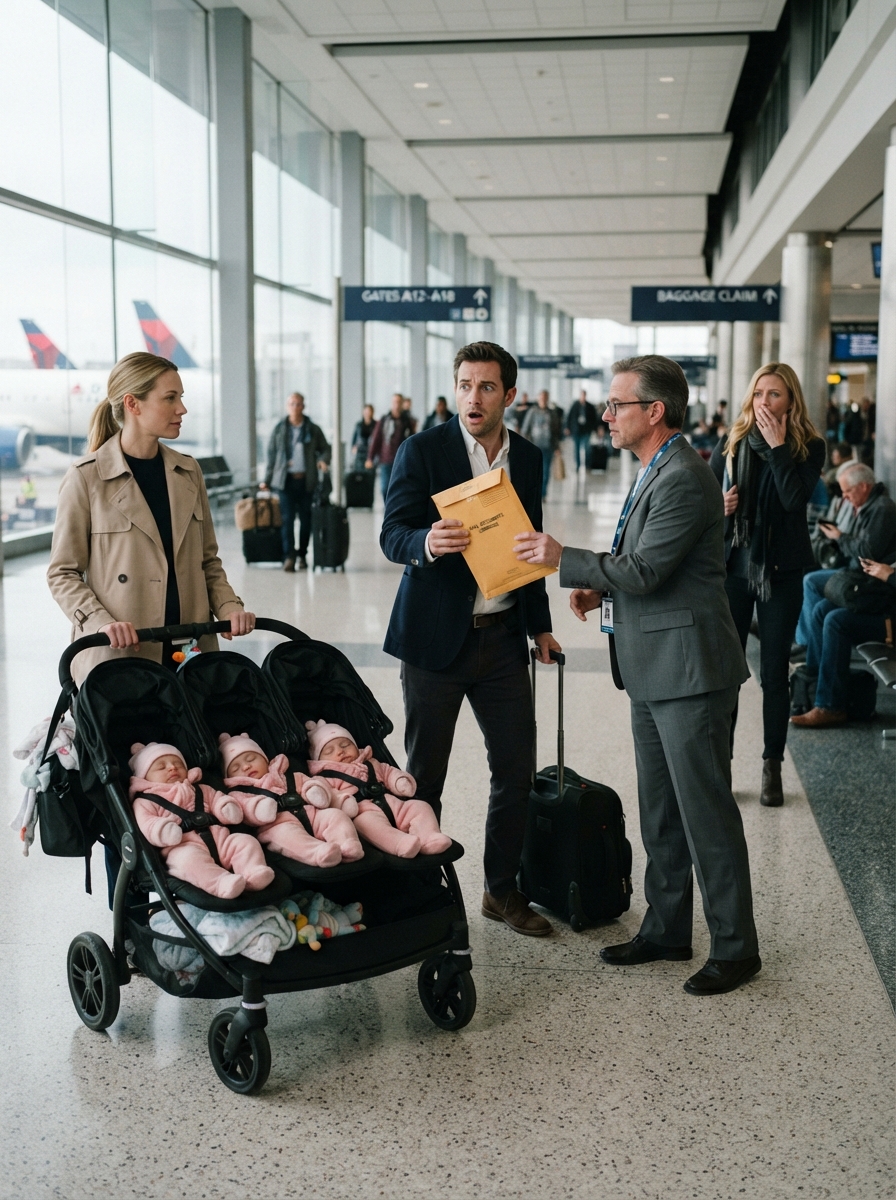
A man in a gray suit approached from behind him, holding a thick envelope. “Daniel?”
Daniel turned around.
The process server had arrived right on schedule. That part wasn’t luck — once my lawyer confirmed his return flight, she arranged for service at the airport. Public place, confirmed arrival, no way to dodge it.
“Are you Daniel?” the man asked again.
Daniel’s face drained of color as the envelope was handed over.
“What is this?”
“You’ve been served.”
“Served with what?” Claire asked, looking between them.
I answered before he could. “My divorce filing, emergency financial orders, and notice to the bank about the forged mortgage documents.”
Daniel turned on me. “You did this here?”
“No,” I said. “You did this when you forged my signature on a second mortgage to fund your Mediterranean getaway.”
Claire went rigid. “What?”
“There was no company contest,” I said, still watching Daniel. “There was debt. A lot of it.”
“You told me you won that trip,” Claire said to him.
He tried to smile; it fell apart halfway. “I can explain.”
“Can you?” she asked.
He reached for her arm. She stepped away before he could touch her.
“You have a wife, three newborns, a house heading toward foreclosure, and forged loan papers,” she said. “What’s the explanation supposed to sound like?”
“You set me up,” he said, turning to me, furious now that his act had crumbled.
I adjusted the blanket over the nearest baby. “No. I just let the truth catch up with you.”
He tore open the envelope with shaking hands, flipping through the pages in a panic.
“Helen, listen to me—”
“I listened to you for months,” I said. “When you said you needed a break. When you said we’d talk later. When you acted like leaving me was temporary instead of a choice.”
Claire was already backing away. “Don’t call me,” she told him, then turned and walked out of the terminal without a glance back.
Daniel watched her go for a stunned second before facing me again. “This isn’t over.”
He’d once told me I always figured things out. For once, he was right.
He finally looked at the stroller — really looked. Three sleeping girls. Three pink hats. Three faces he’d chosen never to know.
For just a second, something real crossed his face. It didn’t matter anymore.
“It is for me,” I said.
I picked up the Welcome Home, Daddy sign, folded it in half, and tucked it into the stroller’s basket. Then I gripped the handlebar and walked past him before he could finish talking.
“You should read every page before you call anyone,” I said. “Especially the part about the forged signature.”
“Helen—”
I kept walking. The airport doors slid open, sunlight hit my face, and I pushed my daughters toward the parking lot — without their father, yes, but with far more stability now that he was finally, truly gone.
