


She never lifted her eyes from the papers in front of her. No defense prepared, no witnesses to call, no reason to expect mercy.
Isabella Cortez occupied the front row dressed in black, as though she were the injured party. She cried with practiced grace, pressing a silk handkerchief to the corners of her eyes. Beside her, one of the country’s most celebrated attorneys sat with an air of quiet assurance.

“That necklace was my mother’s,” Isabella said when given the floor. “It holds immeasurable sentimental value. And the woman I trusted in my home stole it.”
Across the room, Teresa finally gathered herself enough to speak. “I didn’t steal anything,” she said, her voice unsteady but firm. “I’m innocent.”
Judge Harrison brought the gavel down. “Silence. The evidence is clear. The necklace was found among your belongings.”
“Because someone placed it there.”
A brief pause followed.
“Are you accusing Mrs. Cortez of lying?”
Teresa held Isabella’s gaze. For just a moment, the carefully maintained tears vanished. In those eyes, Teresa saw what had always lived beneath the polished surface — cold, settled resentment.
“Yes,” Teresa said. “She’s lying.”
A faint smile crossed the judge’s face. “Let the record show that the defendant is slandering the victim. That will not serve her well.”
Teresa felt the room tilt around her. The judge, the rhythm of the proceedings, the certainty in every voice — it had all been settled before she ever walked through the door. But why would Isabella go to such lengths to destroy her? She was only a cook.
The answer sat three rows back in the gallery.
An eleven-year-old girl with a neat braid and worried eyes. Sofia. Isabella’s daughter — or so the world believed.
Teresa’s public defender rose with visible hesitation. Daniel Brooks, twenty-eight years old, inexperienced and visibly on edge. “Your Honor,” he began, “my client maintains her innocence. We request additional time to gather evidence.”
Judge Harrison didn’t spare him a glance. “The defense has had sufficient time.”
“I was assigned this case two days ago,” Daniel said quietly.
“Are you questioning this court, Counselor?”
He swallowed. Everyone in the room understood that pushing back against Judge Harrison could cost a lawyer everything. “No, Your Honor. I’m asking for fairness.”
“Fairness?” the judge repeated. “The necklace was found in her closet. There are photographs. Witnesses. What more do you need?”
Muffled laughter rippled through the room.
Teresa closed her eyes and let herself return to how it had started.
She had been in the kitchen putting together breakfast — eggs, fruit, fresh juice — when Isabella’s scream pierced the house. “My necklace! It’s gone!”
The staff gathered upstairs. The jewelry box lay open. Isabella’s face was a mask of fury.
“No one leaves until it’s found.”
Officers searched every room. When they reached Teresa’s modest quarters, they turned up the diamond necklace folded inside a blouse at the back of her closet.
“I didn’t put that there,” she pleaded.
No one listened. The handcuffs closed around her wrists.
“Twelve years I gave you work,” Isabella said, her voice glacial. “And you repay me like this.”
On the staircase, Sofia had stood watching without a word. When her eyes found Teresa’s, she didn’t see guilt there.
She saw grief.
Back in the courtroom, Isabella’s attorney laid out photographs of the necklace in Teresa’s closet. He spoke of supposed debts, of betrayal. The murmuring in the gallery swelled.
But Sofia wasn’t watching Teresa.
She was watching her mother.
Because three nights earlier, Sofia had seen something she hadn’t fully understood in the moment — something she had instinctively captured on her phone.
Judge Harrison raised his gavel. “This court finds Teresa Morales guilty of aggravated theft. The sentence is fifteen years at Greenfield Women’s Prison.”
“No…” Teresa whispered.
The gavel began to fall —
“Wait!”
The courtroom doors flew open.
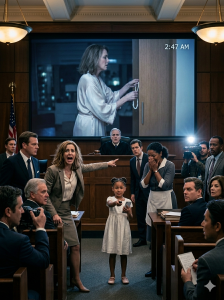
Sofia ran in, still in her school uniform. “I have proof!”
The judge’s brow furrowed. “Remove her.”
“I have a video!” she cried, thrusting her phone into the air. “Teresa is innocent!”
The courtroom broke into uproar.
The footage appeared on the large screen.
A hallway, 2:47 a.m. The image shifted slightly. Isabella emerged from her bedroom in a pale robe, glancing carefully in both directions. She moved without sound to Teresa’s room, stepped inside, and tucked the necklace into the closet.
Just before leaving, her voice came through clearly:
“She knows too much. She can’t stay.”
Silence swallowed the room whole.
“That video is fake!” Isabella shouted.
Forensic experts would later confirm it was entirely authentic.
The case came apart quickly after that.
Prosecutor Martin Hale uncovered a concealed connection: Judge Harrison had been privately entangled with Isabella for more than a decade. Financial records traced payments from Cortez Holdings to accounts linked to the judge.
He was suspended immediately. The case passed to Judge Laura Bennett, a jurist known for her integrity.
Teresa was released.
Outside the courthouse, Sofia wrapped her arms around her. “I’m going to fix this,” she whispered.
Then the deepest truth surfaced.
Sofia was not Isabella’s biological daughter.
She was Teresa’s.
Twelve years earlier, Teresa had fallen in love with Michael Cortez, Isabella’s husband. When Teresa found herself pregnant, Isabella discovered the affair. She threatened exposure and imprisonment. After Sofia was born, Isabella registered the baby as her own. Michael was said to have left the country.
Later investigations told a different story. He had not gone willingly. Isabella had arranged for him to be held in a psychiatric facility in Chicago, bribing officials to keep him there under heavy sedation.
As authorities began pulling apart the web of corruption — unlawful adoptions, bribed officials, compromised judges — Michael was finally freed.
The legal proceedings that followed grew in scope. Facing decades behind bars, Isabella cooperated with investigators. She exposed a broader network that reached as far as Senator Robert Gaines and several other figures of influence.
When it was over, Isabella received a twenty-year sentence. Judge Harrison was sentenced to thirty-five years. The senator died in custody.
Michael acknowledged questionable conduct in his business past but was cleared once investigations established that he had stepped away upon discovering criminal activity.
Teresa was granted custody of Sofia.
On Sofia’s twelfth birthday, Michael placed before her the documents for a trust fund he had quietly established years before.
“What will you do with it?” he asked.
Sofia sat with the question for a moment. “I want to help families like ours. Mothers who lost their children because powerful people thought they could take them.”
That conviction gave rise to the Sofia Hope Foundation, devoted to reuniting families torn apart by corruption and illegal adoption. In its first year, twelve families were reunited. Within five years, the number exceeded a hundred.
In time, Sofia became a lawyer focusing on family and human rights. At eighteen, she made one final visit to Isabella in prison.
“I don’t forgive you,” she said, her voice even. “But I won’t carry hate anymore. You don’t control my life.”

Isabella looked down.
Sofia walked out unencumbered.
Ten years on, in the same courthouse where she had once sprinted through the doors as a child, Sofia received a National Justice Award.
“This award isn’t mine,” she said. “It belongs to the woman who worked inside her own child’s house for twelve years just to remain close to her. Teresa Morales — my mother.”
The courtroom rose. Teresa wept without restraint.
That evening, settled together in their small home — modest but genuinely their own — Teresa understood that every humiliation, every injustice, had been the path to this moment.
At the far end of the darkness, they had found light.
A week later, a letter arrived from the prison. Inside was a single line in uneven handwriting:
“Thank you for loving her the way I never could. — I.”
Teresa folded the letter, placed it in a drawer, and never spoke of it again.
Some stories need no explanation.
Only closure.
