


The sound of that five-hundred-dollar leather shoe slamming into my arthritic knee will haunt me until the day I die.
It wasn’t a hard kick, nothing that could snap a bone, but the casual, indifferent way he did it. Like shooing off a stray dog that gets too close to your spotless porch.
My name is Martha. I’m sixty-eight years old, and for the past fifteen years I’ve been pouring cheap, burnt coffee into thick ceramic mugs at Sunny’s Diner, a tired little roadside place on the edge of a forgotten rust-belt town in Ohio that the rest of the country left behind long ago.
My spine is a wreck of compressed discs, my knuckles are swollen from arthritis, and the soles of my shoes are worn down to bare rubber.
I don’t work here because I enjoy the smell of stale grease and bleach. I work here because I have a twelve-year-old grandson named Leo who was born with a defective heart valve.
My daughter, Sarah, died bringing him into this world. The hospital bills swallowed her life insurance, my retirement savings, and the equity in my small house. Now, Leo needs a second surgery.
Forty-two thousand dollars. That’s the magic number standing between my grandson and a full life.
So, I smile. I swallow my pride. I let truck drivers call me “sweetheart” and I clean up vomit in the men’s room for minimum wage plus whatever crumpled dollar bills people leave on the sticky tables.
It was a Tuesday, right in the middle of the 11:30 AM lunch rush. The diner was packed. The air conditioning was broken again, making the air thick, humid, and heavy with the scent of frying bacon and desperation.
I was carrying a tray of four lumberjack breakfasts—pancakes, eggs, sausage, heavy plates that made my wrists scream in agony—when the front bell jingled.
The diner went quiet. Not completely silent, but the low hum of conversation dropped noticeably.
I turned my head and saw a man standing in the doorway who clearly did not belong in our zip code.
He was in his early fifties, with silver hair perfectly coiffed, a tailored Italian suit that cost more than my car, and a Rolex on his wrist that caught the harsh fluorescent light.
He was flanked by two younger men in dark suits—lawyers or assistants, carrying leather portfolios.
This was Richard Vance.
Everyone in town knew his face from the billboards and the angry town hall meetings. He was a billionaire real estate developer from out of state, quietly buying up distressed properties, foreclosing on family homes, and planning to bulldoze our entire Main Street to build a massive logistics hub.
He was the reason half my regular customers were drinking water instead of soda, saving their pennies because their rents had just been doubled.
“I want that booth,” Vance barked, not to our manager, Bob, who was already sweating and rushing over, but just into the air, expecting reality to bend to his will.
He pointed directly at booth number four. The largest, most secluded booth in the back corner.
Bob, a middle-aged man with a comb-over and the backbone of a jellyfish, practically tripped over his own feet. “M-Mr. Vance! Welcome to Sunny’s. I’m so sorry, sir, but that booth is currently occupied. I can clear the one right next to it—”
“I don’t want the one next to it,” Vance said, his voice dripping with condescension. “I want the corner. It’s the only place in this dump that doesn’t smell entirely like fryer oil and failure. Tell him to move.”
I watched from across the room, my heart sinking.
Because the man sitting in booth number four was not someone you asked to move.
We called him Silas. At least, that’s the name he gave me three years ago when he first started coming in.
He was a mountain of a man, easily six-foot-four, with shoulders so broad he barely fit in the vinyl booth. His arms were covered in thick, dark tattoos—skulls, tribal lines, and symbols I didn’t recognize but knew instinctively were earned in places I never wanted to visit.
He always wore heavy steel-toed boots, faded jeans, and a scuffed black leather vest over a white t-shirt. He had a thick beard, a scar running through his left eyebrow, and eyes that looked like dead, cold slate.
He came in every Tuesday and Thursday at exactly 11:00 AM. He ordered a black coffee and a slice of cherry pie. He never spoke to anyone but me. He left a twenty-dollar bill under his plate every single time, never asking for change.
I liked Silas. He was quiet, respectful, and he looked at me like I was a human being, not part of the diner’s furniture.
Bob hesitated, wiping sweat from his forehead. “Sir, I really can’t ask a paying customer to—”
“I am buying this entire block on Friday,” Vance interrupted, his voice raising a decibel, cutting through the diner. “Which means I will own the land under your feet, the grease traps in your kitchen, and the miserable paycheck you take home. Go. Tell him. To move.”
Bob swallowed hard. He looked at Silas, who was staring out the window, completely ignoring the commotion. Then Bob looked at me, a silent, pathetic plea for help in his eyes.
I sighed, setting my heavy tray down on a nearby counter. My knees popped as I walked over. I couldn’t let Bob do it; Bob would stutter and make it worse.
“I’ll handle it, Bob,” I muttered.
I walked past Vance, who didn’t even look at me, treating me like empty space.
I approached booth four. “Silas, honey,” I said softly.
The giant man slowly turned his head. His cold eyes softened just a fraction when they landed on me. “Morning, Martha. How’s the boy?”
“Leo’s having a good day. Breathing a little easier,” I smiled, though the lie tasted like ash. Leo had been up all night coughing. “Listen, Silas. We got a bit of a situation. The suit at the front is throwing a tantrum. Wants your corner.”
Silas didn’t blink. He took a slow sip of his black coffee. His massive, scarred hands dwarfed the ceramic mug.
“I was here first, Martha,” his voice was a deep, gravelly rumble that vibrated in my chest.
“I know, honey. I know,” I pleaded, keeping my voice down. “But he’s looking for a fight, and Bob is about to have a heart attack. There’s a nice booth right up front. I’ll bring you a fresh pie, on the house. Please? For me?”
Silas looked at my tired face. He looked at my swollen knuckles resting on the edge of his table. He knew I was just trying to keep the peace, to keep my job.
He let out a slow, heavy breath. “For you, Martha.”
He picked up his coffee and his plate, rising to his full, intimidating height. The diner seemed to shrink around him.
Vance smirked triumphantly as Silas walked past him to the front booth. Vance didn’t even acknowledge the massive biker, just motioned for his two lapdogs to follow him as he slid into the freshly vacated booth four.
I quickly grabbed a wet rag and some sanitizing spray to wipe down the table for Vance. My lower back screamed as I bent over, scrubbing the rings of coffee Silas had left behind.
“Hurry up, old woman,” Vance snapped, snapping his fingers at me like I was a dog. “We have a multi-million dollar conference call in ten minutes, and I don’t want to smell your cheap perfume while I’m on it.”
I bit the inside of my cheek so hard I tasted copper. Forty-two thousand dollars, I repeated in my head. For Leo.
“Right away, sir,” I kept my voice neutral, finishing the wipe-down. “Can I get you gentlemen some coffees?”
“Three black coffees. And make sure the mugs are actually clean. This place looks like a health code violation waiting to happen,” Vance sneered, wiping a speck of imaginary dust off his tailored sleeve.
I walked to the counter, my hands shaking with a mix of exhaustion and suppressed rage. I poured three mugs of our strongest drip coffee. The pot was fresh, the liquid practically boiling.
I put them on a small tray and walked back to the corner booth.
I placed the first mug in front of the lawyer on the left. I placed the second mug in front of the lawyer on the right.
As I reached out to place the third mug in front of Vance, my arthritic thumb twinged. It was a sharp, sudden spike of nerve pain that caused my grip to falter for a microsecond.
I didn’t drop the mug. I caught it. But a small splash of the scalding black coffee sloshed over the rim.
It missed Vance completely. It hit the edge of the table and dripped down.
Three tiny drops of coffee landed on the toe of Vance’s pristine, five-hundred-dollar Italian leather shoe.
Time seemed to freeze.
Vance stared down at the three brown spots on his shoe. His face slowly turned a dangerous shade of crimson.
“I am… so sorry, sir,” I gasped, instinctively reaching into my apron pocket for my towel. “My hand slipped. Let me clean that—”
“Don’t touch me!” Vance roared.
The sound was so loud, so violently sudden, that half the diner jumped. Forks clattered onto plates. The murmur of conversation died instantly. All eyes snapped to the back corner.
Vance stood up, knocking his chair back violently. He towered over me. I was five-foot-two and shrinking with age; he was over six feet and practically vibrating with entitlement.
“Do you know how much these shoes cost, you stupid, decrepit old hag?” he hissed, his spit hitting my cheek.
“I’ll pay to have them shined, sir, I promise, it was an accident—” my voice trembled. The humiliation was a hot flush burning up my neck. Everyone was watching. My neighbors, my regular customers.
“Pay for them?” Vance laughed, a cruel, barking sound. “You probably don’t make enough in a month to buy the shoelaces! Look at you. You’re pathetic. You belong in a nursing home, not serving food to actual contributing members of society.”
Tears pricked my eyes. I fought them back. Don’t cry. Not in front of him.
“Please, sir,” Bob came running over, pale as a ghost. “Mr. Vance, she’s our oldest employee, she didn’t mean it—”
“Shut up, Bob, or you’re fired the second the ink dries on Friday,” Vance snapped without looking at him. Bob instantly shrank back, abandoning me.
Vance looked back down at me. His eyes were completely devoid of empathy. He saw me as a bug on his windshield.
“You want to keep your job, old lady?” Vance said, his voice dropping to a sinister, quiet level that somehow carried across the dead-silent diner.
“Yes, sir,” I whispered.
“Then clean it.”
“I… I will,” I said, reaching down with my rag.
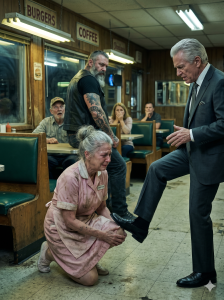
Vance suddenly kicked his foot out, his hard leather shoe striking me sharply right on my bad knee.
I gasped in pain, stumbling backward.
“Not standing up,” Vance smiled, a cold, reptilian stretch of his lips. “Get on your knees. Get on your knees and wipe my shoe with your bare hands and that filthy apron. Show me that you understand your place.”
The diner was a tomb. Nobody moved. The truck drivers looked down at their plates. The young mothers covered their children’s eyes. Nobody was going to save me. They were all too scared of the billionaire who was about to own their town.
My knee throbbed. The pain radiated up my thigh.
I looked at Vance’s face. He was enjoying this. He fed on the power.
Forty-two thousand dollars. I saw Leo’s pale face in the hospital bed.
With a shaky breath, a tear finally escaping and cutting a track through the cheap makeup on my cheek, I slowly began to bend my aching knees toward the grease-stained floor.
I lowered my head. I was going to do it. I was going to surrender every ounce of my human dignity for a paycheck.
My knees were an inch from the floor.
CLANG.
The sound was deafening in the silence.
It came from the front of the diner.
It was the sound of a thick ceramic coffee mug being slammed down onto a table with bone-shattering force.
Vance’s head snapped up.
I froze, hovering just above the floor.
From the front booth, the massive, tattooed man in the leather vest slowly stood up.
Silas didn’t say a word. He didn’t yell.
He just turned his hulking frame around, locked his dead, slate-grey eyes onto Richard Vance, and began a slow, heavy, terrifying march down the center aisle of the diner, straight toward us.
And as I looked at Silas’s face, I realized something that made my blood run absolutely cold.
Vance thought he was bullying a helpless old woman.
But Vance didn’t know the secret I had kept for three years. He didn’t know who Silas really was.
And he had no idea what Silas owed me.
Chapter 2
Every heavy, deliberate step Silas took echoed like a judge’s gavel falling in an empty courtroom. The steady thud-thud-thud of his steel-toed boots on the cheap, cracked linoleum of Sunny’s Diner swallowed whatever noise remained in the room.
I was still hovering an inch above the grease-stained floor, my arthritic knees screaming, my vision blurred with humiliated tears. The air in the diner felt incredibly thin, as if the oxygen had been sucked out the moment Silas stood up.
Richard Vance, the billionaire who held the deed to our town’s misery in his manicured hands, didn’t step back. He simply adjusted the cuffs of his five-thousand-dollar Italian suit and tilted his chin up. He was a man who had never faced a problem a checkbook couldn’t solve. He looked at Silas not as a threat, but as an annoyance—a stray dog wandering onto his country club golf course.
“Is there a problem, Goliath?” Vance sneered, his voice laced with that same toxic, country-club arrogance. He didn’t even bother looking at Silas’s face, his eyes instead dropping to the faded, oil-stained leather of Silas’s biker vest. “Because if you’re looking for an autograph, my assistant can mail you one. Otherwise, step back. I’m handling a disciplinary issue with the help.”
I saw Elias Thorne, the younger of Vance’s two lawyers, shift uncomfortably in the booth. Elias couldn’t have been older than twenty-eight. He wore a sharp navy suit, but his posture lacked Vance’s psychopathic confidence. Elias’s eyes kept darting to his custom Patek Philippe watch, his fingers nervously grazing his silk tie. He looked like a kid who realized too late he had boarded a sinking ship. He saw the sheer mass of Silas, the tribal ink crawling up the biker’s thick neck, the deep, jagged scar bisecting his left eyebrow, and Elias swallowed hard.
“Mr. Vance,” Elias murmured, his voice tight. “Maybe we should just… let the manager handle it. We have the zoning board call in—”
“Shut your mouth, Elias,” Vance barked without breaking eye contact with Silas. “I don’t take orders from you, and I certainly don’t take intimidation from a middle-aged extra from a Sons of Anarchy rerun. Now, move along, biker. The old lady has a shoe to clean.”
Silas stopped right behind me. He was so close I could smell the familiar scent of him—a mixture of stale cigarette smoke, motor oil, and a sharp, metallic undertone that I had long ago learned was the smell of dried blood.
He didn’t look at Vance. Not yet.
Instead, Silas reached down. His massive hands, covered in calluses and faded knuckle tattoos that spelled out D-E-A-D R-O-S-E, gently grasped my upper arms. His touch was shockingly light for a man of his size.
“Get up, Martha,” Silas said. His voice wasn’t loud, but it possessed a low, rumbling frequency that vibrated right through the soles of my worn-out orthopedics.
“Silas, please,” I whispered, panic clawing at my throat. “Don’t do this. I need this job. Leo…”
“I know about the boy,” Silas said softly, hoisting me effortlessly to my feet. He steadied me until he was sure my trembling legs could hold my weight. “But you don’t kneel for a man who hasn’t earned the dirt on your shoes.”
Vance let out a sharp, mocking laugh. “Oh, this is precious. The local trash is unionizing. Listen to me, you walking Hepatitis billboard. I am Richard Vance. By Friday, I will own this pathetic excuse for a restaurant, the dirt beneath it, and the rotting apartment complex this old hag probably lives in. I can ruin your life with a single phone call. I can have you thrown in a cage where you belong. So take your hands off her, back away, and let her do what she’s paid to do.”
I looked around the diner, desperate for someone, anyone, to intervene before this exploded.
Two booths down, Denise, a thirty-four-year-old single mother and ER nurse, was clutching her coffee mug so tightly her knuckles were white. Denise worked a grueling double shift at the county hospital and came here for the cheap eggs. She knew my grandson, Leo. She had snuck extra Jell-O to him when he was in the pediatric ward. I saw the pure agony in her eyes. She wanted to stand up. She wanted to scream at Vance. But I also knew she lived in a duplex owned by one of Vance’s shell companies. If she spoke up, she and her two little girls would be sleeping in her Honda Civic by the end of the week. She met my gaze, a silent, tearful apology passing between us, and looked down at her plate.
But not everyone was looking away.
Over by the pie display case, a nineteen-year-old kid named Tyler was standing perfectly still. Tyler was a community college student who worked the night shift at the local gas station. Just last month, Vance’s development firm had bought his mother’s trailer park and issued thirty-day eviction notices. Tyler had his phone out. The red record button was pulsing. He was capturing every second of this.
Silas slowly turned his massive head to look down at Vance.
“You think you know how the world works,” Silas said, his voice dropping an octave, becoming a lethal, quiet rasp. “You think money builds a wall around you. Keeps the wolves out.”
“My money bought the wolves,” Vance snapped back, stepping closer, completely oblivious to the danger he was putting himself in. “I am the predator here. You are just local wildlife. Now, for the last time, back the hell off.”
Vance made the catastrophic mistake of raising his hand and aggressively shoving Silas in the chest.
It was like watching a toddler try to push over an oak tree.
Silas didn’t even sway. But his dead, slate-grey eyes darkened.
I held my breath. My mind violently flashed back to a torrential Tuesday night exactly three years ago. The night Silas and I forged a bond written in blood and silence.
*It had been past midnight. I was closing Sunny’s alone. Bob, the manager, had conveniently left early, leaving me to mop the floors and count the meager till. The rain was coming down in sheets, hammering against the thin tin roof of the diner.
I had just turned off the neon ‘OPEN’ sign when the back kitchen door was kicked open with enough force to shatter the deadbolt.
I had screamed, dropping the cash drawer.
A man had stumbled into the kitchen, dripping wet, clutching his side. It was Silas. But he didn’t look like the stoic, intimidating giant I knew now. He was pale, shaking, and bleeding profusely from a deep, ragged stab wound just beneath his ribs. His black leather vest was slick with crimson.
“Please,” he had choked out, collapsing against the stainless steel prep table.
Before I could even reach for the phone to dial 911, the roar of multiple heavy motorcycles tore through the rain outside. Headlights swept across the frosted glass of the back door. They were looking for him. The men who did this were circling.
Silas had looked up at me. In his blood-soaked hand, he wasn’t holding a weapon. He was clutching a small, crumpled, water-damaged Polaroid photograph. It was a picture of a little girl with blonde pigtails, maybe six years old.
“Don’t let them find me,” he had gasped, his eyes pleading, stripped of all their hardened armor. “I have to get back to her. Please.”
I don’t know why I did it. Maybe it was because I had just lost my daughter, Sarah, and the thought of another child losing their parent broke something inside me. Maybe it was the raw, desperate humanity in this terrifying man’s eyes.
I dragged his massive, heavy frame into the walk-in pantry. I kicked his bloody boots behind a sack of flour, tossed a heavy tarp over him, and violently mopped the trail of blood on the kitchen floor, dumping a gallon of industrial bleach over the tiles just seconds before the front bell jingled.*
*Three men had walked into the diner. They wore rival cuts. They smelled of wet leather, cheap beer, and murder. The leader, a wiry man with a spiderweb tattoo on his neck, had a hunting knife strapped to his belt.
“We’re looking for a big guy. Bleeding. Came this way,” the leader had demanded.
I had stood there, a sixty-five-year-old woman with a mop, trembling so hard I thought my bones would snap. But I looked the killer dead in the eye and lied.
“I haven’t seen anyone,” I had said, my voice surprisingly steady. “I’ve been locked up in here for an hour. If a bleeding man came in, you’d see it.”
The bleach stung their eyes. The floor was sparkling clean. They searched the bathrooms, peered into the darkened dining room, and eventually, cursing the storm, they left.
I had spent the next four hours in that freezing pantry. I used Sunny’s pathetic first-aid kit—duct tape, gauze, and superglue—to close Silas’s wound. I gave him a clean shirt from Bob’s locker. I made him drink hot tea packed with sugar until his color returned.
He never told me who those men were. He never told me what the fight was about. And he never told me what happened to the little girl in the photograph.
But as he limped out of the back door just before sunrise, he stopped. He looked back at me, his face an unreadable mask of pain and exhaustion.
“I owe you a life, Martha,” he had said, his voice a ragged whisper. “You ever need a wall between you and the dark, you call my name.”*
And now, three years later, in the middle of a crowded, sunlit diner, the dark was standing right in front of me, wearing a five-thousand-dollar suit.
“I’m not going to tell you again, biker,” Vance barked, pulling my mind back to the terrifying present. Vance reached out, his face contorted in an ugly sneer, and grabbed my wrist. His grip was surprisingly tight, his nails digging into my thin, crepey skin. “Get back on your knees, Martha, or you are fired right—”
That was it. That was the spark that hit the powder keg.
Before Vance could finish the syllable, Silas moved. For a man his size, his speed was horrifying.
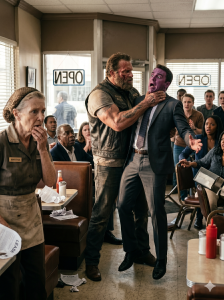
Silas didn’t punch him. He simply reached out with one massive, scarred hand and clamped it around Vance’s throat.
The billionaire’s voice was instantly choked off. The arrogant sneer vanished, replaced by sheer, bulging-eyed panic. Silas lifted his arm, and Vance—a grown man weighing nearly two hundred pounds—was hoisted onto the tips of his expensive leather shoes.
“Mr. Vance!” Elias screamed, jumping up from the booth. The lawyer grabbed Silas’s thick forearm, trying to pry his fingers loose. It was useless. Silas didn’t even acknowledge the lawyer’s existence. He just flexed his shoulder, and Elias was thrown backward, crashing hard into the edge of the adjacent table, spilling hot coffee all over his pristine navy trousers.
The diner erupted. People gasped. A few women screamed. Chairs scraped loudly against the floor as patrons scrambled to get away from the violence. But nobody ran out the door. The morbid human curiosity, the hypnotic draw of watching a tyrant finally face a monster, kept them glued to their spots.
Tyler, the college kid, had stepped closer, holding his phone higher, ensuring he caught the exact moment Vance’s face turned from red to a terrifying shade of purple.
Vance clawed desperately at Silas’s wrist. His manicured fingernails uselessly scratched at the thick, leathery skin and the faded tattoos. He tried to speak, but the only sound that escaped his lips was a pathetic, wheezing squeak.
“You think you’re a predator?” Silas whispered, leaning in so close his beard brushed the collar of Vance’s suit. “You buy buildings. You ruin lives with paper and ink. But out here, in the real world, you are just soft meat in a fancy wrapper.”
“Silas, stop!” I cried out, my voice cracking. I grabbed Silas’s other arm. The muscle beneath his leather vest felt like coiled steel. “Please! You’ll kill him! You’ll go to prison, Silas, let him go!”
Silas’s eyes flickered. The violent fog in them parted just enough to hear my voice. He looked down at me, seeing the absolute terror in my face. I wasn’t just terrified for Vance. I was terrified for Silas. I couldn’t watch the man I saved throw his life away over a spilled cup of coffee.
Silas inhaled deeply, his broad chest expanding. He looked back at Vance, who was now kicking his legs weakly, his eyes rolling back.
With a disgusting thud, Silas opened his hand.
Vance collapsed onto the sticky floor. He hit the ground hard, gasping desperately for air, clutching his bruised throat. His perfect silver hair was disheveled. The knee of his tailored suit was soaked in the puddle of coffee I had spilled earlier. He looked exactly like what he had called me: pathetic.
Elias, the lawyer, scrambled over to his boss, his hands shaking so badly he couldn’t even help Vance sit up. “I’m calling the police!” Elias shrieked, his voice cracking an octave. “You’re going away for a long time, you psychotic animal! This is assault! This is attempted murder!”
“Call them,” Silas said calmly, not stepping back. He stood over the two men in suits, an immovable mountain of consequence. “Tell them Silas Thorne is here.”
Elias froze. The color instantly drained from his face. He stopped reaching for his phone.
I frowned, confused. I looked at Elias, then at Silas. Thorne? Elias Thorne? Silas Thorne?
Vance, still wheezing on the floor, looked up. His eyes darted between his young lawyer and the massive biker standing over him.
“Elias…” Vance croaked, coughing violently. “What… what is he talking about? Who is he?”
Elias looked like he was about to vomit. He stared up at Silas, his eyes filled with a mixture of profound terror and deep, unresolved childhood shame.
“He’s… he’s my older brother, Mr. Vance,” Elias whispered, the words sounding like they were tearing his throat apart.
A collective gasp echoed through the diner. Even Tyler lowered his phone for a fraction of a second in pure shock.
I stared at Silas, my mind reeling. The giant, tattooed enforcer who ate cherry pie in silence, who bled out on my kitchen floor, who lived in the shadows of the criminal underworld… was the older brother of Richard Vance’s cowardly, Ivy-League-educated attack dog?
Silas looked down at Elias with an expression of cold, unadulterated disgust.
“You changed your suit, Eli,” Silas said, his voice dripping with venom. “But you’re still fetching bones for the worst dog in the yard.”
“Silas, please,” Elias begged, tears actually welling in his eyes. He looked around at the crowd, realizing how incredibly damaging this was. “You don’t understand what he’s doing here. This project… it’s a multi-million dollar revitalization. I’m just doing my job!”
“Your job is watching a billionaire force an old woman to her knees?” Silas fired back, his voice echoing off the cheap acoustic tiles of the ceiling. “Mom would be sick if she saw you. Good thing she didn’t live long enough to watch you sell your spine for a Rolex.”
Vance finally managed to push himself up onto his knees. The irony was not lost on anyone in the room. The man who had demanded my subjugation was now kneeling on the filthy floor, gasping for breath, looking up at the people he thought were beneath him.
But Vance was not a man who learned humility. His fear was rapidly morphing into a venomous, unhinged rage.
He staggered to his feet, leaning heavily on the table. The purple bruises in the shape of Silas’s fingers were already blooming rapidly across his neck.
“You…” Vance hissed, pointing a trembling, manicured finger at Silas. “You are a dead man. And you,” he snapped his head toward me, his eyes burning with a hatred so pure it made me step back. “You are finished. Bob!”
Bob, the manager, emerged from the kitchen doorway, trembling like a leaf. He had been hiding the entire time. “Y-yes, Mr. Vance?”
“Fire her,” Vance spat, coughing as the words scraped his bruised windpipe. “Fire her right now, or I swear to God I will buy this diner today, bulldoze it tomorrow, and personally ensure you never work in this state again.”
Bob looked at me. His face was pale, glistening with cheap sweat. We had worked together for ten years. I had covered his shifts when his wife was sick. I had stayed late to help him balance the books. But in his eyes, I saw the ultimate truth of the American rust belt: survival always trumped loyalty.
“Martha…” Bob stammered, unable to meet my eyes. He looked down at his orthopedic shoes. “Martha, I’m… I’m so sorry. I can’t lose this place. You need to pack up your locker. You’re let go.”
The words hit me harder than Vance’s kick.
Fired.
The diner around me seemed to spin. The harsh fluorescent lights buzzed aggressively in my ears.
Forty-two thousand dollars.
That was the number that flashed behind my eyes. The number I needed to fix Leo’s heart. I had eight thousand saved up in a shoebox under my bed. I was relying on the overtime, the tips, the sheer grinding repetition of this miserable job to keep my grandson breathing. And now, because my thumb had twinged, because I had spilled three drops of coffee, it was all gone.
I felt my legs give out. The fight completely drained from my body. I slumped against the edge of the nearest booth, burying my face in my hands. The humiliation, the fear, the crushing weight of my failure—it broke me. I began to sob, the deep, ragged cries of a woman who had absolutely nothing left to lose and yet had just lost everything.
“Are you happy now?” Elias suddenly yelled at Silas, his voice cracking. “Look what you did! You think you’re a hero? You just ruined her life! You always do this! Everything you touch turns to ash, Silas!”
Silas didn’t look at his brother. He didn’t look at Vance, who was smirking triumphantly despite the bruises on his neck.
Silas looked down at me.
He saw the broken old woman sobbing into her dirty pink apron. He saw the grandmother who had hidden him in a pantry and stitched his flesh together.
Slowly, Silas reached into the inside pocket of his heavy leather vest.
“Bob,” Silas called out, his voice cutting through my sobs and the tense murmurs of the crowd.
Bob flinched, looking up from the floor. “Y-yes?”
“How much?” Silas asked.
“How much what?” Bob squeaked.
“How much for the diner?” Silas asked, his tone perfectly flat. “Right now. Cash.”
Vance let out a hoarse, barking laugh. “You’re out of your mind. This lot is zoned for commercial logistics. The land alone is worth a million dollars. You think you can buy it with whatever loose change you make selling meth to high schoolers?”
Silas ignored him. He pulled his hand out of his vest pocket. He wasn’t holding a gun. He wasn’t holding a knife.
He held a thick, heavy, vacuum-sealed plastic brick.
He tossed it casually onto the table right in front of Bob. It landed with a heavy, dense smack.
Through the clear plastic, everyone in the diner could see the tight, neat stacks of hundred-dollar bills.
“There’s two hundred and fifty thousand dollars in that brick,” Silas said calmly. “It’s clean. Untraceable. And it’s yours, Bob, if you sign the deed over to Martha right now.”
The silence that followed was absolute.
Bob stared at the brick of cash as if it were a bomb. Vance’s jaw literally dropped, his arrogant smirk melting into utter confusion. Elias took a step back, his eyes wide with horror, recognizing exactly what kind of money that was and what his brother had done to get it.
I stopped crying. I lowered my hands and stared at the massive biker.
“Silas…” I whispered, my voice trembling. “What did you do?”
Silas finally looked at me, and for the first time in three years, I saw a flicker of profound sadness in his slate-grey eyes.
“I told you I owed you a life, Martha,” he said softly. “But this money… it comes with a ghost.”
Chapter 3
The vacuum-sealed brick of cash rested on the scarred laminate table of booth four, glowing under the harsh fluorescent lights of Sunny’s Diner like a radioactive artifact. Two hundred and fifty thousand dollars. It was a sum so completely foreign to this zip code that it didn’t even look real. It looked like a movie prop.
But the smell was real. Even through the thick plastic, there was a faint, unmistakable scent of aged paper, ink, and something metallic.
Bob, our manager, was literally paralyzed. His hands, which had been shaking a moment ago, were now frozen at his sides. His eyes were wide, unblinking, tracing the tight, perfect stacks of Benjamin Franklins. A bead of sweat broke loose from his comb-over and slid down his pale cheek, dropping onto his polyester collar.
“You’re bluffing,” Richard Vance wheezed, breaking the heavy, suffocating silence. He was still leaning heavily against the table, one hand massaging his bruised, purple throat. He stared at the brick, his aristocratic face twisted into a mask of pure denial. “That’s counterfeit. It has to be. A walking disease like you doesn’t have a quarter of a million dollars in liquid cash.”
Silas didn’t even turn his head to acknowledge Vance. He kept his slate-grey eyes locked on Bob.
“The deed, Bob,” Silas repeated, his deep voice carrying a quiet, terrifying authority. “I know the owner, Old Man Henderson, has been trying to offload this dying building for two years. He offered it to you for a hundred and eighty. You couldn’t get the bank loan. I’m offering you two hundred and fifty. Cash. Today. You take your cut, you pay off Henderson, and you put Martha’s name on the paper.”
“It’s illegal!” Elias Thorne, Silas’s younger brother, suddenly shrieked. The young lawyer stepped forward, his face pale and slick with panicked sweat. He pointed a trembling finger at the brick. “Mr. Vance is right! It’s either counterfeit, or it’s cartel money! Bob, if you touch that, you are an accessory to money laundering, racketeering, and God knows what else!”
“Shut up, Elias,” Silas said, finally looking at his brother. The absolute lack of affection in Silas’s eyes made Elias flinch. “You want to talk about racketeering? You’re standing next to a man who illegally manipulated the zoning board last week to force three family-owned farms into foreclosure. You wrote the paperwork for him. Don’t lecture me about the law.”
Elias swallowed hard, his Adam’s apple bobbing nervously. “I… I do what I have to do to survive in the real world, Silas. You wouldn’t understand.”
“The real world?” Silas let out a low, bitter chuckle that sounded like grinding stones. “You think wearing a silk tie makes you immune to the dirt? Mom died in a county hospital corridor waiting for a bed while men like him,” Silas jabbed a thick, scarred finger toward Vance, “bought up the hospital’s debt and liquidated its assets. And now you carry his briefcase.”
The revelation hit the diner like a physical shockwave. Denise, the ER nurse sitting two booths down, gasped softly, her hand flying to her mouth. Tyler lowered his phone just an inch, his jaw slack.
Elias looked like he had been slapped. His face flushed a deep, shameful crimson. “I… I pay for Mom’s headstone,” he stammered, his voice breaking. “I bought the plot. I did that! What did you do, Silas? You ran! You joined a gang, you went to prison, you abandoned us!”
“I took the charges so you wouldn’t have to,” Silas fired back, his voice finally rising, the raw, suppressed emotion cracking through his hardened exterior. “You were eighteen, Eli. You got caught holding the bag for those rich kids at your prep school. I took the fall so you could go to college. So you could become a lawyer. So you could be better than me!”
The silence that followed was deafening. The truth hung in the humid air of the diner, heavy and suffocating.
Elias was trembling violently now. Tears spilled over his eyelashes, cutting through his expensive cologne. He looked at Silas, the older brother who had sacrificed his freedom, his future, his very soul to keep Elias’s record clean. And Elias had repaid that sacrifice by becoming the exact kind of monster that preyed on people like them.
Vance, completely oblivious to the profound family tragedy unfolding beside him, slammed his hand on the table.
“Enough of this Jerry Springer garbage!” Vance barked, his voice still hoarse from being choked. He glared at Bob. “Bob, listen to me very carefully. If you take that money, I will personally see to it that the IRS audits you for the next ten years. I will tie you up in civil litigation until you are homeless. I will buy the property next door, open a franchise, and run this dump into the ground in a month. You are selling to me. For one hundred and fifty thousand. As agreed.”
Bob looked from the brick of cash to Richard Vance’s furious face.
It was the ultimate test of a broken man. Bob had spent his entire life bowing to power, avoiding conflict, and taking the path of least resistance. He was terrified of Vance. But he was also staring at more money than he had ever seen in his life. Money that could pay for his daughter’s college. Money that could buy him a boat, a house, a way out of this miserable rust-belt trap.
Bob took a deep, shuddering breath. He reached out with a trembling hand.
His fingers brushed the cold plastic of the money brick.
“Mr. Vance,” Bob said, his voice barely a squeak. He cleared his throat and tried again, louder this time. “Mr. Vance… the agreed price was one-fifty. But as you can see… I have a better offer.”
Vance’s eyes bulged. “You insignificant little worm. You’re actually going to cross me? For him?”
“I’m… I’m an independent contractor, sir,” Bob stammered, actually finding a microscopic shred of a spine. He pulled the heavy brick of cash toward his chest, clutching it like a life preserver. “Mr. Henderson gave me the power of attorney to negotiate the sale. Two hundred and fifty thousand is a hundred thousand over asking. I’d be breaching my fiduciary duty if I didn’t accept.”
“You’re going to prison!” Elias shouted, desperately trying to regain control of the situation for his boss.
“Actually,” Silas interrupted, turning to me. “Martha. Do you still have that napkin?”
I blinked, still leaning weakly against the booth, my face stained with cheap makeup and tears. “What… what napkin?”
“The one I signed three years ago,” Silas said softly.
My breath caught in my throat. I remembered. It was the morning after the storm, the morning after I had hidden him in the pantry and stitched up his knife wound. Before he left, he had taken a pen from my apron and scribbled something on a paper napkin, folding it into my pocket. An I.O.U.
I reached into the deep pocket of my pink, stained uniform. My fingers bypassed my order pad, a few spare pens, and found it. A folded, yellowed paper napkin.
I pulled it out with shaking hands.
Silas looked at Bob. “Read it.”
Bob leaned in, squinting at the faded blue ink.
‘I, Silas Thorne, owe Martha Hayes my life. My debts are hers to claim. Whatever I have, whatever I acquire, she holds the lien.’
It was signed and dated. Three years ago.
“It’s a binding contract,” Silas said, staring dead at his younger brother. “You’re the lawyer, Eli. A handwritten contract, signed and dated, acknowledging a life debt. That two hundred and fifty thousand? Legally, it’s already Martha’s. She’s just using her own money to buy the diner. You try to take this to court, Vance, and you’ll be fighting a sixty-eight-year-old grandmother who’s just executing a perfectly legal private contract to buy a commercial property.”
Elias stared at the napkin. His legal mind raced, trying to find a loophole, but he knew the optics. A jury in this county would look at Richard Vance—a predatory billionaire—and Martha—a struggling grandmother with a sick kid—and Vance would be crucified. It would be a PR nightmare that could tank Vance’s entire logistics hub project.
Vance realized it too. The color drained from his face. He wasn’t just beaten; he was outmaneuvered by a man in a filthy leather vest.
“You…” Vance sputtered, pointing a shaking finger at Silas, then at me. “You think you’ve won? You think buying this grease trap saves you? The property taxes are going to double next year. The health inspector works for me. The zoning board eats out of my hand. I will bury this diner in red tape until you’re begging me to buy it for pennies on the dollar!”
“Get out of my diner,” I whispered.
The words slipped out before I could stop them.
Vance stopped ranting. He looked at me, genuinely shocked that I had spoken.
I pushed myself off the booth, standing up straight. The pain in my arthritic knees was still there, pulsing sharply, but something else had taken over. It was a cold, terrifying clarity. I was holding a piece of paper that effectively made me a quarter-of-a-millionaire. I held the key to Leo’s heart surgery.
“I said, get out of my diner, Mr. Vance,” I repeated, my voice steady, ringing clear through the silent room.
Vance glared at me, his eyes filled with a toxic, impotent hatred. He looked at Silas, standing there like a monolithic guardian, and realized he had no moves left to play today.
“You’ll regret this, Martha,” Vance hissed, straightening his ruined suit jacket. “And you, Thorne… you’re a dead man walking.”
Vance turned on his heel and stormed toward the exit, his five-hundred-dollar shoes crunching over the spilled coffee beans on the floor.
Elias hesitated. He looked at Silas, his older brother, the man who had traded his life for Elias’s success.
“Silas…” Elias whispered, his voice trembling. “What did you mean when you said the money comes with a ghost?”
Silas’s face hardened into a mask of granite. “It means you need to take your boss and get out of this town, Eli. Tonight. Because the men I took that money from are going to come looking for it. And they don’t care who gets in the way.”
Elias’s eyes widened in sheer horror. He understood exactly what Silas meant. He backed away slowly, as if Silas were infected with a lethal virus, before turning and practically sprinting out of the diner behind Vance.
The bell above the door jingled sharply as it slammed shut.
The diner was silent for three full seconds.
Then, Denise, the exhausted ER nurse, stood up and began to clap.
Slowly, tentatively, the rest of the diner joined in. Tyler, the college kid, gave a loud, piercing whistle. Truck drivers banged their thick ceramic mugs against the tables. The sound of applause, of genuine, unadulterated relief, washed over the room. For the first time in years, the people of this dying town had seen a bully lose.
But I wasn’t clapping.
I looked up at Silas. The giant man was staring at the door, his jaw clenched so tightly the muscles fluttered beneath his beard.
“Silas,” I said, my voice barely audible over the cheering crowd.
He looked down at me.
“Whose money is that?” I asked, pointing to the plastic brick Bob was still clutching like a newborn baby.
Silas sighed, a heavy, exhausted sound. He gently placed a massive hand on my shoulder.
“Three years ago, Martha, when I stumbled into your kitchen… I was running from a crew called the Iron Wraiths. A bad organization out of Detroit. They deal in heavy narcotics and human trafficking.”
My blood ran cold. The men who had come looking for him that night. The man with the spiderweb tattoo on his neck.
“I was their enforcer,” Silas admitted, his voice laced with deep shame. “I did terrible things for them. But then… they asked me to do something I couldn’t do. They asked me to move a shipment of girls. Young girls.”
I gasped, covering my mouth with my hand.
“I refused,” Silas continued quietly. “I tried to walk away. They didn’t like that. They cornered me. I fought my way out, but they stuck me deep. Before I ran, I hit their main stash house. I took their operating cash. To hurt them. To buy my freedom.”
He looked at the brick of money in Bob’s arms.
“I buried that money in the woods outside of town three years ago. I promised myself I would never touch it. Because the second those bills hit the local economy, the Wraiths will hear about it. They’ll know I’m alive. And they’ll know where I am.”
I felt the room start to spin again. “Silas… no. You can’t. If they find you—”
“They will find me,” Silas interrupted, his slate-grey eyes perfectly calm, accepting his fate. “But it’ll take time. A few weeks, maybe a month. By then, Bob will have cashed it out, the deed will be in your name, and you can take a loan against the property to pay for Leo’s heart surgery. Forty-two thousand, right?”
Tears blurred my vision. “Silas, I can’t let you die for me. I can’t take blood money.”
“It’s not blood money anymore, Martha,” Silas said, offering me a sad, gentle smile. “It’s life money. You saved my life three years ago. I’ve just been living on borrowed time. It’s time to pay the toll.”
He gently squeezed my shoulder, his massive, scarred thumb brushing away a tear on my cheek.
“You take care of that boy, Martha,” Silas whispered. “And you make sure you buy a new coffee pot for this place. The old one burns the roast.”
Without another word, Silas Thorne turned around, his heavy steel-toed boots thudding against the floor, and walked out the back door of the diner, disappearing into the blinding midday sun.
I stood there, staring at the empty doorway, holding the yellowed napkin in my hand.
I was the owner of Sunny’s Diner. I had the money for my grandson’s heart.
But as I looked down at the brick of cash, I realized the terrifying truth. Richard Vance was right about one thing.
I had just started a war. And the wolves were already on their way.
Chapter 4
The silence in the diner after Silas left was not peaceful. It was the ringing, heavy silence that follows a bomb blast.
I stared at the empty doorway, the harsh midday sun baking the cracked asphalt of the parking lot where Silas’s massive shadow had just vanished. The air still smelled like burnt coffee, fear, and the metallic tang of the two hundred and fifty thousand dollars sitting in a vacuum-sealed plastic brick on booth four.
Bob was the first to move. He didn’t speak. He just reached out, his hands trembling violently, and pulled the brick of cash off the table, hugging it to his chest like a life preserver. He looked around the diner with the wide, paranoid eyes of a hunted animal. The regulars—Denise the ER nurse, Tyler the college kid, the truck drivers who had just been cheering—were now looking at the money, and then at me, with a mixture of awe and profound, instinctual dread.
They all knew what that kind of money meant in a town like ours. It meant blood. It meant consequences.
“Martha,” Bob whispered, his voice cracking. He backed away toward the kitchen doors. “I’m going to call Old Man Henderson. I’m going to… I’m going to get the paperwork. I know a title guy. We can backdate it. Make it quiet.”
“Bob,” I said, my voice sounding hollow, detached from my own body. “Is it worth it?”
He stopped, clutching the plastic brick so tightly his knuckles were white. He looked at me, a middle-aged man who had spent his entire life being stepped on, taking the path of least resistance. “It’s a quarter of a million dollars, Martha. It’s a way out. For both of us. Silas… Silas knew what he was doing.”
Before I could answer, he turned and practically ran into the back office, locking the heavy steel door behind him.
I looked down at my hands. They were shaking. The yellowed paper napkin with Silas’s faded handwriting was still clutched in my fingers. ‘I owe Martha Hayes my life. My debts are hers to claim.’
I didn’t finish my shift. I couldn’t. I untied the stained pink apron that had been my uniform for fifteen years, folded it neatly, and left it on the counter. I walked out of Sunny’s Diner, got into my rusted fifteen-year-old sedan, and drove toward the county hospital.
The drive was a blur. My mind was a chaotic storm of terror and desperate, clawing hope. Forty-two thousand dollars. The number that had haunted my nightmares, the insurmountable wall between my grandson and a future, was suddenly crumbling. But the mortar holding that wall together was the life of a man who had eaten cherry pie in silence every Tuesday and Thursday.
I parked in the sterile, grey concrete structure of the hospital parking garage. The smell of the hospital hit me the moment I walked through the sliding glass doors—bleach, latex, and the quiet despair of families waiting for bad news.
I took the elevator to the pediatric cardiology ward on the fourth floor.
Leo was awake when I walked in. He looked so incredibly small in the massive, mechanized hospital bed. He was twelve, but his defective heart had stunted his growth, making him look closer to nine. His skin was pale, almost translucent, and a web of clear plastic tubes ran from his frail arms to the monitors beeping rhythmically next to him.
But when he saw me, his eyes—Sarah’s eyes, a bright, piercing green—lit up.
“Gramma,” he rasped, his voice weak but trying so hard to be brave.
“Hey, my sweet boy,” I whispered, rushing to his side. I smoothed his messy brown hair, feeling the terrifyingly fragile heat of his forehead. I kissed his cheek, breathing in the scent of his skin, trying to anchor myself to this room, to him.
“You’re here early,” he noticed, coughing weakly. “Did Bob let you off?”
“Something like that,” I managed to say, forcing a smile that felt like it might crack my face in half. I pulled a plastic chair close to his bed and took his small, cold hand in my swollen, arthritic ones.
“Leo,” I said, my voice trembling despite my best efforts to control it. “I have some news. Good news.”
He looked at me, his brow furrowing. “Did you win the lottery, Gramma?”
Tears instantly flooded my eyes. I let out a wet, broken laugh. “Yeah, baby. Something like that. I talked to the doctors downstairs before I came up. They’re… they’re scheduling the surgery. The second surgery. The one that’s going to fix your heart for good.”
Leo’s eyes went wide. For a second, he didn’t say anything. He had lived with the shadow of death hovering over his bed for so long that the concept of a cure was entirely alien to him. Then, a slow, beautiful, devastatingly hopeful smile spread across his pale face.
“Really?” he whispered. “I… I can play baseball? Next spring?”
“You can play baseball,” I sobbed, pressing his hand to my wet cheek. “You can run, and ride a bike, and do whatever you want, Leo. You’re going to live. You’re going to have a whole, long life.”
He closed his eyes, a single tear slipping down his cheek, and squeezed my hand with whatever strength he had left.
As I sat there holding him, watching the rhythmic rise and fall of his chest, the sheer, crushing weight of what had happened hit me. I was buying this boy’s life with dirty money. I was buying it with Silas’s blood. The Iron Wraiths were out there. And Silas was out there, walking directly into their teeth to draw them away from us.
The next three days were a masterclass in suffocating anxiety. Every time a car drove slowly past my small, run-down house, my heart stopped. Every time the phone rang, I expected it to be the police, or worse.
But the gears of survival were turning. Bob moved with a ruthless, desperate efficiency I had never seen in him. True to his word, he found a title lawyer who didn’t ask questions. They bypassed the standard escrow periods, greased the right palms, and executed a private, cash-only transfer of the commercial deed.
On Thursday morning, Bob met me in the hospital cafeteria. He looked exhausted, his comb-over a mess, dark circles under his eyes, but he pushed a thick manila envelope across the Formica table.
“It’s done,” Bob whispered, looking around nervously. “Old Man Henderson took a hundred and fifty grand in a duffel bag and moved to Florida yesterday. The lawyer took a ten-thousand-dollar cut to file it clean. I took the rest, Martha. I’m packing my truck tonight. I’m taking my daughter and we’re moving out west. I’m never coming back to this town.”
I opened the envelope. Inside was a legal deed, stamped by the county clerk, listing Martha Hayes as the sole owner of the property that housed Sunny’s Diner.
“Thank you, Bob,” I said quietly.
“Don’t thank me,” he muttered, standing up quickly. “Just… go to the bank, Martha. Get a commercial line of credit against the property value. Use that clean money to pay the hospital. Wash your hands of the rest. And pray to God those men from Detroit don’t come looking for the paper trail.”
He walked away, practically fleeing the hospital. I never saw Bob again.
I did exactly what he said. Armed with the deed to a commercial property zoned in a prime location that Richard Vance had just aggressively inflated the value of, the local bank practically threw a seventy-thousand-dollar line of credit at me. They didn’t care how a sixty-eight-year-old waitress acquired the property; they only cared about the collateral.
I walked into the hospital billing department on Friday morning and handed them a cashier’s check for forty-two thousand dollars. Paid in full.
Leo’s surgery was scheduled for the following Tuesday.
But while the financial miracle had been secured, the darkness that had purchased it was beginning to close in.
It started on the local news on Sunday evening. I was sitting in Leo’s empty hospital room while he was downstairs getting pre-op scans. The small television mounted in the corner of the room was playing the local broadcast.
The anchor’s voice caught my attention.
“…a massive fire at an abandoned warehouse complex on the outskirts of Detroit. Authorities are calling it a suspected gang-related arson. Police discovered multiple casualties at the scene following reports of heavy gunfire that lasted for nearly twenty minutes…”
My blood turned to ice. I dropped the magazine I was holding.
The broadcast showed aerial footage of a massive, blackened structure still smoldering, surrounded by dozens of police cruisers and fire trucks.
“…sources inside the Detroit Police Department indicate this may be tied to an ongoing turf war involving the notorious Iron Wraiths motorcycle club. While bodies are still being identified, police confirmed they found the remains of a single individual barricaded inside the main office who appeared to have held off multiple attackers before the building was set ablaze…”
I couldn’t breathe. The room spun. I clamped my hands over my mouth to stifle the scream that was tearing its way up my throat.
He went to them.
Silas didn’t just run. He didn’t hide. He took the fight directly to their front door. He made sure they were looking at him, shooting at him, focusing all their rage and violence on him, so they wouldn’t spend a single second looking southward toward a rust-belt diner and an old waitress who had taken their money.
He was the ghost. And he had taken them into the dark with him.
I fell to my knees right there on the sterile linoleum floor of the hospital room, sobbing uncontrollably. I cried for a man who had lived a life of violence, who had made terrible choices, but who had, in the end, possessed more honor, more grace, and more pure humanity than the billionaire in the Italian suit who had tried to force me into the dirt.
Silas Thorne paid his debt. He paid it with everything he had left.
The next morning, the bell above the front door of my house rang.
I wiped my exhausted eyes and looked through the peephole. Standing on my porch was Elias Thorne.
I unlocked the door and opened it slowly.
Elias looked like a ghost himself. He wasn’t wearing his tailored navy suit. He was wearing jeans and a wrinkled gray hoodie. He hadn’t shaved in days. The arrogant, slick, Ivy-League attack dog was completely gone, replaced by a broken, hollowed-out kid carrying a heavy leather briefcase.
“Martha,” he said, his voice raspy.
“They found him, Elias,” I whispered, my voice breaking. “The news…”
Elias nodded slowly, his eyes filling with tears that didn’t fall. “I know. The police called me at 3:00 AM. I’m his only listed next of kin. They… they identified him by his dental records. And the tattoos.”
A heavy, suffocating silence hung between us.
“He did it for you, Elias,” I said softly. “He did it to protect me, but he went out there because he didn’t want them coming anywhere near his little brother.”
Elias let out a choked sob, leaning against the doorframe, burying his face in his hands. He cried the ugly, desperate tears of a man who realizes too late what he had thrown away. He had spent his entire adult life trying to distance himself from his brother, trying to scrub the poverty and the shame from his skin, only to realize that the suit he wore was bought and paid for by Silas’s blood.
I didn’t turn him away. I opened the door wider and let him in. I made him a cup of cheap drip coffee, and we sat at my small kitchen table in silence.
Finally, Elias wiped his eyes and unlatched the heavy leather briefcase he had brought with him.
“Richard Vance is a monster, Martha,” Elias said, his voice finally finding a steady, cold pitch. “I spent the last five years rationalizing what we did. I told myself it was just business. But when I watched him put his hands on you… when I watched him kick you to your knees… and then watching my brother, a man society calls a criminal, give up his life to save yours…”
Elias pulled out stacks of manila folders, USB drives, and ledgers, dumping them onto my kitchen table.
“This is everything,” Elias said, looking me dead in the eye. “Every bribe he paid to the zoning board. Every illegal foreclosure he forced through shell companies. The safety violations he covered up on his construction sites. The tax evasion. I was his primary counsel. I have the paper trail for all of it.”
I looked at the mountain of evidence. “Elias, if you give this to the authorities, you’re implicating yourself. You’ll be disbarred. You might go to prison.”
Elias offered a faint, bitter smile. “Silas went to prison for me when I was eighteen so I could have a life. It’s my turn to take the hit. I’m going to the State Attorney General this afternoon. I’m turning state’s evidence. Vance’s empire is going to burn to the ground by Friday.”
He stood up, leaving the briefcase on the table.
“Keep those,” Elias said. “As an insurance policy. If Vance’s lawyers try to come after you or the diner, you leak those to the press. But they won’t. By tomorrow, Richard Vance’s bank accounts will be frozen, and he’ll be fighting federal indictments for the rest of his miserable life.”
Elias walked to the front door. He paused, looking back at me.
“Silas always said you made the best cherry pie in the county,” Elias said softly. “I’m glad he had someone like you looking out for him, Martha.”
“He was a good man, Elias,” I told him, making sure he heard it. “Underneath it all. He was a good man.”
Elias nodded, stepped out into the morning air, and walked away to burn his own life down to avenge his brother.
Tuesday came.
The surgery took nine grueling, terrifying hours. I sat in the waiting room, clutching my rosary, staring at the clock on the wall until the numbers blurred together. Every time the double doors to the surgical wing swung open, my heart stopped.
Finally, at 6:45 PM, a surgeon in blue scrubs walked out, pulling his mask down. He looked exhausted, but he was smiling.
“Martha?” he asked.
I practically fell out of my chair, rushing toward him.
“He did beautifully,” the surgeon said, putting a steadying hand on my arm. “The valve replacement was a complete success. His vitals are strong. It’s going to be a long recovery, but… he’s going to be fine, Martha. He’s got a brand new engine in there.”
I didn’t say anything. I just collapsed against the surgeon’s chest, weeping with a joy so profound and absolute it physically hurt.
The storm broke. The sky finally cleared.
The next few months were a whirlwind of change that swept through our town like a hurricane.
True to Elias’s word, Richard Vance’s empire imploded spectacularly. The State Attorney General raided Vance’s corporate headquarters the very next day. The news was dominated by footage of the arrogant billionaire being led out of his glass skyscraper in handcuffs, his expensive Italian suit looking rumpled, his face pale and terrified.
Elias Thorne surrendered his law license and pled guilty to conspiracy and racketeering, accepting a plea deal that would put him in a minimum-security federal facility for three years. He took his punishment with a stoic dignity that would have made his older brother proud.
With Vance’s logistics hub project dead in the water, the predatory pressure on our town vanished. The properties he had illegally acquired were seized by the state and slowly returned to the families who had been forced out. The dark cloud that had been suffocating us finally lifted.
And then there was the diner.
My diner.
I didn’t sell it. Once Leo was stable and in rehabilitation, I went back to work. But I wasn’t wearing a stained pink apron anymore.
I used the remainder of the commercial line of credit to fix the place up. We repaired the air conditioning, bought new vinyl booths, fixed the neon sign outside, and finally, mercifully, threw away the old, burnt coffee pots and bought a brand-new, industrial-grade espresso machine.
I hired Tyler, the college kid who had filmed Vance’s downfall, to manage the front-of-house. I hired Denise’s sister to cook. I gave everyone a living wage, because I knew exactly what it felt like to drown on minimum wage.
Sunny’s Diner became a sanctuary. It was packed every day, not just with truck drivers, but with the families who had survived the billionaire’s siege.
It was a Tuesday afternoon, about a year later. The lunch rush had just died down. The air in the diner was cool, smelling of fresh coffee, sizzling bacon, and bleach.
I was wiping down the counter when the front bell jingled.
I looked up and smiled.
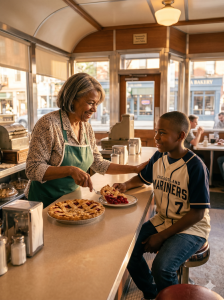
Walking through the door was Leo. He was thirteen now, and he had grown three inches in the last year. His cheeks had color. His eyes were bright. He was wearing a baseball jersey with the number seven on the back, carrying his glove under his arm.
He didn’t walk with the slow, labored shuffle he used to have. He bounded over to the counter, full of chaotic, beautiful, healthy teenage energy.
“Hey, Gramma!” he grinned, dropping his glove on the counter. “Coach said I can pitch on Saturday!”
“That’s amazing, sweetheart,” I beamed, reaching across the counter to ruffle his hair. “You hungry? Want a burger?”
“Can I have a slice of cherry pie instead?” he asked, his eyes pleading.
I paused. The rag in my hand went still.
I looked past Leo, toward the back of the restaurant.
Booth four. The large, secluded booth in the corner.
It was empty.
I never let anyone sit there. It was permanently reserved. On the table, right in the center, sat a thick, pristine ceramic mug filled with black coffee, and a fresh slice of homemade cherry pie on a small plate.
Underneath the plate, slipped beneath the ceramic edge, was a framed, yellowed paper napkin.
I looked at the empty booth, and then down at my grandson, whose heart was beating strong and steady in his chest.
“Of course, Leo,” I smiled, a soft, bittersweet warmth blooming in my chest. “I’ll get you a fresh slice. But that one back there… that one is spoken for.”
I turned around, pouring a fresh cup of coffee, listening to the sound of my grandson laughing as he talked to Tyler about his curveball.
The sound of a five-hundred-dollar leather shoe kicking my knee used to echo in my head. But it doesn’t anymore.
Now, the only sound I hear is the steady, rhythmic heartbeat of my grandson, and the quiet, heavy footsteps of the giant in the leather vest who bought it for him.
Some debts can never be repaid. Some ghosts never truly leave you. They just stand guard in the shadows, drinking black coffee, making sure the wolves never come back to your door.
