


Chapter 1
There is a very specific kind of cold that only hospital floors possess.
It’s a sterile, biting chill that cuts straight through your skin and sinks deep into your aching bones.
I know this cold all too well.
My name is Arthur Pendleton. I am eighty-four years old.
In my life, I have survived the freezing, blood-soaked mud of the Korean War. I have survived the blistering, suffocating heat of the Vietnam jungles. I have survived the devastating loss of my beautiful wife, Martha, to breast cancer ten years ago.
I thought I had survived the worst this world could throw at a man.
I was wrong.
Nothing in my eighty-four years of life had prepared me for the sheer, agonizing humiliation of lying helpless on the linoleum floor of St. Jude’s Medical Center while the people who were supposed to care for me simply looked away.
It started three days ago.
A fractured hip. A stupid, clumsy fall on my own front porch while reaching for the Sunday paper.
At my age, a broken hip isn’t just an injury. It’s a death sentence wrapped in a white hospital gown. It strips away the last tiny shred of independence you fought so hard to keep.
Because of the overcrowding at St. Jude’s, they placed my bed in “Hallway C” — a busy, open-air transit ward near the suburban pavilion.
It was chaotic. Bright fluorescent lights buzzed overhead twenty-four hours a day. People rushed past constantly.
I felt completely exposed. A forgotten relic shoved against a peeling white wall.
But the physical pain of my shattered hip was nothing compared to Nurse Brenda.
Brenda was a woman in her late thirties with bleach-blonde hair tied in a messy bun, heavy makeup, and a permanent scowl etched into her face.
She walked with heavy, aggressive footsteps. She snapped her chewing gum loudly.
And she hated her job.
More specifically, she hated the elderly patients. To her, we were not human beings with histories, families, and souls. We were inconveniences. We were heavy, smelly burdens that kept her from looking at her phone.
From the moment she was assigned to my section, she made my life a living hell.
“Move your leg, old man,” she had snapped on her very first shift, violently yanking the blanket off my shivering body.
When I asked for a cup of water to swallow my pain pills, she rolled her eyes so hard I thought they would pop out of her skull.
“You’re not at the Ritz-Carlton, Arthur. Wait your turn,” she hissed, leaving me thirsty for six excruciating hours.
I endured it.
I am a soldier. I have been trained to endure. I bit my lip until it bled, staring up at the ceiling tiles, silently reciting the names of the men in my platoon to distract myself from the throbbing agony in my hip.
But there is a breaking point for every man.
It happened on a Tuesday morning. The ward was particularly crowded.
Dozens of patients, visitors, and hospital staff were milling around. The air was thick with the smell of strong coffee, bleach, and rubbing alcohol.
A young, timid orderly named Tommy was supposed to be changing my IV bag. Tommy was a good kid, maybe nineteen, but he was terrified of Brenda. Everyone was.
“Tommy! Get over here and clean up Room 12!” Brenda barked from down the hall, her voice cutting through the noise of the ward.
“But… Mr. Pendleton’s IV is beeping, Brenda,” Tommy stammered nervously. “He needs his pain medication…”
Brenda marched over. Her eyes were dark with unprovoked rage.
She shoved Tommy out of the way so hard the poor kid stumbled. “I said, get to Room 12. I’ll deal with this useless fossil.”
Tommy lowered his head in shame and scurried away. He didn’t look at me. He didn’t want to witness what was coming.
That’s the thing about public cruelty. It thrives on silence.
The busy hallway suddenly felt strangely quiet, even though there were at least forty people within earshot.
A woman in a waiting chair suddenly became incredibly interested in a magazine. A passing doctor quickened his pace, pretending to read a chart.
They all saw her aggression. Nobody wanted to intervene.
Brenda grabbed my IV pole and violently yanked the tube. A sharp, burning pain shot up my arm, tearing at my fragile skin.
I gasped, my hands instinctively reaching up to protect the IV line. “Please… Nurse… that hurts.”
My voice sounded pathetic. Weak. Trembling. I hated myself for it. I was a Silver Star recipient. I had carried wounded men through enemy fire. And now, I was begging a bully in pink scrubs to stop hurting my arm.
“Oh, shut up, Arthur. Stop being such a baby,” she sneered, leaning over my bed. Her breath smelled faintly of stale cigarettes and peppermint gum. “You old people are all the same. Whining, complaining, taking up space. You’re just sucking up resources that real people actually need.”
Something inside me snapped.
Maybe it was the days of unbearable pain. Maybe it was the disrespect. Maybe it was the memory of the brave men I buried, men who died so people like her could live in freedom.
“I… I fought for this country,” I whispered, my voice shaking with a quiet, desperate anger. “I demand… to be treated with dignity. I want to speak to your supervisor.”
I reached out with my trembling, arthritic hand, aiming for the red nurse call button clipped to my pillow.
Brenda’s eyes widened. Not with fear, but with absolute, malicious delight.
“You want a supervisor?” she mocked, her voice loud enough for the entire crowded hallway to hear. “You think anyone here cares about an expired old man?”
She slapped my hand away from the button.
“Hey!” I protested, trying to shift my weight to sit up.
It was a fatal mistake.
In my attempt to sit, I moved too close to the edge of the transport bed. The side rail had been lowered.
Brenda saw her opportunity.
Instead of pushing me safely back into the center of the mattress, she planted her hands squarely against my frail shoulders.
And she shoved.
It wasn’t an accident. It wasn’t a slip. It was a deliberate, forceful shove fueled by pure malice.
For a terrifying second, I was completely weightless.
Then, gravity took over.
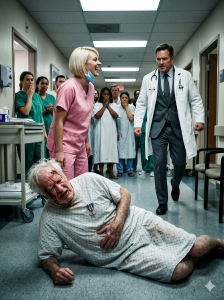
I plummeted over the side of the bed. I hit the hard, unforgiving linoleum floor with a sickening, bone-crunching thud.
The impact tore through my already shattered hip like a grenade exploding inside my body.
A scream ripped from my throat—a ragged, animalistic sound of pure, blinding agony. My vision flashed white. My head bounced against the floor, instantly splitting the skin above my eyebrow.
Warm blood began to trickle down the side of my face, pooling on the cold tiles.
I lay there, curled in a pathetic ball, gasping for air that refused to enter my lungs. The pain was so intense I felt like I was drowning in it.
Through the ringing in my ears, I heard a sound that chilled me to my very soul.
Brenda was laughing.
A loud, mocking, theatrical laugh.
“Oops!” she announced to the crowded hallway, her voice dripping with fake innocence. “The old man is so clumsy! Tried to get out of bed on his own. Look at him, rolling around like a dramatic toddler.”
I forced my eyes open.
The hallway was frozen. Dozens of people. Patients in wheelchairs, visitors holding flowers, other nurses holding clipboards.
They were all staring at me.
Some looked horrified. Some looked deeply uncomfortable.
But nobody moved. Nobody stepped forward to help an eighty-four-year-old bleeding veteran off the floor. The power imbalance was sickening. Brenda stood over me like a conqueror, hands on her hips, her smile wicked and cruel.
“Get up, Arthur,” she snapped, gently kicking the bottom of my slipper with her shoe. “You’re embarrassing yourself. Stop acting.”
I couldn’t breathe. I couldn’t speak. I squeezed my eyes shut, wishing for the floor to open up and swallow me. I prayed for my heart to just stop beating right then and there. I wanted to die rather than endure one more second of this crushing humiliation.
“I said get up!” she yelled, bending down to aggressively grab the collar of my thin hospital gown.
But her hand never reached me.
“Take your hands off that man.”
The voice didn’t come from Brenda. It didn’t come from the cowardly crowd.
It came from the end of the hallway.
It was a deep, resonant voice. Quiet, yet radiating an absolute, terrifying authority that instantly sucked all the oxygen out of the room.
Brenda froze, her arm suspended in mid-air. Her cruel smile vanished instantly, replaced by a pale, sickening dread.
I managed to turn my bleeding head slightly, squinting through my blurred vision.
The crowd of bystanders was hurriedly parting like the Red Sea.
Striding down the center of the hallway was a tall man in a tailored charcoal suit, a pristine white lab coat billowing slightly behind him. His jaw was clenched so tight the muscles twitched. His dark eyes were locked onto Brenda with the intensity of a predator.
It was Dr. David Elias.
The Chief of Surgery. The Chief of Staff. The most powerful, respected, and feared medical professional in the entire hospital network.
And as he stepped closer, his eyes dropped from the terrified nurse down to my bleeding face on the floor.
He stopped dead in his tracks.
The clipboard in his hands slipped from his fingers, clattering loudly against the linoleum. All the color drained from his face.
Because what Nurse Brenda didn’t know—what nobody in that hospital knew—was that Dr. David Elias and I had a history. A very, very long history.
And the elite, untouchable Chief of Surgery was staring at the man who had given him everything.
Chapter 2
Time is a funny thing when you are in agonizing pain. It doesn’t just slow down; it warps. It stretches out like a rubber band pulled tight, vibrating with a frequency that rattles your teeth.
Lying on that unforgiving linoleum, my hip radiating a blinding, white-hot fire, I watched the clipboard slip from Dr. David Elias’s hand. It seemed to take an eternity to fall. I could read the bold, black lettering on the top document. I could see the polished silver of the clip. When it finally hit the floor, the smack of the heavy plastic echoed down Hallway C like a gunshot.
The silence that followed was heavy. It was the kind of suffocating quiet that precedes a violent storm. A few seconds ago, the hallway had been a cacophony of coughing patients, squeaking gurney wheels, and the relentless, mocking laughter of Nurse Brenda. Now, you could hear a pin drop.
“Dr. Elias,” Brenda stammered. Her voice, previously so full of venom and bravado, was suddenly high-pitched and breathless. The cruel smirk had melted off her heavily made-up face, leaving behind a pale mask of sheer, unadulterated terror. “I… I was just… he was trying to get out of bed, Doctor. I tried to catch him, but he’s so frail…”
She was lying. The entire hallway knew she was lying. But Brenda was banking on the unwritten rule of hospital hierarchies: doctors usually backed up their nurses, especially against confused, elderly patients. She assumed her word would be taken as gospel. She assumed I was invisible.
David didn’t even look at her.
He didn’t acknowledge her existence. His dark eyes, usually sharp and calculating, were wide with a shock so profound it made him look twenty years younger. He stared down at me—at the blood pooling near my temple, at my twisted, unnatural posture, at the faded military cap that had been knocked off my head.
“Arthur?” he whispered.
The name barely made it out of his throat. It was a choked, ragged sound.
The last time I had seen David Elias, he was nineteen years old, standing on the platform of the Greyhound bus station downtown, clutching a duffel bag and a one-way ticket to Chicago. He had been a skinny, terrified kid with a black eye from his alcoholic father and a brilliant, restless mind that was drowning in the suffocating poverty of our South Side neighborhood.
Now, he was fifty-five. The Chief of Surgery. A man whose name appeared in gold lettering on the hospital’s donor wall. Silver streaked through his dark hair, and the custom charcoal suit he wore probably cost more than my first car. But looking up at him through the hazy, red-tinged blur of my own blood, I still saw the scared, desperate teenager who used to hide in the back of my auto repair shop to do his chemistry homework.
“Hey, Davey,” I rasped, trying to force a smile. It was a mistake. The movement sent a fresh wave of agony ripping through my shattered pelvis. I groaned, my jaw snapping shut, a cold sweat breaking out across my forehead.
David broke from his paralysis.
“Trauma team! Now!” he roared.
The sheer volume and ferocity of his voice made everyone in the corridor physically jump. It wasn’t a request; it was a detonation.
He dropped to his knees beside me, completely ignoring the pool of my blood staining the knees of his expensive trousers. His large, steady hands hovered over me, moving with lightning speed as he conducted a rapid visual assessment. The Chief of Surgery—a man who usually only stepped into an operating room for high-profile, six-figure procedures—was kneeling in the grime of a transit hallway, treating an old man like the President of the United States.
“Arthur, don’t move. Do not try to shift your weight,” David said, his voice dropping to a low, soothing cadence. It was the voice of a professional, but beneath the clinical calm, I could hear a dangerous tremor of emotion. He pulled a penlight from his breast pocket, gently lifting my eyelid. “Pupils are responsive. You have a laceration on the right supraorbital ridge. Tell me about the pain, Arthur. Where is it?”
“Hip,” I managed to wheeze, my chest tight. “Right side. It feels… it feels like it’s grinding, Davey.”
David’s jaw clenched so tightly I thought his teeth might crack. He looked down at my hip, noting the unnatural external rotation of my right leg. A classic sign of a severe femoral neck fracture.
“Dr. Elias, I can explain,” Brenda tried again, stepping closer, her hands fluttering nervously. “He was being uncooperative. He was reaching for the call button and lost his balance. I was trying to—”
David snapped his head up. The look he gave her would have stripped the bark off an oak tree.
“Step back.” The words were quiet, but they carried a lethal weight.
Brenda flinched as if she had been physically struck. “But Doctor, I’m the assigned—”
“I said, step back!” David barked, his voice echoing off the peeling paint of the walls. “Do not come within ten feet of this patient. Do not touch his chart. Do not look at him.”
Two nurses and an orderly—young Tommy, looking pale and terrified—came sprinting down the hall pushing a trauma gurney, a crash cart trailing behind them.
“Get a c-collar on him, stabilize the pelvis with a binder, and I want two large-bore IVs started immediately,” David ordered, rattling off instructions with terrifying precision. “Push five milligrams of morphine right now. Let’s get him onto the board on my count.”
“Dr. Elias, we have Protocol 4 in the ER—” one of the responding nurses started to say.
“Screw protocol!” David snapped. “He’s going straight to Surgical Suite One. Page Dr. Aris for orthopedics and tell him if he isn’t scrubbed in within five minutes, I will personally fire him. This is my patient. He doesn’t wait.”
As the team moved in, wrapping a stiff collar around my neck and gently sliding a backboard beneath me, the edges of my vision started to darken. The sheer exhaustion of the pain, combined with the sudden rush of adrenaline, was draining the last reserves of my strength.
Through the haze, I felt a sharp pinch in my left arm as Tommy successfully started a new IV line. A few seconds later, a cool, rushing sensation spread through my veins. The morphine hit my system like a heavy, velvet blanket, muffling the sharp edges of the agony. The burning fire in my hip dulled to a deep, throbbing ache.
“I’ve got you, Arthur,” David whispered, leaning in close as the team lifted the backboard onto the gurney. He placed a warm, steady hand on my shoulder. “You’re safe now. I promise you, you are safe.”
“M’sorry, Davey,” I slurred, the medication pulling me under. “Didn’t mean to make a mess on your floor.”
David let out a broken, tearless sob. “Don’t you dare apologize. Don’t you dare.”
As they began to wheel me away, moving at a dead sprint toward the surgical elevators, I managed to turn my head just a fraction.
Nurse Brenda was standing frozen against the wall. The crowd of bystanders, who had been perfectly content to watch me bleed moments ago, were now glaring at her with open hostility. She looked small. Defeated. But as my eyes met hers for a fleeting second, I didn’t see remorse. I saw a bitter, resentful panic. She wasn’t sorry she had pushed me. She was sorry she had been caught by the one man who cared.
The surgical elevator doors slid open, and the bright, sterile lights above me became a rushing blur.
As the darkness finally pulled me under, my mind didn’t linger on the pain, or the hospital, or the cruel nurse. It drifted backward, slipping effortlessly across four decades of time, landing in a dusty, oil-stained garage on the corner of 4th and Elm.
It was the summer of 1986.
I was forty-four years old, recently discharged from active duty, and sinking all my meager savings into a failing auto repair shop. Martha, God rest her soul, had been working double shifts at the diner just to keep our lights on. The neighborhood was rough. It was the kind of place where dreams went to die, suffocated by unemployment, drugs, and the constant, grinding pressure of poverty.
David Elias was sixteen.
He didn’t look like a future Chief of Surgery back then. He looked like a feral cat. He was all sharp angles and bruised knuckles, wearing a threadbare denim jacket that was two sizes too big for him.
I first met him at two in the morning.
I had been staying late at the shop, trying to rebuild a transmission on a rusted-out Chevy, when I heard the unmistakable sound of breaking glass in the front office.
I grabbed a heavy steel wrench from my toolbox and crept through the dark bay. When I flipped the light switch, I fully expected to find a junkie looking for cash to steal.
Instead, I found David.
He had a crowbar in one hand, and he was frantically trying to pry open the drawer of my battered cash register. His hands were shaking violently. When the lights hit him, he froze, dropping the crowbar with a clatter. He looked at me, and then he looked at the wrench in my hand.
He didn’t run. He just squeezed his eyes shut and braced himself for the blow. He expected to be hit. He expected it because, as I would later learn, being hit was the only currency his father used to communicate.
I stood there for a long time, looking at this skinny, terrified boy. I looked at the purple bruise blooming across his cheekbone. I looked at the worn-out soles of his sneakers.
I didn’t call the cops. I lowered the wrench.
“The register’s empty, kid,” I had said, my voice gruff but quiet. “But if you’re hungry, there’s half a meatloaf sandwich in the mini-fridge in the back.”
He had opened his eyes, staring at me as if I had spoken in a foreign language. He didn’t move.
“Go on,” I nudged. “Before the mayonnaise goes bad.”
That night, David ate the sandwich like a starving animal. He sat on an overturned milk crate in my garage, surrounded by the smell of motor oil and exhaust, and he finally stopped shaking.
I told him he owed me for the broken window. I told him he was going to work it off by sweeping the floors and organizing my tool benches every day after school.
He showed up the next day at 3:15 PM sharp.
He showed up the day after that. And the day after that.
Sweeping floors turned into changing oil. Changing oil turned into replacing brake pads. David was a sponge. He had an intellect that was almost frightening in its intensity. He absorbed information like he was starving for it. He could diagnose an engine misfire just by listening to the rhythm of the cylinders.
But as the months passed, I noticed something else. I noticed the thick, heavy textbooks he would sneak into his backpack. Advanced biology. Organic chemistry. Human anatomy.
One rainy Tuesday, I found him sitting in the back office, squinting at a textbook under the flickering fluorescent light, trying to memorize the bones of the human hand.
“You wanna be a mechanic, Davey?” I had asked him, leaning against the doorframe, wiping grease off my hands with a rag.
He looked down, suddenly ashamed. “No, sir. Not really.”
“Then what do you want to be?”
He hesitated. In his world, having a dream was a dangerous thing. It gave life something to crush. “I… I want to be a doctor, Mr. Pendleton. A surgeon.”
I didn’t laugh. I didn’t tell him it was impossible for a kid from the South Side with a drunk for a father and no money to his name to make it into medical school.
Instead, I walked over, tapped the textbook, and said, “Then you better learn how to keep your hands steady. An engine block can take a mistake. A human heart can’t.”
For the next three years, my auto shop became his sanctuary. It was the only place he felt safe. When his father went on a bender and kicked him out, David slept on the ratty sofa in my office. Martha would bring him hot soup and mend his clothes. We became the parents he never had.
When he graduated high school as the valedictorian—a miracle in our district—he received a partial scholarship to a state university. But it wasn’t enough. The tuition gap, plus room and board, was insurmountable for a kid with zero family contribution.
I remember the day he came into the shop to tell me he was giving up. He was going to enlist, or maybe try to get a full-time job at the steel mill. He was trying to be brave, but his eyes were hollow. The light had gone out of them.
I didn’t say a word. I walked to my safe, unlocked it, and pulled out an envelope.
It contained eight thousand dollars.
It was every single penny Martha and I had managed to scrape together over a decade. It was supposed to be our down payment on a little house out in the suburbs, a place with a real yard where she could plant her hydrangeas.
I handed the envelope to him.
“Mr. Pendleton… what is this?” he asked, feeling the thick stack of bills.
“That’s your first year of tuition,” I said. “And your dorm fees. You buy your books. You keep your head down. And you become a doctor.”
David had burst into tears. He tried to give it back. He begged me not to do it, saying he couldn’t take my life savings.
“You listen to me, David Elias,” I had told him, gripping his shoulders tightly. “You are meant for greater things than this neighborhood. You have a gift. I fought in wars so boys like you could have a future. Don’t you dare insult me by throwing yours away.”
He took the money. He went to college. He worked three jobs to pay for the rest of his undergrad, and he earned a full-ride academic scholarship to Johns Hopkins for medical school.
We kept in touch for a long time. He sent letters. He sent a photo of himself in his white coat. But as he climbed the ranks, as the world of elite medicine swallowed him whole, the letters became less frequent. Life happened. Martha got sick. The medical bills piled up. I lost the shop. I lost the house. I lost Martha.
I didn’t blame David for drifting away. He was busy saving lives. He belonged to a different world now—a world of private jets, medical conferences in Geneva, and life-saving miracles. I was just an old mechanic fading away in a quiet suburb. I hadn’t wanted to bother him. I hadn’t wanted to be a burden.
And now, thirty-five years later, the boy whose education I had bought with my life savings was the only thing standing between me and death.
I woke up to the rhythmic, electronic beep of a heart monitor.
My mouth tasted like dry cotton and pennies. I tried to open my eyes, but my lids felt like they were made of lead. Slowly, the world swam into focus.
I wasn’t in Hallway C anymore.
There were no buzzing fluorescent lights. There was no smell of bleach and stale coffee.
I was in a private suite. The room was massive, bathed in the soft, warm light of a late afternoon sun streaming through floor-to-ceiling windows. There were fresh flowers on a mahogany nightstand. The bed I was lying on felt like a cloud, perfectly contouring to my body, eliminating any pressure points.
And, miraculously, the agonizing, tearing pain in my hip was gone. It had been replaced by a dull, manageable ache, a sign of heavy painkillers and a successful surgery.
I turned my head slightly.
Sitting in a leather armchair beside my bed, looking completely exhausted, was David.
He had stripped off his suit jacket and tie. His white coat was draped over the back of the chair. He was still wearing his surgical scrubs underneath his dress shirt, and his dark hair was a mess. He was leaning forward, his elbows resting on his knees, his face buried in his hands.
He looked older now. The stress of the day had etched deep lines into his forehead.
“Davey?” I whispered. My voice was dry, cracking like old parchment.
His head snapped up. In an instant, he was on his feet and leaning over the bed, his eyes scanning my face with intense, professional scrutiny before softening into profound relief.
“Arthur. You’re awake.” He grabbed a plastic cup with a straw and gently brought it to my lips. “Take a small sip. Just wet your throat. The anesthesia is going to make you feel parched.”
I drank the water. It was the best thing I had ever tasted. I swallowed carefully, letting my mind catch up to my surroundings.
“My hip…” I murmured.
“Pinned and stabilized,” David said quickly. “I did the surgery myself. Dr. Aris assisted. It was a complex fracture, Arthur. The fall shattered the neck of the femur, and there were bone fragments near the artery. But we got it. I used titanium pins. The alignment is perfect. You’re going to need physical therapy, and it will be a long road, but you will walk again.”
I let out a long, shaky breath, closing my eyes. “Thank you. You… you didn’t have to do that.”
“Didn’t have to?” David’s voice cracked. He pulled back, and I saw a flash of anger in his eyes—not at me, but at the universe. “Arthur, do you have any idea what it did to me, walking down that hallway and seeing you on the floor? Bleeding? Treated like… like garbage in my own hospital?”
He turned away, pacing to the window. He ran a hand violently through his hair. His broad shoulders were tense, radiating a furious energy.
“I tried to find you,” he said, his voice dropping to a low, tight whisper. “After I finished my residency. I came back to the neighborhood. The shop was closed. The landlord said you and Martha had moved. I hired a private investigator a few years ago, but the trail went cold. Arthur… why didn’t you call me? Why didn’t you tell me Martha was sick?”
The guilt in his voice was heavy enough to crush bone.
“You were busy, son,” I said softly. “You were saving the world. I read about you in the papers. The Elias Procedure for pediatric heart defects. I cut the article out. I kept it in my wallet. I was so proud of you, Davey. I didn’t want to drag you back down into my mess.”
David turned back to me. There were tears shining in his eyes, tracking slowly down his tired face. This powerful, untouchable surgeon was weeping.
“Drag me down?” he choked out. “Arthur, everything I am, everything I have built, is because of you. You saved my life. You gave me a future when my own father was trying to beat it out of me. The money you gave me… I know what that was. I know that was your house money. You sacrificed your dream so I could have mine.”
He walked back to the bed and sat down heavily on the edge, taking my frail, wrinkled hand in his strong, surgeon’s grip.
“I have spent the last thirty years trying to be a man worthy of the sacrifice you made for me,” David said, his voice trembling with emotion. “And today, I found out that the hospital I run—the institution I built to heal people—allowed a vicious, cruel bully to torture the man who made it all possible.”
The memory of Nurse Brenda flashed in my mind. The violent shove. The impact of the floor. The mocking laughter. A cold shiver ran through my body, despite the warm blankets.
David felt it. He squeezed my hand tighter, his eyes hardening into chips of dark flint. The tears vanished, replaced by a cold, terrifying resolve.
“I read your chart while you were in recovery,” David said, his tone shifting. It was no longer the voice of the boy I saved. It was the voice of the Chief of Staff. It was surgical, precise, and completely devoid of mercy. “I saw the notes Brenda logged. I saw the medication times. I saw how long she left you without water. I spoke to Tommy, the orderly. He was terrified, but he told me everything. He told me how she treated you for the last three days. He told me she deliberately pushed you.”
I swallowed hard. “She… she has a lot of anger, David.”
“I don’t give a damn about her anger,” David spat, the venom in his voice startling me. “She assaulted an elderly patient. She assaulted a decorated veteran. She assaulted my father.”
The word hung in the air. Father.
I felt a tear slip free from my eye, tracking hotly down my cheek into my ear.
David stood up, smoothing down his dress shirt. He picked up his white coat from the chair and slid his arms into the sleeves. He adjusted his collar, his face a mask of absolute, chilling determination.
“Where are you going?” I asked, suddenly anxious.
“I have a meeting,” David said softly, though there was nothing soft about his eyes.
“Davey… don’t ruin her life. She might have kids. She might have problems.” I hated her, I truly did, but the instinct to protect was hardwired into my soul.
David looked at me, a sad, bitter smile touching his lips. “You always were too good for this world, Arthur. But there is a difference between mercy and justice. She nearly killed you today. She tortured you for her own amusement. And she did it in front of an entire ward that was too terrified to stop her.”
He walked to the door, pausing with his hand on the handle.
“Rest, Arthur. You’re safe now. You will never spend another moment of your life in pain or fear. I swear it.”
“David,” I called out, my voice weak. “What are you going to do?”
He didn’t turn around. He just looked at the wooden panels of the door.
“I am going to amputate the infection from my hospital,” Dr. Elias said quietly. “And I am going to make sure Nurse Brenda never touches another patient as long as she lives.”
He stepped out into the hallway, and the heavy door clicked shut behind him.
Chapter 3
The heavy oak door to my private suite clicked shut, and for the first time in what felt like a lifetime, I was truly alone.
The silence in the room wasn’t the suffocating, terrifying quiet of Hallway C, where nobody would answer your cries for help. This was a rich, insulated silence. The kind of quiet that cost thousands of dollars a night. Outside the thick, double-paned glass of my window, the sun was beginning its slow descent over the Chicago suburbs, casting long, bruised shadows of purple and gold across the manicured hospital lawns.
I lay perfectly still against the high-thread-count sheets, terrified that if I moved, the fragile illusion of safety would shatter, and I would wake up back on that freezing linoleum floor, bleeding and broken.
The morphine still hummed pleasantly in my veins, keeping the sharp teeth of my shattered hip at bay, but it did nothing to numb my mind. My thoughts raced, tumbling over each other in a chaotic storm of memories, pain, and profound disbelief.
David Elias.
Little Davey, the bruised, starving teenager who used to sleep on the oil-stained sofa in my auto shop, was now the architect of this massive, sterile empire. He was the man who held the power of life and death in his meticulously scrubbed hands. And I had been bleeding on his floor.
I turned my head toward the mahogany nightstand. There, sitting next to a pitcher of ice water, was my old military cap. It had been dusted off, the faded fabric carefully smoothed out. Beside it lay my Silver Star. The medal’s ribbon was frayed, the metal slightly dented from where it had struck the pavement when I fell. David must have picked it up. He must have carried it with him into the operating room.
A lump rose in my throat, thick and hard to swallow. I closed my eyes, and suddenly, Martha was there.
Not the frail, exhausted woman she was at the end, but the vibrant, fierce woman I had married. I could almost smell her—a mix of vanilla extract and the cheap aerosol hairspray she used on Sundays. I could almost feel her cool hand resting against my bruised forehead.
“You look like hell, old man,” her voice echoed in my memory, laced with that tough, enduring love that had carried us through decades of hardship. “But you’re still here. You’re still fighting.”
“I didn’t fight, Martha,” I whispered into the quiet room, a single tear escaping the corner of my eye and soaking into the pristine white pillowcase. “I just lay there. I let her do it. I was so weak.”
The shame of it was a physical weight on my chest. I had survived mortar fire in the freezing mountains of the Chosin Reservoir. I had carried a wounded corporal two miles through dense jungle foliage in Vietnam with a piece of shrapnel embedded in my own shoulder. I had built a life with my bare hands. But in that hallway, stripped of my clothes, my mobility, and my dignity, I had been reduced to nothing. I had been a victim. And the realization that I was now an old, defenseless man was a bitter pill that lodged itself deep in my throat.
I didn’t know then the sheer magnitude of the hurricane David was unleashing outside my door. I was safely tucked away in the eye of the storm, oblivious to the fact that the Chief of Surgery was systematically tearing his own hospital administration apart to avenge my honor.
It wasn’t until much later—weeks after my surgery, pieced together from the whispered accounts of nurses, the tearful confessions of Tommy the orderly, and David’s own reluctant admissions—that I learned exactly what happened when he walked out of my room that afternoon.
This is what happened when Dr. David Elias went to war.
The moment the door to my VIP suite closed behind him, the emotional, tear-filled son vanished. The Chief of Surgery took his place.
David didn’t walk down the corridor; he stalked. His jaw was locked, his dark eyes burning with a cold, terrifying fury that caused passing nurses to flatten themselves against the walls to get out of his way. He bypassed the surgical wing entirely and took the private executive elevator up to the tenth floor—the administrative nervous system of St. Jude’s Medical Center.
He didn’t bother knocking when he reached the double glass doors of the Risk Management and Human Resources department. He shoved them open so violently that the heavy glass shuddered in its metal frames.
The receptionist, a young woman with a headset halfway over her ear, jumped in her seat. “Dr. Elias! Can I—”
“Where is Sterling?” David demanded, his voice dangerously low, carrying across the open-plan office like the crack of a whip.
Richard Sterling was the Hospital Administrator, a man who cared far more about liability insurance premiums, PR optics, and quarterly profit margins than he did about patient outcomes. He was a corporate shark in a tailored suit, and he and David had clashed for years over budgeting and patient care protocols.
“Mr. Sterling is in a conference call with the board of directors,” the receptionist stammered, gesturing nervously toward the frosted glass walls of the main boardroom. “He explicitly asked not to be dis—”
David didn’t wait for her to finish. He strode across the plush carpeting and kicked the boardroom door open.
Inside, Richard Sterling was sitting at the head of a massive mahogany table, flanked by two corporate lawyers. He was leaning into a speakerphone, halfway through a sentence about third-quarter revenue projections. He looked up, his face flushing with immediate annoyance.
“David, what in the hell are you doing?” Sterling snapped, reaching out to mute the speakerphone. “I am in the middle of a live briefing with the regional directors. This is highly inappropriate.”
“Hang up,” David ordered. He walked to the head of the table, leaned over, and slammed his hand down onto the speakerphone, abruptly terminating the call.
The two lawyers blinked in stunned silence. Sterling stood up, his face purpling with rage.
“Have you lost your mind?” Sterling shouted. “You can’t just storm in here and—”
“Shut up and sit down, Richard,” David said. His voice wasn’t loud, but it possessed a lethal, icy authority that sucked all the oxygen out of the room. He didn’t blink. He just stared at the administrator with the predatory intensity of a wolf cornering a rabbit.
Sterling hesitated. He was a powerful man, but he was a bureaucrat. David was the golden goose. David’s surgical patents, his elite reputation, and his high-profile patient list were the only reasons St. Jude’s was ranked in the top five hospitals in the Midwest. Sterling knew that if it came down to a power struggle, the board would back the Chief of Surgery every time.
Slowly, Sterling sank back into his leather chair, straightening his tie with trembling fingers. “Fine. What is the meaning of this, David? I assume there is a catastrophic medical emergency?”
“There is an emergency,” David said softly, pacing slowly around the edge of the large table. “A moral one. An ethical one. A catastrophic failure of everything this institution is supposed to represent.”
David stopped pacing and leaned his knuckles against the polished wood.
“Approximately four hours ago,” David began, his voice dangerously calm, “I walked into Transit Hallway C. It was overcrowded, understaffed, and chaotic. All conditions we have argued about for months, Richard. Conditions you refused to fix because of ‘budget constraints.’”
Sterling rolled his eyes slightly. “David, we’ve had this conversation. The emergency room overflow is a seasonal issue. We are doing the best we can with the space we have. Now, if this is about your pet project for a new wing—”
“This is not about a new wing,” David interrupted, his tone turning to steel. “This is about an eighty-four-year-old decorated military veteran. A man who was admitted with a shattered hip and placed in that hallway. A man who was subsequently medically neglected, verbally abused, and physically assaulted by a member of our nursing staff while dozens of people watched.”
The two corporate lawyers instantly sat up straighter, the word assaulted triggering an immediate Pavlovian response. Liability. Lawsuits. Millions of dollars in damages.
“Assaulted?” Sterling repeated, his annoyance instantly replaced by a sharp, calculating panic. “What are you talking about? Who was the patient? Who was the nurse?”
“The nurse’s name is Brenda Miller,” David stated flatly. “The patient is Arthur Pendleton.”
Sterling frowned, typing the name rapidly into the laptop in front of him. “Pendleton… Pendleton… Okay, I see the file. A Medicare transit patient. Triaged for a femoral fracture. Wait, his file says he sustained a secondary injury due to a fall from a gurney. ‘Patient was combative and lost balance while attempting to stand unaided.’ Nurse Miller filed an incident report two hours ago. It’s logged as an accidental patient-induced fall.”
“It’s a lie,” David said. “She falsified the medical record. A federal offense.”
“David, you can’t just throw accusations like that around,” Sterling said defensively, trying to regain control of the room. “Nurse Miller has been with us for five years. She’s fully tenured. She has union protection. If the report says he fell, we have to follow standard HR procedure. Old people get confused. They try to get out of bed, they slip. It happens every week. It’s unfortunate, but we have protocols for this.”
David stared at him. The sheer, callous indifference in Sterling’s voice was nauseating. To Sterling, I wasn’t a human being who had been tortured. I was a statistical anomaly. A “Medicare transit patient.” A potential insurance headache.
“She didn’t just let him fall, Richard,” David said, his voice dropping an octave, practically vibrating with rage. “She pushed him. She placed her hands on his shoulders, and she shoved him off a transport bed without side rails onto a concrete floor. She re-shattered a fractured hip. She caused a secondary concussion and a severe facial laceration. And while he lay on the floor bleeding, begging for help, she stood over him and laughed.”
Silence descended on the boardroom. It was thick, heavy, and toxic.
One of the lawyers cleared his throat. “Dr. Elias… with all due respect, were you a witness to this event? Did you see her push him?”
“No,” David admitted. “I arrived seconds after he hit the floor.”
Sterling let out a long, patronizing sigh, leaning back in his chair. The panic left his face, replaced by a smug, bureaucratic confidence. “Well, then, David. I appreciate your passion for patient care, but we have a classic he-said-she-said situation. An elderly man on heavy narcotics claims he was pushed. A tenured nurse claims he fell. Without a direct witness, we can’t just fire her. The union would crucify us. We’ll put her on paid administrative leave for a few days, do a standard internal review, and reassign her to a different floor. Case closed.”
“You are not reassigning her,” David said.
“I run the administrative side of this hospital, David,” Sterling snapped, finally losing his temper. “You cut people open. I handle the liability. We are not exposing this hospital to a massive wrongful termination suit just because you have a soft spot for an old veteran who got confused!”
David didn’t yell. He didn’t bang his fist on the table. He simply reached into the inner pocket of his white lab coat, pulled out his cell phone, and placed it gently on the center of the mahogany table.
“Ten minutes ago,” David said quietly, “I went down to the security office in the basement. I pulled the master file for the CCTV camera positioned above the nurse’s station in Hallway C. The camera that looks directly down at bed 42.”
Sterling’s face froze. The two lawyers suddenly looked very, very sick.
David tapped the screen of his phone, mirroring the video feed directly to the massive flat-screen television mounted on the boardroom wall.
The screen flickered to life. The footage was high-definition, silent, and devastatingly clear.
There I was, a frail, tiny figure in a thin gown, lying on the bed. The video showed Tommy the orderly trying to change my IV. It showed Brenda storming over, her face twisted in a snarl. It showed her violently shoving Tommy out of the way. It showed her yanking my IV line, and my body arching in obvious pain.
Then, the video showed me reaching for the call button. It showed Brenda swatting my hand away.
And finally, it showed the shove.
It was undeniable. In high definition, without the noise of the hallway to distract from the visual truth, the malice was chilling. Brenda planted her hands firmly on my frail shoulders, braced her feet, and pushed with all her strength. The camera captured my body tumbling over the edge. It captured the horrifying way my head bounced off the floor.
It captured Brenda standing over my bleeding body, throwing her head back, and laughing.
The silence in the boardroom was absolute. The only sound was the faint hum of the air conditioning.
Sterling stared at the frozen frame of Brenda laughing, his mouth slightly open. All the color had drained from his face, leaving him looking like a wax mannequin. The lawyers were rapidly scribbling notes, their faces grim. They knew what they were looking at. They weren’t looking at a medical mistake. They were looking at a felony.
“She pushed him,” one of the lawyers whispered, sounding genuinely horrified.
“She deliberately assaulted a vulnerable patient,” David confirmed, his voice hard as diamond. He turned his gaze back to Sterling, who was visibly sweating. “And then, she logged onto a hospital computer and falsified a medical record to cover her tracks. She lied to her attending physician. She lied to you.”
David walked over to the table and leaned in until he was inches from Sterling’s face.
“That man,” David said, his voice dropping to a terrifying, deadly whisper, “is Arthur Pendleton. When I was sixteen years old, living on the streets, that man took me in. He fed me. He gave me a job. And when I couldn’t afford college, that man emptied his life savings—the money meant to buy a home for his sick wife—and he gave it to me. Every single thing I am, every life I have ever saved in this hospital, is because of the man she threw onto the floor.”
Sterling swallowed loudly, his eyes wide with a newfound, profound terror. He finally understood. This wasn’t just a Chief of Surgery defending a patient. This was a son destroying the monsters who hurt his father.
“So, here is what is going to happen, Richard,” David stated, straightening up and adjusting his cuffs. “You are not going to put Nurse Miller on paid administrative leave. You are not going to conduct a quiet internal review.”
“David, the union—” Sterling tried weakly.
“Screw the union!” David roared, finally letting his explosive anger out. The sound was deafening. “You call the police! You call the precinct right now, and you report an aggravated assault and elder abuse on hospital property! You draft a termination letter for gross misconduct and you revoke her license credentials instantly.”
David walked to the door, placing his hand on the handle. He looked back at the three terrified men at the table.
“If she is not out of this building in handcuffs within the hour,” David promised, his voice devoid of any warmth, “I will take this security footage to the Chicago Tribune, CNN, and every local news station in the state. I will resign as Chief of Surgery, I will take my patents with me, and I will personally bankroll Arthur Pendleton’s multi-million dollar lawsuit against you, Richard. Are we clear?”
Sterling nodded rapidly, his hands shaking as he reached for his desk phone to dial security. “Crystal clear, Dr. Elias.”
While the corporate machinery of St. Jude’s went into a frantic, terrified overdrive to terminate her, Brenda Miller was sitting in the third-floor breakroom, sipping a diet soda and scrolling through her phone.
She felt completely secure. She had filed the incident report. She had established the narrative. The old man was crazy and fell. She had the protection of her seniority, her union, and the deeply ingrained hospital culture that always protected its staff over its transit patients. To her, the encounter with Dr. Elias in the hallway had been a momentary scare, nothing more. A brief scolding from an overzealous doctor.
She didn’t know that the ground beneath her feet had already collapsed.
The door to the breakroom swung open. Brenda didn’t bother to look up from her phone.
“Break’s over in ten, Susan, tell them to wait,” Brenda muttered, taking another sip of her soda.
“I’m not Susan.”
Brenda’s head snapped up.
Standing in the doorway was Dr. David Elias. He wasn’t alone. Behind him stood two uniformed Chicago police officers, and next to them, looking incredibly uncomfortable in a cheap suit, was Frank, the head of the hospital’s nursing union.
Brenda’s stomach plummeted. The diet soda slipped from her hand, clattering onto the cheap linoleum table and spilling dark liquid everywhere.
“Dr. Elias…” she started, her voice suddenly trembling. She looked at the police officers, her eyes darting frantically. “What is this? What’s going on?”
David stepped fully into the room. He didn’t look angry anymore. He looked completely, chillingly hollow. He looked at Brenda not as a colleague, not even as a human being, but as a malignant tumor that he was about to excise.
“Brenda Miller,” David said, his voice flat and clinical. “As of three minutes ago, your employment at St. Jude’s Medical Center has been terminated with cause. Your medical credentials have been suspended pending a full state board review.”
Brenda stood up, her chair screeching violently against the floor. Panic clawed at her throat. “Terminated? You can’t do that! Frank! Tell him he can’t do that! I have rights! It was an accident! He fell!”
She turned desperately to her union representative. Frank, a man who usually fought tooth and nail for every nurse, couldn’t even look her in the eye. He stared fixedly at the floor, shifting his weight uncomfortably.
“They showed me the video, Brenda,” Frank muttered, his voice thick with disgust. “From the security camera. We saw what you did to that old man. The union cannot, and will not, protect you from criminal assault charges. You’re on your own.”
The color completely drained from Brenda’s face. The video. She had forgotten about the camera mounted above the station. In her arrogance, in her absolute certainty that she was untouchable, she had committed a crime right in front of a digital witness.
Her legs gave out, and she collapsed heavily back into her plastic chair. The tough, cruel, bullying facade crumbled instantly, revealing the pathetic, cowardly reality beneath.
“Please,” she begged, tears of genuine terror finally spilling down her cheeks. The heavy makeup around her eyes began to run, turning into black, ugly streaks. “Please, Dr. Elias. I’ll apologize. I was stressed. We’re so understaffed. I haven’t been sleeping. I didn’t mean to hurt him, I swear! I have a mortgage. I have car payments. If you take my license, my life is over!”
David walked over to the table. He stood over her, looking down at the weeping, pathetic woman who had laughed while I bled.
“Did you care about his life, Brenda?” David asked softly. “When you deprived him of water for six hours, did you care about his suffering? When you tore out his IV line, did you care about his pain? When you shoved an eighty-four-year-old man onto a concrete floor and watched him bleed, did you care about his life?”
Brenda sobbed, hiding her face in her hands. “I’m sorry! I’m so sorry!”
“You aren’t sorry you hurt him,” David said, his voice devoid of any pity. “You are only sorry that the man you broke turned out to be the father of the Chief of Surgery.”
David turned to the police officers and gave a curt nod. “Officers, she is no longer an employee of this hospital. She is trespassing. Arrest her.”
The officers stepped forward. One of them pulled a pair of heavy steel handcuffs from his belt.
“Brenda Miller, stand up,” the older officer commanded, grabbing her firmly by the arm and hauling her to her feet. “You are under arrest for aggravated battery of a senior citizen and elder abuse. You have the right to remain silent…”
As the officer read her Miranda rights, they marched her out of the breakroom. They didn’t take her out through the quiet, private back exits.
David made sure they took her out the front.
They walked her in handcuffs, sobbing and humiliated, right through the center of Hallway C.
The entire transit ward stopped. Patients sat up in their beds. Visitors lowered their magazines. Doctors and nurses froze in their tracks. The woman who had terrorized the floor, who had ruled the ward through cruelty and fear, was being paraded out in steel bracelets, her career destroyed, her life ruined.
Nobody said a word. But as she passed the spot on the floor where I had bled—the spot that had already been meticulously scrubbed clean by the janitorial staff—a young, timid orderly named Tommy stepped out of a patient room.
He looked at the weeping, handcuffed bully. He didn’t smile, and he didn’t gloat. He simply turned his back on her and walked away to help a patient.
It was the ultimate erasure. She was gone, and the hospital was instantly a better place for it.
Back in my VIP suite, I knew nothing of the drama unfolding in the halls below.
I was drifting in and out of a morphine-induced twilight, watching the shadows lengthen across the wall. The gentle hum of the heart monitor was the only sound keeping me tethered to reality.
Around six in the evening, the heavy door opened quietly.
David walked in.
He looked entirely different from the furious, terrifying force of nature that had stormed out of my room hours earlier. He looked exhausted. His shoulders were slumped, his tie was loosened, and the fire in his eyes had burned out, leaving only a deep, profound sadness.
He walked over to the armchair beside my bed and collapsed into it, resting his head in his hands, letting out a long, shuddering breath.
“Davey?” I rasped, my throat still dry.
He looked up, offering me a weak, tired smile. “Hey, Arthur. How’s the pain?”
“Manageable,” I lied gently. “You look like you just fought a war.”
“Something like that,” he murmured. He leaned forward, resting his elbows on his knees, staring at his hands. “She’s gone, Arthur. Terminated. Arrested. Her license will be permanently revoked by the end of the week. She will never hurt another patient again.”
I let out a slow breath. I didn’t feel a sense of triumph. I didn’t feel vindicated. I just felt an overwhelming, crushing sadness for the entire broken world.
“I didn’t want her life ruined, David,” I said softly.
David looked at me, his eyes shining with unshed tears. “You didn’t ruin her life, Arthur. She did. She made a choice to be cruel. And I made a choice to ensure she faced the consequences.”
He reached out and gently placed his hand over mine. His fingers were warm and strong. The hands of a healer.
“But it’s not just her,” David said, his voice thickening with emotion. “It’s me. It’s the hospital. I’ve been so focused on the surgeries, on the prestige, on building this massive empire… that I stopped looking at what was happening on the ground floor. I let the administrators cut corners. I let them understaff the transit wards. I created an environment where someone like Brenda could thrive, where a good kid like Tommy was too terrified to speak up. I failed you, Arthur. Before you even walked through those doors, I failed you.”
I looked at this brilliant, powerful man—a man who had saved thousands of lives—and saw the vulnerable, terrified teenager who used to hide in my garage, carrying the weight of a world that had beaten him down.
Slowly, fighting the pain in my shoulder, I turned my hand over and gripped his wrist. My grip was weak, trembling with age, but it was firm.
“Look at me, David,” I commanded gently.
He raised his head, a single tear slipping down his cheek.
“You did not fail me,” I said, my voice steady, putting every ounce of truth I possessed into the words. “You survived. You became a good man. You became a healer. That is all I ever wanted for you. What happened in that hallway… that was the ugliness of the world. But what happened after? The fact that you fought for me? That is the beauty. You are my legacy, Davey. And I have never, not for one single second, been anything less than incredibly proud of you.”
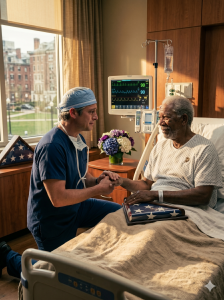
David broke.
The Chief of Surgery, the untouchable god of the hospital, lowered his head to the edge of my mattress and wept. He wept for the pain I had suffered, he wept for the years we had lost, and he wept for the sheer, overwhelming relief of finally being forgiven.
I rested my trembling hand on his head, softly stroking his greying hair, just as I had done thirty-five years ago in a dusty, oil-stained garage.
We stayed like that for a long time as the sun finally set, leaving the room bathed in the soft, golden glow of the bedside lamp. The storm was over. The infection had been cut out.
But as I lay there, listening to the steady, reassuring beep of my own heart monitor, I knew that our story wasn’t quite finished. David had avenged me, yes. But healing a broken bone is entirely different from healing a broken spirit. And the real journey—for both of us—was only just beginning.
Chapter 4
They say that breaking a bone at eighty-four years old is the beginning of the end. It’s the universe’s brutal way of telling you that your time is up, that the machinery is finally failing, and that you should just quietly fade away into the sterile white background of a nursing home.
For the first few days after my surgery, in the deep, dark hours of the night when the morphine wore off and the cold ache settled deep into my pelvis, I believed them. I believed I was finished.
But I had underestimated the sheer, stubborn willpower of Dr. David Elias.
My recovery was not a gentle fading into the twilight; it was a grueling, agonizing, glorious battle. And David was my commanding officer.
The physical therapy started on day four. They brought in a spitfire of a therapist named Sarah—a young woman from South Side Chicago who chewed cinnamon gum, wore her hair in tight braids, and possessed the terrifying, unyielding cheerfulness of an army drill sergeant.
“Alright, Mr. Pendleton,” Sarah had announced, tossing a brightly colored resistance band onto my bed. “Dr. Elias told me you survived the Chosin Reservoir. If you can survive freezing temperatures and mortar fire, you can survive a lap around this nurse’s station. Let’s get moving.”
It was torture. Pure, unadulterated torture.
Every time I put weight on my right leg, it felt as though someone was driving a rusted railroad spike straight up into my spine. My muscles, atrophied from age and trauma, screamed in protest. I sweated through my hospital gown. I cursed. I cried out in frustration. There were days I sat on the edge of the bed, gripping the handles of my walker so tightly my knuckles turned white, tears of defeat streaming down my face, begging them to just let me lie down and die.
But David never let me quit.
Despite running one of the most prestigious surgical departments in the Midwest, despite his back-to-back operations and endless administrative meetings, David was there. Every single afternoon at 4:00 PM, the heavy door to the rehab suite would swing open. He would strip off his pristine white coat, roll up the sleeves of his expensive dress shirt, and stand right beside Sarah.
“One more step, Arthur,” David would encourage, his hand hovering just inches from my back, ready to catch me if I stumbled. “Just to the window. Look at the window. You’ve got this.”
He didn’t treat me like a fragile, dying old man. He treated me like the man who had taught him how to rebuild a transmission with bruised, bleeding knuckles. He reminded me of who I was.
And slowly, agonizingly, the needle moved.
A shuffle to the window became a walk down the hall. A walk down the hall became a lap around the ward. The titanium pins in my hip settled, my muscles remembered how to fire, and the fog of pain began to lift.
While I fought the war in the physical therapy room, a different kind of battle was wrapping up in the courthouse downtown.
The hospital’s internal investigation into Nurse Brenda Miller had been swift and merciless. Under the crushing weight of the security footage and the terrified but honest testimony of Tommy the orderly, Brenda’s union had abandoned her entirely. The district attorney, smelling blood in the water and a high-profile elder abuse case that would look great in an election year, pressed hard.
She was charged with aggravated felony assault. Faced with the undeniable video evidence, her public defender convinced her to take a plea deal.
I didn’t attend the sentencing. I had no desire to see her in an orange jumpsuit. I had no desire to watch a woman’s life crumble into ash. But David went. He sat in the front row of the gallery, his face a mask of cold, unreadable stone.
He came to my room that evening, smelling faintly of the autumn air outside.
“It’s done,” he said quietly, sitting in his usual leather chair beside my bed. “Three years in a minimum-security state facility. Five years of probation after that. And her nursing license has been permanently revoked by the state board. She will never legally be allowed to care for another human being again.”
I stared down at my hands, tracing the blue veins standing out against my papery skin. “How did she look, Davey?”
David hesitated. “She looked broken, Arthur. She cried when the judge read the sentence. She looked out into the gallery and she looked at me. I think… I think she finally understood the magnitude of what she did.”
“Good,” I whispered. It wasn’t a word born of malice, but of closure. The world had rebalanced itself. The monster in Hallway C was gone, and the quiet, timid people like Tommy could finally breathe.
Two weeks later, the morning finally arrived. Discharge day.
Sarah, my drill-sergeant therapist, actually teared up when she handed me my discharge papers. I was no longer using a walker. I had graduated to a heavy, polished wooden cane with a brass handle that David had bought for me. I was walking with a severe limp, and I was slower than molasses in January, but I was walking. I was independent.
I had packed my small duffel bag with my few belongings. I sat on the edge of the bed, wearing a clean pair of slacks and a button-down shirt, waiting for the medical transport van to take me back to my small, lonely suburban apartment.
The door opened, but it wasn’t an orderly with a wheelchair. It was David.
He was wearing casual clothes—a thick knit sweater and dark jeans. He walked in, picked up my duffel bag, and slung it over his shoulder.
“Ready to go, Arthur?” he smiled.
“I reckon so, son,” I sighed, gripping my cane and standing up carefully. “Though I can’t say I’m looking forward to the quiet. My apartment feels like a tomb these days.”
David stopped in the doorway and looked back at me, an amused, gentle twinkle in his dark eyes. “Who said anything about your apartment?”
I frowned, confused. “Davey, the lease is paid through the end of the year. I have to go home.”
“Arthur,” David said, stepping closer and placing a warm hand on my shoulder. “I had my assistant terminate your lease three weeks ago. I sent a moving crew to pack up your furniture, your photos, and Martha’s things. They’ve already been unpacked.”
My heart hammered against my ribs. “Unpacked? Unpacked where?”
“My house,” David stated simply. “In Evanston. I have five bedrooms, four bathrooms, and a ground-floor suite that has been completely empty for a decade. It’s got a walk-in shower with grab bars, wide doorways, and French doors that open directly onto the backyard.”
I shook my head vigorously, a sudden wave of panic washing over me. “No. No, absolutely not. David, I won’t do it. I am not going to be a burden on you. You are a busy man. You have a life. You have galas, and meetings, and… and I’m an old man who needs help tying his shoes on a bad day. I won’t drag you down.”
“Stop,” David commanded, his voice firm, leaving absolutely no room for argument. “Arthur, you listen to me. I am a fifty-five-year-old bachelor living in a mausoleum of a house. I have no wife. I have no children. The only family I have ever known, the only father who ever gave a damn whether I lived or died, is standing right in front of me.”
His voice cracked slightly, and he took a deep, steadying breath.
“You gave up your home for me, Arthur. Thirty-five years ago, you handed me the keys to your future so I could build mine. Do you really think I am going to let you go back to a dark, empty apartment to eat frozen dinners by yourself? You are coming home with me. And that is final.”
I looked into his eyes. I saw the fierce, unyielding loyalty of a man who understood the true weight of a debt. I saw the frightened teenager who just wanted to belong. And, for the first time since my beautiful Martha passed away, I saw a future that didn’t terrify me.
I swallowed the lump in my throat, my eyes filling with hot tears. “Okay, Davey. Okay. Let’s go home.”
The drive up to Evanston was a blur of autumn colors. When we pulled up to the massive, sprawling stone house overlooking Lake Michigan, my breath caught in my throat. It was magnificent. It was the kind of house you saw in magazines, the kind of house Martha used to point out in the Sunday paper with a wistful sigh.
David led me inside, down a wide, sunlit corridor, and pushed open a pair of heavy oak doors.
“This is your room, Arthur,” he said quietly.
I stepped inside. It was perfect. The walls were painted a warm, soothing cream. My own familiar armchair was sitting in the corner. Martha’s antique cedar chest was at the foot of a massive, comfortable bed. And on the nightstand, in a beautiful mahogany shadow box, was my Silver Star, properly mounted and displayed for the world to see.
But it wasn’t the room that made me break down. It was the view.
I walked slowly over to the French doors and looked out into the backyard.
There, planted perfectly in the rich, dark soil, bathed in the afternoon sunlight, were dozens of hydrangea bushes. Blue, pink, and vibrant purple. They were Martha’s favorite flowers. David had planted an entire garden of them, right outside my window.
I leaned heavily against my cane, pressing my trembling hand against the cool glass of the windowpane, and I wept. They were not tears of pain, or humiliation, or fear. They were tears of pure, overwhelming gratitude.
Life settled into a beautiful, quiet rhythm.
I woke up every morning to the smell of fresh coffee. David and I would eat breakfast together in the kitchen before he left for the hospital. He hired a wonderful housekeeper named Maria who cooked me hot meals and chattered away in Spanish, filling the massive house with warmth and noise. I spent my afternoons sitting in the garden, reading historical biographies, watching the wind rustle through the hydrangeas.
In the evenings, David would come home, exhausted but smiling. We would sit by the fireplace, drinking a small glass of bourbon, and he would tell me about his day. He told me about the lives he saved. He told me about the tricky valve replacements, the pediatric heart repairs, the miracles he performed with a scalpel.
And as I listened to him, the last lingering shadows of my trauma in Hallway C finally faded away. I realized that my legacy wasn’t an auto shop that went bankrupt. My legacy wasn’t a broken hip. My legacy was sitting right in front of me, saving the world, one beating heart at a time.
But David Elias wasn’t quite finished rewriting history.
Almost a year to the day after my fall, David came home early on a Friday afternoon. He was wearing his best charcoal suit, and he had a strange, nervous energy about him.
“Put on your good suit, Arthur,” he said, tossing my freshly dry-cleaned blazer onto the sofa. “We’re going for a ride.”
“Where are we going?” I asked, struggling to thread my belt through the loops of my slacks.
“St. Jude’s,” he replied, his eyes flashing with a secret excitement. “There’s something I need you to see.”
The drive back to the hospital made my stomach flutter with an old, familiar anxiety. I hadn’t been back to St. Jude’s since the day I was discharged. The memory of the cold linoleum, the blinding fluorescent lights, and Brenda’s mocking laughter still haunted the dark corners of my mind.
But when David pulled his sleek black sedan into the VIP parking lot, the anxiety morphed into profound confusion.
There was a crowd gathered near the suburban pavilion entrance. Not a chaotic crowd of patients, but a formal gathering. There were local news crews, journalists with cameras, hospital board members in expensive suits, and dozens of doctors and nurses in their white coats.
“Davey, what is all this?” I asked, gripping my cane tightly as he helped me out of the car.
“Just trust me,” he smiled, offering me his arm for support.
We walked slowly toward the crowd. As we approached, people began to part, creating a wide aisle for us to walk down. I saw Richard Sterling, the hospital administrator, looking incredibly nervous but offering me a tight, respectful nod. I saw Sarah, my physical therapist, beaming with pride. I even saw Tommy, the young orderly, standing a bit taller than he used to, wearing a brand new set of dark blue scrubs.
At the front of the crowd, blocking the entrance to what used to be Hallway C, was a massive red silk ribbon.
David guided me to the front and turned to face the crowd. The low murmur of voices instantly died down. The news cameras flashed.
“Good afternoon,” David began, his deep, resonant voice projecting easily over the gathered crowd. “A year ago, a horrific incident occurred in this very building. An incident born of systemic neglect, overcrowding, and a catastrophic failure of empathy. We allowed the most vulnerable among us to be pushed into the shadows. We allowed them to be treated as burdens.”
David turned slightly, looking directly at me. His eyes were shining.
“But pain,” David continued, his voice thick with emotion, “is a powerful teacher. It forces us to examine our fractures. It forces us to rebuild. Over the last twelve months, using private donations, board reallocations, and a personal endowment, we have completely gutted and redesigned the suburban transit wing of St. Jude’s Medical Center.”
He gestured to the double doors behind the red ribbon.
“There are no more transit hallways,” David announced proudly. “There are no more open-air beds. What stands behind these doors is a state-of-the-art, seventy-bed, private-suite elder care and trauma recovery center. It is staffed with double the required nursing ratio. It is designed for dignity, for quiet, and for respect. It is a place where the people who built this country will be treated with the reverence they deserve.”
The crowd erupted into applause. I stood there, stunned, my heart hammering in my chest.
David held up a hand, silencing the crowd once more. He reached into his pocket and pulled out a pair of oversized golden scissors. He walked over and pressed them gently into my trembling hands.
“This hospital is a place of healing,” David said, his voice dropping slightly, meant just for me, though the microphones caught every word. “But I didn’t learn how to heal in medical school, Arthur. I learned it in a dusty garage on the South Side. I learned it from a mechanic who looked at a broken, bleeding kid, and instead of throwing him out… gave him a sandwich, a wrench, and a future.”
A tear spilled down David’s cheek, and he didn’t bother to wipe it away.
“Ladies and gentlemen,” Dr. David Elias declared, his voice ringing with absolute triumph. “It is my profound honor to officially open the Martha and Arthur Pendleton Wing for Senior Dignity and Care.”
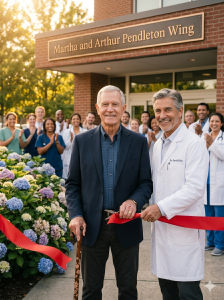
A massive roar of applause swept through the crowd. Camera shutters clicked frantically.
Above the double doors, a heavy velvet tarp was pulled away, revealing a beautiful, shining bronze plaque.
The Martha and Arthur Pendleton Wing.
Dedicated to those who fought for our future. May we always protect yours.
I stared at the plaque, the letters blurring as hot, heavy tears streamed down my face. Martha’s name. My beautiful, fierce Martha’s name, cast in bronze, permanently etched into the very foundation of the hospital. She would never be forgotten. I would never be forgotten.
My trembling hands gripped the golden scissors. David placed his strong hands over mine, guiding my fingers. Together, the Chief of Surgery and the broken-down veteran snipped the red ribbon in half.
The crowd cheered again, but all I could hear was the steady, reassuring thrum of my own beating heart.
As the doors swung open, revealing a bright, beautiful, sunlit corridor filled with private rooms, soft colors, and smiling nurses, David wrapped his arm tightly around my frail shoulders.
I leaned my head against him, finally, completely at peace. The cold linoleum floor was just a memory. The cruelty of the world had been answered with overwhelming light.
And as I walked through those doors, my cane clicking softly against the pristine new floor, I realized the greatest truth of my eighty-four years on this earth.
A cruel push may knock you down into the dark, but if you spend your life planting seeds of kindness in others, you will never have to pull yourself back up alone.
