


The cold, hard linoleum of Gate B24 slammed into my face, yet the sharp pain shooting through my shoulder meant nothing next to the sickening crack that rang out across the terminal.
It was the sound of Eleanor’s cane breaking in two.
I am sixty-eight years old. I completed two tours in the Marines, took shrapnel to my lower spine that makes standing feel like chewing on glass, and I swallow my pride every single day just to request a little extra time to board a plane.
But sitting there on the floor of JFK Airport, surrounded by two hundred silent strangers, I had never felt more completely powerless.
My name is Marcus Vance. And until ten minutes ago, my biggest concern was making sure I got back to Atlanta in time to place fresh hydrangeas on my wife’s grave for our anniversary.
Eleanor passed away eight months ago. The cane was hers. It wasn’t just a piece of wood; it was cherry wood, hand-carved by her grandfather, worn smooth at the top by forty years of her gentle touch.
When my legs started giving out on me, she gave it to me. “Lean on me, Marcus,” she used to whisper. “Like you always have.”
Since the day her heart gave out, I hadn’t let that cane out of my sight. I slept with it leaning against the nightstand. I held it across my lap in this damn wheelchair because holding it felt like holding her hand.
Then came Julian Sterling.
I didn’t know his name at the time. All I saw was an angry kid in his early twenties, reeking of expensive cedarwood cologne, wearing a bespoke suit that cost more than my first mortgage.
He had missed his First Class boarding call. He strode up to the priority lane, flanked by two nervous-looking assistants carrying his leather duffel bags, his face flushed with the kind of rage that only belongs to people who have never been told “no.”
“Sir, boarding group one has already proceeded,” the young gate agent stammered, her hands trembling over her keyboard. “You’ll have to wait until we clear the wheelchair passengers. He’s next.”
She pointed a shaking finger at me. I was sitting right at the edge of the jet bridge entrance, my boarding pass clutched in my hand, Eleanor’s cane resting across my knees.
Julian slowly turned his head to look at me. His eyes were cold, flat, and hollow. He didn’t see a man. He saw a roadblock. An inconvenience.
“Move,” he snapped, his voice barely above a whisper, yet it cut through the noise of the crowded terminal like a razor blade.
“Son, they’ll call you in just a second,” I said, keeping my voice steady. My drill instructor voice. Calm, but firm. “I just need a minute to get my chair locked onto the ramp.”
Julian stepped into my personal space. The scent of his cologne was nauseatingly strong. I noticed the heavy platinum watch on his wrist catching the glare of the overhead fluorescent lights.
“I don’t care what you need,” he spat, leaning down so his face was inches from mine. “My family owns half the real estate in this city. My father is Richard Sterling. I do not wait in line behind people like you.”
“People like me?” I asked, my grip tightening on the smooth cherry wood of the cane.
“Useless. Crippled. Leeches,” Julian sneered.
Before I could even process the audacity of the insult, his hand shot out.
It wasn’t a punch. It was a slap. A degrading, humiliating, open-handed slap across my left cheek.
The sound cracked like a whip. A woman in the row behind me screamed.
My head snapped to the side, my vision blurring for a fraction of a second. But Julian wasn’t done.
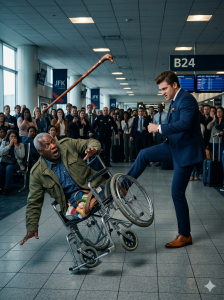
Infuriated that I hadn’t immediately cowered, he took a step back, raised his $800 Italian leather loafer, and drove his foot violently into the right wheel of my chair.
The force was explosive. The wheelchair pitched violently to the left.
I tried to brace myself, but my legs wouldn’t respond. I tipped over the edge, slamming hard onto the terminal floor. My shoulder took the brunt of the impact, tearing a muscle I knew would take months to heal.
But I didn’t care about my shoulder.
As I hit the ground, Eleanor’s cane slipped from my grasp. It rolled across the floor, stopping right at Julian’s feet.
The terminal went dead silent. Over two hundred people—businessmen in suits, mothers with strollers, college kids with headphones around their necks—all froze. Nobody moved. Nobody breathed.
I propped myself up on my good elbow, my chest heaving. “Don’t,” I choked out, staring at the cane near his shoes. “Please. Don’t touch that.”
It was the first time I had begged another man for anything since I was bleeding out in a trench forty years ago.
Julian looked down at the cane. Then he looked at me. A slow, cruel smile crept across his face. He enjoyed this. He was feeding on the power.
He bent down, picked up the cherry wood cane, and examined the beautiful, hand-carved floral patterns near the handle.
“Trash,” he muttered.
He brought his knee up and brought the cane down hard against it.
CRACK.
The sound echoed through my very soul. It physically tore something out of my chest.
The sturdy cherry wood, the wood that had supported my beautiful wife for decades, the wood that held the last lingering traces of her touch, splintered violently into two jagged, broken halves.
My breath stopped. The world around me blurred into a tunnel.
Julian casually tossed the two broken pieces into the nearby trash receptacle, wiping his hands on his expensive trousers as if he had just touched something diseased.
“Clean this mess up,” he barked at the terrified gate agent, pointing down at me. “And get me on my fucking plane.”
For illustrative purposes only
He adjusted his suit jacket and began walking down the jet bridge.
I just lay there on the cold floor, staring at the rim of the trash can. My vision was swimming. Hot tears—tears of rage, of grief, of a broken heart—spilled down my weathered cheeks. Eleanor. I’m so sorry, Eleanor.
I felt completely, utterly destroyed.
But as Julian Sterling disappeared down the tunnel, assuming he had just crushed another nameless bug under his designer shoe, he made one fatal miscalculation.
He didn’t notice the young man in the third row, wearing a faded denim jacket, holding his smartphone up with shaking hands.
He didn’t know that the red recording light had been blinking the entire time.
And he certainly didn’t know that within exactly four hours, his father’s billion-dollar empire was going to start burning to the ground.
**Chapter 2**
The coldness of the terminal floor seeped through my thin olive-green jacket, chilling the sweat that had broken out across my back. But that physical cold was nothing compared to the ice forming in my chest.
Crack.
The sound of Eleanor’s cane breaking didn’t just echo in the cavernous space of Gate B24; it echoed backward through time. It echoed through forty years of marriage. It echoed through the quiet Sunday mornings on our porch in Atlanta, through the sterile hallways of the oncology ward, through the rain-soaked afternoon when I had to watch them lower her casket into the Georgia clay. That cherry wood cane was the last physical anchor I had to the woman who had saved my life more times than I could count. And Julian Sterling—a boy whose hands had likely never built a single thing, never defended a single soul—had just snapped it over his knee like kindling.
I lay there on the industrial linoleum, my left shoulder screaming in agony. The fall had done something to my rotator cuff; a hot, tearing sensation radiated down to my fingertips. My legs, useless and heavy with the old shrapnel damage from Beirut, felt like dead weight.
I looked up. The world was entirely still, save for Julian adjusting the cuffs of his bespoke navy suit.
“Clean this mess up,” he barked, his voice dripping with aristocratic boredom. He didn’t look at me again. He didn’t look at the broken wood resting atop the half-empty Starbucks cups in the trash bin. He simply turned his back and walked down the jet bridge, flanked by his two nervous assistants, swallowing up the space that didn’t belong to him.
The silence he left behind was deafening. There were at least two hundred people waiting for this flight to Atlanta. Business travelers typing furiously on their laptops, families wrangling exhausted children, college kids returning from spring break.
Not one of them had moved.
I propped myself up on my right elbow, my breathing ragged. I looked at the crowd. I saw a man in a tailored charcoal suit look away, suddenly fascinated by his phone. I saw a mother pull her young daughter a few inches closer to her side, shielding her eyes. They were paralyzed. Not by fear of physical violence—Julian Sterling was a string bean in an expensive suit, he posed no threat to a healthy man. They were paralyzed by the sheer, unadulterated aura of power. They recognized the invisible shield of wealth that protected men like Julian. Intervening meant stepping into the blast radius of his entitlement. So, they did what modern society has trained us to do best: they minded their own business.
“Sir?”
A trembling voice broke the silence. I turned my head. It was the gate agent. Her name tag, slightly crooked on her Delta uniform, read Sarah. She couldn’t have been older than twenty-five. Her face was entirely drained of color, her eyes wide with a mixture of terror and profound shame.
Sarah took a hesitant step from behind her podium. I could see the internal war raging behind her eyes. I saw a young woman who probably had student loans, maybe a kid in daycare, rent due on the first of the month. I saw someone who knew exactly what would happen if she filed a formal complaint against the son of Richard Sterling, a man whose venture capital firm owned half the commercial real estate in Manhattan. She would be fired before her shift ended.
“Sir, please,” Sarah whispered, crouching down beside me. Her hands hovered over me, unsure of where to touch. “Let me… let me help you.”
“Don’t,” I grunted, the word scraping against my dry throat. It wasn’t directed at her out of anger, but out of a desperate need to preserve whatever shred of dignity I had left. “Just… give me a second.”
I gripped the edge of my tipped-over wheelchair. My left arm gave out immediately, a sickening pop echoing in my shoulder joint. I collapsed back onto the floor, squeezing my eyes shut as a wave of nausea washed over me.
“Stand back, folks. Give him some room!”
The authoritative boom of a deep voice sliced through the murmurs of the crowd. Heavy boots approached. I opened my eyes to see the dark navy trousers of a Port Authority police officer.
Officer Thomas Hayes was a man who looked like he had spent thirty years carrying the weight of the city on his shoulders. Graying at the temples, a thick mustache, and eyes that had seen too many tragedies in too many terminals. He knelt beside me, his large, calloused hands surprisingly gentle as they gripped my good shoulder.
“You alright, Pop?” Hayes asked, his voice a low rumble. “What happened here?”
Before I could answer, a sharp, nasal voice cut in from the crowd.
“He fell.”
I turned my head. One of Julian’s assistants—a slick-haired young man carrying a leather briefcase—had rushed back up the jet bridge. He stood at the edge of the crowd, his face a mask of practiced corporate neutrality.
“The elderly gentleman lost his balance while trying to maneuver his chair in front of Mr. Sterling,” the assistant lied smoothly, not even blinking. “It was quite startling. Mr. Sterling was simply trying to get to his flight. The gentleman became belligerent.”
I stared at the assistant, my jaw tight. The audacity of the lie was breathtaking. It was so brazen, so efficiently delivered, that I almost believed he had convinced himself of it.
Officer Hayes frowned, looking from the slick-haired assistant down to me. Then, his eyes drifted to the trash can. He saw the two pieces of beautiful, hand-carved cherry wood sticking out from the garbage.
“He fell?” Hayes repeated, his tone thick with skepticism. He looked back at the assistant. “And his cane just happened to snap in two and throw itself away?”
“It was a chaotic moment,” the assistant said smoothly. “My employer was quite distressed by the gentleman’s aggressive behavior.”
“He kicked my chair.” My voice was a raspy whisper, but it carried. The crowd murmured. I locked eyes with Officer Hayes. “He slapped my face. He kicked the wheel of my chair. And he broke my wife’s cane.”
Hayes’s jaw tightened. He looked up at the crowd. “Anyone see this? Can anyone corroborate what this man is saying?”
The silence returned, thicker and heavier than before.
I looked at Sarah, the gate agent. She was standing behind her podium again. When Hayes looked at her, she dropped her gaze to her keyboard, her face flushed red. She was crying silently, tears tracking down her cheeks, but she shook her head. She couldn’t do it. The risk was too high.
I looked at the businessman in the charcoal suit. He turned and walked away toward the duty-free shop.
A profound, suffocating darkness settled over my chest. I had bled for this country. I had watched my friends die in the mud for the right of these people to stand here in safety. And yet, not one of them was willing to risk a delayed flight or a minor confrontation to speak the truth. This was the world I was living in. A world where truth was dictated by the price tag on your suit.
“Look, Officer,” the assistant pressed, checking his watch. “My employer is Julian Sterling. I’m sure you know who his father is. We have a board meeting in Atlanta this afternoon. If this man needs medical attention, please, send the bill to our office. But we really must be going.”
The name dropped like an anvil. Julian Sterling.
I saw the micro-expression on Officer Hayes’s face. The slight widening of the eyes, the subtle shift in posture. Even cops in New York knew that the Sterling family operated on a different plane of existence. They were the kind of people who could make a thirty-year pension disappear with a single phone call to the mayor’s office.
Hayes looked down at me. In his eyes, I saw an apology he could never voice. He was a good cop, but he was a tired man fighting a system built to protect wolves.
“I need EMTs to Gate B24,” Hayes spoke into his shoulder radio, his voice flat. He turned back to the assistant. “Get on your plane. But tell your boss if I find out differently, I don’t care who his daddy is.”
It was a hollow threat, and we all knew it. The assistant gave a tight, patronizing smile and disappeared down the jet bridge.
Two paramedics arrived minutes later. They were efficient, professional, and entirely detached. They asked me questions about my pain scale, checked my pupils, and carefully lifted me back into my wheelchair. Every movement sent a jolt of white-hot pain through my shoulder, but I didn’t make a sound. I wouldn’t give this crowd the satisfaction of hearing me groan.
“We need to take you to the hospital, Mr. Vance,” the female paramedic said softly, wrapping my arm in a sling. “That shoulder needs an x-ray, and at your age, a fall like that—”
“No,” I interrupted. “I need to get to Atlanta. Today is my anniversary.”
“Sir, the airline isn’t going to let you board in this condition,” Sarah, the gate agent, finally spoke up, her voice trembling. “And… and Mr. Sterling is in First Class. The captain won’t allow a passenger on board who has had an altercation with another passenger. It’s protocol.”
I stared at her. “He assaulted me, and I’m the one being denied boarding?”
Sarah burst into fresh tears, covering her mouth with her hand. “I’m so sorry. I’m so, so sorry.”
The sheer injustice of it felt like a physical weight pressing down on my chest. I wasn’t just beaten; I was being erased. I looked over at the trash can. The top half of Eleanor’s cane, the part worn smooth by her touch, was peeking over the rim.
“Can someone…” I swallowed hard, fighting the knot in my throat. “Can someone please get that for me?”
Officer Hayes walked over to the trash can. He gently pulled the two broken pieces of cherry wood from the garbage, wiping them off with his handkerchief before handing them to me.
I cradled the broken wood in my lap. It felt lifeless. The warmth was gone. I closed my eyes, and for the first time since Eleanor died, I felt completely, utterly alone.
As the paramedics began to wheel me away toward the terminal exit, away from my flight, away from Eleanor’s grave, I didn’t look back at the crowd. I didn’t want to see their pity or their guilt.
But if I had looked back, I would have noticed one person who hadn’t looked away.
Sitting against the far glass window, partially obscured by a pillar, was a young man named David Miller. He was twenty-three, wearing a faded denim jacket, with dark circles under his eyes. David was a freelance videographer, scraping by on instant ramen and gig work, nursing a deep, burning resentment for the corporate elite ever since a private equity firm had raided his father’s pension fund, leaving his family bankrupt.
David hadn’t frozen. David hadn’t looked away.
From the moment Julian Sterling had raised his voice, David’s instincts had kicked in. His iPhone 14 Pro had been recording in stunning 4K resolution at sixty frames per second.
He had captured everything. The arrogance. The slap. The brutal kick to the wheelchair. The sickening crack of the cane. The cold, sociopathic smirk on Julian’s face as he threw it away. He had even captured the assistant’s blatant lies to the police officer.
David sat frozen in his seat as they wheeled me away. His heart was hammering against his ribs like a trapped bird. He knew what he had in his hands. It wasn’t just a video; it was a stick of digital dynamite.
He knew airport security. He knew that if Sterling’s people realized someone had filmed the incident, they would have airport police confiscate his phone under some fabricated security pretext before he even made it through the terminal doors. Wealth protected wealth.
So, David didn’t board his flight either.
He quietly slipped his phone into the inner pocket of his denim jacket, pulled his baseball cap down low over his eyes, and walked in the opposite direction, toward the airport bathrooms.
He locked himself inside the handicap stall. His hands were shaking so violently he almost dropped the phone into the toilet.
He opened Twitter. He opened TikTok. He opened Facebook.
He didn’t know who the old man in the wheelchair was. He didn’t know the significance of the wooden cane. But he knew the face of the billionaire’s son who had done it.
David typed out a simple caption, his thumbs flying across the screen.
Billionaire Richard Sterling’s son, Julian, violently assaults a disabled elderly Black veteran at JFK. Snaps his cane and throws it in the trash. The police did nothing. Delta let him fly First Class. Make him famous.
He attached the video. Uncut. Unedited. Raw, violent, and undeniable.
David took a deep breath, staring at the blue “Post” button. He knew that pushing this button was going to change things. It was going to paint a target on his back. The Sterling family had lawyers who could ruin his life.
But then he thought of the old man on the floor, cradling the broken pieces of wood like a dying child.
David’s jaw set.
He hit ‘Publish’.
By the time I was loaded into the back of an ambulance outside Terminal 4, staring blankly at the ceiling as the EMTs cut away my olive-green jacket to examine my shoulder, the video had zero views.
Ten minutes later, as the ambulance hit the Van Wyck Expressway, it had a thousand.
By the time the doctors at Jamaica Hospital gave me a shot of morphine for the pain, it had a hundred thousand.
And as Julian Sterling ordered his first glass of vintage champagne at thirty thousand feet, completely unaware of the inferno he had left behind, the internet was beginning to burn.
**Chapter 3**
The emergency room at Jamaica Hospital smelled like a bitter cocktail of industrial bleach, stale coffee, and human desperation. It was a chaotic, fluorescent-lit purgatory that stood in stark contrast to the sterile, climate-controlled privilege of the first-class cabin Julian Sterling was currently occupying somewhere over the eastern seaboard.
I was parked in a narrow cubicle separated from the rest of the ER by a thin, faded floral curtain. The air was thick with the sounds of a Friday afternoon in Queens: the steady, rhythmic beeping of cardiac monitors, the low moans of a man with a broken femur two beds down, and the sharp, urgent calls of triage nurses over the intercom.
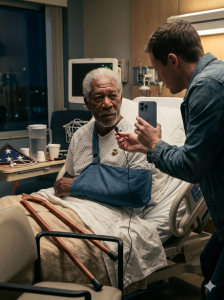
My left arm was immobilized in a heavy blue sling, bound tightly against my chest. The ER doctor, a hollow-eyed resident who looked like he hadn’t slept since Tuesday, had given me the news twenty minutes earlier. The violent impact against the terminal floor hadn’t just dislocated my shoulder; it had severely torn the rotator cuff and aggravated the decades-old structural damage from the shrapnel resting near my spine.
“At your age, Mr. Vance, this isn’t a ‘put it in a sling and take some Advil’ situation,” Dr. Aris had told me, his pen tapping nervously against his clipboard. “You’re looking at reconstructive surgery. And even then, your mobility… it’s going to be compromised. I’m scheduling an MRI, but you need to understand that your baseline has changed.”
Your baseline has changed.
Those were the exact words the Army surgeon had used in 1983 when he told me I’d never run a marathon again. I had survived that. I had learned to walk with a limp, learned to swallow the nerve pain, learned to adapt. But I had done all of that with Eleanor by my side.
I turned my head slowly, the muscles in my neck screaming in protest. Resting on the cheap plastic visitor’s chair next to my gurney were the two jagged pieces of Eleanor’s cherry wood cane.
Officer Hayes had wrapped them in a brown paper bag from a hospital vending machine, but the splintered ends poked through the top. I stared at the wood, my vision blurring. The anger that had been keeping me conscious was slowly draining away, replaced by a deep, suffocating grief. That cane had been the last physical anchor keeping my wife tethered to this world. And in a fraction of a second, a spoiled, arrogant kid had reduced it to garbage just because I was breathing the air he wanted to walk through.
I closed my eyes and let my head fall back against the thin, crinkly pillow. The physical pain was a white-hot fire burning in my shoulder, but the ache in my chest was absolute zero. I just wanted to go home. I wanted to sit on my porch in Atlanta. I wanted to turn back the clock six hours.
“Excuse me? Sir?”
I opened my eyes. A young nurse, her scrubs a bright, cheerful pink that completely contradicted the exhausted bags under her eyes, was standing at the foot of my bed. She was holding a tablet against her chest, but she wasn’t looking at my charts. She was staring at me with a mixture of shock and profound sadness.
“Can I help you, miss?” I asked, my voice raspy and dry.
“Are you… are you Marcus Vance?” she asked, her voice dropping to a harsh whisper. She glanced nervously over her shoulder toward the nurse’s station, as if she were speaking to a ghost.
“That’s what it says on the plastic bracelet,” I muttered, holding up my right wrist.
The nurse slowly reached into her scrub pocket and pulled out her smartphone. Her hand was actually trembling. “I… I didn’t want to bother you. But the other nurses, we were talking, and someone said the name on the chart matched, and… oh my god, it is you.”
She stepped forward and gently turned the phone screen toward me.
At first, I didn’t understand what I was looking at. It was a video playing on Twitter. The camera angle was slightly shaky, looking through the gap between two rows of airport seating.
Then, I saw my own faded olive-green jacket. I saw my wheelchair.
And I saw Julian Sterling standing over me.
My breath hitched in my throat. Watching the assault from the outside was a completely different kind of violation. When you’re in the moment, your adrenaline narrows your focus to survival. But watching the video, I saw the full, sickening context.
I saw how small I looked in that chair. I saw the vicious, explosive force of Julian’s $800 leather loafer kicking the wheel. I watched myself pitch sideways, my body slamming against the unforgiving floor with a heavy, sickening thud.
The nurse let out a soft, involuntary gasp, even though she had clearly watched it already.
On the tiny screen, Julian leaned down. He picked up Eleanor’s cane. He examined it with a look of utter disgust.
And then, he broke it over his knee.
Crack.
Even compressed through the tiny speakers of a smartphone, the sound of the wood snapping cut through the noise of the emergency room. It sounded like a gunshot.
“I’m so sorry,” the nurse whispered, quickly pulling the phone away and pressing it to her chest. There were actual tears welling in her eyes. “My grandfather was in the Navy. If someone ever did that to him…” She shook her head, unable to finish the sentence. “Mr. Vance… the whole world is watching this.”
“What do you mean?” I asked, a cold knot forming in my stomach. I don’t use social media. I didn’t understand the scale of the digital universe.
“This video was posted less than three hours ago,” she said, her voice filled with a kind of breathless awe. “It has twelve million views. It’s the number one trending topic in the country. Everyone is looking for you. The local news vans just pulled up into the ambulance bay outside.”
My heart pounded against my ribs. “News vans?”
“They know you’re here. The paramedic who brought you in tweeted that he transported the ‘JFK victim’ to Jamaica Hospital. Security is trying to keep them out of the lobby, but…” She hesitated. “Mr. Vance, the man who did this to you… do you know who his father is?”
“He said his name was Sterling,” I replied, fighting a wave of nausea.
The nurse nodded grimly. “Richard Sterling. Sterling Vanguard Holdings. They’re a multi-billion dollar private equity firm. They buy up hospitals, defense contractors, pharmaceutical companies. They own half of Manhattan.” She leaned in closer. “And the internet just found out that their company is three days away from securing a massive federal contract with the Department of Veterans Affairs.”
The room seemed to tilt.
I stared at the ceiling tiles, trying to process the scale of what she had just told me. A company trying to secure billions of dollars in taxpayer money to “serve” military veterans was owned by a man whose son had just publicly assaulted a disabled Marine and destroyed his dead wife’s cane.
It wasn’t just a PR nightmare. It was a corporate apocalypse.
Before the nurse could say another word, the floral curtain was ripped open.
Two men stood in the narrow entryway. They didn’t look like doctors, and they certainly didn’t look like police detectives. They looked like they had stepped out of a high-end corporate boardroom. They wore identical charcoal-gray suits, crisp white shirts, and silk ties. Their faces were smooth, emotionless masks.
“Excuse me, you can’t be in here,” the pink-scrubbed nurse protested, immediately stepping between the men and my bed. “This is a restricted triage area. Visiting hours are—”
The taller of the two men didn’t even look at her. He simply pulled a thick, black leather wallet from his breast pocket, opened it, and flashed a silver badge.
“Hospital Administration,” he lied smoothly, his voice as cold as ice. “We need a word with the patient. Privately. Please return to your station, or I’ll have the Chief of Medicine review your employment file.”
The nurse paled. She looked at me, terrified, then back at the men. She knew they weren’t hospital admins, but the sheer aura of authority and unspoken wealth radiating from them paralyzed her. She gave me one last, desperate look of apology before slipping past them and disappearing down the hallway.
The taller man stepped into the cubicle and pulled the curtain completely shut, cutting us off from the rest of the ER. The smaller man stood by the gap, arms crossed, playing the role of the bouncer.
“Mr. Vance,” the tall man said. He didn’t offer his hand. He didn’t smile. He simply pulled a metal folding chair to the side of my bed and sat down. “My name is Arthur Kline. I am Senior Legal Counsel for Sterling Vanguard Holdings. And I am here to make your life considerably better.”
I didn’t say a word. I just stared at him, my good hand resting on the thin hospital blanket.
“I’m going to be very direct with you, Marcus,” Arthur continued, crossing one leg over the other, perfectly exposing a sliver of expensive silk sock. “A very unfortunate misunderstanding occurred this morning at JFK Airport between yourself and my employer’s son, Julian. Tensions were high. Flights were delayed. Mistakes were made on both sides.”
“Mistakes on both sides?” The words tasted like ash in my mouth.
Arthur held up a hand, a patronizing gesture of peace. “Let me finish. This incident has unfortunately been captured on film by an opportunistic bystander who has manipulated the context to create a viral sensation. It is causing a great deal of unnecessary distress for the Sterling family, and, I imagine, for you as well.”
He reached into his tailored jacket and pulled out a manila envelope, placing it gently on the edge of my mattress.
“Inside this envelope is a cashier’s check made out to Marcus Vance in the amount of two point five million dollars,” Arthur said, his voice dropping to a smooth, hypnotic register. “Tax-free. It has already been cleared.”
I stared at the envelope. Two and a half million dollars. It was a number so large it felt abstract. It was the kind of money that would pay off my mortgage instantly. It would cover the reconstructive surgery on my shoulder with the best private doctors in the world. I could set up a trust fund for my grand-nieces. I could live the rest of my life without ever looking at the price tag on a menu.
“What do you want?” I asked. My voice was steady, betraying none of the adrenaline surging through my veins.
“Very little,” Arthur smiled. It was a shark’s smile. All teeth, no warmth. “Inside that envelope is also a Non-Disclosure Agreement. It states that the altercation at the airport was a mutual misunderstanding. It states that Julian Sterling accidentally bumped your chair, causing you to fall, and that he did not intentionally break your cane. Most importantly, it states that you decline to press charges, and you will not speak to the media—ever.”
He leaned closer, his expensive cologne—something musky and sharp—filling the small space.
“Furthermore, we have drafted a brief press release in your name,” Arthur continued. “It will go out to the major news networks within the hour. It simply says you have accepted a private apology from the Sterling family, that you forgive Julian for his clumsiness, and you ask the public to respect your privacy. You sign the paper, the money is yours, and we disappear.”
The silence in the cubicle was suffocating. The only sound was the distant beeping of a heart monitor from the next room over.
I looked at the manila envelope. Then, I turned my head and looked at the plastic visitor’s chair.
I looked at the jagged, broken, splintered remains of Eleanor’s cherry wood cane.
I saw her hands, arthritic and trembling, gripping the smooth curved handle as she walked through her garden. I remembered the way she would tap it against my boots when I was being stubborn. I remembered the smell of the cherry wood, mixed with her lavender perfume.
I looked back at Arthur Kline.
He was watching my eyes, tracking my gaze. He saw me looking at the broken wood.
“We can replace the cane, Marcus,” Arthur offered, misreading my silence. “We can have a master carpenter carve you an exact replica out of the finest mahogany in the world. We can even make a donation to a charity of your choice in your late wife’s name. A hundred thousand dollars to the American Cancer Society. How does that sound?”
They really believed they could buy anything. They believed that grief had a price tag, that dignity was just an asset to be negotiated. They believed that because Julian had been born into a world insulated by billions of dollars, he was fundamentally untouchable.
A slow, burning heat began to rise in my chest. It wasn’t the frantic, chaotic anger of the airport. It was a cold, precise, military rage. It was the same quiet fury I used to feel staring across a dark tree line, waiting for the enemy to make a mistake.
“Mr. Kline,” I said, my voice dropping to a low, dangerous gravel.
“Yes, Marcus?” Arthur smiled, reaching for a silver Montblanc pen inside his jacket, assuming the deal was done.
“I served two tours in the United States Marine Corps,” I said slowly, enunciating every syllable. “I have a piece of rusted metal resting a quarter of an inch from my spinal cord. I have buried the only woman I ever loved. And I have lived sixty-eight years on this earth without compromising my soul for a paycheck.”
Arthur’s smile faltered. His hand stopped halfway into his jacket. “Marcus, let’s be reasonable. Two point five million dollars—”
“I don’t care if it’s two point five billion,” I cut him off, my voice rising, filling the small space. “Your boss’s son didn’t ‘bump’ me. He assaulted me. He humiliated me in front of two hundred people. And he destroyed a piece of my wife that I can never get back.”
The smaller man by the curtain shifted his weight, his hand dropping casually toward his waistband. It was a subtle intimidation tactic, meant to remind me of my vulnerability. It didn’t work.
“Marcus,” Arthur’s voice lost all its smooth veneer. It became hard, flat, and threatening. “You are making a very emotional, very foolish decision. You are an old man with a torn shoulder sitting in a county hospital. Richard Sterling is not a man you want to make an enemy of. If you refuse this offer, we will not offer it again. Instead, we will hire the most vicious defense attorneys in New York. We will dig into your past. We will find every mistake you’ve ever made. We will drag your name through the mud until the public believes you attacked Julian. We will ruin you.”
I stared right into Arthur Kline’s eyes. I didn’t blink. I didn’t flinch.
“You can’t ruin a man who has nothing left to lose,” I whispered.
I reached over with my good hand, grabbed the manila envelope, and tossed it onto the floor at Arthur’s expensive Italian leather shoes.
“Get out of my room.”
Arthur stared at the envelope on the floor. His face turned a dangerous shade of crimson. He slowly stood up, buttoning his suit jacket with trembling hands.
“You’re going to regret this, old man,” Arthur spat, the aristocratic mask completely slipping away. “Before the sun sets today, you are going to wish you had taken this money.”
He turned on his heel and stormed out of the cubicle, the smaller man trailing closely behind him.
The curtain fluttered shut, leaving me alone with the rhythmic beeping of the hospital machines. My heart was pounding so hard I thought my chest was going to crack open. Adrenaline pumped through my veins, mixing with the pain in my shoulder to create a dizzying, nauseating cocktail.
I had just declared war on a billionaire.
I closed my eyes, taking deep, shuddering breaths, trying to calm the spike in my blood pressure. I knew Arthur wasn’t bluffing. They were going to try to destroy me. They were going to leak false stories to the press. They were going to make my life a living hell.
“That… that was the most badass thing I have ever seen in my entire life.”
My eyes snapped open.
Standing on the other side of my bed, having slipped through the gap in the curtain opposite the doorway, was a young man. He looked to be in his early twenties. He was wearing a faded denim jacket, a backward baseball cap, and he had dark, exhausted circles under his eyes.
In his right hand, he was holding an iPhone 14 Pro, the camera lenses pointing directly at the floor where the envelope had just been.
“Who the hell are you?” I demanded, trying to sit up, but groaning as a spike of pain shot through my collarbone. “How did you get in here?”
The kid quickly put his phone in his pocket and held up both hands in surrender. “Woah, woah, easy! Please, Mr. Vance, don’t call security. I’m not a reporter. I swear. I snuck in through the loading dock. I’ve been hiding in the linen closet for twenty minutes waiting for those corporate goons to leave.”
He stepped closer into the light. He looked terrified, but there was a fierce, manic energy burning in his eyes.
“My name is David Miller,” he said, his voice shaking slightly. “I was on your flight. I was sitting three rows behind you at Gate B24.”
I stared at him, my mind racing. “You…”
“I’m the one who filmed it,” David confessed, swallowing hard. “I’m the one who posted the video.”
The silence stretched between us. I looked at this kid. He didn’t look like a savior. He looked like a college student drowning in debt. But he had done what two hundred other adults had been too terrified to do. He had refused to look away.
“Why did you do it?” I asked softly.
David looked down at his worn sneakers. “Five years ago, Sterling Vanguard Holdings bought out the manufacturing plant where my dad worked in Ohio. Three months later, they liquidated the pension fund to pay for a stock buyback. My dad lost everything. His retirement, his house, his dignity. I watched men in suits just like those guys walk in and destroy my family’s life without ever losing sleep over it.”
He looked back up at me, his eyes blazing with a raw, unfiltered intensity.
“When I saw that kid in the tailored suit slap you…” David’s voice cracked. “When I saw him break your wife’s cane and throw it in the trash like it was nothing… I couldn’t let them get away with it again. I knew if I didn’t film it, it would be your word against a billionaire’s. And we both know who the cops believe.”
A profound sense of gratitude washed over me, heavy and warm. This kid had risked everything. Sterling’s lawyers were going to come after him just as hard as they were coming after me.
“They offered me two and a half million dollars to keep my mouth shut,” I said quietly.
“I know,” David smiled a grim, tight smile. He tapped the pocket of his denim jacket where his phone was. “I heard the whole thing through the curtain. I hit record the second they walked in. I got the audio of Arthur Kline offering you the bribe, threatening you, and admitting that Julian broke the cane.”
My jaw dropped.
David Miller hadn’t just filmed the assault. He had just recorded an illegal attempt at witness tampering and corporate blackmail by the senior legal counsel of a multi-billion dollar firm.
“Mr. Vance,” David said, stepping closer to the bed. “In about ten minutes, every major news network in this country is going to be banging down the doors of this hospital. Sterling’s PR team is already spinning a narrative online, saying you provoked Julian, saying you’re an unstable veteran looking for a payout.”
David reached into his backpack and pulled out a small, professional lapel microphone and a portable ring light.
“We have to get ahead of the story,” David said, his voice urgent, pleading. “They think they control the narrative because they have billions of dollars. But we have the truth. And we have the internet.”
He held out the tiny microphone toward me.
“Tell me about your wife, Marcus. Tell me about the cane. Tell the world exactly who Julian Sterling really is.”
I looked at the young man standing before me. I looked at the broken pieces of cherry wood resting on the plastic chair. And then, I thought about Eleanor.
I thought about how much she hated bullies. I thought about how she would stand up to anyone, no matter how big they were, if she thought they were hurting someone vulnerable. Lean on me, Marcus, she used to say.
She couldn’t hold me up physically anymore. But her spirit, the memory of her unbreakable strength, was surging through my veins.
I reached out with my good hand and took the small microphone from David. I clipped it to the collar of my hospital gown.
“Turn on the camera, son,” I said, my voice steady, resonant, and completely devoid of fear.
David’s face lit up. He quickly set up the ring light on the edge of the rolling tray table, bathing my face in a stark, unforgiving glow. He held up his phone, framing the shot to include my battered face, my sling, and the broken pieces of the cane in the background.
“Recording in three, two, one…” David whispered, tapping the screen.
I looked directly into the lens. I didn’t see a piece of glass and metal. I saw the millions of people who were going to watch this. I saw Richard Sterling sitting in his penthouse. I saw Julian sipping champagne in first class.
“My name is Marcus Vance,” I began, my voice echoing in the small, quiet space of the emergency room. “I am a veteran of the United States Marine Corps. And four hours ago, a young man named Julian Sterling decided that my life, and the memory of my deceased wife, was worthless.”
I paused, letting the silence hang for a split second.
“He was wrong. And I am about to show him exactly how wrong he is.”
For illustrative purposes only
The war hadn’t ended at Gate B24. It had only just begun. And I was going to burn their empire to the ground, one piece of cherry wood at a time.
**Chapter 4**
The red recording light on David’s iPhone blinked off, but the heat in the small hospital room remained. I let out a long, ragged exhale, my good hand trembling slightly as it rested against the sterile white sheets. I felt completely drained, as if I had just run a marathon with a hundred-pound rucksack strapped to my back, yet at the same time, my chest felt impossibly light. For the first time since that sickening crack echoed through the terminal, I wasn’t just a victim lying on the linoleum. I was a Marine again, and I had just fired the opening salvo.
David didn’t say a word. He was staring at his phone screen, his thumbs moving with frantic, practiced precision. He didn’t just post the raw video. He knew how the digital world breathed. He attached it to the original thread, weaving it into the very fabric of the conversation that was already setting the internet ablaze.
“It’s up,” David whispered, his voice hoarse. He looked up at me, his eyes wide with a mixture of terror and awe. “Mr. Vance… it’s out there. There’s no taking it back now.”
I nodded slowly. “Good.”
Within fifteen minutes, the atmosphere in the emergency room shifted entirely. The hollow-eyed resident, Dr. Aris, burst back through the floral curtain, followed closely by the hospital’s Chief Administrator—a nervous-looking woman in a sharp blazer who was practically vibrating with anxiety.
“Mr. Vance,” the administrator said, her voice tight. “The lobby is completely overrun. We have CNN, Fox, MSNBC, and about fifty independent journalists blocking the ambulance bay. The NYPD has had to set up barricades. We are moving you to a secure private suite on the VIP floor immediately.”
“I don’t have the insurance for a VIP floor,” I said flatly.
“The hospital is absorbing the cost, sir,” she replied quickly, shooting a panicked glance at David, who was still holding his phone. “We just need to ensure your safety and… and manage the disruption to our other patients.”
They wheeled me out of the chaotic ER and into a private elevator. The higher we went, the quieter it got. The suite they put me in looked more like a high-end hotel room than a hospital, all mahogany veneer and subdued lighting. It was the exact kind of room a Sterling would expect to recover in.
Once the doctors left to prepare my surgical schedule, David hooked his phone up to the massive flat-screen television on the wall, mirroring his screen so we could watch the fallout in real-time.
What I saw over the next three hours was nothing short of a corporate apocalypse.
Arthur Kline and the crisis management team at Sterling Vanguard Holdings had attempted to deploy a classic, aggressive public relations defense. They had issued a sterile, heavily lawyered press release claiming that “an unfortunate misunderstanding” had occurred, that Julian Sterling had been “accosted,” and that the family was “exploring all legal avenues against defamatory online content.” It was a textbook brand-protection strategy, relying on the assumption that their immense wealth could control the narrative through intimidation and corporate spin.
But they had fundamentally misunderstood the battleground. They brought a legal brief to a street fight.
When David posted my response video—the raw, unfiltered truth of a grieving veteran sitting in a hospital bed, exposing the two-and-a-half-million-dollar bribe and the threat to ruin my life—the Sterling PR machine completely collapsed. It was a masterclass in the destruction of brand equity. The sheer, undeniable authenticity of my grief shattered their carefully constructed corporate facade.
“Look at this,” David breathed, pointing at the screen.
The hashtag #JusticeForMarcus wasn’t just trending; it was dominating the global conversation. But it wasn’t just outrage anymore; it was highly organized, weaponized accountability.
Internet sleuths had dug up everything. They found the names of the board members of Sterling Vanguard. They found the shell companies. And, most devastatingly, a coalition of veteran advocacy groups had mobilized with terrifying speed.
At 4:15 PM, a breaking news banner flashed across CNN. The anchor, looking genuinely stunned, adjusted his earpiece.
“We are receiving breaking news out of Washington. The Department of Veterans Affairs has just announced the immediate suspension of all pending contracts with Sterling Vanguard Holdings, citing serious ethical concerns and an ongoing federal review of the company’s leadership culture. This includes the cancellation of the multi-billion-dollar infrastructure deal scheduled to be signed this Friday.”
I let out a breath I didn’t know I was holding. Richard Sterling hadn’t just lost a PR battle; he had just lost billions in taxpayer money. His empire was bleeding out in front of the entire world.
“Their stock is in freefall,” David said, his eyes glued to a financial tracker. “Shareholders are dumping Vanguard like it’s radioactive. Board members are publicly resigning. Mr. Vance… you broke them.”
I looked away from the screen, my eyes settling on the brown paper bag resting on the bedside table. The splintered ends of Eleanor’s cherry wood cane were still visible.
“I didn’t break them,” I said quietly. “Their own arrogance did. I just held up the mirror.”
The climax of the day, however, didn’t happen in a boardroom or a hospital. It happened on the tarmac of Hartsfield-Jackson Atlanta International Airport.
Flight 1482 touched down at exactly 5:30 PM.
Through the news feeds, we watched the grainy helicopter footage circling the runway. Julian Sterling had spent the last three hours entirely cut off from the world, sipping complimentary champagne, insulated by the quiet hum of the first-class cabin, assuming his lawyers had already buried me under a pile of cash and NDAs.
He had no idea he was flying directly into a hurricane.
As the plane taxied to the gate, the captain didn’t turn off the seatbelt sign. Instead, heavily armed federal marshals and local Atlanta police boarded the aircraft.
A passenger in the second row managed to live-stream the arrest. We watched it on the hospital television.
Julian was sitting in seat 2A, scrolling through his phone, likely just turning off airplane mode and seeing the thousands of frantic missed calls and texts from his father and Arthur Kline. The color drained from his face so fast he looked like a corpse. The absolute, unadulterated terror in his eyes was visceral. The invisible shield of his wealth had evaporated while he was thirty thousand feet in the air.
“Julian Sterling,” a broad-shouldered officer said, his voice cutting through the silent cabin. “Stand up. Keep your hands where I can see them.”
“Do you know who my father is?” Julian stammered, his voice cracking, regressing instantly into a terrified child. “You can’t do this. I have a flight… I have a meeting…”
“Your father’s lawyers are currently barricaded in their Manhattan offices, son,” the officer replied coldly. “Turn around. Put your hands behind your back.”
They didn’t just march him off the plane. They paraded him through the terminal. The same kind of terminal where he had assaulted me. But this time, the crowd wasn’t silent. The video of the assault had been looping on the airport news screens for two hours. As Julian was led through the concourse in handcuffs, the deafening roar of booing and shouted insults echoed off the glass walls. He kept his head down, his designer suit suddenly looking like a cheap prison uniform, his posture completely shattered.
He was booked into Fulton County Jail on charges of aggravated assault of a senior citizen, destruction of property, and committing a hate crime—the local DA, recognizing a career-making case, was throwing the absolute maximum at him. There would be no quiet bail. There would be no backroom deals. The world was watching too closely.
I turned off the television. The silence in my hospital room was heavy, but it was a peaceful weight.
David sat back in his chair, running a hand through his hair. “It’s over.”
“No,” I said softly, feeling the deep, throbbing ache in my shoulder. “The noise is over. The healing is just starting.”
Three weeks later.
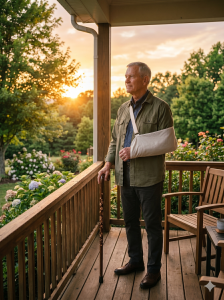
The humid, sweet air of Georgia wrapped around me like a familiar blanket. I sat on the porch of my house in Atlanta, the evening crickets just starting their chorus. My left arm was still in a sling, recovering from the grueling reconstructive surgery that the hospital had ultimately performed completely pro-bono—a gesture of goodwill that also served as a desperate attempt to distance themselves from Vanguard Holdings, who had previously been one of their major donors.
The Sterling empire was a shell of its former self. Richard Sterling had been ousted by his own board of directors in a frantic attempt to save the company, though the federal investigations into their business practices were only just beginning. Arthur Kline was facing disbarment for witness tampering. And Julian was sitting in a county cell, awaiting a trial that his family could no longer afford to rig.
But none of that brought me joy. Justice is necessary, but it isn’t a replacement for peace.
I heard the crunch of tires on gravel. A battered Honda Civic pulled into my driveway.
David Miller stepped out, looking significantly healthier than he had in that New York emergency room. The GoFundMe page that the internet had spontaneously set up for him—rewarding the “kid who didn’t look away”—had raised over four hundred thousand dollars in three days. He had paid off his father’s debts, bought out his own student loans, and accepted a job offer as an investigative producer for an independent media outlet in Atlanta. He had become a regular fixture on my porch over the last few weeks.
He walked up the wooden steps, holding a long, rectangular box wrapped in brown paper.
“Evening, Marcus,” David smiled, taking a seat in the wicker chair next to mine.
“Evening, son. What’s that you got there?”
David handed the box across to me. “It arrived at the station today. It’s addressed to you. The return address is from a woodworking shop in Oregon.”
I frowned, carefully pulling away the brown paper with my good hand. Inside was a custom-made wooden case, lined with deep blue velvet.
Resting in the velvet was a cane.
But it wasn’t a replica of Eleanor’s. The master carpenter who had watched the video online hadn’t tried to replace the irreplaceable.
Instead, he had crafted a masterpiece out of dark, polished American Walnut. It was sturdy, heavy, and undeniably masculine. But inlaid along the shaft, running from the handle down to the brass tip, were delicate, meticulously carved cherry blossoms. The wood for the blossoms had been salvaged from the broken pieces of Eleanor’s cane, which David had carefully shipped to the carpenter weeks ago without telling me.
I ran my calloused thumb over the smooth cherry wood petals embedded in the dark walnut. It was a beautiful, heartbreaking fusion. It was the strength I needed now, carrying the memory of the love that had sustained me then.
Tears hot and thick welled in my eyes, spilling over my weathered cheeks. I didn’t try to wipe them away.
For illustrative purposes only
“He included a note,” David said softly, pointing to a small card tucked into the velvet.
I picked it up. The handwriting was sharp and precise.
Mr. Vance, some things in this world can be broken by the hands of cruel men. But the roots of true love, and the steel of a Marine’s spirit, run too deep to ever be pulled up. Lean on this. And know that you never walk alone.
I clutched the cane to my chest, the polished wood pressing against my heart. I looked out at the fading Georgia sunset, the sky painted in bruised purples and brilliant golds.
I had lost a piece of my past on the cold floor of JFK Airport, stolen by a boy who understood the price of everything and the value of absolutely nothing. But sitting here, holding the beautiful, resilient evidence of human compassion, I realized something profound.
They can break our wood. They can bruise our bodies. They can try to bury us under the crushing weight of their gold and their entitlement.
But they can never, ever break our spirit.
“You want to go see her?” David asked quietly, nodding toward my driveway.
I gripped the handle of the new cane. I planted the brass tip onto the porch boards, feeling the solid, unwavering support. With a grunt of effort, I pushed myself up to a standing position, my back straight, my chin held high.
“Yeah,” I said, a small, genuine smile finally breaking across my face. “I think Eleanor would like to see this.”
