

**The Touch That Changed Everything**
The patio fell into a heavy, breathless silence. It wasn’t the courteous pause of strangers making small talk. This was the kind of quiet that pressed against your ribs, thick with disbelief and the metallic taste of impending chaos.

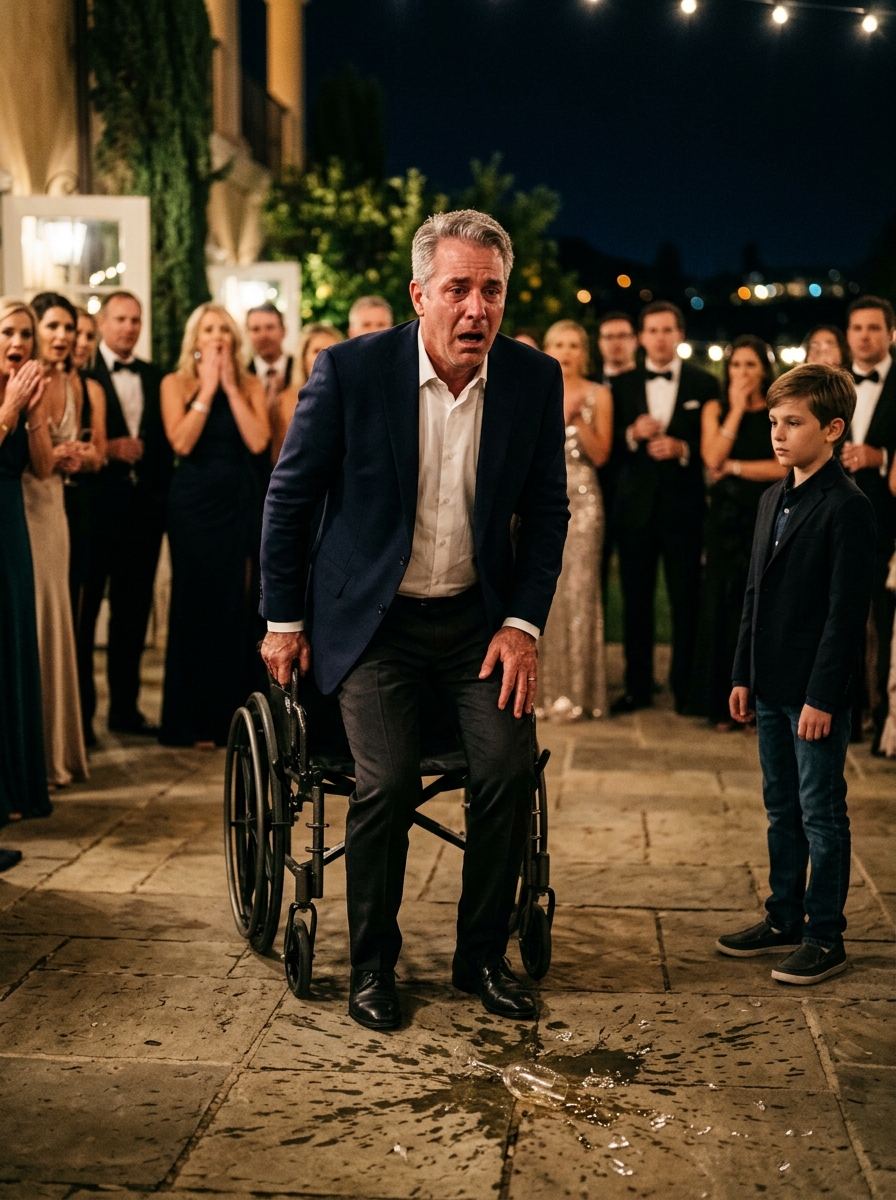
The boy stood barefoot on the cold stone tiles, his small frame illuminated by strings of fairy lights that now seemed mocking in their cheer. His fingers hovered inches above the man’s knee—the exact spot highlighted in faded margins of an old medical journal the boy had somehow memorized. Marcus Hale, once a titan of venture capital, sat motionless in his sleek wheelchair, the product of millions in adaptive technology.
“Fifteen seconds,” Marcus announced loudly, his voice carrying the practiced authority of boardrooms. “After that, I call the police.”
Phones were already out. Guests whispered excitedly. Someone muttered that this would break the internet before midnight. The boy closed his eyes, drew a slow breath, and pressed his palm firmly against the man’s knee.
A scream tore through the warm night air.
“Get your hands off me!”
Then, abruptly, it stopped.
Marcus froze. His face drained of color. For eleven years, that leg had been dead weight—numb, unresponsive, a constant reminder of the drunk driver who had changed his life on a rain-slicked highway. But now something shifted deep inside. Not pain. Not even movement at first. Just… sensation. A faint, electric tingle where there had been nothing.
“That’s not possible,” he whispered, voice cracking.
The boy stepped back calmly, his expression neutral, almost clinical. “Try,” he said.
Laughter rippled through the crowd—nervous, uncertain. Then it died completely.
Because Marcus Hale’s fingers were twitching.
—
**Chapter Two: The Story Everyone Accepted**
Eleven years earlier, doctors in starched white coats had delivered the verdict in a sterile hospital room that smelled of antiseptic and regret. “Complete spinal cord injury at T10,” they said. “You will never walk again.” The words landed like stones. Marcus, at thirty-eight one of the youngest partners at his firm, had built an empire on betting against impossible odds. Now the impossible had bet against him.
What the medical team never emphasized was that his condition was listed internally as “unlikely to recover,” not impossible. The difference was subtle but legally significant. “Unlikely” didn’t justify nine-figure settlements. “Never” kept victims compliant and insurance companies solvent. Marcus accepted the narrative because fighting it required energy he no longer possessed. He sold his story to the press, secured a massive payout, and pivoted his investments into biotech—ironically, the very sector that had failed him.
He became the face of resilience. Motivational speeches. TED Talks. A bestselling memoir titled *Wheels Forward*. The world loved the story. No one questioned the gaps.
—
**Chapter Three: When the Body Remembers**
Back on the patio, Marcus gripped the arms of his wheelchair until his knuckles whitened. Sweat beaded on his forehead despite the cool evening breeze.
“I can’t,” he muttered.
The boy met his gaze steadily. There was no theatrical excitement in those young eyes, no fear, no desire for applause. Just quiet certainty.
“Yes,” the boy said. “You can.”
Marcus pushed. His legs trembled violently, muscles atrophied from years of disuse protesting the sudden command. For a terrifying second, nothing happened. Then, slowly, impossibly, his right foot shifted forward. He rose—shaky, unsteady, like a newborn foal—but he rose.
The crowd gasped. A woman dropped her champagne flute; it shattered on the stone. The check Marcus had been holding—a generous donation meant for a children’s hospital—slipped from his fingers and fluttered to the ground like a dying bird.
He stood. Not strong. Not graceful. But standing.
Tears streamed down his face as he took one trembling step, then another. The boy watched without smiling.
—
**Chapter Four: Fear Changes Sides**
Police arrived within minutes, sirens painting the mansion’s white walls in flashing red and blue. But they weren’t there to arrest the boy. Too many questions had erupted at once. Guests who had laughed were now demanding answers. Who was this child? How had he done what every specialist said couldn’t be done?
One officer knelt in front of the boy, who couldn’t have been more than twelve.
“What’s your name, son?”
The boy hesitated. Names were dangerous. Names left digital footprints, paper trails, and vulnerabilities.
Marcus stepped forward—actually stepped—and placed a protective hand on the boy’s shoulder.
“No,” he said firmly. “He stays with me.”
The officer raised an eyebrow. “You’re protecting him?”
Marcus swallowed hard, his legs still trembling beneath him.
“No,” he replied. “I’m afraid of losing him.”
**Chapter Five: The Truth That Hurt More**
Later that night, in the marble expanse of Marcus’s penthouse overlooking the glittering city, the full story emerged.
The boy’s name was Elias. He had no last name on record—at least not one the system acknowledged. His mother, Dr. Lena Voss, had been a brilliant neurologist working on a revolutionary neural regeneration project. The clinical trial she participated in—funded by a conglomerate Marcus had heavily invested in—promised to repair spinal injuries like his. Instead, it had gone catastrophically wrong.
Lena died during the trial. The company buried the data, paid off families, and rebranded the project. Elias, only seven at the time, had been left with nothing but his mother’s hidden journals, photographic memory, and an intellect that bordered on the superhuman. He had spent years piecing together fragmented research, cross-referencing suppressed studies, and identifying the precise neuromuscular pathways that conventional medicine had overlooked.
He wasn’t a miracle worker. He was the living proof of what had been deliberately hidden.
Marcus sat on his sofa—actually sat, legs stretched out in front of him for the first time in over a decade—staring at the boy reading advanced medical texts meant for specialists three times his age.
“I thought I was the victim,” Marcus said quietly.
Elias looked up. “You were. But you were also the beneficiary. Your investments helped bury my mother’s work. Your silence kept the system alive.”
The words landed like physical blows. Marcus had grown rich on the same ecosystem that had erased this child’s life.
—
**Chapter Six: The Offer That Failed**
“I’ll give you everything,” Marcus said the next morning. Sunlight poured through floor-to-ceiling windows. “Money. A home. The best education. A legal name. Protection.”
Elias shook his head, turning a page in a thick textbook.
“I don’t want your money.”
Marcus leaned forward. “Then what do you want?”
The boy smiled—just once, a small, fleeting thing that carried more weight than any scream.
“The truth.”
—
**Epilogue: What They Laughed At**
The collapse was quiet at first, then devastating.
Investigative journalists, tipped off by leaked documents Elias had memorized years earlier, began digging. Records were subpoenaed. Doctors who had signed off on falsified reports faced hearings. The biotech firm at the center of it all watched its stock price evaporate. Careers ended not with dramatic arrests but with resignation letters and quiet settlements.
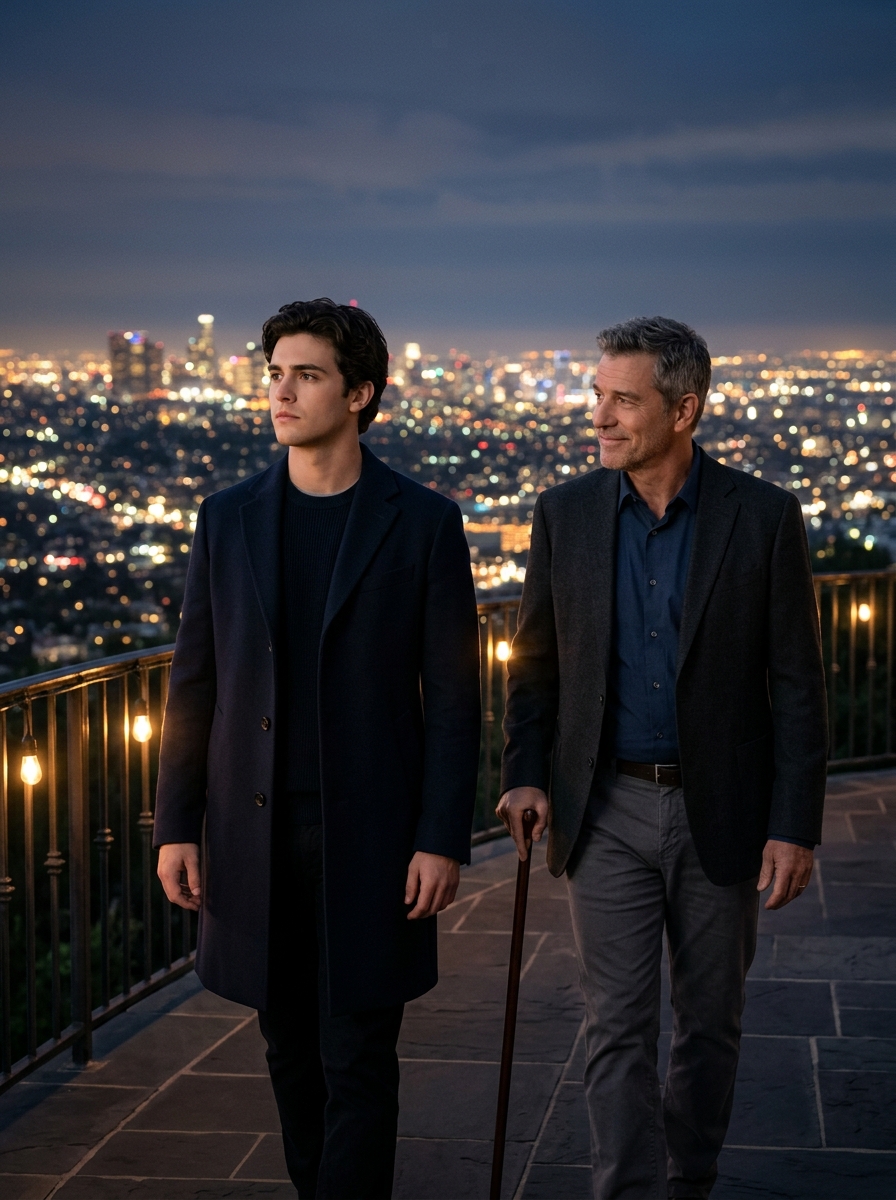
Years later, a seasoned reporter sat across from Elias—now a young man in his early twenties—on the same patio where everything had begun. Marcus Hale walked slowly beside them, still using a cane but moving with growing confidence.
“Why did you do it?” the reporter asked. “Risk everything for one man in a crowd that mocked you?”
Elias looked out over the city lights, the same ones that had once seemed so distant and untouchable.
“They laughed at me,” he said calmly. “They thought money made them untouchable. It didn’t.”
He paused, a small smile touching his lips again.
“Science was never the miracle. Memory was. And truth always finds its way through the cracks they thought they sealed.”
Marcus placed a hand on the young man’s shoulder—the same shoulder he had once gripped in fear and gratitude. The boy who had once been invisible had rewritten both their stories.
In the end, the world didn’t just witness a miracle on a quiet patio. It witnessed the moment when one overlooked child reminded everyone that knowledge, courage, and memory could still humble empires.
