


Chapter 1: The Weight of the Bread
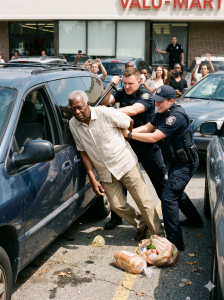
The heat rising from the supermarket parking lot asphalt pressed down like a physical burden, heavy with exhaust fumes and the odor of rotting trash. Arthur shifted the plastic handles of his grocery bag, his fingers stiff from decades of labor. At seventy-five, his back no longer straightened fully, and his left knee sent a sharp stab of pain with every curb he stepped off. Yet his mind remained sharp and his spirit steady. He simply wanted to reach home, toast two slices of sourdough, and settle in with the morning paper.
“Hey! You! Stop right there!”
The shout sliced through the murmur of shoppers and idling engines. Arthur didn’t turn, assuming it was directed at the teenagers hanging around the cart return.
A hand struck his shoulder hard, spinning him around and sending a bolt of white-hot pain through his bad knee. He stumbled, his heels catching on the cracked pavement.
“I said stop, old man! Don’t you walk away from me!”
Arthur looked up into the face of a man who looked barely old enough to shave. Officer Miller was young, his uniform crisp and his eyes bright with dangerous adrenaline. Behind him, Officer Davis stood with one hand already on his taser.
“Is there a problem, Officer?” Arthur asked. His voice was gravelly but steady.
“The problem is the bread you didn’t pay for,” Miller snapped. He snatched the plastic bag from Arthur’s hand. The thin plastic tore, and the loaf of sourdough fell onto the oil-stained ground. “I saw you walk past the register. I saw you look right at the cashier and keep moving.”
Arthur glanced down at the bread lying in a shallow puddle of gray water beside a parked minivan’s tire. “I paid at the self-checkout, son. The receipt is in my pocket. If you’ll just let me—”
“I didn’t tell you to move!” Miller barked. He crowded into Arthur’s space, his chest nearly touching the older man’s. “And don’t call me ‘son.’ You think because you’re old, the rules don’t apply? You think you can just take what you want?”
“I am telling you, I have the proof,” Arthur said, his eyes narrowing. He started to reach for his shirt pocket.
Miller didn’t wait. He seized Arthur’s wrist, twisted it behind his back, and slammed him chest-first against the side of the minivan. The metal burned from the midday sun. Arthur’s cheek pressed against the hot glass, his breath fogging the window.
“Resisting? Really?” Miller laughed, a cold, mocking sound. He drove his forearm into the back of Arthur’s neck, pinning him harder against the vehicle.
A crowd began to gather—that familiar American circle of spectators. A woman in yoga pants halted her cart, mouth open but feet rooted in place. A group of teenagers raised their phones, lenses aimed like weapons.
“Officer, please,” a voice called from the crowd. It was a middle-aged man holding a gallon of milk. “He’s just an old man. You don’t need to do that.”
“Get back!” Davis yelled, drawing his baton and pointing it at the man. “Police business! Keep moving or you’re next for interference!”
The man with the milk backed away, face pale. The crowd didn’t leave; they simply retreated farther, still filming through their screens.
Inside the store, behind the thick glass doors, the head of security, Henderson, watched the entire scene. Arthur had seen him every week for five years. They had chatted about the weather and the local high school football team. Arthur looked toward the entrance, eyes pleading for a witness. Henderson met his gaze, then slowly reached up, pulled the blind cord, and closed them.
The betrayal cut deeper than the scorching metal.
“Clean it up,” Davis ordered, pointing his baton at the bread in the puddle. “Pick it up and put it in the bag, thief.”
Arthur gritted his teeth. “I am not a thief. And I am warning you, Officer Miller. You are crossing a line you cannot uncross. Release me now.”
Miller laughed, pressing more of his weight into Arthur’s neck. “Or what? You gonna call your grandkids? You’re nothing. You’re a gray-haired shoplifter who’s about to spend the night in a cell.”
Miller grabbed the back of Arthur’s light windbreaker, meaning to yank him off the car and onto the ground. As he pulled, the fabric of the inner pocket snagged on a sharp piece of trim. The pocket tore with a sharp rip.
A heavy metallic object slipped free.
It struck the asphalt with a solid thud-clink. It didn’t bounce like cheap metal. It carried the unmistakable weight of solid gold. The object rolled across the pavement and stopped between the feet of a third officer who had just pulled his cruiser into the lane.
Sergeant Harris had seen thirty years of the city’s worst. He had stepped out to tell the rookies to finish up and return to patrol. But as he looked down, his eyes fixed on the object.
It was a ring. Massive. Solid gold. On its face, an eagle with wings spread wide, and beneath it, four crisp, unmistakable stars.
Harris felt the blood leave his face. His heart pounded—not with excitement, but with raw terror. He recognized that ring. He had seen it in history books, official portraits, and on the hands of men who could shift mountains with one phone call.
“Miller,” Harris whispered, voice thin and cracked.
“Sarge, check this out,” Miller said, still holding Arthur down. “Caught this one red-handed. He’s even got some stolen jewelry.”
“Miller!” Harris roared, voice returning. He lunged forward, planting his boot over the gold ring to shield it from the dirty pavement. He grabbed Miller’s arm and yanked him off the old man with such force the rookie nearly fell.
“Sarge? What the—?”
Harris ignored him. He stared at Arthur, who was slowly straightening, his face now a mask of cold military precision. The old man bent down, retrieved his ring, and wiped a smear of oil from the gold with his thumb.
“I hope,” Arthur said, his voice now like rolling thunder, “that your body cameras were on. Because you’re going to need them for the deposition.”
Harris glanced at the rookies, then back at the man wearing the four-star ring. “Sir… General… I am so sorry.”
Arthur ignored the Sergeant. He fixed his gaze on the two rookies, whose smirks faded as they realized the situation had shifted from a routine arrest to a career-ending disaster.
Arthur pulled a cell phone from his other pocket. He didn’t dial 911. He called a direct line to a man in Washington D.C. who disliked being disturbed during lunch.
“This is Arthur,” he said into the phone, eyes locked on Miller’s badge. “I’ve been detained. I need the JAG office on the line. Now.”
Chapter 2: The Ghost in the Machine
The patrol cruiser smelled of stale coffee and the sharp ozone scent of the dashboard laptop. Officer Miller sat in the driver’s seat, hands shaking so badly he gripped the wheel to steady them. His breathing came in shallow, ragged bursts that fogged the side window.
“Shut up, Miller,” Davis hissed from the passenger seat. Davis wasn’t shaking, but his face had gone the color of curdled milk. He kept checking the side-view mirror, watching Sergeant Harris on the asphalt twenty feet away, speaking with the old man—the General.
“I didn’t know, man,” Miller whispered, voice cracking. “How was I supposed to know? He was just some old guy in a windbreaker buying sourdough. He looked like… he just looked like a target.”
“Stop talking,” Davis snapped, eyes darting to the body camera on Miller’s chest. Its green light still blinked. A silent witness to every shove, every insult, and the sound of the four-star ring hitting the ground. “Just sit there. Harris is handling it. We’re rookies. We made a mistake based on a shoplifting report. That’s our story. It’s a procedural error. That’s all.”
Outside, the parking lot had turned into a silent graveyard. The shoppers who had been filming were now being moved away by backup officers. The quiet felt oppressive.
Arthur stood beside the minivan, refusing the seat Sergeant Harris offered. He no longer looked like a victim. He stood with an iron-straight spine, chin level, eyes fixed on some distant point. He held his phone to his ear, voice low and measured.
“I don’t want an apology, Greg,” Arthur said into the phone. “I want the digital footprint. Everything. Store security feeds, the municipal grid cameras on 5th and Main, and the bodycam IDs for Miller and Davis. I want a federal lock on the precinct server within the hour. No, don’t wait for the warrant. Use the emergency oversight protocol. They’re going to try to scrub it.”
Arthur ended the call and finally turned to Sergeant Harris. The veteran officer, who had cuffed a thousand people, looked ready to disappear into the nearest storm drain.
“General, please,” Harris began, voice pleading. “Miller is a hothead. He’s young. He’s from a family with a lot of… local influence. If we can just go down to the station, we can pull the report, I’ll personally buy you a new bag of groceries, and we can put this behind us. There’s no need to involve the JAG or the feds. It’s a local matter.”
Arthur leaned close, his face inches from the Sergeant’s. “It stopped being a local matter the second he put his hands on my neck after I told him I had a receipt. It stopped being a local matter when your security guard turned his back. This isn’t about me, Harris. It’s about the person who doesn’t have four stars in their pocket. It’s about what happens to them when the cameras aren’t rolling.”
Arthur turned and walked toward his own unassuming ten-year-old sedan. He didn’t look back.
Twenty minutes later, Miller and Davis sat in the precinct locker room, thick with panic.
“We have to dump the footage,” Miller said, pacing between the metal lockers. “If the Chief sees that I kicked his knee while he was down… if he hears what I said about ‘you people’… I’m done. My dad can’t fix this.”
Davis leaned against a locker, chewing his thumbnail. “Harris said he’d try to stall. But we can’t just delete it. There’s an audit trail.”
“The system ‘glitches’ all the time, Davis!” Miller shouted. “The server in the basement is twenty years old. If the file corrupts during upload, it’s gone. It happens once a month. Just… help me.”
They moved to the tech room, a cramped space filled with humming servers and glowing monitors. The on-duty tech, a bored civilian named Kevin, was on a smoke break. Miller sat at the terminal, fingers racing across the keys. He located the upload queue.
Officer Miller – Event 4492 – 13:14 HRS.
His mouse hovered over ‘Force Delete.’ His heart hammered like a trapped bird. One click, and the proof of his cruelty would vanish into corrupted data.
“Do it,” Davis whispered.
Miller clicked.
The screen flickered. A progress bar appeared: Deleting… 10%… 40%… 80%…
Suddenly the screen flashed violent red. A large white lock icon appeared in the center.
FEDERAL OVERSIGHT PROTOCOL ACTIVATED. SERVER LOCKED.
Miller froze. He clicked frantically, but the cursor had disappeared.
“What is that?” Davis hissed. “What did you do?”
“I didn’t do anything!” Miller screamed.
A printer in the corner whirred to life. It ejected a single sheet. Davis grabbed it. It was a formal notice from the Department of Justice, Office of the Inspector General, declaring all precinct digital assets under federal litigation hold. Any attempt to alter, delete, or move data would be prosecuted as a felony.
The timestamp at the bottom showed the hold had begun three minutes earlier.
The tech room door opened. It wasn’t Kevin. It was the Chief of Police, his usual neutral expression gone. He looked like a man walking to the gallows.
“Chief,” Miller began, jumping up so fast his chair toppled. “We were just… checking the upload.”
The Chief didn’t glance at them. He stared at the red screen, the lock icon, then at the two rookies with a chill that turned the air icy.
“Pack your lockers,” the Chief said, voice flat and dead. “Don’t take your badges. Don’t take your sidearms. Go to the briefing room and sit down. Don’t talk to each other. Don’t call your lawyers yet. Just sit.”
“Chief, my father—” Miller started.
“Your father is currently on a recorded line with the Mayor,” the Chief cut in, meeting Miller’s eyes. “And the Mayor is being told by a 4-star General that if this precinct doesn’t handle this with total transparency, the National Guard will be performing an ‘administrative audit’ of our entire budget by Monday morning.”
The Chief stepped back into the hallway. “The General is in the lobby. He isn’t filing a complaint. He’s waiting for the witness.”
“What witness?” Davis asked, voice trembling.
The Chief pointed toward the glass doors. Standing there with a small cracked tablet was a ten-year-old boy in a stained hoodie. His mother stood beside him, hand on his shoulder.
The boy had been hiding behind the shopping carts. He hadn’t just watched. He had a clear view of the moment Miller’s boot struck Arthur’s knee—and a backup of the video on a cloud drive the police servers couldn’t reach.
Arthur sat on a wooden bench in the lobby, hands folded over his cane. He watched the two rookies being led to the briefing room. He didn’t shout. He didn’t sneer. He simply drew a small pocket watch from his vest—a retirement gift from the Joint Chiefs—and checked the time.
“Eleven minutes,” Arthur whispered to himself. “They lasted eleven minutes before they tried to hide.”
He looked up at the boy with the tablet and gave a small, solemn nod. The evidence was no longer only in the machine. It was in the hands of the very people they thought they could ignore.
Chapter 3: The Reversal
The air inside Precinct 4’s briefing room felt thick and oppressive. It was a windowless space of beige walls and buzzing fluorescent lights, carrying the scent of floor wax and stale coffee. Officers Miller and Davis sat at the far end of the long laminate table, looking less like officers and more like schoolboys awaiting punishment. Miller’s boot tapped frantically against the linoleum, a restless rhythm like a ticking clock.
Davis kept wiping his sweaty palms on his uniform pants. “They’re just trying to scare us,” he whispered, eyes flicking toward the heavy oak door. “Harris is just covering his own tail. My dad’s lawyer said—”
“Your dad’s lawyer isn’t in this room, Davis,” Miller hissed. “Did you see that screen? The red lock? That wasn’t the Chief. That was the Feds.”
The door handle turned with a heavy metallic click.
Chief Randall entered first, his face a rigid mask of barely contained anger. He didn’t sit. He moved to the corner and stood with arms crossed. Next came the Mayor, a man who normally thrived on cameras and greetings, now looking desperate to disappear into the walls.
Finally, Arthur entered.
He had changed out of the torn windbreaker and now wore a crisp charcoal-gray suit that appeared more expensive than the officers’ cruisers. A small, understated pin with four silver stars adorned his lapel. He no longer resembled an old man shoved against a minivan. He carried the bearing of someone who had spent forty years shaping the destiny of nations.
Two men in dark, impeccably tailored suits followed him. They wore no visible badges but projected clear federal authority through their leather portfolios and commanding presence.
“Gentlemen,” one of the suits said, his voice as sharp as a razor. “I am Special Agent Vance with the Department of Justice, Civil Rights Division. To my left is Colonel Marcus Reed, Lead Counsel for the Office of the Judge Advocate General.”
Miller attempted to rise, forcing a look of rookie sincerity onto his face. “Sir, there’s been a huge misunderstanding about a shoplifting—”
“Sit down, Officer Miller,” Colonel Reed said. The command was quiet yet struck like a physical blow. Miller dropped back into his chair so hard it slid backward several inches.
“We aren’t here to discuss sourdough bread,” Agent Vance said, opening his portfolio. “We are here to discuss a systemic violation of civil rights, the physical assault of a retired United States General, and a subsequent attempt to destroy federal evidence.”
“We didn’t destroy anything!” Davis blurted out.
The Chief leaned forward, his voice a low growl. “Then why did I just watch you two on the tech room security feed trying to bypass the server encryption at 2:14 PM?”
The room fell silent. Miller’s boot stopped tapping.
“General Arthur was kind enough to suggest we handle the initial inquiry here,” Colonel Reed said, nodding toward Arthur. Arthur stayed quiet, his eyes fixed on Miller with a calm, terrifying intensity. “However, the General also ensured that the ‘technical difficulties’ this precinct is known for were bypassed.”
Vance turned a laptop toward the rookies. “This is the recovered footage from Officer Miller’s bodycam. It seems the ‘corrupted’ file was actually quite healthy once we pulled it from the cloud buffer.”
He hit play.
The room filled with the sounds of the parking lot. The shaky video showed Arthur turning around, confused. Then Miller’s voice rang out, loud and harsh: “I said shut up, old man!”
The footage captured the violent shove, the bread hitting the puddle, Arthur’s cheek pressed against the glass. Most damning of all, it clearly recorded Miller’s mocking laugh and the words, “You people always have an excuse.”
The Mayor flinched. The Chief stared at the floor.
“And here,” Vance said, clicking a second file, “is the footage from the store’s exterior 4K camera. The one your Sergeant said was ‘out of order’ during his initial talk with the General.”
The video was crystal clear. It showed Miller kicking Arthur’s knee, the elderly man’s leg buckling, and the complete absence of provocation. It also captured the security guard, Henderson, closing the blinds.
“Mr. Henderson has already been detained for questioning regarding his cooperation with local law enforcement to suppress evidence,” Vance noted dryly.
Arthur finally spoke. He didn’t raise his voice. “Officer Miller, do you remember what I told you in that parking lot?”
Miller swallowed, his throat making a loud clicking sound. He couldn’t speak.
“I told you that you were crossing a line you couldn’t uncross,” Arthur said. “You saw a man you thought was powerless. You saw an age and a skin color and you decided that gave you the right to be a predator. You didn’t see a citizen. You saw a target.”
Arthur stood up slowly, leaning on his cane, yet his presence dominated the entire room. He walked over to Miller. The rookie shrank back into his seat, looking small and pathetic.
“You aren’t the law, son,” Arthur whispered. “The law is a shield. You tried to use it as a club. And because you tried to hide what you did, you turned a simple assault into a federal conspiracy.”
Colonel Reed stepped forward and placed two sets of heavy stainless-steel handcuffs on the laminate table. They were not standard police cuffs but high-security federal restraints.
“Chief Randall,” the Colonel said. “The General has declined to accept a private apology. He has, however, requested that the law be applied with the same ‘vigor’ Officer Miller showed in the parking lot.”
The Chief looked at Miller and Davis. The betrayal in his eyes was complete. “Turn around. Hands behind your backs.”
“Chief, please!” Davis cried out, his voice rising into a whine. “I just stood there! I didn’t touch him!”
“That’s the problem, Davis,” the Chief said, his voice cracking with shame. “You just stood there. In this department, that makes you an accomplice.”
The clicking of the handcuffs echoed as the only sound in the room. The two rookies, who had laughed about “shoplifters” barely an hour earlier, were now being led out of their own briefing room.
As they entered the hallway, they found it lined with every officer on shift. Word had spread quickly. There was no “Blue Wall” of silence today—only cold stares.
In the lobby, local news cameras had already assembled, alerted not by the police but by the mother of the ten-year-old boy who had recorded the incident.
As Miller and Davis were escorted out past the flashing lights and microphones, Miller’s father—a prominent local businessman—tried to push through the crowd toward his son. He was blocked by a line of State Troopers.
“That’s my son!” he screamed. “Do you know who I am?”
Agent Vance stepped into his path, holding up a federal badge. “We know exactly who you are, Mr. Miller. We’ve also opened an inquiry into your recent ‘contributions’ to the Police Union’s legal defense fund. I suggest you go find a very good lawyer. You’re going to need one by tomorrow morning.”
Arthur exited the precinct last. He paused at the top of the stone steps, sunlight glinting off the gold stars on his lapel. The crowd of protesters and reporters fell quiet as he descended.
He walked directly to the ten-year-old boy and his mother. Reaching into his pocket, he removed the 4-star ring.
“You did a brave thing today,” Arthur told the boy. “You stood up when the adults turned away.”
He pressed a small commemorative military coin into the boy’s hand—a coin awarded only for extraordinary courage under fire.
“Keep that,” Arthur said. “It’s a reminder that no one is too small to change the world.”
As Arthur got into his car, Sergeant Harris—the man who had tried to cover it up—stood at the curb and offered a crisp but trembling salute.
Arthur looked at him through the window, his expression unreadable. He did not return the salute. He simply rolled up the window and drove away, leaving the precinct to face the ruins of its own corruption.
Chapter 4: The Line is Drawn
The morning of the federal hearing dawned gray and humid, the city sky a flat, oppressive sheet of slate. Outside the Dirksen Courthouse, satellite trucks and reporters packed the sidewalk, their cameras trained on the heavy bronze doors. This was no longer a local story. The footage of Arthur being slammed against the minivan had gone viral, reaching forty million views in three days. It had become a national flashpoint for police accountability, and today the hammer would fall.
Arthur sat in the back of a black SUV, hands resting on the silver head of his cane. He wore his full dress blues. The four stars on his shoulders caught the dim morning light, sharp and cold. He studied his reflection in the glass—not with pride, but with weary, solemn resolve. He had spent his life defending the Constitution from foreign threats; he had never imagined he would have to defend it in a supermarket parking lot.
“We’re ready, General,” Colonel Reed said from the front seat.
Arthur nodded once. He stepped out, and the explosion of camera flashes came instantly. He ignored the questions. He ignored the protesters holding signs with his face. He climbed the courthouse steps with the measured, rhythmic stride of a soldier on march.
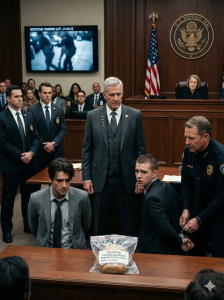
Inside the hearing room, the atmosphere was morgue-cold. Miller and Davis sat at a table flanked by three high-priced defense attorneys. Miller looked skeletal, his once-arrogant face now sunken and pale. He no longer wore his uniform, only a cheap, ill-fitting suit that made him look like a boy playing dress-up. His father sat behind him in the gallery, face tight with sweating desperation.
At the front sat a panel of three federal judges. This was not yet a trial; it was an evidentiary hearing to determine the full scope of the civil rights charges.
“Call your first witness,” the lead judge directed.
Agent Vance rose. “The government calls Officer Tyler Miller.”
The room held its breath as Miller approached the stand. His hand shook so badly during the oath that the bailiff had to steady his arm. For the next four hours, the world watched Miller’s life come apart.
Under Vance’s relentless questioning, the “Blue Wall” did not crack—it shattered. Vance played the recovered audio from the precinct tech room, capturing Miller and Davis desperately trying to delete the cloud buffer.
“Officer Miller,” Vance said, his voice echoing through the high-ceilinged room. “In the recording, you told Officer Davis, and I quote: ‘The old man is a nobody. If the file is gone, it’s just our word against a shoplifter.’ Is that correct?”
Miller’s mouth opened and closed like a fish out of water. “I… I was under extreme stress. I thought he was a threat.”
“A threat?” Vance repeated, his voice dropping to a whisper more terrifying than a shout. “A seventy-five-year-old man with a bag of sourdough bread? A man who told you six times he had a receipt? A man who was already pinned against a car?”
Vance pressed a key. The courtroom monitors displayed a side-by-side comparison of Miller’s police report and the actual bodycam footage. In the report, Miller claimed Arthur had “swung his grocery bag in a menacing manner.” In the video, the bag stayed at Arthur’s side until Miller ripped it away.
“You lied on a sworn federal document to justify an assault on a decorated veteran,” Vance said. “And you did so because you believed your badge gave you the power to erase the truth.”
By the time Miller left the stand, he was weeping openly. He had lost everything. His father’s influence could not reach inside a federal courtroom. The “local power” he had once bragged about proved a grain of sand against the Department of Justice.
Then Arthur took the stand.
The room fell so quiet the ticking of the far wall clock became audible. Arthur did not look at the judges. He looked straight at the two young men who had humiliated him.
“I didn’t come here for revenge,” Arthur said, his voice steady and resonant. “I’ve seen enough blood and enough broken lives to last ten lifetimes. I came here because of a word you two don’t seem to understand: Service. You wore that badge as if it were a crown. You thought it made you better than the people you were sworn to protect. But a badge is a heavy thing. It’s supposed to weigh you down with responsibility, not lift you up with ego.”
He reached into his pocket and pulled out the loaf of sourdough bread—now stale and sealed in an evidence bag. He placed it on the ledge of the witness stand.
“This is what you thought was worth a man’s dignity,” Arthur said. “A five-dollar loaf of bread. You were willing to break a man’s leg and ruin his name over a lie. And the most tragic part is that if I hadn’t dropped that ring, I would be in a jail cell right now, and you would be out looking for your next victim.”
The judge leaned forward. “General, do you have a recommendation for the court regarding the sentencing phase?”
Arthur looked at Miller, then Davis, then the Chief of Police in the back row. “The Chief has already resigned. That is a start. As for these two… I don’t want them in a cage for the rest of their lives. I want them to lose the one thing they abused. I want them barred from ever holding a position of public trust again. I want their names entered into the national decertification database. I want them to walk through the world as ordinary citizens—the very people they treated with such contempt.”
The fallout became a scorched-earth cleansing of the local precinct. Within a month, the city’s police budget fell under federal receivership. Fourteen other officers were suspended for their roles in the cover-up. Henderson, the store security guard, was fired and faced a massive civil lawsuit that cost him his house.
A week after the final hearing, Arthur returned to the supermarket.
The parking lot looked the same—the same heat, the same smell of exhaust. But as he stepped out of his car, things had changed. A young store employee immediately brought him a cart.
“Sir,” the young man said, his eyes full of deep, genuine respect. “Let me help you with that.”
Arthur walked through the aisles. People paused. They didn’t stare with cameras; they nodded. They stepped aside not out of fear, but out of a collective, silent apology.
He reached the bread aisle and selected a fresh loaf of sourdough. At the register—the same one from the week before—the new young cashier scanned it.
“That’ll be four-ninety-five, sir,” she said.
Arthur handed her a five-dollar bill. When she moved to give him the nickel change, he raised his hand.
“Keep it,” he said with a small, tired smile.

He walked back into the sunlight, posture straight, cane clicking steadily against the pavement. He placed the bread on the passenger seat. He glanced at his hand—the four-star ring gleamed on his finger under the afternoon sun.
He looked toward the spot where he had been slammed against the minivan. The oil puddle had vanished. The asphalt was clean. For the first time in a week, Arthur drew a full, deep breath.
He started the engine and drove away, a simple citizen in a free country, his dignity not only restored but etched into the history of the town he had finally, truly, saved.
**THE END**
