


Then the embassy doors swung open.
And Lucien Marrow’s smile vanished before mine could even begin to form.
The President entered first.
Right beside him stood my brother.
Not my coworker.
Not my boss.
My brother.
Gabriel Vale.
The man Lucien had spent the whole night name-dropping.
The President’s honored guest.
The real reason the ballroom was packed.
For one second, nobody moved.
Not the violinist.
Not the waiters.
Not the women who had been half-laughing into their glasses.
Not even Lucien, who remained standing there with his legs apart as if I should be grateful for the humiliation.
Then Gabriel saw me on the floor.
He stopped cold.
His face changed in a way I had only seen once before — at our father’s funeral.
“Ethan,” he said.
Just my name.
Quiet.
But deadly.
You could feel the entire room realize, all at once, that something had gone horribly wrong.
I stood up slowly.
My knees hurt.
My palms stung against the polished floor.
And Lucien, because he was exactly the kind of spoiled coward everyone thought he was, tried to laugh.
“It’s a misunderstanding,” he said, smoothing his jacket. “The staff member was being corrected.”
The President turned to look at him.
“Corrected?”
Nobody answered.
The ballroom had gone so silent I could hear a phone screen lock somewhere near the dessert table.
I am Ethan Vale.
Thirty-two.
Former military security detail.
Current contract bodyguard.
And, at that point in my life, broke enough to say yes to a humiliating shift inside the Valedoran Embassy because my mother’s medical bills had eaten through everything I had saved.
My brother Gabriel had gone the other direction in life.
Scholarships.
Diplomacy.
Government advisory work.
The kind of polished brilliance that got him invited into rooms where history was negotiated over crystal glasses and fake smiles.
We loved each other.
We just lived in different worlds.
I never used his name.
Not for jobs.
Not for favors.
Not for sympathy.
And definitely not for dignity.
That night, I was assigned to side-hall security for the diplomatic banquet.
Gabriel had been invited as the President’s lead ethics envoy — the man presenting a new cross-border anti-corruption agreement.
Lucien Marrow and his family had spent weeks telling everybody they were central to the evening.
That was the first lie.
The truth was uglier.
The Marrows were an old titled family from Valedora — rich, connected, ceremonial nobility with too many portraits and not enough character.
They had the money.
They had the surname.
They had the kind of arrogance that made them think people in uniforms were furniture.
And Lucien was the worst of them.
He was in his late twenties, soft hands, sharp tux, expensive watch, rotten soul.
By dessert, he was already drunk on privilege.
He had snapped at a server for pouring sparkling water instead of still.
He had mocked a junior attaché’s accent.
He had told a female staffer to “try smiling like someone paid to be pretty.”
I had watched all of it.
I had kept quiet.
Because that was not my first night around the Marrow family.
For three weeks, I had been picking up banquet shifts at the embassy whenever I could.
I needed the money.
But I also needed proof.
Staff were being underpaid.
Tips were disappearing.
Security logs were being altered.
Temporary workers were being threatened into silence.
And every complaint seemed to vanish the moment the Marrow name appeared.
So I did what quiet men do when loud men get sloppy.
I watched.
I saved timestamps.
I copied staffing sheets.
I noted camera placements.
I kept every insult, every deleted shift, every “accidental” payroll discrepancy in a folder no one knew existed.
I didn’t know the collapse would happen that night.
But I knew men like Lucien always go one cruelty too far.
It happened outside the main ballroom doors.
He had been trying to impress a cluster of donors and minor officials.
Talking too loudly.
Laughing too hard.
Performing wealth like it was a talent.
Then he looked at me.
Really looked.
At my worn cuffs.
My old shoes.
My posture.
My silence.
And he decided I was safe to destroy.
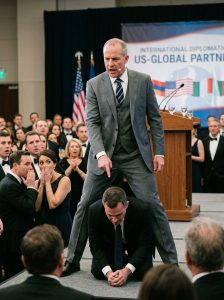
“You,” he snapped, crooking a finger at me like I was a dog.
I stepped over.
“Yes, sir?”
“Get on your knees.”
There are moments in life when your body hears something before your pride does.
Mine went cold.
I thought I had misheard him.
He smiled.
“No, don’t look confused. You people are always confused. Crawl between my legs. Let them see what class looks like.”
A few guests laughed.
Not because it was funny.
Because cowardice loves an audience.
I glanced once toward my supervisor.
He looked away.
Of course he did.
Lucien leaned closer so only I could hear him.
“You want this job? You want your little paycheck? Then bend.”
I should tell you I fought back.
That I grabbed him by the collar.
That I said something heroic.
I didn’t.
I thought about my mother in a rehab bed.
I thought about the invoice due Friday.
I thought about what poor men lose when rich men get bored.
And I got down on my hands and knees.
The marble floor was cold.
The laughter was worse.
Lucien spread his stance wider.
“Lower,” he said again.
Someone behind him whispered, “This is insane.”
Someone else whispered, “Record it.”
So I crawled.
Between his legs.
Like he’d ordered.
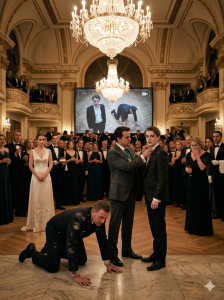
Humiliation has a physical sound.
It is not screaming.
It is not crying.
It is the tiny burst of laughter from people who are relieved it isn’t happening to them.
When I stood up, Lucien smirked like he had invented power.
Then the doors opened.
And the room learned the difference between power and consequences.
Gabriel walked straight toward me.
The President beside him did not smile, did not wave, did not greet a single donor.
Gabriel stopped two feet away.
“Who did this?”
Lucien tried to step in with his practiced grin.
“Mr. Vale, welcome. There’s been a misunderstanding. Your brother—”
Gabriel turned so fast Lucien actually flinched.
“My brother,” he said, “is a decorated security professional. And you just degraded him in an official diplomatic venue, in front of witnesses, under active security recording.”
The word brother hit the room like broken glass.
You could see people recalculating.
Faces changed.
Phones lowered, then rose again for a very different reason.
Lucien’s father, Lord Adrian Marrow, rushed forward from the head table, his wife right behind him.
He was an older version of Lucien — polished, entitled, and instantly frightened the moment his money stopped working.
“Gabriel,” he said, forcing a laugh. “Surely this can be handled privately.”
The President finally spoke.
“No,” he said. “It cannot.”
That was when I knew the night was not just about me.
Gabriel looked at the ambassador.
“Bring legal counsel. Freeze the ballroom exits. Pull corridor camera feed fourteen, timestamp 8:43 p.m. Then pull the internal audit file I submitted this morning.”
A sound ran through the room.
Not laughter.
Fear.
Lucien’s father went pale.
Because he understood something Lucien still didn’t:
This wasn’t a family argument.
This was the legal hammer.
The screen behind the orchestra lit up.
At first the guests thought it was a mistake.
Then corridor footage appeared.
Clear.
High angle.
Undeniable.
Lucien blocking me.
Lucien pointing down.
Lucien forcing me to kneel.
Lucien grinning while I crawled between his legs.
Gasps broke out around the ballroom.
One woman who had laughed earlier looked like she might be sick.
Gabriel did not raise his voice.
He never had to.
“Three weeks ago,” he said, “my office began reviewing financial irregularities tied to the Marrow family’s charitable trust, diplomatic staffing budgets, and title registry filings.”
The ambassador closed his eyes.
He already knew.
“It gets worse,” Gabriel continued.
A second screen came up.
Payroll sheets.
Altered signatures.
Offshore transfers.
Payments routed through embassy event funds.
Government stipends redirected into shell charities.
And the final blow:
Registry documents showing the Marrows’ noble rank had been expanded and protected through forged lineage certifications and bribed clerks.
Lucien stared at the screen, confused at first, then terrified.
His mother grabbed his arm.
His father whispered, “Don’t speak.”
But Lucien had spent his whole life being protected from silence.
He pointed at me.
“This is because of him? Because of some bodyguard?”
Gabriel looked straight at him.
“No. This is because your family confused status with immunity.”
Then he did something I will never forget.
He walked over to me in front of every donor, minister, and camera in that room… and straightened my collar.
The same collar Lucien had laughed at.
The same cheap suit everyone had ignored.
And Gabriel said, clearly, for the entire ballroom to hear:
“My brother did not embarrass this embassy tonight. You did.”
The President nodded once.
Then he addressed the room.
“Under Article 12 of the National Honors Integrity Act and Section 9 of Diplomatic Conduct Standards, the Marrow family is hereby suspended from ceremonial privilege pending immediate revocation proceedings.”
There was a wave of stunned whispering.
But he wasn’t finished.
“Effective tonight, their access to diplomatic accounts is frozen. Their titles are under emergency review. Their travel privileges are suspended. And the criminal referral package moves forward at dawn.”
Lucien’s father stumbled backward into a chair.
His mother started crying.
Lucien looked around the room for support and found none.
Not from the donors he had entertained.
Not from the officials he had bragged to.
Not from the guests who had laughed.
Money gives a man many friends.
Evidence makes them disappear.
Then came the part he never imagined.
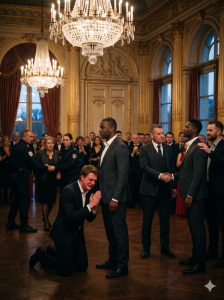
Lucien dropped to his knees in front of me.
Right there on the same floor where he had ordered me to crawl.
“Please,” he said, grabbing at the air near my jacket. “I was drunk. I didn’t know who you were.”
And that was the sentence that finished him.
Not because of who my brother was.
Because of what it revealed.
He believed the humiliation would have been acceptable if I had actually been a nobody.
That was the rot.
That was the truth.
Gabriel heard it too.
So did the President.
So did every person holding a phone.
I stepped back.
“You’re right,” I told him. “You didn’t know who I was. You also didn’t care.”
Lucien started crying.
His father tried one last time.
“We can settle this,” he said, voice shaking. “Name a number.”
The President’s expression hardened.
“That sentence,” he said, “is now part of the record.”
Embassy security escorted the Marrows out through the side entrance they used to reserve for staff.
No music played.
No one clapped.
No one defended them.
By midnight, the footage had been sealed into the case file.
By morning, the audit had gone public.
Within seventy-two hours, the Marrows’ ceremonial noble titles were formally revoked.
Their diplomatic privileges were canceled.
Their family foundations were shut down.
Their domestic assets were frozen pending corruption charges.
And because the government determined they had disgraced the state and interfered with official funds, they were removed from the country and sent overseas under a supervised exile order while the full prosecution moved forward.
The headlines were brutal.
The pity was scarce.
The kneeling photo of Lucien spread faster than any speech his family had ever paid to publish.
But the part that mattered most to me happened after the ballroom emptied.
The President came over.
No cameras then.
No performance.
Just the two of us and Gabriel.
He looked at my scraped hands and said, “I am sorry you were treated that way in a house carrying our flag.”
Then he shook my hand.
Not like I was staff.
Like I was a man.
Gabriel and I stood there after everyone left.
For a second, we were boys again.
Two brothers in borrowed jackets trying to survive a world that respected the wrong people too easily.
“You should have called me,” he said.
“I know,” I said.
“I would have come.”
“I know.”
He hugged me anyway.
Hard.
No speeches.
No politics.
Just family.
A month later, the embassy compensated every worker whose pay had been stolen.
Three staff members got their jobs back.
Two senior administrators resigned.
My mother’s treatment bills were covered after I accepted a permanent security-director role with the international ethics office Gabriel had been building.
Not because I was his brother.
Because I was good at the work.
And because, for once, the truth had arrived before the cover-up.
I still own that cheap black suit.
I keep it in the back of my closet.
Not because I enjoy remembering the worst night of my life.
Because I never want to forget what that room taught me:
Cruel people do not reveal your worth.
They reveal their own.
Stand with dignity.
Stand with the worker in the cheap suit.
Share this for every person who was told to bend so a rich coward could feel tall.
