


I caught my arrogant son-in-law treating my 8-month pregnant daughter like a slave.
The retired Army Colonel in me took over that night.
Maya sounded brittle on our last call, blaming “third-trimester exhaustion.” Thirty years in Special Forces taught me to never ignore a tactical anomaly. I drove four hours straight to her house without warning.
When she opened the door, my blood turned to ice.
She was heavily pregnant, yet shivering in a thin sweater. Her hands were raw, cracked, bleeding. For a split second, relief flashed across her face. Then terror replaced it — the hollow, calculating stare of a hostage who just realized her captor now had a new victim to punish.
I stepped inside.
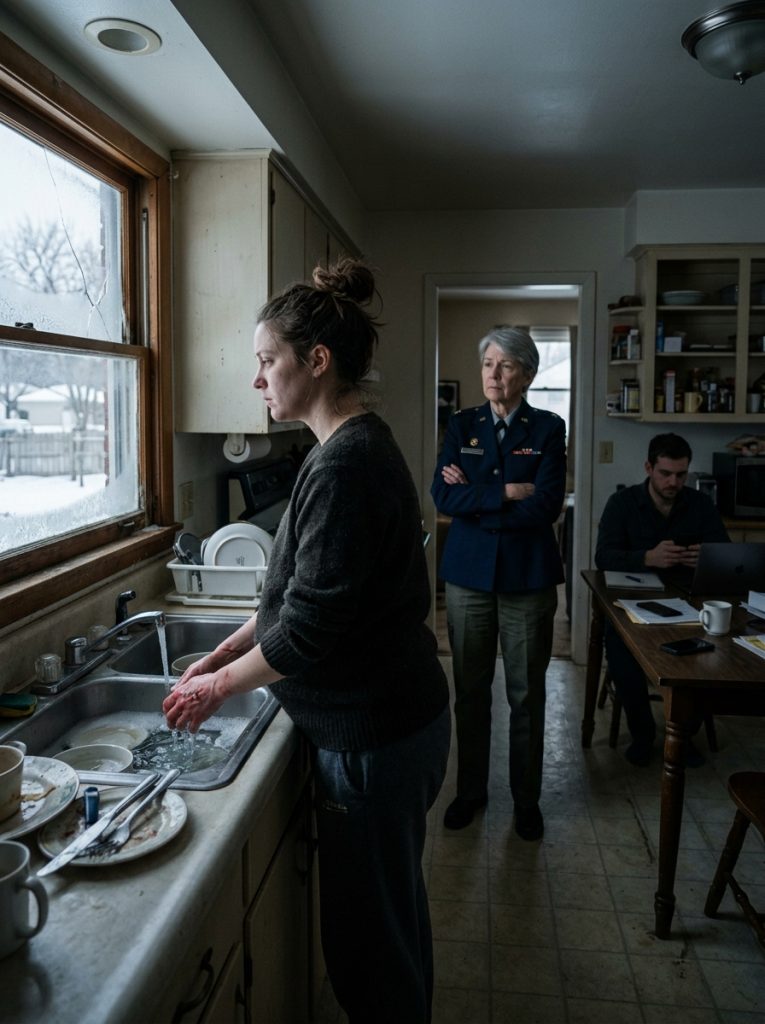
The dining room was suffocatingly warm. Julian and his mother sat at the table like royalty, plates piled high with food. Laughter, clinking glasses, the smell of roasted meat.
But the kitchen window above the sink was wide open to the freezing winter wind. Maya had been plunging her swollen, bare hands into a basin of icy water, scrubbing their cast-iron pans.
Before she could even dry her hands, Julian slammed his fist on the table so hard the plates jumped.
“Stop washing the damn dishes!” he barked, not even glancing at his pregnant wife. “Bring more food. Now.”
Maya flinched violently, curling her entire body inward to shield her belly from an expected blow.
That was the moment the mother in me died. The Colonel took command.
I didn’t scream. I didn’t argue with domestic terrorists. I simply set my purse down, pulled out my encrypted satellite phone, and pressed a highly secured speed-dial.
“Elias,” I whispered. “Code Four. Hostage situation. Heavily pregnant non-combatant. Immediate tactical extraction. My location.”
Julian smirked from the table, assuming I was calling the local police — the same department he liked to brag he could “buy off.”
Five minutes later, the front door burst open.
Four men in civilian clothes moved like shadows. No shouting. No guns drawn unnecessarily. Just silent, professional efficiency. Elias himself led them.
Julian jumped up so fast his chair fell backward. “What the hell is this?!”
Elias ignored him completely. He looked only at Maya. “Ma’am, we’re here to take you to safety. No one will touch you again.”
Maya started crying — not from fear this time, but from the kind of relief that breaks a person after months of hell.
Julian’s mother tried to protest. One of the operators simply raised a hand and she sat back down, pale.
I walked over to Julian, looked him dead in the eyes, and spoke quietly enough that only he could hear:
“You made my daughter wash dishes in freezing water while she carried your child. You treated her like a prisoner in her own home. Tonight, you’re going to learn what real fear feels like.”
They took Maya out first, wrapped in a warm blanket, straight into a waiting black SUV. Medical team was already on standby at a private facility I had arranged.
As for Julian and his mother…
Within the hour, their bank accounts were frozen. Julian’s employer received an anonymous but extremely detailed file about his behavior. By morning, his boss — a retired General I once served with — had personally fired him. Their house, which was still in my late husband’s trust, was being legally reclaimed.
Julian called me that night from a motel, screaming and crying.
I answered on speaker so Maya could hear.
“You don’t understand,” he sobbed. “I didn’t mean it. I was stressed from work—”
I cut him off.
“You had eight months to be a man. You chose to be a tyrant instead. Now you live with the consequences.”
I hung up.
Maya gave birth two weeks later to a healthy baby boy. She named him Elias.
She is now living with me. She is healing. She is smiling again.
And Julian?
Last I heard, he’s working night shifts at a warehouse, still trying to explain to people why his entire life collapsed in a single evening.
Never underestimate a mother who spent three decades in the darkness so her family could live in the light.
Some monsters don’t need fists or guns.
They just need one quiet phone call.
Dưới đây là phần tiếp nối mở rộng câu chuyện (~1500+ ký tự), giữ nguyên phong cách “military thriller + domestic rescue”:
That night didn’t end when the SUVs drove away.
It ended when the silence finally settled back into Maya’s lungs.
At the private medical facility, everything moved with controlled precision—no chaos, no questions, no waiting rooms filled with strangers. Just soft lighting, calm voices, and professionals who understood exactly what kind of trauma they were dealing with without needing it explained.
Maya stayed close to me the entire time, her fingers still clutching the edge of my sleeve like a lifeline. Every time a door opened too fast, she flinched. Every time footsteps echoed too sharply, her body tightened instinctively.
That wasn’t fear anymore.
That was conditioning.
And I recognized it instantly.
Thirty years in the military had taught me a painful truth: you don’t just extract someone from danger. You have to extract danger from inside them too.
A nurse approached quietly. “Colonel, her vitals are stable, but emotionally she’s still in high alert. She keeps asking if he knows where she is.”
“He won’t,” I said.
Not as a promise.
As a certainty.
Because by the time Julian realized what had happened, he was already out of the system that protected him.
Two days later, Elias came to see us.
He didn’t wear tactical gear this time—just a dark coat and the same calm expression he had worn during extraction operations overseas.
“Everything is locked down,” he said. “No contact. No tracing. He tried to hire a lawyer. That lawyer declined within ten minutes after receiving the documentation.”
Maya looked up at me. “You really destroyed his life…”
I turned to her slowly.
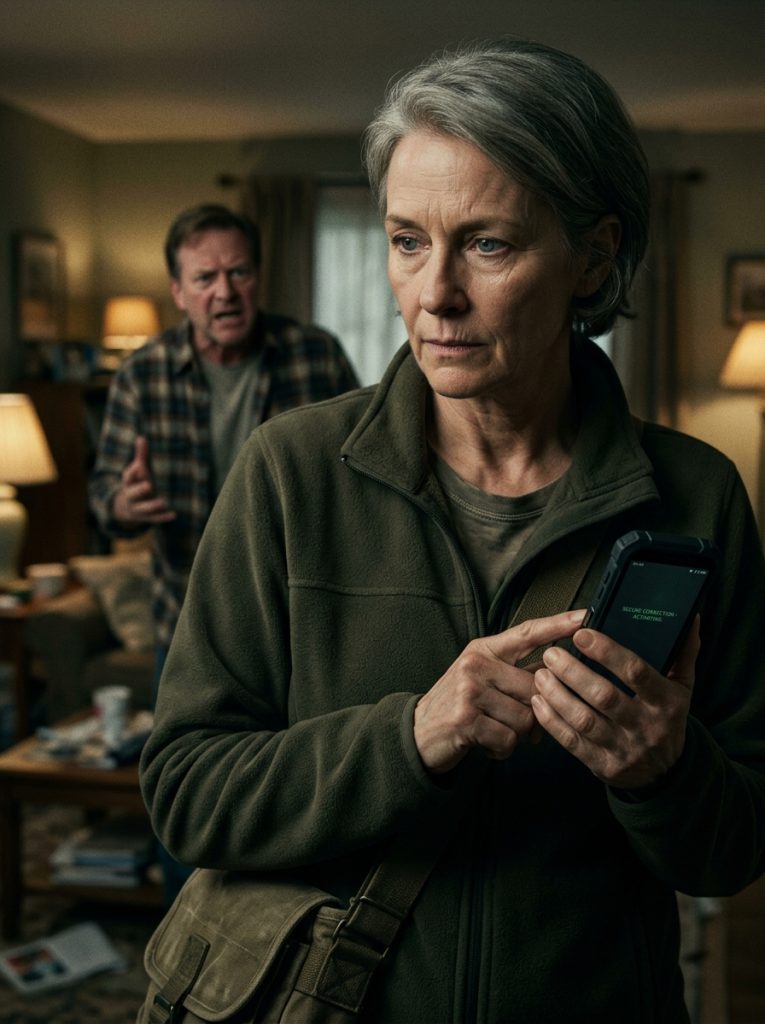
“No,” I said. “He did that himself the moment he decided your suffering was acceptable.”
She didn’t respond right away. Her hands rested over her stomach, where the baby had begun to move stronger now, more consistently, like he was finally in a world that made sense.
“I kept thinking I was overreacting,” she whispered. “I thought… maybe it wasn’t bad enough to leave.”
I sat beside her.
“That’s what captivity does,” I said quietly. “It doesn’t convince you you’re safe. It convinces you you’re stuck.”
Her eyes filled again—but this time, there was something different behind the tears.
Anger.
Clarity.
Awakening.
Three weeks later, the legal fallout finished collapsing like a house built on rotten foundations.
Julian’s financial accounts were audited. His company quietly severed all association with him after internal review. Beatrice tried to reach out once, sending a long message about “misunderstandings” and “family dignity.”
I forwarded it directly to my attorney.
There was no reply.
There was no negotiation.
There was only distance.
The first time Maya laughed again was a small thing.
It happened in my kitchen.
She was struggling to fold baby clothes I had bought in bulk, insisting she “wanted to learn normal things again.” She fumbled, cursed softly under her breath, then suddenly stopped and smiled like she didn’t recognize the sound she just made.
“I forgot what that felt like,” she said.
“What?”
“Not being afraid all the time.”
I didn’t answer immediately.
Because some truths don’t need commentary.
They just need to be witnessed.
Months later, when Elias came by for dinner, he looked at Maya holding her son and said something unexpected.
“You know,” he said, “most extractions I’ve been part of were from war zones.”
He paused.
“But that night in your kitchen… felt worse.”
Maya frowned slightly. “Worse than war?”
Elias nodded once.
“Because in war, everyone knows they’re in danger. In your house… only one person did. And she was the one being destroyed quietly.”
The room fell silent after that.
Not heavy.
Just honest.
Later that night, after everyone had left, Maya stood by the window holding her baby.
“Do you think he’ll ever understand what he did?” she asked.
I looked at her reflection in the glass.
“No,” I said. “And that’s not your burden to carry.”
She nodded slowly.
A long silence passed.
Then she said something I will never forget.
“I used to think strength was staying.”
She looked down at her son.
“Now I think strength is leaving in time to protect someone else.”
Outside, the world continued as if nothing had changed.
Cars drove. Lights flickered. Houses glowed warmly against the dark.
But inside that home, something fundamental had shifted forever.
Not revenge.
Not punishment.
Something quieter.
Something stronger.
A line had been drawn—and crossed—and then sealed shut behind them.
And for the first time in a long time, the only sound in Maya’s life was the steady, peaceful rhythm of a future that finally belonged to her.
