


Chapter 1 — Parade-Ground Perfect Gray dawn washed Fort Reynolds in steel and symmetry.
Formations gleamed.
Boots mirrored the sky.
Uniforms were knife-sharp, breaths held, eyes forward.
On mornings like this, discipline wasn’t a guideline—it was the air everyone breathed.
The gravel’s crisp crunch announced General Marcus before he came into view.
Every soldier knew that rhythm: inspection, precision, consequence.
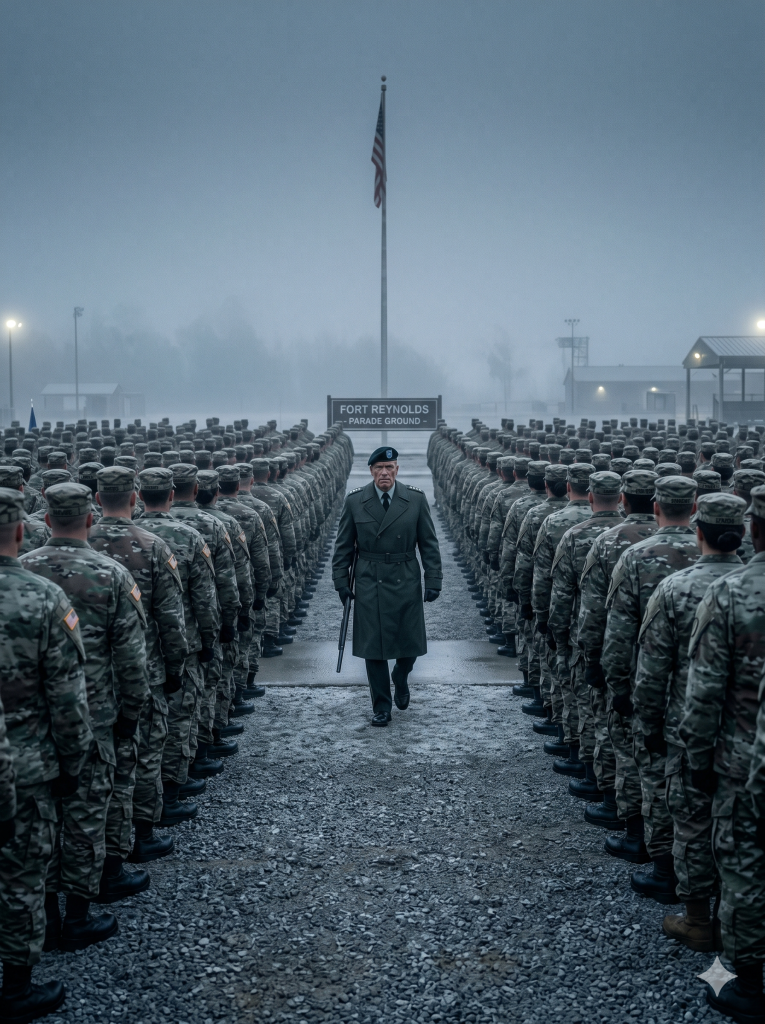
At the end of Third Platoon stood Private Alara Hayes—steady, composed, a reputation for flawless compliance.
Her dark hair lay braided beneath her cap.
One strand—no more than a line of shadow—had slipped free and caught the light.
To most, nothing.
To Marcus, noncompliance.
Chapter 2 — The Cut Heard by the Whole Base
“Step forward, Private Hayes!”
Alara moved without a tremor.
Chin level, gaze straight, voice silent.
“You keep standards, or standards keep you,” Marcus growled, circling.
“If a detail is beneath you, the mission will be too.”
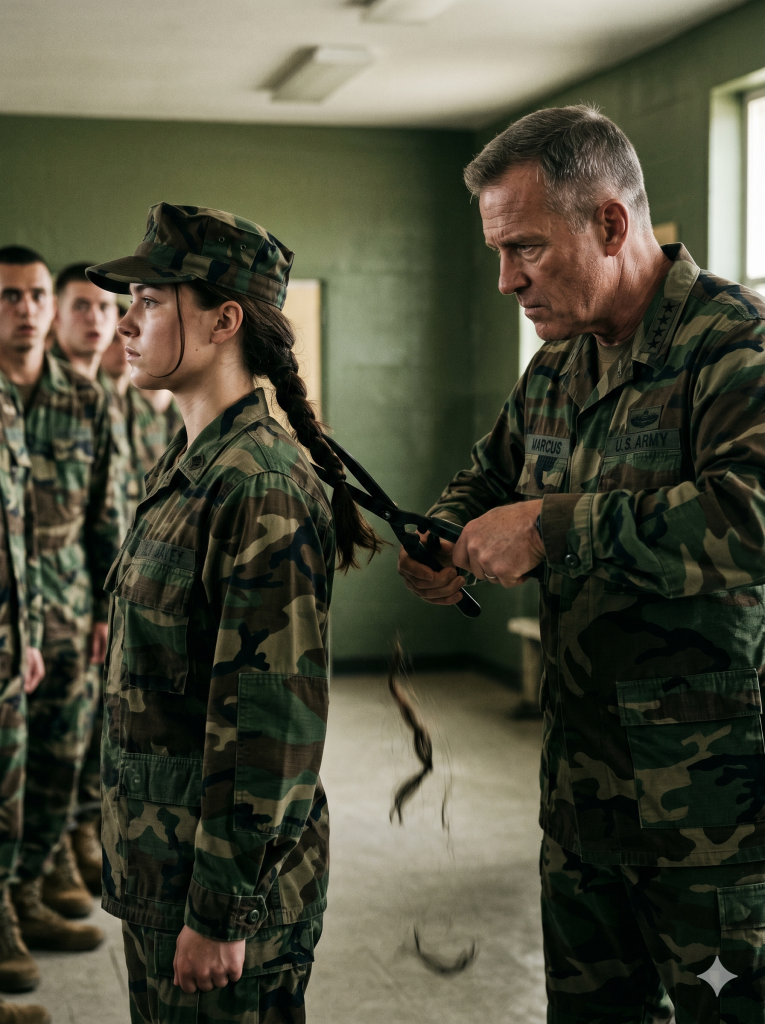
He lifted a pair of field shears from the kit—swift, practiced—and in a single motion snipped the braid.
Hair fell like a dark ribbon onto dust.
Gasps rippled—then vanished into the same rigid silence that swallowed every misstep on this ground.
Alara didn’t flinch.
“Understood, sir.”
Marcus dropped the braid.
“Next time, remember what respect looks like.”
He turned to move on—then froze.
Chapter 3 — The Badge That Shouldn’t Exist
Half-hidden within her collar, worn thin by time, was an emblem: a black hawk over a crimson sun.
It wasn’t regulation.
It wasn’t decorative.
It wasn’t supposed to exist in open view—ever.
Hawthorne Echo.
A classified rescue detachment formally dissolved after the Sector 9 catastrophe.
Officially, five members; four men and one woman.
All listed KIA.
Files sealed, citations delayed, names whispered only in corridors where memory still saluted.
By noon, the mess hall hummed.
“Did you see the general’s face?”
“Echo Team—no way.”
“Sector 9? I thought nobody made it out.”
And at the center of it all, the quiet private who never missed a step.
Chapter 4 — The Office, the Braid, and the Truth
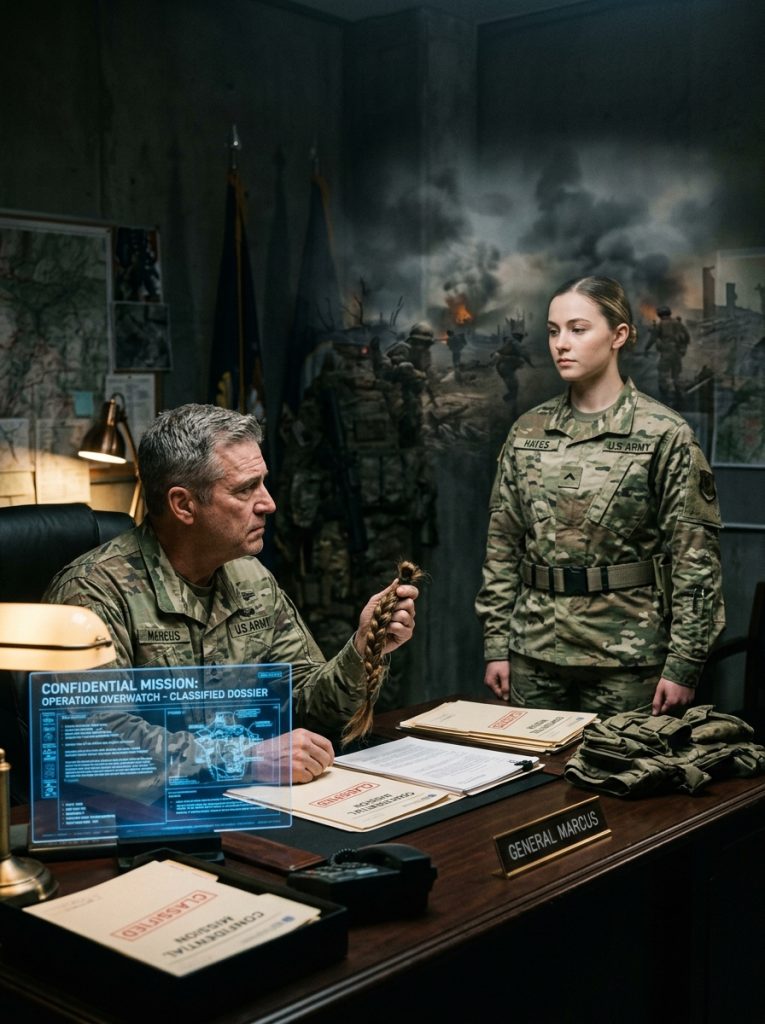
Marcus summoned her.
On the desk lay the severed braid—no longer a punishment, suddenly a question.
“Where did you get that insignia, Private?”
Alara’s eyes met his.
“Permission to speak freely.”
He nodded.
“I didn’t get it,” she said softly.
“I earned it. Before Sector 9.”
Memory struck like a flare: the night sky pulsing, a fractured perimeter, smoke swallowing coordinates.
Radio bursts: ECHO MOVING / STRUCTURE COMPROMI— then silence.
Bodies never recovered.
A final report stamped with the ink of uncertainty.
“You were there,” Marcus whispered.
“Yes, sir.”
A breath.
“Others didn’t come home.
The unit was buried.
The story was easier to carry in silence.”
Chapter 5 — The Weight of a Salute
Marcus stood very still.
The shears felt heavy in hindsight.
“I was wrong,” he said—no parade-ground thunder, only truth.
“You don’t need a lesson in respect.
You are the lesson.”
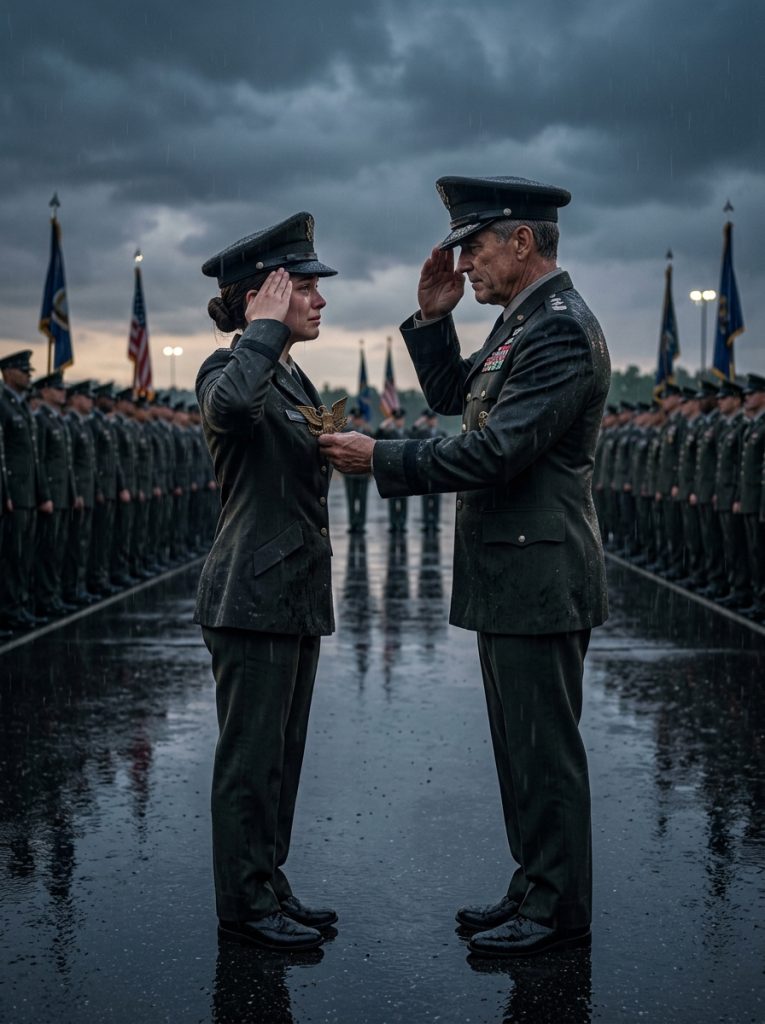
Rain rolled across the yard like an apology from the sky.
Marcus stepped outside with Alara at his side.
Windows filled; barracks doors opened.
In full view of Fort Reynolds, he pinned the faded hawk-and-sun back where it belonged.
Dưới đây là phần mở rộng tiếp nối câu chuyện, giữ đúng tông quân đội, căng thẳng và cảm xúc nội tâm:
Chapter 6 — The Silence After Recognition
The moment the insignia touched her collar again, something shifted across Fort Reynolds.
It wasn’t loud. It wasn’t dramatic.
It was worse than that—it was recalibration.
People who had spoken freely in the mess hall now found reasons to lower their voices. Conversations bent around Alara Hayes like metal around a magnet. Not fear exactly… but the uneasy awareness that they had been standing near a story far larger than they were ever briefed for.
Alara didn’t react.
She never did.
That was what made her dangerous in the eyes of some—and untouchable in the eyes of others.
Marcus remained beside her as the rain eased into a fine mist. The general’s posture had changed since the parade ground. Not weaker—just stripped of its unnecessary weight.
“Echo was declared erased for a reason,” he said quietly as they walked. “Politics. Panic. Paperwork. After Sector 9, command needed closure more than truth.”
Alara’s boots struck the pavement in steady rhythm. “Closure is a luxury for people who weren’t inside it.”
That stopped him for half a step.
She noticed—but didn’t look at him.
They passed the motor pool. Soldiers pretended not to watch.
Marcus exhaled slowly. “You were listed KIA.”
“I know.”
“And you didn’t correct it.”
“No one was asking survivors,” she replied. “They were asking for endings.”
The words landed clean. No bitterness. Just fact.
A fact heavier than any medal.
Chapter 7 — What Survives a Catastrophe
That night, Marcus requested the sealed file.
For the first time in six years, authorization codes still opened the ghost of Hawthorne Echo.
Five names.
Four marked dead.
One marked unconfirmed.
Alara Hayes.
Attached reports were fragmented—sensor failures, collapsed structure, hostile interference. But buried in the logs was a sequence Marcus had never fully understood until now:
ECHO-4 REQUEST EXTRACTION
ECHO-2 COMPROMISED
ECHO-1 CONTINUES MISSION
LAST SIGNAL: “WE’RE NOT LEAVING THEM HERE”
Marcus closed the file slowly.
In the reflection of the monitor, he saw himself not as a general—but as a man who had accepted silence too easily.
A knock interrupted him.
“Enter.”
Alara stepped in.
Not in uniform inspection posture. Not rigid. Just present.
“You shouldn’t be looking at that alone,” she said.
“I needed to understand,” Marcus replied.
She shook her head slightly. “No. You needed to remember that it was real.”
A pause.
Then Marcus asked the question he should have asked years ago.
“What happened in Sector 9… after contact was lost?”
Alara looked down for the first time since she had arrived at Fort Reynolds.
When she spoke, her voice was not distant. It was controlled—like someone holding a door shut behind them.
“We completed the mission objective. But extraction failed. The structure collapsed from secondary detonation. Two exits were sealed. One corridor remained unstable.”
She paused.
“We had civilians inside that corridor.”
Marcus listened without interruption.
“We carried as many as we could. But time ran out faster than physics allowed.”
Her hands flexed slightly at her sides—barely noticeable, but real.
“Echo protocol said prioritize extraction of team assets if civilians could not be reached in time.”
“And you didn’t follow it,” Marcus said softly.
“No,” she answered. “None of us did.”
Silence filled the office.
Not uncomfortable.
Just final.
Chapter 8 — The Cost of Decisions
Marcus leaned back, rubbing a hand across his face.
“Command called it a failure,” he said.
“It was,” Alara replied.
A beat passed.
“But not for the reasons they wrote.”
That sentence changed the temperature of the room.
Marcus looked at her more carefully now—not as a private, not as a file, but as someone who had carried weight long after the structure collapsed.
“You kept the insignia,” he said.
“Yes.”
“Even after being declared dead.”
“Yes.”
“Why?”
Alara hesitated for the first time.
Then: “Because someone has to remember what it cost when procedures stop being human.”
The words didn’t accuse him.
That made them sharper.
Marcus stood slowly and walked toward the window. Outside, Fort Reynolds continued its night cycle—lights shifting, patrols moving, a machine pretending nothing had changed.
But something had.
“Do you resent me?” he asked.
Alara didn’t answer immediately.
“I resented the version of command that signed the report,” she said finally. “Not the man who stood on a parade ground today and hesitated before ordering a haircut.”
That almost made him smile.
Almost.
Chapter 9 — The Return of Echo
Three days later, an emergency directive arrived from higher command.
Unmarked envelope. No digital trail.
Marcus opened it alone.
Hawthorne Echo — Reactivation Consideration.
He read it twice.
Then a third time.
The military didn’t resurrect dead programs unless something had already gone wrong again.
He looked at the window across the hall where Alara stood speaking with a junior officer. The soldier’s posture was stiff—uncertain whether to salute or simply listen.
Alara noticed Marcus watching.
She ended the conversation and walked over.
“They’re reconsidering Echo,” Marcus said.
“I know,” she replied.
“That means they need you.”
“They don’t need me,” Alara corrected quietly. “They need what Echo proved can be done when people stop waiting for permission to do the right thing.”
Marcus studied her.
For the first time, he saw not a remnant of a classified unit—but the reason it existed at all.
“If they reactivate it,” he said, “you’ll be pulled back into field command.”
Alara’s eyes didn’t waver.
“I never left it,” she said.
Chapter 10 — The Unwritten Rank
That evening, Marcus issued an unofficial order.
No ceremony. No press. No announcement.
Just a single act carried out under fading daylight.
In the center of the parade ground where he had once cut away a braid for discipline, he called the formation again.
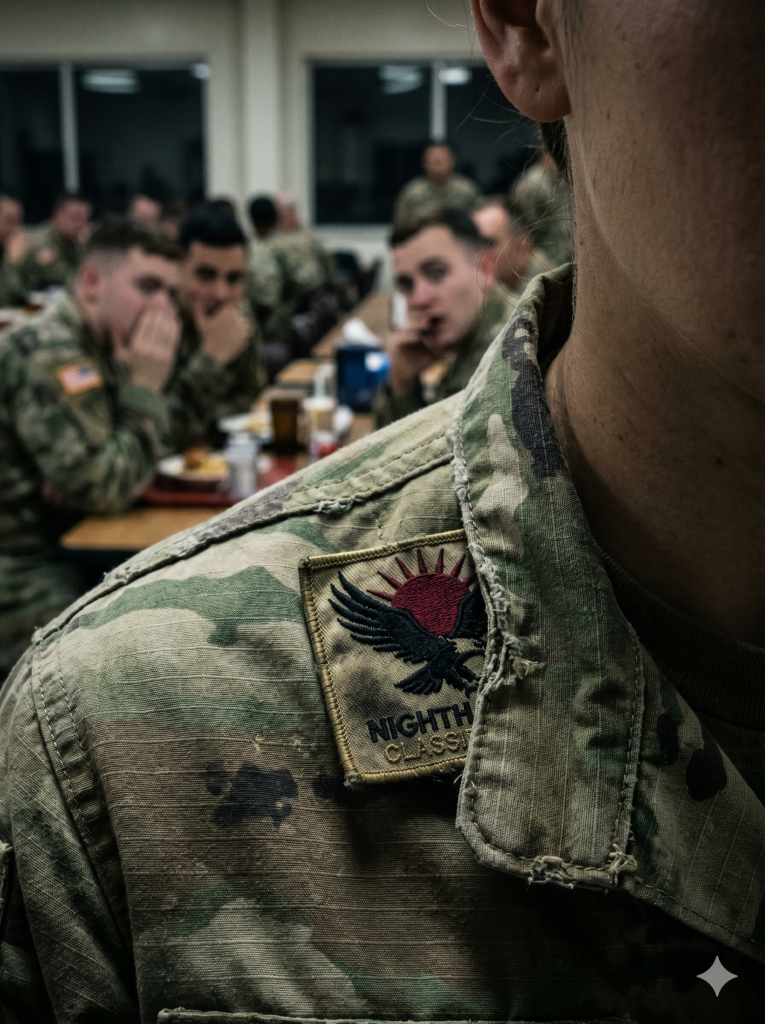
Soldiers assembled quickly—word travels fast even when silence is enforced.
Alara stood at the front, as always.
Marcus stepped forward.
He removed his general’s insignia for the first time in his career.
A silence spread so absolute it felt like pressure.
“I spent my career believing structure is what holds the military together,” he said.
He looked at Alara.
“But I was wrong about what structure is for.”
He held up the insignia of Hawthorne Echo—restored days earlier.
“This is not a decoration,” he said. “It is a reminder that survival is not always the same as obedience.”
He paused.
“And sometimes, the people we erase from our records are the only reason there is still a record to keep.”
No one moved.
Not even the wind seemed willing to interrupt.
Marcus stepped forward and placed the insignia back onto Alara’s uniform—not as correction this time, but recognition.
Then he stepped back and saluted.
Not as a general.
But as a soldier acknowledging something he could no longer outrank.
Alara returned the salute.
And for the first time since Sector 9, it did not feel like silence carrying loss.
It felt like silence carrying weight that finally had somewhere to go.
