


The leather briefcase slipped from Daniel Whitaker’s hand and struck the marble floor with a sharp crack.
It was the kind of sound meant to command respect—expensive, deliberate—but in that instant, it meant nothing. Daniel stood frozen, staring through the towering windows at the manicured garden beyond: flawless grass, blooming roses, a silent fountain carved from stone.
And yet, what was happening outside did not belong in his world.
Gabriel Whitaker—his son, his only heir, the child Europe’s finest specialists had condemned to a lifetime in a wheelchair—was standing.
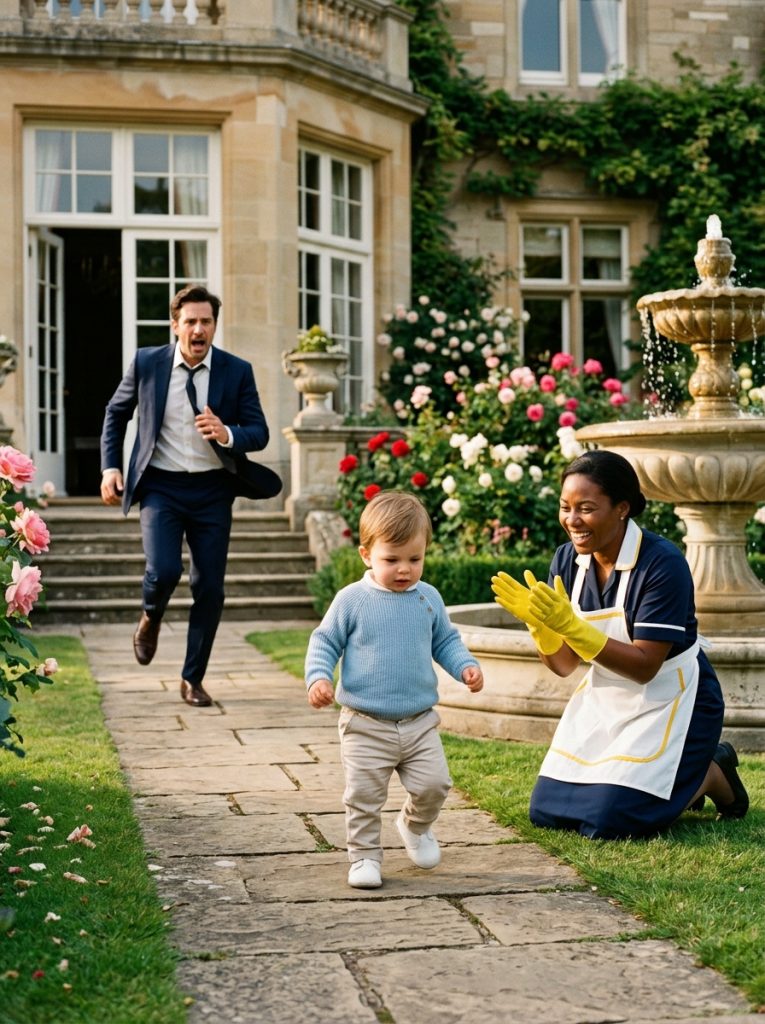
No braces. No harnesses. No doctors hovering nearby. Just his small body planted on the grass, orthopedic shoes sinking slightly as his legs trembled under the weight of gravity. He swayed, fighting to stay upright with a determination Daniel couldn’t comprehend—because for years, Daniel had believed something else entirely: that his son was fragile, breakable, destined to remain still.
A few feet away, kneeling in a spotless blue uniform and bright yellow rubber gloves that looked absurd in such luxury, was Marisol Bennett—the new maid, barely three weeks into the job. She wasn’t watching Gabriel with fear or pity. She was watching him the way you watch a victor nearing the finish line.
She clapped her gloved hands softly, rhythmically, as if each sound were pulling him forward.
“Come on, my champion,” she encouraged gently. “You’re strong. Come to me.”
Daniel’s breath caught. Panic crawled up his spine. The doctors had warned him—Gabriel’s spine was delicate. One wrong fall could destroy everything. This woman was risking the only thing that mattered to him.
“No!” Daniel shouted.
He ran for the sliding door and yanked it open. The glass rattled violently. Marisol looked up—but didn’t move. Gabriel laughed. A bright, fearless laugh Daniel hadn’t heard in years.
The boy lifted one foot. Then the other.
One step. Two. Three.
Daniel froze mid-stride. Sweat glistened on Gabriel’s forehead. His legs shook with effort. And there it was—hope, dangerous and undeniable.
Then Gabriel tilted forward.
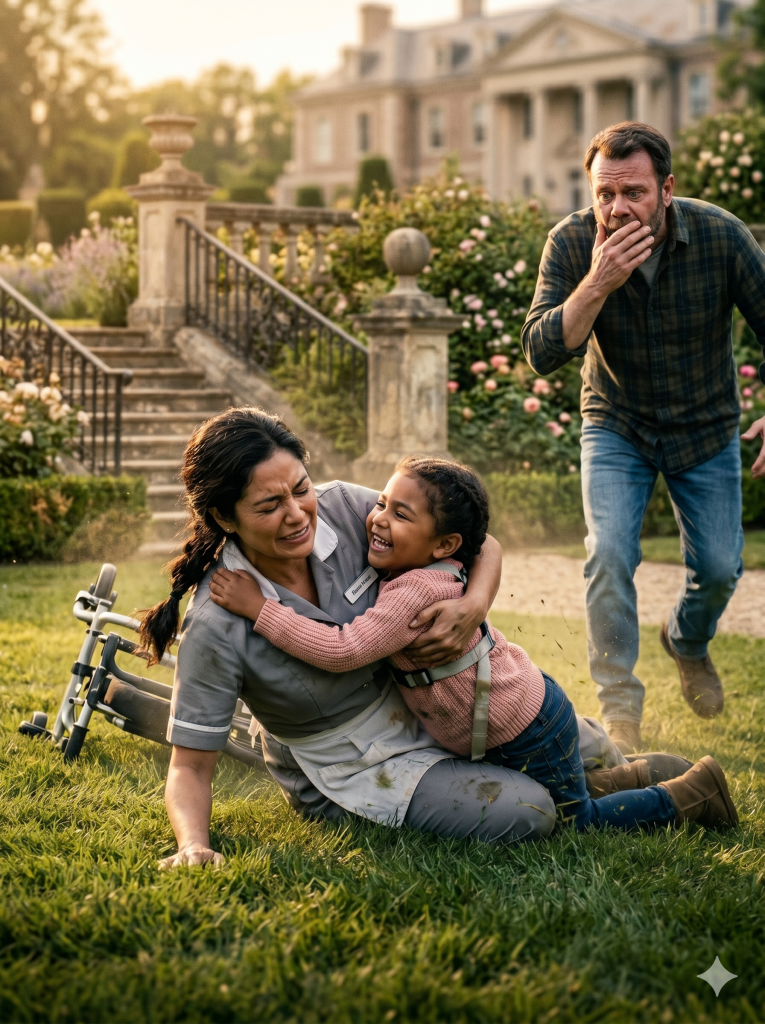
“I’ve got you!” Marisol lunged, catching him instantly, rolling onto the grass to cushion the fall with her own body. Gabriel didn’t cry. He laughed, wrapping his arms around her neck.
Daniel reached them, breathless, yanking his son into his arms, searching for injuries.
“What were you thinking?” he roared. “You could’ve killed him! He’s disabled!”
Marisol stood slowly, smoothing her apron. She didn’t look away.
“No, Mr. Whitaker,” she said calmly. “He’s not disabled. He’s a child who needed to believe he could. And he just walked.”
Daniel clutched Gabriel tighter, fury blazing.
“You’re fired. Leave before I call the police.”
Marisol stepped back—hurt.
Then a small hand tugged Daniel’s jacket.
“Da… da…”
Daniel froze.
Gabriel pointed at Marisol.
“Daddy… look…”
Daniel set him down carefully. Gabriel planted his feet, held his father’s pant leg, and whispered the word that shattered everything:
“I walked.”
That moment should’ve been sacred. But the Whitaker mansion wasn’t a sacred place—it was a house of silence and unhealed wounds. And miracles never arrive alone.
High heels clicked sharply against stone.
“Daniel, what is going on here?” Ivana’s voice cut through the air.
She pointed accusingly at Marisol.
“That woman pushed him. Call security immediately!”
As she turned and walked away, Gabriel stretched his arm toward her. He didn’t cry.
Gabriel’s small hand remained stretched toward his mother long after Ivana disappeared through the glass doors.
The garden fell silent again except for the distant splash of the fountain and Daniel’s uneven breathing.
Marisol lowered her eyes. “I should go, Mr. Whitaker.”
Daniel didn’t answer immediately. His pulse hammered violently in his ears while Gabriel clung to his leg, still standing. Still standing.
For years, every specialist had spoken in careful tones and polished medical language.
Limited mobility.
Permanent nerve damage.
Minimal chance of independent standing.
Daniel had spent millions trying to save his son. Private clinics in Switzerland. Experimental therapies in Germany. Surgeons in London. Every report ended the same way—with sympathy disguised as professionalism.
And yet this woman, armed with nothing but yellow gloves and impossible faith, had achieved something none of them could.
Gabriel tugged softly at his father’s trousers.
“Daddy… I did good?”
Daniel looked down at him.
The boy’s cheeks were flushed bright pink with effort and excitement. Sweat dampened the curls against his forehead. His legs trembled so badly it looked painful, but his eyes… his eyes were alive.
Not frightened.
Not defeated.
Alive.
Daniel swallowed hard.
“Yes,” he whispered roughly. “You did very good.”
Gabriel smiled so widely that Daniel felt something crack open deep inside his chest.
It hurt.
Because he realized he hadn’t seen that smile in years.
Not really.
The boy suddenly swayed again, exhausted from the effort. Daniel immediately scooped him into his arms.
Gabriel rested his head against his father’s shoulder but kept looking toward Marisol.
“She helped me,” he murmured.
Daniel’s jaw tightened.
For a long moment, nobody spoke.
Then, from somewhere inside the mansion, Ivana’s voice echoed sharply.
“Security!”
Daniel closed his eyes briefly.
The spell was broken.
Two guards hurried toward the garden entrance, confused and out of breath. Their eyes moved between Daniel, the trembling child in his arms, and Marisol standing quietly on the grass.
“Sir?” one of them asked cautiously.
Daniel looked at Marisol.
She stood perfectly still despite the humiliation burning in her eyes. Her hands were clasped in front of her apron now, the bright yellow gloves stained green from the grass. She looked less like a threat and more like someone preparing herself to lose everything.
And suddenly Daniel noticed something strange.
She wasn’t afraid for herself.
She was afraid for Gabriel.
Afraid that the boy would stop believing again.
“Return inside,” Daniel told the guards coldly.
Both men hesitated.
“But Mrs. Whitaker said—”
“I gave you an order.”
The guards immediately nodded and retreated.
Marisol looked stunned.
Daniel shifted Gabriel higher in his arms. “Take him upstairs,” he said quietly to her.
Her brows furrowed. “What?”
“You heard me.”
Before she could answer, Gabriel wrapped both arms around Daniel’s neck and whispered weakly, “Tired.”
Daniel looked at his son’s exhausted face and finally understood the truth he had refused to see for years.
Gabriel had not been living.
He had been surviving.
Inside the mansion, everything was controlled. Every hallway padded. Every corner protected. Nurses hovered constantly. Tutors spoke to him with pity hidden behind smiles. Even Daniel himself had become a prison disguised as a father.
No running.
No climbing.
No risks.
No falling.
Especially no hope.
Because hope was dangerous.
Hope could destroy people.
Daniel knew that better than anyone.
As Marisol carefully walked beside him toward the staircase, memories he spent years burying began clawing back into his mind.
The accident.
Rain hammering against glass.
Twisted metal.
Gabriel screaming in the back seat.
And Elena.
God.
Elena.
Daniel hadn’t spoken his late wife’s name aloud in almost three years.
She had died instantly that night while doctors fought for twelve hours to save Gabriel’s spine. Daniel still remembered sitting in the hospital chapel at dawn, blood on his cuffs, listening to a surgeon explain that his son might never walk again.
Something inside him had died too.
After that, protecting Gabriel became an obsession so consuming that nothing else mattered.
Not joy.
Not childhood.
Not even Gabriel himself.
When they reached the second floor, Marisol carefully opened Gabriel’s bedroom door.
The room looked more like a rehabilitation center than a child’s space. Medical equipment lined the walls beside shelves of untouched toys. There were no muddy shoes. No scattered games. No signs of chaos or life.
Marisol noticed it too.
Her expression softened with quiet sadness.
Daniel gently lowered Gabriel onto the bed. The child was already half asleep from exhaustion, but his fingers reached instinctively toward Marisol again.
“Stay,” he mumbled.
Marisol looked uncertainly at Daniel.
He should’ve told her no.
Instead, he heard himself say, “Five minutes.”
Gabriel smiled sleepily.
Marisol sat beside the bed and removed her ridiculous yellow gloves. Then she began rubbing Gabriel’s legs gently, carefully easing the strain from his muscles.
“What are you doing?” Daniel asked.
“Helping with the soreness,” she answered softly. “His muscles worked harder today than they probably ever have.”
Daniel watched silently.
Her movements were confident. Familiar.
Not random.
“You’ve done this before,” he said.
Marisol hesitated.
“My younger brother,” she admitted quietly. “He had cerebral palsy.”
Daniel frowned slightly.
“Had?”
“He passed away when he was sixteen.”
The room grew still.
Marisol kept her eyes on Gabriel while she spoke.
“The doctors told my mother he would never sit up alone. Never feed himself. Never speak clearly.” A faint smile touched her lips. “But Mateo hated being told what he couldn’t do.”
Daniel found himself listening despite every instinct telling him not to.
“He fell hundreds of times,” she continued. “Sometimes he cried. Sometimes he got angry enough to throw things at me.” She laughed softly at the memory. “But every small victory mattered to him. Every inch.”
Daniel looked down at his sleeping son.
Gabriel’s fingers were still curled loosely around Marisol’s sleeve.
“When he stood for the first time,” she whispered, “my mother cried for an hour.”
Daniel’s throat tightened unexpectedly.
“Why are you telling me this?”
Marisol finally looked at him directly.
“Because your son has the same look my brother had.” Her voice trembled slightly now. “Children know when the world has already given up on them, Mr. Whitaker.”
The words struck harder than Daniel expected.
He turned away sharply.
“That’s enough.”
Marisol nodded immediately and stood.
“I’m sorry.”
But Daniel couldn’t stop hearing the sentence repeating in his head.
Children know when the world has already given up on them.
After Marisol quietly left the room, Daniel remained beside Gabriel’s bed long into the evening.
The mansion was silent again.
Cold again.
From downstairs came the distant sound of crystal glasses and Ivana’s voice speaking angrily on the phone, undoubtedly complaining about the “reckless maid.”
Daniel barely listened.
Instead, he stared at his son sleeping peacefully beneath the dim bedside lamp.
Then his eyes drifted lower.
To Gabriel’s shoes.
Grass stains clung to the soles.
Daniel suddenly remembered something Elena once told him shortly after Gabriel was born.
“You know what scares me most?” she had said while rocking the baby in her arms.
Daniel had smiled. “What?”
“That one day we’ll love him so much we’ll accidentally teach him to be afraid of living.”
At the time, Daniel laughed.
Now the memory felt like a knife twisting slowly into his chest.
Near midnight, Gabriel stirred awake.
“Daddy?”
Daniel leaned forward instantly. “I’m here.”
The boy blinked sleepily. “Did I really walk?”
Daniel stared at him for several seconds before answering.
“Yes,” he whispered. “You really did.”
Gabriel smiled into the pillow.
“I dreamed about it before.”
Daniel brushed damp curls away from his son’s forehead.
“Why didn’t you tell me?”
Gabriel’s smile faded slightly.
“Because everybody gets sad after.”
Daniel froze.
“What do you mean?”
The child shrugged weakly.
“When I say I wanna walk… people look sad. So I stopped saying it.”
Each word landed like another blow.
Daniel thought about the nurses gently changing the subject whenever Gabriel mentioned running. The therapists carefully lowering expectations. The specialists speaking about acceptance instead of possibility.
And himself.
Especially himself.
How many times had he silenced hope because he couldn’t bear disappointment?
Gabriel yawned softly.
“Marisol says falling isn’t bad.”
Daniel gave a humorless laugh under his breath.
“She clearly hasn’t met enough lawyers.”
Gabriel giggled tiredly.
Then, very quietly, he asked, “Daddy… are you mad?”
The question shattered something inside Daniel completely.
His son had just done the impossible.
And still, he was afraid.
Daniel bent forward and pressed his forehead gently against Gabriel’s.
“No,” he whispered hoarsely. “No, buddy. I’m not mad.”
Gabriel relaxed instantly.
Within minutes, he drifted back to sleep.
But Daniel remained there in the darkness, unable to move.
For the first time in years, the walls of the Whitaker mansion no longer felt strong.
They felt suffocating.
And somewhere downstairs, in a tiny servant’s room probably smaller than one of the mansion’s closets, sat the woman who had unknowingly forced Daniel Whitaker to confront a terrifying possibility:
Maybe his son had never been as broken as everyone believed.
Maybe the truly broken person in this house… was him.
