

**A Promise Kept in the Quiet Hallway**
“Don’t say that to her—tell me the truth right now.”
“Is my dad coming or not?”

The words hung in the air of the bustling military terminal like fragile glass. For a long moment, no one moved toward the small circle formed by Grace, her daughter Lily, and the kneeling soldier. Grief has a way of creating invisible barriers; even strangers sensed it and kept their distance.
The soldier, still on one knee, kept his hand hovering where he had just released the child’s drawing. His fingers curled slowly, as if clutching something invisible he wasn’t ready to let go. Grace tightened her arms around Lily. The little girl buried her face in her mother’s coat, but one small hand never released the folded drawing and photograph. Her fingers crushed the edges.
The soldier noticed. Something shifted in his weathered face—not panic, but a deep, pained recognition.
“Please,” he said softly. “Don’t fold it too hard.”
Grace looked up through her tears. “What?”
The soldier swallowed. “Her dad… he told me to make sure she kept it flat.”
Grace’s face tightened. “Why?”
He didn’t answer right away. Behind him, the terminal pulsed with life: families laughing through tears, names shouted in joy, children lifted high into the air. The world refused to pause. But in their small circle, time had stopped.
The soldier lowered his voice. “Because there’s something inside.”
Grace stared. Lily slowly lifted her head, cheeks wet, breathing in small, broken gasps. “What’s inside?” she whispered.
The soldier’s hardness finally cracked. “Something your daddy made me promise not to open.”
With trembling hands, Grace took the drawing from Lily and unfolded it carefully on her lap. At first glance, it was a typical child’s masterpiece: three stick figures beneath a yellow sun, a house with a red roof. *Mommy. Daddy. Me.* But tucked beneath the taped edge of the photograph was a thin strip of paper, folded with military precision.
Grace knew that fold. Ethan had always hidden notes that way for birthday surprises—tiny perfect squares slipped behind frames or into lunchboxes. Her hand flew to her mouth.
The soldier’s eyes filled. “He said you would know where to look.”
Grace peeled the strip free and unfolded it. Five words: *Grace, ask Torres about Dawn.*
She looked up sharply. “Torres?”
The soldier nodded, guilt etching his features. “That’s me. Daniel Torres.”
Grace’s voice sharpened. “You told my daughter her father couldn’t come back. But you didn’t say he was dead.”
Torres closed his eyes. The silence that followed felt heavier than any battlefield.
Lily pulled back. “Mommy?”
Grace didn’t look away. “Is Ethan dead?”
Torres met their eyes. “No,” he whispered.
The word landed like a shockwave. Hope, in that moment, felt violent rather than beautiful. Grace nearly pushed Lily behind her. “Then why would you say that to her? Why let her think—”
“I didn’t say he was dead,” Torres said, voice breaking. “I said he couldn’t come back. I know what that means to a child. And I hate myself for it.”
Lily stared at him, tears paused. “My daddy is alive?”
“Yes,” Torres replied. “But he couldn’t walk through those doors today.”
Grace’s grip tightened on the note. “Where is he?”
Torres pointed toward a quiet hallway far from the celebrations—a dim corridor with no balloons, no signs, only two solemn officers at the entrance. “He’s here.”
The pieces clicked for Grace. The oddly empty hallway. Soldiers glancing away. Torres stepping out alone with Ethan’s bag—the one with Lily’s blue ribbon still tied to the zipper.
Lily’s face collapsed into confusion and fragile hope. “Why didn’t Daddy come?”
“Because he was afraid you’d be scared of him.”
Torres recounted the story with a shaking breath. During an evacuation that never made clean headlines, Ethan had gone back for three trapped civilians—two children and their grandmother—after the order to withdraw. The blast caught him. He survived, but at great cost: part of a leg lost, burns along one side, damage to his voice.
Grace closed her eyes. Of course Ethan went back. He was the man who stopped traffic for injured dogs, gave his coat to strangers in snowstorms, and made rabbit-shaped pancakes for his daughter.
“You were supposed to be told officially,” Torres explained. “But there was a delay. Ethan found out the homecoming ceremony was still happening. He begged us not to let Lily see him first in a hospital bed. He wanted her to remember the father who lifted her onto his shoulders.”
Lily’s small voice cut through. “He promised.”
Torres reached into the bag and pulled out a wrinkled envelope. “He asked me to give this only if she ran to me. He knew she might mistake me for him from afar. He wanted her to choose.”
Inside was Ethan’s handwriting, weaker now, lines slanting with effort:
*My brave Lily,*
*If you are hearing this, it means I got scared. Not of the bad guys. I got scared of your face when you saw me. Daddy does not look like the same superhero right now. But I did come back. If you still want me, ask Sergeant Torres to take you to Dawn.*
“Dawn?” Lily asked.
Torres explained softly, “It’s what he named the medical transport room. Because if he survived until morning, everything after was borrowed sunrise.”
The hallway beckoned. Lily hesitated, fixing her white bow—Daddy’s favorite—and clutching her stuffed rabbit. She asked the hardest questions only a child could voice: “Is he scary?” “What if I cry?” “What if he doesn’t know me?”
Torres answered with earned tenderness. “He’s scared too.”
That shifted something in Lily. Children understand fear when they see it in adults. With her mother’s help straightening her bow and brushing off her bunny, she decided. “I want to show him I kept it flat.”
Torres led them down the cold hallway. Fluorescent lights hummed. Lily’s shoes made tiny echoes. At the door, she clutched her drawing. Torres opened it.
The room was dim, antiseptic-scented. Machines beeped softly. And there sat Ethan—smaller, changed, burns healing along one side of his face, left leg ending beneath the blanket. But his eyes were the same.
He tried to smile. It trembled, then returned, honest and afraid. “Hi, Bug,” he rasped.
Lily stood frozen, taking him in—the marks, the blanket, the careful hand. Ethan didn’t hide. He let her look.
She stepped forward. “I kept it flat.”
Ethan’s face crumpled as he took the drawing. A tear slid down his unburned cheek. “Good job.”
“You didn’t come through the doors,” Lily said. “You promised.”
“I know. I wanted to.”
Lily climbed carefully onto the bed, learning the new geography of pain. She tucked her rabbit against his chest. “You can borrow him. For when you’re scared.”
Ethan broke then, silently, holding her with infinite care. Grace pressed her forehead to his shoulder. The family folded together—not as they once were, but as they were now.
Torres lingered by the door. Ethan looked up. “Danny. Stay.”
Torres shook his head. “This is family.”
“You are why I still have one.”
Torres stepped closer. Grace’s lingering anger softened. The man who had delivered the painful words had also been saved by her husband. He had carried out Ethan’s wishes out of debt and brotherhood.
In the quiet room, as morning light strengthened through the high window, they began the long work of knowing each other again. Lily traced the burns gently with one finger. Ethan whispered stories of the rabbit pancakes he would make again, even if he needed help standing. Grace held both their hands, bridging the old memory and the new reality.
Ethan had not broken his promise. He had come home—just not the way anyone expected. The real promise had never been about walking through doors standing tall. It was about returning to them, however broken, and trusting their love to make him whole again.
Lily fell asleep against his side, drawing still clutched in her hand. Torres sat quietly in the corner, part of the circle now. Grace whispered to her husband, “We’re here. All of us.”
Outside, the terminal celebrations continued. Inside Dawn, a different kind of homecoming unfolded—one measured not in cheers but in careful touches, shared tears, and the slow rebuilding of a family under borrowed sunrise.
The road ahead would be long: physical therapy, nightmares, learning to navigate a changed body and voice. There would be days Lily missed the old Daddy, and nights Ethan doubted himself. But in that room, the foundation was laid. A child’s drawing, a hidden note, a father’s fear met with a daughter’s courage.
Dawn had broken. And with it came the beginning of something new—stronger, perhaps, for having been tested in fire.
**A Promise Kept in Dawn**
It would not vanish in one morning. But now it had somewhere softer to rest.
“Thank you,” Grace said.
Torres closed his eyes. “I’m sorry.”
Grace nodded. “I know.”
That was not forgiveness yet. But it was a door opening.
Ethan looked at Lily. “I heard you,” he whispered.
Lily lifted her head. “At the doors?”
He nodded. “When you said welcome home.”
Her chin trembled. “I said it to the wrong soldier.”
Ethan looked at Torres, then back at Lily. “No,” he whispered. “You said it to the man who helped me make it home.”
Lily thought about that. Then she looked at Torres. “Welcome home,” she said softly.
Torres covered his face with one hand. The room filled with quiet crying—not the sharp grief from the terminal, but something bruised yet alive.
Outside the small window, pale daylight spread slowly over the runway. Planes rested in the distance. Families kept reuniting beyond the hallway. The world still carried its noise, its joy, its unfairness. But in that room, morning finally reached them.
Lily rested her cheek against her father’s chest. Ethan’s hand trembled as he smoothed her white bow. Grace held the folded drawing flat between them. For a long time, no one tried to speak. They only listened to the fragile rhythm of Ethan’s breathing—the sound that proved he was still there. Not the same. Not untouched. But home.
—
**He Told Her to Know Her Place**
By sunrise, the Dalton Protocol had erased his name from command.
“Know your place,” Voss snapped.
Maya did not move, and that was the first mistake he noticed too late.
**Part 1**
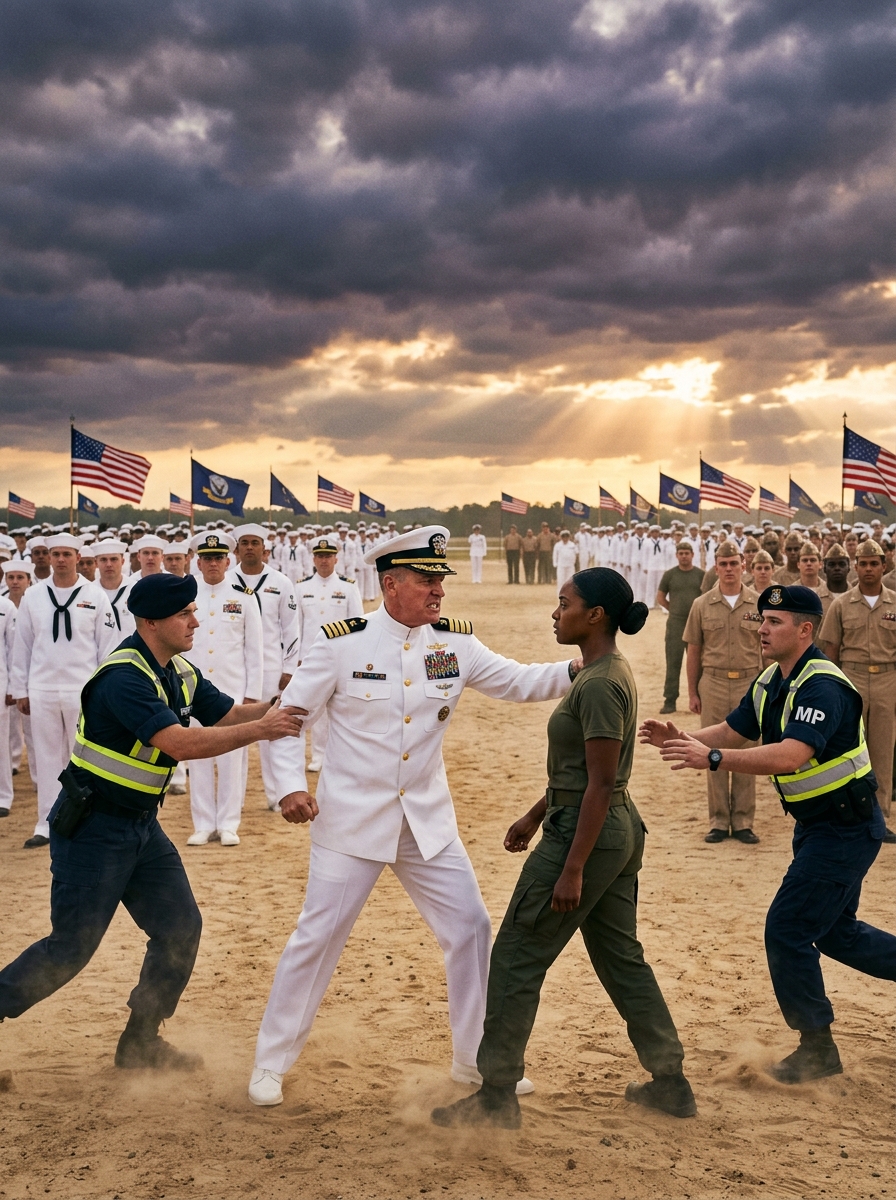
The first thing Maya Dalton noticed was not the heat rising from the parade field, nor the thousand uniforms locked beneath the bruised Georgia sky. It was fear—small, practiced, carefully concealed—drifting through the ranks like a silent current. It lingered in a young sailor’s tight jaw, flickered when an older chief petty officer lowered his eyes too soon, and trembled in the silence after every barked command.
Harbor Ridge Naval Station had dressed for ceremony that morning. Flags snapped in the wind. Polished brass caught pale light. Rows of sailors stood in perfect formation along the sandy training ground. This was meant to be a leadership demonstration, a public display of discipline. Cameras were absent, but senior officers watched with measured interest.
Rear Admiral Conrad Voss wanted obedience, not interest. He paced the edge of the training mat, clipboard in hand, contempt in the other. His white uniform gleamed. Medals lined his chest like proof that history had already forgiven him. At fifty-eight, his shoulders remained broad. His face was rigid, mouth thin, blue eyes cold enough to erase confidence.
“Again,” he snapped at a nervous ensign attempting a wrist-release technique. “If that had been real, you’d already be bleeding.”
He humiliated three sailors before ten. He mocked a lieutenant’s accent. He shoved a recruit hard enough to stagger him, then called it instruction. Each time, the formation tightened. No one spoke.
Maya stood at the edge of the mat in plain dark training gear, hair in a tight bun, posture quiet and balanced. On the roster, she was listed as a civilian safety observer. She looked young enough to underestimate. Both worked in her favor.
Her eyes never stopped moving. Voss had a long record: anonymous complaints, retaliation, careers quietly destroyed. One whistleblower reassigned, another dismissed. The Dalton Protocol existed for men like him—those protected by silence.
When her turn came, Maya stepped onto the mat.
Voss glanced at her as if she were misplaced furniture. “Civilian observer. Let’s see if consultants can do more than write reports.”
A few officers laughed politely. Maya did not.
Captain Ellis Grant stood beside her, almost apologetic. “Basic defensive stance,” he said quietly. “Nothing complex.”
Maya set her stance, then shifted her left heel half an inch. Barely visible. Enough.
Voss’s head snapped toward her. “There. Wrong.”
“Would you like me to adjust, Admiral?”
He strode over, boots grinding sand. “That’s sloppy.”
“Then correct it.”
Too calm.
“You people come onto my base with clipboards and theories,” Voss said, voice rising. “Know your place.”
His hand shot forward. He grabbed her shoulder and shoved her back.
Gasps broke the formation before silence crushed them again. Maya stumbled one step, absorbed the force, then stilled. Perfect balance. No fear.
Voss twisted his mouth. “There.”
Maya glanced at his hand on her shoulder. “You just made a mistake.”
Voss laughed. “Do you know who I am?”
“Yes.” Maya’s voice dropped, cold and precise. “Dalton Protocol is now active.”
Six officers stepped forward in perfect synchronization. Two military police moved in. A legal officer pulled a sealed folder free.
“Rear Admiral Conrad Voss, you are relieved of command pending formal review.”
Voss stared. “You don’t have authority.”
“They do now,” Maya said. She pulled free a thin black credential. “Special Investigator Maya Dalton. Office of Command Integrity.”
Voss’s face drained, then rage surged. “You planned this. You baited me.”
“I gave you a chance to lead,” Maya replied. “You chose to put your hands on someone before a thousand witnesses.”
Military police seized his arms. His polished shoes dragged through sand. Medals clattered. He looked smaller. Human.
Lieutenant Commander Hale, the legal officer, began reading charges: abuse of power, retaliation, coercive intimidation.
Voss turned to her softly. “Lieutenant Commander Hale. Think very carefully.”
Hale froze. Voss still knew pressure points.
Captain Grant stepped forward. “Keep reading, Commander.”
Hale continued. Command channels suspended. Effective immediately.
A black SUV arrived quietly. Deputy Undersecretary Elaine Mercer stepped out, gray suit, silver hair. The moment she appeared, senior officers shifted uneasily.
Mercer stopped beside Maya. “Did he injure you?”
“No.”
Voss scoffed. Mercer turned to him. “No, Conrad. The theater is over.”
The use of his first name changed everything. “You should have stayed in Washington.”
“I tried,” Mercer said. “For nine years.”
Maya looked at her. Nine years. The number matched buried reports.
Grant stepped closer. “I requested your assignment.”
Maya’s pulse ticked. “Why?”
“Because your father built the first version of the Dalton Protocol.”
The field disappeared for Maya. Colonel Aaron Dalton—her father—had investigated Voss nine years ago. He had refused to close the file. He had not died in an accident.
Voss snarled it was a lie, but too quickly.
Maya turned to him, stillness dangerous. “You told me to know my place. My place was in the file you buried.”
Mercer flinched. Grant lowered his eyes. Hale held the folder tighter.
Voss lunged against the MPs. “This is illegal. Every person involved will regret it.”
Maya watched the formation. The young sailor now stared directly at Voss. The chief petty officer no longer looked down. The rhythm of fear had broken.
Mercer spoke quietly. “The theater is over, Conrad.”
As the sun rose higher over Harbor Ridge, Maya felt the weight of her father’s unfinished work settle on her shoulders. It would not vanish in one morning. But now it had somewhere softer to rest.
The Dalton Protocol had done its job. A man who demanded everyone know their place had finally been shown his.
Grace’s words from the quiet medical room echoed in Maya’s mind later that day, though the two women would never meet. Some promises are kept not by walking through doors standing tall, but by refusing to let fear close them forever.
In one corner of the country, a father held his daughter under borrowed sunrise. In another, a daughter finished her father’s fight beneath the same Georgia sky. Different battles. Same courage. Same refusal to let cruelty hide behind rank, behind silence, behind the lie that some places are untouchable.
By sunrise, names had been restored. Some erased. Others remembered.
And morning, fragile and honest, reached them all.
**A Promise Kept in Dawn**
It would not vanish in one morning. But now it had somewhere softer to rest.
“Thank you,” Grace said.
Torres closed his eyes. “I’m sorry.”
Grace nodded. “I know.”
That was not forgiveness yet. But it was a door opening.
Ethan looked at Lily. “I heard you,” he whispered.
Lily lifted her head. “At the doors?”
He nodded. “When you said welcome home.”
Her chin trembled. “I said it to the wrong soldier.”
Ethan looked at Torres, then back at Lily. “No. You said it to the man who helped me make it home.”
Lily thought about that. Then she looked at Torres. “Welcome home,” she said softly.
Torres covered his face with one hand. The room filled with quiet crying—not the sharp grief from the terminal, but something bruised yet alive.
Outside the small window, pale daylight spread slowly over the runway. Planes rested in the distance. Families kept reuniting beyond the hallway. The world still carried its noise, its joy, its unfairness. But in that room, morning finally reached them.
Lily rested her cheek against her father’s chest. Ethan’s hand trembled as he smoothed her white bow. Grace held the folded drawing flat between them. For a long time, no one tried to speak. They only listened to the fragile rhythm of Ethan’s breathing—the sound that proved he was still there. Not the same. Not untouched. But home.
—
**He Told Her to Know Her Place**
By sunrise, the Dalton Protocol had erased his name from command.
“Know your place,” Voss snapped.
Maya did not move, and that was the first mistake he noticed too late.
Her voice was quiet enough that everyone leaned in to hear.
“This is why commanders should fear records.”
Hale opened the folder wider. “There is more.”
Voss lunged again. This time the MPs almost lost him. “Stop her! That folder is classified under operational protection!”
Mercer stepped forward. “Declassified under emergency review authority this morning.”
Voss froze.
Maya looked at Mercer. “This morning?”
Mercer’s eyes glistened. “I didn’t bring you here just to catch him shoving someone.”
Maya’s anger sharpened. “You used me.”
“Yes,” Mercer said. The honesty hit harder than denial.
Grant looked pained. Hale looked away.
“You put me in front of him knowing he had a history with my family,” Maya said.
Mercer nodded. “Yes. Because he would only make the mistake if the person in front of him reminded him of the man he hated most. You have your father’s posture when you refuse to bend.”
The twist landed slowly. Voss had not shoved a civilian observer. He had shoved a ghost. A daughter. A consequence.
Maya turned back to Voss. “You knew my name. You knew when I stepped onto the mat.”
Voss’s eyes burned. “I knew Aaron Dalton had a daughter. He used to talk about you. Little girl with missing front teeth. Purple jacket.”
Maya felt the world tilt. She had never seen that photograph.
Grant whispered, “Conrad, stop.” But Voss kept going, painting her father as sentimental, weak.
“Where is the file?” Maya demanded.
Grant, broken, reached into his jacket and withdrew an old waterproof envelope. “I was a lieutenant then. Your father trusted me with a duplicate set. Voss threatened my brother.”
Hale covered her mouth. Mercer stiffened.
Maya took the envelope. Inside were folded pages, a small drive, and the photograph—her father’s hand on her small shoulder, both of them laughing into sunlight.
She read her father’s final statement aloud, voice breaking on every line.
“My Maya, if you are reading this, it means someone braver than me finally opened the door. I hope that person is not you… Justice is not revenge wearing a uniform. It is the discipline to tell the truth when revenge would feel easier.”
The field stood in perfect silence. A thousand uniforms, one shared breath.
“You killed him,” Maya told Voss. “You built the conditions. You buried his evidence. You forced people into silence. Then when he died, you called it an accident and promoted yourself through the hole he left.”
One by one, voices rose.
The young sailor stepped forward. “My name is Daniel Price. I will testify.”
Chief Mara Ellison followed. “So will I.”
More names. More testimonies. Not a roar, but a slow, trembling restoration.
Voss struggled as the MPs led him away. His cap fell into the sand. No one picked it up. Captain Grant retrieved it only to hand it to Hale as evidence.
Maya looked at Mercer, Grant, and Hale. “You will tell everything. You may lose your commands. You will not be protected from consequences.”
Each of them accepted it.
Mercer approached carefully. “I owe you an apology that will never be large enough.”
“You owe my mother the truth,” Maya said. “And every person on this base a record that cannot vanish.”
Grant added one last piece. “Your father saved my brother anyway. He had already sent the appeal before he died.”
Maya folded the letter with great care. The anger inside her did not disappear. It simply found somewhere softer to rest.
In the quiet medical room half a continent away, Ethan held his daughter while Grace pressed her forehead to his shoulder. A different kind of justice. A different kind of dawn.
Two stories unfolded under the same sunrise. In one, a father kept his promise by returning broken and brave. In the other, a daughter finished her father’s fight by refusing to stay silent.
Both proved the same truth: courage is not the absence of fear. It is the decision to open the door anyway—whether that door leads to a dim hospital room named Dawn or a sunlit parade field where monsters finally lose their rank.
Maya stood on the sand long after Voss was gone. She looked at the photograph again, then at the officers now choosing truth over safety. Her father’s words echoed in her chest.
Justice is the discipline to tell the truth.
She would carry that discipline forward. Not as revenge. As record. As the promise that some names, once erased, could still be spoken aloud.
Lily, thousands of miles away, whispered to her father, “You can borrow my bunny when you’re scared.”
Ethan smiled through tears. “I’m not scared anymore, Bug. Not with you here.”
Grace watched them both and thought of the soldier who had delivered the hardest words so that this moment could exist. Torres sat quietly in the corner, no longer an outsider.
Morning had reached them all.
Some promises are kept by walking through doors on prosthetic legs. Others by stepping onto parade fields with nothing but a name and the truth. Both require the same quiet courage: the willingness to be seen exactly as you are—changed, imperfect, still fighting—and to trust that love, or justice, will meet you there.
By sunrise, two families had begun to heal. One bound by blood and borrowed time. The other by evidence, testimony, and the slow architecture of accountability.
The world outside kept moving—unfair, noisy, alive. But in their separate rooms of dawn, something unbreakable had taken root.
A child’s drawing stayed flat. A father’s letter stayed open. And fear, finally, knew its place.
**A Promise Kept in Dawn**
It would not vanish in one morning. But now it had somewhere softer to rest.
“Thank you,” Grace said.
Torres closed his eyes. “I’m sorry.”
Grace nodded. “I know.”
That was not forgiveness yet. But it was a door opening.
Ethan looked at Lily. “I heard you,” he whispered.
Lily lifted her head. “At the doors?”
He nodded. “When you said welcome home.”
Her chin trembled. “I said it to the wrong soldier.”
Ethan looked at Torres, then back at Lily. “No. You said it to the man who helped me make it home.”
Lily thought about that. Then she looked at Torres. “Welcome home,” she said softly.
Torres covered his face with one hand. The room filled with quiet crying—not the sharp grief from the terminal, but something bruised yet alive.
Outside the small window, pale daylight spread slowly over the runway. Planes rested in the distance. Families kept reuniting beyond the hallway. The world still carried its noise, its joy, its unfairness. But in that room, morning finally reached them.
Lily rested her cheek against her father’s chest. Ethan’s hand trembled as he smoothed her white bow. Grace held the folded drawing flat between them. For a long time, no one tried to speak. They only listened to the fragile rhythm of Ethan’s breathing—the sound that proved he was still there. Not the same. Not untouched. But home.
—
**He Told Her to Know Her Place**
By sunrise, the Dalton Protocol had erased his name from command.
“Know your place,” Voss snapped.
Maya did not move, and that was the first mistake he noticed too late.
Her voice was quiet enough that everyone leaned in to hear.
“This is why commanders should fear records.”
Hale opened the folder wider. “There is more.”
Voss lunged again. This time the MPs almost lost him. “Stop her! That folder is classified under operational protection!”
Mercer stepped forward. “Declassified under emergency review authority this morning.”
The revelations unfolded like a slow dawn. Mercer admitted she had used Maya as bait because only a daughter’s posture would make Voss strike. Grant produced the hidden envelope containing her father’s evidence. Hale revealed a second folder—complaints hidden for years inside her daughter’s piano bench.
Maya opened her father’s letter on the parade field and read his words aloud:
“My Maya, if you are reading this, it means someone braver than me finally opened the door… Justice is not revenge wearing a uniform. It is the discipline to tell the truth when revenge would feel easier.”
One by one, voices rose. Petty Officer Daniel Price. Chief Mara Ellison. Others followed. Names returned. Fear broke.
Voss was led away, his cap left in the sand like a discarded symbol of power. Maya stood where he had shoved her, shoulder aching, and absorbed the final page of her father’s letter.
*My Maya,*
*If this reaches you, someone failed before someone became brave.*
*Do not spend your life hating the first person.*
*Find the second.*
*Systems are not saved by clean people.*
*They are saved by people who stop hiding the stain.*
*You do not have to become hard to become strong.*
*Come home when you can.*
*Your mother keeps the porch light on.*
Maya pressed the page to her knee as tears fell. For nine years she had chased strength through distance and duty. Her father, speaking across time, reminded her that real strength stayed human.
Later, Grant gave her the faded newspaper clipping. Her father had used his final leverage to clear Grant’s brother for a naval medical program, even while his own inquiry was being buried. Maya touched the circled sentence—*Review supported by Colonel Aaron Dalton*—and felt pride bloom beneath the pain. The Dalton Protocol had not been born from suspicion alone. It had been born from mercy with teeth.
She told Grant, “I don’t forgive you today. But I believe you can still tell the truth.”
Hale stepped forward, eyes red. “There’s something else.” She handed Maya the thin folder of hidden complaints. “I kept copies. In my daughter’s piano bench. It was the only place Voss would never search.”
Maya closed the folder gently. “You did not fail them by being afraid. You fail them only if you stop now.”
The ceremony ended without announcement. Formations dissolved into quiet clusters of sailors speaking names and stories long silenced. Maya called her mother from the edge of the field.
“Mom… I found him. I found what Dad left.”
Her mother’s sob carried nine years of quiet grief. “He didn’t stop. He didn’t give up.”
“Are you safe?” her mother asked.
Maya looked across the sand at Hale gathering statements, Grant standing ready for consequences, and Mercer making calls to Washington. “I am. But it’s not over.”
“Then finish it properly.”
Near midnight, Maya returned alone to the training mat. She shifted her left heel half an inch—the same deliberate mistake—and stood in the empty field. Lieutenant Commander Hale joined her.
“My daughter has a recital next week,” Hale said. “She asked if brave people feel scared. I lied and told her no.”
Maya watched the first pale line of dawn touch the horizon. “Tell her the truth tomorrow. Brave people are the ones who move while scared.”
They stood together until the sky lightened. Maya’s phone buzzed with a message from her mother: *Porch light on.*
She smiled through fresh tears, folded her father’s letter against her heart, and turned toward the gate. For the first time in nine years, Maya Dalton went home carrying more than evidence. She carried her father’s voice, the names of those who had finally spoken, and the small, impossible mercy that the light had never gone out.

In one corner of the country, a wounded father held his daughter under borrowed sunrise. In another, a daughter finished her father’s fight beneath a Georgia sky that was finally opening. Different battles. Same courage.
Both stories proved the same truth on the same morning: promises are kept not by perfection, but by the willingness to be seen—broken, afraid, changed—and still step forward. Ethan kept his by returning on one leg and letting Lily see every scar. Maya kept hers by reading her father’s words aloud and refusing to let fear close the door again.
Lily whispered to her father, “You can borrow my bunny when you’re scared.”
Ethan smiled. “I’m not scared anymore, Bug. Not with you here.”
Grace watched them and thought of Torres, who had delivered pain so truth could arrive. Across the miles, Maya felt the same quiet resolve as she drove toward a porch light that had waited nine years.
Dawn is never clean. It is bruised sky yielding to light. It is a child climbing carefully into a changed father’s arms. It is a parade field where names replace silence. It is mercy with teeth, justice that stays human, and the discipline to tell the truth even when it costs everything.
By sunrise, two families—bound by blood and by borrowed courage—began to heal. Fear finally knew its place. And morning, fragile and honest, reached them all.
