

**A Test of Legacy: The Founder Who Walked In from the Rain**
“Stop. Don’t take another step.”
“Someone call security—now.”
“This isn’t a shelter. Get out.”

The sentences sliced through the hushed elegance of Le Veyron like a blade. For a moment, the entire restaurant seemed to freeze between heartbeats. Golden sunlight streamed through tall glass windows, pooling across white marble floors and starched linen tablecloths. Crystal glasses shimmered like captured flames. Conversations, once polished and low, hung suspended in the air.
The old man stood just inside the entrance. He appeared to be in his seventies, perhaps older. His coat clung to his shoulders in damp, sagging layers, darkened by rain that refused to dry. Frayed sleeves and misshapen shoes—once fine leather—left wet footprints on the marble with every step. Each mark was a dark accusation in a place designed to feel untouchable.
A ripple of discomfort spread across the room. Heads turned. A woman paused with her glass halfway to her lips. A server’s hand hovered above a plate. No one spoke, yet the silence itself rendered judgment.
The manager arrived swiftly, mid-forties, impeccably tailored, his posture a study in controlled authority. He positioned himself like a barrier between the intruder and the dining room. “This isn’t a shelter,” he repeated, voice low but edged. “You need to leave.”
The old man did not retreat. His gaze moved slowly across the room—not lost, not confused, but observant. That quiet scrutiny unsettled everyone more than shouting ever could.
A restrained laugh broke from a nearby table, followed by another. A woman in a pale dress pressed fingers beneath her nose. “God… he smells like the street,” she murmured. The words spread like quiet poison among those who knew they belonged.
Water dripped from the old man’s coat, each drop hitting the marble with unnatural clarity. Staff moved with practiced efficiency: chairs dragged subtly to block his path, signals exchanged without words. A young waiter approached, pulled coins from his pocket, and let them clatter to the floor. “Take it,” he said casually, “and go.”
The old man looked at the coins, then reached inside his coat. He withdrew a small, worn piece of cloth—old, folded with care—and began wiping his hands. Slowly. Deliberately. The act ignored every command, every insult. It simply existed on its own terms.
The manager’s jaw tightened. “Did you hear me? You need to leave. Now.”
Still, the old man continued wiping his hands. As the cloth shifted, light caught on something golden. A ring. Thick, simple, engraved with a sharp, familiar symbol—the original crest of the restaurant, the one reserved for the founder’s portrait and the first menus.
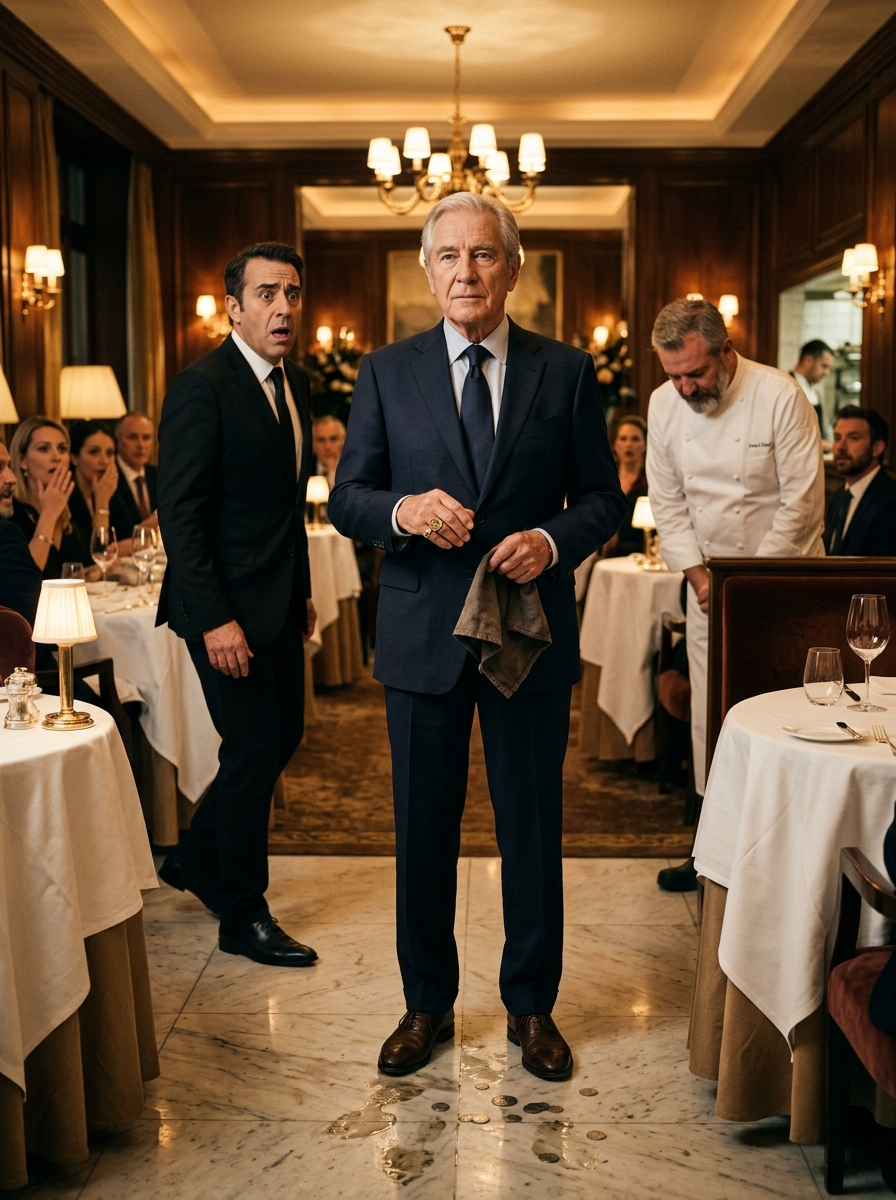
Recognition dawned slowly, then crashed like a wave. Laughter died. Murmurs ceased. The manager’s certainty faltered. A server in the back turned sharply toward the kitchen. The balance of the room had shifted.
Chef Julian emerged from the kitchen doorway, a broad man in his fifties whose face drained of color. He stepped forward and lowered his head deeply. “Mr. Veyron,” he whispered.
The name struck like thunder. Arthur Veyron—the founder himself.
The manager scrambled to recover. “Mr. Veyron, this is an unexpected honor. Had we known—”
“That is exactly why I did not tell you,” Arthur replied calmly.
He surveyed the coins on the floor, the dragged chairs, the guests who had laughed and whispered. No one met his eyes comfortably. The silence had become a mirror.
An elderly woman named Clara rose from a window table. She had been there since before sunrise, observing. She joined Arthur, her voice steady. “Twenty years ago, this restaurant opened with one rule: Feed the person first. Judge them never.”
Clara revealed that Arthur had once arrived hungry and penniless at a kitchen door. A woman named Elena Reyes fed him without questions. That single act of kindness built an empire. Clara carried documents and testimonies. Julian had quietly documented the decline: cut staff meals, halted donations, policies that prized exclusivity over humanity.
Arthur listened as Julian spoke of the changes under the new manager—rules that treated compassion as a threat to the brand. The old man’s hand tightened around his cloth, the very napkin from his first meal, embroidered with the founding rule.
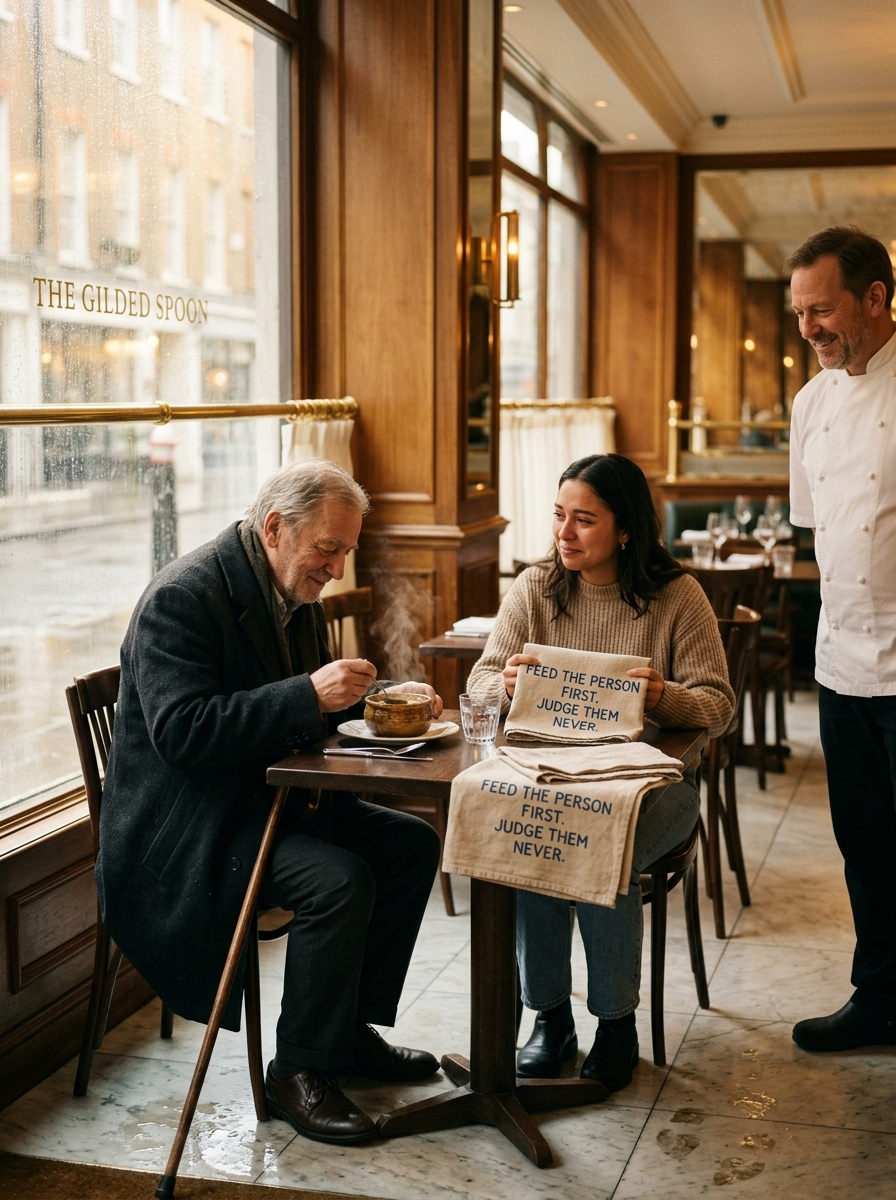
Maya Reyes, a young server, stepped forward. Her grandmother was Elena. She carried the matching towel, faded but intact. Arthur’s voice broke slightly as he learned Elena had passed. The two pieces of fabric—napkin and towel—were laid together, symbols of a promise nearly lost.
Consequences followed with clarity, not cruelty. The manager was dismissed. The young waiter, Ethan, faced suspension but also redemption: months learning in the kitchen and rebuilding the meal program. Arthur reinstated staff meals, community breakfasts, and apprenticeships. Maya’s family name would be honored. Clara would oversee service culture. Julian would lead operations openly.
Arthur sat at a simple table near the entrance. Julian brought soup—onion, butter, pepper, dark-toasted bread. Nothing luxurious. Everything essential. Arthur ate slowly, eyes closed, remembering the boy who once cried over soup because kindness had touched his hunger.
The restaurant did not applaud. It simply witnessed. Wet footprints remained on the marble a while longer—a deliberate reminder. Guests passed them on their way out. Staff remembered. Ethan stood with a broom, learning that some stains are lessons.
By late morning, the light had shifted, but the warmth in the room came from something deeper than sunlight. Arthur had tested his legacy and found it wounded but not dead. Mercy, once the foundation, could be rebuilt.
END
