

“Hey! No—kid, get out of there!”
The shout rang out across the enclosure, sharp and frantic, but it arrived a second too late.
By then the boy had already fallen.
Not climbed.
Not paused.

Fallen.
Straight over the barrier and into the tiger’s domain.
For a fraction of a second, everything froze.
The crowd.
The noise.
Even the air itself seemed to pause.
Then the world rushed back in.
Screaming.
People stumbling backward, phones trembling in their grip.
A woman dropping her drink as it splashed across the concrete.
Security radios crackling with overlapping voices.
And beneath it all—
Something deeper.
Lower.
A sound that didn’t need volume to be felt.
The tiger moved.
The enclosure sat at the center of the park, a wide open space of stone and sand, designed to feel natural but bordered by steel, glass, and the quiet illusion of safety.
People came here every day for that illusion.
For danger they could observe without consequence.
For the thrill of closeness without risk.
They leaned against railings, pointed cameras, laughed too loudly.
They came for something wild—
As long as it stayed contained.
Inside, stretched across a slab of sun-warmed rock, lay the reason for all of it.
Massive.
Orange and black.
Scarred along one shoulder where fur never fully grew back.
A creature that hadn’t roared in days—but didn’t need to.
Everyone felt it anyway.
They called him Atlas.
By late afternoon, the light softened into gold, stretching shadows long across the enclosure floor.
Dust drifted lazily through the air.
Visitors lined the barrier, some listening to a handler talk through routine facts—feeding schedules, behavioral patterns, rehearsed calm meant to reassure.
Safe.
Predictable.
Controlled.
Until it wasn’t.
Because now, in the middle of that carefully maintained world—
A boy stood where no one should stand.
He hit the ground hard, one knee slamming into the dust, his body catching itself just enough to keep from falling flat.
The impact sent a small cloud of dirt rising around him.
He didn’t cry out.
Didn’t look back.
He pushed himself up.
Slowly.
Hands trembling.
Breath uneven.
He was small.
Too small.
Wearing a faded hoodie, worn sneakers, the kind of clothes that blended into any crowd until the moment they didn’t.
Dust clung to his sleeves, streaked across his cheek.
And in his right hand—
He held something.
A strip of leather.
Old.
Cracked.
Familiar.
Across the enclosure, Atlas lifted his head.
It wasn’t sudden.
Not dramatic.
Just… inevitable.
Like gravity shifting.
Like something waking up that had never truly been asleep.
His eyes found the boy instantly.
Locked.
Unmoving.
And the air changed.
People shouted for the gates to open.
For security to move faster.
For someone—anyone—to fix what had just happened.
“Get him out of there!”
“Open the door!”
“Do something!”
But the boy didn’t run.
Didn’t look for help.
Didn’t even glance back at the voices tearing through the air behind him.
Instead—
He stepped forward.
One small step into a space that belonged to something far bigger than him.
His lips trembled.
“Please… look at me.”
Atlas rose.
Muscles rolled beneath his coat as he shifted his weight, stepping down from the stone with a quiet, heavy grace.
One step.
Then another.
Each movement slow.
Measured.
Unmistakably intentional.
The ground seemed to feel it.
The crowd recoiled instinctively, pressing backward even behind layers of steel and glass.
A woman covered her mouth, eyes wide.
A man shouted again for the boy to run.
He didn’t.
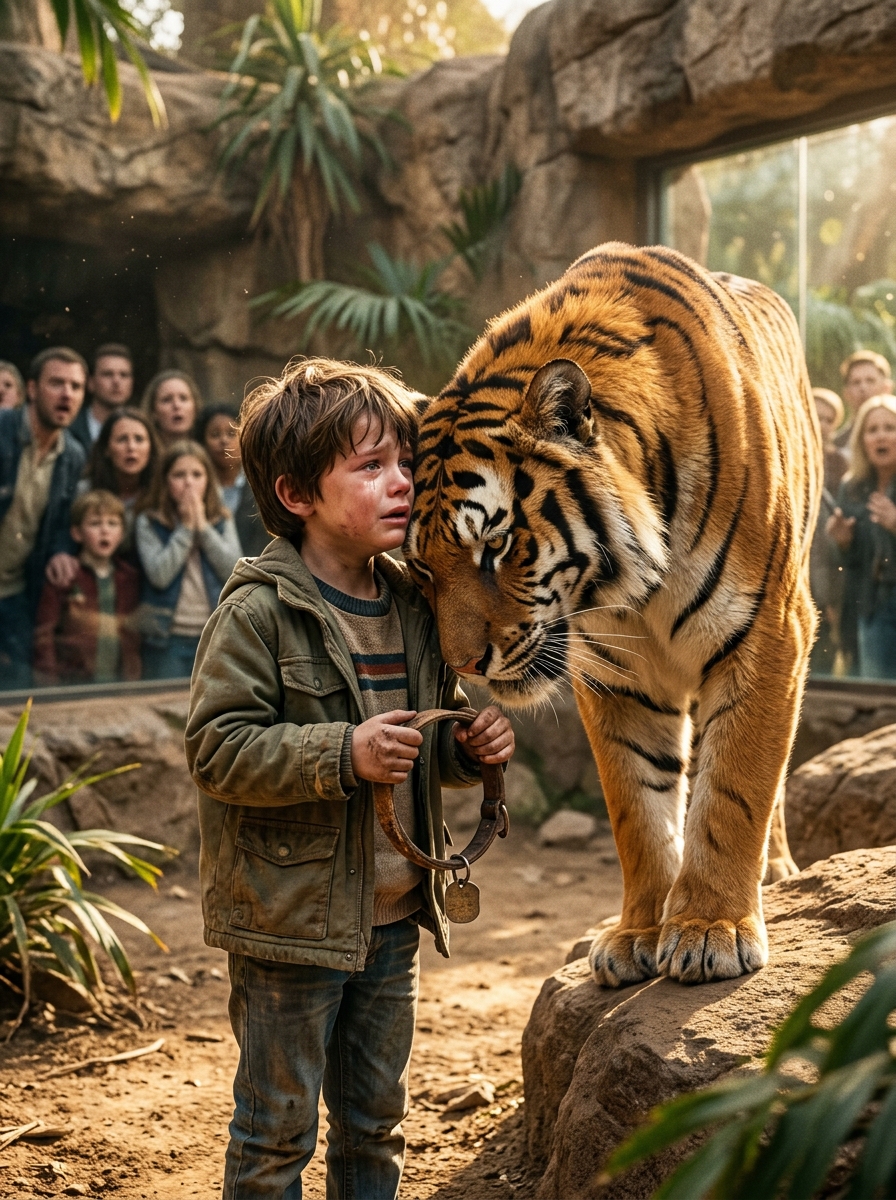
Instead, he lifted the leather higher.
A collar.
Worn from time.
Edges darkened.
A small metal tag hanging from it, scratched but still catching the light.
Atlas stopped.
Not far.
Not safe.
But not charging.
Not yet.
A handler near the barrier leaned forward slightly, voice dropping as if volume might break something fragile forming in the space between them.
“What is that…?”
The boy swallowed.
“My dad said you’d know this.”
The words hung there.
Not loud.
Not dramatic.
But heavy.
The kind of weight that shifts everything it touches.
Silence didn’t fall all at once.
It fractured into place.
The front row first.
Then the people behind them.
Then the ones still shouting.
Until even the panic seemed to hesitate.
Because something in Atlas had changed.
Not softened.
Not tamed.
But… focused.
The violence didn’t disappear.
It redirected.
His gaze narrowed—not on the boy—
But on the collar.
The boy’s eyes filled.
“He raised you,” he said, voice shaking. “He told me you weren’t like the others.”
Atlas moved again.
Closer.
Slower.
The distance between them shrinking with each step.
Dust stirred under his paws.
The boy’s hand trembled harder now, but he didn’t lower it.
“If you remember him…”
His voice cracked under the weight of everything he didn’t know how to say.
“…please don’t hurt me.”
Then Atlas lunged.
Everything shattered.
The crowd screamed.
“I found you.”
For a moment, Atlas did not move.
Then the tiger pressed his head harder against the boy’s chest, as if the words had reached some place deeper than memory.
Rachel suddenly understood the collar was not just proof. It was a key.
She turned sharply toward the other handler.
“Stop the dart team.”
He stared at her. “Rachel, there’s a child in there.”
“I said stop them.”
Across the enclosure, two staff members had already reached the emergency platform. One lifted a tranquilizer rifle with shaking hands.
Rachel’s voice cracked through the radio.
“Do not fire. Repeat, do not fire.”
The man with the rifle froze.
The crowd behind the glass began murmuring again, confusion replacing panic.
“Why aren’t they saving him?”
“That tiger could kill him.”
“Get the boy out!”
But Rachel kept staring at Atlas.
Because now she saw it clearly.
The tiger was not trapping the boy.
He was shielding him.
His body formed a wall between the child and the service gate.
His eyes were no longer fixed on the boy.
They were fixed on the humans rushing in.
Atlas gave a low warning sound.
The boy felt it vibrate through his ribs.
He lifted his face from the tiger’s fur, cheeks wet, breathing broken.
“No,” he whispered. “They’re not going to hurt me.”
Atlas didn’t look convinced.
Rachel slowly raised both hands where the tiger could see them.
“Easy, Atlas,” she said, voice soft. “Easy, boy.”
The tiger’s ears shifted.
Not fully relaxed.
But listening.
Rachel’s heart pounded.
No one called Atlas “boy” anymore.
Except Daniel Hart had.
She remembered it now from the old training tapes.
Daniel’s calm voice.
Easy, boy.
Not command.
Not control.
Trust.
The little boy looked toward her.
His eyes were red, terrified, and strangely familiar.
“What’s your name?” Rachel asked.
The child swallowed.
“Eli.”
Rachel’s breath caught.
Eli Hart.
Daniel’s son.
A name she had seen once in an old incident report buried deep in the archive.
Before she could speak again, a man pushed through the crowd behind the barrier.
He wore a dark suit, a zoo director’s badge, and the expression of someone terrified for the wrong reason.
“Remove that child now,” Director Voss snapped. “Use sedation if necessary.”
Rachel turned slowly.
“Sedation could make Atlas panic.”
“Then contain the animal.”
“He is containing the situation.”
Voss’s face hardened. “That animal is a liability.”
The word cut through the air.
Atlas’s head lifted.
A low growl rolled out of him.
Eli clung tighter to his neck.
“Don’t,” the boy whispered. “Please don’t make him scared.”
Rachel stared at Voss.
Something cold moved through her.
Why had the director arrived so fast?
Why did he look more angry than relieved?
And why had he not asked how the child got inside?
Then Eli said the sentence that changed everything.
“My dad told me not to trust the man with the silver badge.”
Rachel’s eyes flicked to Voss’s chest.
Silver badge.
The director went still.
Only for half a second.
But Rachel saw it.
So did Atlas.
The tiger rose slightly, placing one huge paw in front of Eli.
The crowd quieted again.
Rachel stepped closer to the emergency barrier.
“Eli,” she said carefully, “where is your father?”
The boy’s lips trembled.
“He’s not dead.”
The words struck Rachel like a physical blow.
Voss’s jaw tightened.
Eli wiped his face with one sleeve.
“Everybody said he died. But he sent me the collar. He sent me a letter.”
Rachel’s voice dropped.
“What did the letter say?”
Eli looked at Atlas, then at Rachel.
“He said Atlas was the only one who saw what really happened.”
A stunned silence passed through the staff line.
Voss forced a laugh.
“This child is traumatized. Get him out before he invents more stories.”
But Rachel wasn’t looking at Voss anymore.
She was looking at the brass tag in the dust.
Daniel.
On the back, half-covered by dirt, there was another engraving.
Rachel moved closer to the glass and squinted.
Three words.
Not a pet.
A witness.
The collar had never been a keepsake. It was evidence.
Eli bent down, picked it up, and turned the tag over with shaking fingers.
“My dad said if I ever found Atlas, I should show this to someone kind.”
His eyes found Rachel.
“I think that’s you.”
Rachel had to steady herself against the rail.
Years of rumors rearranged themselves in her mind.
Daniel Hart had supposedly entered the enclosure alone one night.
Atlas had attacked.
The zoo had buried the scandal quietly.
Voss had been promoted three months later.
But if Atlas had attacked Daniel, why had Daniel’s collar survived outside the enclosure?
Why had Atlas never trusted anyone afterward?
And why had Daniel’s son come here now?
Rachel looked at Voss.
His face had gone pale.
“You knew,” she said.
Voss’s expression sharpened. “Choose your next words carefully.”
The threat was soft.
But everyone nearby heard it.
Eli hugged Atlas again, voice muffled against the tiger’s fur.
“My dad said bad people wanted to sell Atlas.”
Voss snapped, “That is enough.”
But Eli kept going.
“He said Atlas wasn’t aggressive. He said someone made him look dangerous so they could move him away.”
Rachel’s stomach turned.
Private collectors.
Illegal transfers.
Insurance payouts.
A rescued tiger with a famous scar.
A dead keeper who knew too much.
Atlas suddenly looked toward the far service tunnel.
His body stiffened.
Rachel followed his gaze.
Two uniformed men stood there, half-hidden near the gate.
They were not zoo security.
They wore no visible identification.
One held a dart rifle.
Not the zoo’s model.
Voss spoke into his radio, voice low.
“Proceed.”
Rachel lunged toward him.
“No!”
The first dart fired.
Atlas moved faster than thought.
He shoved Eli down with the side of his head, covering the boy with his own body.
The dart struck Atlas’s scarred shoulder.
A horrible sound rose from the crowd.
Eli screamed.
“No! Atlas!”
The tiger staggered but did not fall.
His legs trembled.
His eyes burned toward the tunnel.
Rachel grabbed Voss’s wrist.
“What did you do?”
Voss ripped free. “What I should have done years ago.”
That was when the second hidden motive revealed itself.
The old janitor near the snack kiosk dropped his broom.
For most of the afternoon, no one had noticed him.
Gray beard.
Bent posture.
Faded uniform.
Just another invisible worker in a crowded zoo.
But now he straightened.
And pulled a small camera from inside his jacket.
“Federal Wildlife Service,” he said loudly. “Nobody moves.”
The crowd gasped.
Voss turned white.
Rachel stared.
The janitor’s tired eyes locked onto Eli.
“Your father was right, kid.”
Eli froze.
“You knew my dad?”
The man nodded once.
“My name is Marcus Reed. Daniel Hart was my partner.”
Voss backed away.
Marcus raised his badge.
“And Director Voss has just been recorded ordering the illegal sedation and removal of a protected Bengal tiger.”
Police sirens wailed somewhere beyond the visitor path.
Voss looked toward the exit.
But zoo security had already blocked it.
For the first time, the director looked truly afraid.
Not of Atlas.
Of the truth.
Inside the enclosure, Atlas’s body sank lower.
The sedative was working.
Eli pressed both hands against the tiger’s face.
“Stay awake,” he begged. “Please. I just found you.”
Atlas blinked slowly.
His breathing grew heavy.
Rachel shouted for the veterinary team.
“Real vets only! No one from Voss’s crew!”
She entered through the safety lock with two trusted keepers, moving slowly, palms open.
Atlas growled weakly.
Eli looked at him through tears.
“It’s okay. She’s kind. Remember?”
Rachel knelt several feet away.
“I’m going to help him,” she said. “But I need you to keep talking to him.”
Eli nodded, sobbing.
He leaned close to Atlas’s ear.
“My dad said you were brave,” he whispered. “He said you saved him once. Now let us save you.”
Atlas’s eyes shifted toward the boy.
The growl faded.
Rachel worked quickly.
The dart had not gone deep, but the dose was strong.
Too strong for a standard tranquilizer.
Meant to collapse him.
Maybe worse.
Her hands shook with anger as she treated him.
Outside the glass, Marcus was speaking to police.
“The original report was falsified,” he said. “Daniel Hart did not die in an animal attack. He disappeared after collecting proof of illegal trafficking.”
Eli heard enough to lift his head.
“My dad is alive?”
Marcus’s face softened.
Rachel stopped moving for half a second.
The entire crowd seemed to wait with him.
Marcus exhaled.
“Yes.”
Eli’s mouth opened, but no sound came out.
“He’s alive,” Marcus said. “But he’s been in witness protection. He stayed away because Voss had people watching you and your mother.”
Eli shook his head.
“No. He would have come back.”
“He tried.”
Marcus’s voice broke for the first time.
“He sent letters. Most never reached you.”
Eli looked down at the collar.
“This one did.”
Marcus nodded.
“Because your mother hid it until she thought you were old enough.”
Eli’s face crumpled.
“She died last month.”
The words landed quietly.
No spectacle.
No gasp.
Just grief.
Rachel closed her eyes for a second.
Now she understood why he had come alone.
Not because he was reckless.
Because he had lost the last person keeping him away.
Because the collar was the only promise left.
Atlas made a faint rumble.
Eli turned back to him.
“I’m here,” he whispered. “I’m still here.”
Hours seemed to pass in minutes.
Voss was taken away in handcuffs.
The hidden men were arrested near the service tunnel.
The zoo was closed.
Visitors were escorted out, many still crying, many refusing to delete the footage because they knew the world needed to see it.
Atlas survived.
But he did not wake quickly.
Eli refused to leave the medical observation room.
Rachel gave him a blanket and a cup of water.
He didn’t touch the water.
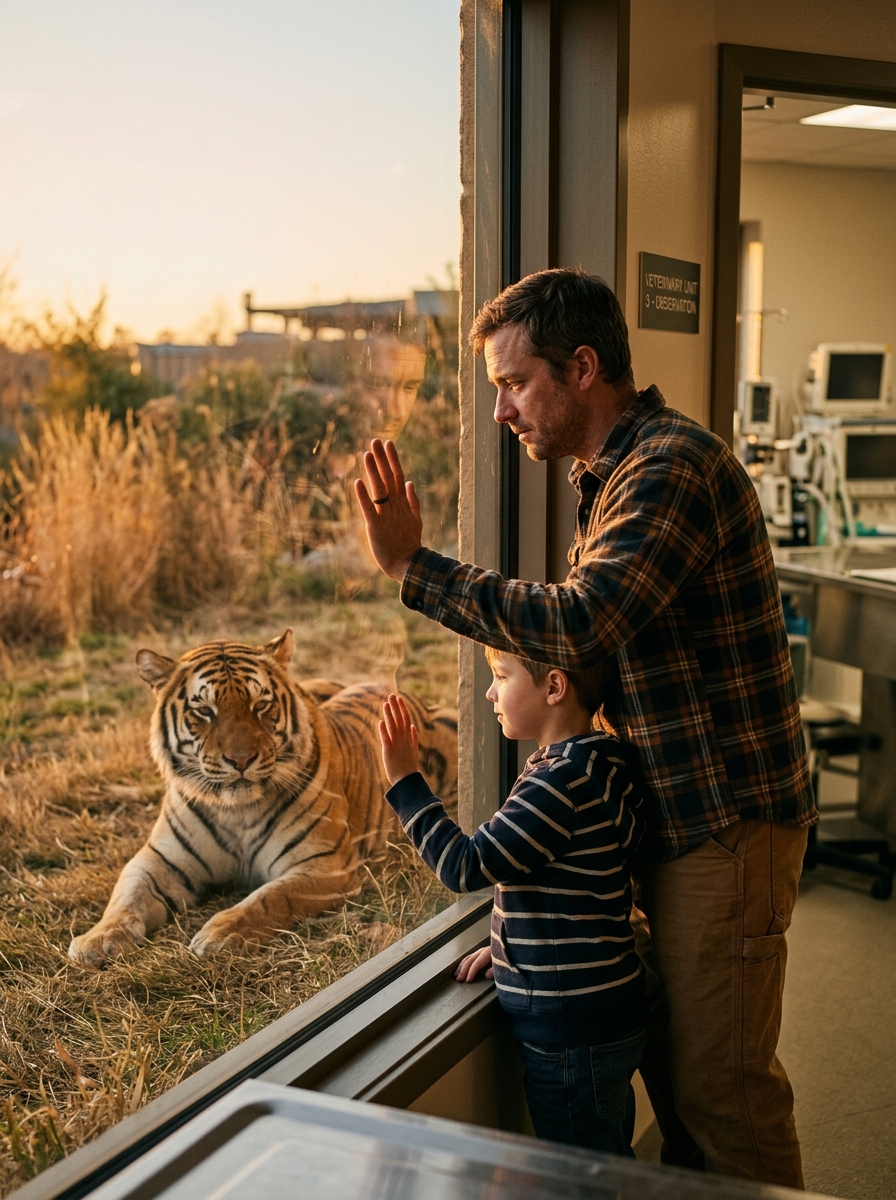
He sat on the floor beside the reinforced glass, one small hand pressed to it.
On the other side, Atlas slept under careful monitoring.
The great tiger looked smaller in sleep.
Still powerful.
Still magnificent.
But wounded in ways no scar could show.
Near midnight, Marcus returned.
Beside him stood a man with tired eyes, a gray streak in his dark hair, and a face that seemed to break apart the moment he saw the boy.
Eli stood slowly.
The man took one step forward.
Then stopped, as if afraid he no longer had the right.
“Eli,” he whispered.
The boy stared at him.
His whole body trembled.
“You’re real?”
Daniel Hart covered his mouth with one hand.
“I’m real.”
Eli’s face twisted with anger and pain.
“You left.”
Daniel flinched.
“Yes.”
“You let me think you were dead.”
“I know.”
“You let Mom cry.”
Daniel’s eyes filled.
“I know.”
Eli’s voice rose, small and shattered.
“Why didn’t you come home?”
Daniel fell to his knees.
Not dramatically.
Not for forgiveness.
Because he could no longer stand.
“Because if I came home, they would have found you.”
Eli shook his head, sobbing.
“I needed you.”
Daniel bowed his head.
“I know.”
For a long moment, neither moved.
Then Daniel reached into his jacket and pulled out a second strip of leather.
An old bracelet.
Worn, cracked, matching the collar.
“I kept this,” he said. “Every day.”
Eli stared at it.
Daniel’s voice broke.
“Your mother cut it from the same piece of leather. One for Atlas. One for me. She said if we ever got separated, we’d still belong to the same promise.”
Eli looked at the collar in his hand.
Then at the bracelet.
The collar had not only led him to Atlas. It had led him back to his father.
Eli crossed the room in three steps and crashed into Daniel’s arms.
Daniel held him like someone holding the last living piece of his heart.
“I’m sorry,” Daniel whispered again and again. “I’m so sorry.”
Eli cried into his shoulder.
“I found him.”
Daniel closed his eyes.
“I know.”
“He remembered.”
Daniel looked through the glass at Atlas.
The tiger’s eyes had opened.
Weak.
Heavy.
But open.
Atlas stared at Daniel.
The room went still.
Daniel slowly stood, keeping one hand on Eli’s shoulder.
Rachel moved to stop him, then didn’t.
Daniel approached the glass.
Atlas lifted his head an inch.
A low rumble moved through him.
Daniel pressed his palm to the glass.
“Easy, boy.”
Atlas closed his eyes.
The sound deepened.
Not rage.
Not warning.
Recognition.
Daniel’s face collapsed.
“My old friend,” he whispered.
Atlas, too weak to stand, pressed his head against the glass from the other side.
Eli placed his smaller hand beside Daniel’s.
Father, son, and tiger remained like that beneath the dim medical lights.
No crowd.
No cameras.
No screaming.
Just three survivors connected by a promise everyone else had misunderstood.
The next morning, the zoo changed forever.
Voss’s trafficking network was exposed.
Daniel testified.
Marcus released the footage.
Rachel was appointed interim director, though she never celebrated it.
Atlas was moved to a protected sanctuary wing with no public shows, no forced displays, and no private buyers hidden behind donations.
Eli and Daniel were allowed to visit him under Rachel’s supervision.
Not as owners.
Not as performers.
As family of a different kind.
The world called it a miracle.
Rachel knew better.
It was not a miracle.
It was memory.
It was loyalty.
It was a child brave enough to walk into fear because love had left him a map.
Weeks later, when Atlas was strong again, Eli visited at sunset.
He stood behind the safety line beside Daniel.
The collar had been cleaned but not repaired.
Its cracks remained.
Its scars remained.
Like Atlas.
Like Daniel.
Like Eli.
Rachel unlocked the inner viewing gate, giving them a safe distance but a clear view.
Atlas emerged from the tall grass.
Golden light moved across his stripes.
He stopped in front of them.
Eli lifted one hand.
Not touching.
Just reaching.
Atlas lowered his head.
Daniel whispered, “He remembers you now, too.”
Eli smiled through tears.
A small smile.
Broken and healing at the same time.
“I remember him too.”
Atlas blinked slowly.
The sunset warmed the glass between them until it almost disappeared.
And for the first time since his mother died, Eli did not feel completely alone.
He leaned gently against his father’s side.
Daniel wrapped an arm around him.
Across the quiet space, Atlas lay down in the grass and rested his head on his paws, watching over them.
No one spoke for a long time.
There was nothing left to prove.
Only the soft sound of evening wind moving through the bamboo.
And a boy, finally safe, whispering through the glass:
“I’m home.”
